Assi. Prof. T. M. Diwakar
SITCOE
 Introduction of Temperature Transducer
 Types of Temperature Transducer
 Features of Temperature Transducer
 Conditions for Choosing the Sensing Element
 Application of Temperature Transducer
 A Temperature Transducer is a device that
converts the thermal quantity into any physical
quantity such as mechanical energy, pressure
and electrical signals etc.
 E.g. In Thermocouple the electrical potential
difference is produced due to temperature
difference across its terminals. So,
thermocouple is an temperature transducer.
 Contact Temperature Sensor:-
In these the sensing element is in direct
contact with the thermal source. They use the
conduction for transfer of thermal energy.
 Non-contact Temperature Sensor:-
In these the sensing element is not in direct
contact with the thermal source. They use
principle of convection for heat flow.
Various Non-contact Temperature Sensor :-
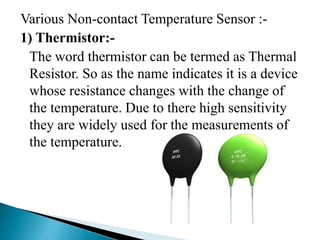
1) Thermistor:-
The word thermistor can be termed as Thermal
Resistor. So as the name indicates it is a device
whose resistance changes with the change of
the temperature. Due to there high sensitivity
they are widely used for the measurements of
the temperature.
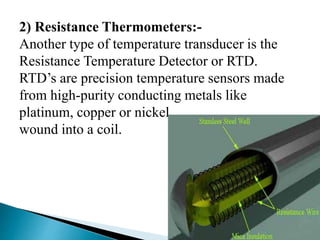
2) Resistance Thermometers:-
Another type of temperature transducer is the
Resistance Temperature Detector or RTD.
RTD’s are precision temperature sensors made
from high-purity conducting metals like
platinum, copper or nickel
wound into a coil.
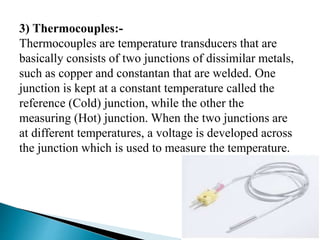
3) Thermocouples:-
Thermocouples are temperature transducers that are
basically consists of two junctions of dissimilar metals,
such as copper and constantan that are welded. One
junction is kept at a constant temperature called the
reference (Cold) junction, while the other the
measuring (Hot) junction. When the two junctions are
at different temperatures, a voltage is developed across
the junction which is used to measure the temperature.
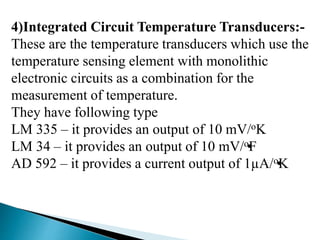
4)Integrated Circuit Temperature Transducers:-
These are the temperature transducers which use the
temperature sensing element with monolithic
electronic circuits as a combination for the
measurement of temperature.
They have following type
LM 335 – it provides an output of 10 mV/oK
LM 34 – it provides an output of 10 mV/•oF
AD 592 – it provides a current output of 1µA/•oK
Features of Temperature Transducers are as
follows:-
 The input to them are always the thermal
quantities
 They generally converts the thermal quantity
into electrical quantity
 They are usually used for the measurement of
the temperature and heat flow
Desirable Conditions are as follows:-
 Change per unit resistance of material per unit
change in temperature should be large
 The material should have a high resistivity so that
minimum volume of material is used for its
construction
 The material should have continuous and stable
relationship with temperature
 Transduction Element
 Temperature transducer is used to
measure the temperature of the air such
that to control the temperature of several
control systems like air-conditioning,
heating, ventilation, and so on.

Temperature transduser ppt

  • 1.
    Assi. Prof. T.M. Diwakar SITCOE
  • 2.
     Introduction ofTemperature Transducer  Types of Temperature Transducer  Features of Temperature Transducer  Conditions for Choosing the Sensing Element  Application of Temperature Transducer
  • 3.
     A TemperatureTransducer is a device that converts the thermal quantity into any physical quantity such as mechanical energy, pressure and electrical signals etc.  E.g. In Thermocouple the electrical potential difference is produced due to temperature difference across its terminals. So, thermocouple is an temperature transducer.
  • 4.
     Contact TemperatureSensor:- In these the sensing element is in direct contact with the thermal source. They use the conduction for transfer of thermal energy.  Non-contact Temperature Sensor:- In these the sensing element is not in direct contact with the thermal source. They use principle of convection for heat flow.
  • 5.
    Various Non-contact TemperatureSensor :- 1) Thermistor:- The word thermistor can be termed as Thermal Resistor. So as the name indicates it is a device whose resistance changes with the change of the temperature. Due to there high sensitivity they are widely used for the measurements of the temperature.
  • 6.
    2) Resistance Thermometers:- Anothertype of temperature transducer is the Resistance Temperature Detector or RTD. RTD’s are precision temperature sensors made from high-purity conducting metals like platinum, copper or nickel wound into a coil.
  • 7.
    3) Thermocouples:- Thermocouples aretemperature transducers that are basically consists of two junctions of dissimilar metals, such as copper and constantan that are welded. One junction is kept at a constant temperature called the reference (Cold) junction, while the other the measuring (Hot) junction. When the two junctions are at different temperatures, a voltage is developed across the junction which is used to measure the temperature.
  • 8.
    4)Integrated Circuit TemperatureTransducers:- These are the temperature transducers which use the temperature sensing element with monolithic electronic circuits as a combination for the measurement of temperature. They have following type LM 335 – it provides an output of 10 mV/oK LM 34 – it provides an output of 10 mV/•oF AD 592 – it provides a current output of 1µA/•oK
  • 9.
    Features of TemperatureTransducers are as follows:-  The input to them are always the thermal quantities  They generally converts the thermal quantity into electrical quantity  They are usually used for the measurement of the temperature and heat flow
  • 10.
    Desirable Conditions areas follows:-  Change per unit resistance of material per unit change in temperature should be large  The material should have a high resistivity so that minimum volume of material is used for its construction  The material should have continuous and stable relationship with temperature  Transduction Element
  • 11.
     Temperature transduceris used to measure the temperature of the air such that to control the temperature of several control systems like air-conditioning, heating, ventilation, and so on.