Transdermal Drug Delivery Systems
INTRODUCTION, PERMEATION THROUGH SKIN, FACTORS AFFECTING PERMEATION,
PERMEATION ENHANCERS, BASIC COMPONENTS OF TDDS, FORMULATION APPROACHES
Introduction
 Transdermal drug delivery (TDD) is the administration of therapeutic agents
through the intact skin for systemic effect.
 Only a small number of drug products are available for TDDS.
 Problems
 Drugs physical properties- molecular size, polarity,
 biological properties- dermal irritation, insufficient bioavailability
Advantages
 Avoids first pass metabolism
 Maintains constant blood levels for longer period of time
 Decrease the dose of administration
 Decrease unwanted/ side effects
 Decreases gastro-intestinal side effects
 Easy to discontinue in case of toxic effects
 Increased patient compliance
 Great advantage for patients who are unconscious.
 Relatively large area of application in comparison to buccal / nasal cavity
Disadvantages
 Drug must have certain desirable physicochemical properties
 Drugs with daily dose less than 10 mg/day are preferred
 Local irritation at the site of administration (drug, adhesive/ other excipients)
 Barrier function of skin changes form one site to another, from person to
person and with age
 TDDS cannot deliver ionic drug
 TDDS cannot achieve high drug levels in Blood/ plasma
 Drugs of large molecular size can not be formulated as TDD
Routes of drug penetration across skin
 Three potential entry
(MACRO ROUTES) to
the viable tissue:
 Via the sweat ducts
 Across the continuous
stratum corneum
(diffusion)
 3. Through the hair
follicles with their
associated sebaceous
glands.
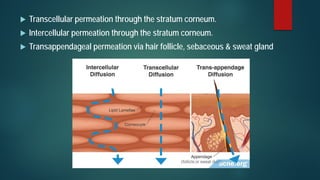
 Transcellular permeation through the stratum corneum.
 Intercellular permeation through the stratum corneum.
 Transappendageal permeation via hair follicle, sebaceous & sweat gland
 Transcellular and intercellular permeation requires diffusion through epidermis
and dermis.
 Transappendageal permeation allows diffusional leakage of polar molecules in
to epidermis and direct permeation in to dermis.
 The relative importance of these routes depends on factors like time of
permeation, physicochemical properties (pka, molecular size, stability,
partition coefficient), integrity and thickness of stratum corneum, density of
sweat glands and follicles, skin hydration, metabolism and vehicle effects
Mechanism of precutaneous drug absorption
 Transepidermal pathway is responsible for drug diffusion across the skin
 Permeation by the transepidermal route first involves partitioning in to stratum
corneum.
 Most substances diffuse cross stratum corneum via intercellular lipiodal route which
is tortuous pathway.
 Extremely polar compounds and ions pass by microscopic path through stratum
corneum.
 Lipophilic molecules concentrate in and diffuse easily through the horny layers.
 When permeating drug exists stratum corneum, it enters wet cell mass of viable
epidermis
 As epidermis has no direct blood supply, the drug is forced to diffuse across it to
reach the vasculature.
 The viable epidermis is a permeable field that functions as a viscid watery regimen to
most penetrants.
 Extremely hydrophilic (Ions and polar non- electrolytes), extremely hydrophobic
(lipophilic non-electrolytes) have difficulty in passing through viable epidermis.
 The epidermal cell membranes are tightly joined and there is little inercellular space
for ions and polar non electrolytes to diffusionally squeeze through.
 Permeation in viable epidermis requires frequent crossing of cell membrames, which
is prohibitive event for water-soluble species.
 On the other hand extremely lipophilic molecules are constrained form dissolving in
watery regimen
Transappendageal route
 Fractional area available through this route is 0.1 %
 Human skin contains 40-70 hair follicles, 200 to 250 sweat glands on every sq.cm of
skin area.
 Mainly water soluble substance diffuse faster through appendages than that of other
layers.
 Sweat glands and hair follicles act as a shunt i.e. easy pathway for diffusion through
rate limiting ST corneum.
 Follicular route is important for permeation because the opening of the follicular pore
is relatively large and sebum aids in the diffusion of the penetrant.
 Partitioning into the sebum followed by the diffusion to the depths of the epidermis is
the mechanism of drug permeation
 The Permeability coefficient at steady state (Pss) of the skin tissue to the drug is
given by
Pss = Ks x Dss / Hs
Where, Ks = partition coefficient of drug in to stratum corneum
Dss = apparent diffusivity for the steady state diffusion of the drug
Hs = over all thickness of skin tissue.
 The Flux (Jss) of the penetrating drug is given by
Jss = Pss x Cveh
Where, Jss = steady stste flux
Cveh = concentration of drug in vehicle/ formulation
Factors influencing dermal penetration of drugs
 Biological factors
1. Skin condition
2. Skin age
3. Blood flow
4. Regional skin site
5. Skin metabolism
6. Species difference.
 Physicochemical factors
1. Skin hydration
2. Temperature and pH
3. Diffusion coefficient
4. Drug concentration
5. Partition coefficient
6. Molecular size and shape.
7. Solubility, ionization, Melting point
 Increase in Conc. of drug in vehicle increases amount of drug absorbed per
unit of surface area per time interval.
 The drug in vehicle must interface the skin surface in sufficient conc
 More drug is absorbed when it is applied to large surface area.
 Drug should have greater physicochemical attraction to the skin than to
dispersed vehicle.
 The aqueous solubility of drug determines the conc present at the absorption
site.
 The partition coefficient influences the rate of transport across the absorption
site
 Solutes with molecular weight 800-1000 daltons, with adequate solubility in mineral
oil and water (> 1mg/ml) can penetrate through skin
 Drug absorption enhances from vehicles that easily covers the skin surface, mix
readily with sebum.
 Vehicle that increases the amount of moisture imbedded by the skin improves drug
absorption ex: oleagenous vehicles.
 Hydration of the skin softens stratum corneum, increases the size of pores, allowing
greater flow of substances
 Site of application influences degree of drug absorption. Skin in post auricular layer
is more permeable to drugs.
 Longer the contact period of drug with skin, greater will be absorption.
Basic components of transdermal patch
1. Polymer matrix/ matrices
2. The drug
3. Pressure sensitive adhesives
4. Permeation enhancers
5. Excipients/ other supportive materials
Polymer matrix
 The polymer is formulated either as a matrix/ reservoir to controls the release of
the drug from the device.
 Ideal characters:
 The polymer molecular weight, glass transition temperature and chemical functionality must
allow proper diffusion & release of drug
 It should be stable, non reactive with the drug, easily manufactured and fabricated into the
desired product
 The polymer and its degradation products must be non toxic or non antagonistic to the host
 The mechanical properties of the polymer should not deteriorate excessively when the large
amount of the active agents are incorporated into it
The polymers used in the transdermal drug delivery systems are
 Natural polymers
Cellulose derivatives, zein, gelatin, shellac, waxes, proteins, gums & their
derivatives, natural rubber starch etc.
 Synthetic elastomers
Poly butadiene, hydrin rubber, poly siloxane silicone rubber, nitrile, acrylonitrile,
butyl rubber, butadiene Neoprene etc.
 Synthetic polymers
Polyvinyl chloride, polyethylene, poly propylene, polyacrylate, polyamide, polyurea,
polyvinyl pyrrolidone, poly methyl methaacrylate
Drug
 For successful development of a transdermal drug delivery, the following are
the desirable properties of a drug
 Physicochemical properties.-
 It is generally accepted that the best drug candidates for passive adhesive Transdermal
patches must be
 Non-ionic
 Low molecular weight (less than 1000 Daltons)
 Adequate solubility in oil and water
 Low melting point (less than 200℃ )
 Potent (dose ideally less than 10 mg per day)
 Biological properties
 The drug should be potent with a daily dose of order of a few mg/ day
 The half life of the drug should be short
 The drug must not induce a cutaneous irritant or allergic response
 Drugs degraded in the GIT or inactivated by the hepatic first pass are suitable candidates
for transdermal drug delivery
 Tolerance of drug must not be developed
 Drugs which are to be administered for long period of time or which cause adverse
effects are suitable
Pressure sensitive adhesives
 These provide good adherence characteristics & help to secure the
transdermal device on the skin over long period of time.
 Ideal properties
 Should not irritate or sensitize the skin or affect normal functions of the skin
 Should adhere to the skin aggressively
 Should be easily removed
 Should not leave an unwashable residue on the skin
 Should have an intimate contact with the skin
 Should be compatible with the drug, excipients and permeation enhancers
 Permeation of drug should not be affected
The major classes of pressure sensitive adhesives are Polyisobutylenes, Acrylic &
Silicone based adhesives
1. Polyisobutylene based adhesives: (Tg = - 62°C)
 These elastomeric polymers are commonly used as primary base polymer and as tackifiers.
 The higher the mol. Wt. of PIB the lower its permeability.
 These are preferred for drugs with low solubility and low polarity.
2. Acrylic adhesives: (Tg = - 55 to - 15°C)
 These are produced by co-polymerization of acrylic esters with acrylic acid and other functional
monomers
 These are used as matrix adhesives and dominate the medical market
 These are moderately polar and have moisture permeability
 3. Silicone based adhesives: (Tg = - 127°C)
 These are composed of long chain resin.
 The unique semi-organic structure give silicone a high flexibility.
 Silicone adhesives have high permeability to moisture and oxygen which reduces degree
of occlusion.
 These are suitable for TDDS in which drug releasing surface is covered with adhesive.
Permeation enhancers
 These are the compounds which promote skin permeability by altering the skin
as a barrier to the flux of a desired penetrant (drug)
 These are also known as accelerants / sorption promoters.
 Ideal properties
1. Should work rapidly
2. The activity and duration of effect should be both predictable and reproducible.
3. should not have pharmacological activity.
4. Should work unidirectionally (prevent loss of endogenous material from body).
5. When removed form skin, the barrier properties should return both rapidly and fully
 Permeation enhancers act through 3 possible mechanisms;
1. The enhancers disrupt stratum corneum lipid organization, making it
permeable & increases drug diffusion coefficient. Ex: Azone, terpenes, fatty
acids, DMSO and alcohols
 Oleic acid and terpenes at high loadings pool with lipids, phase separate and form
permeable pores which allow easier access to the viable epidermis for polar molecules.
 DMSO, ethanol and micellar solutions also extract lipids, making horny layer more
permeable by forming aqueous channels
 2. The enhancers interact with keratin (intra cellular protein) in corneocytes to
open up dense protein structures and make them more permeable. Ex: Ionic
surfactants, decyl methyl sulphoxide and DMSO
 3. Many solvents enter stratum corneum, changes its solution properties by
altering the chemical environment and increasing partitioning of second
molecule (drug/ co-enhancer/ co-solvent) in to the horny layer. Ex: ethanol
increases penetration of nitroglycerin & estradiol.
 Many chemical enhancer use combination of 3 mechanisms. DMSO (above
60%) disturb inter cellular organization, extract lipids & interact with keratin
and facilitate lipid drug partitioning.
 Precutaneous absorption of most of the drugs is passive diffusion process, as
given by Fick`s first law of diffusion
Where, J = flux of drug, D = drug diffusion coefficient of skin, K = skin-vehicle partition coefficient of
drug, C = drug Conc. in the vehicle/ product, h = thickness of skin
 Permeation enhancers act on skin to improve drug diffusibility/solubility/ both
 DMSO and azone can increase diffusability in the stratum corneum by acting as
solvents to dissolve the skin lipids and to denaturate skin proteins
 Ethanol, macrocyclic ketones, lactones can modify drug solubility parameters,
partition coefficient from vehicle to skin and the permeability coefficient in the skin
J =
DKC
𝒉𝒉
1. Solvents
 Increases penetration by swelling the polar pathway transport or fluidising lipids
 Eg: water, ethanol, methanol, DMS, homologs of methyl sulphoxide, dimethyl
acetamide and DMF, 2-pyrrolidone, Nmethyl, 2-pyrrolidone, laurocapram, PG,
glycerol, silicone fluids, isopropyl palmitate.
2. Surfactants
 Enhances the polar pathway transport of hydrophilic drugs
 Anionic surfactants can penetrate and interact strongly with the skin, cationic
surfactant are irritants.
a. Anionic surfactants: Dioctyl sulpho succinate, SLS, deco decylmethyl sulphoxide etc.
b. Non ionic surfactants: Pluronic F127, Pluronic F68,etc.
c. Bile salts: Sodium taurocholate, sodium deoxy cholate, sodium tauroglycocholate.
3. Binary systems
 These open heterogeneous multi laminate pathway & continuous pathways
 Propylene glucol-oleic acid and 1,4-butane diol-linoleic acid.
4. Miscellaneous
 Urea-hydrating and keratolytic agent, N,N-dimethyl-mtoluamide, calcium
thioglycolate, anti cholinergic agents
5. Potential permetion enhancers
 Euclyptol, di-o-methyl-ß-cyclodextrin and soyabean casein
Excipients/ other supportive materials.
 These include Release liners, Backing layers, Microporous membranes & Packing
substrates.
1. Release liner
 During storage the patch is covered by a protective liner that is removed &
discharged immediately before the application of the patch to the skin.
 The release liner should be capable of easily peeled off by the user and should not
interfere with the functionality of the product.
 It prevents loss of drug that has migrated through adhesive layer during storage and
protects product against contamination.
 Cost must be compatible with a disposable concept as loner will be thrown away.
Ex: impermeable materials like polyesters and metal foils
2. Backing layer
 Flexible and provide good bond to the drug reservoir
 Prevent drug from leaving the dosage form from the top
 Accept printing
 Should be impermeable to water vapour.
E.g. metallic plastic laminate, plastic backing with absorbent pad and occlusive
base plate, adhesive foam pad with occlusive base plate.
Materials used:-- polyester-polyethylene coextruded films
3. Microporous or semi-permeable or rate controlling membrane
 These are used to limit the flow of the drug from both reservoir and matrix
systems
 The function depends on the design of the specific system, the size of the
active component and the need to have a rate-limiting factor in order to satisfy
the release and absorption characteristics of the system.
Ex: Ethylene Vinyl Acetate Membranes (EVA), Microporous Polyethylene
Membranes
 4. Packing substrates
 Transdermal patches are packed as unit doses in sealed pouches
 The pouching material is critical for stability & integrity of product.
 The structure and construction of film pouch depends on product
characteristics, reactivity and adsorption phenomena of drug and external
factors (light, oxygen)
 Three main layers used for pouches:
1. External printable layer
2. Aluminium foil layer
3. Internal plastic heat sealable layer
Approaches in development of TDDS
 Membrane permeation controlled systems / Reservoir type systems
 Adhesive- dispersion type systems
 Matrix diffusion- controlled systems
 Microreservoir type/ microsealed dissolution controlled systems
Membrane-moderated or Permeation controlled TDDS
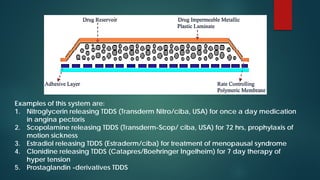
 Drug reservoir (homogenous dispersion of drug with polymeric matrix or
suspension of drug in unleachable viscous liquid medium such as silicone fluid)
is encapsulated within drug impermeable metallic plastic laminate and a rate
controlling polymeric membrane (ethylene vinyl acetate co polymer).
 The rate of drug release is determined by the permeability of the rate controlling
membrane
 A layer of adhesive polymer is applied on membrane to secure the device on skin
 The rate of release of drug is always maintained at constant rate & the type of
release is zero order
 Release rate of this TDDS depends upon the polymer composition, permeability
coefficient and thickness of the rate controlling membrane and adhesive.
Examples of this system are:
1. Nitroglycerin releasing TDDS (Transderm Nitro/ciba, USA) for once a day medication
in angina pectoris
2. Scopolamine releasing TDDS (Transderm-Scop/ ciba, USA) for 72 hrs, prophylaxis of
motion sickness
3. Estradiol releasing TDDS (Estraderm/ciba) for treatment of menopausal syndrome
4. Clonidine releasing TDDS (Catapres/Boehringer Ingelheim) for 7 day therapy of
hyper tension
5. Prostaglandin -derivatives TDDS
Adhesive dispersion type systems
 Drug reservoir is formulated by homogenous dispersion of drug with adhesive
polymer poly(isobutylene) or poly acrylate.
 Then spreading of this medicated adhesive by solvent casting/ hot melt on flat
sheet of drug impermeable metallic plastic backing to form thin drug reservoir
layer.
 On top of the drug reservoir layer, thin layers of rate controlling adhesive
polymer of specific permeability and constant thickness are applied to
produce an adhesive dispersion- diffusion controlled TDDS
Examples for this system
1. Isosorbide dinitrate -releasing TDDS for once a day medication
of angina pectoris
2. Verapamil releasing TDDS
Matrix diffusion – controlled system
 Drug reservoir of homogenous dispersion of drug with hydrophilic or lipophilic
polymer is prepared with one of the following methods
1. Homogenous dispersion of finely ground drug particles with liquid polymer
or highly viscous base polymer followed by cross linking of polymer chains
2. Homogenous mixing of drug solid with rubbery polymer at an elevated
temperature
3. Dissolving the drug and polymer in a common solvent followed by solvent
evaporation in a mould at an elevated temperature or under vacuum.
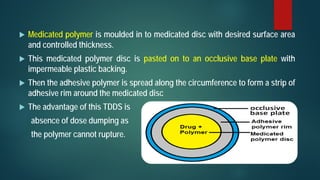
 Medicated polymer is moulded in to medicated disc with desired surface area
and controlled thickness.
 This medicated polymer disc is pasted on to an occlusive base plate with
impermeable plastic backing.
 Then the adhesive polymer is spread along the circumference to form a strip of
adhesive rim around the medicated disc
 The advantage of this TDDS is
absence of dose dumping as
the polymer cannot rupture.
Example: Nitro glycerin releasing TDDS (Nitro-Dur and Nitro-Dur II
/Key pharmaceuticals,USA) deliver daily dose of 0.5mg/cm2 for
therapy of angina pectoris.
Microreservoir type/ microsealed dissolution controlled systems
 This is combination of the reservoir and matrix diffusion systems
 Drug reservoir
1. Suspension of drug in aqueous solution of water soluble liquid polymer
2. Homogenously dispersing of drug suspension in a lipophilic polymer (silicone
elastomer)
3. As a result discrete unleachable microscopic spheres of drug reservoir is formed which
is stabilized by cross linking.
4. Medicated polymer is moulded in to medicated polymer discs of desired surface area
and controlled thickness
 Depending on property of drug and desired rate of drug release disc is coated
with a layer of bio compatible polymer
 This medicated polymer disc is pasted on to an occlusive base plate with
impermeable plastic backing
 Then the adhesive polymer is spread along the circumference to form a strip of
adhesive rim around the medicated disc
Example: Nitro glycerin releasing TDDS (Nitrodisc, searle, USA)
deliver daily dose of 0.5mg/cm2 for once a day therapy of
angina pectoris.

Unit III_Transdermal DDS.pdf

  • 1.
    Transdermal Drug DeliverySystems INTRODUCTION, PERMEATION THROUGH SKIN, FACTORS AFFECTING PERMEATION, PERMEATION ENHANCERS, BASIC COMPONENTS OF TDDS, FORMULATION APPROACHES
  • 3.
    Introduction  Transdermal drugdelivery (TDD) is the administration of therapeutic agents through the intact skin for systemic effect.  Only a small number of drug products are available for TDDS.  Problems  Drugs physical properties- molecular size, polarity,  biological properties- dermal irritation, insufficient bioavailability
  • 4.
    Advantages  Avoids firstpass metabolism  Maintains constant blood levels for longer period of time  Decrease the dose of administration  Decrease unwanted/ side effects  Decreases gastro-intestinal side effects  Easy to discontinue in case of toxic effects  Increased patient compliance  Great advantage for patients who are unconscious.  Relatively large area of application in comparison to buccal / nasal cavity
  • 5.
    Disadvantages  Drug musthave certain desirable physicochemical properties  Drugs with daily dose less than 10 mg/day are preferred  Local irritation at the site of administration (drug, adhesive/ other excipients)  Barrier function of skin changes form one site to another, from person to person and with age  TDDS cannot deliver ionic drug  TDDS cannot achieve high drug levels in Blood/ plasma  Drugs of large molecular size can not be formulated as TDD
  • 6.
    Routes of drugpenetration across skin  Three potential entry (MACRO ROUTES) to the viable tissue:  Via the sweat ducts  Across the continuous stratum corneum (diffusion)  3. Through the hair follicles with their associated sebaceous glands.
  • 7.
     Transcellular permeationthrough the stratum corneum.  Intercellular permeation through the stratum corneum.  Transappendageal permeation via hair follicle, sebaceous & sweat gland
  • 8.
     Transcellular andintercellular permeation requires diffusion through epidermis and dermis.  Transappendageal permeation allows diffusional leakage of polar molecules in to epidermis and direct permeation in to dermis.  The relative importance of these routes depends on factors like time of permeation, physicochemical properties (pka, molecular size, stability, partition coefficient), integrity and thickness of stratum corneum, density of sweat glands and follicles, skin hydration, metabolism and vehicle effects
  • 9.
    Mechanism of precutaneousdrug absorption  Transepidermal pathway is responsible for drug diffusion across the skin  Permeation by the transepidermal route first involves partitioning in to stratum corneum.  Most substances diffuse cross stratum corneum via intercellular lipiodal route which is tortuous pathway.  Extremely polar compounds and ions pass by microscopic path through stratum corneum.  Lipophilic molecules concentrate in and diffuse easily through the horny layers.  When permeating drug exists stratum corneum, it enters wet cell mass of viable epidermis
  • 10.
     As epidermishas no direct blood supply, the drug is forced to diffuse across it to reach the vasculature.  The viable epidermis is a permeable field that functions as a viscid watery regimen to most penetrants.  Extremely hydrophilic (Ions and polar non- electrolytes), extremely hydrophobic (lipophilic non-electrolytes) have difficulty in passing through viable epidermis.  The epidermal cell membranes are tightly joined and there is little inercellular space for ions and polar non electrolytes to diffusionally squeeze through.  Permeation in viable epidermis requires frequent crossing of cell membrames, which is prohibitive event for water-soluble species.  On the other hand extremely lipophilic molecules are constrained form dissolving in watery regimen
  • 11.
    Transappendageal route  Fractionalarea available through this route is 0.1 %  Human skin contains 40-70 hair follicles, 200 to 250 sweat glands on every sq.cm of skin area.  Mainly water soluble substance diffuse faster through appendages than that of other layers.  Sweat glands and hair follicles act as a shunt i.e. easy pathway for diffusion through rate limiting ST corneum.  Follicular route is important for permeation because the opening of the follicular pore is relatively large and sebum aids in the diffusion of the penetrant.  Partitioning into the sebum followed by the diffusion to the depths of the epidermis is the mechanism of drug permeation
  • 12.
     The Permeabilitycoefficient at steady state (Pss) of the skin tissue to the drug is given by Pss = Ks x Dss / Hs Where, Ks = partition coefficient of drug in to stratum corneum Dss = apparent diffusivity for the steady state diffusion of the drug Hs = over all thickness of skin tissue.  The Flux (Jss) of the penetrating drug is given by Jss = Pss x Cveh Where, Jss = steady stste flux Cveh = concentration of drug in vehicle/ formulation
  • 13.
    Factors influencing dermalpenetration of drugs  Biological factors 1. Skin condition 2. Skin age 3. Blood flow 4. Regional skin site 5. Skin metabolism 6. Species difference.  Physicochemical factors 1. Skin hydration 2. Temperature and pH 3. Diffusion coefficient 4. Drug concentration 5. Partition coefficient 6. Molecular size and shape. 7. Solubility, ionization, Melting point
  • 14.
     Increase inConc. of drug in vehicle increases amount of drug absorbed per unit of surface area per time interval.  The drug in vehicle must interface the skin surface in sufficient conc  More drug is absorbed when it is applied to large surface area.  Drug should have greater physicochemical attraction to the skin than to dispersed vehicle.  The aqueous solubility of drug determines the conc present at the absorption site.  The partition coefficient influences the rate of transport across the absorption site
  • 15.
     Solutes withmolecular weight 800-1000 daltons, with adequate solubility in mineral oil and water (> 1mg/ml) can penetrate through skin  Drug absorption enhances from vehicles that easily covers the skin surface, mix readily with sebum.  Vehicle that increases the amount of moisture imbedded by the skin improves drug absorption ex: oleagenous vehicles.  Hydration of the skin softens stratum corneum, increases the size of pores, allowing greater flow of substances  Site of application influences degree of drug absorption. Skin in post auricular layer is more permeable to drugs.  Longer the contact period of drug with skin, greater will be absorption.
  • 16.
    Basic components oftransdermal patch 1. Polymer matrix/ matrices 2. The drug 3. Pressure sensitive adhesives 4. Permeation enhancers 5. Excipients/ other supportive materials
  • 17.
    Polymer matrix  Thepolymer is formulated either as a matrix/ reservoir to controls the release of the drug from the device.  Ideal characters:  The polymer molecular weight, glass transition temperature and chemical functionality must allow proper diffusion & release of drug  It should be stable, non reactive with the drug, easily manufactured and fabricated into the desired product  The polymer and its degradation products must be non toxic or non antagonistic to the host  The mechanical properties of the polymer should not deteriorate excessively when the large amount of the active agents are incorporated into it
  • 18.
    The polymers usedin the transdermal drug delivery systems are  Natural polymers Cellulose derivatives, zein, gelatin, shellac, waxes, proteins, gums & their derivatives, natural rubber starch etc.  Synthetic elastomers Poly butadiene, hydrin rubber, poly siloxane silicone rubber, nitrile, acrylonitrile, butyl rubber, butadiene Neoprene etc.  Synthetic polymers Polyvinyl chloride, polyethylene, poly propylene, polyacrylate, polyamide, polyurea, polyvinyl pyrrolidone, poly methyl methaacrylate
  • 19.
    Drug  For successfuldevelopment of a transdermal drug delivery, the following are the desirable properties of a drug  Physicochemical properties.-  It is generally accepted that the best drug candidates for passive adhesive Transdermal patches must be  Non-ionic  Low molecular weight (less than 1000 Daltons)  Adequate solubility in oil and water  Low melting point (less than 200℃ )  Potent (dose ideally less than 10 mg per day)
  • 20.
     Biological properties The drug should be potent with a daily dose of order of a few mg/ day  The half life of the drug should be short  The drug must not induce a cutaneous irritant or allergic response  Drugs degraded in the GIT or inactivated by the hepatic first pass are suitable candidates for transdermal drug delivery  Tolerance of drug must not be developed  Drugs which are to be administered for long period of time or which cause adverse effects are suitable
  • 21.
    Pressure sensitive adhesives These provide good adherence characteristics & help to secure the transdermal device on the skin over long period of time.  Ideal properties  Should not irritate or sensitize the skin or affect normal functions of the skin  Should adhere to the skin aggressively  Should be easily removed  Should not leave an unwashable residue on the skin  Should have an intimate contact with the skin  Should be compatible with the drug, excipients and permeation enhancers  Permeation of drug should not be affected
  • 22.
    The major classesof pressure sensitive adhesives are Polyisobutylenes, Acrylic & Silicone based adhesives 1. Polyisobutylene based adhesives: (Tg = - 62°C)  These elastomeric polymers are commonly used as primary base polymer and as tackifiers.  The higher the mol. Wt. of PIB the lower its permeability.  These are preferred for drugs with low solubility and low polarity. 2. Acrylic adhesives: (Tg = - 55 to - 15°C)  These are produced by co-polymerization of acrylic esters with acrylic acid and other functional monomers  These are used as matrix adhesives and dominate the medical market  These are moderately polar and have moisture permeability
  • 23.
     3. Siliconebased adhesives: (Tg = - 127°C)  These are composed of long chain resin.  The unique semi-organic structure give silicone a high flexibility.  Silicone adhesives have high permeability to moisture and oxygen which reduces degree of occlusion.  These are suitable for TDDS in which drug releasing surface is covered with adhesive.
  • 24.
    Permeation enhancers  Theseare the compounds which promote skin permeability by altering the skin as a barrier to the flux of a desired penetrant (drug)  These are also known as accelerants / sorption promoters.  Ideal properties 1. Should work rapidly 2. The activity and duration of effect should be both predictable and reproducible. 3. should not have pharmacological activity. 4. Should work unidirectionally (prevent loss of endogenous material from body). 5. When removed form skin, the barrier properties should return both rapidly and fully
  • 25.
     Permeation enhancersact through 3 possible mechanisms; 1. The enhancers disrupt stratum corneum lipid organization, making it permeable & increases drug diffusion coefficient. Ex: Azone, terpenes, fatty acids, DMSO and alcohols  Oleic acid and terpenes at high loadings pool with lipids, phase separate and form permeable pores which allow easier access to the viable epidermis for polar molecules.  DMSO, ethanol and micellar solutions also extract lipids, making horny layer more permeable by forming aqueous channels
  • 26.
     2. Theenhancers interact with keratin (intra cellular protein) in corneocytes to open up dense protein structures and make them more permeable. Ex: Ionic surfactants, decyl methyl sulphoxide and DMSO  3. Many solvents enter stratum corneum, changes its solution properties by altering the chemical environment and increasing partitioning of second molecule (drug/ co-enhancer/ co-solvent) in to the horny layer. Ex: ethanol increases penetration of nitroglycerin & estradiol.  Many chemical enhancer use combination of 3 mechanisms. DMSO (above 60%) disturb inter cellular organization, extract lipids & interact with keratin and facilitate lipid drug partitioning.
  • 27.
     Precutaneous absorptionof most of the drugs is passive diffusion process, as given by Fick`s first law of diffusion Where, J = flux of drug, D = drug diffusion coefficient of skin, K = skin-vehicle partition coefficient of drug, C = drug Conc. in the vehicle/ product, h = thickness of skin  Permeation enhancers act on skin to improve drug diffusibility/solubility/ both  DMSO and azone can increase diffusability in the stratum corneum by acting as solvents to dissolve the skin lipids and to denaturate skin proteins  Ethanol, macrocyclic ketones, lactones can modify drug solubility parameters, partition coefficient from vehicle to skin and the permeability coefficient in the skin J = DKC 𝒉𝒉
  • 28.
    1. Solvents  Increasespenetration by swelling the polar pathway transport or fluidising lipids  Eg: water, ethanol, methanol, DMS, homologs of methyl sulphoxide, dimethyl acetamide and DMF, 2-pyrrolidone, Nmethyl, 2-pyrrolidone, laurocapram, PG, glycerol, silicone fluids, isopropyl palmitate. 2. Surfactants  Enhances the polar pathway transport of hydrophilic drugs  Anionic surfactants can penetrate and interact strongly with the skin, cationic surfactant are irritants. a. Anionic surfactants: Dioctyl sulpho succinate, SLS, deco decylmethyl sulphoxide etc. b. Non ionic surfactants: Pluronic F127, Pluronic F68,etc. c. Bile salts: Sodium taurocholate, sodium deoxy cholate, sodium tauroglycocholate.
  • 29.
    3. Binary systems These open heterogeneous multi laminate pathway & continuous pathways  Propylene glucol-oleic acid and 1,4-butane diol-linoleic acid. 4. Miscellaneous  Urea-hydrating and keratolytic agent, N,N-dimethyl-mtoluamide, calcium thioglycolate, anti cholinergic agents 5. Potential permetion enhancers  Euclyptol, di-o-methyl-ß-cyclodextrin and soyabean casein
  • 30.
    Excipients/ other supportivematerials.  These include Release liners, Backing layers, Microporous membranes & Packing substrates. 1. Release liner  During storage the patch is covered by a protective liner that is removed & discharged immediately before the application of the patch to the skin.  The release liner should be capable of easily peeled off by the user and should not interfere with the functionality of the product.  It prevents loss of drug that has migrated through adhesive layer during storage and protects product against contamination.  Cost must be compatible with a disposable concept as loner will be thrown away. Ex: impermeable materials like polyesters and metal foils
  • 31.
    2. Backing layer Flexible and provide good bond to the drug reservoir  Prevent drug from leaving the dosage form from the top  Accept printing  Should be impermeable to water vapour. E.g. metallic plastic laminate, plastic backing with absorbent pad and occlusive base plate, adhesive foam pad with occlusive base plate. Materials used:-- polyester-polyethylene coextruded films
  • 32.
    3. Microporous orsemi-permeable or rate controlling membrane  These are used to limit the flow of the drug from both reservoir and matrix systems  The function depends on the design of the specific system, the size of the active component and the need to have a rate-limiting factor in order to satisfy the release and absorption characteristics of the system. Ex: Ethylene Vinyl Acetate Membranes (EVA), Microporous Polyethylene Membranes
  • 33.
     4. Packingsubstrates  Transdermal patches are packed as unit doses in sealed pouches  The pouching material is critical for stability & integrity of product.  The structure and construction of film pouch depends on product characteristics, reactivity and adsorption phenomena of drug and external factors (light, oxygen)  Three main layers used for pouches: 1. External printable layer 2. Aluminium foil layer 3. Internal plastic heat sealable layer
  • 34.
    Approaches in developmentof TDDS  Membrane permeation controlled systems / Reservoir type systems  Adhesive- dispersion type systems  Matrix diffusion- controlled systems  Microreservoir type/ microsealed dissolution controlled systems
  • 35.
    Membrane-moderated or Permeationcontrolled TDDS  Drug reservoir (homogenous dispersion of drug with polymeric matrix or suspension of drug in unleachable viscous liquid medium such as silicone fluid) is encapsulated within drug impermeable metallic plastic laminate and a rate controlling polymeric membrane (ethylene vinyl acetate co polymer).  The rate of drug release is determined by the permeability of the rate controlling membrane  A layer of adhesive polymer is applied on membrane to secure the device on skin  The rate of release of drug is always maintained at constant rate & the type of release is zero order  Release rate of this TDDS depends upon the polymer composition, permeability coefficient and thickness of the rate controlling membrane and adhesive.
  • 36.
    Examples of thissystem are: 1. Nitroglycerin releasing TDDS (Transderm Nitro/ciba, USA) for once a day medication in angina pectoris 2. Scopolamine releasing TDDS (Transderm-Scop/ ciba, USA) for 72 hrs, prophylaxis of motion sickness 3. Estradiol releasing TDDS (Estraderm/ciba) for treatment of menopausal syndrome 4. Clonidine releasing TDDS (Catapres/Boehringer Ingelheim) for 7 day therapy of hyper tension 5. Prostaglandin -derivatives TDDS
  • 37.
    Adhesive dispersion typesystems  Drug reservoir is formulated by homogenous dispersion of drug with adhesive polymer poly(isobutylene) or poly acrylate.  Then spreading of this medicated adhesive by solvent casting/ hot melt on flat sheet of drug impermeable metallic plastic backing to form thin drug reservoir layer.  On top of the drug reservoir layer, thin layers of rate controlling adhesive polymer of specific permeability and constant thickness are applied to produce an adhesive dispersion- diffusion controlled TDDS
  • 38.
    Examples for thissystem 1. Isosorbide dinitrate -releasing TDDS for once a day medication of angina pectoris 2. Verapamil releasing TDDS
  • 39.
    Matrix diffusion –controlled system  Drug reservoir of homogenous dispersion of drug with hydrophilic or lipophilic polymer is prepared with one of the following methods 1. Homogenous dispersion of finely ground drug particles with liquid polymer or highly viscous base polymer followed by cross linking of polymer chains 2. Homogenous mixing of drug solid with rubbery polymer at an elevated temperature 3. Dissolving the drug and polymer in a common solvent followed by solvent evaporation in a mould at an elevated temperature or under vacuum.
  • 40.
     Medicated polymeris moulded in to medicated disc with desired surface area and controlled thickness.  This medicated polymer disc is pasted on to an occlusive base plate with impermeable plastic backing.  Then the adhesive polymer is spread along the circumference to form a strip of adhesive rim around the medicated disc  The advantage of this TDDS is absence of dose dumping as the polymer cannot rupture.
  • 41.
    Example: Nitro glycerinreleasing TDDS (Nitro-Dur and Nitro-Dur II /Key pharmaceuticals,USA) deliver daily dose of 0.5mg/cm2 for therapy of angina pectoris.
  • 42.
    Microreservoir type/ microsealeddissolution controlled systems  This is combination of the reservoir and matrix diffusion systems  Drug reservoir 1. Suspension of drug in aqueous solution of water soluble liquid polymer 2. Homogenously dispersing of drug suspension in a lipophilic polymer (silicone elastomer) 3. As a result discrete unleachable microscopic spheres of drug reservoir is formed which is stabilized by cross linking. 4. Medicated polymer is moulded in to medicated polymer discs of desired surface area and controlled thickness
  • 43.
     Depending onproperty of drug and desired rate of drug release disc is coated with a layer of bio compatible polymer  This medicated polymer disc is pasted on to an occlusive base plate with impermeable plastic backing  Then the adhesive polymer is spread along the circumference to form a strip of adhesive rim around the medicated disc
  • 44.
    Example: Nitro glycerinreleasing TDDS (Nitrodisc, searle, USA) deliver daily dose of 0.5mg/cm2 for once a day therapy of angina pectoris.