TRANSDERMAL DRUG DELIVERY
SYSTEM
Prepared By :- Mugdha A Joshi]
Asst. Professor,
IVM’s, IIPER,
Talegaon Dabhade.
ADVANTAGES AND DISADVANTAGES
o Advantages:-
1. Gastrointestinal drug absorption difficulties
covered by administration of TDDS.
2. Useful in case of vomiting of patient having
diarrhea
3. Avoids first pass metabolism
4. Non-invasive avoid inconvenience of
parenteral therapy
5. Provides extended therapy with single
application
6. Drug therapy can be terminated rapidly
o Disadvantages:-
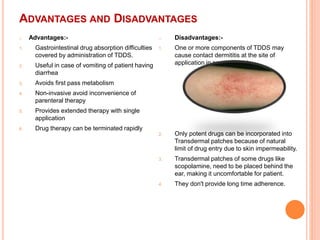
1. One or more components of TDDS may
cause contact dermititis at the site of
application in some patients.
2. Only potent drugs can be incorporated into
Transdermal patches because of natural
limit of drug entry due to skin impermeability.
3. Transdermal patches of some drugs like
scopolamine, need to be placed behind the
ear, making it uncomfortable for patient.
4. They don't provide long time adherence.
 Skin permeation kinetics is important for successful development of TDDS
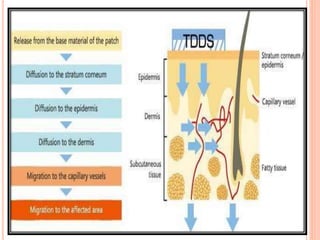
 It involves following steps.
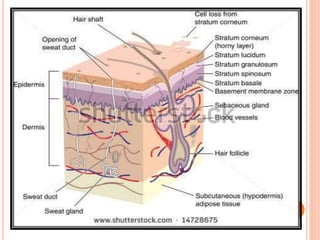
1. Absorption by stratum corneum
2. Penetration of drug through epidermis
3. Uptake of drug by the capillary network
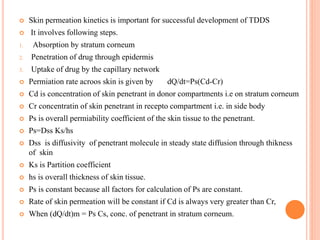
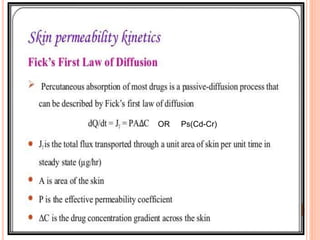
 Permiation rate acroos skin is given by dQ/dt=Ps(Cd-Cr)
 Cd is concentration of skin penetrant in donor compartments i.e on stratum corneum
 Cr concentratin of skin penetrant in recepto compartment i.e. in side body
 Ps is overall permiability coefficient of the skin tissue to the penetrant.
 Ps=Dss Ks/hs
 Dss is diffusivity of penetrant molecule in steady state diffusion through thikness
of skin
 Ks is Partition coefficient
 hs is overall thickness of skin tissue.
 Ps is constant because all factors for calculation of Ps are constant.
 Rate of skin permeation will be constant if Cd is always very greater than Cr,
 When (dQ/dt)m = Ps Cs, conc. of penetrant in stratum corneum.
OR Ps(Cd-Cr)
PHYSICOCHEMICALFACTROS
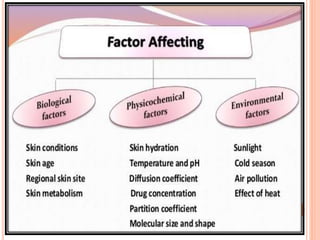
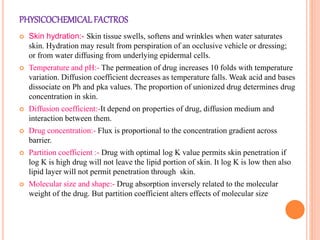
 Skin hydration:- Skin tissue swells, softens and wrinkles when water saturates
skin. Hydration may result from perspiration of an occlusive vehicle or dressing;
or from water diffusing from underlying epidermal cells.
 Temperature and pH:- The permeation of drug increases 10 folds with temperature
variation. Diffusion coefficient decreases as temperature falls. Weak acid and bases
dissociate on Ph and pka values. The proportion of unionized drug determines drug
concentration in skin.
 Diffusion coefficient:-It depend on properties of drug, diffusion medium and
interaction between them.
 Drug concentration:- Flux is proportional to the concentration gradient across
barrier.
 Partition coefficient :- Drug with optimal log K value permits skin penetration if
log K is high drug will not leave the lipid portion of skin. It log K is low then also
lipid layer will not permit penetration through skin.
 Molecular size and shape:- Drug absorption inversely related to the molecular
weight of the drug. But partition coefficient alters effects of molecular size
IDEAL MOLECULAR PROPERTIES OF TDDS
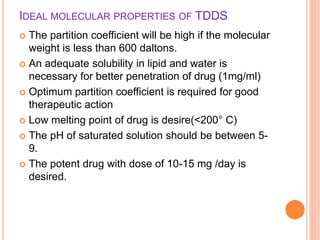
 The partition coefficient will be high if the molecular
weight is less than 600 daltons.
 An adequate solubility in lipid and water is
necessary for better penetration of drug (1mg/ml)
 Optimum partition coefficient is required for good
therapeutic action
 Low melting point of drug is desire(<200° C)
 The pH of saturated solution should be between 5-
9.
 The potent drug with dose of 10-15 mg /day is
desired.
TECHNIQUES TO ENHANCE PERMEATION ACROSS
SKIN
 Chemical enhancers:-
 Reversibly damaging or altering the physicochemical
nature of stratum corneum to reduce its diffusion
resistance.
 Increas skin hydration
 Change structure of lipid and lipoproteins in intracellular
channels through solvent action or denaturation or both.
 More than 275 compounds have been cited in literature
as skin permiation enhancers.eg. Acetone,
dimethylacetamide, DMSO, ethanol, oleic acid,
propylene glycol, SLS.
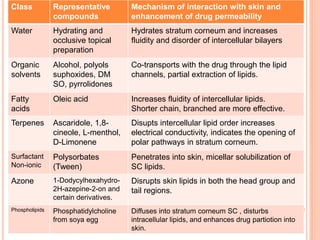
Class Representative
compounds
Mechanism of interaction with skin and
enhancement of drug permeability
Water Hydrating and
occlusive topical
preparation
Hydrates stratum corneum and increases
fluidity and disorder of intercellular bilayers
Organic
solvents
Alcohol, polyols
suphoxides, DM
SO, pyrrolidones
Co-transports with the drug through the lipid
channels, partial extraction of lipids.
Fatty
acids
Oleic acid Increases fluidity of intercellular lipids.
Shorter chain, branched are more effective.
Terpenes Ascaridole, 1,8-
cineole, L-menthol,
D-Limonene
Disupts intercellular lipid order increases
electrical conductivity, indicates the opening of
polar pathways in stratum corneum.
Surfactant
Non-ionic
Polysorbates
(Tween)
Penetrates into skin, micellar solubilization of
SC lipids.
Azone 1-Dodycylhexahydro-
2H-azepine-2-on and
certain derivatives.
Disrupts skin lipids in both the head group and
tail regions.
Phospholipids Phosphatidylcholine
from soya egg
Diffuses into stratum corneum SC , disturbs
intracellular lipids, and enhances drug partiotion into
skin.
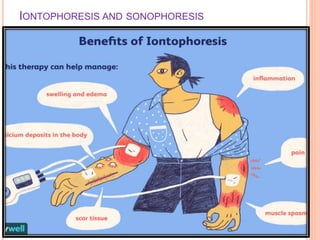
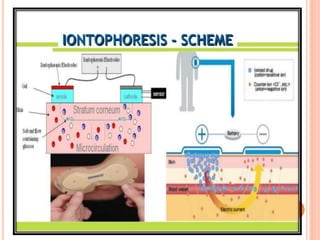
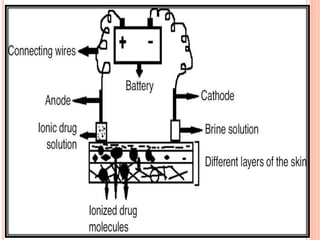
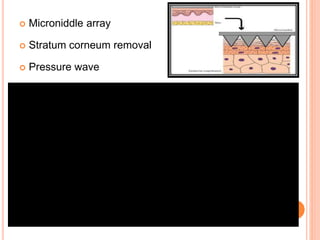
IONTOPHORESIS AND SONOPHORESIS
 Microniddle array
 Stratum corneum removal
 Pressure wave
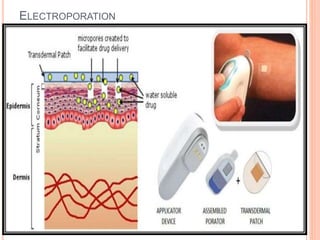
ELECTROPORATION
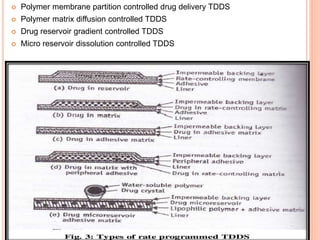
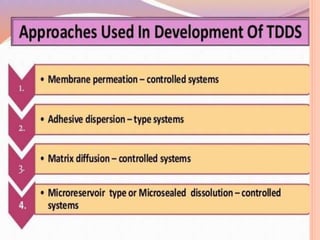
 Polymer membrane partition controlled drug delivery TDDS
 Polymer matrix diffusion controlled TDDS
 Drug reservoir gradient controlled TDDS
 Micro reservoir dissolution controlled TDDS
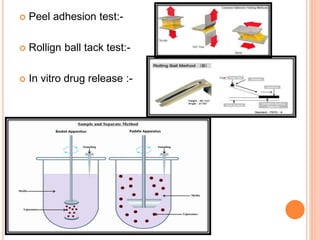
 Peel adhesion test:-
 Rollign ball tack test:-
 In vitro drug release :-
Unit iii  transdermal drug delivery system

Unit iii transdermal drug delivery system

  • 1.
    TRANSDERMAL DRUG DELIVERY SYSTEM PreparedBy :- Mugdha A Joshi] Asst. Professor, IVM’s, IIPER, Talegaon Dabhade.
  • 4.
    ADVANTAGES AND DISADVANTAGES oAdvantages:- 1. Gastrointestinal drug absorption difficulties covered by administration of TDDS. 2. Useful in case of vomiting of patient having diarrhea 3. Avoids first pass metabolism 4. Non-invasive avoid inconvenience of parenteral therapy 5. Provides extended therapy with single application 6. Drug therapy can be terminated rapidly o Disadvantages:- 1. One or more components of TDDS may cause contact dermititis at the site of application in some patients. 2. Only potent drugs can be incorporated into Transdermal patches because of natural limit of drug entry due to skin impermeability. 3. Transdermal patches of some drugs like scopolamine, need to be placed behind the ear, making it uncomfortable for patient. 4. They don't provide long time adherence.
  • 6.
     Skin permeationkinetics is important for successful development of TDDS  It involves following steps. 1. Absorption by stratum corneum 2. Penetration of drug through epidermis 3. Uptake of drug by the capillary network  Permiation rate acroos skin is given by dQ/dt=Ps(Cd-Cr)  Cd is concentration of skin penetrant in donor compartments i.e on stratum corneum  Cr concentratin of skin penetrant in recepto compartment i.e. in side body  Ps is overall permiability coefficient of the skin tissue to the penetrant.  Ps=Dss Ks/hs  Dss is diffusivity of penetrant molecule in steady state diffusion through thikness of skin  Ks is Partition coefficient  hs is overall thickness of skin tissue.  Ps is constant because all factors for calculation of Ps are constant.  Rate of skin permeation will be constant if Cd is always very greater than Cr,  When (dQ/dt)m = Ps Cs, conc. of penetrant in stratum corneum.
  • 8.
  • 10.
    PHYSICOCHEMICALFACTROS  Skin hydration:-Skin tissue swells, softens and wrinkles when water saturates skin. Hydration may result from perspiration of an occlusive vehicle or dressing; or from water diffusing from underlying epidermal cells.  Temperature and pH:- The permeation of drug increases 10 folds with temperature variation. Diffusion coefficient decreases as temperature falls. Weak acid and bases dissociate on Ph and pka values. The proportion of unionized drug determines drug concentration in skin.  Diffusion coefficient:-It depend on properties of drug, diffusion medium and interaction between them.  Drug concentration:- Flux is proportional to the concentration gradient across barrier.  Partition coefficient :- Drug with optimal log K value permits skin penetration if log K is high drug will not leave the lipid portion of skin. It log K is low then also lipid layer will not permit penetration through skin.  Molecular size and shape:- Drug absorption inversely related to the molecular weight of the drug. But partition coefficient alters effects of molecular size
  • 11.
    IDEAL MOLECULAR PROPERTIESOF TDDS  The partition coefficient will be high if the molecular weight is less than 600 daltons.  An adequate solubility in lipid and water is necessary for better penetration of drug (1mg/ml)  Optimum partition coefficient is required for good therapeutic action  Low melting point of drug is desire(<200° C)  The pH of saturated solution should be between 5- 9.  The potent drug with dose of 10-15 mg /day is desired.
  • 12.
    TECHNIQUES TO ENHANCEPERMEATION ACROSS SKIN  Chemical enhancers:-  Reversibly damaging or altering the physicochemical nature of stratum corneum to reduce its diffusion resistance.  Increas skin hydration  Change structure of lipid and lipoproteins in intracellular channels through solvent action or denaturation or both.  More than 275 compounds have been cited in literature as skin permiation enhancers.eg. Acetone, dimethylacetamide, DMSO, ethanol, oleic acid, propylene glycol, SLS.
  • 13.
    Class Representative compounds Mechanism ofinteraction with skin and enhancement of drug permeability Water Hydrating and occlusive topical preparation Hydrates stratum corneum and increases fluidity and disorder of intercellular bilayers Organic solvents Alcohol, polyols suphoxides, DM SO, pyrrolidones Co-transports with the drug through the lipid channels, partial extraction of lipids. Fatty acids Oleic acid Increases fluidity of intercellular lipids. Shorter chain, branched are more effective. Terpenes Ascaridole, 1,8- cineole, L-menthol, D-Limonene Disupts intercellular lipid order increases electrical conductivity, indicates the opening of polar pathways in stratum corneum. Surfactant Non-ionic Polysorbates (Tween) Penetrates into skin, micellar solubilization of SC lipids. Azone 1-Dodycylhexahydro- 2H-azepine-2-on and certain derivatives. Disrupts skin lipids in both the head group and tail regions. Phospholipids Phosphatidylcholine from soya egg Diffuses into stratum corneum SC , disturbs intracellular lipids, and enhances drug partiotion into skin.
  • 14.
  • 18.
     Microniddle array Stratum corneum removal  Pressure wave
  • 19.
  • 21.
     Polymer membranepartition controlled drug delivery TDDS  Polymer matrix diffusion controlled TDDS  Drug reservoir gradient controlled TDDS  Micro reservoir dissolution controlled TDDS
  • 24.
     Peel adhesiontest:-  Rollign ball tack test:-  In vitro drug release :-