By: Ajay Mehra
Shweta saxena
Vipin Bhargav
 Transactional Analysis is a model of people and
relationships that was developed during the 1960s
by Dr. Eric Berne.
 It is a technique use to help people better
understand their own and other’s behavior,
especially in interpersonal relationships.
 It offers a modal of personality and the dynamics of
self and its relationship to others that makes possible
a clear and meaningful discussion of behavior.
 In further education this form of communication
should be used to teach learners how to
communicate with adults.
 Berne suggests when we communicate we do so in
one of these states.
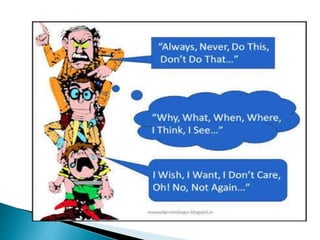
 Basically there are three types of ego
states :
 Parent
 Adult
 Child
The parent is the ego state that contains the external
events that were imposed on a person in the first
five years of their life. These are constructs that are
imposed on the child. These people tend to talk to
people and treat others like children.
Examples :-
 Don't talk to strangers.
 Always hold a grown-up's hand when you cross
the street.
 Don't touch a hot stove.
 Critical Parent Ego State – These people tries to
make the child do as the parent wants them to do.
The personality of critical parent includes prejudged
thoughts, feelings and beliefs perhaps transferring
values or helping child to understand and live in
society. They may also have negative intent, using
the child as a whipping boy.
 Examples : - Don’t argue, Be quiet, Shame on you.
 Nurturing Parent Ego state – These are caring and
concerned and often may appear as a mother and
father figures. They seek to keep the Child
contented, offering a safe haven and unconditional
love to calm the Child's troubles.
 Examples – don’t worry, let me help.
 The Adult in us is the 'grown up' rational person who
talks reasonably and assertively, neither trying to
control nor reacting aggressively towards others. The
Adult is comfortable with them self, for many of us,
our 'ideal self'.
 Examples – I think, I see, always given rational
statements.
 Thoughts, feelings, attitudes and behavioral patterns
based on child like emotions.
 Free Child – These are mainly two types first Natural
and second Little professor. These are largely un-self-
aware and is characterized by the non-speech noises
they make (yahoo, whee, etc.). They like playing and
are open and vulnerable.
 Adaptive Child- These are reacts to the world around
them, either changing themselves to fit in or
rebelling against the forces they feel.
 Examples – No, Please, always give assertive
statements .
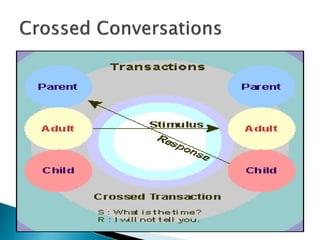
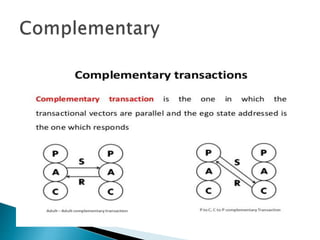
 Basically conversation has two types
(1) Crossed
(2) Complementary
Transactional analysis class

Transactional analysis class

  • 1.
    By: Ajay Mehra Shwetasaxena Vipin Bhargav
  • 2.
     Transactional Analysisis a model of people and relationships that was developed during the 1960s by Dr. Eric Berne.  It is a technique use to help people better understand their own and other’s behavior, especially in interpersonal relationships.
  • 3.
     It offersa modal of personality and the dynamics of self and its relationship to others that makes possible a clear and meaningful discussion of behavior.  In further education this form of communication should be used to teach learners how to communicate with adults.  Berne suggests when we communicate we do so in one of these states.
  • 4.
     Basically thereare three types of ego states :  Parent  Adult  Child
  • 5.
    The parent isthe ego state that contains the external events that were imposed on a person in the first five years of their life. These are constructs that are imposed on the child. These people tend to talk to people and treat others like children. Examples :-  Don't talk to strangers.  Always hold a grown-up's hand when you cross the street.  Don't touch a hot stove.
  • 6.
     Critical ParentEgo State – These people tries to make the child do as the parent wants them to do. The personality of critical parent includes prejudged thoughts, feelings and beliefs perhaps transferring values or helping child to understand and live in society. They may also have negative intent, using the child as a whipping boy.  Examples : - Don’t argue, Be quiet, Shame on you.
  • 7.
     Nurturing ParentEgo state – These are caring and concerned and often may appear as a mother and father figures. They seek to keep the Child contented, offering a safe haven and unconditional love to calm the Child's troubles.  Examples – don’t worry, let me help.
  • 8.
     The Adultin us is the 'grown up' rational person who talks reasonably and assertively, neither trying to control nor reacting aggressively towards others. The Adult is comfortable with them self, for many of us, our 'ideal self'.  Examples – I think, I see, always given rational statements.
  • 9.
     Thoughts, feelings,attitudes and behavioral patterns based on child like emotions.
  • 10.
     Free Child– These are mainly two types first Natural and second Little professor. These are largely un-self- aware and is characterized by the non-speech noises they make (yahoo, whee, etc.). They like playing and are open and vulnerable.
  • 11.
     Adaptive Child-These are reacts to the world around them, either changing themselves to fit in or rebelling against the forces they feel.  Examples – No, Please, always give assertive statements .
  • 13.
     Basically conversationhas two types (1) Crossed (2) Complementary