1
Contents
1. Purpose of Training and about Diesel Engine…………………. 1
2. Working Principle………………………………………………. 4
3. Classification of Diesel Engine…………………………………. 6
4. Terminology in Diesel Engine………………………………….. 7
5. Engine Components……………………………………………. 9
6. Identification of some more parts……………………………... 17
7. Tools……………………………………………………………. 19
8. Piping System of Ship…………………………………………. 21
2
Chapter – 1
Purpose of training and about Diesel Engine
The Purpose:
 Diesel Engine
 Working Principle of Diesel Engine.
 Diesel Engine Process.
 Classification of Diesel Engine.
 Terminology used in Diesel Engine.
 Components of Diesel Engine.
 Operation of Maintenance.
 Piping System of Ship
Diesel Engine:
The diesel engine (also known as a compression-ignition engine) is an internal
combustion engine that uses the heat of compression to initiate Ignition and burn the fuel
that has been injected into the combustion chamber.
The diesel engine has the highest thermal efficiency of any standard internal or
external combustion engine due to its very high compression ratio and inherent
lean burn which enables heat dissipation by the excess air.
Diesel engines are manufactured in two-stroke and four-stroke versions. They
were originally used as a more efficient replacement for stationary steam engines.
The world's largest diesel engine is currently a Wärtsilä-Sulzer RTA96-C
Common Rail marine diesel of about 84.42 MW (113,210 hp) at 102 rpm[4] output.
Fig: 1(a & b) Diesel Engine
3
Historyof Diesel Engine:
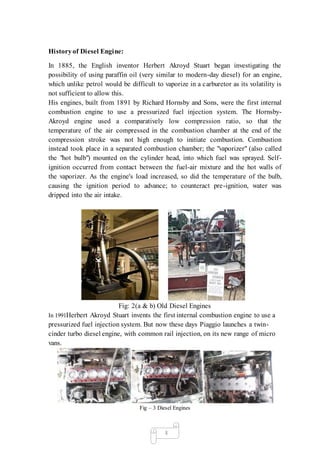
In 1885, the English inventor Herbert Akroyd Stuart began investigating the
possibility of using paraffin oil (very similar to modern-day diesel) for an engine,
which unlike petrol would be difficult to vaporize in a carburetor as its volatility is
not sufficient to allow this.
His engines, built from 1891 by Richard Hornsby and Sons, were the first internal
combustion engine to use a pressurized fuel injection system. The Hornsby-
Akroyd engine used a comparatively low compression ratio, so that the
temperature of the air compressed in the combustion chamber at the end of the
compression stroke was not high enough to initiate combustion. Combustion
instead took place in a separated combustion chamber; the "vaporizer" (also called
the "hot bulb") mounted on the cylinder head, into which fuel was sprayed. Self-
ignition occurred from contact between the fuel-air mixture and the hot walls of
the vaporizer. As the engine's load increased, so did the temperature of the bulb,
causing the ignition period to advance; to counteract pre-ignition, water was
dripped into the air intake.
Fig: 2(a & b) Old Diesel Engines
In 1991Herbert Akroyd Stuart invents the first internal combustion engine to use a
pressurized fuel injection system. But now these days Piaggio launches a twin-
cinder turbo diesel engine, with common rail injection, on its new range of micro
vans.
Fig – 3 Diesel Engines
4
Chapter – 2
Working Principle
Working Principle:
 A reciprocating engine, in the cylinders of which an introduced
charge of air is compressed sufficiently to ensure spontaneous ignition
and combustion of an atomized stream of fuel injected into the said
charge of compressed air.
 Engine which works on the Diesel principle or Diesel cycle.
The diesel internal combustion engine differs from the gasoline powered Otto
cycle by using highly compressed hot air to ignite the fuel rather than using a spark
plug (compression ignition rather than spark ignition).
In the true diesel engine, only air is initially introduced into the combustion
chamber. The air is then compressed with a compression ratio. This high
compression heats the air to 550 °C (1,022 °F). At about the top of the
compression stroke, fuel is injected directly into the compressed air in the
combustion chamber. This may be into a (typically toroidal) void in the top of the
piston or a pre-chamber depending upon the design of the engine. The fuel injector
ensures that the fuel is broken down into small droplets, and that the fuel is
distributed evenly. The heat of the compressed air vaporizes fuel from the surface
of the droplets. The vapour is then ignited by the heat from the compressed air in
the combustion chamber, the droplets continue to vaporise from their surfaces and
burn, getting smaller, until all the fuel in the droplets has been burnt.
Diesel Cycle:
1-2 ISENTROPIC COMPRESSION
2-3 HEAT ADDITION AT CONST. PR
3-4 ISENTROPIC EXPANSION
4-1 HEAT REJECTION AT CONST. V
P-V Diagram for the Ideal Diesel cycle. The
cycle follows the numbers 1-4 in clockwise
direction. In the diesel cycle the combustion
occurs at almost constant pressure and the
exhaust occurs at constant volume. On this
diagram the work that is generated for each cycle
corresponds to the area within the loop.
5
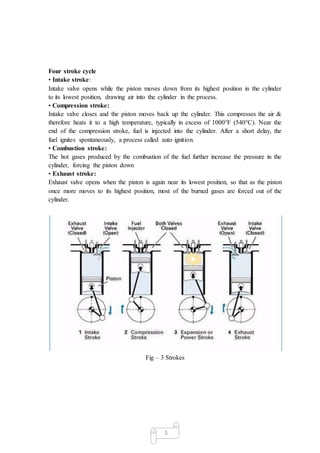
Four stroke cycle
• Intake stroke:
Intake valve opens while the piston moves down from its highest position in the cylinder
to its lowest position, drawing air into the cylinder in the process.
• Compression stroke:
Intake valve closes and the piston moves back up the cylinder. This compresses the air &
therefore heats it to a high temperature, typically in excess of 1000°F (540°C). Near the
end of the compression stroke, fuel is injected into the cylinder. After a short delay, the
fuel ignites spontaneously, a process called auto ignition.
• Combustion stroke:
The hot gases produced by the combustion of the fuel further increase the pressure in the
cylinder, forcing the piston down
• Exhaust stroke:
Exhaust valve opens when the piston is again near its lowest position, so that as the piston
once more moves to its highest position, most of the burned gases are forced out of the
cylinder.
Fig – 3 Strokes
6
Chapter – 3
Classification of Diesel Engine
Classification:
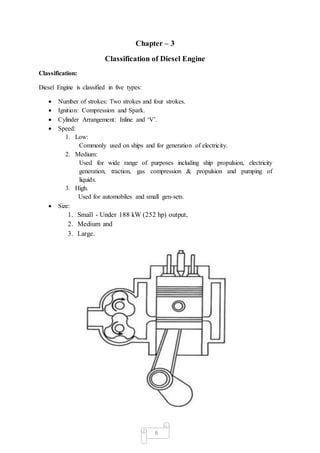
Diesel Engine is classified in five types:
 Number of strokes: Two strokes and four strokes.
 Ignition: Compression and Spark.
 Cylinder Arrangement: Inline and ‘V’.
 Speed:
1. Low:
Commonly used on ships and for generation of electricity.
2. Medium:
Used for wide range of purposes including ship propulsion, electricity
generation, traction, gas compression & propulsion and pumping of
liquids.
3. High.
Used for automobiles and small gen-sets.
 Size:
1. Small - Under 188 kW (252 hp) output,
2. Medium and
3. Large.
7
Chapter – 4
Terminology of Diesel Engine
Terminology:
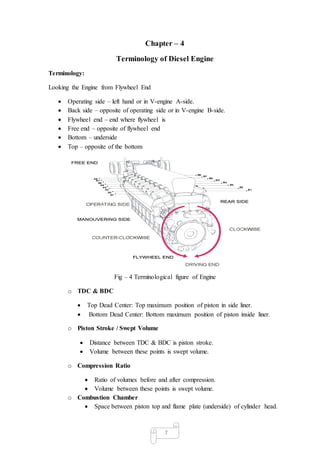
Looking the Engine from Flywheel End
 Operating side – left hand or in V-engine A-side.
 Back side – opposite of operating side or in V-engine B-side.
 Flywheel end – end where flywheel is
 Free end – opposite of flywheel end
 Bottom – underside
 Top – opposite of the bottom
Fig – 4 Terminological figure of Engine
o TDC & BDC
 Top Dead Center: Top maximum position of piston in side liner.
 Bottom Dead Center: Bottom maximum position of piston inside liner.
o Piston Stroke / Swept Volume
 Distance between TDC & BDC is piston stroke.
 Volume between these points is swept volume.
o Compression Ratio
 Ratio of volumes before and after compression.
 Volume between these points is swept volume.
o Combustion Chamber
 Space between piston top and flame plate (underside) of cylinder head.
B1
A2
A3
A4
A5
A6
A7
A8
B3
B2
B4
B5
B6
B7
B8
A1
REAR SIDE
FREE END
MANOUVERING SIDE
FLYWHEEL END
B1
A2
A3
A4
A5
A6
A7
A8
B3
B2
B4
B5
B6
B7
B8
A1
REAR SIDE
FREE END
MANOUVERING SIDE
FLYWHEEL END
REAR SIDE
FREE END
MANOUVERING SIDE
FLYWHEEL END
8
o Peak Pressure / Combustion Pressure
 Maximum pressure developed during combustion.
o Mean Effective Pressure
 Theoretical mean pressure acting on piston during power stroke.
o Indicated Power
 Power calculated on the with MIP within cylinder.
 Calculated from indicator diagram.
= PLANn Here
P – MIP (Nm)
L – Stroke length (m)
A –Area of cylinder (m2)
N – Number of power stroke(4 stroke – RPM/2)
n – Number of cylinders
o Break Power
 Actual power available at crankshaft
o Thermal Efficiency
 Ratio of energy received by piston during power stroke to the energy
supplied, in terms of fuel.
 In other words, it is a ratio of break power to indicated power.
o Mechanical Efficiency
 Part of power developed in engine is used to overcome friction of engine
parts. This power is not available as power output.i.e. I.P. = B.P. + F.P.
(friction power)
 Ratio.
o Limitations
 Friction losses in piston & liner
 Acceleration stresses in components
 Service life of components
 Mechanical load & Thermal load on components
9
Chapter – 5
Engine Components
Engine Block:
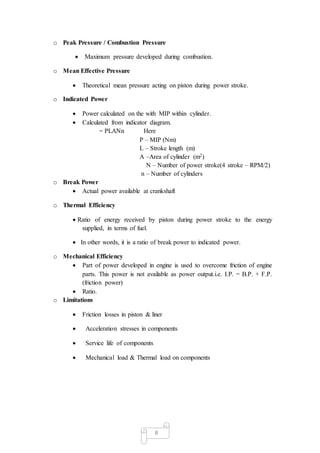
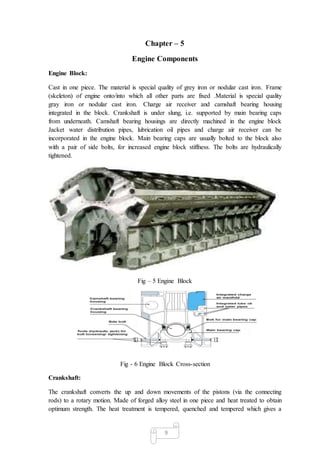
Cast in one piece. The material is special quality of grey iron or nodular cast iron. Frame
(skeleton) of engine onto/into which all other parts are fixed .Material is special quality
gray iron or nodular cast iron. Charge air receiver and camshaft bearing housing
integrated in the block. Crankshaft is under slung, i.e. supported by main bearing caps
from underneath. Camshaft bearing housings are directly machined in the engine block
Jacket water distribution pipes, lubrication oil pipes and charge air receiver can be
incorporated in the engine block. Main bearing caps are usually bolted to the block also
with a pair of side bolts, for increased engine block stiffness. The bolts are hydraulically
tightened.
Fig – 5 Engine Block
Fig - 6 Engine Block Cross-section
Crankshaft:
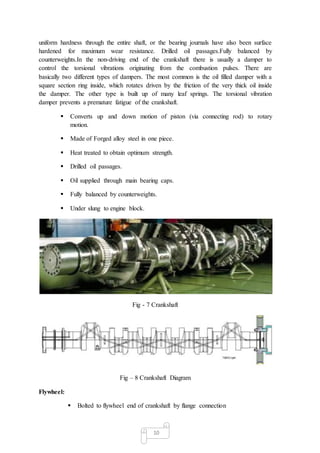
The crankshaft converts the up and down movements of the pistons (via the connecting
rods) to a rotary motion. Made of forged alloy steel in one piece and heat treated to obtain
optimum strength. The heat treatment is tempered, quenched and tempered which gives a
10
uniform hardness through the entire shaft, or the bearing journals have also been surface
hardened for maximum wear resistance. Drilled oil passages.Fully balanced by
counterweights.In the non-driving end of the crankshaft there is usually a damper to
control the torsional vibrations originating from the combustion pulses. There are
basically two different types of dampers. The most common is the oil filled damper with a
square section ring inside, which rotates driven by the friction of the very thick oil inside
the damper. The other type is built up of many leaf springs. The torsional vibration
damper prevents a premature fatigue of the crankshaft.
 Converts up and down motion of piston (via connecting rod) to rotary
motion.
 Made of Forged alloy steel in one piece.
 Heat treated to obtain optimum strength.
 Drilled oil passages.
 Oil supplied through main bearing caps.
 Fully balanced by counterweights.
 Under slung to engine block.
Fig - 7 Crankshaft
Fig – 8 Crankshaft Diagram
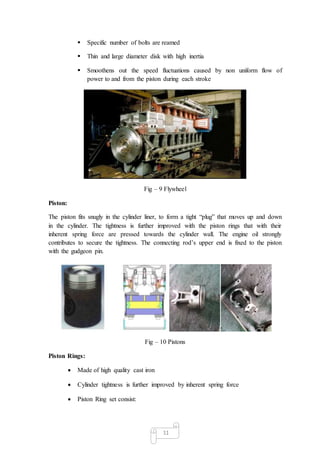
Flywheel:
 Bolted to flywheel end of crankshaft by flange connection
11
 Specific number of bolts are reamed
 Thin and large diameter disk with high inertia
 Smoothens out the speed fluctuations caused by non uniform flow of
power to and from the piston during each stroke
Fig – 9 Flywheel
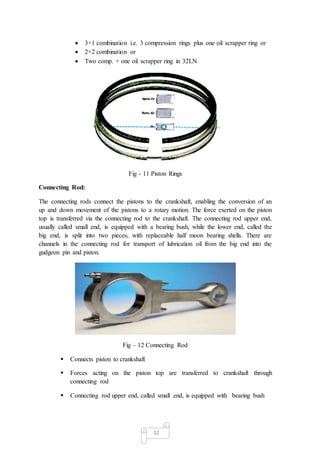
Piston:
The piston fits snugly in the cylinder liner, to form a tight “plug” that moves up and down
in the cylinder. The tightness is further improved with the piston rings that with their
inherent spring force are pressed towards the cylinder wall. The engine oil strongly
contributes to secure the tightness. The connecting rod’s upper end is fixed to the piston
with the gudgeon pin.
Fig – 10 Pistons
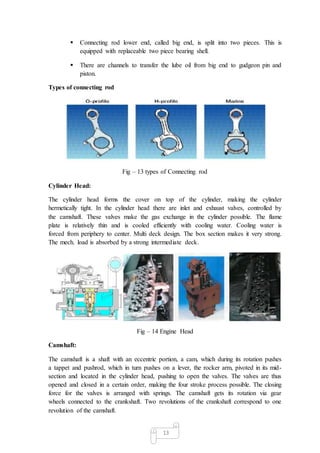
Piston Rings:
 Made of high quality cast iron
 Cylinder tightness is further improved by inherent spring force
 Piston Ring set consist:
12
 3+1 combination i.e. 3 compression rings plus one oil scrapper ring or
 2+2 combination or
 Two comp. + one oil scrapper ring in 32LN
Fig - 11 Piston Rings
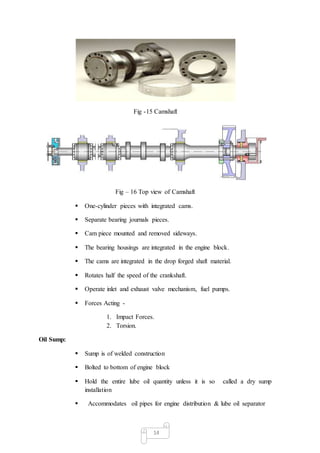
Connecting Rod:
The connecting rods connect the pistons to the crankshaft, enabling the conversion of an
up and down movement of the pistons to a rotary motion. The force exerted on the piston
top is transferred via the connecting rod to the crankshaft. The connecting rod upper end,
usually called small end, is equipped with a bearing bush, while the lower end, called the
big end, is split into two pieces, with replaceable half moon bearing shells. There are
channels in the connecting rod for transport of lubrication oil from the big end into the
gudgeon pin and piston.
Fig – 12 Connecting Rod
 Connects piston to crankshaft
 Forces acting on the piston top are transferred to crankshaft through
connecting rod
 Connecting rod upper end, called small end, is equipped with bearing bush
13
 Connecting rod lower end, called big end, is split into two pieces. This is
equipped with replaceable two piece bearing shell.
 There are channels to transfer the lube oil from big end to gudgeon pin and
piston.
Types of connecting rod
Fig – 13 types of Connecting rod
Cylinder Head:
The cylinder head forms the cover on top of the cylinder, making the cylinder
hermetically tight. In the cylinder head there are inlet and exhaust valves, controlled by
the camshaft. These valves make the gas exchange in the cylinder possible. The flame
plate is relatively thin and is cooled efficiently with cooling water. Cooling water is
forced from periphery to center. Multi deck design. The box section makes it very strong.
The mech. load is absorbed by a strong intermediate deck.
Fig – 14 Engine Head
Camshaft:
The camshaft is a shaft with an eccentric portion, a cam, which during its rotation pushes
a tappet and pushrod, which in turn pushes on a lever, the rocker arm, pivoted in its mid-
section and located in the cylinder head, pushing to open the valves. The valves are thus
opened and closed in a certain order, making the four stroke process possible. The closing
force for the valves is arranged with springs. The camshaft gets its rotation via gear
wheels connected to the crankshaft. Two revolutions of the crankshaft correspond to one
revolution of the camshaft.
14
Fig -15 Camshaft
Fig – 16 Top view of Camshaft
 One-cylinder pieces with integrated cams.
 Separate bearing journals pieces.
 Cam piece mounted and removed sideways.
 The bearing housings are integrated in the engine block.
 The cams are integrated in the drop forged shaft material.
 Rotates half the speed of the crankshaft.
 Operate inlet and exhaust valve mechanism, fuel pumps.
 Forces Acting -
1. Impact Forces.
2. Torsion.
Oil Sump:
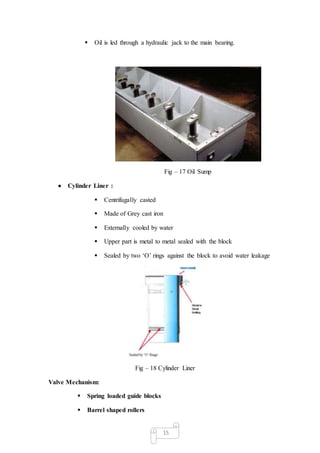
 Sump is of welded construction
 Bolted to bottom of engine block
 Hold the entire lube oil quantity unless it is so called a dry sump
installation
 Accommodates oil pipes for engine distribution & lube oil separator
15
 Oil is led through a hydraulic jack to the main bearing.
Fig – 17 Oil Sump
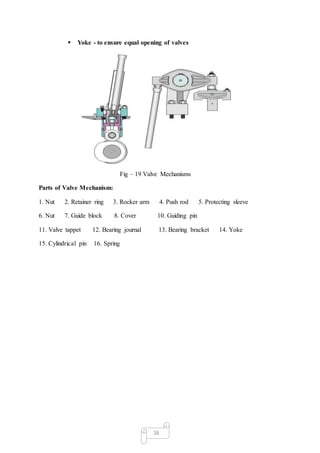
 Cylinder Liner :
 Centrifugally casted
 Made of Grey cast iron
 Externally cooled by water
 Upper part is metal to metal sealed with the block
 Sealed by two ‘O’ rings against the block to avoid water leakage
Fig – 18 Cylinder Liner
Valve Mechanism:
 Spring loaded guide blocks
 Barrel shaped rollers
16
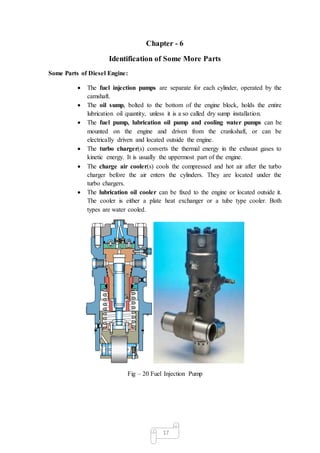
 Yoke - to ensure equal opening of valves
Fig – 19 Valve Mechanisms
Parts of Valve Mechanism:
1. Nut 2. Retainer ring 3. Rocker arm 4. Push rod 5. Protecting sleeve
6. Nut 7. Guide block 8. Cover 10. Guiding pin
11. Valve tappet 12. Bearing journal 13. Bearing bracket 14. Yoke
15. Cylindrical pin 16. Spring
17
Chapter - 6
Identification of Some More Parts
Some Parts of Diesel Engine:
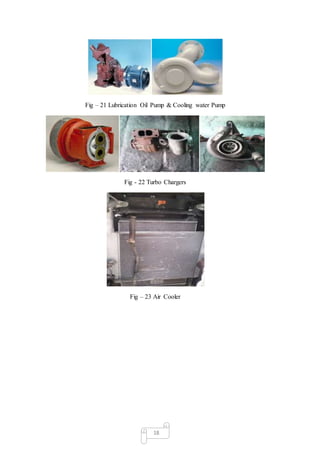
 The fuel injection pumps are separate for each cylinder, operated by the
camshaft.
 The oil sump, bolted to the bottom of the engine block, holds the entire
lubrication oil quantity, unless it is a so called dry sump installation.
 The fuel pump, lubrication oil pump and cooling water pumps can be
mounted on the engine and driven from the crankshaft, or can be
electrically driven and located outside the engine.
 The turbo charger(s) converts the thermal energy in the exhaust gases to
kinetic energy. It is usually the uppermost part of the engine.
 The charge air cooler(s) cools the compressed and hot air after the turbo
charger before the air enters the cylinders. They are located under the
turbo chargers.
 The lubrication oil cooler can be fixed to the engine or located outside it.
The cooler is either a plate heat exchanger or a tube type cooler. Both
types are water cooled.
Fig – 20 Fuel Injection Pump
18
Fig – 21 Lubrication Oil Pump & Cooling water Pump
Fig - 22 Turbo Chargers
Fig – 23 Air Cooler
19
Chapter – 7
Tools
Tools:
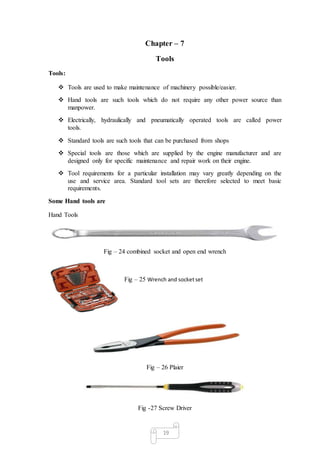
 Tools are used to make maintenance of machinery possible/easier.
 Hand tools are such tools which do not require any other power source than
manpower.
 Electrically, hydraulically and pneumatically operated tools are called power
tools.
 Standard tools are such tools that can be purchased from shops
 Special tools are those which are supplied by the engine manufacturer and are
designed only for specific maintenance and repair work on their engine.
 Tool requirements for a particular installation may vary greatly depending on the
use and service area. Standard tool sets are therefore selected to meet basic
requirements.
Some Hand tools are
Hand Tools
Fig – 24 combined socket and open end wrench
Fig – 25 Wrench and socketset
Fig – 26 Plaier
Fig -27 Screw Driver
20
Fig – 28 Hammer
Power Tools
Fig – 29 Drill and Socket Wrench
21
Chapter – 8
Piping System of Ship
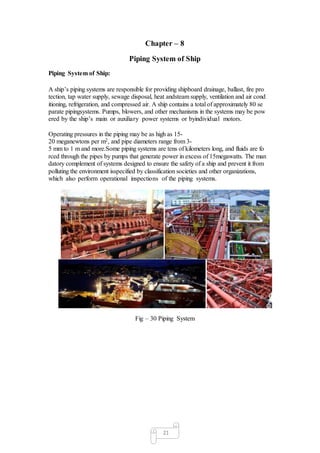
Piping System of Ship:
A ship’s piping systems are responsible for providing shipboard drainage, ballast, fire pro
tection, tap water supply, sewage disposal, heat andsteam supply, ventilation and air cond
itioning, refrigeration, and compressed air. A ship contains a total of approximately 80 se
parate pipingsystems. Pumps, blowers, and other mechanisms in the systems may be pow
ered by the ship’s main or auxiliary power systems or byindividual motors.
Operating pressures in the piping may be as high as 15-
20 meganewtons per m2, and pipe diameters range from 3-
5 mm to 1 m and more.Some piping systems are tens of kilometers long, and fluids are fo
rced through the pipes by pumps that generate power in excess of 15megawatts. The man
datory complement of systems designed to ensure the safety of a ship and prevent it from
polluting the environment isspecified by classification societies and other organizations,
which also perform operational inspections of the piping systems.
Fig – 30 Piping System

Training report on Diesel Engine's component Engine head

  • 1.
    1 Contents 1. Purpose ofTraining and about Diesel Engine…………………. 1 2. Working Principle………………………………………………. 4 3. Classification of Diesel Engine…………………………………. 6 4. Terminology in Diesel Engine………………………………….. 7 5. Engine Components……………………………………………. 9 6. Identification of some more parts……………………………... 17 7. Tools……………………………………………………………. 19 8. Piping System of Ship…………………………………………. 21
  • 2.
    2 Chapter – 1 Purposeof training and about Diesel Engine The Purpose:  Diesel Engine  Working Principle of Diesel Engine.  Diesel Engine Process.  Classification of Diesel Engine.  Terminology used in Diesel Engine.  Components of Diesel Engine.  Operation of Maintenance.  Piping System of Ship Diesel Engine: The diesel engine (also known as a compression-ignition engine) is an internal combustion engine that uses the heat of compression to initiate Ignition and burn the fuel that has been injected into the combustion chamber. The diesel engine has the highest thermal efficiency of any standard internal or external combustion engine due to its very high compression ratio and inherent lean burn which enables heat dissipation by the excess air. Diesel engines are manufactured in two-stroke and four-stroke versions. They were originally used as a more efficient replacement for stationary steam engines. The world's largest diesel engine is currently a Wärtsilä-Sulzer RTA96-C Common Rail marine diesel of about 84.42 MW (113,210 hp) at 102 rpm[4] output. Fig: 1(a & b) Diesel Engine
  • 3.
    3 Historyof Diesel Engine: In1885, the English inventor Herbert Akroyd Stuart began investigating the possibility of using paraffin oil (very similar to modern-day diesel) for an engine, which unlike petrol would be difficult to vaporize in a carburetor as its volatility is not sufficient to allow this. His engines, built from 1891 by Richard Hornsby and Sons, were the first internal combustion engine to use a pressurized fuel injection system. The Hornsby- Akroyd engine used a comparatively low compression ratio, so that the temperature of the air compressed in the combustion chamber at the end of the compression stroke was not high enough to initiate combustion. Combustion instead took place in a separated combustion chamber; the "vaporizer" (also called the "hot bulb") mounted on the cylinder head, into which fuel was sprayed. Self- ignition occurred from contact between the fuel-air mixture and the hot walls of the vaporizer. As the engine's load increased, so did the temperature of the bulb, causing the ignition period to advance; to counteract pre-ignition, water was dripped into the air intake. Fig: 2(a & b) Old Diesel Engines In 1991Herbert Akroyd Stuart invents the first internal combustion engine to use a pressurized fuel injection system. But now these days Piaggio launches a twin- cinder turbo diesel engine, with common rail injection, on its new range of micro vans. Fig – 3 Diesel Engines
  • 4.
    4 Chapter – 2 WorkingPrinciple Working Principle:  A reciprocating engine, in the cylinders of which an introduced charge of air is compressed sufficiently to ensure spontaneous ignition and combustion of an atomized stream of fuel injected into the said charge of compressed air.  Engine which works on the Diesel principle or Diesel cycle. The diesel internal combustion engine differs from the gasoline powered Otto cycle by using highly compressed hot air to ignite the fuel rather than using a spark plug (compression ignition rather than spark ignition). In the true diesel engine, only air is initially introduced into the combustion chamber. The air is then compressed with a compression ratio. This high compression heats the air to 550 °C (1,022 °F). At about the top of the compression stroke, fuel is injected directly into the compressed air in the combustion chamber. This may be into a (typically toroidal) void in the top of the piston or a pre-chamber depending upon the design of the engine. The fuel injector ensures that the fuel is broken down into small droplets, and that the fuel is distributed evenly. The heat of the compressed air vaporizes fuel from the surface of the droplets. The vapour is then ignited by the heat from the compressed air in the combustion chamber, the droplets continue to vaporise from their surfaces and burn, getting smaller, until all the fuel in the droplets has been burnt. Diesel Cycle: 1-2 ISENTROPIC COMPRESSION 2-3 HEAT ADDITION AT CONST. PR 3-4 ISENTROPIC EXPANSION 4-1 HEAT REJECTION AT CONST. V P-V Diagram for the Ideal Diesel cycle. The cycle follows the numbers 1-4 in clockwise direction. In the diesel cycle the combustion occurs at almost constant pressure and the exhaust occurs at constant volume. On this diagram the work that is generated for each cycle corresponds to the area within the loop.
  • 5.
    5 Four stroke cycle •Intake stroke: Intake valve opens while the piston moves down from its highest position in the cylinder to its lowest position, drawing air into the cylinder in the process. • Compression stroke: Intake valve closes and the piston moves back up the cylinder. This compresses the air & therefore heats it to a high temperature, typically in excess of 1000°F (540°C). Near the end of the compression stroke, fuel is injected into the cylinder. After a short delay, the fuel ignites spontaneously, a process called auto ignition. • Combustion stroke: The hot gases produced by the combustion of the fuel further increase the pressure in the cylinder, forcing the piston down • Exhaust stroke: Exhaust valve opens when the piston is again near its lowest position, so that as the piston once more moves to its highest position, most of the burned gases are forced out of the cylinder. Fig – 3 Strokes
  • 6.
    6 Chapter – 3 Classificationof Diesel Engine Classification: Diesel Engine is classified in five types:  Number of strokes: Two strokes and four strokes.  Ignition: Compression and Spark.  Cylinder Arrangement: Inline and ‘V’.  Speed: 1. Low: Commonly used on ships and for generation of electricity. 2. Medium: Used for wide range of purposes including ship propulsion, electricity generation, traction, gas compression & propulsion and pumping of liquids. 3. High. Used for automobiles and small gen-sets.  Size: 1. Small - Under 188 kW (252 hp) output, 2. Medium and 3. Large.
  • 7.
    7 Chapter – 4 Terminologyof Diesel Engine Terminology: Looking the Engine from Flywheel End  Operating side – left hand or in V-engine A-side.  Back side – opposite of operating side or in V-engine B-side.  Flywheel end – end where flywheel is  Free end – opposite of flywheel end  Bottom – underside  Top – opposite of the bottom Fig – 4 Terminological figure of Engine o TDC & BDC  Top Dead Center: Top maximum position of piston in side liner.  Bottom Dead Center: Bottom maximum position of piston inside liner. o Piston Stroke / Swept Volume  Distance between TDC & BDC is piston stroke.  Volume between these points is swept volume. o Compression Ratio  Ratio of volumes before and after compression.  Volume between these points is swept volume. o Combustion Chamber  Space between piston top and flame plate (underside) of cylinder head. B1 A2 A3 A4 A5 A6 A7 A8 B3 B2 B4 B5 B6 B7 B8 A1 REAR SIDE FREE END MANOUVERING SIDE FLYWHEEL END B1 A2 A3 A4 A5 A6 A7 A8 B3 B2 B4 B5 B6 B7 B8 A1 REAR SIDE FREE END MANOUVERING SIDE FLYWHEEL END REAR SIDE FREE END MANOUVERING SIDE FLYWHEEL END
  • 8.
    8 o Peak Pressure/ Combustion Pressure  Maximum pressure developed during combustion. o Mean Effective Pressure  Theoretical mean pressure acting on piston during power stroke. o Indicated Power  Power calculated on the with MIP within cylinder.  Calculated from indicator diagram. = PLANn Here P – MIP (Nm) L – Stroke length (m) A –Area of cylinder (m2) N – Number of power stroke(4 stroke – RPM/2) n – Number of cylinders o Break Power  Actual power available at crankshaft o Thermal Efficiency  Ratio of energy received by piston during power stroke to the energy supplied, in terms of fuel.  In other words, it is a ratio of break power to indicated power. o Mechanical Efficiency  Part of power developed in engine is used to overcome friction of engine parts. This power is not available as power output.i.e. I.P. = B.P. + F.P. (friction power)  Ratio. o Limitations  Friction losses in piston & liner  Acceleration stresses in components  Service life of components  Mechanical load & Thermal load on components
  • 9.
    9 Chapter – 5 EngineComponents Engine Block: Cast in one piece. The material is special quality of grey iron or nodular cast iron. Frame (skeleton) of engine onto/into which all other parts are fixed .Material is special quality gray iron or nodular cast iron. Charge air receiver and camshaft bearing housing integrated in the block. Crankshaft is under slung, i.e. supported by main bearing caps from underneath. Camshaft bearing housings are directly machined in the engine block Jacket water distribution pipes, lubrication oil pipes and charge air receiver can be incorporated in the engine block. Main bearing caps are usually bolted to the block also with a pair of side bolts, for increased engine block stiffness. The bolts are hydraulically tightened. Fig – 5 Engine Block Fig - 6 Engine Block Cross-section Crankshaft: The crankshaft converts the up and down movements of the pistons (via the connecting rods) to a rotary motion. Made of forged alloy steel in one piece and heat treated to obtain optimum strength. The heat treatment is tempered, quenched and tempered which gives a
  • 10.
    10 uniform hardness throughthe entire shaft, or the bearing journals have also been surface hardened for maximum wear resistance. Drilled oil passages.Fully balanced by counterweights.In the non-driving end of the crankshaft there is usually a damper to control the torsional vibrations originating from the combustion pulses. There are basically two different types of dampers. The most common is the oil filled damper with a square section ring inside, which rotates driven by the friction of the very thick oil inside the damper. The other type is built up of many leaf springs. The torsional vibration damper prevents a premature fatigue of the crankshaft.  Converts up and down motion of piston (via connecting rod) to rotary motion.  Made of Forged alloy steel in one piece.  Heat treated to obtain optimum strength.  Drilled oil passages.  Oil supplied through main bearing caps.  Fully balanced by counterweights.  Under slung to engine block. Fig - 7 Crankshaft Fig – 8 Crankshaft Diagram Flywheel:  Bolted to flywheel end of crankshaft by flange connection
  • 11.
    11  Specific numberof bolts are reamed  Thin and large diameter disk with high inertia  Smoothens out the speed fluctuations caused by non uniform flow of power to and from the piston during each stroke Fig – 9 Flywheel Piston: The piston fits snugly in the cylinder liner, to form a tight “plug” that moves up and down in the cylinder. The tightness is further improved with the piston rings that with their inherent spring force are pressed towards the cylinder wall. The engine oil strongly contributes to secure the tightness. The connecting rod’s upper end is fixed to the piston with the gudgeon pin. Fig – 10 Pistons Piston Rings:  Made of high quality cast iron  Cylinder tightness is further improved by inherent spring force  Piston Ring set consist:
  • 12.
    12  3+1 combinationi.e. 3 compression rings plus one oil scrapper ring or  2+2 combination or  Two comp. + one oil scrapper ring in 32LN Fig - 11 Piston Rings Connecting Rod: The connecting rods connect the pistons to the crankshaft, enabling the conversion of an up and down movement of the pistons to a rotary motion. The force exerted on the piston top is transferred via the connecting rod to the crankshaft. The connecting rod upper end, usually called small end, is equipped with a bearing bush, while the lower end, called the big end, is split into two pieces, with replaceable half moon bearing shells. There are channels in the connecting rod for transport of lubrication oil from the big end into the gudgeon pin and piston. Fig – 12 Connecting Rod  Connects piston to crankshaft  Forces acting on the piston top are transferred to crankshaft through connecting rod  Connecting rod upper end, called small end, is equipped with bearing bush
  • 13.
    13  Connecting rodlower end, called big end, is split into two pieces. This is equipped with replaceable two piece bearing shell.  There are channels to transfer the lube oil from big end to gudgeon pin and piston. Types of connecting rod Fig – 13 types of Connecting rod Cylinder Head: The cylinder head forms the cover on top of the cylinder, making the cylinder hermetically tight. In the cylinder head there are inlet and exhaust valves, controlled by the camshaft. These valves make the gas exchange in the cylinder possible. The flame plate is relatively thin and is cooled efficiently with cooling water. Cooling water is forced from periphery to center. Multi deck design. The box section makes it very strong. The mech. load is absorbed by a strong intermediate deck. Fig – 14 Engine Head Camshaft: The camshaft is a shaft with an eccentric portion, a cam, which during its rotation pushes a tappet and pushrod, which in turn pushes on a lever, the rocker arm, pivoted in its mid- section and located in the cylinder head, pushing to open the valves. The valves are thus opened and closed in a certain order, making the four stroke process possible. The closing force for the valves is arranged with springs. The camshaft gets its rotation via gear wheels connected to the crankshaft. Two revolutions of the crankshaft correspond to one revolution of the camshaft.
  • 14.
    14 Fig -15 Camshaft Fig– 16 Top view of Camshaft  One-cylinder pieces with integrated cams.  Separate bearing journals pieces.  Cam piece mounted and removed sideways.  The bearing housings are integrated in the engine block.  The cams are integrated in the drop forged shaft material.  Rotates half the speed of the crankshaft.  Operate inlet and exhaust valve mechanism, fuel pumps.  Forces Acting - 1. Impact Forces. 2. Torsion. Oil Sump:  Sump is of welded construction  Bolted to bottom of engine block  Hold the entire lube oil quantity unless it is so called a dry sump installation  Accommodates oil pipes for engine distribution & lube oil separator
  • 15.
    15  Oil isled through a hydraulic jack to the main bearing. Fig – 17 Oil Sump  Cylinder Liner :  Centrifugally casted  Made of Grey cast iron  Externally cooled by water  Upper part is metal to metal sealed with the block  Sealed by two ‘O’ rings against the block to avoid water leakage Fig – 18 Cylinder Liner Valve Mechanism:  Spring loaded guide blocks  Barrel shaped rollers
  • 16.
    16  Yoke -to ensure equal opening of valves Fig – 19 Valve Mechanisms Parts of Valve Mechanism: 1. Nut 2. Retainer ring 3. Rocker arm 4. Push rod 5. Protecting sleeve 6. Nut 7. Guide block 8. Cover 10. Guiding pin 11. Valve tappet 12. Bearing journal 13. Bearing bracket 14. Yoke 15. Cylindrical pin 16. Spring
  • 17.
    17 Chapter - 6 Identificationof Some More Parts Some Parts of Diesel Engine:  The fuel injection pumps are separate for each cylinder, operated by the camshaft.  The oil sump, bolted to the bottom of the engine block, holds the entire lubrication oil quantity, unless it is a so called dry sump installation.  The fuel pump, lubrication oil pump and cooling water pumps can be mounted on the engine and driven from the crankshaft, or can be electrically driven and located outside the engine.  The turbo charger(s) converts the thermal energy in the exhaust gases to kinetic energy. It is usually the uppermost part of the engine.  The charge air cooler(s) cools the compressed and hot air after the turbo charger before the air enters the cylinders. They are located under the turbo chargers.  The lubrication oil cooler can be fixed to the engine or located outside it. The cooler is either a plate heat exchanger or a tube type cooler. Both types are water cooled. Fig – 20 Fuel Injection Pump
  • 18.
    18 Fig – 21Lubrication Oil Pump & Cooling water Pump Fig - 22 Turbo Chargers Fig – 23 Air Cooler
  • 19.
    19 Chapter – 7 Tools Tools: Tools are used to make maintenance of machinery possible/easier.  Hand tools are such tools which do not require any other power source than manpower.  Electrically, hydraulically and pneumatically operated tools are called power tools.  Standard tools are such tools that can be purchased from shops  Special tools are those which are supplied by the engine manufacturer and are designed only for specific maintenance and repair work on their engine.  Tool requirements for a particular installation may vary greatly depending on the use and service area. Standard tool sets are therefore selected to meet basic requirements. Some Hand tools are Hand Tools Fig – 24 combined socket and open end wrench Fig – 25 Wrench and socketset Fig – 26 Plaier Fig -27 Screw Driver
  • 20.
    20 Fig – 28Hammer Power Tools Fig – 29 Drill and Socket Wrench
  • 21.
    21 Chapter – 8 PipingSystem of Ship Piping System of Ship: A ship’s piping systems are responsible for providing shipboard drainage, ballast, fire pro tection, tap water supply, sewage disposal, heat andsteam supply, ventilation and air cond itioning, refrigeration, and compressed air. A ship contains a total of approximately 80 se parate pipingsystems. Pumps, blowers, and other mechanisms in the systems may be pow ered by the ship’s main or auxiliary power systems or byindividual motors. Operating pressures in the piping may be as high as 15- 20 meganewtons per m2, and pipe diameters range from 3- 5 mm to 1 m and more.Some piping systems are tens of kilometers long, and fluids are fo rced through the pipes by pumps that generate power in excess of 15megawatts. The man datory complement of systems designed to ensure the safety of a ship and prevent it from polluting the environment isspecified by classification societies and other organizations, which also perform operational inspections of the piping systems. Fig – 30 Piping System