Emergency Diesel
Generator
Designed and, Developed by:
Hossam A. Hassanein
1
Diesel Generator
A diesel generator is the
combination of a diesel
engine with an electric
generator and other
ancillary devices ( circuit
breaker, cooling
systems, lubrication
system ect..).
Its purpose is
to generate
electrical
energy
2
Generator Components
Overview
3
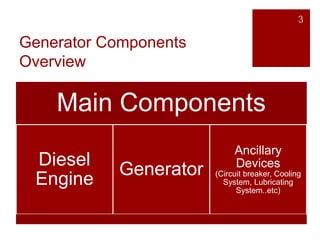
Main Components
Diesel
Engine
Generator
Ancillary
Devices
(Circuit breaker, Cooling
System, Lubricating
System..etc)
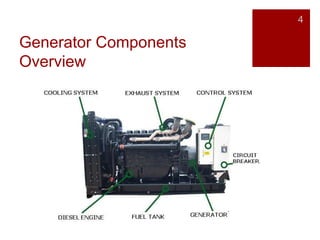
Generator Components
Overview
4
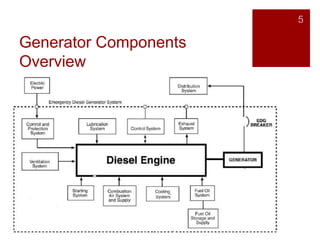
Generator Components
Overview
5
Generator Components
Overview
6
Working Principle
7
Chemical Energy of Fuel
Thermal Energy
Mechanical Energy
Electrical Energy
COMBUSTION
EXPANSION COOLING
OF GASES
GENERATOR
(electromagnetic induction)
8
Diesel
Properties
9
Diesel
Properties
Cetane No.
Measures the
readiness of a fuel to
auto-ignite.
High cetane means
the fuel will ignite
quickly at the
conditions in the
engine (does not
mean the fuel is
highly flammable or
explosive).
Most fuels have
cetane numbers
between 40 and 60.
10
Diesel
Properties
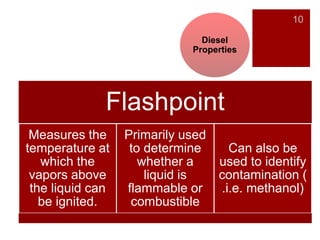
Flashpoint
Measures the
temperature at
which the
vapors above
the liquid can
be ignited.
Primarily used
to determine
whether a
liquid is
flammable or
combustible
Can also be
used to identify
contamination (
.i.e. methanol)
11
Diesel
Properties
Viscosity
A
measurement
of the
resistance to
flow of a liquid
Thicker the
liquid, higher
the viscosity
Water (lower
viscosity) vs.
Vegetable Oil
(higher
viscosity)
12
Diesel
Properties
Cloud Point
Corresponds to the
temperature at which fuel first
starts to crystallize (forms a
faint cloud in liquid) when
cooled.
No specific value is given in the
standard. Requirements vary
depending on location.
Producer reports cloud point at
point of sale
Cold Filter Plug Point (CFPP):
The temperature at which fuel
crystals have agglomerated in
sufficient amounts to cause a
test filter to plug.
The CFPP is less conservative
than the cloud point, and is
considered by some to be a
better indication of low
temperature operability.
13
Diesel
Properties
Fuel Stability
Fuel will undergo
chemical
degradation if in
contact with
oxygen for long
periods or at high
temperatures.
There is no
method specified
in ASTM D 975 for
diesel fuels.
ASTM 6751 is
currently at 3 Hr.
and the EN
specification is 6
Hr.
14
Diesel
Properties
Lubricity
The ability of a
fluid to minimize
friction between,
and damage to,
surfaces in relative
motion under
loaded conditions.
Diesel fuel
injection
equipment relies
on the lubricating
properties of the
fuel.
Biodiesel has
shown higher
lubricity properties
than petroleum
diesel
15
Diesel
Engine
Engine Related Terms
 Bore
 Stroke
 TDC (top dead center)
 BDC (bottom dead center)
 Revolution
 Compression Ratio
 Cycle
16
Diesel
Engine
Bore
Is the diameter of the cylinder
17
Diesel
Engine
Stroke
Is the distance the piston moves up and
down in the cylinder
18
Diesel
Engine
TDC
When the piston is at the very top of its travel,
this is called Top Dead Center, or TDC
19
Diesel
Engine
BDC
When the piston is at the bottom of its travel,
this is called Bottom Dead Center, or BDC
20
Diesel
Engine
Revolution
It is how many times per minute that the crankshaft is
rotating and, used as a measure of rotational speed of
a mechanical component.
21
Diesel
Engine
Compression Ratio
as the ratio of the volume of the cylinder at the beginning of the
compression stroke (when the piston is at BDC) to the volume of the
cylinder at the end of the compression stroke (when the piston is at
TDC).
The higher the compression ratio, the higher the air temperature
in the cylinder at the end of the compression stroke.
Common compression ignition ration: 14:1 to 25:1
22
Diesel
Engine
Cycle
Is the sequences of events that repeat themselves. It is the
thermodynamic cycle which approximates the pressure and
volume of the combustion chamber of the Diesel engine
23
Diesel
Engine
Short
Summary
24
Diesel
Engine
A diesel engine is an internal combustion engine.
It uses the heat of compression to initiate ignition to burn the fuel that has
been injected into the combustion chamber.
The engine was developed by German inventor Rudolf Diesel in 1893.
The engine works on the principle of diesel cycle
25
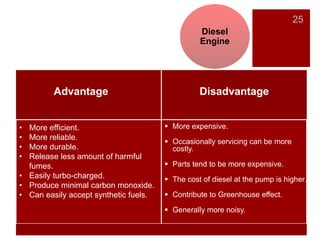
Advantage Disadvantage
• More efficient.
• More reliable.
• More durable.
• Release less amount of harmful
fumes.
• Easily turbo-charged.
• Produce minimal carbon monoxide.
• Can easily accept synthetic fuels.
 More expensive.
 Occasionally servicing can be more
costly.
 Parts tend to be more expensive.
 The cost of diesel at the pump is higher.
 Contribute to Greenhouse effect.
 Generally more noisy.
Diesel
Engine
Two Stroke and
Four Stroke Operation
 A 2-stroke cycle engine develops power
output for each engine revolution (2
Piston Stroke). Thus, one power stroke is
obtained in each revolution of the crank
shaft.
26
Diesel
Engine
 A 4-stroke cycle engine develops power
output for each 2 engine revolutions. (4
Piston stroke). Thus, one power stroke is
obtained in each two revolutions of the crank
shaft.
P-V and T-S
Diagram for
Diesel Cycle
27
Diesel
Engine
28
Diesel
Engine
Intake
Exhaust
Power
Compression
4
STROK
E
CYCLE
Piston descends from the TDC to BDC
increasing the volume of the cylinder. Air
is forced into the cylinder through the
intake port.
Intake
with both valves closed, the piston
returns to TDC compressing the air into
the combustion chamber of the cylinder
head. Temperature gets increased to
hundred degrees.
Compression
Power
Here, the piston once again returns to
top dead centre while the exhaust valve
is open. The spent fuel-air mixture is
expelled.
Exhaust
While the piston is close to TDC, the
compressed fuel injected into a diesel
engine ignites due to the heat generated
in the air during the compression stroke.
4 Stroke Diesel Engine
Animation
29
Diesel
Engine
Basic Parts of Diesel Engine
 Cylinder block
 Piston
 Piston rings
 Piston pin
 Connecting rod
 Crankshaft
30
 Cylinder head
 Intake valve
 Exhaust valve
 Camshaft
 Timing gears
 Liner
Diesel
Engine
Cylinder Block
 Basic frame of the engine.
 Contains the cylinder.
31
Diesel
Engine
Piston
 A sliding plug that
harnesses the force of the
burning gases in the
cylinder.
32
Diesel
Engine
Piston Ring
 The rings seal the compression gases above the
piston keep the oil below the piston rings.
33
Diesel
Engine
Piston Pins
 Also known as the wrist pin, it
connects the piston to the small
end of the connecting rod.
 It transfers the force and allows
the rod to swing back and forth.
34
Diesel
Engine
Connecting Rod
 Connects the piston and piston pin to the crankshaft.
35
Diesel
Engine
Crankshaft
 Along the the piston pin and
connecting rod it converts the up
and down motion (reciprocating) of
the engine to spinning (rotary)
motion.
36
Diesel
Engine
Flywheel
 Carries the inertia
when there is no
power stroke.
37
Diesel
Engine
Cylinder Head
 Forms the top of the
combustion chamber.
 Contains the valves, the
passageways for the fuel
mixture to move in and out of
the engine.
38
Diesel
Engine
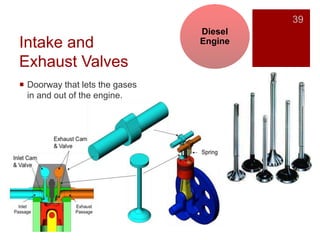
Intake and
Exhaust Valves
 Doorway that lets the gases
in and out of the engine.
39
Diesel
Engine
Camshaft
 Through the use of an eccentric
the cam lobes push the valves
open.
 The valve springs close them.
40
Diesel
Engine
Timing Gears
 These gears drive the camshaft
from the crankshaft.
41
Diesel
Engine
Liner
 Forms the wall of the combustion
chamber.
 Guides the movement of piston.
42
Diesel
Engine

Diesel Generator

  • 1.
    Emergency Diesel Generator Designed and,Developed by: Hossam A. Hassanein 1
  • 2.
    Diesel Generator A dieselgenerator is the combination of a diesel engine with an electric generator and other ancillary devices ( circuit breaker, cooling systems, lubrication system ect..). Its purpose is to generate electrical energy 2
  • 3.
  • 4.
  • 5.
  • 6.
  • 7.
    Working Principle 7 Chemical Energyof Fuel Thermal Energy Mechanical Energy Electrical Energy COMBUSTION EXPANSION COOLING OF GASES GENERATOR (electromagnetic induction)
  • 8.
  • 9.
    9 Diesel Properties Cetane No. Measures the readinessof a fuel to auto-ignite. High cetane means the fuel will ignite quickly at the conditions in the engine (does not mean the fuel is highly flammable or explosive). Most fuels have cetane numbers between 40 and 60.
  • 10.
    10 Diesel Properties Flashpoint Measures the temperature at whichthe vapors above the liquid can be ignited. Primarily used to determine whether a liquid is flammable or combustible Can also be used to identify contamination ( .i.e. methanol)
  • 11.
    11 Diesel Properties Viscosity A measurement of the resistance to flowof a liquid Thicker the liquid, higher the viscosity Water (lower viscosity) vs. Vegetable Oil (higher viscosity)
  • 12.
    12 Diesel Properties Cloud Point Corresponds tothe temperature at which fuel first starts to crystallize (forms a faint cloud in liquid) when cooled. No specific value is given in the standard. Requirements vary depending on location. Producer reports cloud point at point of sale Cold Filter Plug Point (CFPP): The temperature at which fuel crystals have agglomerated in sufficient amounts to cause a test filter to plug. The CFPP is less conservative than the cloud point, and is considered by some to be a better indication of low temperature operability.
  • 13.
    13 Diesel Properties Fuel Stability Fuel willundergo chemical degradation if in contact with oxygen for long periods or at high temperatures. There is no method specified in ASTM D 975 for diesel fuels. ASTM 6751 is currently at 3 Hr. and the EN specification is 6 Hr.
  • 14.
    14 Diesel Properties Lubricity The ability ofa fluid to minimize friction between, and damage to, surfaces in relative motion under loaded conditions. Diesel fuel injection equipment relies on the lubricating properties of the fuel. Biodiesel has shown higher lubricity properties than petroleum diesel
  • 15.
  • 16.
    Engine Related Terms Bore  Stroke  TDC (top dead center)  BDC (bottom dead center)  Revolution  Compression Ratio  Cycle 16 Diesel Engine
  • 17.
    Bore Is the diameterof the cylinder 17 Diesel Engine
  • 18.
    Stroke Is the distancethe piston moves up and down in the cylinder 18 Diesel Engine
  • 19.
    TDC When the pistonis at the very top of its travel, this is called Top Dead Center, or TDC 19 Diesel Engine
  • 20.
    BDC When the pistonis at the bottom of its travel, this is called Bottom Dead Center, or BDC 20 Diesel Engine
  • 21.
    Revolution It is howmany times per minute that the crankshaft is rotating and, used as a measure of rotational speed of a mechanical component. 21 Diesel Engine
  • 22.
    Compression Ratio as theratio of the volume of the cylinder at the beginning of the compression stroke (when the piston is at BDC) to the volume of the cylinder at the end of the compression stroke (when the piston is at TDC). The higher the compression ratio, the higher the air temperature in the cylinder at the end of the compression stroke. Common compression ignition ration: 14:1 to 25:1 22 Diesel Engine
  • 23.
    Cycle Is the sequencesof events that repeat themselves. It is the thermodynamic cycle which approximates the pressure and volume of the combustion chamber of the Diesel engine 23 Diesel Engine
  • 24.
    Short Summary 24 Diesel Engine A diesel engineis an internal combustion engine. It uses the heat of compression to initiate ignition to burn the fuel that has been injected into the combustion chamber. The engine was developed by German inventor Rudolf Diesel in 1893. The engine works on the principle of diesel cycle
  • 25.
    25 Advantage Disadvantage • Moreefficient. • More reliable. • More durable. • Release less amount of harmful fumes. • Easily turbo-charged. • Produce minimal carbon monoxide. • Can easily accept synthetic fuels.  More expensive.  Occasionally servicing can be more costly.  Parts tend to be more expensive.  The cost of diesel at the pump is higher.  Contribute to Greenhouse effect.  Generally more noisy. Diesel Engine
  • 26.
    Two Stroke and FourStroke Operation  A 2-stroke cycle engine develops power output for each engine revolution (2 Piston Stroke). Thus, one power stroke is obtained in each revolution of the crank shaft. 26 Diesel Engine  A 4-stroke cycle engine develops power output for each 2 engine revolutions. (4 Piston stroke). Thus, one power stroke is obtained in each two revolutions of the crank shaft.
  • 27.
    P-V and T-S Diagramfor Diesel Cycle 27 Diesel Engine
  • 28.
    28 Diesel Engine Intake Exhaust Power Compression 4 STROK E CYCLE Piston descends fromthe TDC to BDC increasing the volume of the cylinder. Air is forced into the cylinder through the intake port. Intake with both valves closed, the piston returns to TDC compressing the air into the combustion chamber of the cylinder head. Temperature gets increased to hundred degrees. Compression Power Here, the piston once again returns to top dead centre while the exhaust valve is open. The spent fuel-air mixture is expelled. Exhaust While the piston is close to TDC, the compressed fuel injected into a diesel engine ignites due to the heat generated in the air during the compression stroke.
  • 29.
    4 Stroke DieselEngine Animation 29 Diesel Engine
  • 30.
    Basic Parts ofDiesel Engine  Cylinder block  Piston  Piston rings  Piston pin  Connecting rod  Crankshaft 30  Cylinder head  Intake valve  Exhaust valve  Camshaft  Timing gears  Liner Diesel Engine
  • 31.
    Cylinder Block  Basicframe of the engine.  Contains the cylinder. 31 Diesel Engine
  • 32.
    Piston  A slidingplug that harnesses the force of the burning gases in the cylinder. 32 Diesel Engine
  • 33.
    Piston Ring  Therings seal the compression gases above the piston keep the oil below the piston rings. 33 Diesel Engine
  • 34.
    Piston Pins  Alsoknown as the wrist pin, it connects the piston to the small end of the connecting rod.  It transfers the force and allows the rod to swing back and forth. 34 Diesel Engine
  • 35.
    Connecting Rod  Connectsthe piston and piston pin to the crankshaft. 35 Diesel Engine
  • 36.
    Crankshaft  Along thethe piston pin and connecting rod it converts the up and down motion (reciprocating) of the engine to spinning (rotary) motion. 36 Diesel Engine
  • 37.
    Flywheel  Carries theinertia when there is no power stroke. 37 Diesel Engine
  • 38.
    Cylinder Head  Formsthe top of the combustion chamber.  Contains the valves, the passageways for the fuel mixture to move in and out of the engine. 38 Diesel Engine
  • 39.
    Intake and Exhaust Valves Doorway that lets the gases in and out of the engine. 39 Diesel Engine
  • 40.
    Camshaft  Through theuse of an eccentric the cam lobes push the valves open.  The valve springs close them. 40 Diesel Engine
  • 41.
    Timing Gears  Thesegears drive the camshaft from the crankshaft. 41 Diesel Engine
  • 42.
    Liner  Forms thewall of the combustion chamber.  Guides the movement of piston. 42 Diesel Engine