AT

( Ambala Cantt )
KRISHAN KUMAR
(11101032)
Components of an AC generator:
a. Field
b. Armature
c. Prime mover

d. Rotor
 e. Stator
f. Slip rings
Field
 The field in an AC generator consists of coils of

conductors within the generator that receive a voltage
from a source (called excitation) and produce a magnetic
flux.
 The magnetic flux in the field cuts the armature to produce

a voltage. This voltage is ultimately the output voltage of
the AC generator.
Armature
 The armature is the part of an AC generator in which

voltage is produced.
 This component

consists of many coils of wire that are large enough
to carry the full-load current of the generator.
Prime Mover
 The prime mover is the component that is used to drive

the AC generator.
 The prime mover may be any type of rotating

machine, such as a diesel engine, a steam turbine, or a
motor.
Rotor
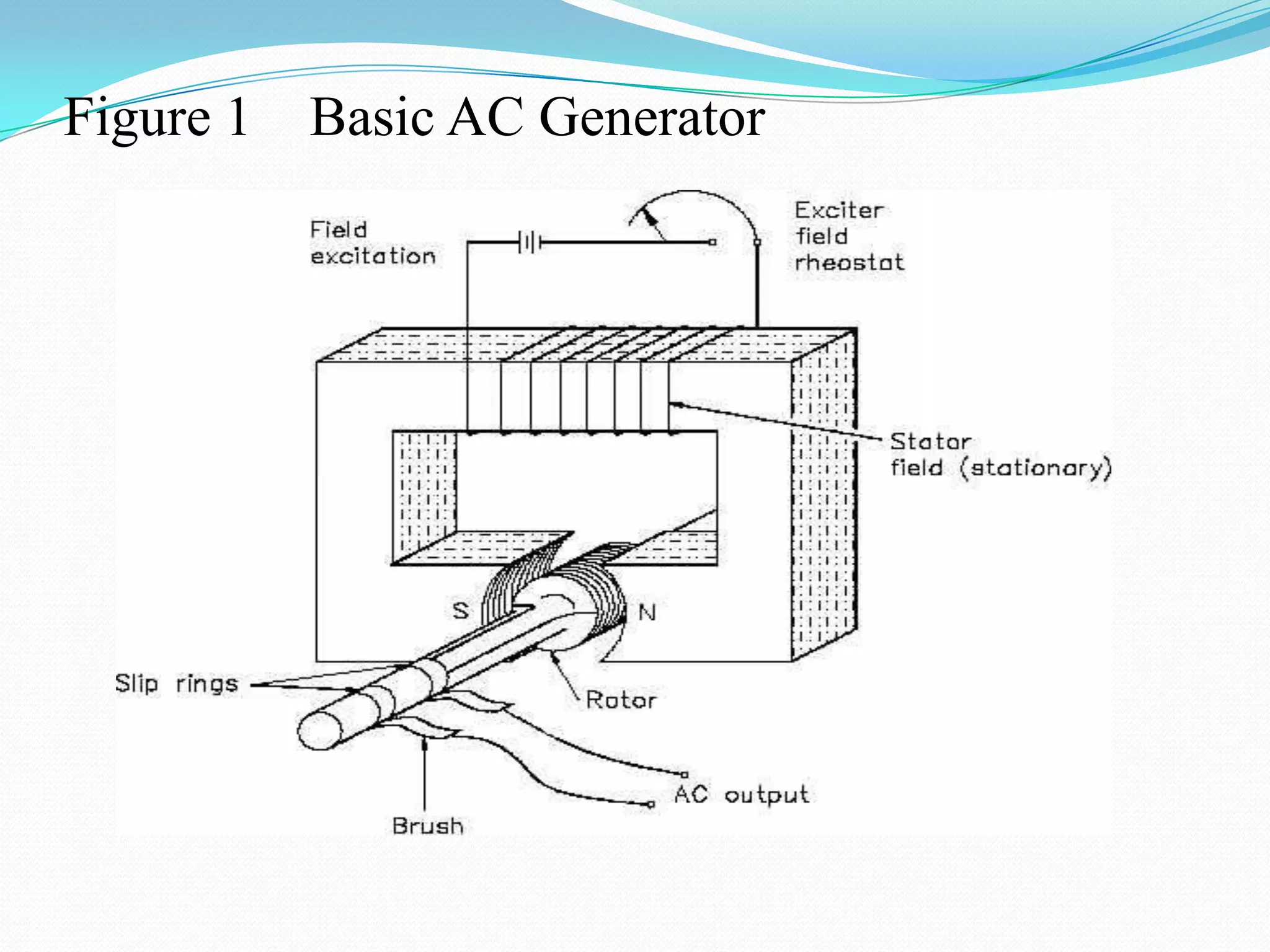
 The rotor of an AC generator is the rotating component of

the generator, as shown in Figure 1.
 The rotor is driven by the generator’s prime mover, which
may be a steam turbine, gas turbine, or diesel engine.
 Depending on the type of generator, this component may
be the armature or the field.
 The rotor will be the armature if the voltage output is
generated there; the rotor will be the field if the field
excitation is applied there.
Figure 1

Basic AC Generator
Stator
 The stator of an AC generator is the part that is stationary

(refer to Figure 1).
 Like the rotor, this component may be the armature or the

field, depending on the type of generator.
 The stator will be the armature if the voltage output is

generated there; the stator will be the field if the field
excitation is applied there.
Slip Rings
 Slip rings are electrical connections that are used to

transfer power to and from the rotor of an AC generator
(refer to Figure 1).
 The slip ring consists of a circular conducting material
that is connected to the rotor windings and insulated from
the shaft.
 Brushes ride on the slip ring as the rotor rotates.
 The electrical connection to the rotor is made by
connections to the brushes.
 Slip rings are used in AC generators because the desired
output of the generator is a sine wave.
Slip Rings
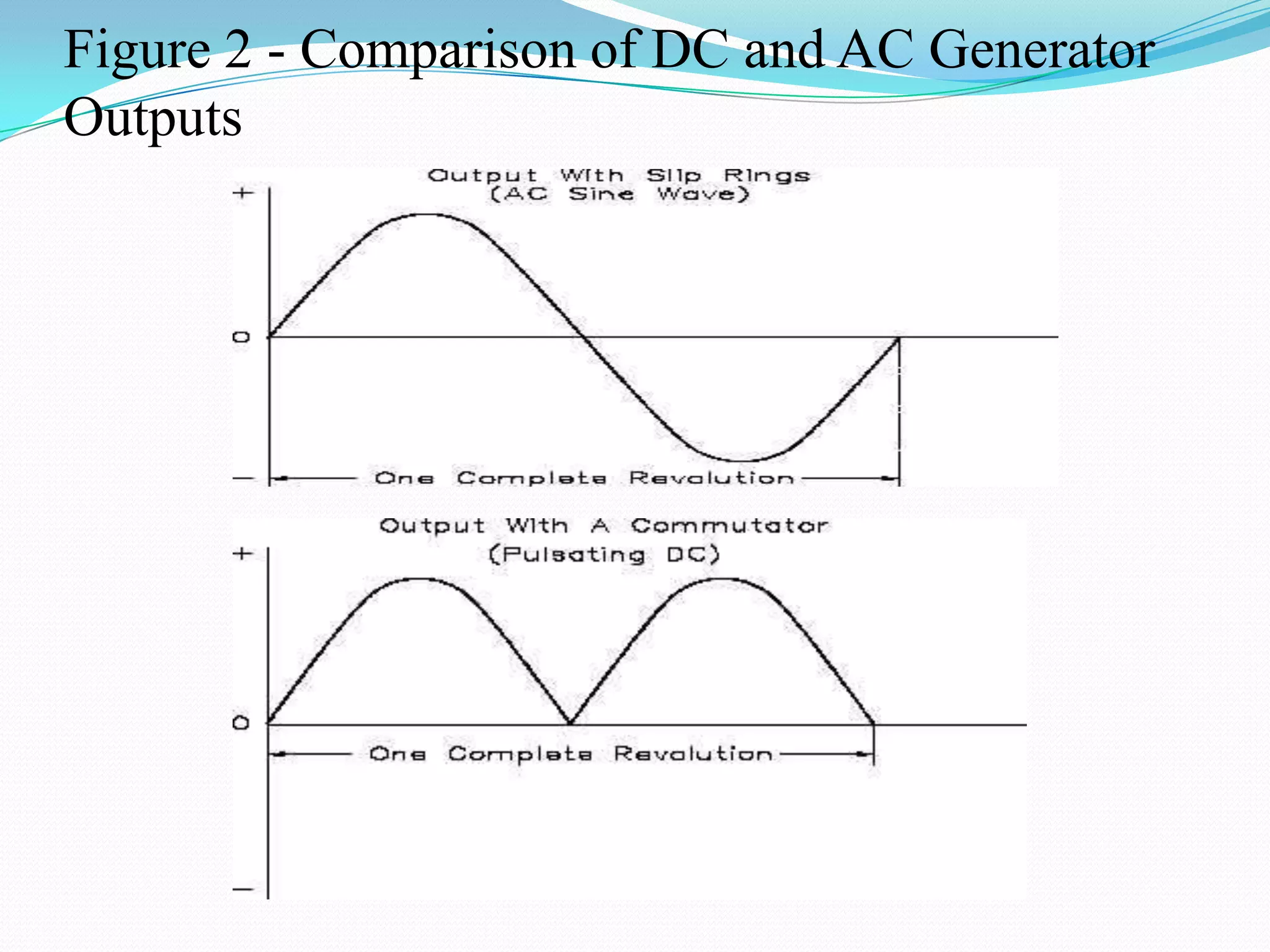
 In a DC generator, a commutator was used to provide an

output whose current always flowed
in the positive direction, as shown in Figure 2.
 This is not necessary for an AC generator.
 Therefore, an AC generator may use slip rings, which will
allow the output current and voltage to oscillate through
positive and negative values.
 This oscillation of voltage and current takes the shape of a
sine wave.
Figure 2 - Comparison of DC and AC Generator
Outputs
Theory of Operation
 The strong magnetic field is produced by a current flow through

the field coil of the rotor.
 The field coil in the rotor receives excitation through

the use of slip rings and brushes.
 Two brushes are spring-held in

contact with the slip rings to provide the continuous
connection between the field coil and the external excitation
circuit.
 The armature is contained within the windings of the stator and is

connected to the output.
Theory of Operation
 Each time the rotor makes one complete revolution, one

complete cycle of AC is developed.
 A generator has many turns of wire wound into the slots of the

rotor.
 The magnitude of AC voltage generated by an AC generator is

dependent on the field strength and speed of the rotor.
 Most generators are operated at a constant speed; therefore, the

generated voltage depends on field excitation, or strength.
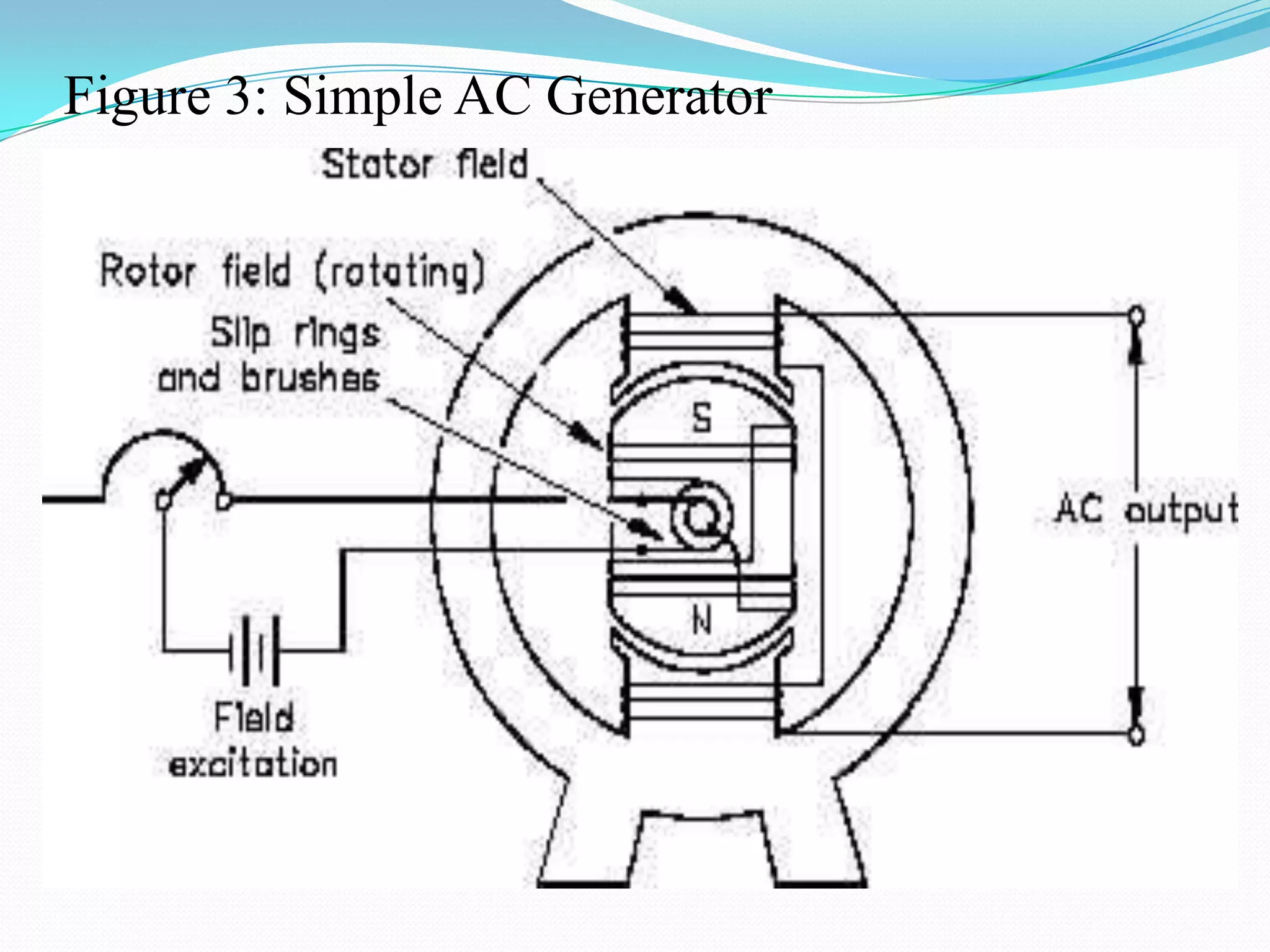
A simple AC generator consists of:
 (a) a strong magnetic field,
 (b) conductors that rotate through that magnetic field, and
 c) a means by which a continuous connection is

provided to the conductors as they are rotating (Figure
3).
Figure 3: Simple AC Generator
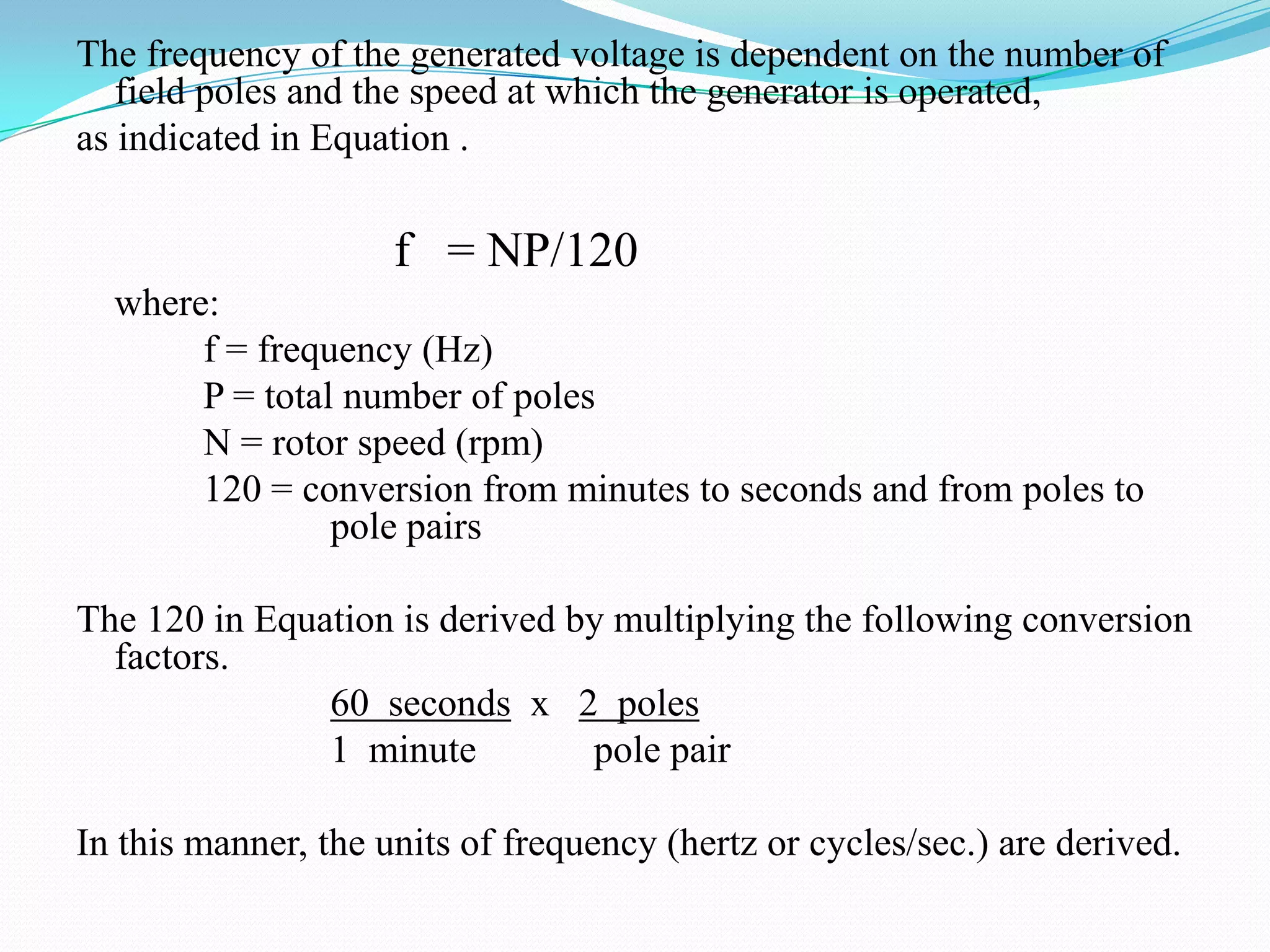
The frequency of the generated voltage is dependent on the number of
field poles and the speed at which the generator is operated,
as indicated in Equation .

f = NP/120
where:
f = frequency (Hz)
P = total number of poles
N = rotor speed (rpm)
120 = conversion from minutes to seconds and from poles to
pole pairs
The 120 in Equation is derived by multiplying the following conversion
factors.
60 seconds x 2 poles
1 minute
pole pair
In this manner, the units of frequency (hertz or cycles/sec.) are derived.
1.) Internal Voltage Drop
 The load current flows through the armature in all AC generators.

The armature has some amount of resistance and inductive
reactance.
 The combination of these make up what

is known as the internal resistance, which causes a loss in a
n AC generator.
 When the load

current flows, a voltage drop is developed across the internal
resistance.
 This voltage drop subtracts from the output voltage

and, therefore, represents generated voltage and power that is
lost and not available to the load.
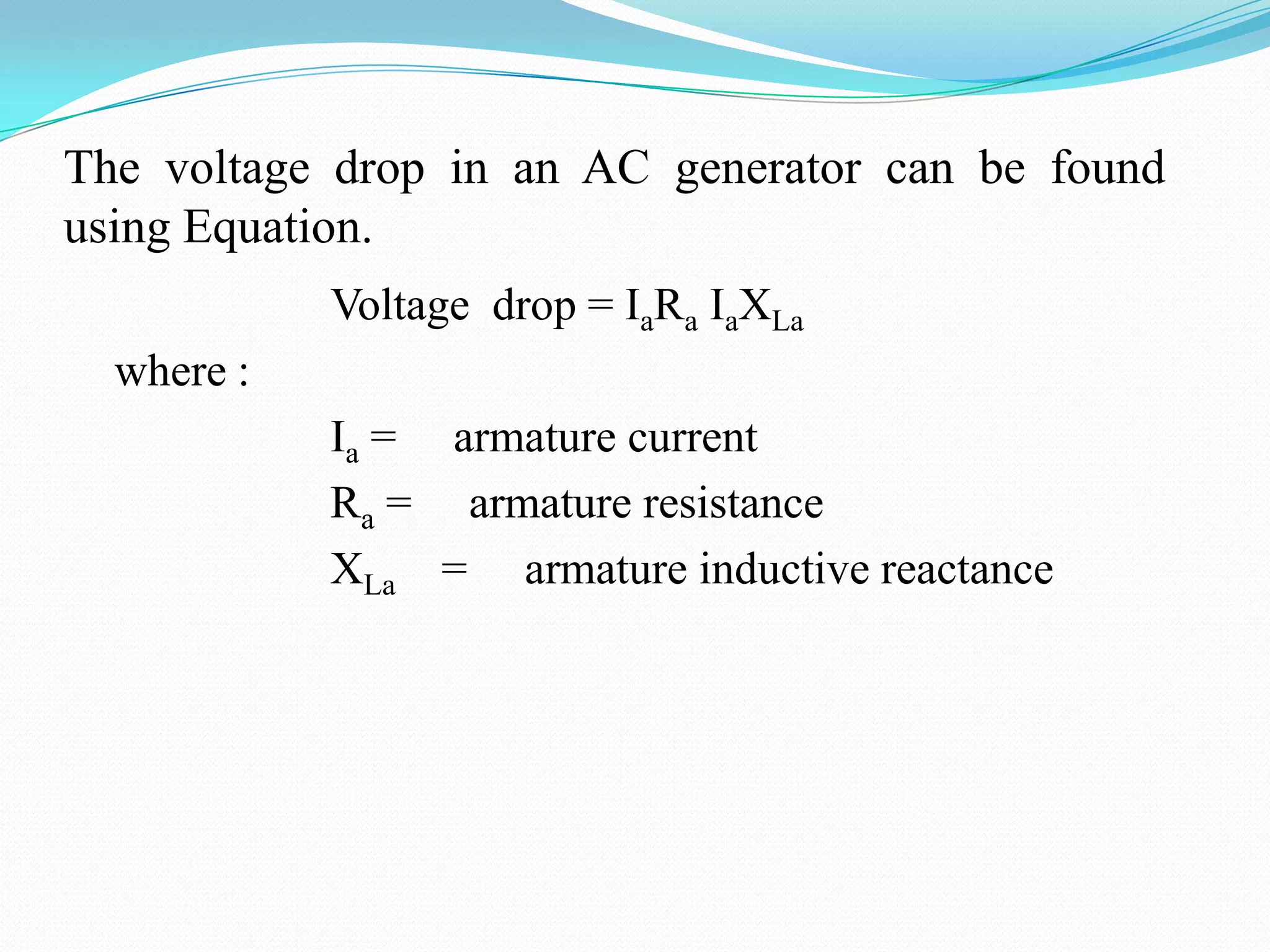
The voltage drop in an AC generator can be found
using Equation.
Voltage drop = IaRa IaXLa
where :
Ia = armature current
Ra = armature resistance
XLa = armature inductive reactance
2.) Hysteresis Losses
 Hysteresis losses occur when iron cores in an AC generat

or are subject to effects from a magnetic field.
 The magnetic domains of the cores are held in alignment
with the field in varying numbers, dependent upon field
strength.
 The magnetic domains rotate, with respect to
the domains not held in alignment, one complete turn duri
ng each rotation of the rotor.
 This
rotation of magnetic domains in the iron causes friction a
nd heat.
2.) Hysteresis Losses
The heat produced by this friction is called
magnetic hysteresis loss.

After the heat-treated silicon steel is formed to the
desired shape, the laminations are heated to a dull red
and then allowed to cool.
This process, known as annealing, reduces hysteresis
losses to a very low value.
To reduce hysteresis losses, most AC armatures ar
e constructed of heat-treated silicon steel, which
has an inherently low hysteresis loss.
3.)Mechanical Losses
 Rotational or mechanical losses can be caused by bearing f

riction, brush friction on the
commutator, and air friction (called windage), which is cau
sed by the air turbulence due to armature rotation.
 Careful maintenance can be instrumental in keeping bearing
friction to a minimum.
 Clean bearings and proper lubrication are essential to the
reduction of bearing friction.
 Brush friction is reduced by ensuring: proper brush
seating, proper brush use, and maintenance
of proper brush tension.
 A smooth and clean commutator also aids in the reduction
of brush friction.
 In very large generators, hydrogen is used within the generator
for cooling; hydrogen, being less dense than air, causes less
windage losses than air.
Efficiency
 Efficiency of an AC generator is the ratio of the useful

power output to the total power input.
 Because any mechanical process experiences some

losses, no AC generators can be 100 percent efficient.
 Efficiency of an AC generator can be calculated using

Equation.
 Efficiency =(Output /Input )x 100
Ratings
Typical name plate data for an AC generator (Figure 4) includes:
 (1) manufacturer;
 (2) serial number and type number;
 (3) speed (rpm), number of poles, frequency of
output, number of phases, and maximum supply voltage;
 (4) capacity rating in KVA and kW
at a specified power factor and maximum output voltage;
 (5) armature and field current per phase; and
 (6) maximum temperature rise.
Power (kW) ratings of an AC generator
 are based on the ability of the prime mover to
overcome generator losses and the ability of
the machine to dissipate the internally generated heat.
 The current rating of an AC generator is based on the insulation
rating of the machine.
Types of AC Generators
 there are two types of AC generators:
1.) the stationary field, rotating armature;
2.) and

the

rotating

field,

stationary armature.

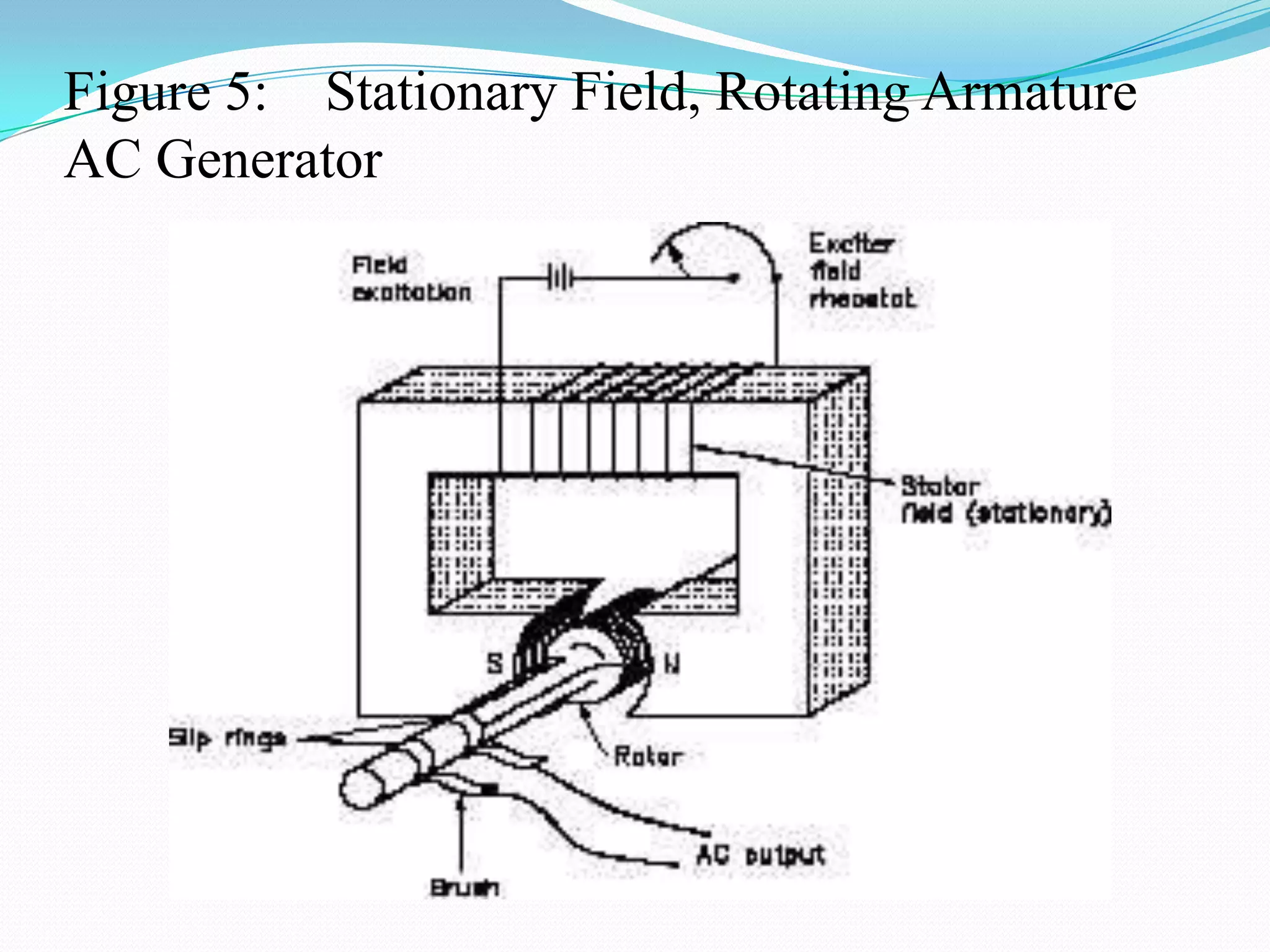
 Small AC generators usually have a stationary

field and a rotating armature (Figure 5).
 One important disadvantage to this arrangement is that the slip-ring
and brush assembly is in series with
the load circuits and, because of worn or dirty components, may
interrupt the flow of current.
Figure 5: Stationary Field, Rotating Armature
AC Generator
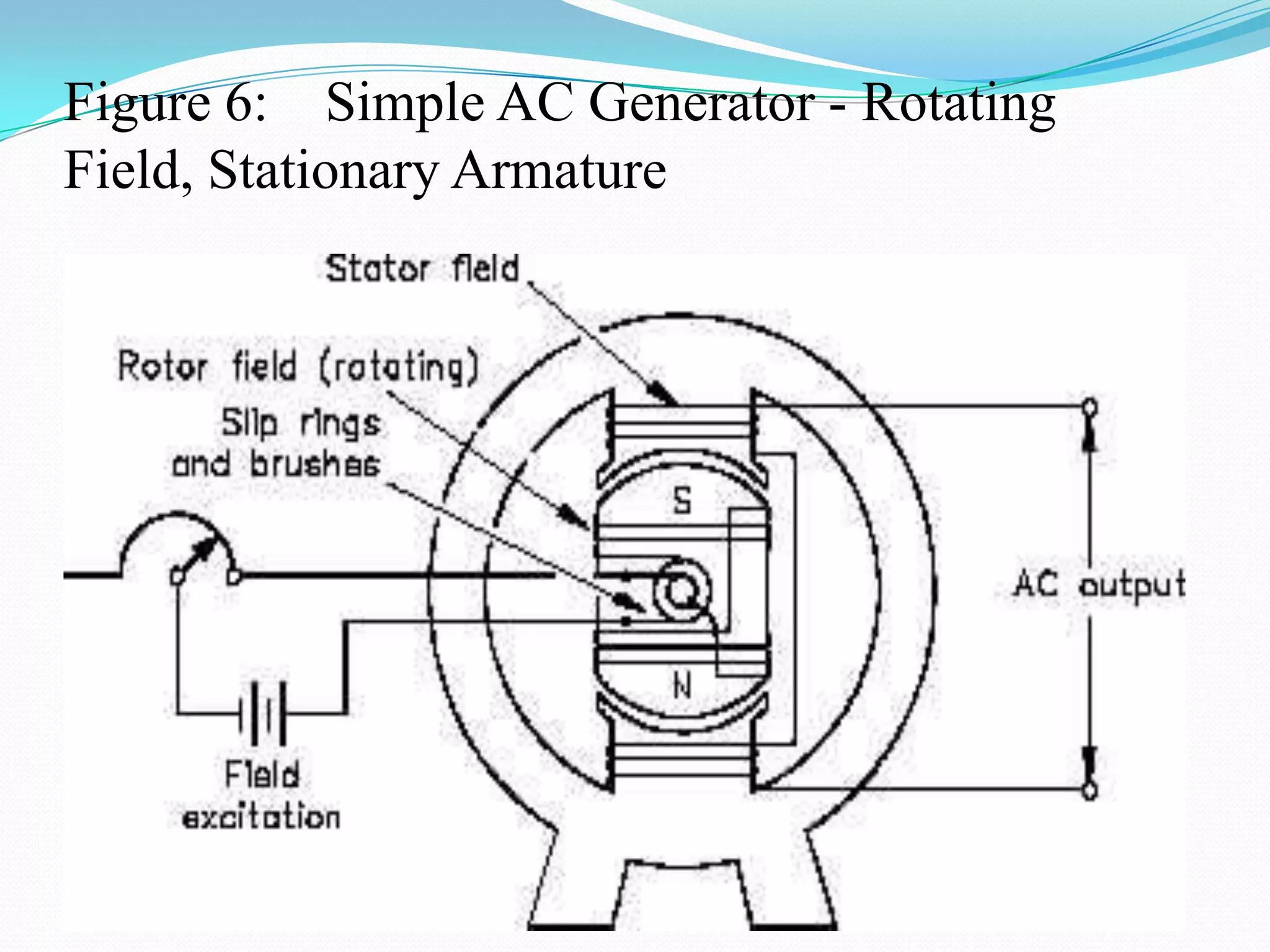
 If DC field excitation is connected

to the rotor, the stationary coils
will have AC induced into them (Figure 6).
 This arrangement is called a rotating field, stationary
armature AC generator.
The rotating field, stationary
armature type AC generator is used when large power
generation is involved.
 In this type of generator, a DC source is supplied
to the rotating field coils, which
produces a magnetic field around the rotating element.
 As the rotor is turned by the prime mover, the field will
cut the conductors of the
stationary armature, and an EMF will be induced into
the armature windings.
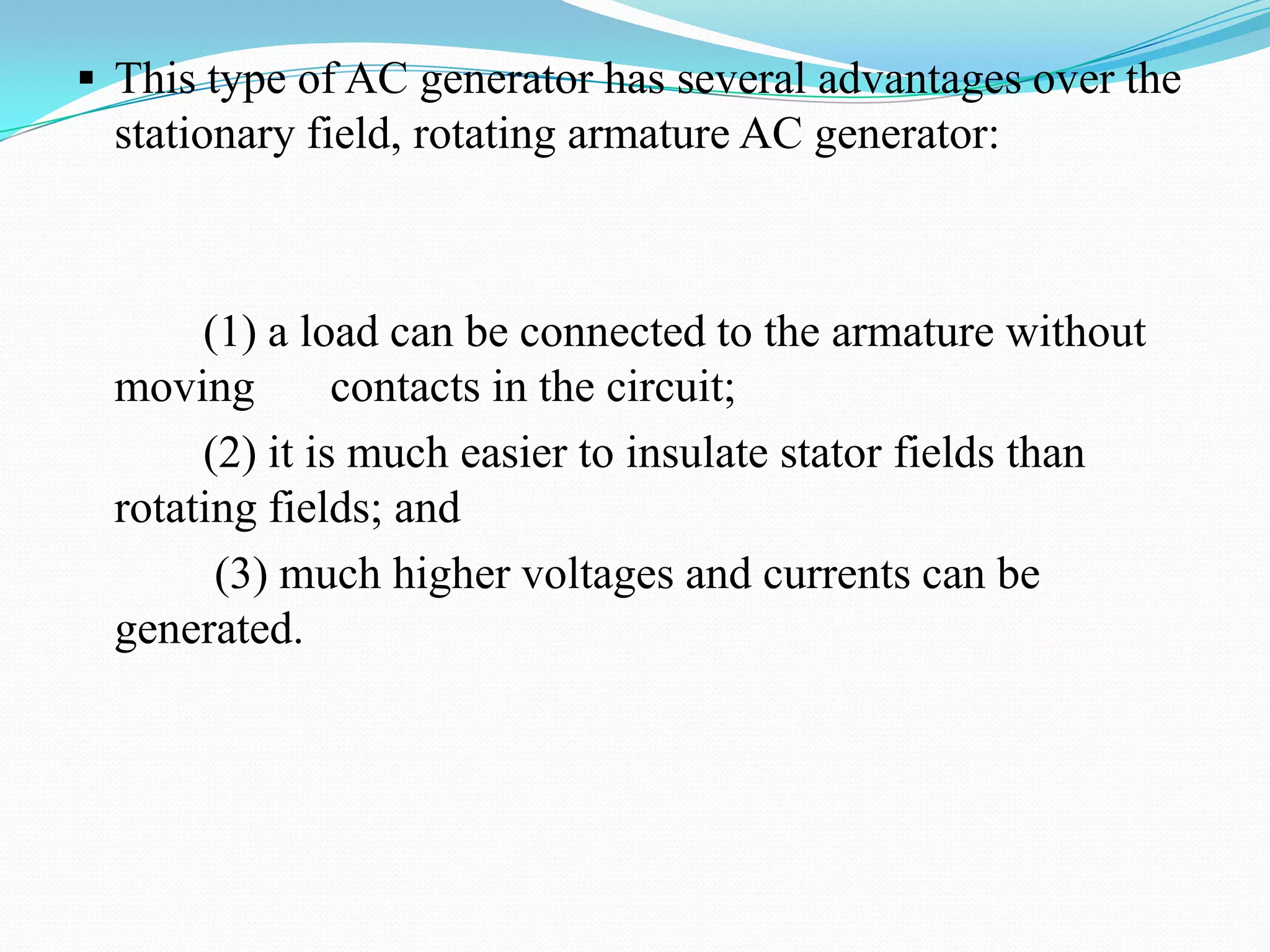
 This type of AC generator has several advantages over the

stationary field, rotating armature AC generator:

(1) a load can be connected to the armature without
moving
contacts in the circuit;
(2) it is much easier to insulate stator fields than
rotating fields; and
(3) much higher voltages and currents can be
generated.
Figure 6: Simple AC Generator - Rotating
Field, Stationary Armature
Three-Phase AC Generators
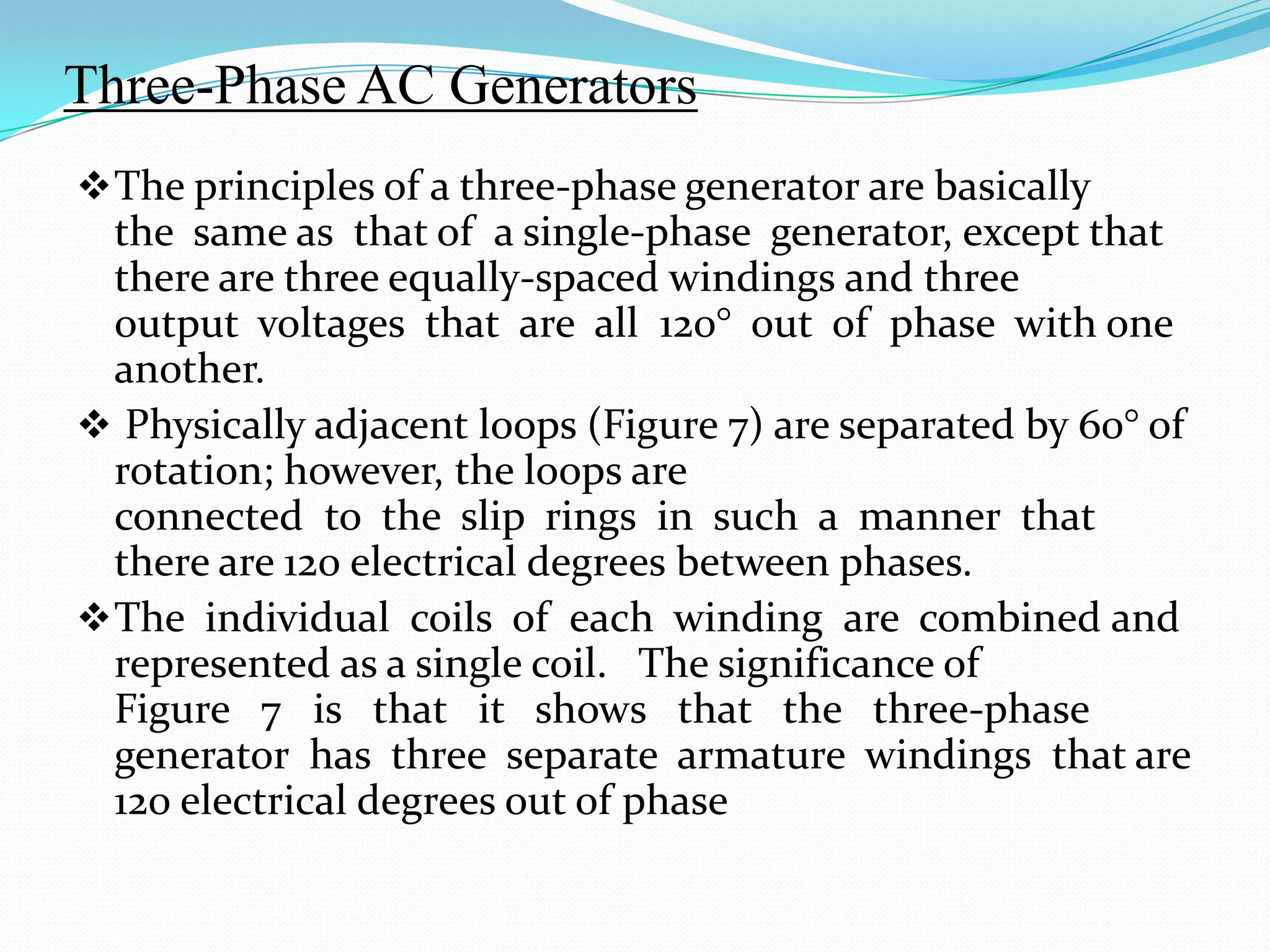
 The principles of a three-phase generator are basically

the same as that of a single-phase generator, except that
there are three equally-spaced windings and three
output voltages that are all 120° out of phase with one
another.
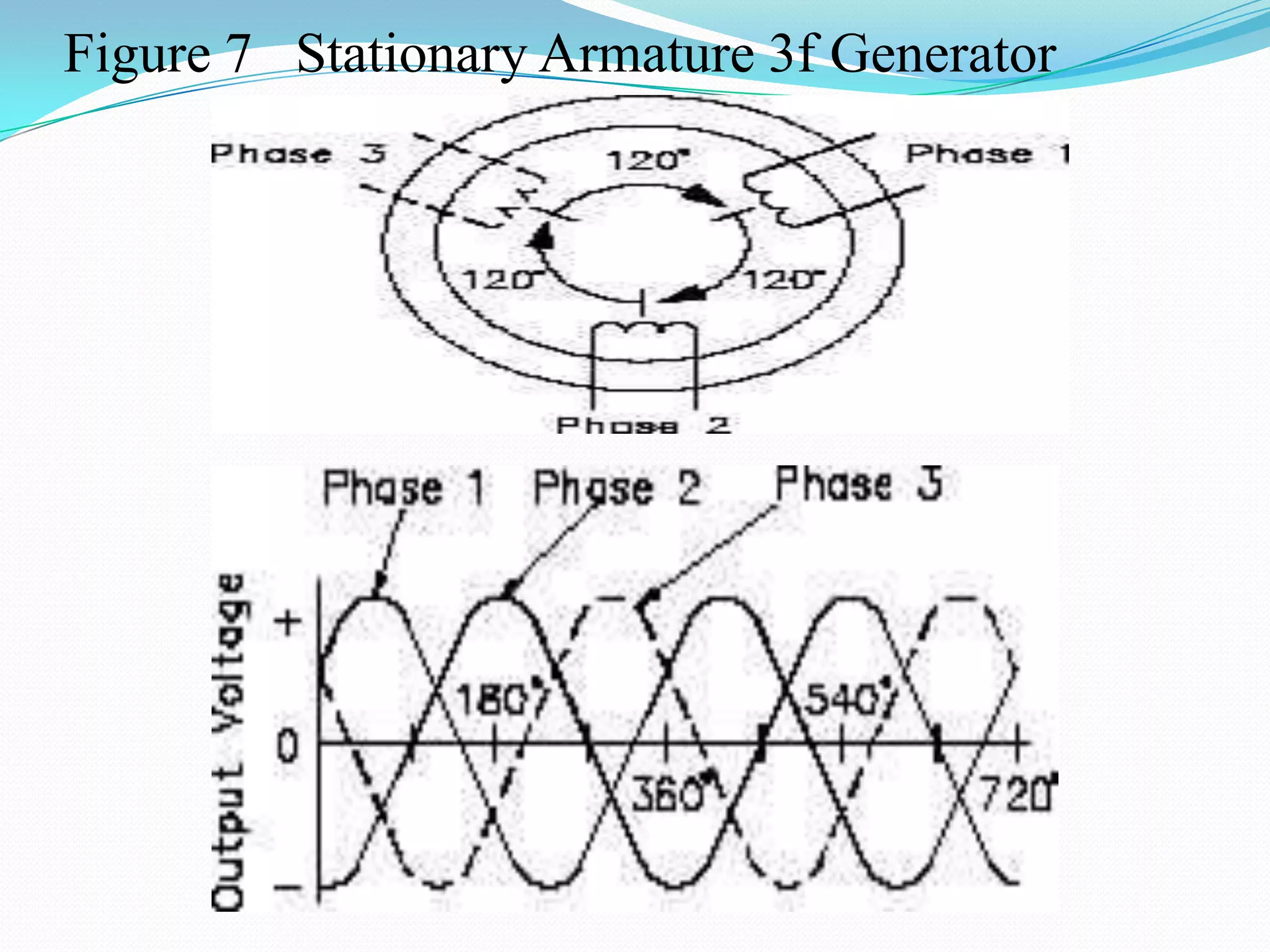
 Physically adjacent loops (Figure 7) are separated by 60° of
rotation; however, the loops are
connected to the slip rings in such a manner that
there are 120 electrical degrees between phases.
 The individual coils of each winding are combined and
represented as a single coil. The significance of
Figure 7 is that it shows that the three-phase
generator has three separate armature windings that are
120 electrical degrees out of phase
Figure 7 Stationary Armature 3f Generator

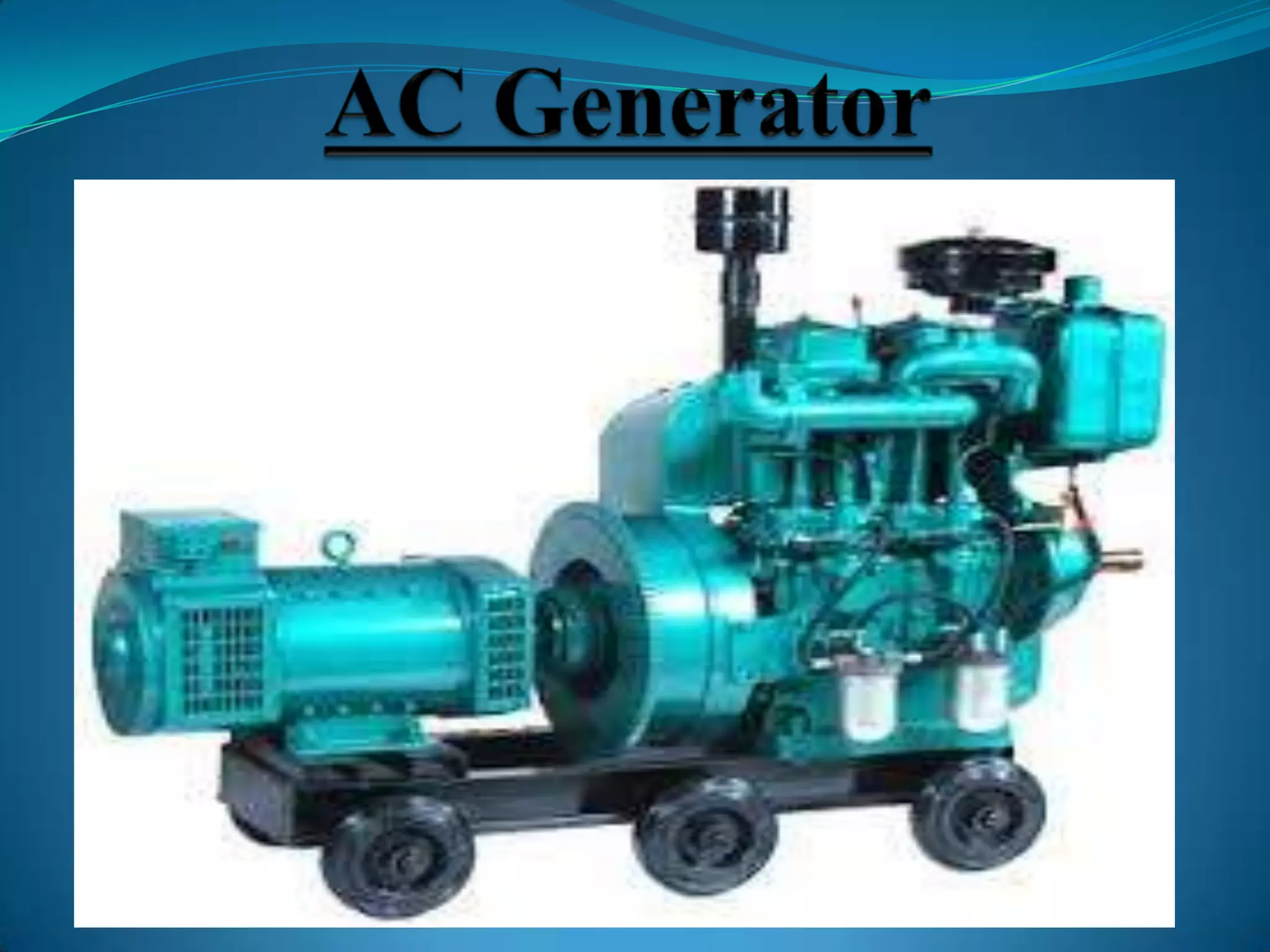
diesel generator

  • 1.
    AT ( Ambala Cantt) KRISHAN KUMAR (11101032)
  • 3.
    Components of anAC generator: a. Field b. Armature c. Prime mover d. Rotor  e. Stator f. Slip rings
  • 4.
    Field  The fieldin an AC generator consists of coils of conductors within the generator that receive a voltage from a source (called excitation) and produce a magnetic flux.  The magnetic flux in the field cuts the armature to produce a voltage. This voltage is ultimately the output voltage of the AC generator.
  • 5.
    Armature  The armatureis the part of an AC generator in which voltage is produced.  This component consists of many coils of wire that are large enough to carry the full-load current of the generator.
  • 6.
    Prime Mover  Theprime mover is the component that is used to drive the AC generator.  The prime mover may be any type of rotating machine, such as a diesel engine, a steam turbine, or a motor.
  • 7.
    Rotor  The rotorof an AC generator is the rotating component of the generator, as shown in Figure 1.  The rotor is driven by the generator’s prime mover, which may be a steam turbine, gas turbine, or diesel engine.  Depending on the type of generator, this component may be the armature or the field.  The rotor will be the armature if the voltage output is generated there; the rotor will be the field if the field excitation is applied there.
  • 8.
  • 9.
    Stator  The statorof an AC generator is the part that is stationary (refer to Figure 1).  Like the rotor, this component may be the armature or the field, depending on the type of generator.  The stator will be the armature if the voltage output is generated there; the stator will be the field if the field excitation is applied there.
  • 10.
    Slip Rings  Sliprings are electrical connections that are used to transfer power to and from the rotor of an AC generator (refer to Figure 1).  The slip ring consists of a circular conducting material that is connected to the rotor windings and insulated from the shaft.  Brushes ride on the slip ring as the rotor rotates.  The electrical connection to the rotor is made by connections to the brushes.  Slip rings are used in AC generators because the desired output of the generator is a sine wave.
  • 11.
    Slip Rings  Ina DC generator, a commutator was used to provide an output whose current always flowed in the positive direction, as shown in Figure 2.  This is not necessary for an AC generator.  Therefore, an AC generator may use slip rings, which will allow the output current and voltage to oscillate through positive and negative values.  This oscillation of voltage and current takes the shape of a sine wave.
  • 12.
    Figure 2 -Comparison of DC and AC Generator Outputs
  • 13.
    Theory of Operation The strong magnetic field is produced by a current flow through the field coil of the rotor.  The field coil in the rotor receives excitation through the use of slip rings and brushes.  Two brushes are spring-held in contact with the slip rings to provide the continuous connection between the field coil and the external excitation circuit.  The armature is contained within the windings of the stator and is connected to the output.
  • 14.
    Theory of Operation Each time the rotor makes one complete revolution, one complete cycle of AC is developed.  A generator has many turns of wire wound into the slots of the rotor.  The magnitude of AC voltage generated by an AC generator is dependent on the field strength and speed of the rotor.  Most generators are operated at a constant speed; therefore, the generated voltage depends on field excitation, or strength.
  • 15.
    A simple ACgenerator consists of:  (a) a strong magnetic field,  (b) conductors that rotate through that magnetic field, and  c) a means by which a continuous connection is provided to the conductors as they are rotating (Figure 3).
  • 16.
    Figure 3: SimpleAC Generator
  • 17.
    The frequency ofthe generated voltage is dependent on the number of field poles and the speed at which the generator is operated, as indicated in Equation . f = NP/120 where: f = frequency (Hz) P = total number of poles N = rotor speed (rpm) 120 = conversion from minutes to seconds and from poles to pole pairs The 120 in Equation is derived by multiplying the following conversion factors. 60 seconds x 2 poles 1 minute pole pair In this manner, the units of frequency (hertz or cycles/sec.) are derived.
  • 19.
    1.) Internal VoltageDrop  The load current flows through the armature in all AC generators. The armature has some amount of resistance and inductive reactance.  The combination of these make up what is known as the internal resistance, which causes a loss in a n AC generator.  When the load current flows, a voltage drop is developed across the internal resistance.  This voltage drop subtracts from the output voltage and, therefore, represents generated voltage and power that is lost and not available to the load.
  • 20.
    The voltage dropin an AC generator can be found using Equation. Voltage drop = IaRa IaXLa where : Ia = armature current Ra = armature resistance XLa = armature inductive reactance
  • 21.
    2.) Hysteresis Losses Hysteresis losses occur when iron cores in an AC generat or are subject to effects from a magnetic field.  The magnetic domains of the cores are held in alignment with the field in varying numbers, dependent upon field strength.  The magnetic domains rotate, with respect to the domains not held in alignment, one complete turn duri ng each rotation of the rotor.  This rotation of magnetic domains in the iron causes friction a nd heat.
  • 22.
    2.) Hysteresis Losses Theheat produced by this friction is called magnetic hysteresis loss. After the heat-treated silicon steel is formed to the desired shape, the laminations are heated to a dull red and then allowed to cool. This process, known as annealing, reduces hysteresis losses to a very low value. To reduce hysteresis losses, most AC armatures ar e constructed of heat-treated silicon steel, which has an inherently low hysteresis loss.
  • 23.
    3.)Mechanical Losses  Rotationalor mechanical losses can be caused by bearing f riction, brush friction on the commutator, and air friction (called windage), which is cau sed by the air turbulence due to armature rotation.  Careful maintenance can be instrumental in keeping bearing friction to a minimum.  Clean bearings and proper lubrication are essential to the reduction of bearing friction.  Brush friction is reduced by ensuring: proper brush seating, proper brush use, and maintenance of proper brush tension.  A smooth and clean commutator also aids in the reduction of brush friction.  In very large generators, hydrogen is used within the generator for cooling; hydrogen, being less dense than air, causes less windage losses than air.
  • 24.
    Efficiency  Efficiency ofan AC generator is the ratio of the useful power output to the total power input.  Because any mechanical process experiences some losses, no AC generators can be 100 percent efficient.  Efficiency of an AC generator can be calculated using Equation.  Efficiency =(Output /Input )x 100
  • 26.
    Ratings Typical name platedata for an AC generator (Figure 4) includes:  (1) manufacturer;  (2) serial number and type number;  (3) speed (rpm), number of poles, frequency of output, number of phases, and maximum supply voltage;  (4) capacity rating in KVA and kW at a specified power factor and maximum output voltage;  (5) armature and field current per phase; and  (6) maximum temperature rise. Power (kW) ratings of an AC generator  are based on the ability of the prime mover to overcome generator losses and the ability of the machine to dissipate the internally generated heat.  The current rating of an AC generator is based on the insulation rating of the machine.
  • 27.
    Types of ACGenerators  there are two types of AC generators: 1.) the stationary field, rotating armature; 2.) and the rotating field, stationary armature.  Small AC generators usually have a stationary field and a rotating armature (Figure 5).  One important disadvantage to this arrangement is that the slip-ring and brush assembly is in series with the load circuits and, because of worn or dirty components, may interrupt the flow of current.
  • 28.
    Figure 5: StationaryField, Rotating Armature AC Generator
  • 29.
     If DCfield excitation is connected to the rotor, the stationary coils will have AC induced into them (Figure 6).  This arrangement is called a rotating field, stationary armature AC generator. The rotating field, stationary armature type AC generator is used when large power generation is involved.  In this type of generator, a DC source is supplied to the rotating field coils, which produces a magnetic field around the rotating element.  As the rotor is turned by the prime mover, the field will cut the conductors of the stationary armature, and an EMF will be induced into the armature windings.
  • 30.
     This typeof AC generator has several advantages over the stationary field, rotating armature AC generator: (1) a load can be connected to the armature without moving contacts in the circuit; (2) it is much easier to insulate stator fields than rotating fields; and (3) much higher voltages and currents can be generated.
  • 31.
    Figure 6: SimpleAC Generator - Rotating Field, Stationary Armature
  • 32.
    Three-Phase AC Generators The principles of a three-phase generator are basically the same as that of a single-phase generator, except that there are three equally-spaced windings and three output voltages that are all 120° out of phase with one another.  Physically adjacent loops (Figure 7) are separated by 60° of rotation; however, the loops are connected to the slip rings in such a manner that there are 120 electrical degrees between phases.  The individual coils of each winding are combined and represented as a single coil. The significance of Figure 7 is that it shows that the three-phase generator has three separate armature windings that are 120 electrical degrees out of phase
  • 33.
    Figure 7 StationaryArmature 3f Generator