Leaf Springs
D. NarendraVarma,
Assistant Professor,
Mechanical Engineering Dept.,
Miracle Educational society Group of Institutions.
Leaf Springs
Leaf springs (also known
as flat springs) are made out
of flat plates. The advantage
of leaf spring over helical
spring is that the ends of the
spring may be guided along a
definite path as it deflects to
act as a structural member in
addition to energy absorbing
device. Thus the leaf springs
may carry lateral loads, brake
torque, driving torque etc., in
addition to shocks.
Construction of Leaf Spring
Equalised Stress in Spring
Leaves (Nipping)
▪ We have already discussed that the stress in the
full length leaves is 50% greater than the stress
in the graduated leaves. In order to utilise the
material to the best advantage, all the leaves
should be equally stressed.
▪ This condition may be obtained in the following
two ways :
▪ 1. By making the full length leaves of smaller
thickness than the graduated leaves. In this way,
the full length leaves will induce smaller bending
stress due to small distance from the neutral axis
to the edge of the leaf.
▪ 2. By giving a greater radius of curvature to the
full length leaves than graduated leaves, as
shown in Fig. 23.31, before the leaves are
assembled to form a spring. By doing so, a gap
or clearance will beleft between the leaves.This
initial gap, as shown by C in Fig. 23.31, is called
nip.
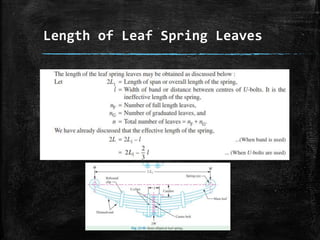
Length of Leaf Spring Leaves
Problem 1
▪ Design a leaf spring for the following
specifications:
Total load = 140 kN ; Number of springs supporting
the load = 4 ; Maximum number of leaves = 10;
Span of the spring = 1000 mm ; Permissible
deflection = 80 mm.
Take Young’s modulus, E = 200 kN/mm2 and
allowable stress in spring material as 600 MPa.
Problem 2
▪ A truck spring has 12 number of leaves, two of
which are full length leaves. The spring supports
are 1.05 m apart and the central band is 85 mm
wide. The central load is to be 5.4 kN with a
permissible stress of 280 MPa. Determine the
thickness and width of the steel spring leaves. The
ratio of the total depth to the width of the spring is
3. Also determine the deflection of the spring.
References
1. Machine Design –V.B.Bhandari .
2. Machine Design – R.S. Khurmi
3. Design Data hand Book - S.Md.Jalaludeen

Leaf springs

  • 1.
    Leaf Springs D. NarendraVarma, AssistantProfessor, Mechanical Engineering Dept., Miracle Educational society Group of Institutions.
  • 2.
    Leaf Springs Leaf springs(also known as flat springs) are made out of flat plates. The advantage of leaf spring over helical spring is that the ends of the spring may be guided along a definite path as it deflects to act as a structural member in addition to energy absorbing device. Thus the leaf springs may carry lateral loads, brake torque, driving torque etc., in addition to shocks.
  • 9.
  • 10.
    Equalised Stress inSpring Leaves (Nipping) ▪ We have already discussed that the stress in the full length leaves is 50% greater than the stress in the graduated leaves. In order to utilise the material to the best advantage, all the leaves should be equally stressed. ▪ This condition may be obtained in the following two ways : ▪ 1. By making the full length leaves of smaller thickness than the graduated leaves. In this way, the full length leaves will induce smaller bending stress due to small distance from the neutral axis to the edge of the leaf. ▪ 2. By giving a greater radius of curvature to the full length leaves than graduated leaves, as shown in Fig. 23.31, before the leaves are assembled to form a spring. By doing so, a gap or clearance will beleft between the leaves.This initial gap, as shown by C in Fig. 23.31, is called nip.
  • 13.
    Length of LeafSpring Leaves
  • 14.
    Problem 1 ▪ Designa leaf spring for the following specifications: Total load = 140 kN ; Number of springs supporting the load = 4 ; Maximum number of leaves = 10; Span of the spring = 1000 mm ; Permissible deflection = 80 mm. Take Young’s modulus, E = 200 kN/mm2 and allowable stress in spring material as 600 MPa.
  • 16.
    Problem 2 ▪ Atruck spring has 12 number of leaves, two of which are full length leaves. The spring supports are 1.05 m apart and the central band is 85 mm wide. The central load is to be 5.4 kN with a permissible stress of 280 MPa. Determine the thickness and width of the steel spring leaves. The ratio of the total depth to the width of the spring is 3. Also determine the deflection of the spring.
  • 19.
    References 1. Machine Design–V.B.Bhandari . 2. Machine Design – R.S. Khurmi 3. Design Data hand Book - S.Md.Jalaludeen