ME 521 – POWER PLANT DESIGN
2014

Aljon M. Altiche
Efrel John L. Manlapaz
Romyrick L. Gliponeo
Emannoel M. Brimon
1
 In a diesel power station, diesel engine is used as the

prime mover. The diesel burns inside the engine and
the products of this combustion act as the working
fluid to produce mechanical energy. The diesel engine
drives alternator which converts mechanical energy
into electrical energy.

2
 Diesel power plants is in the range of 2 to 50 MW capacity. They






are used as central station for small or medium power supplies.
They can be used as stand-by plants to hydro-electric power
plants and steam power plants for emergency services.
They can be used as peak load plants in combinations with
thermal or hydro-plants.
They are quite suitable for mobile power generation and are
widely used in transportation systems such as automobiles,
railways, air planes and ships.
Now-a-days power cut has become a regular feature for
industries. The only solution to tide over this difficulty is to install
diesel generating sets.

3
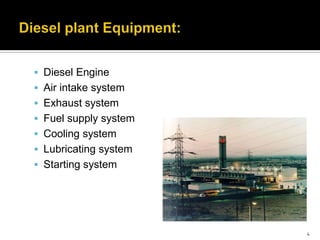
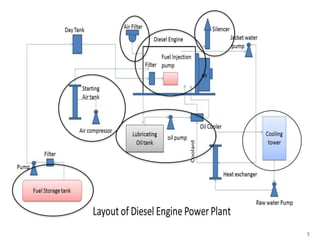
 Diesel Engine
 Air intake system
 Exhaust system
 Fuel supply system

 Cooling system
 Lubricating system
 Starting system

4
5
6
7
 A diesel engine (also known as a compression-

ignition engine) is an internal combustion
engine that uses the heat of compression to initiate
ignition and burn the fuel that has been injected into
the combustion chamber. This contrasts with sparkignition engines such as a petrol engine(gasoline
engine) or gas engine (using a gaseous fuel as
opposed to gasoline), which use a spark plug to ignite
an air-fuel mixture.

8
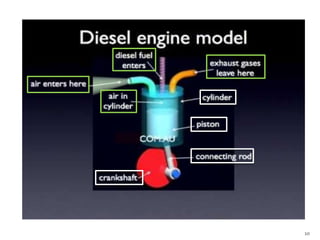
 This occurs in two steps. First, the fuel reacts

chemically (burns by self ignition) and releases energy
in the form of heat. Second the heat causes the
gasses trapped in the cylinder to expand, and the
expanding gases, being confined by the cylinder, must
move the piston to expand. The reciprocating motion
of the piston is then converted into rotational motion
by the crankshaft.

9
v

10
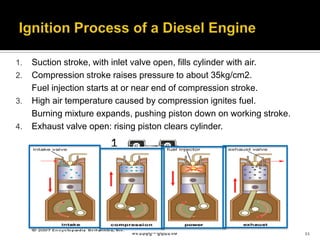
1.
2.
3.
4.

Suction stroke, with inlet valve open, fills cylinder with air.
Compression stroke raises pressure to about 35kg/cm2.
Fuel injection starts at or near end of compression stroke.
High air temperature caused by compression ignites fuel.
Burning mixture expands, pushing piston down on working stroke.
Exhaust valve open: rising piston clears cylinder.

11
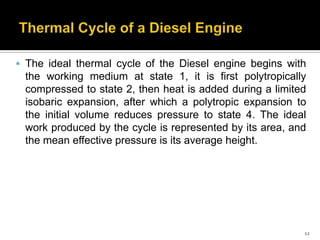
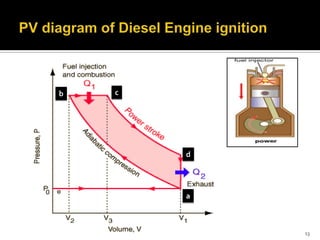
 The ideal thermal cycle of the Diesel engine begins with

the working medium at state 1, it is first polytropically
compressed to state 2, then heat is added during a limited
isobaric expansion, after which a polytropic expansion to
the initial volume reduces pressure to state 4. The ideal
work produced by the cycle is represented by its area, and
the mean effective pressure is its average height.

12
b

c

d

a

13
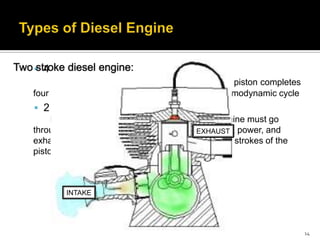
Two  4 Stroke Diesel Engine
stroke diesel engine:
is an internal combustion engine in which the piston completes
four separate strokes which comprise a single thermodynamic cycle

 2 Stroke Diesel Engine
Like the four-stroke engine, the two-stroke engine must go
through the same four events: intake, compression, power, and
EXHAUST
exhaust. But a two-stroke engine requires only two strokes of the
piston to complete one full cycle(crankshaft).

INTAKE

14
15
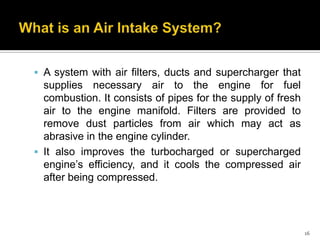
 A system with air filters, ducts and supercharger that

supplies necessary air to the engine for fuel
combustion. It consists of pipes for the supply of fresh
air to the engine manifold. Filters are provided to
remove dust particles from air which may act as
abrasive in the engine cylinder.
 It also improves the turbocharged or supercharged
engine’s efficiency, and it cools the compressed air
after being compressed.

16
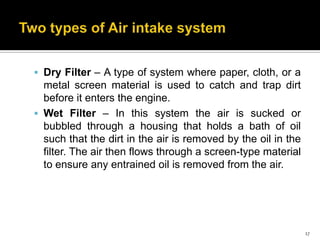
 Dry Filter – A type of system where paper, cloth, or a

metal screen material is used to catch and trap dirt
before it enters the engine.
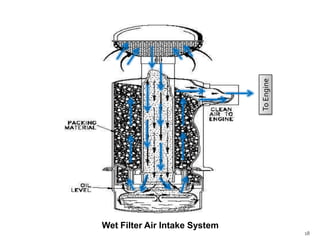
 Wet Filter – In this system the air is sucked or
bubbled through a housing that holds a bath of oil
such that the dirt in the air is removed by the oil in the
filter. The air then flows through a screen-type material
to ensure any entrained oil is removed from the air.

17
To Engine

Wet Filter Air Intake System
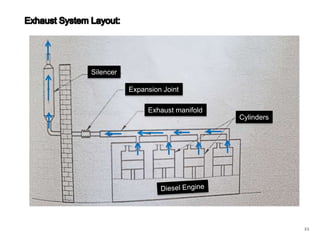
18
19
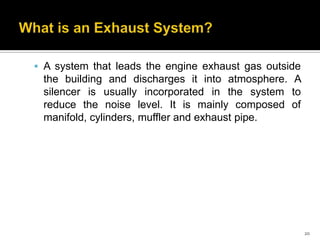
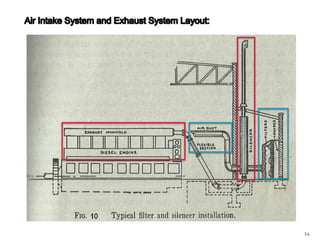
 A system that leads the engine exhaust gas outside

the building and discharges it into atmosphere. A
silencer is usually incorporated in the system to
reduce the noise level. It is mainly composed of
manifold, cylinders, muffler and exhaust pipe.

20
Silencer
Expansion Joint
Exhaust manifold
Cylinders

21
 First, the exhaust system routes the spent combustion

gasses away from the engine, where they are diluted
by the atmosphere. This keeps the area around the
engine habitable.
 Second, the exhaust system confines and routes the
gases to the turbocharger, if used.
 Third, the exhaust system allows mufflers to be used
to reduce the engine noise.

22
a.
b.
c.
d.
e.

The noise should be reduced to a tolerable degree.
It should be exhausted well above the ground level
to reduce the air pollution at breathing level.
The pressure loss in the system should be reduced
to minimum.
The vibrations of exhaust system must be isolated
from the plant by use of flexible exhaust pipe.
A provision should be made to extract the heat from
exhaust if the heating is required for fuel oil heating
or building heating or process heating.

23
24
25
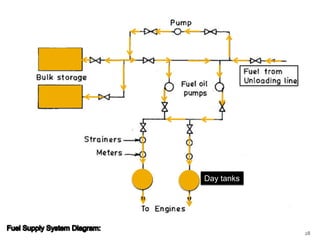
 A system consists of storage tank, strainers, fuel

transfer pump and all day fuel tank.

26
a. The fuel oil is supplied at the plant site by rail or

road. The oil is stored in the storage tank.
b. From the storage tank, oil is pumped to smaller all
day tank at daily or short intervals.
c. From this tank, fuel oil is passed through strainers to
remove suspended impurities.
d. The clean oil is injected into the engine by fuel
injection pump (fuel injection system).

27
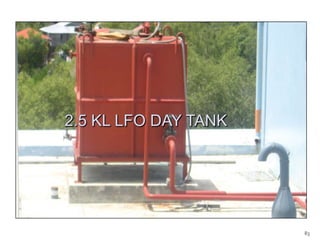
Day tanks

28
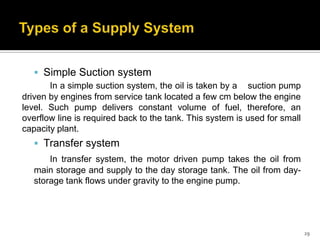
 Simple Suction system
In a simple suction system, the oil is taken by a suction pump
driven by engines from service tank located a few cm below the engine
level. Such pump delivers constant volume of fuel, therefore, an
overflow line is required back to the tank. This system is used for small
capacity plant.

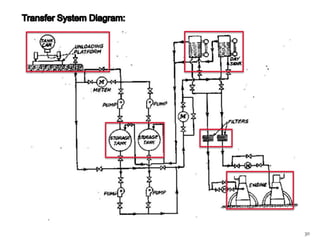
 Transfer system
In transfer system, the motor driven pump takes the oil from
main storage and supply to the day storage tank. The oil from daystorage tank flows under gravity to the engine pump.

29
30
31
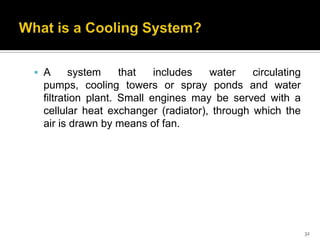
 A

system
that
includes
water
circulating
pumps, cooling towers or spray ponds and water
filtration plant. Small engines may be served with a
cellular heat exchanger (radiator), through which the
air is drawn by means of fan.

32
 If

the engines are not properly cooled, the
temperature existing inside engines would disintegrate
the film of lubricating oil on the liners and wrapping of
valves and pistons takes place. The proper cooling of
the engine is absolutely necessary to extend the life of
the plant. Therefore, exit temperature of the cooling
water must be controlled. If it is too low, lubricating oil
will not spread properly and wearing of piston and
cylinder takes place. If it is too high, the lubricating oil
burns. Therefore, the maximum exit temperature of
the water is limited to 70 C.
33
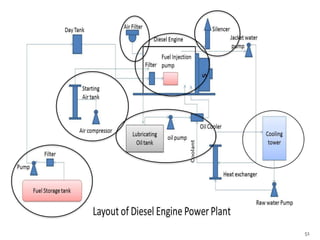
 The temperature of the burning fuel inside the engine

cylinder is 15000C to 20000C. In order to lower this
temperature water is circulated around the engine.
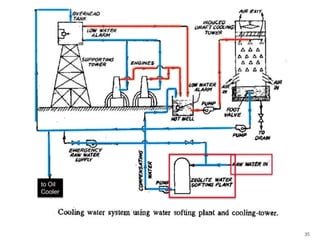
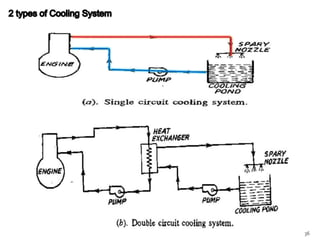
 The hot water leaving the jacket is passed through the
heat exchanger.
 The heat from the heat exchanger is carried away by
the raw water circulated through the heat exchanger
and is cooled in the cooling tower

34
to Oil
Cooler

35
36
37
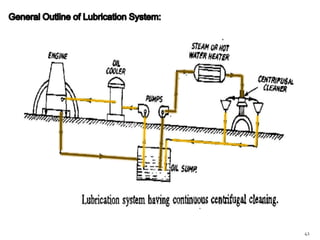
 A system that includes the oil pumps, oil tanks, filters,

coolers and connecting pipes. The function of the
lubrication system is to reduce the friction of moving
parts, reduce the wear and tear of the engine parts
and also helps to cool the engine .

38
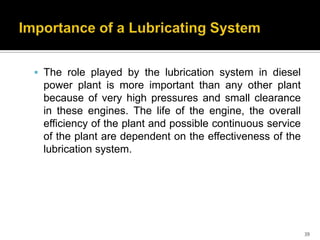
 The role played by the lubrication system in diesel

power plant is more important than any other plant
because of very high pressures and small clearance
in these engines. The life of the engine, the overall
efficiency of the plant and possible continuous service
of the plant are dependent on the effectiveness of the
lubrication system.

39
 Piston and cylinders
 Crankshaft and connecting rod bearings
 Gears or other mechanism designed to transmit

motion to auxiliaries.
 Integral injection or scavenging air compressors.

40
41
42
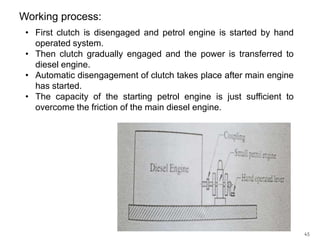
 Engine Starting by an auxiliary small engine
 Compressed air system
 Starting by electric motor

43
 It is composed of two engine:
1. Diesel engine that is main engine.
2. Small petrol engine.

Joining:
• Diesel engine and petrol engine are joined by clutch and gear
arrangements.
• Small petrol engine can be easily started by means of manual
operations

44
Working process:
• First clutch is disengaged and petrol engine is started by hand
operated system.
• Then clutch gradually engaged and the power is transferred to
diesel engine.
• Automatic disengagement of clutch takes place after main engine
has started.
• The capacity of the starting petrol engine is just sufficient to
overcome the friction of the main diesel engine.

45
 The compressed air system is generally used for

starting large diesel engine employed for power plant.
In this system compressed air a pressure of 17 bar is
supplied from an air bottle to the engine cylinder either
through a distributor or directly through inlet manifold.
 In case of multicylinder engines, at least one cylinder
remains on the suction stroke.

46
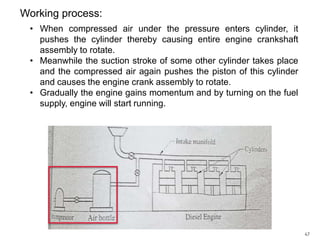
Working process:
• When compressed air under the pressure enters cylinder, it
pushes the cylinder thereby causing entire engine crankshaft
assembly to rotate.
• Meanwhile the suction stroke of some other cylinder takes place
and the compressed air again pushes the piston of this cylinder
and causes the engine crank assembly to rotate.
• Gradually the engine gains momentum and by turning on the fuel
supply, engine will start running.

47
 This system consists of an electric motor which is

drives pinion which engages a gear toothed rim on
engine.
 A storage battery of 12 to 36 volts is used to supply
power to an electric motor.
 The main advantages of electric starting are its
simplicity and effectiveness. This system is used for
small diesel engine.

48
 The engine should not be stopped abruptly. In order to

stop engine, the speed should be decreased gradually
until no power is delivered by generator .Then the
engine is disconnected from the bus bars and is
allowed to run idle for some time.

49
 Stopping fuel supply
 Keeping exhaust valve open
 Shutting of air supply
 Stopping the action of injection pump.

50
51
 Plant layout is simple. Hence it can be quickly installed







and commissioned, while the erection and starting of a
steam power plant or hydro-plant takes a fairly long time.
Quick starting and easy pick-up of loads are possible in a
very short time.
The load operation is easy and requires minimum labours.
Efficiency at part loads does not fall so much as that of a
steam plant.
Fuel handling is easier and no problem of ash disposal
exists.
The plant is smaller in size than steam power plant for
same capacity.
52
 Plant capacity is limited to about 50 MW of power.
 Diesel fuel is much more expensive than coal.
 The maintenance and lubrication costs are high.
 Diesel engines are not guaranteed for operation under

continuous, while steam can work under 25% of
overload continuously.

53
54
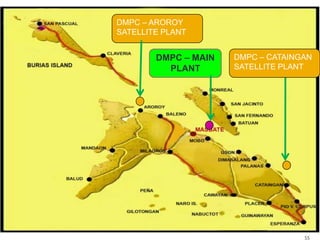
DMPC – AROROY
SATELLITE PLANT

DMPC – MAIN
PLANT

DMPC – CATAINGAN
SATELLITE PLANT

55
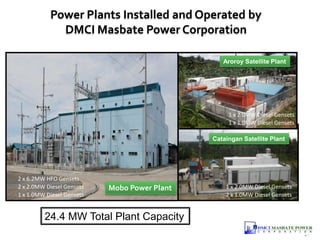
Power Plants Installed and Operated by
DMCI Masbate Power Corporation
Aroroy Satellite Plant

1 x 2.0MW Diesel Gensets
1 x 1.0MW Diesel Gensets
Cataingan Satellite Plant

2 x 6.2MW HFO Gensets
2 x 2.0MW Diesel Gensets
1 x 1.0MW Diesel Gensets

Mobo Power Plant

1 x 2.0MW Diesel Gensets
2 x 1.0MW Diesel Gensets

24.4 MW Total Plant Capacity
56
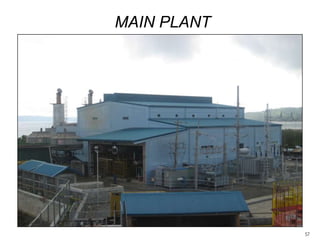
MAIN PLANT

57
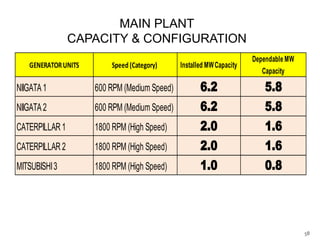
MAIN PLANT
CAPACITY & CONFIGURATION
GENERATOR UNITS

Speed (Category)

Installed MW Capacity

Dependable MW
Capacity

5.8
5.8

NIIGATA 1

600 RPM (Medium Speed)

NIIGATA 2

600 RPM (Medium Speed)

6.2
6.2

CATERPILLAR 1

1800 RPM (High Speed)

2.0

1.6

CATERPILLAR 2

1800 RPM (High Speed)

2.0

1.6

MITSUBISHI 3

1800 RPM (High Speed)

1.0

0.8

58
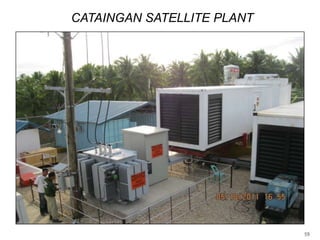
CATAINGAN SATELLITE PLANT

59
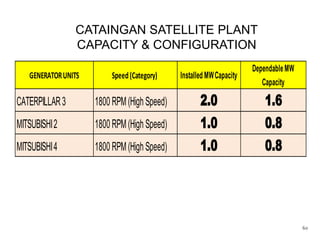
CATAINGAN SATELLITE PLANT
CAPACITY & CONFIGURATION
GENERATOR UNITS

Speed (Category)

CATERPILLAR 3

1800 RPM (High Speed)

MITSUBISHI 2

1800 RPM (High Speed)

MITSUBISHI 4

1800 RPM (High Speed)

Installed MW Capacity

Dependable MW
Capacity

2.0
1.0
1.0

1.6
0.8
0.8

60
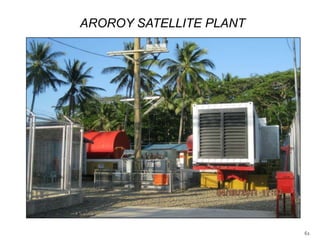
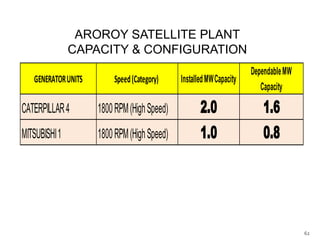
AROROY SATELLITE PLANT

61
AROROY SATELLITE PLANT
CAPACITY & CONFIGURATION
GENERATOR UNITS

Speed (Category)

CATERPILLAR 4

1800 RPM (High Speed)

MITSUBISHI 1

1800 RPM (High Speed)

Installed MW Capacity

Dependable MW
Capacity

2.0
1.0

1.6
0.8

62
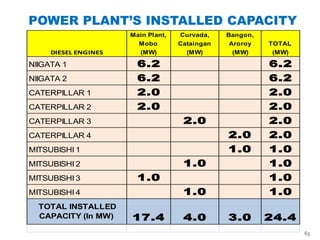
POWER PLANT’S INSTALLED CAPACITY
DIESEL ENGINES

Main Plant,
Mobo
(MW)

Curvada,
Cataingan
(MW)

Bangon,
Aroroy
(MW)

TOTAL
(MW)

NIIGATA 1

6.2

6.2

NIIGATA 2

6.2

6.2

CATERPILLAR 1

2.0

2.0

CATERPILLAR 2

2.0

2.0
2.0

CATERPILLAR 3

2.0

CATERPILLAR 4

2.0

2.0

MITSUBISHI 1

1.0

1.0

1.0

MITSUBISHI 2
MITSUBISHI 3

1.0

1.0
1.0

MITSUBISHI 4
TOTAL INSTALLED
CAPACITY (In MW)

1.0

17.4

4.0

1.0
3.0

24.4
63
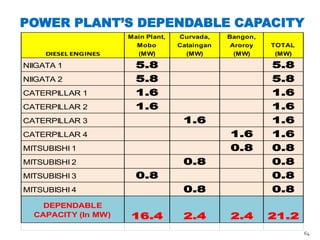
POWER PLANT’S DEPENDABLE CAPACITY
DIESEL ENGINES

Main Plant,
Mobo
(MW)

Curvada,
Cataingan
(MW)

Bangon,
Aroroy
(MW)

TOTAL
(MW)

NIIGATA 1

5.8

5.8

NIIGATA 2

5.8

5.8

CATERPILLAR 1

1.6

1.6

CATERPILLAR 2

1.6

1.6
1.6

CATERPILLAR 3

1.6

CATERPILLAR 4

1.6

1.6

MITSUBISHI 1

0.8

0.8

0.8

MITSUBISHI 2
MITSUBISHI 3

0.8

0.8
0.8

MITSUBISHI 4
DEPENDABLE
CAPACITY (In MW)

0.8

16.4

2.4

0.8
2.4

21.2
64
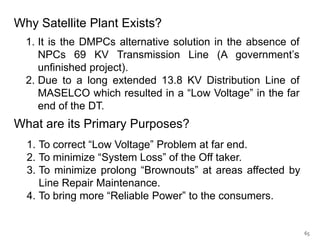
Why Satellite Plant Exists?
1. It is the DMPCs alternative solution in the absence of
NPCs 69 KV Transmission Line (A government’s
unfinished project).
2. Due to a long extended 13.8 KV Distribution Line of
MASELCO which resulted in a “Low Voltage” in the far
end of the DT.

What are its Primary Purposes?
1. To correct “Low Voltage” Problem at far end.
2. To minimize “System Loss” of the Off taker.
3. To minimize prolong “Brownouts” at areas affected by
Line Repair Maintenance.
4. To bring more “Reliable Power” to the consumers.

65
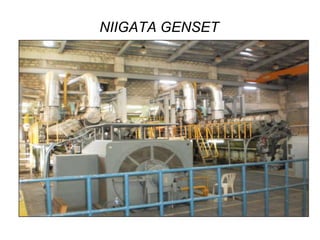
NIIGATA GENSET
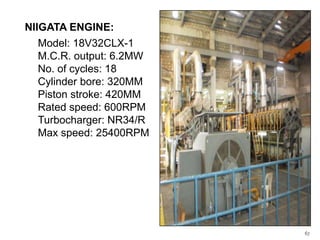
NIIGATA ENGINE:
Model: 18V32CLX-1
M.C.R. output: 6.2MW
No. of cycles: 18
Cylinder bore: 320MM
Piston stroke: 420MM
Rated speed: 600RPM
Turbocharger: NR34/R
Max speed: 25400RPM

67
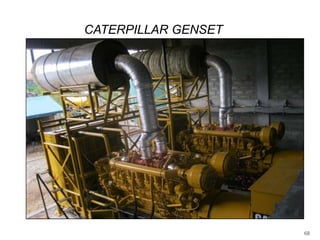
CATERPILLAR GENSET

68
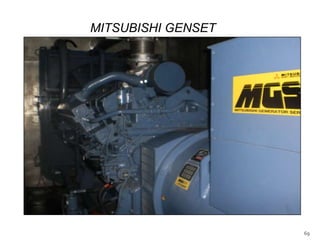
MITSUBISHI GENSET

69
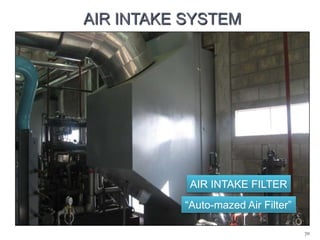
AIR INTAKE SYSTEM

AIR INTAKE FILTER
“Auto-mazed Air Filter”
70
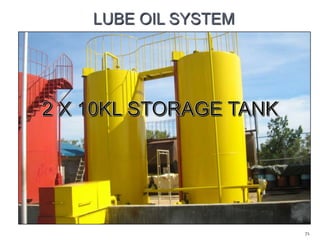
LUBE OIL SYSTEM

71
72
73
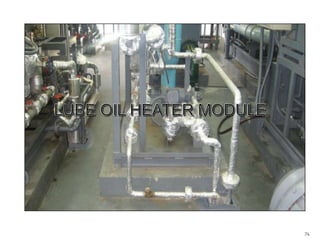
74
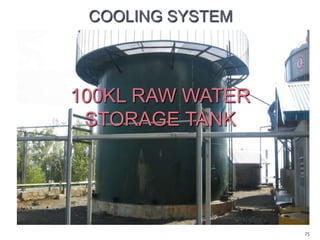
COOLING SYSTEM

100KL RAW WATER
COOLING SYSTEM
STORAGE TANK

75
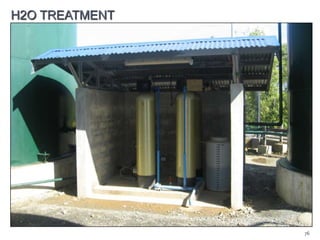
H2O TREATMENT

76
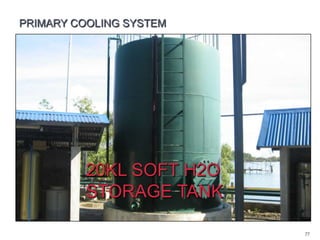
PRIMARY COOLING SYSTEM

20KL SOFT H2O
STORAGE TANK
77
PRIMARY COOLING SYSTEM

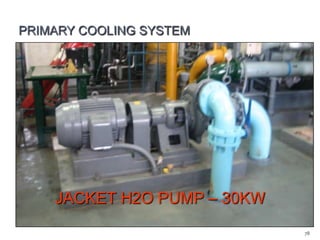
JACKET H2O PUMP – 30KW
78
SECONDARY COOLING SYSTEM

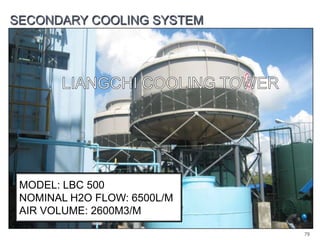
MODEL: LBC 500
NOMINAL H2O FLOW: 6500L/M
AIR VOLUME: 2600M3/M
79
SECONDARY COOLING SYSTEM

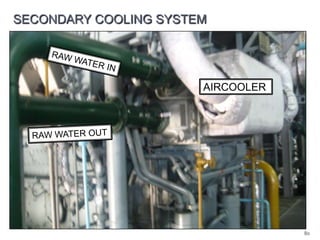
AIRCOOLER

80
SECONDARY COOLING SYSTEM

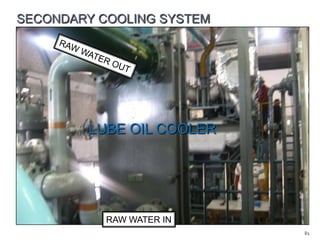
LUBE OIL COOLER

RAW WATER IN
81
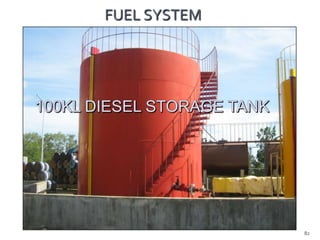
FUEL SYSTEM

82
83
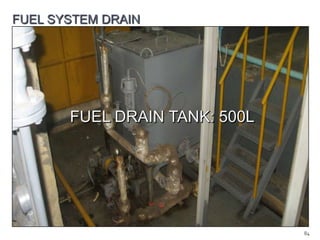
FUEL SYSTEM DRAIN

84
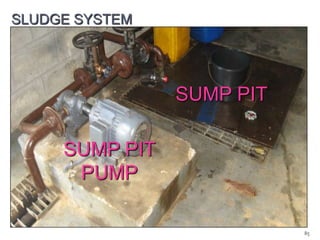
SLUDGE SYSTEM

SUMP PIT
SUMP PIT
PUMP
85
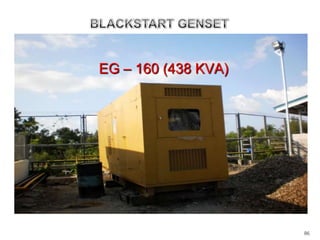
EG – 160 (438 KVA)

86
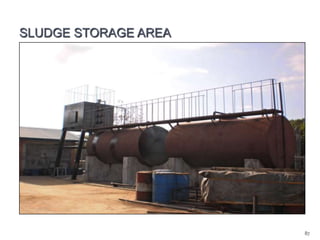
SLUDGE STORAGE AREA

87
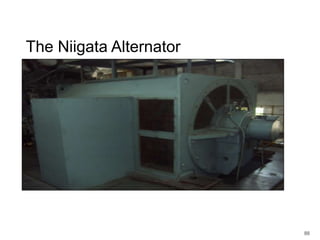
The Niigata Alternator

88
MEDIUM VOLTAGE SWITCHGEAR

1.5-MVA
AUX.
X’FORMER
PANEL

BUS PT
PANEL
20-MVA
X’FORMER
PANEL

NII-2
PANEL
NII-1
PANEL

Single Line Diagram
89
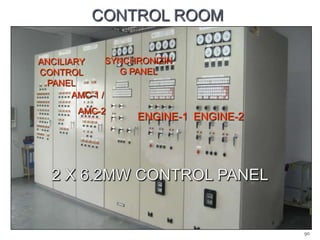
CONTROL ROOM
SYNCHRONIZIN
ANCILIARY
G PANEL
CONTROL
PANEL
AMC-1 /
AMC-2

ENGINE-1 ENGINE-2

90
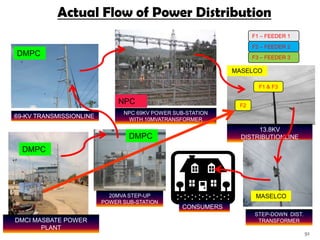
Actual Flow of Power Distribution
F1 – FEEDER 1
F2 – FEEDER 2

DMPC

F3 – FEEDER 3

MASELCO
F1 & F3

NPC
69-KV TRANSMISSIONLINE

F2

NPC 69KV POWER SUB-STATION
WITH 10MVATRANSFORMER

13.8KV
DISTRIBUTIONLINE

DMPC
DMPC

20MVA STEP-UP
POWER SUB-STATION

DMCI MASBATE POWER
PLANT

MASELCO
CONSUMERS
STEP-DOWN DIST.
TRANSFORMER
91
92
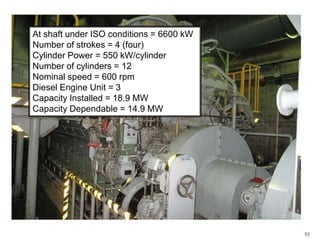
At shaft under ISO conditions = 6600 kW
Number of strokes = 4 (four)
Cylinder Power = 550 kW/cylinder
Number of cylinders = 12
Nominal speed = 600 rpm
Diesel Engine Unit = 3
Capacity Installed = 18.9 MW
Capacity Dependable = 14.9 MW

93
OPERATION PROCEDURES
Pre-Operation Procedures
 Verify order of operation with Shift Supervisor On-duty prior to carrying out prestartup procedures.
 Visually check the Jacket Water [JW] and Injector Cooling [IC] Water
expansion tanks for proper level.
 Check inlet and outlet valves of Nozzle and Jacket Waters systems for proper
open or close positions.
 Press JW and NC water pumps start button located on the Engine Control
Panel [ECP].
 Energize JW and IC water heaters by pressing the “ON” button located on the
Heaters Control Panel [HCP].
 Check the level of the various engine tanks and auxiliary equipment.
 Cooling Tower Pond
 Oil Sump Tank
 Cylinder Lubricating Oil Tank
 Bunker fuel service and settling tank
 Diesel storage tanks
 Turbocharger oil level
 Governor oil level
 Outboard bearing oil level
 Air pressure for 30 and 8 bar tanks
94
 Verify that fuel control linkages and injection pump plunges moves freely.
 Manually lubricate cylinder liners by turning the hand crank of the cylinder
lubricators and check that excessive force is not needed to turn the cranks.
 Check that the various valves for the engine cooling, lubrication, fuel system and
air system are in the correct position.
 Verify with Auxiliary Operator/Maintenance that the lube oil separator/centrifuge
of engine in schedule has been running normally. (The separator must be put in
operation at least four hour before engine operation to remove accumulated dirt
or settled water, if any).
 Run bunker fuel centrifuge (if no engine running).
 Start the Pre-lubricating oil pump.
 Open the indicator cocks in the cylinder heads and rotate the engine several
times with the turning gear to make sure that no water, oil, or fuel has collected in
the cylinder.
 Switch “OFF” the JW and IC heaters and switch-off the injector and jacket watercirculating pumps.
 Switch “OFF” the turning gear motor, disengage the turning gear, and lock the
operating lever.

95
Start-Up Procedure
 Energize main power supply for the engine alarm.
 Start up the following and adjust the pressures:
 Pre-lubricating oil pump (manual position)
 Diesel transfer pump
 Fuel booster module
 Nozzle cooling water pump
 Jacket water pump
 Fuel service pump
 Check that the turning gear is disengaged and that the operating lever is locked.
 Open all the indicator cocks.
 Check starting air tank pressure gauge for the proper pressure of 25 to 30 bar.
 Set the governor load limit to “0” position, and rotate the speed setting knob for at
least five [5] revolutions from zero.
 Set the governor speed droop to “40” position.
 Move each individual fuel pump rack in and out a few times to ensure rack is free
and not binding.
 Press the emergency stop button.
 Open the starting air valve.
 Get clearance and “GO” signal with Shift Supervisor On-duty for startup activation.

96
Stopping Procedures
 Gradually unload (300 KW/min) the generator to avoid extreme thermal
stressing.
 Open/trip the generator circuit breaker just before the KW-hr meter reaches 200
KW.
 Let the generator run for at least 10 to 15 minutes to cool down the engine.
 Set alarm power switch to “DISABLE” position.
 Bring down the engine speed gradually and press the emergency stop button.
 Open all indicator valves to release air from the cylinders. The engine should
stop running after 20 to 30 seconds.
 Push control buttons of the following to “OFF” position.
 Raw water pump
 Cooling tower fan motor
 Jacket water pump
 njector cooling water pump
 Switch “OFF” the chemical feed pump
 Close the starting air main valves.
 Switch “OFF” the pre-lube pump.
 Switch “OFF” main power supply of ECP.

97
MAINTENANCE PROCEDURES
The maintenance work to be carried out on the engine at regular
intervals is described in the maintenance schedule and is to be understood as
a guide. The maintenance intervals are dependent on the mode of operation
and load as well as on the quality of the fuel used.

Precautionary Measure For Maintenance Work
Prior to carrying out any maintenance work on the engine (especially
on the running gear), the following precautions have to be taken.
 Pull out the Vacuum Circuit Breaker of generator engine under maintenance to
avoid accidental closing.
 Installation of automatic control: Put automatic control switch to “OFF” position.
 Close stop valves of starting air receivers.
 Open all indicator cocks on the cylinder heads and leave in this position until
maintenance work is completed.
 Engage turning gear (gear pinion must bee in engage position) and lock the
lever.
 In case the engine had to be stopped due to overheated running gear
 or bearings, wait at least 10 minutes before opening the crankcase doors.

98
Recommendations For Carrying Out The Work
 Prior to turning the crankshaft with the turning gear, make sure that no loose
parts, tools or devices can get jammed.
 When carrying out maintenance works, use the tools and devices intended for
the work.
 Tools and devices should be ready prior to use and be in perfect conditions.
 Hydraulic tools are to be checked from time to time for tightens and perfect
functioning.
 All work must be done carefully, observing utmost cleanliness.
 Where openings appear after certain parts have been removed, pipelines, oil
holes, etc., they must be temporarily closed off in order to prevent entry of any
dirt into the engine.
 All parts overhauled during the course of servicing have to be checked for
perfect functioning before reinstalling back into service.
 Pipes that have been removed have to be checked for tightness after refitting.
 Clearances of moving parts must be checked periodically. Should the maximum
permissible values have been reached or exceeded, these parts must be
replaced.
 When tightening studs, nuts or bolts, the utmost care must be taken not to
damage their threads and that they can be screwed in by hand until metal-tometal contact is obtained. The specified lubricants are to be used.
99
100

Diesel engine report

  • 1.
    ME 521 –POWER PLANT DESIGN 2014 Aljon M. Altiche Efrel John L. Manlapaz Romyrick L. Gliponeo Emannoel M. Brimon 1
  • 2.
     In adiesel power station, diesel engine is used as the prime mover. The diesel burns inside the engine and the products of this combustion act as the working fluid to produce mechanical energy. The diesel engine drives alternator which converts mechanical energy into electrical energy. 2
  • 3.
     Diesel powerplants is in the range of 2 to 50 MW capacity. They     are used as central station for small or medium power supplies. They can be used as stand-by plants to hydro-electric power plants and steam power plants for emergency services. They can be used as peak load plants in combinations with thermal or hydro-plants. They are quite suitable for mobile power generation and are widely used in transportation systems such as automobiles, railways, air planes and ships. Now-a-days power cut has become a regular feature for industries. The only solution to tide over this difficulty is to install diesel generating sets. 3
  • 4.
     Diesel Engine Air intake system  Exhaust system  Fuel supply system  Cooling system  Lubricating system  Starting system 4
  • 5.
  • 6.
  • 7.
  • 8.
     A dieselengine (also known as a compression- ignition engine) is an internal combustion engine that uses the heat of compression to initiate ignition and burn the fuel that has been injected into the combustion chamber. This contrasts with sparkignition engines such as a petrol engine(gasoline engine) or gas engine (using a gaseous fuel as opposed to gasoline), which use a spark plug to ignite an air-fuel mixture. 8
  • 9.
     This occursin two steps. First, the fuel reacts chemically (burns by self ignition) and releases energy in the form of heat. Second the heat causes the gasses trapped in the cylinder to expand, and the expanding gases, being confined by the cylinder, must move the piston to expand. The reciprocating motion of the piston is then converted into rotational motion by the crankshaft. 9
  • 10.
  • 11.
    1. 2. 3. 4. Suction stroke, withinlet valve open, fills cylinder with air. Compression stroke raises pressure to about 35kg/cm2. Fuel injection starts at or near end of compression stroke. High air temperature caused by compression ignites fuel. Burning mixture expands, pushing piston down on working stroke. Exhaust valve open: rising piston clears cylinder. 11
  • 12.
     The idealthermal cycle of the Diesel engine begins with the working medium at state 1, it is first polytropically compressed to state 2, then heat is added during a limited isobaric expansion, after which a polytropic expansion to the initial volume reduces pressure to state 4. The ideal work produced by the cycle is represented by its area, and the mean effective pressure is its average height. 12
  • 13.
  • 14.
    Two  4Stroke Diesel Engine stroke diesel engine: is an internal combustion engine in which the piston completes four separate strokes which comprise a single thermodynamic cycle  2 Stroke Diesel Engine Like the four-stroke engine, the two-stroke engine must go through the same four events: intake, compression, power, and EXHAUST exhaust. But a two-stroke engine requires only two strokes of the piston to complete one full cycle(crankshaft). INTAKE 14
  • 15.
  • 16.
     A systemwith air filters, ducts and supercharger that supplies necessary air to the engine for fuel combustion. It consists of pipes for the supply of fresh air to the engine manifold. Filters are provided to remove dust particles from air which may act as abrasive in the engine cylinder.  It also improves the turbocharged or supercharged engine’s efficiency, and it cools the compressed air after being compressed. 16
  • 17.
     Dry Filter– A type of system where paper, cloth, or a metal screen material is used to catch and trap dirt before it enters the engine.  Wet Filter – In this system the air is sucked or bubbled through a housing that holds a bath of oil such that the dirt in the air is removed by the oil in the filter. The air then flows through a screen-type material to ensure any entrained oil is removed from the air. 17
  • 18.
    To Engine Wet FilterAir Intake System 18
  • 19.
  • 20.
     A systemthat leads the engine exhaust gas outside the building and discharges it into atmosphere. A silencer is usually incorporated in the system to reduce the noise level. It is mainly composed of manifold, cylinders, muffler and exhaust pipe. 20
  • 21.
  • 22.
     First, theexhaust system routes the spent combustion gasses away from the engine, where they are diluted by the atmosphere. This keeps the area around the engine habitable.  Second, the exhaust system confines and routes the gases to the turbocharger, if used.  Third, the exhaust system allows mufflers to be used to reduce the engine noise. 22
  • 23.
    a. b. c. d. e. The noise shouldbe reduced to a tolerable degree. It should be exhausted well above the ground level to reduce the air pollution at breathing level. The pressure loss in the system should be reduced to minimum. The vibrations of exhaust system must be isolated from the plant by use of flexible exhaust pipe. A provision should be made to extract the heat from exhaust if the heating is required for fuel oil heating or building heating or process heating. 23
  • 24.
  • 25.
  • 26.
     A systemconsists of storage tank, strainers, fuel transfer pump and all day fuel tank. 26
  • 27.
    a. The fueloil is supplied at the plant site by rail or road. The oil is stored in the storage tank. b. From the storage tank, oil is pumped to smaller all day tank at daily or short intervals. c. From this tank, fuel oil is passed through strainers to remove suspended impurities. d. The clean oil is injected into the engine by fuel injection pump (fuel injection system). 27
  • 28.
  • 29.
     Simple Suctionsystem In a simple suction system, the oil is taken by a suction pump driven by engines from service tank located a few cm below the engine level. Such pump delivers constant volume of fuel, therefore, an overflow line is required back to the tank. This system is used for small capacity plant.  Transfer system In transfer system, the motor driven pump takes the oil from main storage and supply to the day storage tank. The oil from daystorage tank flows under gravity to the engine pump. 29
  • 30.
  • 31.
  • 32.
     A system that includes water circulating pumps, coolingtowers or spray ponds and water filtration plant. Small engines may be served with a cellular heat exchanger (radiator), through which the air is drawn by means of fan. 32
  • 33.
     If the enginesare not properly cooled, the temperature existing inside engines would disintegrate the film of lubricating oil on the liners and wrapping of valves and pistons takes place. The proper cooling of the engine is absolutely necessary to extend the life of the plant. Therefore, exit temperature of the cooling water must be controlled. If it is too low, lubricating oil will not spread properly and wearing of piston and cylinder takes place. If it is too high, the lubricating oil burns. Therefore, the maximum exit temperature of the water is limited to 70 C. 33
  • 34.
     The temperatureof the burning fuel inside the engine cylinder is 15000C to 20000C. In order to lower this temperature water is circulated around the engine.  The hot water leaving the jacket is passed through the heat exchanger.  The heat from the heat exchanger is carried away by the raw water circulated through the heat exchanger and is cooled in the cooling tower 34
  • 35.
  • 36.
  • 37.
  • 38.
     A systemthat includes the oil pumps, oil tanks, filters, coolers and connecting pipes. The function of the lubrication system is to reduce the friction of moving parts, reduce the wear and tear of the engine parts and also helps to cool the engine . 38
  • 39.
     The roleplayed by the lubrication system in diesel power plant is more important than any other plant because of very high pressures and small clearance in these engines. The life of the engine, the overall efficiency of the plant and possible continuous service of the plant are dependent on the effectiveness of the lubrication system. 39
  • 40.
     Piston andcylinders  Crankshaft and connecting rod bearings  Gears or other mechanism designed to transmit motion to auxiliaries.  Integral injection or scavenging air compressors. 40
  • 41.
  • 42.
  • 43.
     Engine Startingby an auxiliary small engine  Compressed air system  Starting by electric motor 43
  • 44.
     It iscomposed of two engine: 1. Diesel engine that is main engine. 2. Small petrol engine. Joining: • Diesel engine and petrol engine are joined by clutch and gear arrangements. • Small petrol engine can be easily started by means of manual operations 44
  • 45.
    Working process: • Firstclutch is disengaged and petrol engine is started by hand operated system. • Then clutch gradually engaged and the power is transferred to diesel engine. • Automatic disengagement of clutch takes place after main engine has started. • The capacity of the starting petrol engine is just sufficient to overcome the friction of the main diesel engine. 45
  • 46.
     The compressedair system is generally used for starting large diesel engine employed for power plant. In this system compressed air a pressure of 17 bar is supplied from an air bottle to the engine cylinder either through a distributor or directly through inlet manifold.  In case of multicylinder engines, at least one cylinder remains on the suction stroke. 46
  • 47.
    Working process: • Whencompressed air under the pressure enters cylinder, it pushes the cylinder thereby causing entire engine crankshaft assembly to rotate. • Meanwhile the suction stroke of some other cylinder takes place and the compressed air again pushes the piston of this cylinder and causes the engine crank assembly to rotate. • Gradually the engine gains momentum and by turning on the fuel supply, engine will start running. 47
  • 48.
     This systemconsists of an electric motor which is drives pinion which engages a gear toothed rim on engine.  A storage battery of 12 to 36 volts is used to supply power to an electric motor.  The main advantages of electric starting are its simplicity and effectiveness. This system is used for small diesel engine. 48
  • 49.
     The engineshould not be stopped abruptly. In order to stop engine, the speed should be decreased gradually until no power is delivered by generator .Then the engine is disconnected from the bus bars and is allowed to run idle for some time. 49
  • 50.
     Stopping fuelsupply  Keeping exhaust valve open  Shutting of air supply  Stopping the action of injection pump. 50
  • 51.
  • 52.
     Plant layoutis simple. Hence it can be quickly installed      and commissioned, while the erection and starting of a steam power plant or hydro-plant takes a fairly long time. Quick starting and easy pick-up of loads are possible in a very short time. The load operation is easy and requires minimum labours. Efficiency at part loads does not fall so much as that of a steam plant. Fuel handling is easier and no problem of ash disposal exists. The plant is smaller in size than steam power plant for same capacity. 52
  • 53.
     Plant capacityis limited to about 50 MW of power.  Diesel fuel is much more expensive than coal.  The maintenance and lubrication costs are high.  Diesel engines are not guaranteed for operation under continuous, while steam can work under 25% of overload continuously. 53
  • 54.
  • 55.
    DMPC – AROROY SATELLITEPLANT DMPC – MAIN PLANT DMPC – CATAINGAN SATELLITE PLANT 55
  • 56.
    Power Plants Installedand Operated by DMCI Masbate Power Corporation Aroroy Satellite Plant 1 x 2.0MW Diesel Gensets 1 x 1.0MW Diesel Gensets Cataingan Satellite Plant 2 x 6.2MW HFO Gensets 2 x 2.0MW Diesel Gensets 1 x 1.0MW Diesel Gensets Mobo Power Plant 1 x 2.0MW Diesel Gensets 2 x 1.0MW Diesel Gensets 24.4 MW Total Plant Capacity 56
  • 57.
  • 58.
    MAIN PLANT CAPACITY &CONFIGURATION GENERATOR UNITS Speed (Category) Installed MW Capacity Dependable MW Capacity 5.8 5.8 NIIGATA 1 600 RPM (Medium Speed) NIIGATA 2 600 RPM (Medium Speed) 6.2 6.2 CATERPILLAR 1 1800 RPM (High Speed) 2.0 1.6 CATERPILLAR 2 1800 RPM (High Speed) 2.0 1.6 MITSUBISHI 3 1800 RPM (High Speed) 1.0 0.8 58
  • 59.
  • 60.
    CATAINGAN SATELLITE PLANT CAPACITY& CONFIGURATION GENERATOR UNITS Speed (Category) CATERPILLAR 3 1800 RPM (High Speed) MITSUBISHI 2 1800 RPM (High Speed) MITSUBISHI 4 1800 RPM (High Speed) Installed MW Capacity Dependable MW Capacity 2.0 1.0 1.0 1.6 0.8 0.8 60
  • 61.
  • 62.
    AROROY SATELLITE PLANT CAPACITY& CONFIGURATION GENERATOR UNITS Speed (Category) CATERPILLAR 4 1800 RPM (High Speed) MITSUBISHI 1 1800 RPM (High Speed) Installed MW Capacity Dependable MW Capacity 2.0 1.0 1.6 0.8 62
  • 63.
    POWER PLANT’S INSTALLEDCAPACITY DIESEL ENGINES Main Plant, Mobo (MW) Curvada, Cataingan (MW) Bangon, Aroroy (MW) TOTAL (MW) NIIGATA 1 6.2 6.2 NIIGATA 2 6.2 6.2 CATERPILLAR 1 2.0 2.0 CATERPILLAR 2 2.0 2.0 2.0 CATERPILLAR 3 2.0 CATERPILLAR 4 2.0 2.0 MITSUBISHI 1 1.0 1.0 1.0 MITSUBISHI 2 MITSUBISHI 3 1.0 1.0 1.0 MITSUBISHI 4 TOTAL INSTALLED CAPACITY (In MW) 1.0 17.4 4.0 1.0 3.0 24.4 63
  • 64.
    POWER PLANT’S DEPENDABLECAPACITY DIESEL ENGINES Main Plant, Mobo (MW) Curvada, Cataingan (MW) Bangon, Aroroy (MW) TOTAL (MW) NIIGATA 1 5.8 5.8 NIIGATA 2 5.8 5.8 CATERPILLAR 1 1.6 1.6 CATERPILLAR 2 1.6 1.6 1.6 CATERPILLAR 3 1.6 CATERPILLAR 4 1.6 1.6 MITSUBISHI 1 0.8 0.8 0.8 MITSUBISHI 2 MITSUBISHI 3 0.8 0.8 0.8 MITSUBISHI 4 DEPENDABLE CAPACITY (In MW) 0.8 16.4 2.4 0.8 2.4 21.2 64
  • 65.
    Why Satellite PlantExists? 1. It is the DMPCs alternative solution in the absence of NPCs 69 KV Transmission Line (A government’s unfinished project). 2. Due to a long extended 13.8 KV Distribution Line of MASELCO which resulted in a “Low Voltage” in the far end of the DT. What are its Primary Purposes? 1. To correct “Low Voltage” Problem at far end. 2. To minimize “System Loss” of the Off taker. 3. To minimize prolong “Brownouts” at areas affected by Line Repair Maintenance. 4. To bring more “Reliable Power” to the consumers. 65
  • 66.
  • 67.
    NIIGATA ENGINE: Model: 18V32CLX-1 M.C.R.output: 6.2MW No. of cycles: 18 Cylinder bore: 320MM Piston stroke: 420MM Rated speed: 600RPM Turbocharger: NR34/R Max speed: 25400RPM 67
  • 68.
  • 69.
  • 70.
    AIR INTAKE SYSTEM AIRINTAKE FILTER “Auto-mazed Air Filter” 70
  • 71.
  • 72.
  • 73.
  • 74.
  • 75.
    COOLING SYSTEM 100KL RAWWATER COOLING SYSTEM STORAGE TANK 75
  • 76.
  • 77.
    PRIMARY COOLING SYSTEM 20KLSOFT H2O STORAGE TANK 77
  • 78.
    PRIMARY COOLING SYSTEM JACKETH2O PUMP – 30KW 78
  • 79.
    SECONDARY COOLING SYSTEM MODEL:LBC 500 NOMINAL H2O FLOW: 6500L/M AIR VOLUME: 2600M3/M 79
  • 80.
  • 81.
    SECONDARY COOLING SYSTEM LUBEOIL COOLER RAW WATER IN 81
  • 82.
  • 83.
  • 84.
  • 85.
  • 86.
    EG – 160(438 KVA) 86
  • 87.
  • 88.
  • 89.
    MEDIUM VOLTAGE SWITCHGEAR 1.5-MVA AUX. X’FORMER PANEL BUSPT PANEL 20-MVA X’FORMER PANEL NII-2 PANEL NII-1 PANEL Single Line Diagram 89
  • 90.
  • 91.
    Actual Flow ofPower Distribution F1 – FEEDER 1 F2 – FEEDER 2 DMPC F3 – FEEDER 3 MASELCO F1 & F3 NPC 69-KV TRANSMISSIONLINE F2 NPC 69KV POWER SUB-STATION WITH 10MVATRANSFORMER 13.8KV DISTRIBUTIONLINE DMPC DMPC 20MVA STEP-UP POWER SUB-STATION DMCI MASBATE POWER PLANT MASELCO CONSUMERS STEP-DOWN DIST. TRANSFORMER 91
  • 92.
  • 93.
    At shaft underISO conditions = 6600 kW Number of strokes = 4 (four) Cylinder Power = 550 kW/cylinder Number of cylinders = 12 Nominal speed = 600 rpm Diesel Engine Unit = 3 Capacity Installed = 18.9 MW Capacity Dependable = 14.9 MW 93
  • 94.
    OPERATION PROCEDURES Pre-Operation Procedures Verify order of operation with Shift Supervisor On-duty prior to carrying out prestartup procedures.  Visually check the Jacket Water [JW] and Injector Cooling [IC] Water expansion tanks for proper level.  Check inlet and outlet valves of Nozzle and Jacket Waters systems for proper open or close positions.  Press JW and NC water pumps start button located on the Engine Control Panel [ECP].  Energize JW and IC water heaters by pressing the “ON” button located on the Heaters Control Panel [HCP].  Check the level of the various engine tanks and auxiliary equipment.  Cooling Tower Pond  Oil Sump Tank  Cylinder Lubricating Oil Tank  Bunker fuel service and settling tank  Diesel storage tanks  Turbocharger oil level  Governor oil level  Outboard bearing oil level  Air pressure for 30 and 8 bar tanks 94
  • 95.
     Verify thatfuel control linkages and injection pump plunges moves freely.  Manually lubricate cylinder liners by turning the hand crank of the cylinder lubricators and check that excessive force is not needed to turn the cranks.  Check that the various valves for the engine cooling, lubrication, fuel system and air system are in the correct position.  Verify with Auxiliary Operator/Maintenance that the lube oil separator/centrifuge of engine in schedule has been running normally. (The separator must be put in operation at least four hour before engine operation to remove accumulated dirt or settled water, if any).  Run bunker fuel centrifuge (if no engine running).  Start the Pre-lubricating oil pump.  Open the indicator cocks in the cylinder heads and rotate the engine several times with the turning gear to make sure that no water, oil, or fuel has collected in the cylinder.  Switch “OFF” the JW and IC heaters and switch-off the injector and jacket watercirculating pumps.  Switch “OFF” the turning gear motor, disengage the turning gear, and lock the operating lever. 95
  • 96.
    Start-Up Procedure  Energizemain power supply for the engine alarm.  Start up the following and adjust the pressures:  Pre-lubricating oil pump (manual position)  Diesel transfer pump  Fuel booster module  Nozzle cooling water pump  Jacket water pump  Fuel service pump  Check that the turning gear is disengaged and that the operating lever is locked.  Open all the indicator cocks.  Check starting air tank pressure gauge for the proper pressure of 25 to 30 bar.  Set the governor load limit to “0” position, and rotate the speed setting knob for at least five [5] revolutions from zero.  Set the governor speed droop to “40” position.  Move each individual fuel pump rack in and out a few times to ensure rack is free and not binding.  Press the emergency stop button.  Open the starting air valve.  Get clearance and “GO” signal with Shift Supervisor On-duty for startup activation. 96
  • 97.
    Stopping Procedures  Graduallyunload (300 KW/min) the generator to avoid extreme thermal stressing.  Open/trip the generator circuit breaker just before the KW-hr meter reaches 200 KW.  Let the generator run for at least 10 to 15 minutes to cool down the engine.  Set alarm power switch to “DISABLE” position.  Bring down the engine speed gradually and press the emergency stop button.  Open all indicator valves to release air from the cylinders. The engine should stop running after 20 to 30 seconds.  Push control buttons of the following to “OFF” position.  Raw water pump  Cooling tower fan motor  Jacket water pump  njector cooling water pump  Switch “OFF” the chemical feed pump  Close the starting air main valves.  Switch “OFF” the pre-lube pump.  Switch “OFF” main power supply of ECP. 97

  • 98.
    MAINTENANCE PROCEDURES The maintenancework to be carried out on the engine at regular intervals is described in the maintenance schedule and is to be understood as a guide. The maintenance intervals are dependent on the mode of operation and load as well as on the quality of the fuel used. Precautionary Measure For Maintenance Work Prior to carrying out any maintenance work on the engine (especially on the running gear), the following precautions have to be taken.  Pull out the Vacuum Circuit Breaker of generator engine under maintenance to avoid accidental closing.  Installation of automatic control: Put automatic control switch to “OFF” position.  Close stop valves of starting air receivers.  Open all indicator cocks on the cylinder heads and leave in this position until maintenance work is completed.  Engage turning gear (gear pinion must bee in engage position) and lock the lever.  In case the engine had to be stopped due to overheated running gear  or bearings, wait at least 10 minutes before opening the crankcase doors. 98
  • 99.
    Recommendations For CarryingOut The Work  Prior to turning the crankshaft with the turning gear, make sure that no loose parts, tools or devices can get jammed.  When carrying out maintenance works, use the tools and devices intended for the work.  Tools and devices should be ready prior to use and be in perfect conditions.  Hydraulic tools are to be checked from time to time for tightens and perfect functioning.  All work must be done carefully, observing utmost cleanliness.  Where openings appear after certain parts have been removed, pipelines, oil holes, etc., they must be temporarily closed off in order to prevent entry of any dirt into the engine.  All parts overhauled during the course of servicing have to be checked for perfect functioning before reinstalling back into service.  Pipes that have been removed have to be checked for tightness after refitting.  Clearances of moving parts must be checked periodically. Should the maximum permissible values have been reached or exceeded, these parts must be replaced.  When tightening studs, nuts or bolts, the utmost care must be taken not to damage their threads and that they can be screwed in by hand until metal-tometal contact is obtained. The specified lubricants are to be used. 99
  • 100.