It is the process of recruiting,
selecting and training of men.
It is also the process of acquiring,
deploying, and retaining a workforce of
sufficient quantity and quality to create
positive impacts on the organization's
effectiveness.
NATURE OF
STAFFING
Staffing is an important managerial function-
Staffing function is the most important
managerial act along with planning,
organizing, directing and controlling. The
operations of these four functions depend
upon the manpower which is available
through staffing function.
Staffing is a pervasive activity- As staffing
function is carried out by all managers and in
all types of concerns where business activities
are carried out.
Staffing is a continuous activity- This is
because staffing function continues
throughout the life of an organization due to
the transfers and promotions that take place.
The basis of staffing function is efficient
management of personnel- Human resources
can be efficiently managed by a system or
proper procedure, that is, recruitment,
selection, placement, training and
development, providing remuneration, etc.
Staffing helps in placing right men at the right
job. It can be done effectively through proper
recruitment procedures and then finally
selecting the most suitable candidate as per
the job requirements.
Staffing is performed by all
managers depending upon the nature of
business, size of the company, qualifications
and skills of managers,etc. In small companies,
the top management generally performs this
function. In medium and small scale
enterprise, it is performed especially by the
personnel department of that concern.
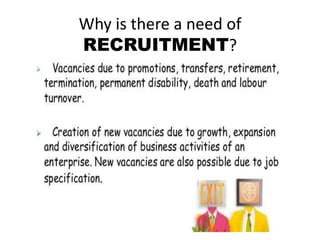
Why is there a need of
RECRUITMENT?
STEPS IN
RECRUITMENT
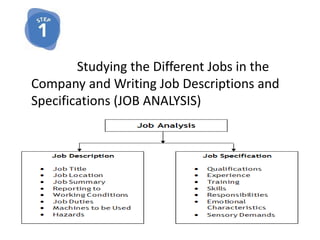
Studying the Different Jobs in the
Company and Writing Job Descriptions and
Specifications (JOB ANALYSIS)
Requisition of New Employee
Actual Recruitment of Applicants
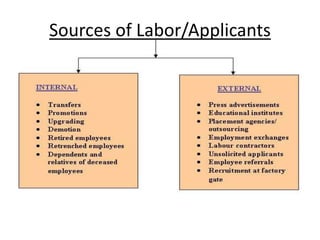
Sources of Labor/Applicants
STEPS IN
SELECTION
Reception
of
Applicants
Preliminary
Interview
Application
Form
Employment
Test
Final Selection
Physical and
Medical
Examination
Hiring
Orientation
STEPS IN
SELECTION
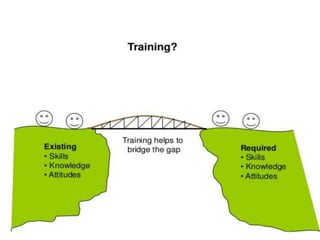
TRAINING
Introduction of new equipment or processes
A change in the employee's job responsibilities
A drop in an employee's productivity or in the
quality of output
An increase in safety violations or accidents
An increased number of questions
Complaints by customers or coworkers
TRAINING NEEDS
ADVANTAGES
OF
TRAINING
DISADVANTAGES OF
TRAINING
COMMON
TYPES OF
TRAINING
ON-THE-JOB TRAINING
AND JOB ROTATION
On-the Job Training and Job Rotation
•The most simple and cost-effective training method.
• Having a person learn the job by actually doing the job. They are trained
in actual working scenario.
VESTIBULE
TRAINING
Vestibule Training
• Procedure and equipment similar to those used in the actual job are set up in a
special working area called a vestibule.
• The trainee is then taught how to perform the job by a skilled person and is able to
learn a job at a comfortable pace without the pressure of production.
• Vestibule training has been used for training typists, word processor operators,
bank tellers, clerks, and other similar jobs.
Apprentice Training
-A system of training in which a worker entering the skilled trades is given
systematic instruction and experience, both on and off the job, in the practical and
theoretical aspects of the work.
Advantages
• training is intense and lengthy.
• it is typically conducted on a one-to-one basis.
Disadvantages
• Length of training is predetermined by trade association, can’t be changed to
accommodate fast learners.
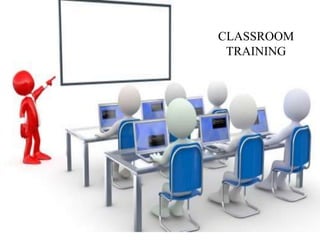
CLASSROOM
TRAINING
Classroom Training
• The most familiar method of training.
• Effective by means of quickly getting information to large groups with limited
or no knowledge of the subject being presented.
• More frequently used for technical, professional, and managerial employees.
PROGRAMMING
INSTRUCTION
Programming Instruction
• Programmed instruction allows students to progress through a unit of
study at their own rate, checking their own answers and advancing
only after answering correctly.
•This is presented either in text form or on computer displays.
• It is normally used to teach factual information.
MANAGEMENT
DEVELOPMENT
PROGRAM
Management Development Program
• It is a systematic process of training and growth by which individuals gain and
apply knowledge, skills, insights and attitudes to manage work organizations
effectively.
•Management development is concerned with developing the attitudes and
skills necessary to become or remain an effective manager.
MOST POPULAR
METHODS
OF
MANAGEMENT
DEVELOPMENT
PROGRAM
UNDERSTUDY
ASSIGNMENTS
Understudy Assignment
•Trainee managers are given staff posts under an experienced manager with
“Assistant to” title
• Trainee get the chance to learn the job under outstanding managers
Advantages
• The understudy managers gain valuable knowledge and experience
• They become important source for filling up vacant posts in future.
Disadvantages
• The trainee may be unable to make major decisions
• The chances for errors are high
Coaching
• It is actively guiding managers by their experienced immediate supervisors. The
coach gives the guidance through direction, advice, criticism and suggestions.
• If the coaching is done by someone other than the immediate supervisors, it is called
mentoring.
Advantages
• This methods provides opportunities for interaction between the coach and the
learner.
• There is rapid feedback of the performance
• Learners are self motivated
Disadvantages
•Heavy reliance is placed on the abilities of the coach. This may limit the scope for
development.
•Managers may be unwilling or unable to coach
EXPERIENCE
Experience
• Employees are promoted into managements jobs and allowed to learn on
their own, from their daily experiences.
JOB
ROTATION
Job Rotation
•It involves shifting managers from position to position. It can be:
(i) Planned Rotation: Managers spend two or three months on a job and
are then moved on. They learn several different jobs.
(ii) Situational Rotation: Shifting is done to meet work schedules or to
make the job challenging to the manager
(iii) Line and staff Rotation: Managers can be shifted between line staff
positions.
Job Rotation (continuation)
Advantages
• Managers can broaden their experience and become familiar with variety of
jobs
• Specialists managers can be developed as generalists
• Boredom and monotony in jobs are reduced
• Managers evaluation is facilitated.
Disadvantages
•Rotated managers have little knowledge when shifted to new tasks.
Productivity may suffer.
•Costs of rotation may be high
SPECIAL PROJECTS
AND COMMITTEE
ASSIGNMENTS
Special Projects and Committee Assignments
•Special projects require the employee to learn about a specific topic.
•Committee assignments, similar to special projects, can be used if the organization
has standing or ad hoc committees.
•An employee works with the committee on its regular duties; thus, the person
develops skills in working with others and learns through the activities of the
committee.
LECTURES
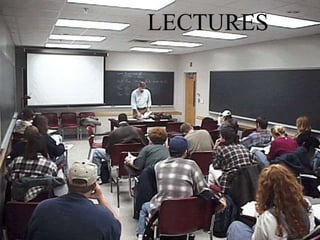
Lectures
•Lectures are oral communication of information to managers by instructors .
• Participants get opportunity to acquire knowledge and develop their
conceptual, analytical and technical skills.
• Training is basically incomplete without lecture.
Advantages
• Lectures can cover large group of audience simultaneously at low cost.
• Large amount of information can be covered in short time.
Disadvantages
• Lectures lack active involvement of learners
• There is no feedback from learners
Case Studies
•With this method, sample situations are presented to the trainee to analyze.
•The trainee is given with some written material, and the some complex
situations of a real or imaginary organization.
•Ideally, the case study should force the trainee to think through problems,
propose solutions, choose among them, and analyze the consequences of the
study.
Advantages
• It brings a note of realism to the instruction.
ROLE
PLAYING
Role Playing
•Creating a more realistic situation
• Usually one of human problems and conflicts
• Closely approximate a real situation
• Enhances their sensitivity, growth and development
Advantages
• This method emphasizes effective management practices through imitation of
role models.
Disadvantages
• It is time consuming.
In-Basket Technique
•In this technique, trainee is given some information about the role to be played
such as, description, responsibilities, general context about the role.
• The trainee is then given the log of materials that make up the in-basket and asked
to respond to materials within a particular time period.
• After all the trainees complete in-basket, a discussion with the trainer takes place.
Business Management Games
•In business games, trainees are given some information that describes a particular
situation and are then asked to make decisions that will best suit in the favor of the
company.
• This method forces trainees to work not only with other group members; they also
must deal with competition within the industry.
Advantages
• They stimulate reality.
• Decisions are made in a competitive environment.
• Feedback is provided about decisions.
• Decisions are made with less than complete data.
UNIVERSITYAND
PROFESSIONALASSOCIATION
SEMINARS
MOVEMENTS OF PERSONNEL
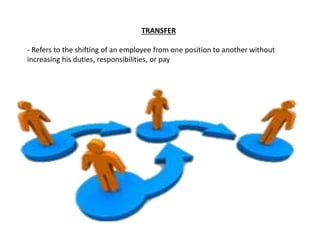
TRANSFER
- Refers to the shifting of an employee from one position to another without
increasing his duties, responsibilities, or pay
PROMOTION
- Refers to the shifting of an employee to a new position to which both his status and
responsibilities are increased.
SEPARATION
- May either be temporary or permanent, voluntary or involuntary.

Staffing

  • 3.
    It is theprocess of recruiting, selecting and training of men.
  • 4.
    It is alsothe process of acquiring, deploying, and retaining a workforce of sufficient quantity and quality to create positive impacts on the organization's effectiveness.
  • 5.
  • 6.
    Staffing is animportant managerial function- Staffing function is the most important managerial act along with planning, organizing, directing and controlling. The operations of these four functions depend upon the manpower which is available through staffing function.
  • 7.
    Staffing is apervasive activity- As staffing function is carried out by all managers and in all types of concerns where business activities are carried out.
  • 8.
    Staffing is acontinuous activity- This is because staffing function continues throughout the life of an organization due to the transfers and promotions that take place.
  • 9.
    The basis ofstaffing function is efficient management of personnel- Human resources can be efficiently managed by a system or proper procedure, that is, recruitment, selection, placement, training and development, providing remuneration, etc.
  • 10.
    Staffing helps inplacing right men at the right job. It can be done effectively through proper recruitment procedures and then finally selecting the most suitable candidate as per the job requirements.
  • 11.
    Staffing is performedby all managers depending upon the nature of business, size of the company, qualifications and skills of managers,etc. In small companies, the top management generally performs this function. In medium and small scale enterprise, it is performed especially by the personnel department of that concern.
  • 13.
    Why is therea need of RECRUITMENT?
  • 14.
  • 15.
    Studying the DifferentJobs in the Company and Writing Job Descriptions and Specifications (JOB ANALYSIS)
  • 16.
  • 17.
  • 18.
  • 24.
  • 25.
  • 27.
  • 30.
    Introduction of newequipment or processes A change in the employee's job responsibilities A drop in an employee's productivity or in the quality of output An increase in safety violations or accidents An increased number of questions Complaints by customers or coworkers TRAINING NEEDS
  • 31.
  • 32.
  • 33.
  • 34.
  • 35.
    On-the Job Trainingand Job Rotation •The most simple and cost-effective training method. • Having a person learn the job by actually doing the job. They are trained in actual working scenario.
  • 36.
  • 37.
    Vestibule Training • Procedureand equipment similar to those used in the actual job are set up in a special working area called a vestibule. • The trainee is then taught how to perform the job by a skilled person and is able to learn a job at a comfortable pace without the pressure of production. • Vestibule training has been used for training typists, word processor operators, bank tellers, clerks, and other similar jobs.
  • 39.
    Apprentice Training -A systemof training in which a worker entering the skilled trades is given systematic instruction and experience, both on and off the job, in the practical and theoretical aspects of the work. Advantages • training is intense and lengthy. • it is typically conducted on a one-to-one basis. Disadvantages • Length of training is predetermined by trade association, can’t be changed to accommodate fast learners.
  • 40.
  • 41.
    Classroom Training • Themost familiar method of training. • Effective by means of quickly getting information to large groups with limited or no knowledge of the subject being presented. • More frequently used for technical, professional, and managerial employees.
  • 42.
  • 43.
    Programming Instruction • Programmedinstruction allows students to progress through a unit of study at their own rate, checking their own answers and advancing only after answering correctly. •This is presented either in text form or on computer displays. • It is normally used to teach factual information.
  • 44.
  • 45.
    Management Development Program •It is a systematic process of training and growth by which individuals gain and apply knowledge, skills, insights and attitudes to manage work organizations effectively. •Management development is concerned with developing the attitudes and skills necessary to become or remain an effective manager.
  • 46.
  • 47.
  • 48.
    Understudy Assignment •Trainee managersare given staff posts under an experienced manager with “Assistant to” title • Trainee get the chance to learn the job under outstanding managers Advantages • The understudy managers gain valuable knowledge and experience • They become important source for filling up vacant posts in future. Disadvantages • The trainee may be unable to make major decisions • The chances for errors are high
  • 50.
    Coaching • It isactively guiding managers by their experienced immediate supervisors. The coach gives the guidance through direction, advice, criticism and suggestions. • If the coaching is done by someone other than the immediate supervisors, it is called mentoring. Advantages • This methods provides opportunities for interaction between the coach and the learner. • There is rapid feedback of the performance • Learners are self motivated Disadvantages •Heavy reliance is placed on the abilities of the coach. This may limit the scope for development. •Managers may be unwilling or unable to coach
  • 51.
  • 52.
    Experience • Employees arepromoted into managements jobs and allowed to learn on their own, from their daily experiences.
  • 53.
  • 54.
    Job Rotation •It involvesshifting managers from position to position. It can be: (i) Planned Rotation: Managers spend two or three months on a job and are then moved on. They learn several different jobs. (ii) Situational Rotation: Shifting is done to meet work schedules or to make the job challenging to the manager (iii) Line and staff Rotation: Managers can be shifted between line staff positions.
  • 55.
    Job Rotation (continuation) Advantages •Managers can broaden their experience and become familiar with variety of jobs • Specialists managers can be developed as generalists • Boredom and monotony in jobs are reduced • Managers evaluation is facilitated. Disadvantages •Rotated managers have little knowledge when shifted to new tasks. Productivity may suffer. •Costs of rotation may be high
  • 56.
  • 57.
    Special Projects andCommittee Assignments •Special projects require the employee to learn about a specific topic. •Committee assignments, similar to special projects, can be used if the organization has standing or ad hoc committees. •An employee works with the committee on its regular duties; thus, the person develops skills in working with others and learns through the activities of the committee.
  • 58.
  • 59.
    Lectures •Lectures are oralcommunication of information to managers by instructors . • Participants get opportunity to acquire knowledge and develop their conceptual, analytical and technical skills. • Training is basically incomplete without lecture. Advantages • Lectures can cover large group of audience simultaneously at low cost. • Large amount of information can be covered in short time. Disadvantages • Lectures lack active involvement of learners • There is no feedback from learners
  • 61.
    Case Studies •With thismethod, sample situations are presented to the trainee to analyze. •The trainee is given with some written material, and the some complex situations of a real or imaginary organization. •Ideally, the case study should force the trainee to think through problems, propose solutions, choose among them, and analyze the consequences of the study. Advantages • It brings a note of realism to the instruction.
  • 62.
  • 63.
    Role Playing •Creating amore realistic situation • Usually one of human problems and conflicts • Closely approximate a real situation • Enhances their sensitivity, growth and development Advantages • This method emphasizes effective management practices through imitation of role models. Disadvantages • It is time consuming.
  • 64.
    In-Basket Technique •In thistechnique, trainee is given some information about the role to be played such as, description, responsibilities, general context about the role. • The trainee is then given the log of materials that make up the in-basket and asked to respond to materials within a particular time period. • After all the trainees complete in-basket, a discussion with the trainer takes place.
  • 65.
    Business Management Games •Inbusiness games, trainees are given some information that describes a particular situation and are then asked to make decisions that will best suit in the favor of the company. • This method forces trainees to work not only with other group members; they also must deal with competition within the industry. Advantages • They stimulate reality. • Decisions are made in a competitive environment. • Feedback is provided about decisions. • Decisions are made with less than complete data.
  • 66.
  • 67.
  • 68.
    TRANSFER - Refers tothe shifting of an employee from one position to another without increasing his duties, responsibilities, or pay
  • 69.
    PROMOTION - Refers tothe shifting of an employee to a new position to which both his status and responsibilities are increased.
  • 70.
    SEPARATION - May eitherbe temporary or permanent, voluntary or involuntary.