


Talent Management
University of Budapest MBA
Visiting Professor Program
Gary Wheeler SPHR, GPHR, CCP, CBP
To Get the Most Out of Your
Experience…You Must Be Willing to
Have Some ...
4
Seminar Topics
• Understanding Your Organization’s Strategy
• Creating a Talent Management Strategy
• Recruitment and Selection
• Onboarding
• Performance Management
• Employee Training and Development
• Attitude Surveys and Employee Engagement
• Career Development
• Succession Planning
5
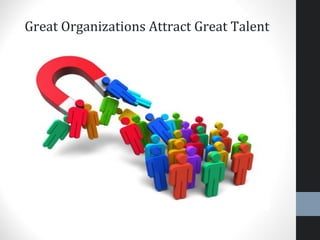
Great Organizations Attract Great Talent
6
What is a Talent Management
7
What is a Talent Management
• Talent Management is the function and process of
managing the employee experience from recruitment to
separation from the organization.
• Talent Management consists of several organizational
HR processes that are designed to attract, develop and
retain employees. An effective Talent Management
process will aide in attracting and retaining high-
performance employees.
8
Talent Management Areas
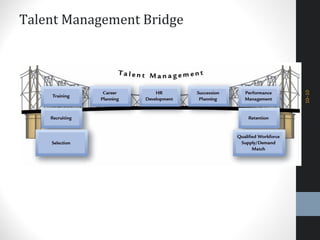
• Talent Management HR processes includes:
• Recruiting
• Selection
• Training
• Performance Management
• Career Planning and Career Development
• Employee Retention
• Succession Planning
9
10–10
Talent Management Bridge
10–11
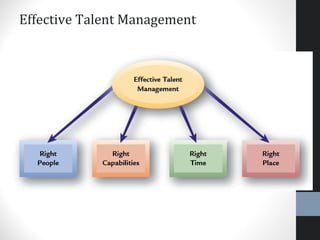
Effective Talent Management
Strategy
• Everything starts with Strategy
• This week’s seminars
1. Creating a Strategic Plan
2. Talent Management
3. Performance Management
• Everything starts with the organization’s
strategy
12
Organization Strategy
• Your organization strategy is the foundation of
your talent management program
• Organization Strategy
• High Cost – Market Cost – Low Cost
• Talent Management and People Strategy
• Compensation Strategy
• Organization Strategy = Market Strategy
13
Market Strategy
• Low Cost Products & Services
• Wal-Mart Stores
• Meet Market Cost Products & Services
• Sears, JC Penny, Macy’s
• High Cost Products & Services
• Niemen Marcus
• Differentiation
• Quality
• Service
• Specialization
14
Compensation Strategy
• Lower Salaries = Higher Employee Turnover
• Wal-Mart Stores
• Market Price Salaries = Average Employee Turnover
• Sears, JC Penny, Macy’s
• Higher Salaries = Lower Employee Turnover
• Niemen Marcus
• Differentiation
• Quality
• Service
• Specialization
15
Talent Management Strategy
• Organization Strategy
• Determine the quality of the products and services
you would like to provide
• Determine your market approach strategy
• Low cost below market
• Market competitor
• Differentiation and above market pricing
• Dictates compensation strategy & people strategy
• Low cost = lower wages
• Market cost = market wages
• High cost = higher than market wages
16
Recruiting and Selection
• Design a Strategic approach to recruiting
• Benefits of a Strategic Approach
• Matches recruiting activity with organizational and human
resource plans.
• Acquiring the Right Human Capital Entails:
• Knowing the business and industry
• Identifying keys to success in the labor market
• Cultivating networks and relationships
• Promoting the company brand
• Creating recruiting metrics
7–17
Recruiting Strategy
• Looking for engineers, recruit at engineering schools
• Looking for interior designers, recruit at schools that have a
great program
• Consider professional organizations and societies
• Develop ongoing relationships
• Implement an internship program
• Implement a co-op Program
• Implement a visiting professor program
• Adopt a school
• Sponsorships
7–18
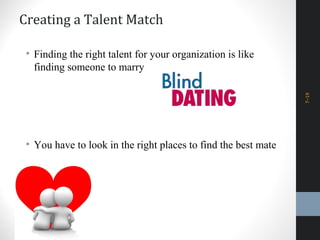
Creating a Talent Match
• Finding the right talent for your organization is like
finding someone to marry
• You have to look in the right places to find the best mate
7–19
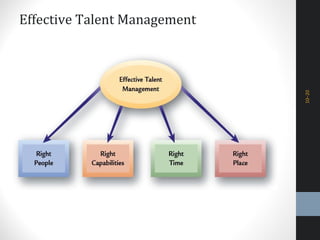
10–20
Effective Talent Management
Interviewing
• Objective
1. Give information
2. Get information
3. Make a friend
• Initial interview
1. Phone / Skype interview
2. Personal F2F interview
3. Group
21
Group Interview
• All candidates in at one time
1. Take 1-hour to explain your business
2. History & culture
3. Job description
4. Compensation (Total Rewards)
5. Performance expected / metrics
• Open up to questions
• Candidates sign up for f2f
22
Interview Alternatives
• Behavior interview
• Skill interview
• Interview Presentation
• Panel interview
• Step progression interview
• Final interview
• Team interview
23
Behavior Interview Question Example 1
• Tell me about a time when you and a team member
did not see eye to eye and you became upset with
each other. How did you handle it and what was the
outcome?
• Situation: ____________________________
• Your Action: __________________________
• Outcome: ____________________________
24
Behavior Interview Question Example 2
• Tell me about a time when you and a team member
did not see eye to eye and you became upset with
each other. How did you handle it and what was the
outcome?
• Situation: ________________________
• Your Action: ______________________
• Outcome: ________________________
25
Behavior /Skill Interview
Flu Vaccinations
How many doses would you administer to a six-month old
child?
•Two-doses 30-days apart
What dosage amount would you administer to a child under
three-years of age?
•.25 ML’s
What dosage amount would administer to a child three-years or
older?
•.5 ML’s
26
Onboarding
• The Onboarding process is often overlooked
• A quality Onboarding process can impact employee
performance, loyalty, attitude, retention and quality
• Onboarding is the process where new hires become
adjusted to the social and performance aspects of
their jobs quickly and smoothly, and learn the
attitudes, knowledge, skills, and behaviors required
to function effectively
27
Onboarding Areas
• Welcome letter or offer letter
• Administrative paperwork
• Orientation (classroom or one-on-one)
• Facility Tour
• Meeting other employees
• Assigning a mentor
• Job shadowing
• On-the-job training
• 90-day probation
28
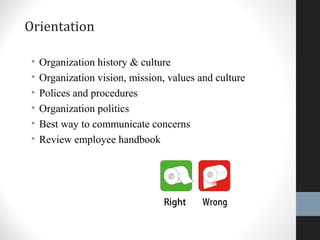
Orientation
• Organization history & culture
• Organization vision, mission, values and culture
• Polices and procedures
• Organization politics
• Best way to communicate concerns
• Review employee handbook
29
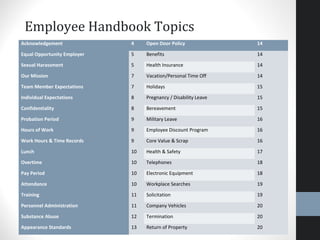
Employee Handbook Topics
30
Acknowledgement 4 Open Door Policy 14
Equal Opportunity Employer 5 Benefits 14
Sexual Harassment 5 Health Insurance 14
Our Mission 7 Vacation/Personal Time Off 14
Team Member Expectations 7 Holidays 15
Individual Expectations 8 Pregnancy / Disability Leave 15
Confidentiality 8 Bereavement 15
Probation Period 9 Military Leave 16
Hours of Work 9 Employee Discount Program 16
Work Hours & Time Records 9 Core Value & Scrap 16
Lunch 10 Health & Safety 17
Overtime 10 Telephones 18
Pay Period 10 Electronic Equipment 18
Attendance 10 Workplace Searches 19
Training 11 Solicitation 19
Personnel Administration 11 Company Vehicles 20
Substance Abuse 12 Termination 20
Appearance Standards 13 Return of Property 20
Job Shadowing
• Work in other departments learning other roles
• Work in other departments to understand other roles
• Half-day assignments
• Full-day assignments
• Several day assignments
31
On The Job Training
• Reading and learning job procedures and processes
• Supervisor training
• Lecture
• Demonstrate
• Employee performs tasks
• Follow-up
• Evaluate
32
On The Job Training cont.
• Reading and learning job procedures and processes
• Supervisor Model the Behavior
• Lecture
• Show
• Make the employee do the task
• Follow-up
• Train or retrain
33
9–34
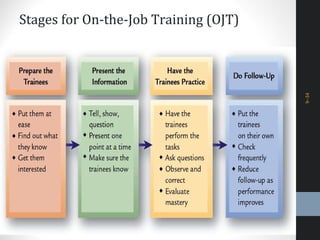
Stages for On-the-Job Training (OJT)
90-Day Probation Period
• Your first 90-days of employment is a probationary
period
• Your manager will evaluate your performance
during and after the 90-day period to determine if
you will attain regular employee status
Employees not meeting performance guidelines will
be terminated
• Performance includes but is not limited to:
performing assigned duties, customer service,
taking initiative, punctuality, attitude, following
directions, etc.
35
What is Performance Management?
36
• Performance management includes activities which
ensure individual goals are consistently met in an
effective and efficient manner and are aligned with the
organization, division, department, manager and
individuals
• Individual goals role up to the organization’s goals and
they support the organization’s mission and strategic plan
Performance Management
• A Performance Management System consists of an
evaluation system involving key performance
indicators (KPI’s)
• KPI’s are created by setting SMART Goals
• S specific
• M measurable
• A achievable
• R realistic
• T timely
37
Benefits of Performance Management
• Organization
• Outcomes are tied to the mission
• Outcomes are tied to strategy
• Outlines responsibility
• Manager
• Identifies expectations
• Creates an objective evaluation system
• Staff
• Let’s people know where they stand
• Greater chance of receiving recognition
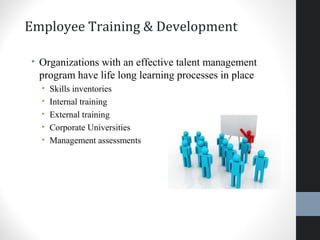
Employee Training & Development
• Organizations with an effective talent management
program have life long learning processes in place
• Skills inventories
• Internal training
• External training
• Corporate Universities
• Management assessments
39
Learning Management System
• Knowledge & experience = Human Capital Value
• Capture human capital value through LMS
• LMS – Learning Management System is an online
platform that can be used to access prior issues and
problems
40
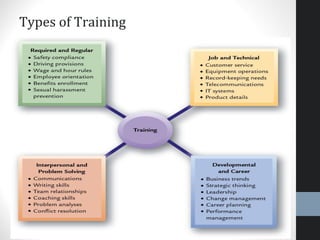
Types of Training
Employee Training and Development
• Create a Strategic Training Program
• Organization Competitiveness and Training
• Training makes organizations more competitive.
• Training helps retain valuable employees.
• Training helps accomplish organizational strategies.
• Benefits of Strategic Training
• HR and trainers partner with operating managers to solve
problems, and to make contributions to organizational results.
• Managers are less likely to think that training alone can solve
performance problems.
Attitude Surveys
43
Employee Attitude Surveys
•Attitude surveys / employee opinion surveys are a
fundamental tool to find out how your employees feel
about your organization and their manager
•Survey’s can help an organization
• Improve employee retention
• Increase employee satisfaction
• Increase productivity
44
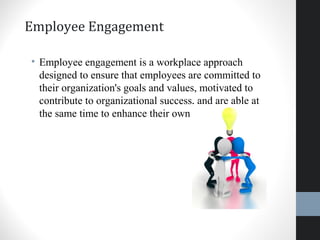
Employee Engagement
• Employee engagement is a workplace approach
designed to ensure that employees are committed to
their organization's goals and values, motivated to
contribute to organizational success, and are able at
the same time to enhance their own sense.
45
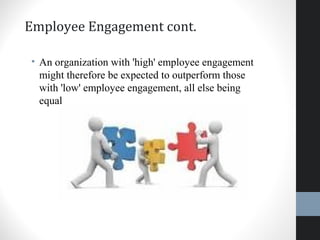
Employee Engagement cont.
• An organization with 'high' employee engagement
might therefore be expected to outperform those
with 'low' employee engagement, all else being
equal
46
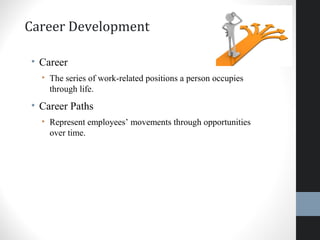
Career Development
• Career
• The series of work-related positions a person occupies
through life.
• Career Paths
• Represent employees’ movements through opportunities
over time.
47
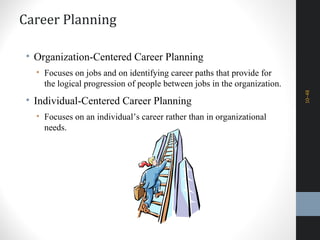
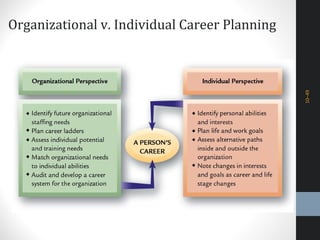
Career Planning
• Organization-Centered Career Planning
• Focuses on jobs and on identifying career paths that provide for
the logical progression of people between jobs in the organization.
• Individual-Centered Career Planning
• Focuses on an individual’s career rather than in organizational
needs.
10–48
10–49
Organizational v. Individual Career Planning
Succession Planning
• Succession Planning is the process of planning and
developing employees for roles at the higher levels
of the organization
• Typically
• Director
• Vice President
• Senior Vice President
• CEO
50
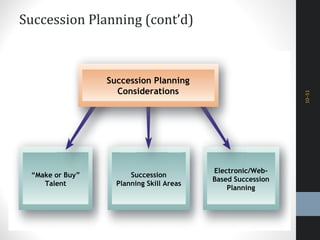
Succession Planning (cont’d)
10–51
Succession Planning
Considerations
“Make or Buy”
Talent
Succession
Planning Skill Areas
Electronic/Web-
Based Succession
Planning
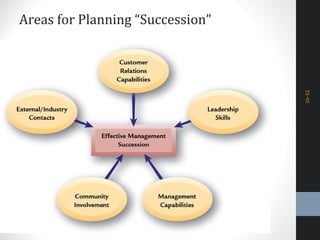
10–52
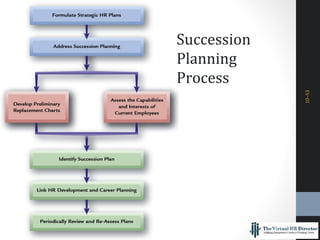
Areas for Planning “Succession”
10–53
Succession
Planning
Process
EXAMPLE
CAREER DEVELOPMENT &
SUCCESSION PLANNING
PROCESS
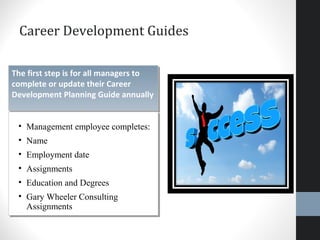
Career Development Guides
The first step is for all managers to
complete or update their Career
Development Planning Guide annually
• Management employee completes:
• Name
• Employment date
• Assignments
• Education and Degrees
• Gary Wheeler Consulting
Assignments
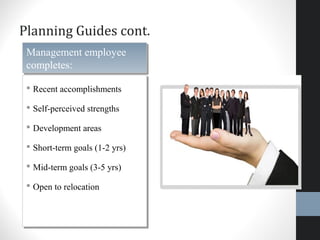
Planning Guides cont.
Management employee
completes:
Management employee
completes:
 Recent accomplishments
 Self-perceived strengths
 Development areas
 Short-term goals (1-2 yrs)
 Mid-term goals (3-5 yrs)
 Open to relocation
 Recent accomplishments
 Self-perceived strengths
 Development areas
 Short-term goals (1-2 yrs)
 Mid-term goals (3-5 yrs)
 Open to relocation
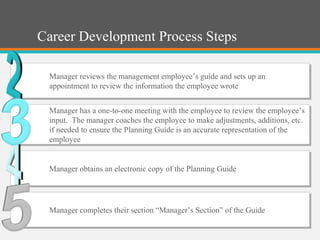
Manager reviews the management employee’s guide and sets up an
appointment to review the information the employee wrote
Manager reviews the management employee’s guide and sets up an
appointment to review the information the employee wrote
Manager has a one-to-one meeting with the employee to review the employee’s
input. The manager coaches the employee to make adjustments, additions, etc.
if needed to ensure the Planning Guide is an accurate representation of the
employee
Manager has a one-to-one meeting with the employee to review the employee’s
input. The manager coaches the employee to make adjustments, additions, etc.
if needed to ensure the Planning Guide is an accurate representation of the
employee
Manager obtains an electronic copy of the Planning GuideManager obtains an electronic copy of the Planning Guide
Manager completes their section “Manager’s Section” of the GuideManager completes their section “Manager’s Section” of the Guide
Career Development Process Steps
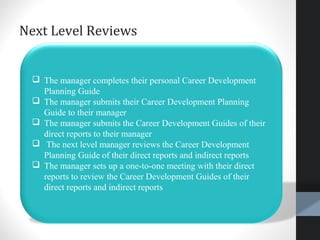
 The manager completes their personal Career Development
Planning Guide
 The manager submits their Career Development Planning
Guide to their manager
 The manager submits the Career Development Guides of their
direct reports to their manager
 The next level manager reviews the Career Development
Planning Guide of their direct reports and indirect reports
 The manager sets up a one-to-one meeting with their direct
reports to review the Career Development Guides of their
direct reports and indirect reports
Next Level Reviews
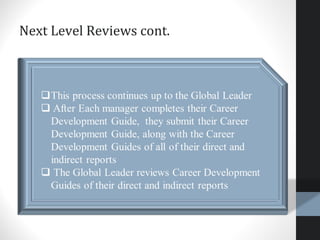
Next Level Reviews cont.
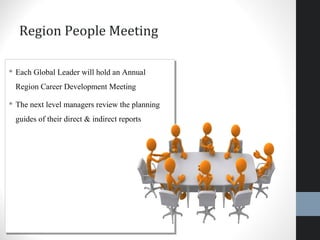
Region People Meeting
 Each Global Leader will hold an Annual
Region Career Development Meeting
 The next level managers review the planning
guides of their direct & indirect reports
 Each Global Leader will hold an Annual
Region Career Development Meeting
 The next level managers review the planning
guides of their direct & indirect reports
Region People Meeting cont.
• It is important that all managers and potential managers are
included in the Region Career Development Meetings
• Each manager reporting to the Global Leader will review
their team
• HR assists Global Leader
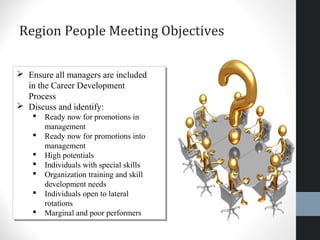
 Ensure all managers are included
in the Career Development
Process
 Discuss and identify:
 Ready now for promotions in
management
 Ready now for promotions into
management
 High potentials
 Individuals with special skills
 Organization training and skill
development needs
 Individuals open to lateral
rotations
 Marginal and poor performers
 Ensure all managers are included
in the Career Development
Process
 Discuss and identify:
 Ready now for promotions in
management
 Ready now for promotions into
management
 High potentials
 Individuals with special skills
 Organization training and skill
development needs
 Individuals open to lateral
rotations
 Marginal and poor performers
Region People Meeting Objectives
After The Meeting
 The Global Leader will
obtain an electronic copy of
all guides
 The Global Leader will take
the Career Development
Guides with them to the
Global People Meeting
 The Global Leader will
obtain an electronic copy of
all guides
 The Global Leader will take
the Career Development
Guides with them to the
Global People Meeting
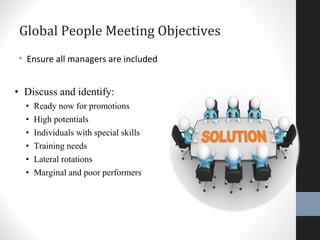
Global People Meeting Objectives
• Ensure all managers are included
• Discuss and identify:
• Ready now for promotions
• High potentials
• Individuals with special skills
• Training needs
• Lateral rotations
• Marginal and poor performers
Post People Meeting
• The Global Leaders finalize their notes on the Career
Development Guides
• Global Leaders review the Guides with their direct reports
• Managers will do the same all of the way down to the manager
and senior associate levels
• It is the responsibility of the employee and the employee’s
manager to implement the plan
• Managers are to use the Career Development Plans in
conjunction with performance evaluation reviews
Final Learning Tip
• Project & present topics with confidence
• Engage the audience
• Power Point Presentations
• Talking points are discussion guidelines
• Average six to eight words per line
• Six to eight bullet points per slide
• Look at the audience
Talent Management Summary
67
Questions?
68

Talent management 5 23-15 final

  • 1.
    Talent Management University ofBudapest MBA Visiting Professor Program Gary Wheeler SPHR, GPHR, CCP, CBP
  • 3.
    To Get theMost Out of Your Experience…You Must Be Willing to Have Some ...
  • 4.
  • 5.
    Seminar Topics • UnderstandingYour Organization’s Strategy • Creating a Talent Management Strategy • Recruitment and Selection • Onboarding • Performance Management • Employee Training and Development • Attitude Surveys and Employee Engagement • Career Development • Succession Planning 5
  • 6.
  • 7.
    What is aTalent Management 7
  • 8.
    What is aTalent Management • Talent Management is the function and process of managing the employee experience from recruitment to separation from the organization. • Talent Management consists of several organizational HR processes that are designed to attract, develop and retain employees. An effective Talent Management process will aide in attracting and retaining high- performance employees. 8
  • 9.
    Talent Management Areas •Talent Management HR processes includes: • Recruiting • Selection • Training • Performance Management • Career Planning and Career Development • Employee Retention • Succession Planning 9
  • 10.
  • 11.
  • 12.
    Strategy • Everything startswith Strategy • This week’s seminars 1. Creating a Strategic Plan 2. Talent Management 3. Performance Management • Everything starts with the organization’s strategy 12
  • 13.
    Organization Strategy • Yourorganization strategy is the foundation of your talent management program • Organization Strategy • High Cost – Market Cost – Low Cost • Talent Management and People Strategy • Compensation Strategy • Organization Strategy = Market Strategy 13
  • 14.
    Market Strategy • LowCost Products & Services • Wal-Mart Stores • Meet Market Cost Products & Services • Sears, JC Penny, Macy’s • High Cost Products & Services • Niemen Marcus • Differentiation • Quality • Service • Specialization 14
  • 15.
    Compensation Strategy • LowerSalaries = Higher Employee Turnover • Wal-Mart Stores • Market Price Salaries = Average Employee Turnover • Sears, JC Penny, Macy’s • Higher Salaries = Lower Employee Turnover • Niemen Marcus • Differentiation • Quality • Service • Specialization 15
  • 16.
    Talent Management Strategy •Organization Strategy • Determine the quality of the products and services you would like to provide • Determine your market approach strategy • Low cost below market • Market competitor • Differentiation and above market pricing • Dictates compensation strategy & people strategy • Low cost = lower wages • Market cost = market wages • High cost = higher than market wages 16
  • 17.
    Recruiting and Selection •Design a Strategic approach to recruiting • Benefits of a Strategic Approach • Matches recruiting activity with organizational and human resource plans. • Acquiring the Right Human Capital Entails: • Knowing the business and industry • Identifying keys to success in the labor market • Cultivating networks and relationships • Promoting the company brand • Creating recruiting metrics 7–17
  • 18.
    Recruiting Strategy • Lookingfor engineers, recruit at engineering schools • Looking for interior designers, recruit at schools that have a great program • Consider professional organizations and societies • Develop ongoing relationships • Implement an internship program • Implement a co-op Program • Implement a visiting professor program • Adopt a school • Sponsorships 7–18
  • 19.
    Creating a TalentMatch • Finding the right talent for your organization is like finding someone to marry • You have to look in the right places to find the best mate 7–19
  • 20.
  • 21.
    Interviewing • Objective 1. Giveinformation 2. Get information 3. Make a friend • Initial interview 1. Phone / Skype interview 2. Personal F2F interview 3. Group 21
  • 22.
    Group Interview • Allcandidates in at one time 1. Take 1-hour to explain your business 2. History & culture 3. Job description 4. Compensation (Total Rewards) 5. Performance expected / metrics • Open up to questions • Candidates sign up for f2f 22
  • 23.
    Interview Alternatives • Behaviorinterview • Skill interview • Interview Presentation • Panel interview • Step progression interview • Final interview • Team interview 23
  • 24.
    Behavior Interview QuestionExample 1 • Tell me about a time when you and a team member did not see eye to eye and you became upset with each other. How did you handle it and what was the outcome? • Situation: ____________________________ • Your Action: __________________________ • Outcome: ____________________________ 24
  • 25.
    Behavior Interview QuestionExample 2 • Tell me about a time when you and a team member did not see eye to eye and you became upset with each other. How did you handle it and what was the outcome? • Situation: ________________________ • Your Action: ______________________ • Outcome: ________________________ 25
  • 26.
    Behavior /Skill Interview FluVaccinations How many doses would you administer to a six-month old child? •Two-doses 30-days apart What dosage amount would you administer to a child under three-years of age? •.25 ML’s What dosage amount would administer to a child three-years or older? •.5 ML’s 26
  • 27.
    Onboarding • The Onboardingprocess is often overlooked • A quality Onboarding process can impact employee performance, loyalty, attitude, retention and quality • Onboarding is the process where new hires become adjusted to the social and performance aspects of their jobs quickly and smoothly, and learn the attitudes, knowledge, skills, and behaviors required to function effectively 27
  • 28.
    Onboarding Areas • Welcomeletter or offer letter • Administrative paperwork • Orientation (classroom or one-on-one) • Facility Tour • Meeting other employees • Assigning a mentor • Job shadowing • On-the-job training • 90-day probation 28
  • 29.
    Orientation • Organization history& culture • Organization vision, mission, values and culture • Polices and procedures • Organization politics • Best way to communicate concerns • Review employee handbook 29
  • 30.
    Employee Handbook Topics 30 Acknowledgement4 Open Door Policy 14 Equal Opportunity Employer 5 Benefits 14 Sexual Harassment 5 Health Insurance 14 Our Mission 7 Vacation/Personal Time Off 14 Team Member Expectations 7 Holidays 15 Individual Expectations 8 Pregnancy / Disability Leave 15 Confidentiality 8 Bereavement 15 Probation Period 9 Military Leave 16 Hours of Work 9 Employee Discount Program 16 Work Hours & Time Records 9 Core Value & Scrap 16 Lunch 10 Health & Safety 17 Overtime 10 Telephones 18 Pay Period 10 Electronic Equipment 18 Attendance 10 Workplace Searches 19 Training 11 Solicitation 19 Personnel Administration 11 Company Vehicles 20 Substance Abuse 12 Termination 20 Appearance Standards 13 Return of Property 20
  • 31.
    Job Shadowing • Workin other departments learning other roles • Work in other departments to understand other roles • Half-day assignments • Full-day assignments • Several day assignments 31
  • 32.
    On The JobTraining • Reading and learning job procedures and processes • Supervisor training • Lecture • Demonstrate • Employee performs tasks • Follow-up • Evaluate 32
  • 33.
    On The JobTraining cont. • Reading and learning job procedures and processes • Supervisor Model the Behavior • Lecture • Show • Make the employee do the task • Follow-up • Train or retrain 33
  • 34.
  • 35.
    90-Day Probation Period •Your first 90-days of employment is a probationary period • Your manager will evaluate your performance during and after the 90-day period to determine if you will attain regular employee status Employees not meeting performance guidelines will be terminated • Performance includes but is not limited to: performing assigned duties, customer service, taking initiative, punctuality, attitude, following directions, etc. 35
  • 36.
    What is PerformanceManagement? 36 • Performance management includes activities which ensure individual goals are consistently met in an effective and efficient manner and are aligned with the organization, division, department, manager and individuals • Individual goals role up to the organization’s goals and they support the organization’s mission and strategic plan
  • 37.
    Performance Management • APerformance Management System consists of an evaluation system involving key performance indicators (KPI’s) • KPI’s are created by setting SMART Goals • S specific • M measurable • A achievable • R realistic • T timely 37
  • 38.
    Benefits of PerformanceManagement • Organization • Outcomes are tied to the mission • Outcomes are tied to strategy • Outlines responsibility • Manager • Identifies expectations • Creates an objective evaluation system • Staff • Let’s people know where they stand • Greater chance of receiving recognition
  • 39.
    Employee Training &Development • Organizations with an effective talent management program have life long learning processes in place • Skills inventories • Internal training • External training • Corporate Universities • Management assessments 39
  • 40.
    Learning Management System •Knowledge & experience = Human Capital Value • Capture human capital value through LMS • LMS – Learning Management System is an online platform that can be used to access prior issues and problems 40
  • 41.
  • 42.
    Employee Training andDevelopment • Create a Strategic Training Program • Organization Competitiveness and Training • Training makes organizations more competitive. • Training helps retain valuable employees. • Training helps accomplish organizational strategies. • Benefits of Strategic Training • HR and trainers partner with operating managers to solve problems, and to make contributions to organizational results. • Managers are less likely to think that training alone can solve performance problems.
  • 43.
  • 44.
    Employee Attitude Surveys •Attitudesurveys / employee opinion surveys are a fundamental tool to find out how your employees feel about your organization and their manager •Survey’s can help an organization • Improve employee retention • Increase employee satisfaction • Increase productivity 44
  • 45.
    Employee Engagement • Employeeengagement is a workplace approach designed to ensure that employees are committed to their organization's goals and values, motivated to contribute to organizational success, and are able at the same time to enhance their own sense. 45
  • 46.
    Employee Engagement cont. •An organization with 'high' employee engagement might therefore be expected to outperform those with 'low' employee engagement, all else being equal 46
  • 47.
    Career Development • Career •The series of work-related positions a person occupies through life. • Career Paths • Represent employees’ movements through opportunities over time. 47
  • 48.
    Career Planning • Organization-CenteredCareer Planning • Focuses on jobs and on identifying career paths that provide for the logical progression of people between jobs in the organization. • Individual-Centered Career Planning • Focuses on an individual’s career rather than in organizational needs. 10–48
  • 49.
  • 50.
    Succession Planning • SuccessionPlanning is the process of planning and developing employees for roles at the higher levels of the organization • Typically • Director • Vice President • Senior Vice President • CEO 50
  • 51.
    Succession Planning (cont’d) 10–51 SuccessionPlanning Considerations “Make or Buy” Talent Succession Planning Skill Areas Electronic/Web- Based Succession Planning
  • 52.
  • 53.
  • 54.
  • 55.
    Career Development Guides Thefirst step is for all managers to complete or update their Career Development Planning Guide annually • Management employee completes: • Name • Employment date • Assignments • Education and Degrees • Gary Wheeler Consulting Assignments
  • 56.
    Planning Guides cont. Managementemployee completes: Management employee completes:  Recent accomplishments  Self-perceived strengths  Development areas  Short-term goals (1-2 yrs)  Mid-term goals (3-5 yrs)  Open to relocation  Recent accomplishments  Self-perceived strengths  Development areas  Short-term goals (1-2 yrs)  Mid-term goals (3-5 yrs)  Open to relocation
  • 57.
    Manager reviews themanagement employee’s guide and sets up an appointment to review the information the employee wrote Manager reviews the management employee’s guide and sets up an appointment to review the information the employee wrote Manager has a one-to-one meeting with the employee to review the employee’s input. The manager coaches the employee to make adjustments, additions, etc. if needed to ensure the Planning Guide is an accurate representation of the employee Manager has a one-to-one meeting with the employee to review the employee’s input. The manager coaches the employee to make adjustments, additions, etc. if needed to ensure the Planning Guide is an accurate representation of the employee Manager obtains an electronic copy of the Planning GuideManager obtains an electronic copy of the Planning Guide Manager completes their section “Manager’s Section” of the GuideManager completes their section “Manager’s Section” of the Guide Career Development Process Steps
  • 58.
     The managercompletes their personal Career Development Planning Guide  The manager submits their Career Development Planning Guide to their manager  The manager submits the Career Development Guides of their direct reports to their manager  The next level manager reviews the Career Development Planning Guide of their direct reports and indirect reports  The manager sets up a one-to-one meeting with their direct reports to review the Career Development Guides of their direct reports and indirect reports Next Level Reviews
  • 59.
  • 60.
    Region People Meeting Each Global Leader will hold an Annual Region Career Development Meeting  The next level managers review the planning guides of their direct & indirect reports  Each Global Leader will hold an Annual Region Career Development Meeting  The next level managers review the planning guides of their direct & indirect reports
  • 61.
    Region People Meetingcont. • It is important that all managers and potential managers are included in the Region Career Development Meetings • Each manager reporting to the Global Leader will review their team • HR assists Global Leader
  • 62.
     Ensure allmanagers are included in the Career Development Process  Discuss and identify:  Ready now for promotions in management  Ready now for promotions into management  High potentials  Individuals with special skills  Organization training and skill development needs  Individuals open to lateral rotations  Marginal and poor performers  Ensure all managers are included in the Career Development Process  Discuss and identify:  Ready now for promotions in management  Ready now for promotions into management  High potentials  Individuals with special skills  Organization training and skill development needs  Individuals open to lateral rotations  Marginal and poor performers Region People Meeting Objectives
  • 63.
    After The Meeting The Global Leader will obtain an electronic copy of all guides  The Global Leader will take the Career Development Guides with them to the Global People Meeting  The Global Leader will obtain an electronic copy of all guides  The Global Leader will take the Career Development Guides with them to the Global People Meeting
  • 64.
    Global People MeetingObjectives • Ensure all managers are included • Discuss and identify: • Ready now for promotions • High potentials • Individuals with special skills • Training needs • Lateral rotations • Marginal and poor performers
  • 65.
    Post People Meeting •The Global Leaders finalize their notes on the Career Development Guides • Global Leaders review the Guides with their direct reports • Managers will do the same all of the way down to the manager and senior associate levels • It is the responsibility of the employee and the employee’s manager to implement the plan • Managers are to use the Career Development Plans in conjunction with performance evaluation reviews
  • 66.
    Final Learning Tip •Project & present topics with confidence • Engage the audience • Power Point Presentations • Talking points are discussion guidelines • Average six to eight words per line • Six to eight bullet points per slide • Look at the audience
  • 67.
  • 68.

Editor's Notes

  • #4 Get it called out with a SMILE … 1 Min