PRESENTED BY :

ROLL NO.

MS. GILLIAN DOURADO

68

MR. NAVIN DUBEY

69

MR. BURHANUDDIN KACHWALA

76

MR. RAMLAVAT PATEL

89

MS. AAYUSHI TREHAN

115

MR. SAVIO MENEZES

117
1/22/2014
WHAT WILL WE LEARN ???
 INTRODUCTION



TRAINING
DEVELOPMENT

 WHY TRAINING ?
 WHY NEEDS ASSESSMENT ?

 NEEDS ASSESSMENT METHODS
 METHODS & TECHNIQUES OF TRAINING



ON-THE-JOB TRAINING
OFF-THE-JOB TRAINING

 CAREER DEVELOPMENT
 SUMMARY
1/22/2014
INTRODUCTION TO TRAINING
1

 Training is :


a short term process



an activity based concept



skills are learned or relearned



aims to enhance individual effectiveness on the job



involving practical application of programmed knowledge

MET Institute of Management

HRM

1/22/2014
INTRODUCTION - DEVELOPMENT
2

 Development is less skill oriented
 Focuses

on knowledge about business environment,
management principles & techniques, human relations,
specific industry analysis

 It involves –


Personality development



A long run intervention



Relates individuals to the organization in terms of goals, skills, attitudes,
behaviors & values

MET Institute of Management

HRM

1/22/2014
INTRODUCTION (contd..)
3

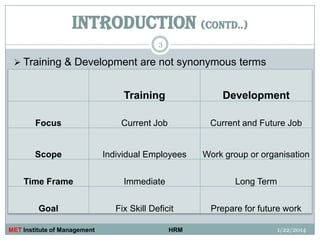
 Training & Development are not synonymous terms

Training

Development

Focus

Current Job

Current and Future Job

Scope

Individual Employees

Work group or organisation

Time Frame

Immediate

Long Term

Goal

Fix Skill Deficit

Prepare for future work

MET Institute of Management

HRM

1/22/2014
WHY TRAINING ?
4

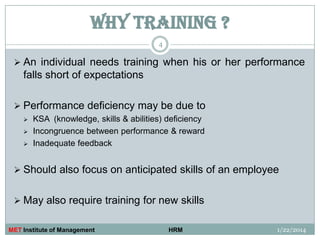
 An individual needs training when his or her performance

falls short of expectations
 Performance deficiency may be due to




KSA (knowledge, skills & abilities) deficiency
Incongruence between performance & reward
Inadequate feedback

 Should also focus on anticipated skills of an employee
 May also require training for new skills
MET Institute of Management

HRM

1/22/2014
NEEDS ASSESSMENT IN AN ORGANIZATION
5

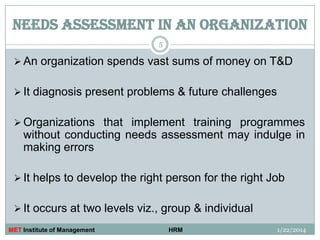
 An organization spends vast sums of money on T&D
 It diagnosis present problems & future challenges
 Organizations that implement training programmes

without conducting needs assessment may indulge in
making errors
 It helps to develop the right person for the right Job
 It occurs at two levels viz., group & individual
MET Institute of Management

HRM

1/22/2014
Needs assessment methods
6

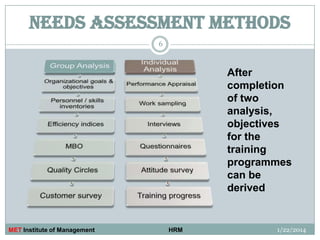
After
completion
of two
analysis,
objectives
for the
training
programmes
can be
derived

MET Institute of Management

HRM

1/22/2014
METHODS & TECHNIQUES OF TRAINING
7

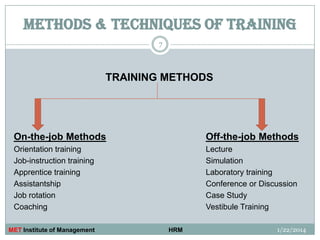
TRAINING METHODS

On-the-job Methods

Off-the-job Methods

Orientation training
Job-instruction training
Apprentice training
Assistantship
Job rotation
Coaching

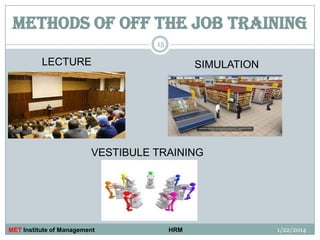
Lecture
Simulation
Laboratory training
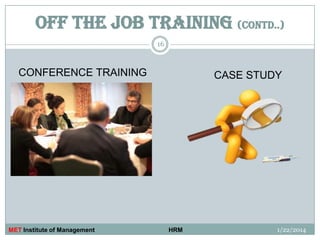
Conference or Discussion
Case Study
Vestibule Training

MET Institute of Management

HRM

1/22/2014
METHODS OF TRAINING (CONTD..)
8

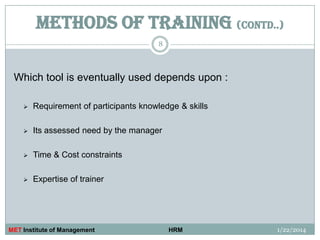
Which tool is eventually used depends upon :


Requirement of participants knowledge & skills



Its assessed need by the manager



Time & Cost constraints



Expertise of trainer

MET Institute of Management

HRM

1/22/2014
ON THE JOB TRAINING
9



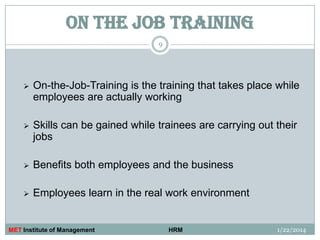
On-the-Job-Training is the training that takes place while
employees are actually working



Skills can be gained while trainees are carrying out their
jobs



Benefits both employees and the business



Employees learn in the real work environment

MET Institute of Management

HRM

1/22/2014
METHODS OF ON THE JOB TRAINING
10

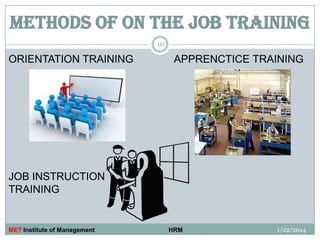
ORIENTATION TRAINING

APPRENCTICE TRAINING

JOB INSTRUCTION
TRAINING

MET Institute of Management

HRM

1/22/2014
ON THE JOB TRAINING (CONTD..)
11

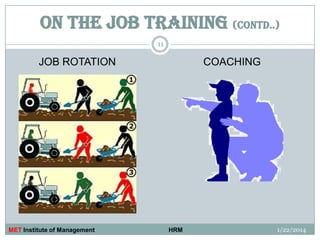
JOB ROTATION

MET Institute of Management

COACHING

HRM

1/22/2014
ON THE JOB TRAINING (contd..)
12

Advantages of On-the-Job Training:


It is directly in the context of job



It is often informal



It is most effective because it is learning by experience



It is least expensive



Trainees are highly motivated



Free from artificial classroom situations

MET Institute of Management

HRM

1/22/2014
ON THE JOB TRAINING (contd..)
13

Disadvantages of On-the-Job Training:


Trainer may not be experienced enough to train or he may not be so
inclined



It is not systematically organized



Poorly conducted programs may create safety hazards

MET Institute of Management

HRM

1/22/2014
OFF THE JOB TRAINING
14

 It refers to the training done on behalf of employers and is

usually conducted away from their working location
 Involves

theories and practical application, including
appraisal and examinations done at provider's site

 To improve the employees' level of work performance
 It is usually done via lectures and seminars

MET Institute of Management

HRM

1/22/2014
METHODS OF OFF THE JOB TRAINING
15

LECTURE

SIMULATION

VESTIBULE TRAINING

MET Institute of Management

HRM

1/22/2014
OFF THE JOB TRAINING (CONTD..)
16

CONFERENCE TRAINING

MET Institute of Management

CASE STUDY

HRM

1/22/2014
OFF THE JOB TRAINING (contd..)
17

 ADVANTAGES


Gets employees away from their work environment to a place where
their frustrations and bustle of work are eliminated



Can be a source to supply the latest information, current trends, skills
and techniques



Experts in their field would cover these courses, and this would mean
that training for staff members would be taught to a reasonable standard



Sending an employee on a course could help to make an employee feel
more valued as they would feel as if they are receiving quality training

MET Institute of Management

HRM

1/22/2014
OFF THE JOB TRAINING (contd..)
18

 DISADVANTAGES


The overall cost could prove quite expensive



No guarantee that sufficient skills of knowledge will be transferable or
valuable



The different learning speeds of individuals who are usually forced to
progress at a compromise rate



Not all the learners will be starting at the same knowledge or skill level

MET Institute of Management

HRM

1/22/2014
CAREER DEVELOPMENT
19

 Career Development is a formal approach
 Benefits both employees & the organization

 Adds value to themselves & to the company
 It looks at :


how individuals manage their careers within and between organizations



how organizations structure the career progress of their members

MET Institute of Management

HRM

1/22/2014
SUMMARY
20

 Training is confined to shop-floor workers, whereas Development

is meant for executives
 Training & Development provides specific skills, abilities & skills

and knowledge to employees
 It lends stability & flexibility to an organization
 Accident, scrap and damage to machinery can be avoided or

minimized
 Future needs of employees will be taken care by training &

development
MET Institute of Management

HRM

1/22/2014
1/22/2014
Training & Development

Training & Development

  • 1.
    PRESENTED BY : ROLLNO. MS. GILLIAN DOURADO 68 MR. NAVIN DUBEY 69 MR. BURHANUDDIN KACHWALA 76 MR. RAMLAVAT PATEL 89 MS. AAYUSHI TREHAN 115 MR. SAVIO MENEZES 117 1/22/2014
  • 2.
    WHAT WILL WELEARN ???  INTRODUCTION   TRAINING DEVELOPMENT  WHY TRAINING ?  WHY NEEDS ASSESSMENT ?  NEEDS ASSESSMENT METHODS  METHODS & TECHNIQUES OF TRAINING   ON-THE-JOB TRAINING OFF-THE-JOB TRAINING  CAREER DEVELOPMENT  SUMMARY 1/22/2014
  • 3.
    INTRODUCTION TO TRAINING 1 Training is :  a short term process  an activity based concept  skills are learned or relearned  aims to enhance individual effectiveness on the job  involving practical application of programmed knowledge MET Institute of Management HRM 1/22/2014
  • 4.
    INTRODUCTION - DEVELOPMENT 2 Development is less skill oriented  Focuses on knowledge about business environment, management principles & techniques, human relations, specific industry analysis  It involves –  Personality development  A long run intervention  Relates individuals to the organization in terms of goals, skills, attitudes, behaviors & values MET Institute of Management HRM 1/22/2014
  • 5.
    INTRODUCTION (contd..) 3  Training& Development are not synonymous terms Training Development Focus Current Job Current and Future Job Scope Individual Employees Work group or organisation Time Frame Immediate Long Term Goal Fix Skill Deficit Prepare for future work MET Institute of Management HRM 1/22/2014
  • 6.
    WHY TRAINING ? 4 An individual needs training when his or her performance falls short of expectations  Performance deficiency may be due to    KSA (knowledge, skills & abilities) deficiency Incongruence between performance & reward Inadequate feedback  Should also focus on anticipated skills of an employee  May also require training for new skills MET Institute of Management HRM 1/22/2014
  • 7.
    NEEDS ASSESSMENT INAN ORGANIZATION 5  An organization spends vast sums of money on T&D  It diagnosis present problems & future challenges  Organizations that implement training programmes without conducting needs assessment may indulge in making errors  It helps to develop the right person for the right Job  It occurs at two levels viz., group & individual MET Institute of Management HRM 1/22/2014
  • 8.
    Needs assessment methods 6 After completion oftwo analysis, objectives for the training programmes can be derived MET Institute of Management HRM 1/22/2014
  • 9.
    METHODS & TECHNIQUESOF TRAINING 7 TRAINING METHODS On-the-job Methods Off-the-job Methods Orientation training Job-instruction training Apprentice training Assistantship Job rotation Coaching Lecture Simulation Laboratory training Conference or Discussion Case Study Vestibule Training MET Institute of Management HRM 1/22/2014
  • 10.
    METHODS OF TRAINING(CONTD..) 8 Which tool is eventually used depends upon :  Requirement of participants knowledge & skills  Its assessed need by the manager  Time & Cost constraints  Expertise of trainer MET Institute of Management HRM 1/22/2014
  • 11.
    ON THE JOBTRAINING 9  On-the-Job-Training is the training that takes place while employees are actually working  Skills can be gained while trainees are carrying out their jobs  Benefits both employees and the business  Employees learn in the real work environment MET Institute of Management HRM 1/22/2014
  • 12.
    METHODS OF ONTHE JOB TRAINING 10 ORIENTATION TRAINING APPRENCTICE TRAINING JOB INSTRUCTION TRAINING MET Institute of Management HRM 1/22/2014
  • 13.
    ON THE JOBTRAINING (CONTD..) 11 JOB ROTATION MET Institute of Management COACHING HRM 1/22/2014
  • 14.
    ON THE JOBTRAINING (contd..) 12 Advantages of On-the-Job Training:  It is directly in the context of job  It is often informal  It is most effective because it is learning by experience  It is least expensive  Trainees are highly motivated  Free from artificial classroom situations MET Institute of Management HRM 1/22/2014
  • 15.
    ON THE JOBTRAINING (contd..) 13 Disadvantages of On-the-Job Training:  Trainer may not be experienced enough to train or he may not be so inclined  It is not systematically organized  Poorly conducted programs may create safety hazards MET Institute of Management HRM 1/22/2014
  • 16.
    OFF THE JOBTRAINING 14  It refers to the training done on behalf of employers and is usually conducted away from their working location  Involves theories and practical application, including appraisal and examinations done at provider's site  To improve the employees' level of work performance  It is usually done via lectures and seminars MET Institute of Management HRM 1/22/2014
  • 17.
    METHODS OF OFFTHE JOB TRAINING 15 LECTURE SIMULATION VESTIBULE TRAINING MET Institute of Management HRM 1/22/2014
  • 18.
    OFF THE JOBTRAINING (CONTD..) 16 CONFERENCE TRAINING MET Institute of Management CASE STUDY HRM 1/22/2014
  • 19.
    OFF THE JOBTRAINING (contd..) 17  ADVANTAGES  Gets employees away from their work environment to a place where their frustrations and bustle of work are eliminated  Can be a source to supply the latest information, current trends, skills and techniques  Experts in their field would cover these courses, and this would mean that training for staff members would be taught to a reasonable standard  Sending an employee on a course could help to make an employee feel more valued as they would feel as if they are receiving quality training MET Institute of Management HRM 1/22/2014
  • 20.
    OFF THE JOBTRAINING (contd..) 18  DISADVANTAGES  The overall cost could prove quite expensive  No guarantee that sufficient skills of knowledge will be transferable or valuable  The different learning speeds of individuals who are usually forced to progress at a compromise rate  Not all the learners will be starting at the same knowledge or skill level MET Institute of Management HRM 1/22/2014
  • 21.
    CAREER DEVELOPMENT 19  CareerDevelopment is a formal approach  Benefits both employees & the organization  Adds value to themselves & to the company  It looks at :  how individuals manage their careers within and between organizations  how organizations structure the career progress of their members MET Institute of Management HRM 1/22/2014
  • 22.
    SUMMARY 20  Training isconfined to shop-floor workers, whereas Development is meant for executives  Training & Development provides specific skills, abilities & skills and knowledge to employees  It lends stability & flexibility to an organization  Accident, scrap and damage to machinery can be avoided or minimized  Future needs of employees will be taken care by training & development MET Institute of Management HRM 1/22/2014
  • 23.