Talent Management Career Development & Succession Planning (CDSP) http://www.themanagementskills.com/
 
Integrated Approach Performance Management Succession  Planning Senior  Management Development BUSINESS STRATEGY BUSINESS RESULTS Training & Development Talent Management Rewards Management Recruitment & Selection Career  Management
Aim Foster a process of building leadership capability across the lines of business / support functions The emphasis is on developing a broad spectrum of talent within the management ranks so that the availability of internal talent will not be a constraint to the organization's strategic direction  Identify the key leadership success factors
Outcomes  Retention and development of high potential employees Builds internal staff capabilities (bench strength) for the emerging organizational demands Maps various succession options  Facilitates developmental moves across the organization  Establishes a professionally managed organization with the systems in place to ensure that it will have effective leaders going forward
Contemporary Issues: Changing Nature of Work & Organization Demographics (net-generation, diversity) Globalization Technology Redefined concept of ‘Loyalty’ Challenges in differentiating high performers from poor performers  Wanted Rapid career progression
Intelligent Career know why  (values attitudes, internal needs, identity and lifestyle);  know how  (career competencies, skills, expertise, capabilities, tacit, and explicit knowledge); know whom  (networking, relationships how to find right people) know what  (opportunities, threats & requirements),  know where  (entering, training and advancing) and  know when  (timing of choices and requirements)
Web - Career Work today is about expanding your web by making more connections (knowing more people) spinning stronger strands (gaining more experience and skills) A Web is flexible, expandable and you can always tear it down and build a new one elsewhere
Protean Career The career of the 21 st  century will be  protean A career that is driven by the person, not the organization, and that will be reinvented by the person from time to time, as the person and the environment change Characteristics Focus of  psychological  success rather than vertical success Life long series of identity changes and continuous learning Career age counts, not chronological age Job security replaced by goal of employability Sources of developments are work challenges and relationships
Talent Management Performance Management Succession  Planning Senior  Management Development BUSINESS STRATEGY BUSINESS RESULTS Training & Development Talent Management Rewards Management Recruitment & Selection Career  Management
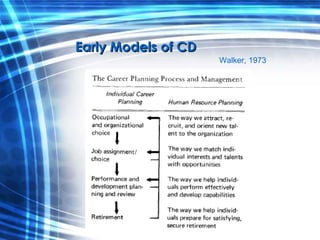
Early Models of CD Walker, 1973
Early Models of CD   (Cont.) Reif & Newstro, 1974
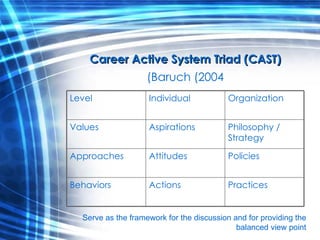
Career Active System Triad (CAST) Baruch (2004) Serve as the framework for the discussion and for providing the balanced view point Level Individual Organization Values Aspirations Philosophy / Strategy Approaches Attitudes Policies Behaviors Actions Practices
Elements of Career Management Individual (Self) Assessment of Abilities, Interests, career need and goals Organizational Assessment of employee abilities and potential Communication of information concerning career opportunities with the organization Career Counseling to set realistic goals and plan for their attainment http://www.themanagementskills.com/
Talent Management Performance Management Succession  Planning Senior  Management Development BUSINESS STRATEGY BUSINESS RESULTS Training & Development Talent Management Rewards Management Recruitment & Selection Career  Management
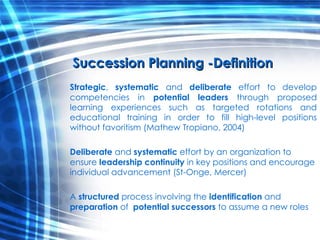
Succession Planning -Definition Strategic ,  systematic  and  deliberate  effort to develop competencies in  potential leaders  through proposed learning experiences such as targeted rotations and educational training in order to fill high-level positions without favoritism (Mathew Tropiano, 2004) Deliberate  and  systematic  effort by an organization to ensure  leadership continuity  in key positions and encourage individual advancement (St-Onge, Mercer) A  structured  process involving the  identification  and  preparation  of  potential successors  to assume a new roles
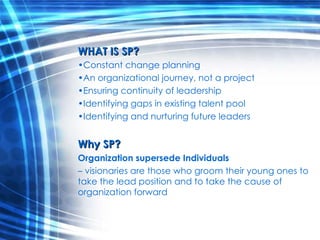
WHAT IS SP? Constant change planning An organizational journey, not a project Ensuring continuity of leadership Identifying gaps in existing talent pool Identifying and nurturing future leaders Why SP? Organization supersede Individuals  –  visionaries are those who groom their young ones to take the lead position and to take the cause of organization forward
Ref: Troopiano, 2004 CEO/ Leadership Commitment & Involvement Education and Training Self Development Competency driven Strategically Targeted Rotational Assignments Future Competencies Needed Aligned with Strategic Plan Results Talent Driven culture Accelerated Development Vision for future advancement Accountability Measurability Succession Planning Model
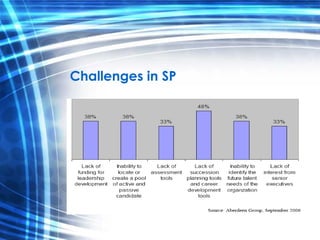
Challenges in SP
Benefits of SP Source: Aberdeen Group, September 2006 Tells about the extent to which leadership job openings can be filled from the internal pool the av. no. of qualified candidates for each leadership position the number of positions with two or more ‘ready now’ candidates  the attrition rate from the succession pool
Garman & Gllawe, 2004
Top level succession planning different Garman & Gllawe, 2004
Remember Succession plan may be expected practice – its absence is more a curse than its presence a blessing Succession program should limit their focus to linch-pin positions – those considered most critical to the organization’s need. http://www.themanagementskills.com/

Career Development & Succession Planning

  • 1.
    Talent Management CareerDevelopment & Succession Planning (CDSP) http://www.themanagementskills.com/
  • 2.
  • 3.
    Integrated Approach PerformanceManagement Succession Planning Senior Management Development BUSINESS STRATEGY BUSINESS RESULTS Training & Development Talent Management Rewards Management Recruitment & Selection Career Management
  • 4.
    Aim Foster aprocess of building leadership capability across the lines of business / support functions The emphasis is on developing a broad spectrum of talent within the management ranks so that the availability of internal talent will not be a constraint to the organization's strategic direction Identify the key leadership success factors
  • 5.
    Outcomes Retentionand development of high potential employees Builds internal staff capabilities (bench strength) for the emerging organizational demands Maps various succession options Facilitates developmental moves across the organization Establishes a professionally managed organization with the systems in place to ensure that it will have effective leaders going forward
  • 6.
    Contemporary Issues: ChangingNature of Work & Organization Demographics (net-generation, diversity) Globalization Technology Redefined concept of ‘Loyalty’ Challenges in differentiating high performers from poor performers Wanted Rapid career progression
  • 7.
    Intelligent Career knowwhy (values attitudes, internal needs, identity and lifestyle); know how (career competencies, skills, expertise, capabilities, tacit, and explicit knowledge); know whom (networking, relationships how to find right people) know what (opportunities, threats & requirements), know where (entering, training and advancing) and know when (timing of choices and requirements)
  • 8.
    Web - CareerWork today is about expanding your web by making more connections (knowing more people) spinning stronger strands (gaining more experience and skills) A Web is flexible, expandable and you can always tear it down and build a new one elsewhere
  • 9.
    Protean Career Thecareer of the 21 st century will be protean A career that is driven by the person, not the organization, and that will be reinvented by the person from time to time, as the person and the environment change Characteristics Focus of psychological success rather than vertical success Life long series of identity changes and continuous learning Career age counts, not chronological age Job security replaced by goal of employability Sources of developments are work challenges and relationships
  • 10.
    Talent Management PerformanceManagement Succession Planning Senior Management Development BUSINESS STRATEGY BUSINESS RESULTS Training & Development Talent Management Rewards Management Recruitment & Selection Career Management
  • 11.
    Early Models ofCD Walker, 1973
  • 12.
    Early Models ofCD (Cont.) Reif & Newstro, 1974
  • 13.
    Career Active SystemTriad (CAST) Baruch (2004) Serve as the framework for the discussion and for providing the balanced view point Level Individual Organization Values Aspirations Philosophy / Strategy Approaches Attitudes Policies Behaviors Actions Practices
  • 14.
    Elements of CareerManagement Individual (Self) Assessment of Abilities, Interests, career need and goals Organizational Assessment of employee abilities and potential Communication of information concerning career opportunities with the organization Career Counseling to set realistic goals and plan for their attainment http://www.themanagementskills.com/
  • 15.
    Talent Management PerformanceManagement Succession Planning Senior Management Development BUSINESS STRATEGY BUSINESS RESULTS Training & Development Talent Management Rewards Management Recruitment & Selection Career Management
  • 16.
    Succession Planning -DefinitionStrategic , systematic and deliberate effort to develop competencies in potential leaders through proposed learning experiences such as targeted rotations and educational training in order to fill high-level positions without favoritism (Mathew Tropiano, 2004) Deliberate and systematic effort by an organization to ensure leadership continuity in key positions and encourage individual advancement (St-Onge, Mercer) A structured process involving the identification and preparation of potential successors to assume a new roles
  • 17.
    WHAT IS SP?Constant change planning An organizational journey, not a project Ensuring continuity of leadership Identifying gaps in existing talent pool Identifying and nurturing future leaders Why SP? Organization supersede Individuals – visionaries are those who groom their young ones to take the lead position and to take the cause of organization forward
  • 18.
    Ref: Troopiano, 2004CEO/ Leadership Commitment & Involvement Education and Training Self Development Competency driven Strategically Targeted Rotational Assignments Future Competencies Needed Aligned with Strategic Plan Results Talent Driven culture Accelerated Development Vision for future advancement Accountability Measurability Succession Planning Model
  • 19.
  • 20.
    Benefits of SPSource: Aberdeen Group, September 2006 Tells about the extent to which leadership job openings can be filled from the internal pool the av. no. of qualified candidates for each leadership position the number of positions with two or more ‘ready now’ candidates the attrition rate from the succession pool
  • 21.
  • 22.
    Top level successionplanning different Garman & Gllawe, 2004
  • 23.
    Remember Succession planmay be expected practice – its absence is more a curse than its presence a blessing Succession program should limit their focus to linch-pin positions – those considered most critical to the organization’s need. http://www.themanagementskills.com/

Editor's Notes

  • #10 The protean person’s own personal career choices and search for self-fulfillment are the unifying or integrative elements in his/her life. The criterion of success is internal (psychological success), not external.
  • #14 CAST integrates individual and organizational focus to career development – it is an active system CAST is set at the three level of analysis – Values - The basic underlying level – the principle, ,orals, culture – forms the roots from which the other levels emerge. Approaches and assumptions – translates those values into the third level, Behavior - Action and practice.
  • #15 self-exploration and analysis – self assessment (e.g. workshops, tailor made work books by IBM, Xerox, GM & GE) – we can also develop same at our end Accurate assessment – AC, biographical information, PMS and current job history Informal or formal? Informal – employee learn about career development opportunities from their supervisors within the context of developmental performance appraisal and interviews. Formal – traditional/ behavioral career paths identified and communicated through work-books etc Possible career directions, possible career advancements, specific job vacancies Developmental performance appraisal interviews, identify gaps and developmental opportunities
  • #17 Structured – process having some reliable structure and/or custom and not ‘just-in-time’ identification of successor Identification & preparation -
  • #22 Link to strategy as more aspirational than actualized – even in best practice companies