1
Outline
Training & Development
Training Cycle
Step 1: Needs Analysis (Needs Assessment)
Step 2: Design & Develop Training Program
Step 3: Deliver the Training
Step 4: Training Evaluation
2
Training & Development
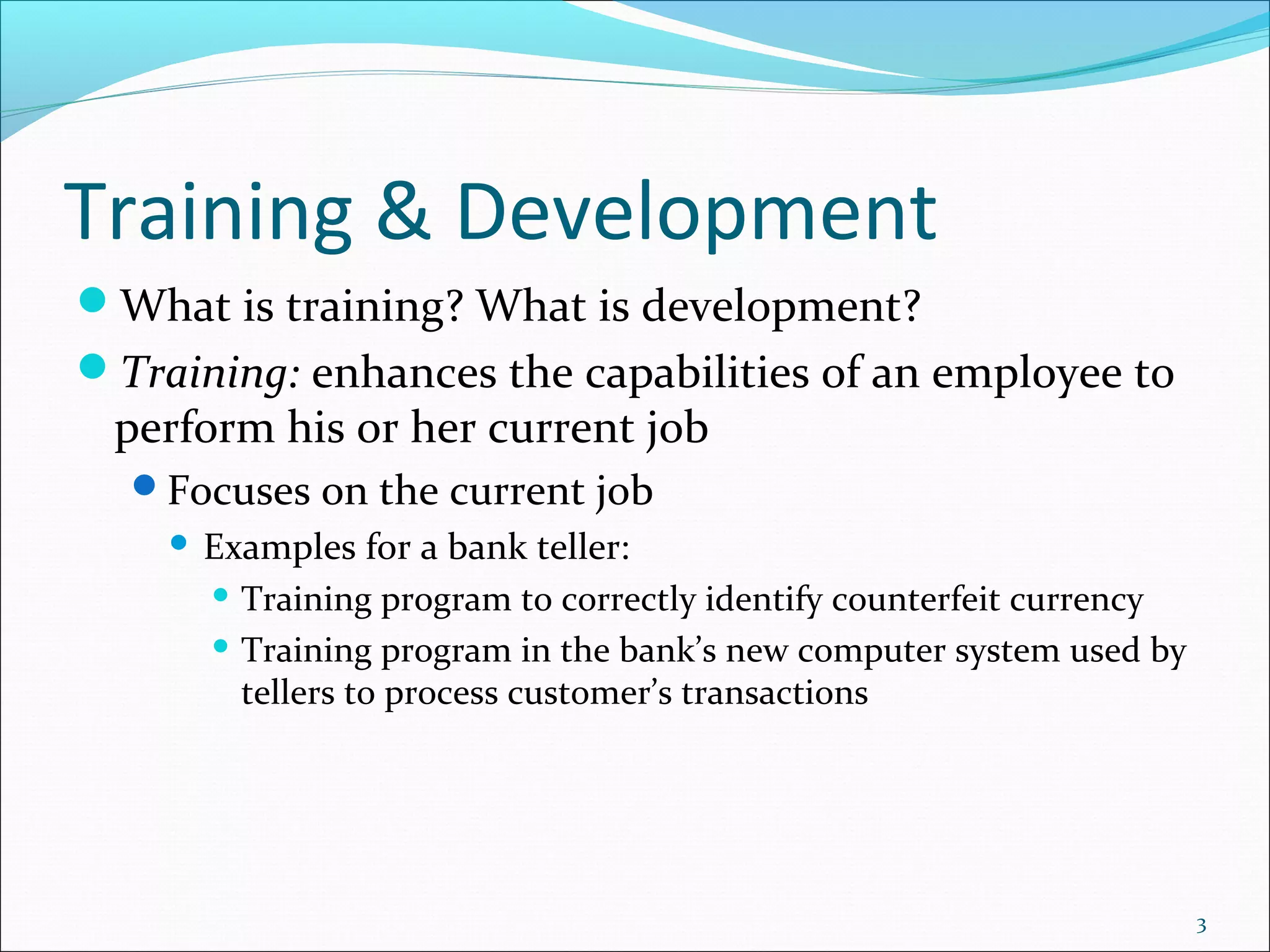
What is training? What is development?
Training: enhances the capabilities of an employee to
perform his or her current job
Focuses on the current job
 Examples for a bank teller:
 Training program to correctly identify counterfeit currency
 Training program in the bank’s new computer system used by
tellers to process customer’s transactions
3
Training & Development
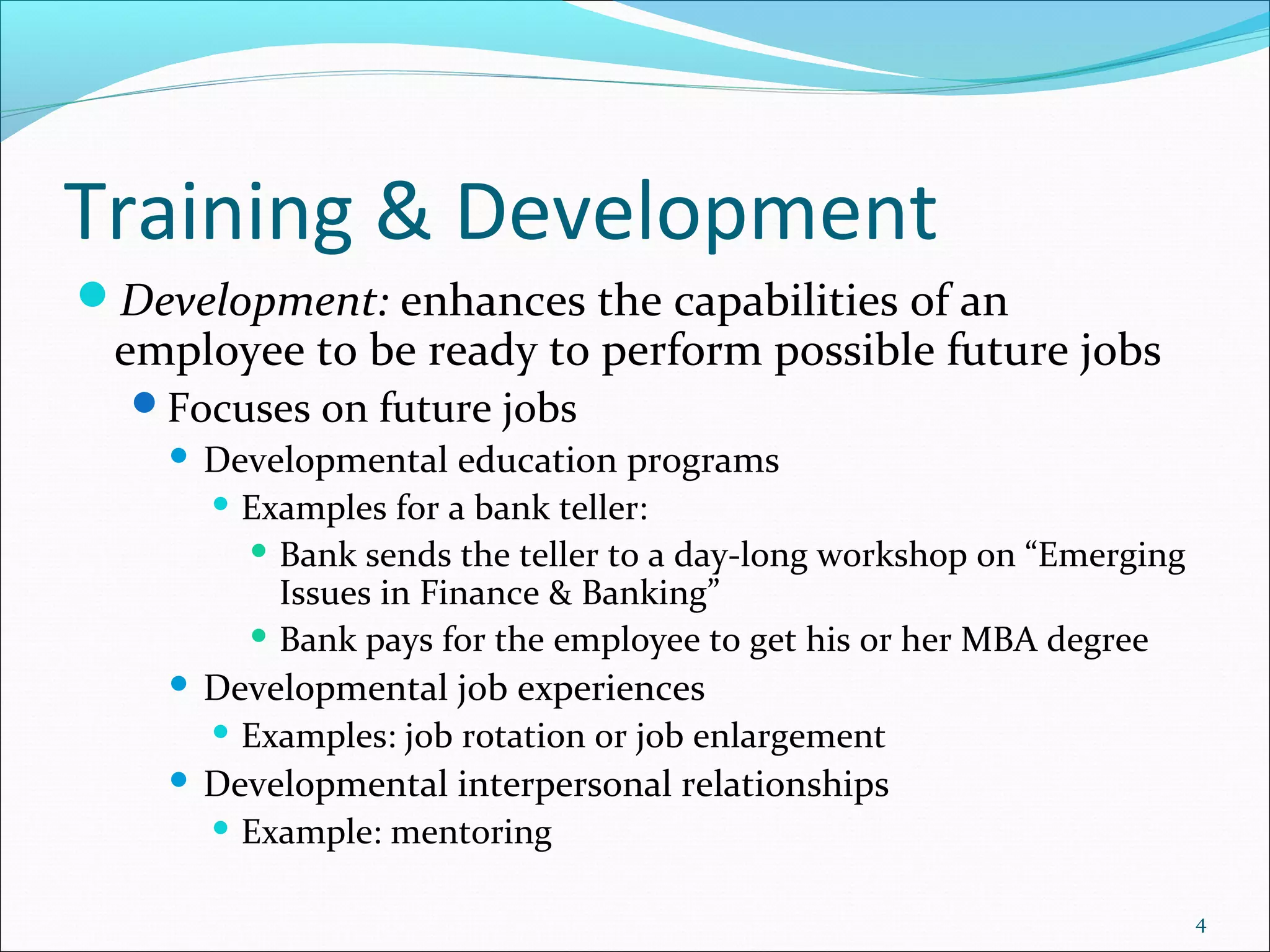
Development: enhances the capabilities of an
employee to be ready to perform possible future jobs
Focuses on future jobs
 Developmental education programs
 Examples for a bank teller:
 Bank sends the teller to a day-long workshop on “Emerging
Issues in Finance & Banking”
 Bank pays for the employee to get his or her MBA degree
 Developmental job experiences
 Examples: job rotation or job enlargement
 Developmental interpersonal relationships
 Example: mentoring
4
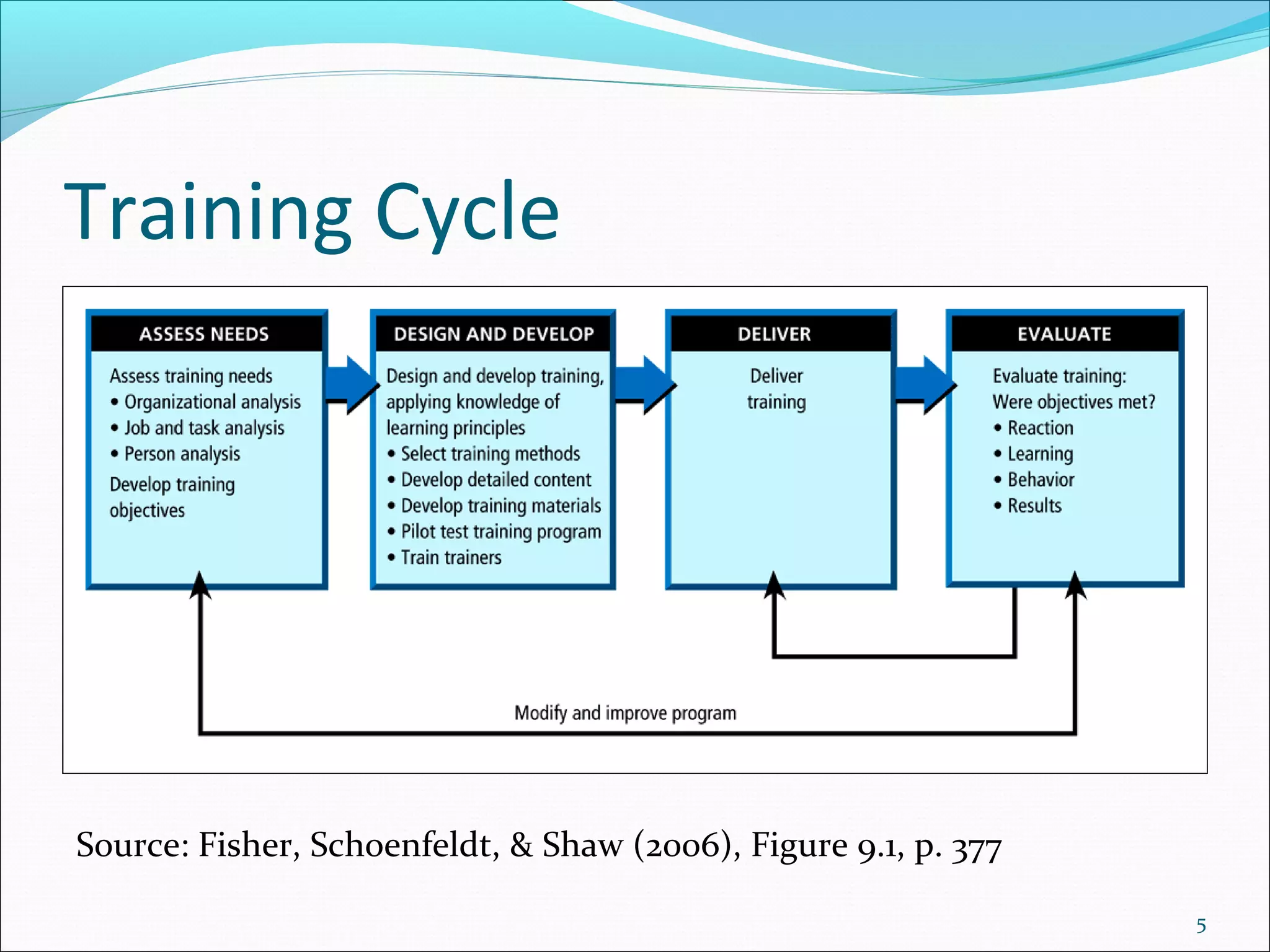
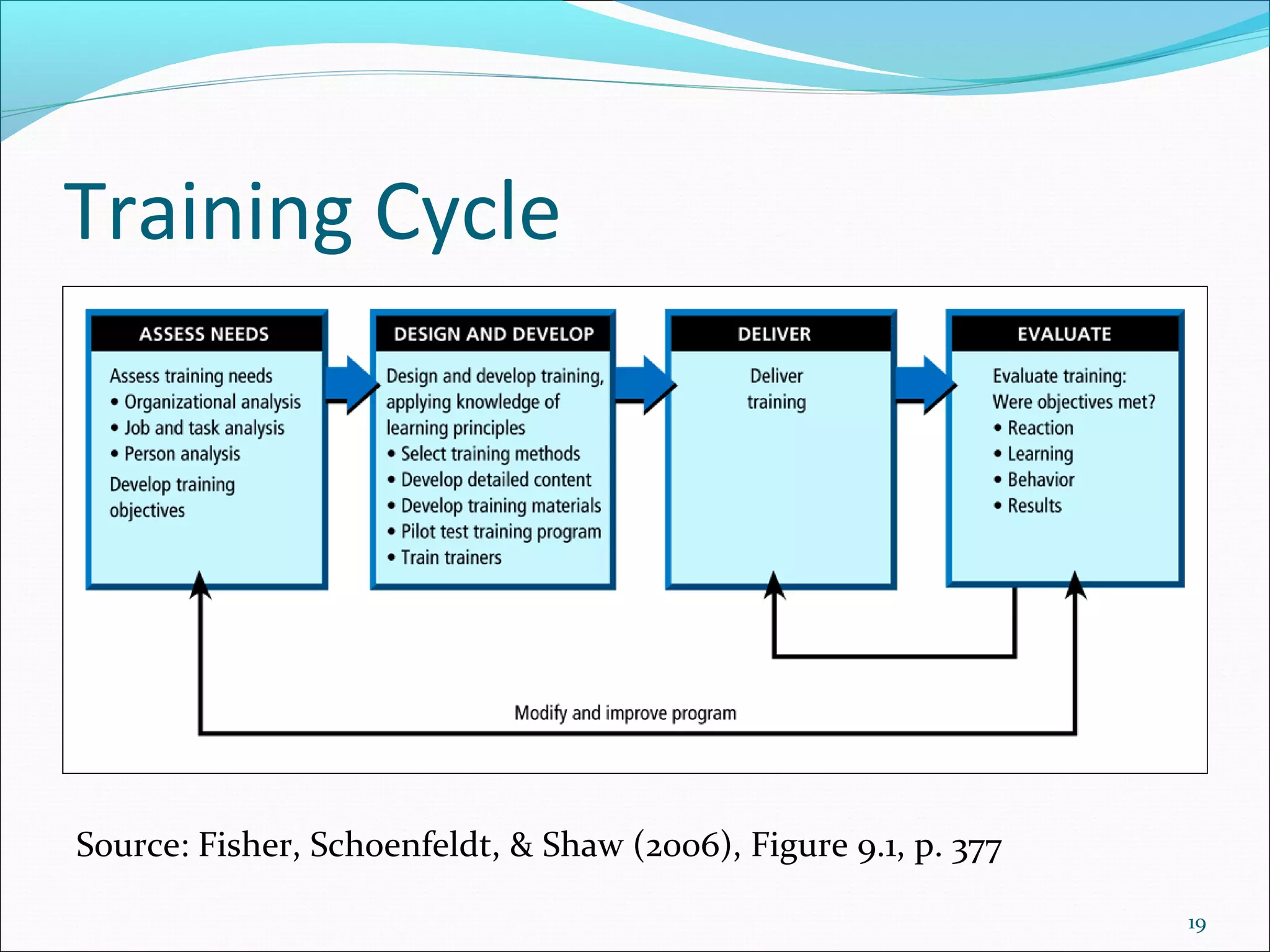
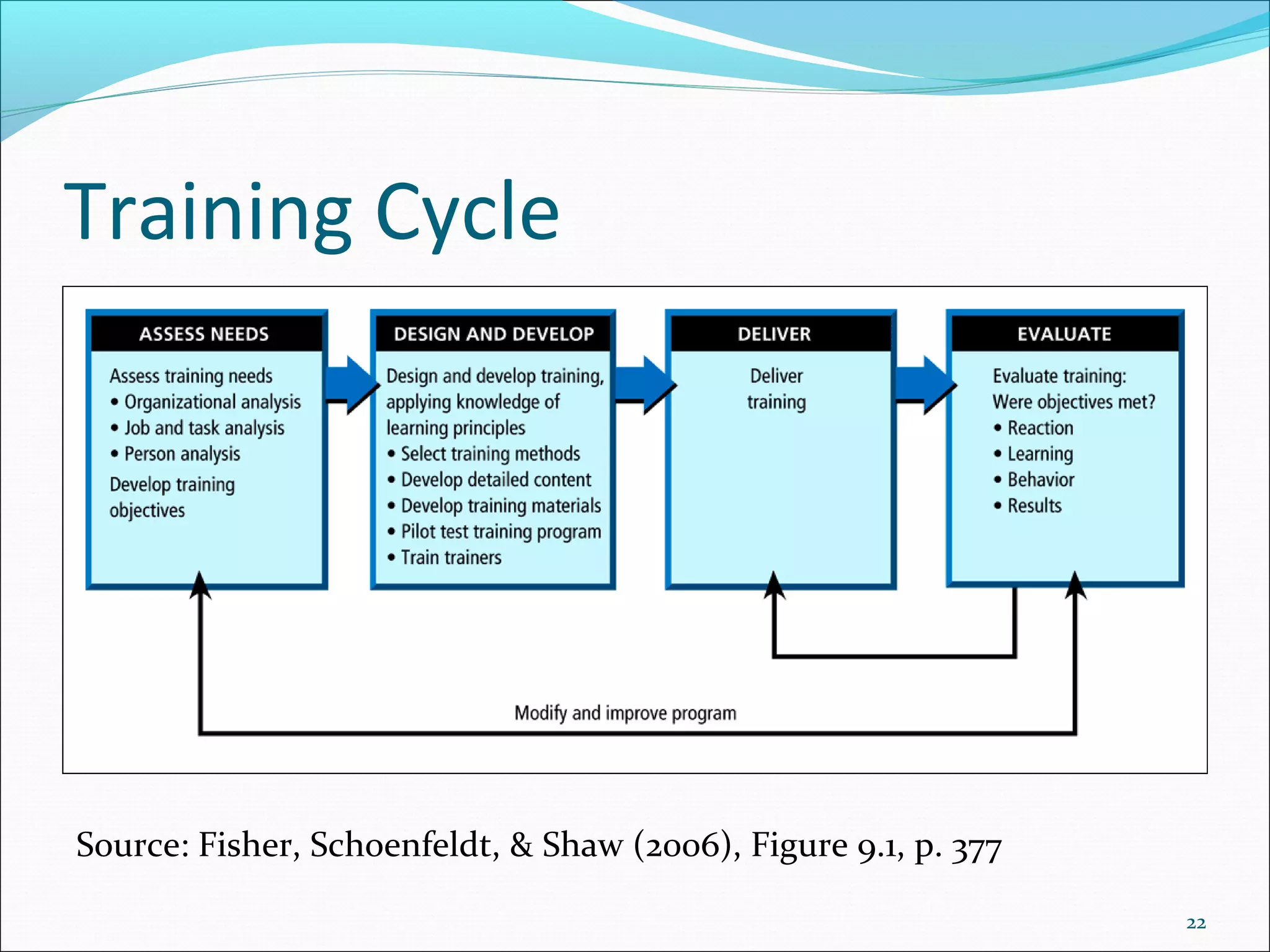
Training Cycle
Source: Fisher, Schoenfeldt, & Shaw (2006), Figure 9.1, p. 377
5
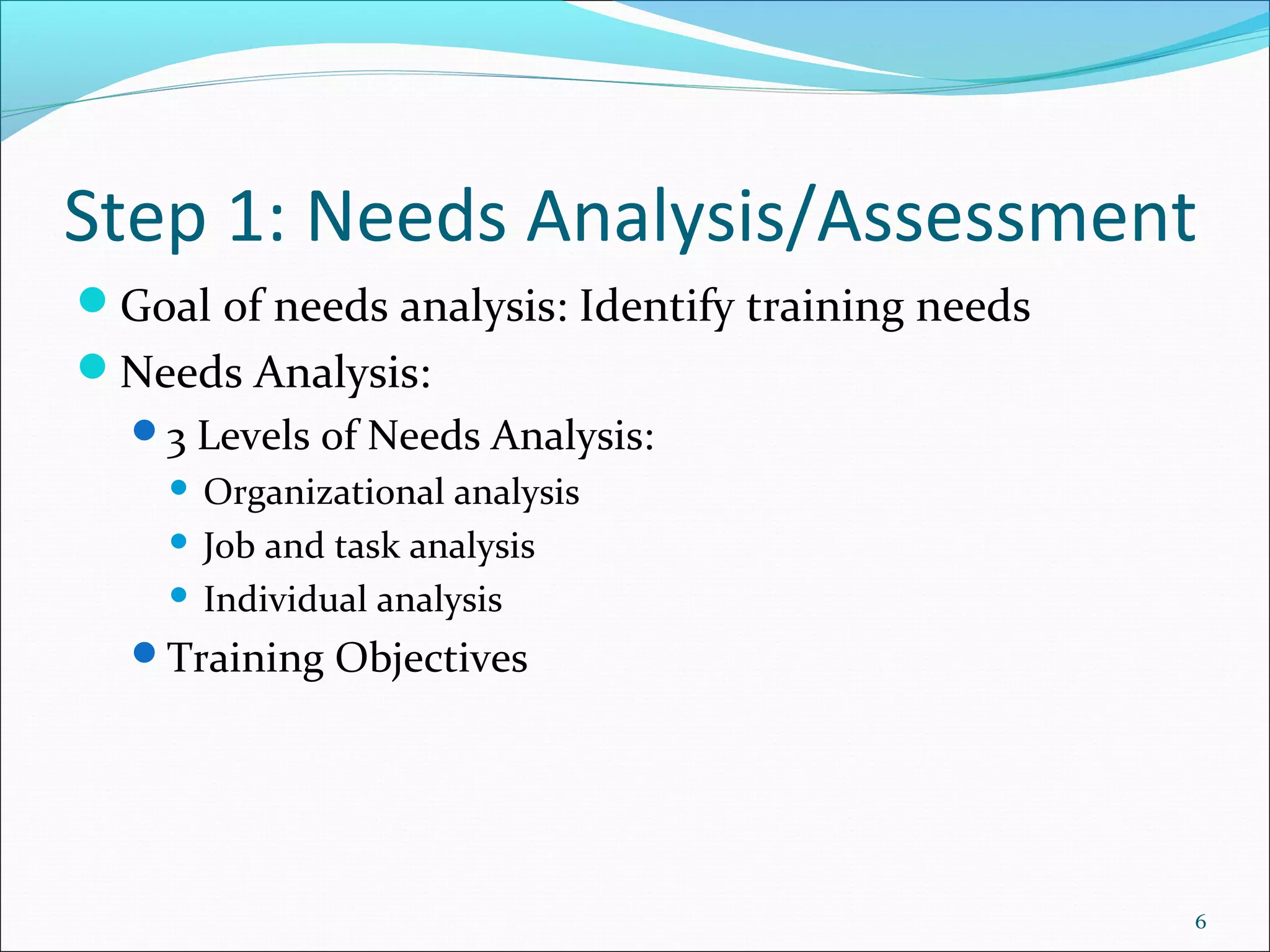
Step 1: Needs Analysis/Assessment
Goal of needs analysis: Identify training needs
Needs Analysis:
3 Levels of Needs Analysis:
 Organizational analysis
 Job and task analysis
 Individual analysis
Training Objectives
6
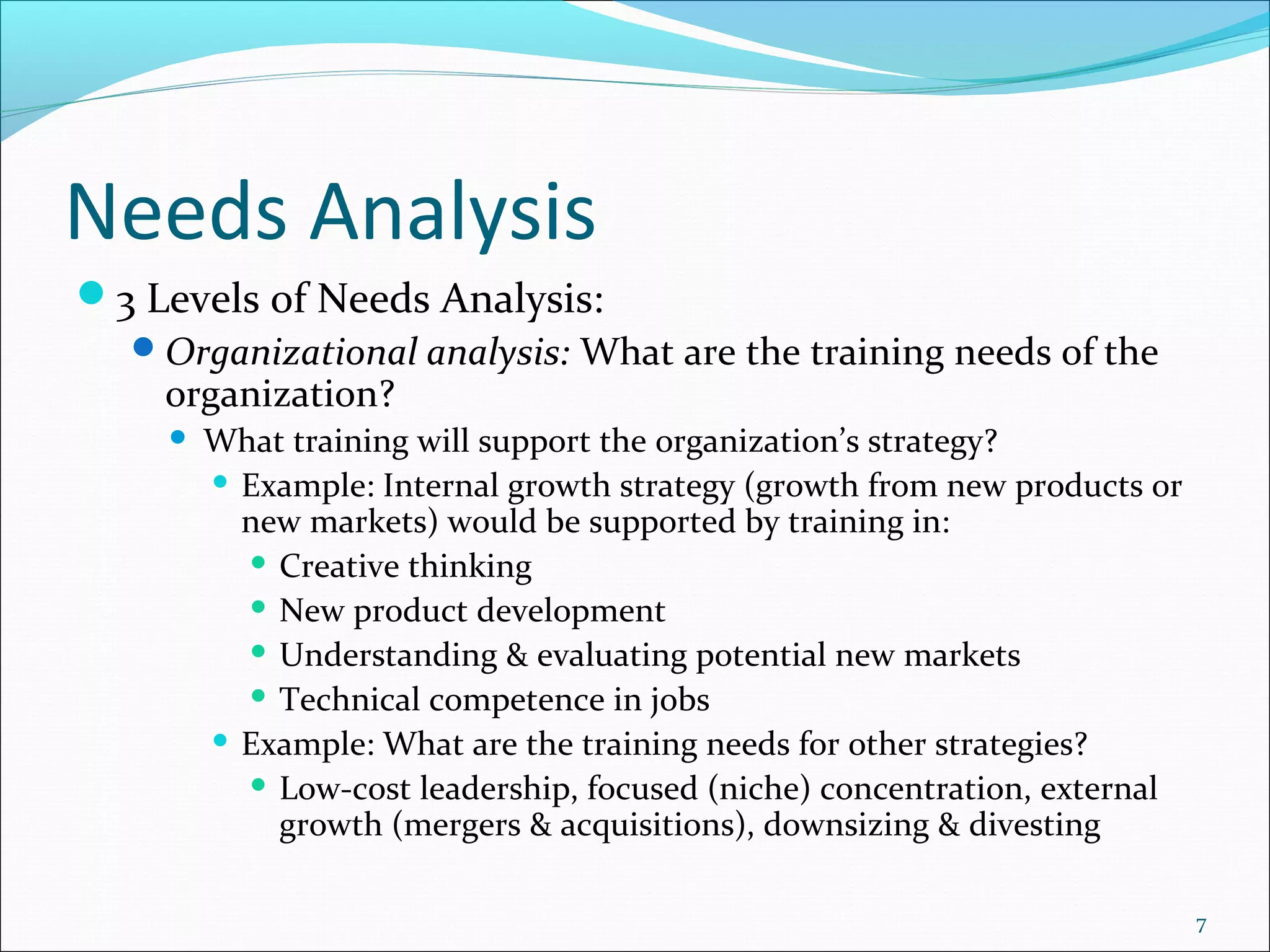
Needs Analysis
3 Levels of Needs Analysis:
Organizational analysis: What are the training needs of the
organization?
 What training will support the organization’s strategy?
 Example: Internal growth strategy (growth from new products or
new markets) would be supported by training in:
 Creative thinking
 New product development
 Understanding & evaluating potential new markets
 Technical competence in jobs
 Example: What are the training needs for other strategies?
 Low-cost leadership, focused (niche) concentration, external
growth (mergers & acquisitions), downsizing & divesting
7
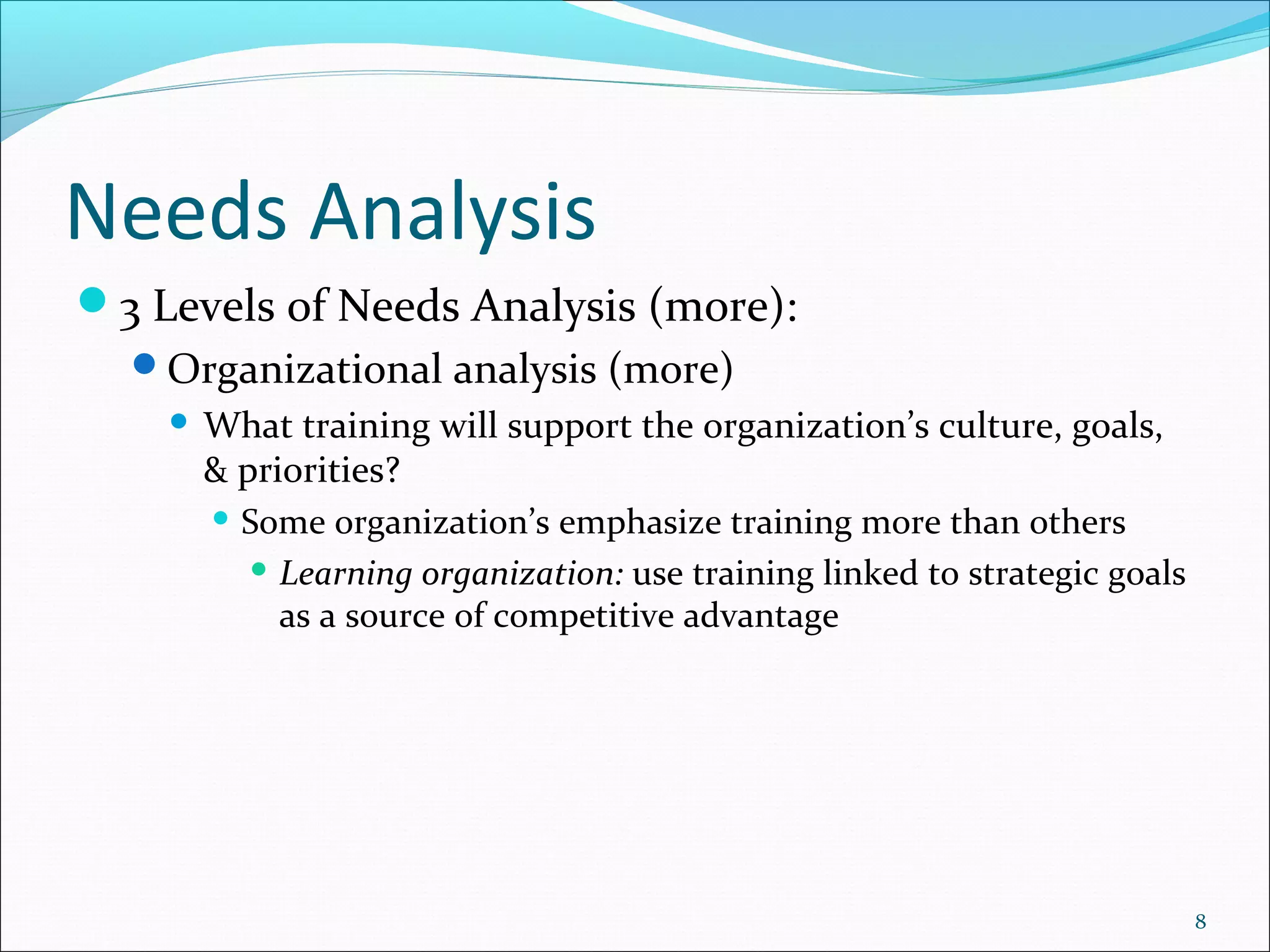
Needs Analysis
3 Levels of Needs Analysis (more):
Organizational analysis (more)
 What training will support the organization’s culture, goals,
& priorities?
 Some organization’s emphasize training more than others
 Learning organization: use training linked to strategic goals
as a source of competitive advantage
8
Needs Analysis
3 Levels of Needs Analysis (more):
Organizational analysis (more)
 Use benchmarks of organizational health & success to identify
training needs
 General examples:
 Headcount
 Productivity
 Costs
 Quality
 Specific examples for an airline:
 On-time rates
 Lost baggage rates
 Employee injury rates
9
Needs Analysis
3 Levels of Needs Analysis (more):
Job and task analysis: What are the training needs of
each job in the organization?
 Examine the job descriptions:
 What tasks & duties are performed by each job?
 For each task:
 Do new hires already know how to perform the task or will
they have to be trained? (Helps to identify training needs)
 What are the consequences of performing the task
incorrectly? (Helps to set training priorities)
 Can the task be learned on the job, or should it be taught
off the job? (Helps to identify training methods)
10
Needs Analysis
3 Levels of Needs Analysis (more):
Individual analysis: What are the training needs of each
individual employee in the organization?
 Examine each employee’s performance appraisal
 Do certain employees, or groups of employees, have job
performance that might be improved by training that is cost-
effective?
11
Needs Analysis
Training Objectives: Use the 3 levels of needs analysis
to establish the training objectives for the training
program
Training objectives answer the question: What will
employees be able to do as a consequence of the
training?
 Make the training objectives specific, concrete, & measurable
 Example for a bank teller training program in detecting
counterfeit currency:
 Identify counterfeit currency correctly 100% of the time
12
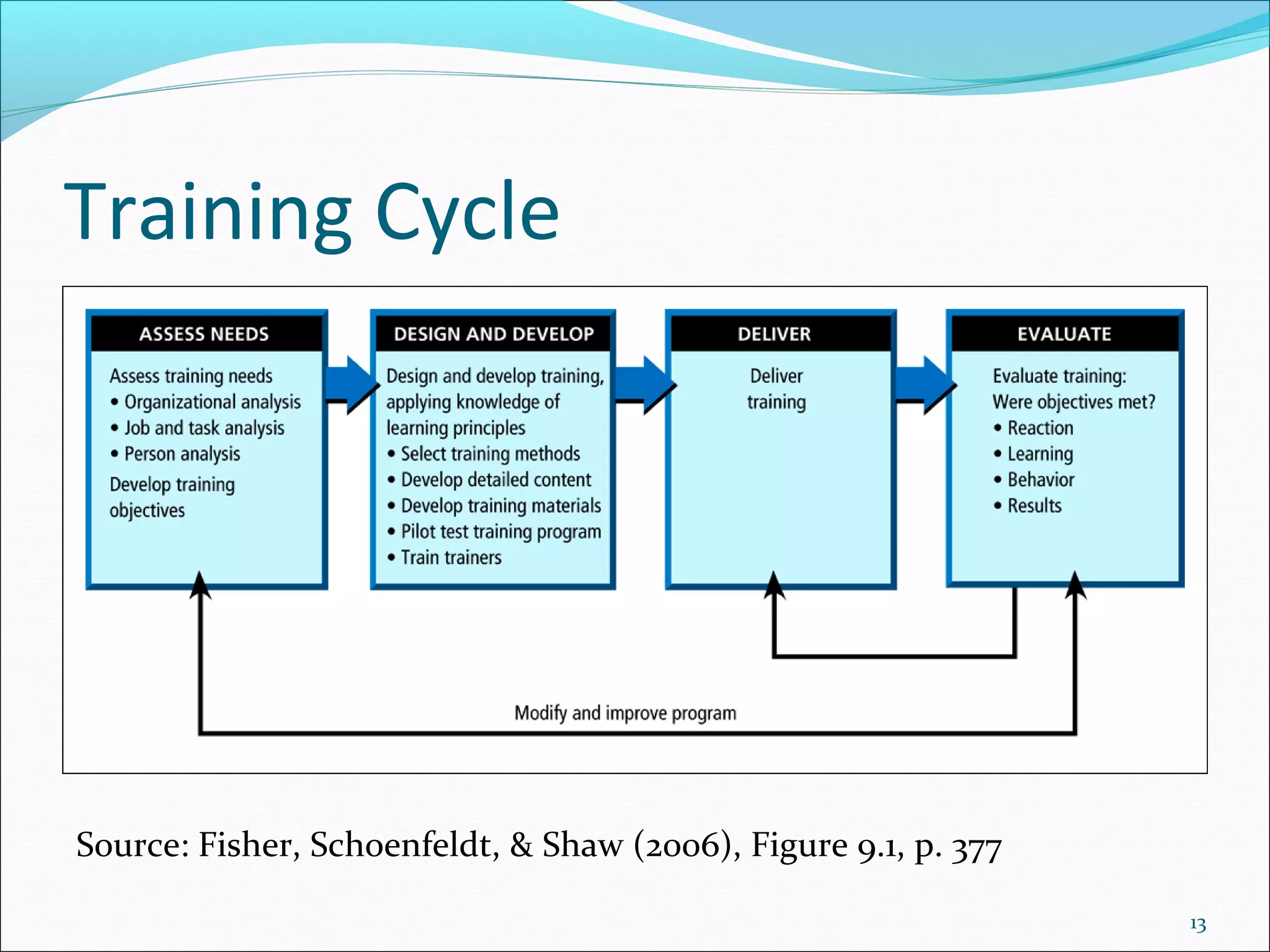
Training Cycle
Source: Fisher, Schoenfeldt, & Shaw (2006), Figure 9.1, p. 377
13
Step 2: Design & Develop Training
Program
3 Stages of Learning: Design the training program to
move employees up to Stage 3
Stage 1: Declarative knowledge (cognitive phase)
 Learn facts & concepts
 High demands on memory & attention
 Performance is slow & halting
 Errors are common
Stage 2: Knowledge compilation (associative phase)
 Performance begins to improve
 Reduced concentration is required
14
Design & Develop Training
Program
3 Stages of Learning (more):
Stage 3: Procedural knowledge (autonomous phase)
 Performance becomes automatic
 Performance is fluid & correct
 Little conscious concentration is required
15
Design & Develop Training
Program
Training Methods: decide which training method to use
On-the-job training (OJT): training is at the actual work site
using the actual work equipment
 Advantages:
 The training setting and the work setting are the same
 May reduce costs: avoid the cost of a separate training facility
 Enhances trainee motivation: job-relevancy of training is more
obvious to the trainees
 Disadvantages:
 May be disruptive to normal operations
 May have more distractions that interfere with learning
 May have safety concerns
16
Design & Develop Training
Program
Training Methods (more):
Off-the-job training: training takes place off the job at a
training facility designed for training
 Advantages:
 Avoids disruptions to normal operations
 Minimizes distractions
 Avoids safety concerns
 Disadvantages:
 Differences between the training setting and the work setting
 Costs may be higher due to the cost of the training facility
 Trainee motivation may be reduced because the job-relevancy
of the training is not as obvious
17
Design & Develop Training
Program
Training Methods (more):
Off-the-job training (more):
 Off-the-job training techniques:
 Lectures
 Discussions
 Cases
 Role-plays
 Simulations
18
Training Cycle
Source: Fisher, Schoenfeldt, & Shaw (2006), Figure 9.1, p. 377
19
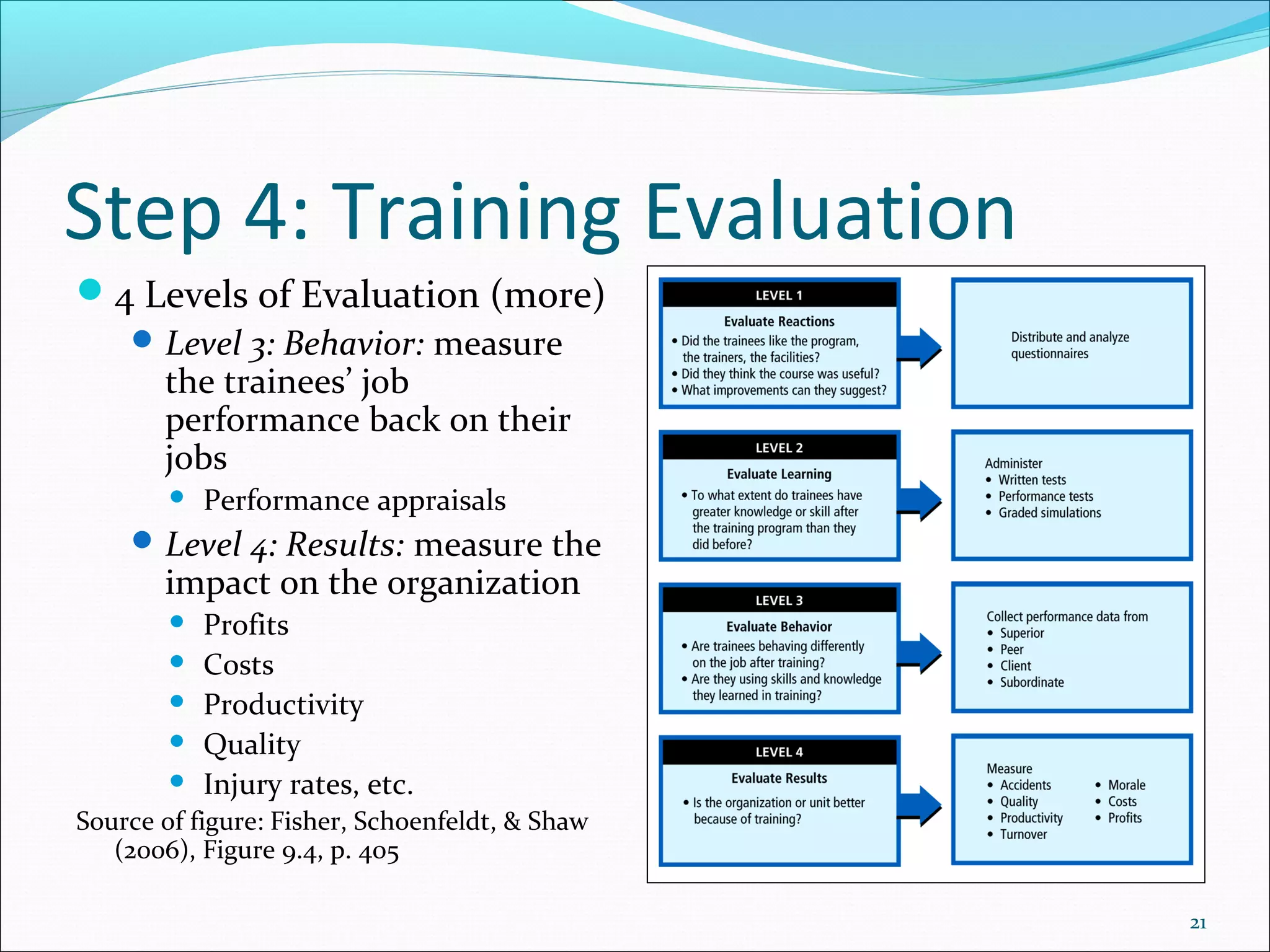
Step 4: Training Evaluation
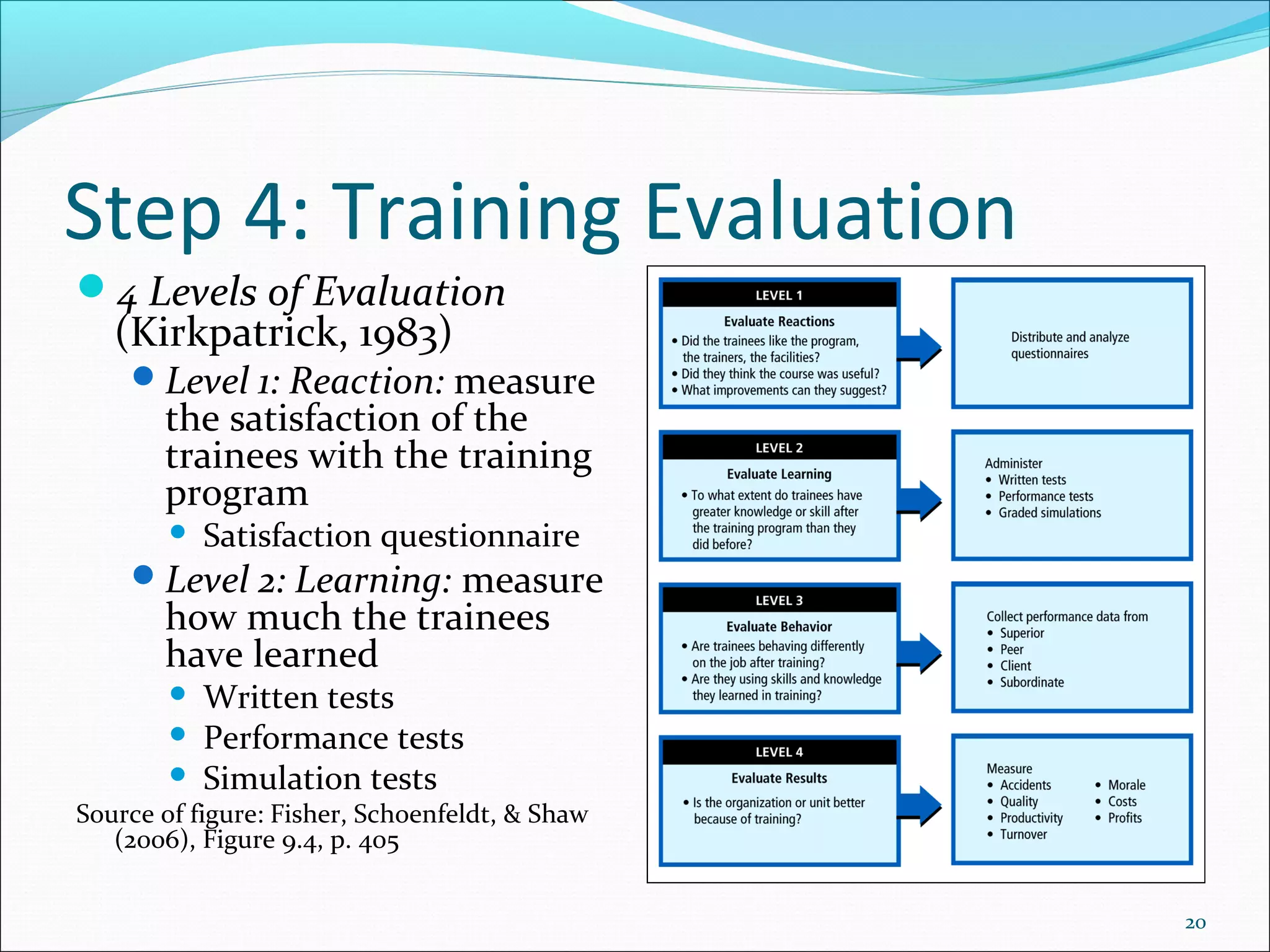
4 Levels of Evaluation
(Kirkpatrick, 1983)
Level 1: Reaction: measure
the satisfaction of the
trainees with the training
program
 Satisfaction questionnaire
Level 2: Learning: measure
how much the trainees
have learned
 Written tests
 Performance tests
 Simulation tests
Source of figure: Fisher, Schoenfeldt, & Shaw
(2006), Figure 9.4, p. 405
20
Step 4: Training Evaluation
4 Levels of Evaluation (more)
Level 3: Behavior: measure
the trainees’ job
performance back on their
jobs
 Performance appraisals
Level 4: Results: measure the
impact on the organization
 Profits
 Costs
 Productivity
 Quality
 Injury rates, etc.
Source of figure: Fisher, Schoenfeldt, & Shaw
(2006), Figure 9.4, p. 405
21
Training Cycle
Source: Fisher, Schoenfeldt, & Shaw (2006), Figure 9.1, p. 377
22
Outline
Training & Development
Training Cycle
Step 1: Needs Analysis (Needs Assessment)
Step 2: Design & Develop Training Program
Step 3: Deliver the Training
Step 4: Training Evaluation
23

Training and developmen 2

  • 1.
  • 2.
    Outline Training & Development TrainingCycle Step 1: Needs Analysis (Needs Assessment) Step 2: Design & Develop Training Program Step 3: Deliver the Training Step 4: Training Evaluation 2
  • 3.
    Training & Development Whatis training? What is development? Training: enhances the capabilities of an employee to perform his or her current job Focuses on the current job  Examples for a bank teller:  Training program to correctly identify counterfeit currency  Training program in the bank’s new computer system used by tellers to process customer’s transactions 3
  • 4.
    Training & Development Development:enhances the capabilities of an employee to be ready to perform possible future jobs Focuses on future jobs  Developmental education programs  Examples for a bank teller:  Bank sends the teller to a day-long workshop on “Emerging Issues in Finance & Banking”  Bank pays for the employee to get his or her MBA degree  Developmental job experiences  Examples: job rotation or job enlargement  Developmental interpersonal relationships  Example: mentoring 4
  • 5.
    Training Cycle Source: Fisher,Schoenfeldt, & Shaw (2006), Figure 9.1, p. 377 5
  • 6.
    Step 1: NeedsAnalysis/Assessment Goal of needs analysis: Identify training needs Needs Analysis: 3 Levels of Needs Analysis:  Organizational analysis  Job and task analysis  Individual analysis Training Objectives 6
  • 7.
    Needs Analysis 3 Levelsof Needs Analysis: Organizational analysis: What are the training needs of the organization?  What training will support the organization’s strategy?  Example: Internal growth strategy (growth from new products or new markets) would be supported by training in:  Creative thinking  New product development  Understanding & evaluating potential new markets  Technical competence in jobs  Example: What are the training needs for other strategies?  Low-cost leadership, focused (niche) concentration, external growth (mergers & acquisitions), downsizing & divesting 7
  • 8.
    Needs Analysis 3 Levelsof Needs Analysis (more): Organizational analysis (more)  What training will support the organization’s culture, goals, & priorities?  Some organization’s emphasize training more than others  Learning organization: use training linked to strategic goals as a source of competitive advantage 8
  • 9.
    Needs Analysis 3 Levelsof Needs Analysis (more): Organizational analysis (more)  Use benchmarks of organizational health & success to identify training needs  General examples:  Headcount  Productivity  Costs  Quality  Specific examples for an airline:  On-time rates  Lost baggage rates  Employee injury rates 9
  • 10.
    Needs Analysis 3 Levelsof Needs Analysis (more): Job and task analysis: What are the training needs of each job in the organization?  Examine the job descriptions:  What tasks & duties are performed by each job?  For each task:  Do new hires already know how to perform the task or will they have to be trained? (Helps to identify training needs)  What are the consequences of performing the task incorrectly? (Helps to set training priorities)  Can the task be learned on the job, or should it be taught off the job? (Helps to identify training methods) 10
  • 11.
    Needs Analysis 3 Levelsof Needs Analysis (more): Individual analysis: What are the training needs of each individual employee in the organization?  Examine each employee’s performance appraisal  Do certain employees, or groups of employees, have job performance that might be improved by training that is cost- effective? 11
  • 12.
    Needs Analysis Training Objectives:Use the 3 levels of needs analysis to establish the training objectives for the training program Training objectives answer the question: What will employees be able to do as a consequence of the training?  Make the training objectives specific, concrete, & measurable  Example for a bank teller training program in detecting counterfeit currency:  Identify counterfeit currency correctly 100% of the time 12
  • 13.
    Training Cycle Source: Fisher,Schoenfeldt, & Shaw (2006), Figure 9.1, p. 377 13
  • 14.
    Step 2: Design& Develop Training Program 3 Stages of Learning: Design the training program to move employees up to Stage 3 Stage 1: Declarative knowledge (cognitive phase)  Learn facts & concepts  High demands on memory & attention  Performance is slow & halting  Errors are common Stage 2: Knowledge compilation (associative phase)  Performance begins to improve  Reduced concentration is required 14
  • 15.
    Design & DevelopTraining Program 3 Stages of Learning (more): Stage 3: Procedural knowledge (autonomous phase)  Performance becomes automatic  Performance is fluid & correct  Little conscious concentration is required 15
  • 16.
    Design & DevelopTraining Program Training Methods: decide which training method to use On-the-job training (OJT): training is at the actual work site using the actual work equipment  Advantages:  The training setting and the work setting are the same  May reduce costs: avoid the cost of a separate training facility  Enhances trainee motivation: job-relevancy of training is more obvious to the trainees  Disadvantages:  May be disruptive to normal operations  May have more distractions that interfere with learning  May have safety concerns 16
  • 17.
    Design & DevelopTraining Program Training Methods (more): Off-the-job training: training takes place off the job at a training facility designed for training  Advantages:  Avoids disruptions to normal operations  Minimizes distractions  Avoids safety concerns  Disadvantages:  Differences between the training setting and the work setting  Costs may be higher due to the cost of the training facility  Trainee motivation may be reduced because the job-relevancy of the training is not as obvious 17
  • 18.
    Design & DevelopTraining Program Training Methods (more): Off-the-job training (more):  Off-the-job training techniques:  Lectures  Discussions  Cases  Role-plays  Simulations 18
  • 19.
    Training Cycle Source: Fisher,Schoenfeldt, & Shaw (2006), Figure 9.1, p. 377 19
  • 20.
    Step 4: TrainingEvaluation 4 Levels of Evaluation (Kirkpatrick, 1983) Level 1: Reaction: measure the satisfaction of the trainees with the training program  Satisfaction questionnaire Level 2: Learning: measure how much the trainees have learned  Written tests  Performance tests  Simulation tests Source of figure: Fisher, Schoenfeldt, & Shaw (2006), Figure 9.4, p. 405 20
  • 21.
    Step 4: TrainingEvaluation 4 Levels of Evaluation (more) Level 3: Behavior: measure the trainees’ job performance back on their jobs  Performance appraisals Level 4: Results: measure the impact on the organization  Profits  Costs  Productivity  Quality  Injury rates, etc. Source of figure: Fisher, Schoenfeldt, & Shaw (2006), Figure 9.4, p. 405 21
  • 22.
    Training Cycle Source: Fisher,Schoenfeldt, & Shaw (2006), Figure 9.1, p. 377 22
  • 23.
    Outline Training & Development TrainingCycle Step 1: Needs Analysis (Needs Assessment) Step 2: Design & Develop Training Program Step 3: Deliver the Training Step 4: Training Evaluation 23