Training and Developing Employees
HRM
Chapter 4
2
Chapter outlines
 Why do we Need Training?
 What is Training & Training Principles?
 A Systematic Approach to Training
 A Training Lesson Plan
3
Do Organizations Need Training
 The answer is “YES”
 However, we must
know the purpose and
functions of training
before we can use it.
4
What is Training?
 Training and development is a function of
human resource management concerned with
organizational activity aimed at bettering the
performance of individuals and groups in
organizational settings.
 It has been known by several names,
including "human resource development",
and "learning and development".
5
Differences between Training &
Development
 Training is short term, task oriented and targeted
on achieving a change of attitude, skills and
knowledge in a specific area. It is usually job
related.
 Development is a long term investment in human
resources.
6
Importance of Training
 Achieves high service standards
 Refreshes memory of old employees
 Achieves learning about new things; technology,
products / service delivery
 Reduces mistakes - minimizing costs
 Opportunity for staff to feedback / suggest
improvements
 Improves communication & relationships - better
teamwork
7
Benefits of Training
 Most training is targeted to ensure trainees “learn”
something they apply to their job.
 Increased job satisfaction and morale among
employees.
 Increased employee motivation.
 Increased capacity to adopt new technologies and
methods.
 Reduced employee turnover.
 Increased efficiencies in processes, resulting in
financial gain.
8
The ASK Concept
 If we follow the GAP concept, training is simply
a means to use activities to fill the gaps of
performance between the actual results and the
expected results.
 This GAP can be separated into 3 main topics:
1. Attitude
2. Skills
3. Knowledge
TYPES OF TRAINING:
 Induction or orientation training : Induction is concerned
with introducing or orienting a new employees to the
organization and its procedures, rules and regulations. When
a new employee reports to work, he must be helped to get
acquainted with the work environment and fellow
employees.it is very short informative training given after
recruitment .It creates a feeling of involvement in the minds
of newly appointed employees
9
Continued
 job training: Job training relates to a specific job that the
worker has to handle.
 It gives information about machines, the process of
production, instructions to be followed, methods to be used,
and so on.
 It develops skills and confidence among the workers and
enables them to perform the job efficiently. Job training is
the most common of formal in plant training programmes.
 It is necessary for the new employees to acquaint them with
the jobs they are expected to perform
10
Continued
 Refresher training or retraining: The
refresher training is meant for the old
employees of the enterprises. The basic
purpose of refresher training is to acquaint the
existing workforce with the latest methods of
performing their jobs and improve their
efficiency further.
 Retraining programs are designed to avoid
personnel obsolescence. 11
Continued
 Internship training: Under this method, the
educational or vocational institute enters into
an arrangement with an industrial enterprise
for providing practical knowledge, to its
students.
 Internship training is usually meant for such
vocations where advanced theoretical
knowledge is to be backed up by practical
experience on the job 12
Continued
 Apprenticeship training: Apprenticeship training is a
process by which people become skilled workers, usually
through a combination of formal learning and long-term on-
the-job training.
 The Apprenticeship Training program is a combination of
on-the-job training and classroom training,
13
14
A Systematic Approach to Training
Key Concepts in Preparing a Training Plan
Before you train and develop people identify what:
 They must know - before they can perform job
 They should know - to improve performance
 Would be nice for them to know – but not
necessary to perform duties.
15
Model of the Training Process
Assessment Stage Training Stage Evaluation Stage
Organizational
Needs Assessment
Task Need Assessment
Development of
Training Objectives
Design & Select
Procedures
Measure Training
Results
Development of
Criteria for Training
Evaluation
Train Compare Results to
Criteria
Feedback
16
Nine Steps in the Training Process
1. Assessing training needs
2. Preparing training plan
3. Specifying training objectives
4. Designing the training program(s)
5. Selecting the instructional methods
6. Completing the training plan
7. Implementing the training program
8. Evaluating the training
9. Planning future training
17
Training Calendar Example
1 2 3 4 5 6 7...
Attitude
Train the trainer
Job competency
Sales techniques
Telephone manner
…
Training Area Month in the year
18
3) Specifying Training Objectives
Training Objectives must be specific & measurable.
Why? Very difficult to measure effectiveness after
course is finished.
 What should trainees be able to accomplish after
participating in the training program?
 What is the desired level of such accomplishment,
according to industry or organizational standards?
 Do you want to develop attitudes, skills, knowledge or
some combination of these three?
19
4) Designing the Training Program(s)
1. Program duration
2. Program structure
3. Instruction methods
4. Trainers qualification
5. Nature of trainees
6. Support resources –
materials, classroom
7. Training location &
environment
8. Criteria & methods
for assessing
participant learning
and achievement
9. Criteria & methods
for evaluating the
program
20
5) Selecting Instructional Methods
On-the job-training (OJT)
 learn while you’re working
Off -the job-training
 In house, training or classroom
 External, consultancies or attending external classes
 Independent bodies, such as government talks
 Distance learning, from books or notes
 Computer-assisted learning
 Interactive-video training
 Video conferencing, same as classroom except teachers and
students are in different locations.
21
6) Completing the Training Plan
 Topic – Knowledge , skill or attitude ingredient
 Method – direct (one way communication) or
indirect (discussion, games, experimental
exercises…). Important as evaluation of trainees
usually lies on the perception on what they did in the
training session
 Time – length, period, breaks important to consider
 Location – away from the office?
22
7) Implementing the Training Program
Besides trainers qualifications and experience:
 Participant selection
 Group comfort - physical & psychological
 Trainer enthusiasm & skills
 Effective communication
 Feedback mechanism
 The need to learn new training skills
 Preparation by trainers
23
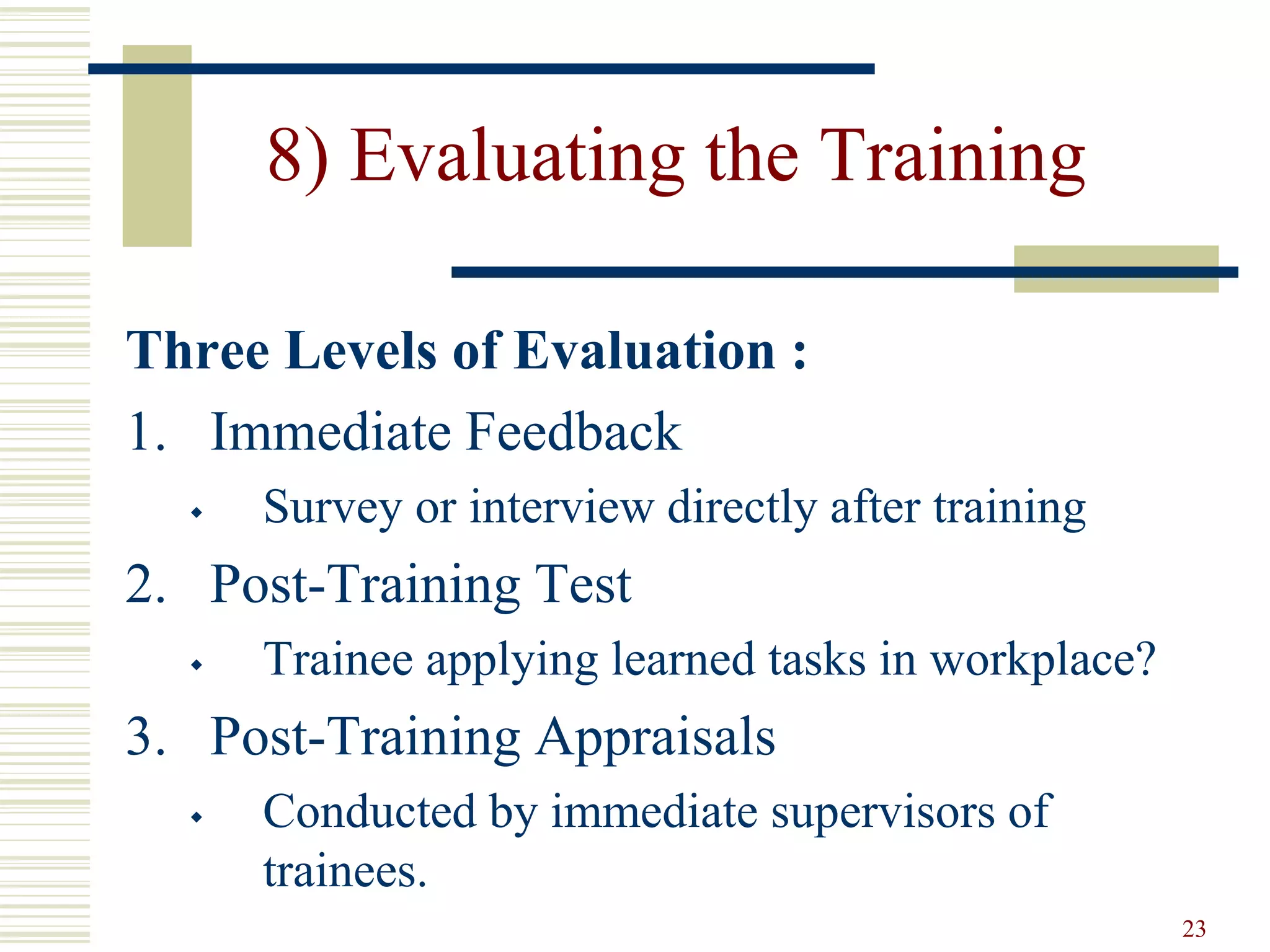
8) Evaluating the Training
Three Levels of Evaluation :
1. Immediate Feedback
 Survey or interview directly after training
2. Post-Training Test
 Trainee applying learned tasks in workplace?
3. Post-Training Appraisals
 Conducted by immediate supervisors of
trainees.

HRM COURSE Training.ppt

  • 1.
    Training and DevelopingEmployees HRM Chapter 4
  • 2.
    2 Chapter outlines  Whydo we Need Training?  What is Training & Training Principles?  A Systematic Approach to Training  A Training Lesson Plan
  • 3.
    3 Do Organizations NeedTraining  The answer is “YES”  However, we must know the purpose and functions of training before we can use it.
  • 4.
    4 What is Training? Training and development is a function of human resource management concerned with organizational activity aimed at bettering the performance of individuals and groups in organizational settings.  It has been known by several names, including "human resource development", and "learning and development".
  • 5.
    5 Differences between Training& Development  Training is short term, task oriented and targeted on achieving a change of attitude, skills and knowledge in a specific area. It is usually job related.  Development is a long term investment in human resources.
  • 6.
    6 Importance of Training Achieves high service standards  Refreshes memory of old employees  Achieves learning about new things; technology, products / service delivery  Reduces mistakes - minimizing costs  Opportunity for staff to feedback / suggest improvements  Improves communication & relationships - better teamwork
  • 7.
    7 Benefits of Training Most training is targeted to ensure trainees “learn” something they apply to their job.  Increased job satisfaction and morale among employees.  Increased employee motivation.  Increased capacity to adopt new technologies and methods.  Reduced employee turnover.  Increased efficiencies in processes, resulting in financial gain.
  • 8.
    8 The ASK Concept If we follow the GAP concept, training is simply a means to use activities to fill the gaps of performance between the actual results and the expected results.  This GAP can be separated into 3 main topics: 1. Attitude 2. Skills 3. Knowledge
  • 9.
    TYPES OF TRAINING: Induction or orientation training : Induction is concerned with introducing or orienting a new employees to the organization and its procedures, rules and regulations. When a new employee reports to work, he must be helped to get acquainted with the work environment and fellow employees.it is very short informative training given after recruitment .It creates a feeling of involvement in the minds of newly appointed employees 9
  • 10.
    Continued  job training:Job training relates to a specific job that the worker has to handle.  It gives information about machines, the process of production, instructions to be followed, methods to be used, and so on.  It develops skills and confidence among the workers and enables them to perform the job efficiently. Job training is the most common of formal in plant training programmes.  It is necessary for the new employees to acquaint them with the jobs they are expected to perform 10
  • 11.
    Continued  Refresher trainingor retraining: The refresher training is meant for the old employees of the enterprises. The basic purpose of refresher training is to acquaint the existing workforce with the latest methods of performing their jobs and improve their efficiency further.  Retraining programs are designed to avoid personnel obsolescence. 11
  • 12.
    Continued  Internship training:Under this method, the educational or vocational institute enters into an arrangement with an industrial enterprise for providing practical knowledge, to its students.  Internship training is usually meant for such vocations where advanced theoretical knowledge is to be backed up by practical experience on the job 12
  • 13.
    Continued  Apprenticeship training:Apprenticeship training is a process by which people become skilled workers, usually through a combination of formal learning and long-term on- the-job training.  The Apprenticeship Training program is a combination of on-the-job training and classroom training, 13
  • 14.
    14 A Systematic Approachto Training Key Concepts in Preparing a Training Plan Before you train and develop people identify what:  They must know - before they can perform job  They should know - to improve performance  Would be nice for them to know – but not necessary to perform duties.
  • 15.
    15 Model of theTraining Process Assessment Stage Training Stage Evaluation Stage Organizational Needs Assessment Task Need Assessment Development of Training Objectives Design & Select Procedures Measure Training Results Development of Criteria for Training Evaluation Train Compare Results to Criteria Feedback
  • 16.
    16 Nine Steps inthe Training Process 1. Assessing training needs 2. Preparing training plan 3. Specifying training objectives 4. Designing the training program(s) 5. Selecting the instructional methods 6. Completing the training plan 7. Implementing the training program 8. Evaluating the training 9. Planning future training
  • 17.
    17 Training Calendar Example 12 3 4 5 6 7... Attitude Train the trainer Job competency Sales techniques Telephone manner … Training Area Month in the year
  • 18.
    18 3) Specifying TrainingObjectives Training Objectives must be specific & measurable. Why? Very difficult to measure effectiveness after course is finished.  What should trainees be able to accomplish after participating in the training program?  What is the desired level of such accomplishment, according to industry or organizational standards?  Do you want to develop attitudes, skills, knowledge or some combination of these three?
  • 19.
    19 4) Designing theTraining Program(s) 1. Program duration 2. Program structure 3. Instruction methods 4. Trainers qualification 5. Nature of trainees 6. Support resources – materials, classroom 7. Training location & environment 8. Criteria & methods for assessing participant learning and achievement 9. Criteria & methods for evaluating the program
  • 20.
    20 5) Selecting InstructionalMethods On-the job-training (OJT)  learn while you’re working Off -the job-training  In house, training or classroom  External, consultancies or attending external classes  Independent bodies, such as government talks  Distance learning, from books or notes  Computer-assisted learning  Interactive-video training  Video conferencing, same as classroom except teachers and students are in different locations.
  • 21.
    21 6) Completing theTraining Plan  Topic – Knowledge , skill or attitude ingredient  Method – direct (one way communication) or indirect (discussion, games, experimental exercises…). Important as evaluation of trainees usually lies on the perception on what they did in the training session  Time – length, period, breaks important to consider  Location – away from the office?
  • 22.
    22 7) Implementing theTraining Program Besides trainers qualifications and experience:  Participant selection  Group comfort - physical & psychological  Trainer enthusiasm & skills  Effective communication  Feedback mechanism  The need to learn new training skills  Preparation by trainers
  • 23.
    23 8) Evaluating theTraining Three Levels of Evaluation : 1. Immediate Feedback  Survey or interview directly after training 2. Post-Training Test  Trainee applying learned tasks in workplace? 3. Post-Training Appraisals  Conducted by immediate supervisors of trainees.