 Traction is the force used to generate motion between a
body and a tangential surface using dry friction, for an
automobile it is b/w tyre and road surface
 Acceleration of a vehicle is limited by two factors
power of the engine and traction force between the tyre
and road surface
 Thus it is necessary to have traction control in order to
maintain the vehicle motion in adverse conditions like
slippery surface or in climbing hills
 Differential(1876) that gives power to wheel having more
traction, it results in wheel slip but with locking it gives
consistent power output.
 Four wheel drive(1903) that gives power to all wheels
thus improves off road performance and a better traction
than differential drive but has more weight.
 Anti lock Brake System which improve the vehicle
control during braking, avoiding wheel locking.
 A TCS should not be confused with ABS both work
on the same principle in opposite conditions.
 TCS apply the brakes when the wheel tries to spin and
loose traction and hence increase the traction force and
provides acceleration to the vehicle.
 An A.B.S releases the brake when wheels go into
locking and provides good steering while braking in
slippery surfaces
 Traction control is an active vehicle safety feature
designed to help the vehicle make effective use of all the
traction available on the road when accelerating in
slippery conditions.
 For a four wheel drive vehicle T.C.S can be used with
minimal modifications along A.B.S with an additional
wheel slip sensor and an E.C.U to override the brake is
only necessary
 For R.W.D and F.W.D more modifications are required in
A.B.S system
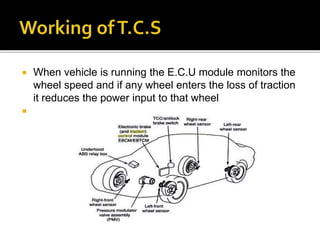
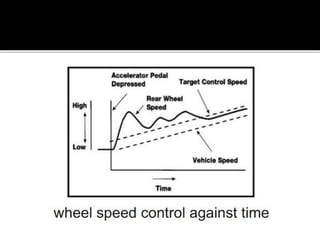
 When vehicle is running the E.C.U module monitors the
wheel speed and if any wheel enters the loss of traction
it reduces the power input to that wheel

 Controlling the wheel slippage is the aim of traction
control system based on the mode of control it can be
broadly classified into
 Torque managed TCS
 Brake applied TCS
 Torque management in TCS is obtained by
 Retarding of ignition timing
 Reduce or cut of fuel injection pulses to one or more cylinders
 Increase EGR flow
 Brake applied TCS is used when vehicle is running at
low road speeds it is good for wet and snow condition
on road
 In torque managed system as the wheel slippage is
sensed a signal is send by the ECU to retard ignition or
partially close the throttle to reduce the power output
and hence attaining the control of wheel slip
 Traction control works by preventing tires from
slipping, thereby allowing your wheels to take full
advantage of the traction that is available on the
road. Traction control cannot increase the total
amount of traction available.
 The difference is that vehicle with traction control
can successfully accelerate in low-traction
conditions since traction control prevents their
wheels from spinning.
 Since the vehicle’s wheels are not spinning, drivers
are able to maintain steering control. it has just
better handling on whatever little traction is
available.
 http://brainonboard.ca/program_resources/Vehicle_Safe
ty_Features_Fact_Sheet_Eng_TractionControl
 Popular mechanics magazine march 1990
 Automotive brakes By Jack Erjavec

Traction control

  • 2.
     Traction isthe force used to generate motion between a body and a tangential surface using dry friction, for an automobile it is b/w tyre and road surface  Acceleration of a vehicle is limited by two factors power of the engine and traction force between the tyre and road surface  Thus it is necessary to have traction control in order to maintain the vehicle motion in adverse conditions like slippery surface or in climbing hills
  • 3.
     Differential(1876) thatgives power to wheel having more traction, it results in wheel slip but with locking it gives consistent power output.  Four wheel drive(1903) that gives power to all wheels thus improves off road performance and a better traction than differential drive but has more weight.  Anti lock Brake System which improve the vehicle control during braking, avoiding wheel locking.
  • 4.
     A TCSshould not be confused with ABS both work on the same principle in opposite conditions.  TCS apply the brakes when the wheel tries to spin and loose traction and hence increase the traction force and provides acceleration to the vehicle.  An A.B.S releases the brake when wheels go into locking and provides good steering while braking in slippery surfaces  Traction control is an active vehicle safety feature designed to help the vehicle make effective use of all the traction available on the road when accelerating in slippery conditions.
  • 5.
     For afour wheel drive vehicle T.C.S can be used with minimal modifications along A.B.S with an additional wheel slip sensor and an E.C.U to override the brake is only necessary  For R.W.D and F.W.D more modifications are required in A.B.S system
  • 6.
     When vehicleis running the E.C.U module monitors the wheel speed and if any wheel enters the loss of traction it reduces the power input to that wheel 
  • 7.
     Controlling thewheel slippage is the aim of traction control system based on the mode of control it can be broadly classified into  Torque managed TCS  Brake applied TCS  Torque management in TCS is obtained by  Retarding of ignition timing  Reduce or cut of fuel injection pulses to one or more cylinders  Increase EGR flow
  • 8.
     Brake appliedTCS is used when vehicle is running at low road speeds it is good for wet and snow condition on road  In torque managed system as the wheel slippage is sensed a signal is send by the ECU to retard ignition or partially close the throttle to reduce the power output and hence attaining the control of wheel slip
  • 10.
     Traction controlworks by preventing tires from slipping, thereby allowing your wheels to take full advantage of the traction that is available on the road. Traction control cannot increase the total amount of traction available.  The difference is that vehicle with traction control can successfully accelerate in low-traction conditions since traction control prevents their wheels from spinning.  Since the vehicle’s wheels are not spinning, drivers are able to maintain steering control. it has just better handling on whatever little traction is available.
  • 12.