Shaheem
TM Reg. No.
90012064
DOI ,
Anti-lockBrakingS
y
s
t
e
ma
n
d
it’s
A
d
v
a
n
c
e
m
e
n
t
s
Overvie
w
 Introduction
 What is ABS
 Timeline of ABS
 Motivation for development
 Simple hydraulic braking
system
 Principles of ABS
 Components
 Working
 Types
 Advancements
 Advantages & Disadvantages
 summary
Introductio
n
 Conventional braking system - Wheel lockup
 Reduces steering ability - vehicle slides out of control
 Anti-lock Braking system (ABS) – Driver can break hard- No
locking of
wheels
What is ABS
?
 Anti-lock braking system (ABS) - automobile
safety
system
 Prevent wheel locking
 Skidding wheel - less traction than a Non-skidding
wheel
 Anti-lock brakes benefit
Can stop faster
Steer while you
stop
Preventing skidding
Maintain traction
Motivation for ABS
development
Under hard braking – Ideal system
should
 Provide the shortest stopping
distances
on all surfaces
Maintain vehicle stability and steer
ability.
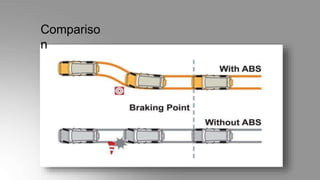
Compariso
n
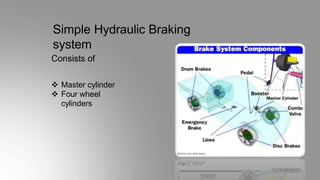
Simple Hydraulic Braking
system
Consists of
 Master cylinder
 Four wheel
cylinders
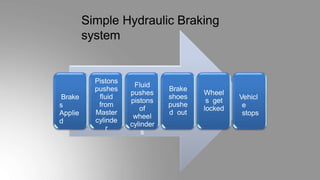
Simple Hydraulic Braking
system
Brake
s
Applie
d
Pistons
pushes
fluid
from
Master
cylinde
r
Fluid
pushes
pistons
of
wheel
cylinder
s
Brake
shoes
pushe
d out
Wheel
s get
locked
Vehicl
e
stops
Principles of
ABS
 When brakes applied- vehicle speed comes down
 Decrease in vehicle speed not always proportional to decrease in wheel
speed
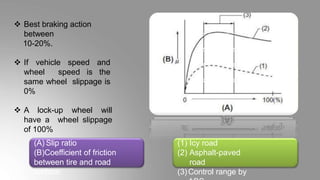
 Non-correspondence - Slip
 Magnitude measured as Slip ratio
Slip ratio = [(Vehicle speed – Wheel speed)/Vehicle speed ]× 100%
When
Slip ratio = 0% : Vehicle speed corresponds exactly to wheel speed
Slip ratio = 100% : Wheels locked - vehicle moves
 Best braking action
between
10-20%.
 If vehicle speed and
wheel speed is the
same wheel slippage is
0%
 A lock-up wheel will
have a wheel slippage
of 100%
(A) Slip ratio
(B)Coefficient of friction
between tire and road
surface
(1) Icy road
(2) Asphalt-paved
road
(3)Control range by
Pressure Modulation in
ABS
 Release and reapply of the brake pedal – avoid locking of wheels -
avoid the
skidding
 Antilock braking system does the same
 Brakes applied - pressure is quickly applied & released at the wheels -
pressure modulation
 Pressure modulation prevent the wheel locking
 ABS modulate the pressure 15 times per seconds
 ABS precisely controls the slip rate of wheels - ensure maximum grip force
from the tyre - ensures maneuverability and stability
ABS Components
Overview
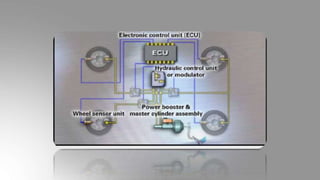
1.Hydraulic Unit
2.Electronic Brake Control Module
[EBCM] 3.Four wheel speed sensors
4.Interconnecting wiring
5.ABS indicator
ABS
components
ABS systems
are
 Integrated
 Non-
integrated
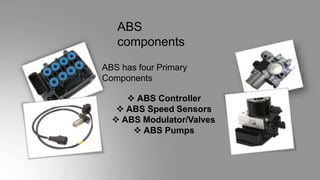
ABS
components
ABS has four Primary
Components
 ABS Controller
 ABS Speed Sensors
 ABS Modulator/Valves
 ABS Pumps
Working of
ABS
Under normal braking
 Brakes applied
 No current flow from ECU to hydraulic unit
 Solenoid valves not energized – brake master cylinder
pressure
reaches wheels Vehicles stops
 ABS not involved - Still ECU monitors each wheel for
lock- up
Working of
ABS
When wheel lock-up sensed
 Wheel sensors senses a wheel lock-up
 ECU sends a current to hydraulic unit
 The solenoid valve gets energised
 Valve isolates the brake circuit from master cylinder
 Stops the braking pressure at wheel rising – kept it
constant
Working of
ABS
Still wheel deceleration is rapid
 ECU sends larger current to hydraulic unit
 Armature of Hydraulic unit moves faster
 Opens a passage : Brake circuit – Master
cylinder
 Pressure in brake caliper reduced
Working of
ABS
When wheel is accelerated again
 ECU stops current to Hydraulic unit
 De-energises the solenoid valve
 Pressure is build up
 The cycle repeats several times in a
second
 Vehicle stops safely
Working of solenoid valve in
ABS
It has 3 modes
 Increase
pressure
 Hold pressure
 Decrease
pressure
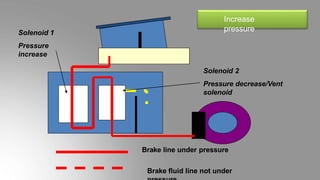
Solenoid 1
Pressure
increase
Solenoid 2
Pressure decrease/Vent
solenoid
Brake line under pressure
Brake fluid line not under
Increase
pressure
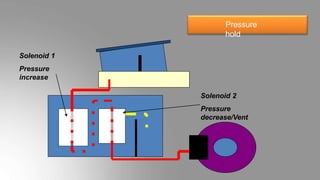
Solenoid 1
Pressure
increase
Solenoid 2
Pressure
decrease/Vent
Pressure
hold
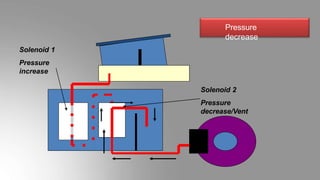
Solenoid 1
Pressure
increase
Solenoid 2
Pressure
decrease/Vent
Pressure
decrease
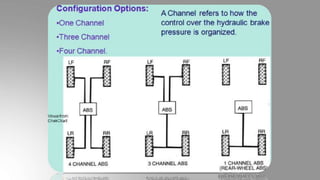
Types of
ABS
Three types
 Four channel – Four sensor
ABS
 Three channel – Three sensor
ABS
 One channel – One sensor
ABS
Advancemen
ts
 Automatic Stability Control / Electronic Stability
Control
(Program) - ESP
 Automatic Traction Control - ATC
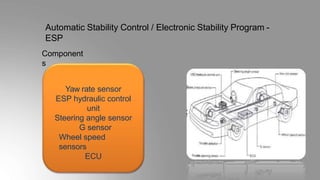
Automatic Stability Control / Electronic Stability Program -
ESP
Component
s
Yaw rate sensor
ESP hydraulic control
unit
Steering angle sensor
G sensor
Wheel speed
sensors
ECU
Operatio
n
Under normal driving
 ESC works in background- monitors steering & vehicle
direction
 Determines intended direction – steering angle sensor
 Determines vehicle’s actual direction- yaw sensor- wheel speed
sensors
 Compares the obtained data
Operatio
n
When detects a loss of steering control
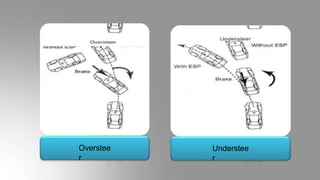
 Detects – Understeer or Oversteer
 ESC estimates direction of speed
 Applies brakes to individual wheels asymmetrically
 Create torque about vehicle’s vertical axis- oppose skid
 Brings vehicle back to control
 Additional operation – reduces engine power, operate
transmission
Overstee
r
Understee
r
Automatic Traction Control -
ATC
 Apply brakes when drive wheel attempts to spin and lose
traction
 A secondary function of ESP
 Activated when throttle input & engine torque is mismatched to
road
surface conditions
Automatic Traction Control -
ATC
ATC intervention consists of the following
 Brake force applied to one or more wheels
 Reduction or suppression of spark sequence to one or more
cylinders
 Reduction of fuel supply to one or more cylinders
 Closing the throttle
Components of traction
control
 The main hardware for traction control and ABS are
same
 Wheel sensors
 ECU
 ATC valve
Advantages of
ABS
 Reduce the stopping distance.
 Steer while the brakes are firmly applied.
 Maintain directional stability and control over steering during
braking.
 Safe and effective.
 Automatically changes the brake fluid pressure at each wheel to
maintain
optimum brake performance.
 ABS absorbs the unwanted turbulence shock waves.
Disadvantages of
ABS
 Increased braking distances under some limited
circumstances
 cost
 Maintenance cost of a car equipped with ABS is
more
 System damage
Summar
y
The antilock braking system controls braking force by controlling the
hydraulic pressure of the braking system, so that the wheels do not
lock during braking.
The antilock braking system prevents wheels locking or skidding, no
matter how hard brakes are applied, or how slippery the road surface.
Steering stays under control and stopping distances are generally
reduced.
ABS.pptx

ABS.pptx

  • 1.
    Shaheem TM Reg. No. 90012064 DOI, Anti-lockBrakingS y s t e ma n d it’s A d v a n c e m e n t s
  • 2.
    Overvie w  Introduction  Whatis ABS  Timeline of ABS  Motivation for development  Simple hydraulic braking system  Principles of ABS  Components  Working  Types  Advancements  Advantages & Disadvantages  summary
  • 3.
    Introductio n  Conventional brakingsystem - Wheel lockup  Reduces steering ability - vehicle slides out of control  Anti-lock Braking system (ABS) – Driver can break hard- No locking of wheels
  • 4.
    What is ABS ? Anti-lock braking system (ABS) - automobile safety system  Prevent wheel locking  Skidding wheel - less traction than a Non-skidding wheel  Anti-lock brakes benefit Can stop faster Steer while you stop Preventing skidding Maintain traction
  • 5.
    Motivation for ABS development Underhard braking – Ideal system should  Provide the shortest stopping distances on all surfaces Maintain vehicle stability and steer ability.
  • 6.
  • 7.
    Simple Hydraulic Braking system Consistsof  Master cylinder  Four wheel cylinders
  • 8.
  • 9.
    Principles of ABS  Whenbrakes applied- vehicle speed comes down  Decrease in vehicle speed not always proportional to decrease in wheel speed  Non-correspondence - Slip  Magnitude measured as Slip ratio Slip ratio = [(Vehicle speed – Wheel speed)/Vehicle speed ]× 100% When Slip ratio = 0% : Vehicle speed corresponds exactly to wheel speed Slip ratio = 100% : Wheels locked - vehicle moves
  • 10.
     Best brakingaction between 10-20%.  If vehicle speed and wheel speed is the same wheel slippage is 0%  A lock-up wheel will have a wheel slippage of 100% (A) Slip ratio (B)Coefficient of friction between tire and road surface (1) Icy road (2) Asphalt-paved road (3)Control range by
  • 11.
    Pressure Modulation in ABS Release and reapply of the brake pedal – avoid locking of wheels - avoid the skidding  Antilock braking system does the same  Brakes applied - pressure is quickly applied & released at the wheels - pressure modulation  Pressure modulation prevent the wheel locking  ABS modulate the pressure 15 times per seconds  ABS precisely controls the slip rate of wheels - ensure maximum grip force from the tyre - ensures maneuverability and stability
  • 12.
    ABS Components Overview 1.Hydraulic Unit 2.ElectronicBrake Control Module [EBCM] 3.Four wheel speed sensors 4.Interconnecting wiring 5.ABS indicator
  • 13.
  • 14.
    ABS components ABS has fourPrimary Components  ABS Controller  ABS Speed Sensors  ABS Modulator/Valves  ABS Pumps
  • 15.
    Working of ABS Under normalbraking  Brakes applied  No current flow from ECU to hydraulic unit  Solenoid valves not energized – brake master cylinder pressure reaches wheels Vehicles stops  ABS not involved - Still ECU monitors each wheel for lock- up
  • 16.
    Working of ABS When wheellock-up sensed  Wheel sensors senses a wheel lock-up  ECU sends a current to hydraulic unit  The solenoid valve gets energised  Valve isolates the brake circuit from master cylinder  Stops the braking pressure at wheel rising – kept it constant
  • 17.
    Working of ABS Still wheeldeceleration is rapid  ECU sends larger current to hydraulic unit  Armature of Hydraulic unit moves faster  Opens a passage : Brake circuit – Master cylinder  Pressure in brake caliper reduced
  • 18.
    Working of ABS When wheelis accelerated again  ECU stops current to Hydraulic unit  De-energises the solenoid valve  Pressure is build up  The cycle repeats several times in a second  Vehicle stops safely
  • 20.
    Working of solenoidvalve in ABS It has 3 modes  Increase pressure  Hold pressure  Decrease pressure
  • 21.
    Solenoid 1 Pressure increase Solenoid 2 Pressuredecrease/Vent solenoid Brake line under pressure Brake fluid line not under Increase pressure
  • 22.
  • 23.
  • 24.
    Types of ABS Three types Four channel – Four sensor ABS  Three channel – Three sensor ABS  One channel – One sensor ABS
  • 26.
    Advancemen ts  Automatic StabilityControl / Electronic Stability Control (Program) - ESP  Automatic Traction Control - ATC
  • 27.
    Automatic Stability Control/ Electronic Stability Program - ESP Component s Yaw rate sensor ESP hydraulic control unit Steering angle sensor G sensor Wheel speed sensors ECU
  • 28.
    Operatio n Under normal driving ESC works in background- monitors steering & vehicle direction  Determines intended direction – steering angle sensor  Determines vehicle’s actual direction- yaw sensor- wheel speed sensors  Compares the obtained data
  • 29.
    Operatio n When detects aloss of steering control  Detects – Understeer or Oversteer  ESC estimates direction of speed  Applies brakes to individual wheels asymmetrically  Create torque about vehicle’s vertical axis- oppose skid  Brings vehicle back to control  Additional operation – reduces engine power, operate transmission
  • 30.
  • 31.
    Automatic Traction Control- ATC  Apply brakes when drive wheel attempts to spin and lose traction  A secondary function of ESP  Activated when throttle input & engine torque is mismatched to road surface conditions
  • 32.
    Automatic Traction Control- ATC ATC intervention consists of the following  Brake force applied to one or more wheels  Reduction or suppression of spark sequence to one or more cylinders  Reduction of fuel supply to one or more cylinders  Closing the throttle
  • 33.
    Components of traction control The main hardware for traction control and ABS are same  Wheel sensors  ECU  ATC valve
  • 34.
    Advantages of ABS  Reducethe stopping distance.  Steer while the brakes are firmly applied.  Maintain directional stability and control over steering during braking.  Safe and effective.  Automatically changes the brake fluid pressure at each wheel to maintain optimum brake performance.  ABS absorbs the unwanted turbulence shock waves.
  • 35.
    Disadvantages of ABS  Increasedbraking distances under some limited circumstances  cost  Maintenance cost of a car equipped with ABS is more  System damage
  • 36.
    Summar y The antilock brakingsystem controls braking force by controlling the hydraulic pressure of the braking system, so that the wheels do not lock during braking. The antilock braking system prevents wheels locking or skidding, no matter how hard brakes are applied, or how slippery the road surface. Steering stays under control and stopping distances are generally reduced.