TRACTION
CONTROL
SYSTEMS &
DRIVE BY WIRES
Done By
Mohammed Ilyaaz Rahim. S
Kethan Sridhar
Mohammed Roshan. N
Aravind Kumar. K
WHAT IS TRACTION CONTROL?
• Traction control is an active safety feature that helps to keep a car’s grip between the tires
and the road in slippery or dangerous conditions. The safety feature maintains a car’s
traction by limiting how much the wheels can spin, making it easier to stay connected to the
surface you’re driving on.
• Traction control is a pretty simple concept, yet it is very effective. It is a system that has
active sensors in each of your four wheels, called yaw sensors. The sensors monitor each of
your tries. While monitoring, the sensors keep a careful eye on both the speed of the
vehicle and what the tires are doing.
HOW DOES IT WORKS?
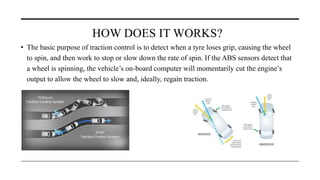
• The basic purpose of traction control is to detect when a tyre loses grip, causing the wheel
to spin, and then work to stop or slow down the rate of spin. If the ABS sensors detect that
a wheel is spinning, the vehicle’s on-board computer will momentarily cut the engine’s
output to allow the wheel to slow and, ideally, regain traction.
ADVANTAGES
• Traction control systems often use the same infrastructure as anti-lock brakes,
which make it easier for the manufacturer to control direct installation traction.
• Traction control systems present effective automatic control for snow and rain
conditions so the main advantage is safety for weather conditions.
• Customers of auto insurance can often receive a discount for traction control.
• Avoiding accidents.
• Sudden twists and turns.
• Slippage of the wheels.
• Stopping distance and more grip.
DISADVANTAGES
• Cost is high because of the high-functioning gear that's involved in traction control can
make a car an increasingly expensive purchase.
• Cost of maintenance.
• Traction control systems are not ideal for all kinds of situations so its use is limited.
• Wear on the brake components.
WHAT IS DRIVE BY WIRE TECHNOLOGY?
• Ride-by-wire technology eliminates any mechanical linkage/ connection between the accelerator and
the throttle. Physical linkage is replaced by sensors connected by wires, that decide how much air
fuel mixture should enter the motorcycle's engine.
• Drive by Wire is a semi-automatic, computer controlled technology mainly used in cars. It is quite
similar to ride by wire technology used in bikes. It controls the vehicular systems such as the
acceleration, handling, braking, steering and other functions of a motor vehicle. It does so sans any
physical/mechanical linkage. A conventional vehicle carries out these functions by either using
mechanical, hydraulic or pneumatic components as the case may be. These components
are prone to wear-and-tear. Hence, their performance & efficiency deteriorates over the
period. And thus, they become inefficient.
HOW DOES A DRIVE BY WIRE SYSTEM
WORKS?
• Drive by wire technology mainly uses electrical/electronic components such
as sensors and/or actuators to control vehicular systems. This technology eliminates the
need to use conventional components such as drive-belts, drive-shafts, pumps, vacuum
boosters and master cylinders etc. Instead, it uses electric motors and electro-mechanical
actuators to execute the functions carried out by the conventional mechanical/hydraulic
components.
• With ride-by-wire technology, sensors detect the position of the accelerator and the
actuators help change the position of the throttle, letting in air-fuel mixture. The
movement of the throttle changes air supply to the engine.
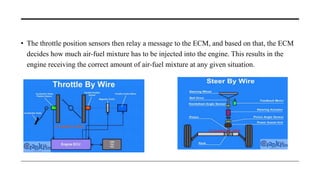
• The throttle position sensors then relay a message to the ECM, and based on that, the ECM
decides how much air-fuel mixture has to be injected into the engine. This results in the
engine receiving the correct amount of air-fuel mixture at any given situation.
ADVANTAGES
• Reduces weight.
• Increases the operational accuracy.
• Eliminates losses caused by mechanical linkages.
• Longer service intervals, i.e. decrease in visits for routine maintenance and other
adjustments.
• Maintenance free operation.
• Better accuracy. And hence, results in better fuel efficiency & lower emissions.
DISADVANTAGES
• Drive by wire system are costly to design and manufacture.
• Software failure may lead to malfunctioning of these systems.
• Error in calculation of required data may lead to an accident.
• Prone to hacking which may jeopardize the control of the vehicle.
THANK YOU

Automobile.pptx

  • 1.
    TRACTION CONTROL SYSTEMS & DRIVE BYWIRES Done By Mohammed Ilyaaz Rahim. S Kethan Sridhar Mohammed Roshan. N Aravind Kumar. K
  • 2.
    WHAT IS TRACTIONCONTROL? • Traction control is an active safety feature that helps to keep a car’s grip between the tires and the road in slippery or dangerous conditions. The safety feature maintains a car’s traction by limiting how much the wheels can spin, making it easier to stay connected to the surface you’re driving on. • Traction control is a pretty simple concept, yet it is very effective. It is a system that has active sensors in each of your four wheels, called yaw sensors. The sensors monitor each of your tries. While monitoring, the sensors keep a careful eye on both the speed of the vehicle and what the tires are doing.
  • 3.
    HOW DOES ITWORKS? • The basic purpose of traction control is to detect when a tyre loses grip, causing the wheel to spin, and then work to stop or slow down the rate of spin. If the ABS sensors detect that a wheel is spinning, the vehicle’s on-board computer will momentarily cut the engine’s output to allow the wheel to slow and, ideally, regain traction.
  • 4.
    ADVANTAGES • Traction controlsystems often use the same infrastructure as anti-lock brakes, which make it easier for the manufacturer to control direct installation traction. • Traction control systems present effective automatic control for snow and rain conditions so the main advantage is safety for weather conditions. • Customers of auto insurance can often receive a discount for traction control. • Avoiding accidents. • Sudden twists and turns. • Slippage of the wheels. • Stopping distance and more grip.
  • 5.
    DISADVANTAGES • Cost ishigh because of the high-functioning gear that's involved in traction control can make a car an increasingly expensive purchase. • Cost of maintenance. • Traction control systems are not ideal for all kinds of situations so its use is limited. • Wear on the brake components.
  • 6.
    WHAT IS DRIVEBY WIRE TECHNOLOGY? • Ride-by-wire technology eliminates any mechanical linkage/ connection between the accelerator and the throttle. Physical linkage is replaced by sensors connected by wires, that decide how much air fuel mixture should enter the motorcycle's engine. • Drive by Wire is a semi-automatic, computer controlled technology mainly used in cars. It is quite similar to ride by wire technology used in bikes. It controls the vehicular systems such as the acceleration, handling, braking, steering and other functions of a motor vehicle. It does so sans any physical/mechanical linkage. A conventional vehicle carries out these functions by either using mechanical, hydraulic or pneumatic components as the case may be. These components are prone to wear-and-tear. Hence, their performance & efficiency deteriorates over the period. And thus, they become inefficient.
  • 7.
    HOW DOES ADRIVE BY WIRE SYSTEM WORKS? • Drive by wire technology mainly uses electrical/electronic components such as sensors and/or actuators to control vehicular systems. This technology eliminates the need to use conventional components such as drive-belts, drive-shafts, pumps, vacuum boosters and master cylinders etc. Instead, it uses electric motors and electro-mechanical actuators to execute the functions carried out by the conventional mechanical/hydraulic components. • With ride-by-wire technology, sensors detect the position of the accelerator and the actuators help change the position of the throttle, letting in air-fuel mixture. The movement of the throttle changes air supply to the engine.
  • 8.
    • The throttleposition sensors then relay a message to the ECM, and based on that, the ECM decides how much air-fuel mixture has to be injected into the engine. This results in the engine receiving the correct amount of air-fuel mixture at any given situation.
  • 9.
    ADVANTAGES • Reduces weight. •Increases the operational accuracy. • Eliminates losses caused by mechanical linkages. • Longer service intervals, i.e. decrease in visits for routine maintenance and other adjustments. • Maintenance free operation. • Better accuracy. And hence, results in better fuel efficiency & lower emissions.
  • 10.
    DISADVANTAGES • Drive bywire system are costly to design and manufacture. • Software failure may lead to malfunctioning of these systems. • Error in calculation of required data may lead to an accident. • Prone to hacking which may jeopardize the control of the vehicle.
  • 11.