
ER. PEEYUSH CHAUHAN
ASSISTANT PROFESSOR
DEPARTMENT OF MECHANICAL ENGINEERING
“Anti-lock Braking System also known as anti-
skid braking system (ABS) is an automobile
safety system which prevents the locking of wheels
during braking and avoid uncontrolled skidding..”
The modern abs system allows steering during braking which
gives more control over the vehicle in case of sudden braking.
The main advantages of using ABS system in vehicle is that it
provides better control over the vehicle and decreases
stopping distance on dry and slippery surfaces.
It works on the principle of threshold braking and cadence
braking.
Cadence braking and threshold braking is a technique in
which a driver applies the brakes and releases it before
locking up the wheel and then applies the brakes and releases
it again before locking.
This process of applying and releasing the brakes on the
wheel is done in pulse form to prevent it from locking and
stop skidding of the vehicle.
The driver practices this technique to achieve better control
over the vehicle during instant braking and stop skidding of
the vehicle.
The ABS system automatically does this cadence braking to
prevent locking of wheel and skidding of vehicle when brakes
are applied.
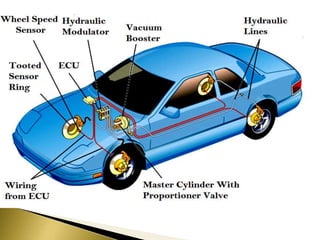
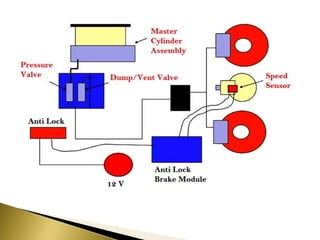
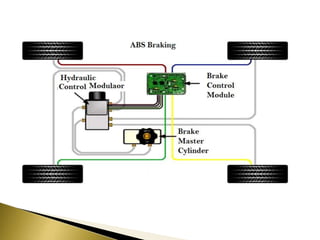
It has four main components
1. speed sensors
2. Valves
3. Pump
4. Controller
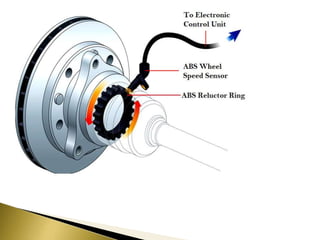
1. Speed Sensors
It is used to calculate the acceleration and deceleration of the
wheel. It consists of a toothed wheel and an electromagnetic
coil or a magnet and a Hall Effect sensor to generate signal.
When the wheel or differentials of the vehicle rotates, it
induces magnetic field around the sensor.
The fluctuation in this magnetic field generates voltage in the
sensor. This voltage generated sends signals to the controller.
With the help of the voltage the controller reads the
acceleration and deceleration of the wheel.
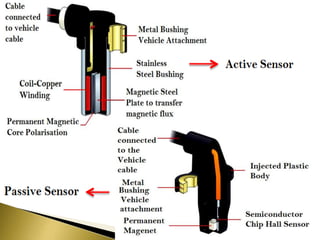
Types of ABS Sensors:- ABS sensors are classified in to two
different types.
1. Passive Sensor
2. Active Sensor
Passive sensors are larger and less accurate than active
sensors and only start to operate when the wheel reaches a
certain speed, therefore they have limited operation at lower
speed. They are also unable to operate in reverse, so thus
unable to determine the direction of travel.
Active sensors on the other hand are a lot more accurate and
are able to detect speeds of less them 0.06 mph, this is vital
for modern traction control systems.
There are two types of active sensor. The Hall sensor and the
Magneto-resistive sensor
Hall sensor – The hall sensor uses the Hall effect, which is a
generation of a voltage (the Hall voltage) across an electrical
conductor, transverse to an electric current in the conductor
and a magnetic field perpendicular to the current. They react
to changes in magnetic fields with a voltage difference which
is send to the ABS control unit as a square wave signal. They
use a semiconductor sensor coupled to an electronic circuit,
protecting the sensor from possible voltage spikes, and a
permanent magnet.
Hall sensors record the wheel speed via either a toothed or
magnetic encoder (ABS ring) often found on the wheel hub,
disc or bearing. The sensors are very accurate, but must be
installed with precision.
Magneto-resistive sensor – These sensors use a magnetic
encoder ring similar in appearance to the encoder ring
associated with the hall sensor. Magneto-resistive sensors are
much more precise, but generally more expensive than Hall
sensors and require a less precise installation position,
therefore meaning that it can be located further away from
the ‘ABS ring’ than the other types of sensors.
2) Valves
The valves regulate the air pressure to the brakes during the
ABS action. There is a valve in the brake line of each brake
that is controlled by the ABS.
In the first position, the brake valve is open and it allows the
pressure from the master cylinder to be transferred to the
brakes.
In the second position, the brake valve remains closed and
pressure from the master cylinder to the brakes is
constrained.
In the third position, the valve releases some of the pressure
on the brakes.
3. Pump
Pump is used to restore the pressure to the hydraulic brakes
after the valve releases the pressure.
When the controller detects wheel slip, it sends signals to
release the valve. After the valve releases the pressure
supplied from the driver, it restore a desired amount of
pressure to the braking system.
The controller modulates (adjust) the status of the pump so
as to provide desired amount of pressure and reduce
slipping of the wheel.
4. Controller
The controller used in the ABS system is of ECU type.
Its main function is to receives information from each
individual wheel speed sensors and if a wheel loses its
traction with the ground, a signal is sent to the controller,
the controller than limit the brake force (EBD) and activate
the ABS modulator.
The activated ABS modulator actuates the braking valves
on and off and varies the pressure to the brakes.
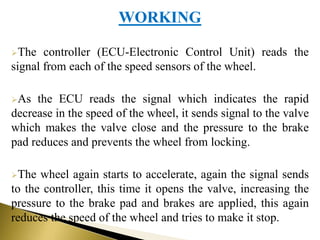
WORKING
The controller (ECU-Electronic Control Unit) reads the
signal from each of the speed sensors of the wheel.
As the ECU reads the signal which indicates the rapid
decrease in the speed of the wheel, it sends signal to the valve
which makes the valve close and the pressure to the brake
pad reduces and prevents the wheel from locking.
The wheel again starts to accelerate, again the signal sends
to the controller, this time it opens the valve, increasing the
pressure to the brake pad and brakes are applied, this again
reduces the speed of the wheel and tries to make it stop.
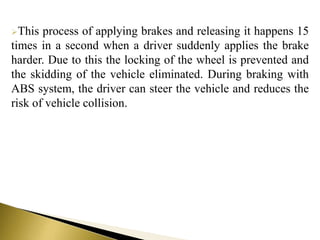
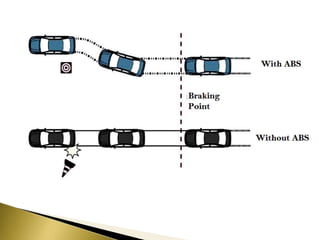
This process of applying brakes and releasing it happens 15
times in a second when a driver suddenly applies the brake
harder. Due to this the locking of the wheel is prevented and
the skidding of the vehicle eliminated. During braking with
ABS system, the driver can steer the vehicle and reduces the
risk of vehicle collision.
Advantages:-
1. It prevents the locking of the wheel and thus eliminates the
chance of skidding.
2. The skidding of the vehicle is completely removed, which
results in excellent control during braking?
3. A better steering control is obtained with the ABS system.
4. It reduces the chance of collision by 30 %.
Disadvantages:-
A vehicle equipped with ABS (Anti-lock Braking System) is
costlier as compared with a vehicle without ABS.
Anti lock braking system

Anti lock braking system

  • 1.
    ER. PEEYUSH CHAUHAN ASSISTANTPROFESSOR DEPARTMENT OF MECHANICAL ENGINEERING
  • 2.
    “Anti-lock Braking Systemalso known as anti- skid braking system (ABS) is an automobile safety system which prevents the locking of wheels during braking and avoid uncontrolled skidding..” The modern abs system allows steering during braking which gives more control over the vehicle in case of sudden braking. The main advantages of using ABS system in vehicle is that it provides better control over the vehicle and decreases stopping distance on dry and slippery surfaces.
  • 3.
    It works onthe principle of threshold braking and cadence braking. Cadence braking and threshold braking is a technique in which a driver applies the brakes and releases it before locking up the wheel and then applies the brakes and releases it again before locking. This process of applying and releasing the brakes on the wheel is done in pulse form to prevent it from locking and stop skidding of the vehicle.
  • 4.
    The driver practicesthis technique to achieve better control over the vehicle during instant braking and stop skidding of the vehicle. The ABS system automatically does this cadence braking to prevent locking of wheel and skidding of vehicle when brakes are applied.
  • 5.
    It has fourmain components 1. speed sensors 2. Valves 3. Pump 4. Controller 1. Speed Sensors It is used to calculate the acceleration and deceleration of the wheel. It consists of a toothed wheel and an electromagnetic coil or a magnet and a Hall Effect sensor to generate signal. When the wheel or differentials of the vehicle rotates, it induces magnetic field around the sensor.
  • 7.
    The fluctuation inthis magnetic field generates voltage in the sensor. This voltage generated sends signals to the controller. With the help of the voltage the controller reads the acceleration and deceleration of the wheel. Types of ABS Sensors:- ABS sensors are classified in to two different types. 1. Passive Sensor 2. Active Sensor Passive sensors are larger and less accurate than active sensors and only start to operate when the wheel reaches a certain speed, therefore they have limited operation at lower speed. They are also unable to operate in reverse, so thus unable to determine the direction of travel.
  • 9.
    Active sensors onthe other hand are a lot more accurate and are able to detect speeds of less them 0.06 mph, this is vital for modern traction control systems. There are two types of active sensor. The Hall sensor and the Magneto-resistive sensor Hall sensor – The hall sensor uses the Hall effect, which is a generation of a voltage (the Hall voltage) across an electrical conductor, transverse to an electric current in the conductor and a magnetic field perpendicular to the current. They react to changes in magnetic fields with a voltage difference which is send to the ABS control unit as a square wave signal. They use a semiconductor sensor coupled to an electronic circuit, protecting the sensor from possible voltage spikes, and a permanent magnet.
  • 10.
    Hall sensors recordthe wheel speed via either a toothed or magnetic encoder (ABS ring) often found on the wheel hub, disc or bearing. The sensors are very accurate, but must be installed with precision. Magneto-resistive sensor – These sensors use a magnetic encoder ring similar in appearance to the encoder ring associated with the hall sensor. Magneto-resistive sensors are much more precise, but generally more expensive than Hall sensors and require a less precise installation position, therefore meaning that it can be located further away from the ‘ABS ring’ than the other types of sensors.
  • 12.
    2) Valves The valvesregulate the air pressure to the brakes during the ABS action. There is a valve in the brake line of each brake that is controlled by the ABS. In the first position, the brake valve is open and it allows the pressure from the master cylinder to be transferred to the brakes. In the second position, the brake valve remains closed and pressure from the master cylinder to the brakes is constrained. In the third position, the valve releases some of the pressure on the brakes.
  • 13.
    3. Pump Pump isused to restore the pressure to the hydraulic brakes after the valve releases the pressure. When the controller detects wheel slip, it sends signals to release the valve. After the valve releases the pressure supplied from the driver, it restore a desired amount of pressure to the braking system. The controller modulates (adjust) the status of the pump so as to provide desired amount of pressure and reduce slipping of the wheel.
  • 14.
    4. Controller The controllerused in the ABS system is of ECU type. Its main function is to receives information from each individual wheel speed sensors and if a wheel loses its traction with the ground, a signal is sent to the controller, the controller than limit the brake force (EBD) and activate the ABS modulator. The activated ABS modulator actuates the braking valves on and off and varies the pressure to the brakes.
  • 18.
    WORKING The controller (ECU-ElectronicControl Unit) reads the signal from each of the speed sensors of the wheel. As the ECU reads the signal which indicates the rapid decrease in the speed of the wheel, it sends signal to the valve which makes the valve close and the pressure to the brake pad reduces and prevents the wheel from locking. The wheel again starts to accelerate, again the signal sends to the controller, this time it opens the valve, increasing the pressure to the brake pad and brakes are applied, this again reduces the speed of the wheel and tries to make it stop.
  • 19.
    This process ofapplying brakes and releasing it happens 15 times in a second when a driver suddenly applies the brake harder. Due to this the locking of the wheel is prevented and the skidding of the vehicle eliminated. During braking with ABS system, the driver can steer the vehicle and reduces the risk of vehicle collision.
  • 21.
    Advantages:- 1. It preventsthe locking of the wheel and thus eliminates the chance of skidding. 2. The skidding of the vehicle is completely removed, which results in excellent control during braking? 3. A better steering control is obtained with the ABS system. 4. It reduces the chance of collision by 30 %. Disadvantages:- A vehicle equipped with ABS (Anti-lock Braking System) is costlier as compared with a vehicle without ABS.