INTRODUCT
ION
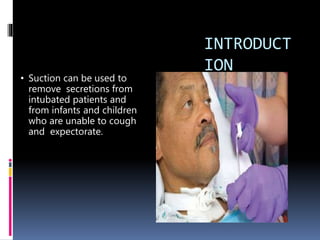
• Suction can be used to
remove secretions from
intubated patients and
from infants and children
who are unable to cough
and expectorate.
GENERAL
PRINCIPLES
• The technique should be as quick, clean and gentle as
possible.
• Suction is very traumatic to delicate mucosal tissue and it is
very easy to introduce infection, especially in intubated
patients.
• Suction should only be carried out as and when necessary,
rather than on a routine basis.
SUCTION
TROLLEY:
• All the equipment needed for airway suction should be set
out on a trolley for ease of access:
1. Sterile plastic gloves - disposable.
2. Suction catheters - appropriate sizes for the
patient.
3. Lubricating jelly water-based only, not oil-based, for
use in nasopharyngeal
suction.
4. Sterile gauze swabs - to transfer jelly to tip of
catheter.
5. sterile water - to flush the secretions through the
catheter and tubing. Sodium bicarbonate acts as a
solvent of the secretions.
6. Forceps (if used).
7. Plastic bag for the collection of disposables
INDICAT
ION
1. Whenever secretions can be heard in an intubated patient.
2. For retained secretions in the spontaneously breathing
patient who is unable to cough and expectorate efficiently.
3. Before and during the release of the cuff on a
tracheostomy tube.
4. If the inflation pressure of the ventilator suddenly' rises.
This may indicate the
presence of a large plug of mucus in one of the larger
bronchi or even within the
endotracheal or tracheostomy tube.
5. If the minute volume (MV) drops, this may indicate
retained secretions
RISKS AND
COMPLICATIONS OF
1. Trauma:
• Mucosal haemorrhage and erosion frequently occur in the
patient who has been suctioned, leading eventually to the
formation of granulation tissue.
• The amount of trauma depends upon the frequency of
suction, the amount of negative pressure applied, the
size and type of catheter used and the vigour of insertion.
2.
Hypoxi
a.
• This can occur following suction.
• To avoid this the suctioning time should be kept to a
minimum, particularly in tl](ose patients who are dependent
on a ventilator, and the inspired oxygen and/or ventilation
may be increased prior to suction providing there are no
contra- indications.
• Cardiovascular effects.
• Cardiac arrhythmias and hypotension can occur during
suction due to hypoxia and/or vagal stimulation from
direct pharyngeal and tracheal irritation.
• Particular care should be taken with neonates as bradycardia
and apnoea can follow nasopharyngeal suction in these
patients
•Atelectasis.
• Too large a suction catheter in too small an airway will
prevent room air from
entering around the catheter during suctioning and
atelectasis, in varying degrees,
may occur.
• Too high a negative suction pressure may also cause
atelectasis and airway collapse.
•Pneumothorax.
• This can occur primarily in premature infants with severe
underlying lung disease due to perforation of segmental
bronchi by a suction catheter
TYPES
Depending on site of
Suctioning
A. Nasotracheal suctioning
(NT)
B. Oropharyngeal suctioning
C. Tracheostomy suctioning
(TT)
D. Endotracheal suctioning
PROCEDURE:-
SUCTION FOR
INTUBATED
PATIENTS
1. Wash
hands.
prepare saline or mucolytic solution - prepare
gloves/forceps.
2. Prepare equipment: - turn on vacuum, check pressure -
attach suction catheter -
3. Prepare patient - if conscious the patient should be
swaddled in a blanket being
aware of infusions, drains, tubes, etc; or he should be held
firmly by an assistant.
The procedure should be explained to the child and
constant reassurance given while suctioning is taking place
4. Physiotherapy may be carried out at this
point if indicated.
5. Place glove on the hand that is to hold suction catheter.
6. Withdraw catheter from its sterile pack with the gloved
hand.
7. Disconnect ventilated patient from ventilator.
8. Insert catherter into tube without applying suction.
9. Push catheter gently and quickly down tube until a slight
resistance is met.
10. Withdraw catheter 0.5cm.
11. Apply suction.
12. Withdraw catheter quickly, rotating gently between
thumb and first finger and
interrupting the suction pressure every few seconds.
13. Reconnect patient to ventilator.
14. The same catheter can then be used to clear secretions from
the mouth and nose.
15. Discard both the glove and the catheter.
16. Repeat until secretions are cleared.
SUCTION FOR NON-INTUBATED PATIENTS
• Children and infants should always be suctioned in side lying to prevent
aspiration of vomit.
1. Wash hands.
2.Prepare equipment: - turn on vacuum, check pressure - attach suction
catheter - prepare saline or mucolytic solution - prepare gloves/forceps.
3. Prepare patient - if conscious the patient should be swaddled in a
blanket being
aware of infusions, drains, tubes, etc; or he should be held firmly by an
assistant. The procedure should be explained to the child and constant
reassurance given while
suctioning is taking place.
4. Physiotherapy may be carried out at this point if indicated.
5. Place glove on the hand that is to hold suction catheter.
6. Withdraw catheter from its sterile pack with the gloved hand
7. Gently insert catheter into the nose using an upward
motion until the nasal septum is passed, then using a
downward motion. If a slight resistance is met, withdraw
catheter slighdy and try again.
8. Insert catheter to the back of the throat until a cough has
been stimulated. It is possible to pass a catheter into the
trachea by inserting the catheter during inspiration, but
an effective cough can be elicited merely by stimulating
the pharynx.
9. Apply suction.
10. Withdraw catheter, rotating slightly between thumb
and first finger and
interrupting the suction every few seconds.
11. Repeat procedure via other nostril.
12. Discard both the glove and the catheter.
13. Repeat until secretions are cleared.
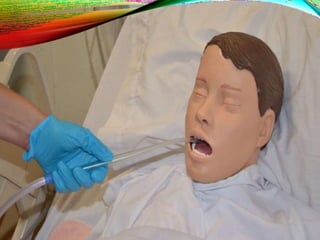
ORAL SUCTION
 Ensure that the catheter is not curling up in the
mouth.
9.Apply suction.
10.Withdraw catheter.
11.Repeat until secretions are clear.
12.Discard both the glove and the cathete
8. Pass suction catheter to the back of the throat until a cough
has been stimulated.
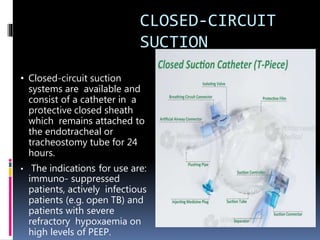
CLOSED-CIRCUIT
SUCTION
• Closed-circuit suction
systems are available and
consist of a catheter in a
protective closed sheath
which remains attached to
the endotracheal or
tracheostomy tube for 24
hours.
• The indications for use are:
immuno- suppressed
patients, actively infectious
patients (e.g. open TB) and
patients with severe
refractory hypoxaemia on
high levels of PEEP.
PRECAUTIONS
1. 100 — i20mmHg is ideal for most patients although
pressure up to —200mmHg may be needed for thick
secretions.
2. Nasopharyngeal suction:
I. When introducing a suction catheter via the nose it is
helpful if the patient’s neck is extended so that the head is
tilted backwards resting on a pillow. If the patient can co-
operate the tongue should be protruded, as this helps when
attempting to pass the catheter between the vocal cords
and into the trachea
II. It must be remembered that nasopharyngeal suction is a
very unpleasant experience for the conscious patient
and should only be used when absolutely necessary.
III. Nasopharyngeal suction should not be used for patients
with head injuries where there is a leak of CSF into the
nasal passages.
3. Oropharyngeal suction.
I. A lubricated plastic airway is usually tie eded to prevent the patient
biting the catheter and it is difficult to direct the catheter accurately
into the pharynx and beyond.
4. Suction via tube
I. Whatever the mode of entry, the physiotherapist must ensure
that no suction
pressure is applied while the catheter is being introduced.
II. If, during nasopharyngeal suction, the patient becomes
cyanosed I and the catheter was difficult to insert, it is
acceptable to disconnect the suction, leaving the catheter in
situ, while administering oxygen J until the patient recovers
and suction can be resumed.
III. No longer than 15 seconds should elapse between the
disconnec - I tion and reconnection of the patient to the
ventilator, more than adequate time for effective removal of
secretions by the experienced I operator. j Where possible, the
patient should be suctioned in side lying or 1 with the head
rotated to one side to avoid aspiration of gastric
contents should vomiting occur.
STEPS
 including RR or adventitious sounds, nasal
secretions, drooling, gastric secretions, or
vomitus in mouth
• Rationale
• Physical signs and symptoms result from pooling
of secretions in upper and lower airways.
1. Assign signs and symptoms of upper and
lower airway
obstruction
nasotracheal or orotracheal
requiring
suctioning,
Assess signs and symptoms associated with hypoxia and
hypercapnia.
• Rationale
• Physical signs and symptoms resulting from
decreased oxygen to tissues indicate need for
suctioning.
Step 2
Step
3
• Determine factors that normally
influence upper or lower airway
functioning
• Fluid Status
• Lack of Humidity
• Infection
• Anatomy
• Rationale
• Fluid overload may increase
amount of secretions. Dehydration
promotes thicker secretions
• The environment influences
secretion formation and gas
exchange, necessitation airway
suctioning when cannot clear
secretions effectively.
• Clients with respiratory infections
are prone to increased secretions
that are thicker and sometimes
more difficult to expectorate
• Abnormal anatomy can impair
normal drainage or secretions.
Step
4
• Assess client’s understanding of procedure
(when applicable)
• Rationale:
• Reveals need for client instruction and also
encourages cooperation.
Step 5
• Obtain physicians order if indicated by agency policy.
●
Rationale
●
Some institutions require a physicians order for
tracheal suctioning
Step 6
• Help client assume position comfortable for nurse and client
(usually semi-Fowler’s or sitting upright with head
hyperextended, unless contraindicated).
• Rationale
• Reduces stimulation of gag reflex, promotes client
comfort and secretion drainage, and prevents
aspiration.
• Lessens strain on nurses’ back.
• Hyperextension fascilitates insertion of catheter into
trachea.
Step
7
• Place pulse oximeter on client’s finger.
Take reading and leave pulse oximeter in
place.
• Rationale
• Provides baseline SpO2 to determine
client’s response to suctioning.
Step 8
• Place tower across client’s chest.
●
Rationale
● Reduces transmission of
microorganisms by protecting gown
from secretions.
Step
9
• Perform hand hygiene.
• Rationale
• Reduces transmission of
microorganisms.
Step
10
Preparation for all types
of suctioning
• Open suction kit or
catheter with use of
aseptic technique. Do not
allow the suction catheter
to touch any unsterile
surfaces.
• Unwrap or open sterile
basin and place on
bedside table. Fill basin
with approx 100ml of
sterile normal saline
solution or water.
Rationale
• Prepares catheter and
prevents transmission of
microorganisms.
Step 10 continued…
Preparation for all types
of suctioning
• Connect one end of
connecting tubing to
suction machine. Place
other end in convenient
location near client.
Check that equipment is
functioning properly by
suctioning a small
amount of water from
basin.
Rationale
• Equipment must be in
proper working order to
prevent delay in the
procedure.
Step 10 continued…
Preparation for all types
of suctioning
• Turn on suction device.
Set regulator to
appropriate negative
pressure: wall suction, 80
– 120mmHg; portable
suction, 7 – 15 mmHg for
adults.
Rationale
• Elevated pressure
settings increase risk of
trauma to mucosa and
can induce greater
hypoxia.
Step 11 – Oropharyngeal Suctioning
Consider applying mask
or face shield.
 Attach suction catheter
to connecting tube.
Remove oxygen mask if
present.
Insert catheter into
client’s mouth.With
suction applied, move
catheter around mouth,
including pharynx and
gum line, until
•
• Apply clean disposable •
glove to dominant hand.
Suction of oral cavity
does not require sterile
glove use.
• Suction may cause
splashing of body fluids.
• If catheter does not have
a suction ctrl, apply
intermittent suction, take
care not to allow suction
tip to invaginate oral
mucosal surfaces with
continuous suction.
Step 11 – Oropharyngeal Suctioning cont’d…
•
• Encourage client to
cough, and repeat
suctioning if needed.
Replace oxygen mask if
used
Suction water from basin
through catheter until
clear from secretions
• Place catheter in a clean
dry area for reuse with
suction turned off or
within client’s reach, with
suction on, if client is
capable of suctioning self.
• Coughing moves
secretions from lower to
upper airways into the
mouth.
• Clearing secretions before
they dry reduces probability of
transmission of
microorganisms and enhances
delivery of preset suction
pressures.
• Facilitates prompt
removal of secretions
when needed in the
future.
Nasopharyngeal
Suctioning
• If indicated, increase
supplemental oxygen
therapy to 100% or as
ordered by physician.
Encourage client’s deep
breathing.
• Preoxygenation and deep
breathing assist in reducing
suction-induced hypoxemia.
Preoxygenation should be
used with caution in oxygen
sensitive clients such as
those with chronic heart and
lung conditions and those
with pneumonia.
Nasopharyngeal Suctioning…
• Open lubricant. Squeeze
small amount onto open
sterile catheter package
without touching package.
• Apply sterile glove to each
hand
• Prepares lubricant while
maintaining sterility. Water
soluble lubricant is used to
avoid lipoid aspiration
pneumonia. Excessive
lubricant can occlude
catheter.
• Reduces transmission of
microorganisms and allows
nurse to maintain sterility of
suction catheter.
Nasopharyngeal Suctioning…
• Pickup suction catheter
with dominant hand without
touching nonsterile
surfaces. Pick up
connecting tubing with
nondominant hand. Secure
catheter to tubing.
• Lightly coat distal 6 to 8 cm
(2-3in) of catheter with
water-soluble lubricant.
• Maintains catheter sterility.
Connects catheter to
suction.
• Lubricates catheter for
easier insertion.
Nasopharyngeal Suctioning…
• Measure the distance from
the tip of the nose to the tip
of the earlobe 13 cm (5in)
• Follow natural course of
naris; slightly slant catheter
downward and advance to
back of pharynx.
• When pulling back the
catheter, slightly roll the
tube between the thumb
and index finger.
• Proper placement ensures
removal of pharyngeal
secretions.
• Rolling the tube back and
forth ensures suctioning in
all areas.
Nasopharyngeal Suctioning…
•
• Encourage client to cough.
• Allow for rest periods and
repeat this procedure until
airway is cleared. Limit
suction time to 3-5 mins.
Reapply oxygen as
needed.
• Coughing facilitates
removal of secretions
• Rest periods allow for rest
and reoxygenation
• Repeated passes with the
suction catheter assist in
clearing the airway of
excessive secretions and
promotes oxygenation.
Nasopharyngeal Suctioning…
• Rinse catheter and
connecting tubing with
normal saline or water until
cleared.
• Reassess client’s
respiratory status.
• Clearing secretions before
they dry reduces probability
of transmission of
microorganisms and
enhances delivery of preset
suction pressures.
VIDEO
THANK YOU

suctioning-procedure-ppt full.pptx

  • 2.
    INTRODUCT ION • Suction canbe used to remove secretions from intubated patients and from infants and children who are unable to cough and expectorate.
  • 3.
    GENERAL PRINCIPLES • The techniqueshould be as quick, clean and gentle as possible. • Suction is very traumatic to delicate mucosal tissue and it is very easy to introduce infection, especially in intubated patients. • Suction should only be carried out as and when necessary, rather than on a routine basis.
  • 4.
    SUCTION TROLLEY: • All theequipment needed for airway suction should be set out on a trolley for ease of access: 1. Sterile plastic gloves - disposable. 2. Suction catheters - appropriate sizes for the patient. 3. Lubricating jelly water-based only, not oil-based, for use in nasopharyngeal suction. 4. Sterile gauze swabs - to transfer jelly to tip of catheter. 5. sterile water - to flush the secretions through the catheter and tubing. Sodium bicarbonate acts as a solvent of the secretions. 6. Forceps (if used). 7. Plastic bag for the collection of disposables
  • 5.
    INDICAT ION 1. Whenever secretionscan be heard in an intubated patient. 2. For retained secretions in the spontaneously breathing patient who is unable to cough and expectorate efficiently. 3. Before and during the release of the cuff on a tracheostomy tube. 4. If the inflation pressure of the ventilator suddenly' rises. This may indicate the presence of a large plug of mucus in one of the larger bronchi or even within the endotracheal or tracheostomy tube. 5. If the minute volume (MV) drops, this may indicate retained secretions
  • 6.
    RISKS AND COMPLICATIONS OF 1.Trauma: • Mucosal haemorrhage and erosion frequently occur in the patient who has been suctioned, leading eventually to the formation of granulation tissue. • The amount of trauma depends upon the frequency of suction, the amount of negative pressure applied, the size and type of catheter used and the vigour of insertion.
  • 7.
    2. Hypoxi a. • This canoccur following suction. • To avoid this the suctioning time should be kept to a minimum, particularly in tl](ose patients who are dependent on a ventilator, and the inspired oxygen and/or ventilation may be increased prior to suction providing there are no contra- indications.
  • 8.
    • Cardiovascular effects. •Cardiac arrhythmias and hypotension can occur during suction due to hypoxia and/or vagal stimulation from direct pharyngeal and tracheal irritation. • Particular care should be taken with neonates as bradycardia and apnoea can follow nasopharyngeal suction in these patients
  • 9.
    •Atelectasis. • Too largea suction catheter in too small an airway will prevent room air from entering around the catheter during suctioning and atelectasis, in varying degrees, may occur. • Too high a negative suction pressure may also cause atelectasis and airway collapse.
  • 10.
    •Pneumothorax. • This canoccur primarily in premature infants with severe underlying lung disease due to perforation of segmental bronchi by a suction catheter
  • 11.
    TYPES Depending on siteof Suctioning A. Nasotracheal suctioning (NT) B. Oropharyngeal suctioning C. Tracheostomy suctioning (TT) D. Endotracheal suctioning
  • 12.
    PROCEDURE:- SUCTION FOR INTUBATED PATIENTS 1. Wash hands. preparesaline or mucolytic solution - prepare gloves/forceps. 2. Prepare equipment: - turn on vacuum, check pressure - attach suction catheter - 3. Prepare patient - if conscious the patient should be swaddled in a blanket being aware of infusions, drains, tubes, etc; or he should be held firmly by an assistant. The procedure should be explained to the child and constant reassurance given while suctioning is taking place 4. Physiotherapy may be carried out at this point if indicated.
  • 13.
    5. Place gloveon the hand that is to hold suction catheter. 6. Withdraw catheter from its sterile pack with the gloved hand. 7. Disconnect ventilated patient from ventilator. 8. Insert catherter into tube without applying suction. 9. Push catheter gently and quickly down tube until a slight resistance is met. 10. Withdraw catheter 0.5cm. 11. Apply suction. 12. Withdraw catheter quickly, rotating gently between thumb and first finger and interrupting the suction pressure every few seconds.
  • 14.
    13. Reconnect patientto ventilator. 14. The same catheter can then be used to clear secretions from the mouth and nose. 15. Discard both the glove and the catheter. 16. Repeat until secretions are cleared.
  • 15.
    SUCTION FOR NON-INTUBATEDPATIENTS • Children and infants should always be suctioned in side lying to prevent aspiration of vomit. 1. Wash hands. 2.Prepare equipment: - turn on vacuum, check pressure - attach suction catheter - prepare saline or mucolytic solution - prepare gloves/forceps. 3. Prepare patient - if conscious the patient should be swaddled in a blanket being aware of infusions, drains, tubes, etc; or he should be held firmly by an assistant. The procedure should be explained to the child and constant reassurance given while suctioning is taking place. 4. Physiotherapy may be carried out at this point if indicated. 5. Place glove on the hand that is to hold suction catheter. 6. Withdraw catheter from its sterile pack with the gloved hand
  • 16.
    7. Gently insertcatheter into the nose using an upward motion until the nasal septum is passed, then using a downward motion. If a slight resistance is met, withdraw catheter slighdy and try again. 8. Insert catheter to the back of the throat until a cough has been stimulated. It is possible to pass a catheter into the trachea by inserting the catheter during inspiration, but an effective cough can be elicited merely by stimulating the pharynx. 9. Apply suction. 10. Withdraw catheter, rotating slightly between thumb and first finger and interrupting the suction every few seconds. 11. Repeat procedure via other nostril. 12. Discard both the glove and the catheter. 13. Repeat until secretions are cleared.
  • 17.
    ORAL SUCTION  Ensurethat the catheter is not curling up in the mouth. 9.Apply suction. 10.Withdraw catheter. 11.Repeat until secretions are clear. 12.Discard both the glove and the cathete 8. Pass suction catheter to the back of the throat until a cough has been stimulated.
  • 18.
    CLOSED-CIRCUIT SUCTION • Closed-circuit suction systemsare available and consist of a catheter in a protective closed sheath which remains attached to the endotracheal or tracheostomy tube for 24 hours. • The indications for use are: immuno- suppressed patients, actively infectious patients (e.g. open TB) and patients with severe refractory hypoxaemia on high levels of PEEP.
  • 20.
    PRECAUTIONS 1. 100 —i20mmHg is ideal for most patients although pressure up to —200mmHg may be needed for thick secretions. 2. Nasopharyngeal suction: I. When introducing a suction catheter via the nose it is helpful if the patient’s neck is extended so that the head is tilted backwards resting on a pillow. If the patient can co- operate the tongue should be protruded, as this helps when attempting to pass the catheter between the vocal cords and into the trachea II. It must be remembered that nasopharyngeal suction is a very unpleasant experience for the conscious patient and should only be used when absolutely necessary. III. Nasopharyngeal suction should not be used for patients with head injuries where there is a leak of CSF into the nasal passages.
  • 21.
    3. Oropharyngeal suction. I.A lubricated plastic airway is usually tie eded to prevent the patient biting the catheter and it is difficult to direct the catheter accurately into the pharynx and beyond. 4. Suction via tube I. Whatever the mode of entry, the physiotherapist must ensure that no suction pressure is applied while the catheter is being introduced. II. If, during nasopharyngeal suction, the patient becomes cyanosed I and the catheter was difficult to insert, it is acceptable to disconnect the suction, leaving the catheter in situ, while administering oxygen J until the patient recovers and suction can be resumed. III. No longer than 15 seconds should elapse between the disconnec - I tion and reconnection of the patient to the ventilator, more than adequate time for effective removal of secretions by the experienced I operator. j Where possible, the patient should be suctioned in side lying or 1 with the head rotated to one side to avoid aspiration of gastric contents should vomiting occur.
  • 22.
    STEPS  including RRor adventitious sounds, nasal secretions, drooling, gastric secretions, or vomitus in mouth • Rationale • Physical signs and symptoms result from pooling of secretions in upper and lower airways. 1. Assign signs and symptoms of upper and lower airway obstruction nasotracheal or orotracheal requiring suctioning,
  • 23.
    Assess signs andsymptoms associated with hypoxia and hypercapnia. • Rationale • Physical signs and symptoms resulting from decreased oxygen to tissues indicate need for suctioning. Step 2
  • 24.
    Step 3 • Determine factorsthat normally influence upper or lower airway functioning • Fluid Status • Lack of Humidity • Infection • Anatomy • Rationale • Fluid overload may increase amount of secretions. Dehydration promotes thicker secretions • The environment influences secretion formation and gas exchange, necessitation airway suctioning when cannot clear secretions effectively. • Clients with respiratory infections are prone to increased secretions that are thicker and sometimes more difficult to expectorate • Abnormal anatomy can impair normal drainage or secretions.
  • 25.
    Step 4 • Assess client’sunderstanding of procedure (when applicable) • Rationale: • Reveals need for client instruction and also encourages cooperation. Step 5 • Obtain physicians order if indicated by agency policy. ● Rationale ● Some institutions require a physicians order for tracheal suctioning
  • 26.
    Step 6 • Helpclient assume position comfortable for nurse and client (usually semi-Fowler’s or sitting upright with head hyperextended, unless contraindicated). • Rationale • Reduces stimulation of gag reflex, promotes client comfort and secretion drainage, and prevents aspiration. • Lessens strain on nurses’ back. • Hyperextension fascilitates insertion of catheter into trachea.
  • 27.
    Step 7 • Place pulseoximeter on client’s finger. Take reading and leave pulse oximeter in place. • Rationale • Provides baseline SpO2 to determine client’s response to suctioning. Step 8 • Place tower across client’s chest. ● Rationale ● Reduces transmission of microorganisms by protecting gown from secretions.
  • 28.
    Step 9 • Perform handhygiene. • Rationale • Reduces transmission of microorganisms.
  • 29.
    Step 10 Preparation for alltypes of suctioning • Open suction kit or catheter with use of aseptic technique. Do not allow the suction catheter to touch any unsterile surfaces. • Unwrap or open sterile basin and place on bedside table. Fill basin with approx 100ml of sterile normal saline solution or water. Rationale • Prepares catheter and prevents transmission of microorganisms.
  • 30.
    Step 10 continued… Preparationfor all types of suctioning • Connect one end of connecting tubing to suction machine. Place other end in convenient location near client. Check that equipment is functioning properly by suctioning a small amount of water from basin. Rationale • Equipment must be in proper working order to prevent delay in the procedure.
  • 31.
    Step 10 continued… Preparationfor all types of suctioning • Turn on suction device. Set regulator to appropriate negative pressure: wall suction, 80 – 120mmHg; portable suction, 7 – 15 mmHg for adults. Rationale • Elevated pressure settings increase risk of trauma to mucosa and can induce greater hypoxia.
  • 32.
    Step 11 –Oropharyngeal Suctioning Consider applying mask or face shield.  Attach suction catheter to connecting tube. Remove oxygen mask if present. Insert catheter into client’s mouth.With suction applied, move catheter around mouth, including pharynx and gum line, until • • Apply clean disposable • glove to dominant hand. Suction of oral cavity does not require sterile glove use. • Suction may cause splashing of body fluids. • If catheter does not have a suction ctrl, apply intermittent suction, take care not to allow suction tip to invaginate oral mucosal surfaces with continuous suction.
  • 33.
    Step 11 –Oropharyngeal Suctioning cont’d… • • Encourage client to cough, and repeat suctioning if needed. Replace oxygen mask if used Suction water from basin through catheter until clear from secretions • Place catheter in a clean dry area for reuse with suction turned off or within client’s reach, with suction on, if client is capable of suctioning self. • Coughing moves secretions from lower to upper airways into the mouth. • Clearing secretions before they dry reduces probability of transmission of microorganisms and enhances delivery of preset suction pressures. • Facilitates prompt removal of secretions when needed in the future.
  • 34.
    Nasopharyngeal Suctioning • If indicated,increase supplemental oxygen therapy to 100% or as ordered by physician. Encourage client’s deep breathing. • Preoxygenation and deep breathing assist in reducing suction-induced hypoxemia. Preoxygenation should be used with caution in oxygen sensitive clients such as those with chronic heart and lung conditions and those with pneumonia.
  • 35.
    Nasopharyngeal Suctioning… • Openlubricant. Squeeze small amount onto open sterile catheter package without touching package. • Apply sterile glove to each hand • Prepares lubricant while maintaining sterility. Water soluble lubricant is used to avoid lipoid aspiration pneumonia. Excessive lubricant can occlude catheter. • Reduces transmission of microorganisms and allows nurse to maintain sterility of suction catheter.
  • 36.
    Nasopharyngeal Suctioning… • Pickupsuction catheter with dominant hand without touching nonsterile surfaces. Pick up connecting tubing with nondominant hand. Secure catheter to tubing. • Lightly coat distal 6 to 8 cm (2-3in) of catheter with water-soluble lubricant. • Maintains catheter sterility. Connects catheter to suction. • Lubricates catheter for easier insertion.
  • 37.
    Nasopharyngeal Suctioning… • Measurethe distance from the tip of the nose to the tip of the earlobe 13 cm (5in) • Follow natural course of naris; slightly slant catheter downward and advance to back of pharynx. • When pulling back the catheter, slightly roll the tube between the thumb and index finger. • Proper placement ensures removal of pharyngeal secretions. • Rolling the tube back and forth ensures suctioning in all areas.
  • 38.
    Nasopharyngeal Suctioning… • • Encourageclient to cough. • Allow for rest periods and repeat this procedure until airway is cleared. Limit suction time to 3-5 mins. Reapply oxygen as needed. • Coughing facilitates removal of secretions • Rest periods allow for rest and reoxygenation • Repeated passes with the suction catheter assist in clearing the airway of excessive secretions and promotes oxygenation.
  • 39.
    Nasopharyngeal Suctioning… • Rinsecatheter and connecting tubing with normal saline or water until cleared. • Reassess client’s respiratory status. • Clearing secretions before they dry reduces probability of transmission of microorganisms and enhances delivery of preset suction pressures.
  • 40.
  • 41.