Rapid Plasma Reagin (RPR)
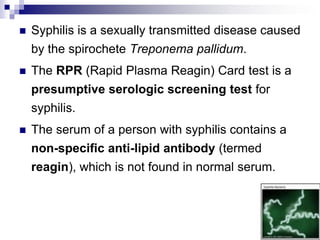
Syphilis is a sexually transmitted disease caused by the spirochete Treponema pallidum. The RPR (Rapid Plasma Reagin) Card test is a presumptive serologic screening test for syphilis. The serum of a person with syphilis contains a non-specific anti-lipid antibody (termed reagin), which is not found in normal serum.
Syphilis infection starts the breakdown of the patient's own tissue cells. Fatty substances which are released, combine with protein from Treponema pallidum to form an antigen which stimulates the body to produce antibodies against both the body's tissue lipids (non-specific or non-treponemal) as well as the T. pallidum protein (specific or treponemal). The RPR Card test detects the nonspecific antilipid antibody and is referred to as a non-treponemal test for syphilis.
Principle of the MethodThe RPR test is a non-treponemal slide agglutination test for the qualitative and semi-quantitative detection of plasma reagins in human serum.Carbon particles coated with a lipid complex are agglutinated when mixed with samples containing reagins.
*The known RPR antigen consists of Cardiolipin, lecithin, andcholesterol bound to charcoal particlesCharcoal makes the reaction visible. If the patient has syphilis, the antilipid antibodies (Reagin) in his/her serum will cross-react with the known RPR lipid antigens giving a visible clumping of the charcoal particles
Procedure:Place 50 µl of sample and one drop of each +ve and –ve controls into separate circles on the test slide.Swirl the RPR-carbon reagent gently before using. Place the micropipette in a vertical position and perpendicular to the slide, and add one drop (20 µl) of this reagent next to the samples to be tested.Mix the drops with a stirrer, spreading them over the entire surface of the circle. Use different stirrers for each samples.Place the slide on a mechanical rotor (shaker) at 80-100 r.p.m. for 8 minutes.Read the test results immediately.
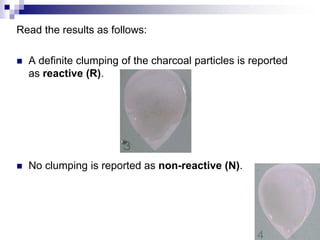
Read the results as follows: A definite clumping of the charcoal particles is reported as reactive (R). No clumping is reported as non-reactive (N).
Type of sample used in the TestSerumPlasma(centrifuge to remove fibrin before testing)Sample not suitable for TestingHaemolysedLipemicHigh conc. Of Billirubin following factors interfere with the test results and should be avoided

Tpi4

  • 1.
  • 2.
    Syphilis is asexually transmitted disease caused by the spirochete Treponema pallidum. The RPR (Rapid Plasma Reagin) Card test is a presumptive serologic screening test for syphilis. The serum of a person with syphilis contains a non-specific anti-lipid antibody (termed reagin), which is not found in normal serum.
  • 3.
    Syphilis infection startsthe breakdown of the patient's own tissue cells. Fatty substances which are released, combine with protein from Treponema pallidum to form an antigen which stimulates the body to produce antibodies against both the body's tissue lipids (non-specific or non-treponemal) as well as the T. pallidum protein (specific or treponemal). The RPR Card test detects the nonspecific antilipid antibody and is referred to as a non-treponemal test for syphilis.
  • 4.
    Principle of theMethodThe RPR test is a non-treponemal slide agglutination test for the qualitative and semi-quantitative detection of plasma reagins in human serum.Carbon particles coated with a lipid complex are agglutinated when mixed with samples containing reagins.
  • 5.
    *The known RPRantigen consists of Cardiolipin, lecithin, andcholesterol bound to charcoal particlesCharcoal makes the reaction visible. If the patient has syphilis, the antilipid antibodies (Reagin) in his/her serum will cross-react with the known RPR lipid antigens giving a visible clumping of the charcoal particles
  • 6.
    Procedure:Place 50 µlof sample and one drop of each +ve and –ve controls into separate circles on the test slide.Swirl the RPR-carbon reagent gently before using. Place the micropipette in a vertical position and perpendicular to the slide, and add one drop (20 µl) of this reagent next to the samples to be tested.Mix the drops with a stirrer, spreading them over the entire surface of the circle. Use different stirrers for each samples.Place the slide on a mechanical rotor (shaker) at 80-100 r.p.m. for 8 minutes.Read the test results immediately.
  • 7.
    Read the resultsas follows: A definite clumping of the charcoal particles is reported as reactive (R). No clumping is reported as non-reactive (N).
  • 8.
    Type of sampleused in the TestSerumPlasma(centrifuge to remove fibrin before testing)Sample not suitable for TestingHaemolysedLipemicHigh conc. Of Billirubin following factors interfere with the test results and should be avoided