Complement fixation tests
• Complements are some special chemicals or protein components that
are a part of our humoral immunity and aid in establishing antigen-
antibody complexes, engulfing, degrading, and washing them away.
They are found in the blood or attached near membranes. Eg. C1, C2,
C3, C4 proteins, etc.
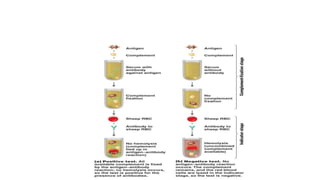
Complement fixation is one of the most important and one of the classical
techniques for determining antigen-antibody complexes present in the testing
sample. This test is based on the principle that the Ag-Ab complex can only fix the
complement and its effect on the hemolysis of RBC used in the indicator system.
When antigen and antibody interact with each other, they form a complex called
antigen-antibody (Ag-Ab ) complex. The complex then interacts with complement
protein and gets fixed with it. After fixing, the complement degrades or gets
cleaved into two fragments i.e. smaller and larger fragments.
If the sample contains desired antibodies or antigens, the Ag-Ab complex will be
formed in the sample after the addition of a complementary reactant(antigen or
antibody, based on the component being detected), and the indicator system will
not be able to react to the added complement(as it already gets fixed with Ag-Ab
complex) which results in no change in the indicator system.
Materials and Reagents
• Sheep erythrocytes suspension (5% suspension of washed sheep RBCs)
• Hemolysin (rabbit anti-sheep red-cell antibody)
• Guinea pig complement, free of antibodies to the agent of interest (Note:
Guinea pig is the commonest source of fresh complement)
• Barbital-buffered diluents
• Plastic microtitre plate
• Centrifuge adapter for microtitre plates
• Water bath for incubation of plates
• Color standards for judging hemolysis (prepared by lysing various
concentrations of red cells)
Procedure
• A serum sample is taken.
• It is then heated at about 56 °C to remove the complement proteins
already present in the sample.
• The serum is then adsorbed with washed sheep RBC. It prevents
interference in the test by anti-RBC antibodies which are cross-
reactive.
• Then the antigen and complement are added to the sample.
• It is then subjected to incubation at a temperature of 37 °C for 30
minutes. It provides conditions and time for the formation of the Ag-
Ab complex.
• And the indicator system is then added and the sample is observed
for change due to occurrence or non-occurrence of hemolysis.
Complement Fixation Test Result Interpretation
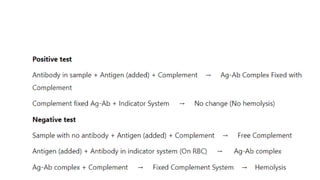
• If the sample contains the specific antibody or antigen of interest,
there will be no change in the solution after the test and it will be
considered a positive test. The non- hemolyzed sensitized RBC will
remain as it is and settle down in the sample.
• If there is some change in the appearance of the sample or solution
during the test due to hemolysis, it will be considered a negative test.
Complement Fixation Test Limitations
• It is one of the old methods not used much in current practices.
• It is slower and more complex in comparison to many easier rapid
detection tests being used currently.
• It is difficult to perform and arrange the reagents used for it.
• Although it is one of the sensitive tests, it has less sensitivity than
other tests such as ELISA.

complement fixation test.pptx

  • 1.
  • 2.
    • Complements aresome special chemicals or protein components that are a part of our humoral immunity and aid in establishing antigen- antibody complexes, engulfing, degrading, and washing them away. They are found in the blood or attached near membranes. Eg. C1, C2, C3, C4 proteins, etc.
  • 3.
    Complement fixation isone of the most important and one of the classical techniques for determining antigen-antibody complexes present in the testing sample. This test is based on the principle that the Ag-Ab complex can only fix the complement and its effect on the hemolysis of RBC used in the indicator system. When antigen and antibody interact with each other, they form a complex called antigen-antibody (Ag-Ab ) complex. The complex then interacts with complement protein and gets fixed with it. After fixing, the complement degrades or gets cleaved into two fragments i.e. smaller and larger fragments. If the sample contains desired antibodies or antigens, the Ag-Ab complex will be formed in the sample after the addition of a complementary reactant(antigen or antibody, based on the component being detected), and the indicator system will not be able to react to the added complement(as it already gets fixed with Ag-Ab complex) which results in no change in the indicator system.
  • 6.
    Materials and Reagents •Sheep erythrocytes suspension (5% suspension of washed sheep RBCs) • Hemolysin (rabbit anti-sheep red-cell antibody) • Guinea pig complement, free of antibodies to the agent of interest (Note: Guinea pig is the commonest source of fresh complement) • Barbital-buffered diluents • Plastic microtitre plate • Centrifuge adapter for microtitre plates • Water bath for incubation of plates • Color standards for judging hemolysis (prepared by lysing various concentrations of red cells)
  • 7.
    Procedure • A serumsample is taken. • It is then heated at about 56 °C to remove the complement proteins already present in the sample. • The serum is then adsorbed with washed sheep RBC. It prevents interference in the test by anti-RBC antibodies which are cross- reactive. • Then the antigen and complement are added to the sample. • It is then subjected to incubation at a temperature of 37 °C for 30 minutes. It provides conditions and time for the formation of the Ag- Ab complex. • And the indicator system is then added and the sample is observed for change due to occurrence or non-occurrence of hemolysis.
  • 8.
    Complement Fixation TestResult Interpretation • If the sample contains the specific antibody or antigen of interest, there will be no change in the solution after the test and it will be considered a positive test. The non- hemolyzed sensitized RBC will remain as it is and settle down in the sample. • If there is some change in the appearance of the sample or solution during the test due to hemolysis, it will be considered a negative test.
  • 9.
    Complement Fixation TestLimitations • It is one of the old methods not used much in current practices. • It is slower and more complex in comparison to many easier rapid detection tests being used currently. • It is difficult to perform and arrange the reagents used for it. • Although it is one of the sensitive tests, it has less sensitivity than other tests such as ELISA.