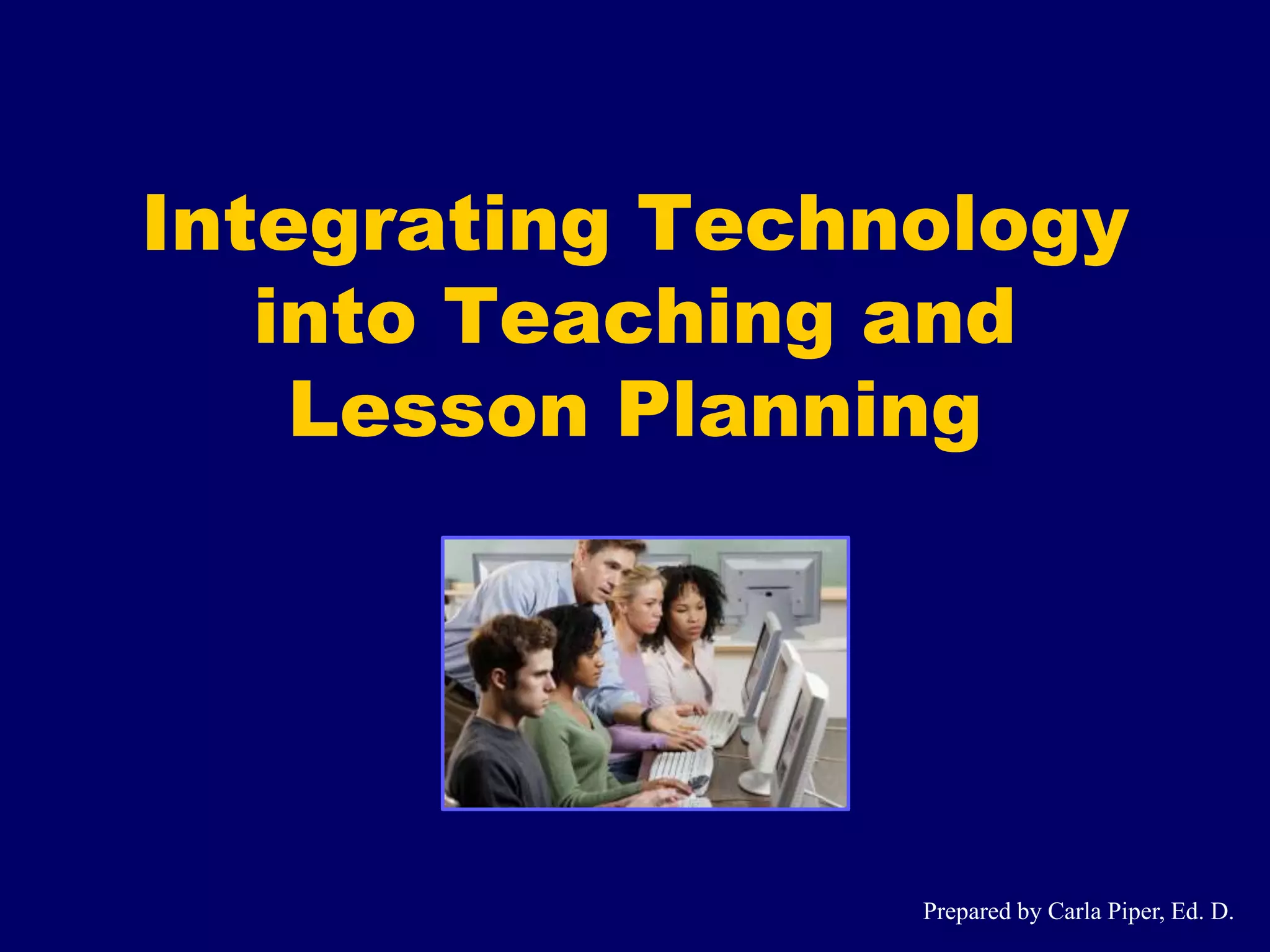
Integrating Technology
into Teaching and
Lesson Planning
Prepared by Carla Piper, Ed. D.
What is Teaching?
Curriculum - What do you teach?
Instruction - How should you teach it?
Assessment –
• How do you determine if you’ve
taught it successfully?
• How do you know students learned
the academic content?
• If learning is not the result, adjust
instruction.
What is Curriculum?
Experienced Curriculum
 “Curriculum is what happens.”
 What the student experiences and
perceives during the day
 Planned or unplanned
Planned Curriculum
 Planned learning experiences
 Know what to teach – CONTENT
 Know how to teach it - PEDAGOGY
Feeny, Christensen, Moravick
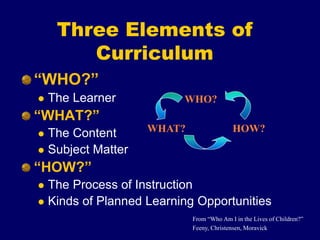
Three Elements of
Curriculum
“WHO?”
 The Learner
“WHAT?”
 The Content
 Subject Matter
“HOW?”
 The Process of Instruction
 Kinds of Planned Learning Opportunities
WHO?
WHAT? HOW?
From “Who Am I in the Lives of Children?”
Feeny, Christensen, Moravick
What do we teach?
Educational Values Based on Vision of Society
What do you believe is worth knowing?
What do you know about the learners and
their development?
What do you know about subject matter
content?
What are the academic standards that
need to be met with this lesson?
What is the best way to promote student
learning? Feeny, Christensen, Moravick
Instruction
Steps to Lesson Planning
What academic standard will be met?
What are your learning objectives?
What is the activity?
What is the sequence or timing?
What technology will you use, when and
why?
Who will participate?
What is the overall purpose of the lesson?
How will you measure student learning?
Planning Instruction
What do you need to teach this
lesson?
 Materials (including digital media)
 Space
 Time
 Resources (including technology/app/device)
What do you do? How? When?
 Introduction – How do you get them interested?
 Procedure – What will you do and say (step-by-step
guide)
 Closure – How will you help students make a transition
to the next activity?
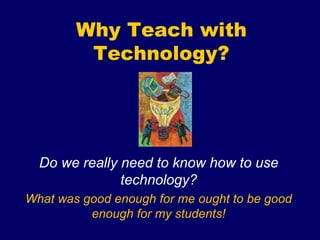
Why Teach with
Technology?
Do we really need to know how to use
technology?
What was good enough for me ought to be good
enough for my students!
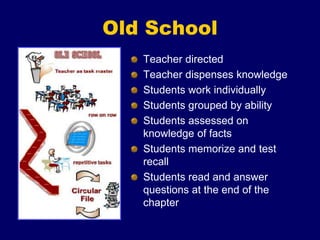
Old School
Teacher directed
Teacher dispenses knowledge
Students work individually
Students grouped by ability
Students assessed on
knowledge of facts
Students memorize and test
recall
Students read and answer
questions at the end of the
chapter
Traditional Classrooms
Every student learns the same materials
Teachers use the identical instructional
delivery mode
Students learn by listening and reading
– and very little by doing authentic tasks
Lecture based method does not
accommodate all learners. Aimed at:
 Verbal-linguistic learners
 Logical-mathematical learners
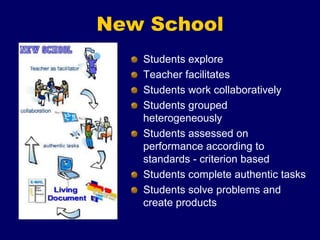
New School
Students explore
Teacher facilitates
Students work collaboratively
Students grouped
heterogeneously
Students assessed on
performance according to
standards - criterion based
Students complete authentic tasks
Students solve problems and
create products
Stage 1: Use technology to do things
we can already do but more convenient:
 Typing vs. word processing
 Calculator vs. spreadsheets
Stage 2: Use technology to improve on
tasks we already do:
 Track student progress
 Create more professional looking products
How do Teachers Decide
to Use New Technologies?
Stage 3:
Use technology to do things that
were not previously possible
Real-time
manipulation of data
- graphs/charts
Professional
publishing and
graphics
Multi-media
presentations
Instant global
communication
Help with students
who have special
needs
Used as a tutor - Student answers questions
or solves problems in sequenced learning
Used to explore - Student discovers through
interactive information, demonstration, or
simulation
Applied as a tool for accomplishing tasks and
expressing creativity
Used to communicate - Student retrieves
and sends information electronically
Classifications of
Educational Technologies
Barbara Means
Traditional 5-Step Lesson
Plan Format
1. Anticipatory Set
• “The Hook” to get students interested, curious,
motivated.
• Setting the stage - providing frame of reference
• Scaffolding – tapping in to previous knowledge
2. The Instruction – Step by Step Learning of
Concept
3. Guided Practice – Individualized? Drill?
4. Part of Assessment Process
5. Closure – Transition to New Topic
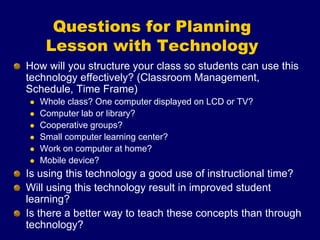
Questions for Planning
Lesson with Technology
How will you structure your class so students can use this
technology effectively? (Classroom Management,
Schedule, Time Frame)
 Whole class? One computer displayed on LCD or TV?
 Computer lab or library?
 Cooperative groups?
 Small computer learning center?
 Work on computer at home?
 Mobile device?
Is using this technology a good use of instructional time?
Will using this technology result in improved student
learning?
Is there a better way to teach these concepts than through
technology?
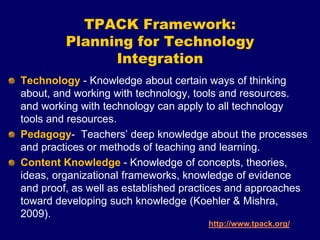
TPACK Framework:
Planning for Technology
Integration
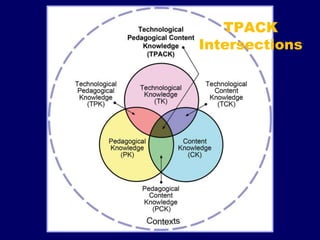
Technology - Knowledge about certain ways of thinking
about, and working with technology, tools and resources.
and working with technology can apply to all technology
tools and resources.
Pedagogy- Teachers’ deep knowledge about the processes
and practices or methods of teaching and learning.
Content Knowledge - Knowledge of concepts, theories,
ideas, organizational frameworks, knowledge of evidence
and proof, as well as established practices and approaches
toward developing such knowledge (Koehler & Mishra,
2009).
http://www.tpack.org/
TPACK
Intersections
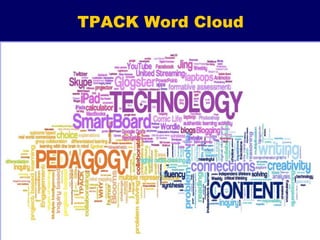
TPACK Word Cloud
TPACK Activity Types
Knowledge Building Activity Types
• How will this use of technology build students’ knowledge
and understanding of this content, concept, or process?
Knowledge Expression Activity Types
• How will you determine what students have learned by
reviewing their “performances of understanding?”
• How will this technology allow students to express their
knowledge related to the standards and learning goals of
this lesson?
• How will the students use this technology to express their
divergent knowledge?
• Is your use of technology utilizing written, visual,
conceptual, product-oriented, or participatory activity types?
Resource
TPACK Activity Types
Click on Links for Examples
Literacy K-6
Secondary English Language Arts
Math
Music
Physical Education
Science
Social Studies
Visual Arts
World Languages
Additional
Resources
What are TPACK
Activities?
Using Technology to
Teach English
Learners
Writing Measurable
Instructional Objectives
Learning objectives connect instructional
planning with curriculum content as
measured by assessment.
By participating in this activity students
will:
 Learn about…?
 Gain greater understanding of…?
 Practice…?
 Develop an awareness of…?
 Express understanding of…?
 Develop skill in…?
 Begin to be able to…
How will you measure learning outcomes?
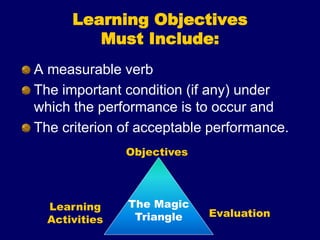
Learning Objectives
Must Include:
A measurable verb
The important condition (if any) under
which the performance is to occur and
The criterion of acceptable performance.
The Magic
Triangle
Learning
Activities
Objectives
Evaluation
ABCD's of Learning
Objectives
Audience - Who will be doing the
behavior?
Behavior - What should the learner be
able to do?
Condition - Under what conditions do
you want the learner to be able to do it?
Degree - How well must it be done?
Writing Learning Objectives
for your Lesson Plan
Audience: The learners
 Who is doing the performance? (not the instructor).
Behavior (Performance):
 What the learner will be able to do?
 Can this performance be seen or heard?
Condition: The conditions under which the learners must
demonstrate their mastery of the objective:
 What will the learners be allowed to use?
 What won't the learners be allowed to use?
Degree (or criterion): Common degrees include: Speed,
Accuracy, Quality
 HOW WELL the behavior must be done?
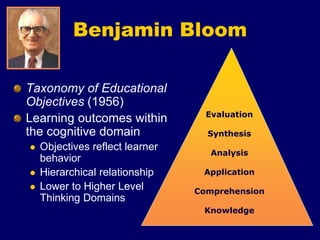
Benjamin Bloom
Taxonomy of Educational
Objectives (1956)
Learning outcomes within
the cognitive domain
 Objectives reflect learner
behavior
 Hierarchical relationship
 Lower to Higher Level
Thinking Domains
Evaluation
Synthesis
Analysis
Application
Comprehension
Knowledge
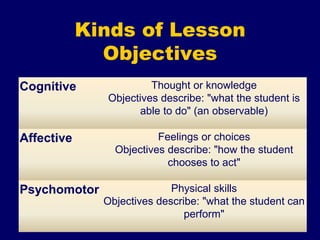
Kinds of Lesson
Objectives
Cognitive Thought or knowledge
Objectives describe: "what the student is
able to do" (an observable)
Affective Feelings or choices
Objectives describe: "how the student
chooses to act"
Psychomotor Physical skills
Objectives describe: "what the student can
perform"
Bloom’s Learning
Taxonomy
Higher order thinking – critical thinking
Three overlapping domains
 Cognitive – Knowledge, recall,
comprehension, analyzing/synthesizing data,
problem solving, etc.
 Psychomotor – physical skills, fine or gross
motor skills, coordination, dexterity
 Affective – attitudes of awareness, interest,
attention, concern, responsibility, respect,
enjoyment, appreciation, motivation
Bloom’s Taxonomy
Higher Level Thinking
KNOWLEDGE: define, list, name, memorize
COMPREHENSION: identify, describe,
explain
APPLICATION: demonstrate, use, show,
teach
ANALYSIS: categorize, compare, calculate
SYNTHESIS: design, create, prepare, predict
EVALUATION: judge, assess, rate, revise
Ask Students to:
Know - recall information in original form
Comprehend - show understanding
Apply - use learning in a new situation
Analyze - show s/he can see relationships
Synthesize - combine and integrate parts of prior
knowledge into a product, plan, or proposal that is
new
Evaluate - assess and criticize on basis of
standards and criteria
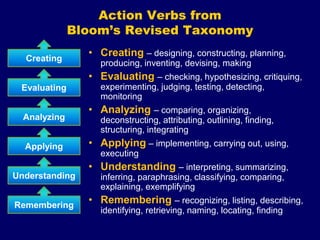
Understanding
Applying
Analyzing
Evaluating
Creating
• Creating – designing, constructing, planning,
producing, inventing, devising, making
• Evaluating – checking, hypothesizing, critiquing,
experimenting, judging, testing, detecting,
monitoring
• Analyzing – comparing, organizing,
deconstructing, attributing, outlining, finding,
structuring, integrating
• Applying – implementing, carrying out, using,
executing
• Understanding – interpreting, summarizing,
inferring, paraphrasing, classifying, comparing,
explaining, exemplifying
• Remembering – recognizing, listing, describing,
identifying, retrieving, naming, locating, finding
Action Verbs from
Bloom’s Revised Taxonomy
Remembering
Assessment and Reflection
Assessment
 What will students say or do to show you objectives were met?
 What will you collect to show student’s learning (portfolios,
observations, work samples, photographs, etc.)
 What technology products will students produce that can be used
as an assessment?
Reflection on your teaching
 How will your assessment guide your teaching practice?
 What needs to be “re-taught” and how can you teach it differently
when assessment demonstrates that some students did not learn
the material?
 Is there a better way to teach this material?
 What will you do differently next time?
 How could you extend this activity for another lesson?
 Was your instruction effective in promoting student learning?
References
TPACK.org - http://www.tpack.org/
TPACK Activity Types - http://activitytypes.wm.edu/
“Pedagogy: A Primer on Education Theory for Technical
Professionals” – Brahler & Johnson. Washington State
University – Download from Microsoft Higher Education
Website
“Multiple Intelligences and Technology” – Edwards (no
longer available)
Bloom’s Digital Technology -
http://www.techlearning.com/techlearning/archives/2008/04/AndrewCh
urches.pdf
Bloom’s Taxonomy -
http://www.odu.edu/educ/roverbau/Bloom/blooms_taxonomy.htm

Tpack planning

  • 1.
    Integrating Technology into Teachingand Lesson Planning Prepared by Carla Piper, Ed. D.
  • 2.
    What is Teaching? Curriculum- What do you teach? Instruction - How should you teach it? Assessment – • How do you determine if you’ve taught it successfully? • How do you know students learned the academic content? • If learning is not the result, adjust instruction.
  • 3.
    What is Curriculum? ExperiencedCurriculum  “Curriculum is what happens.”  What the student experiences and perceives during the day  Planned or unplanned Planned Curriculum  Planned learning experiences  Know what to teach – CONTENT  Know how to teach it - PEDAGOGY Feeny, Christensen, Moravick
  • 4.
    Three Elements of Curriculum “WHO?” The Learner “WHAT?”  The Content  Subject Matter “HOW?”  The Process of Instruction  Kinds of Planned Learning Opportunities WHO? WHAT? HOW? From “Who Am I in the Lives of Children?” Feeny, Christensen, Moravick
  • 5.
    What do weteach? Educational Values Based on Vision of Society What do you believe is worth knowing? What do you know about the learners and their development? What do you know about subject matter content? What are the academic standards that need to be met with this lesson? What is the best way to promote student learning? Feeny, Christensen, Moravick
  • 6.
    Instruction Steps to LessonPlanning What academic standard will be met? What are your learning objectives? What is the activity? What is the sequence or timing? What technology will you use, when and why? Who will participate? What is the overall purpose of the lesson? How will you measure student learning?
  • 7.
    Planning Instruction What doyou need to teach this lesson?  Materials (including digital media)  Space  Time  Resources (including technology/app/device) What do you do? How? When?  Introduction – How do you get them interested?  Procedure – What will you do and say (step-by-step guide)  Closure – How will you help students make a transition to the next activity?
  • 8.
    Why Teach with Technology? Dowe really need to know how to use technology? What was good enough for me ought to be good enough for my students!
  • 9.
    Old School Teacher directed Teacherdispenses knowledge Students work individually Students grouped by ability Students assessed on knowledge of facts Students memorize and test recall Students read and answer questions at the end of the chapter
  • 10.
    Traditional Classrooms Every studentlearns the same materials Teachers use the identical instructional delivery mode Students learn by listening and reading – and very little by doing authentic tasks Lecture based method does not accommodate all learners. Aimed at:  Verbal-linguistic learners  Logical-mathematical learners
  • 11.
    New School Students explore Teacherfacilitates Students work collaboratively Students grouped heterogeneously Students assessed on performance according to standards - criterion based Students complete authentic tasks Students solve problems and create products
  • 12.
    Stage 1: Usetechnology to do things we can already do but more convenient:  Typing vs. word processing  Calculator vs. spreadsheets Stage 2: Use technology to improve on tasks we already do:  Track student progress  Create more professional looking products How do Teachers Decide to Use New Technologies?
  • 13.
    Stage 3: Use technologyto do things that were not previously possible Real-time manipulation of data - graphs/charts Professional publishing and graphics Multi-media presentations Instant global communication Help with students who have special needs
  • 14.
    Used as atutor - Student answers questions or solves problems in sequenced learning Used to explore - Student discovers through interactive information, demonstration, or simulation Applied as a tool for accomplishing tasks and expressing creativity Used to communicate - Student retrieves and sends information electronically Classifications of Educational Technologies Barbara Means
  • 15.
    Traditional 5-Step Lesson PlanFormat 1. Anticipatory Set • “The Hook” to get students interested, curious, motivated. • Setting the stage - providing frame of reference • Scaffolding – tapping in to previous knowledge 2. The Instruction – Step by Step Learning of Concept 3. Guided Practice – Individualized? Drill? 4. Part of Assessment Process 5. Closure – Transition to New Topic
  • 16.
    Questions for Planning Lessonwith Technology How will you structure your class so students can use this technology effectively? (Classroom Management, Schedule, Time Frame)  Whole class? One computer displayed on LCD or TV?  Computer lab or library?  Cooperative groups?  Small computer learning center?  Work on computer at home?  Mobile device? Is using this technology a good use of instructional time? Will using this technology result in improved student learning? Is there a better way to teach these concepts than through technology?
  • 17.
    TPACK Framework: Planning forTechnology Integration Technology - Knowledge about certain ways of thinking about, and working with technology, tools and resources. and working with technology can apply to all technology tools and resources. Pedagogy- Teachers’ deep knowledge about the processes and practices or methods of teaching and learning. Content Knowledge - Knowledge of concepts, theories, ideas, organizational frameworks, knowledge of evidence and proof, as well as established practices and approaches toward developing such knowledge (Koehler & Mishra, 2009). http://www.tpack.org/
  • 18.
  • 19.
  • 20.
    TPACK Activity Types KnowledgeBuilding Activity Types • How will this use of technology build students’ knowledge and understanding of this content, concept, or process? Knowledge Expression Activity Types • How will you determine what students have learned by reviewing their “performances of understanding?” • How will this technology allow students to express their knowledge related to the standards and learning goals of this lesson? • How will the students use this technology to express their divergent knowledge? • Is your use of technology utilizing written, visual, conceptual, product-oriented, or participatory activity types? Resource
  • 21.
    TPACK Activity Types Clickon Links for Examples Literacy K-6 Secondary English Language Arts Math Music Physical Education Science Social Studies Visual Arts World Languages Additional Resources What are TPACK Activities? Using Technology to Teach English Learners
  • 22.
    Writing Measurable Instructional Objectives Learningobjectives connect instructional planning with curriculum content as measured by assessment. By participating in this activity students will:  Learn about…?  Gain greater understanding of…?  Practice…?  Develop an awareness of…?  Express understanding of…?  Develop skill in…?  Begin to be able to… How will you measure learning outcomes?
  • 23.
    Learning Objectives Must Include: Ameasurable verb The important condition (if any) under which the performance is to occur and The criterion of acceptable performance. The Magic Triangle Learning Activities Objectives Evaluation
  • 24.
    ABCD's of Learning Objectives Audience- Who will be doing the behavior? Behavior - What should the learner be able to do? Condition - Under what conditions do you want the learner to be able to do it? Degree - How well must it be done?
  • 25.
    Writing Learning Objectives foryour Lesson Plan Audience: The learners  Who is doing the performance? (not the instructor). Behavior (Performance):  What the learner will be able to do?  Can this performance be seen or heard? Condition: The conditions under which the learners must demonstrate their mastery of the objective:  What will the learners be allowed to use?  What won't the learners be allowed to use? Degree (or criterion): Common degrees include: Speed, Accuracy, Quality  HOW WELL the behavior must be done?
  • 26.
    Benjamin Bloom Taxonomy ofEducational Objectives (1956) Learning outcomes within the cognitive domain  Objectives reflect learner behavior  Hierarchical relationship  Lower to Higher Level Thinking Domains Evaluation Synthesis Analysis Application Comprehension Knowledge
  • 27.
    Kinds of Lesson Objectives CognitiveThought or knowledge Objectives describe: "what the student is able to do" (an observable) Affective Feelings or choices Objectives describe: "how the student chooses to act" Psychomotor Physical skills Objectives describe: "what the student can perform"
  • 28.
    Bloom’s Learning Taxonomy Higher orderthinking – critical thinking Three overlapping domains  Cognitive – Knowledge, recall, comprehension, analyzing/synthesizing data, problem solving, etc.  Psychomotor – physical skills, fine or gross motor skills, coordination, dexterity  Affective – attitudes of awareness, interest, attention, concern, responsibility, respect, enjoyment, appreciation, motivation
  • 29.
    Bloom’s Taxonomy Higher LevelThinking KNOWLEDGE: define, list, name, memorize COMPREHENSION: identify, describe, explain APPLICATION: demonstrate, use, show, teach ANALYSIS: categorize, compare, calculate SYNTHESIS: design, create, prepare, predict EVALUATION: judge, assess, rate, revise
  • 30.
    Ask Students to: Know- recall information in original form Comprehend - show understanding Apply - use learning in a new situation Analyze - show s/he can see relationships Synthesize - combine and integrate parts of prior knowledge into a product, plan, or proposal that is new Evaluate - assess and criticize on basis of standards and criteria
  • 31.
    Understanding Applying Analyzing Evaluating Creating • Creating –designing, constructing, planning, producing, inventing, devising, making • Evaluating – checking, hypothesizing, critiquing, experimenting, judging, testing, detecting, monitoring • Analyzing – comparing, organizing, deconstructing, attributing, outlining, finding, structuring, integrating • Applying – implementing, carrying out, using, executing • Understanding – interpreting, summarizing, inferring, paraphrasing, classifying, comparing, explaining, exemplifying • Remembering – recognizing, listing, describing, identifying, retrieving, naming, locating, finding Action Verbs from Bloom’s Revised Taxonomy Remembering
  • 32.
    Assessment and Reflection Assessment What will students say or do to show you objectives were met?  What will you collect to show student’s learning (portfolios, observations, work samples, photographs, etc.)  What technology products will students produce that can be used as an assessment? Reflection on your teaching  How will your assessment guide your teaching practice?  What needs to be “re-taught” and how can you teach it differently when assessment demonstrates that some students did not learn the material?  Is there a better way to teach this material?  What will you do differently next time?  How could you extend this activity for another lesson?  Was your instruction effective in promoting student learning?
  • 33.
    References TPACK.org - http://www.tpack.org/ TPACKActivity Types - http://activitytypes.wm.edu/ “Pedagogy: A Primer on Education Theory for Technical Professionals” – Brahler & Johnson. Washington State University – Download from Microsoft Higher Education Website “Multiple Intelligences and Technology” – Edwards (no longer available) Bloom’s Digital Technology - http://www.techlearning.com/techlearning/archives/2008/04/AndrewCh urches.pdf Bloom’s Taxonomy - http://www.odu.edu/educ/roverbau/Bloom/blooms_taxonomy.htm