A-level Physics
  A-level Physics


  Unit G484:
  The Newtonian
  World


  Gravitation -- introduction
  Gravitation introduction


Circular motion
Gravitation              LOs


      Write down anything and everything you know
      about ‘gravity’.


Circular motion
Lesson focus
  • Gravitation - introduction


  Learning objectives
  At the end of the lesson you will be able to:


  • describe how a mass creates a gravitational field in the
    space around it;

  • describe gravitational field strength as force per unit mass.


Circular motion
Learning outcomes
  All of you should be able to
  • explain the meaning of gravitational field;
  • use field lines to show the gravitational field in a small region of the
     Earth’s surface, and around the whole Earth;
  • explain the meaning of gravitational field strength.


  Most of you will be able to
  • solve problems involving the shape and strength of a gravitational
     field.


Circular motion
Fields of force                          LOs


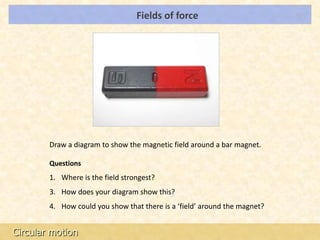
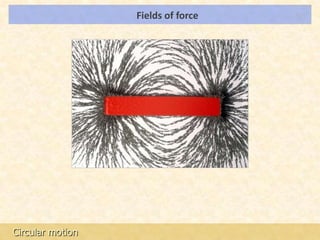
        Draw a diagram to show the magnetic field around a bar magnet.

        Questions
        1. Where is the field strongest?
        3. How does your diagram show this?
        4. How could you show that there is a ‘field’ around the magnet?


Circular motion
Fields of force   LOs


Circular motion
Fields of force                               LOs


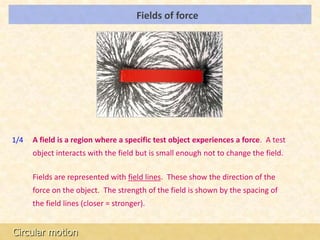
1/4   A field is a region where a specific test object experiences a force. A test
      object interacts with the field but is small enough not to change the field.

      Fields are represented with field lines. These show the direction of the
      force on the object. The strength of the field is shown by the spacing of
      the field lines (closer = stronger).


Circular motion
Gravitational fields              LOs


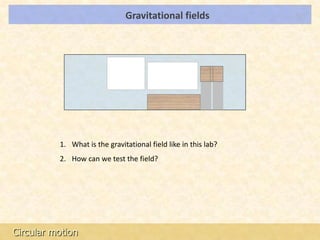
          1. What is the gravitational field like in this lab?
          2. How can we test the field?


Circular motion
Gravitational fields                            LOs


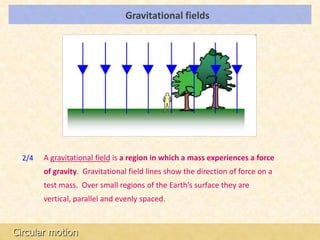
  2/4   A gravitational field is a region in which a mass experiences a force
        of gravity. Gravitational field lines show the direction of force on a
        test mass. Over small regions of the Earth’s surface they are
        vertical, parallel and evenly spaced.


Circular motion
Gravitational fields   LOs


Circular motion
Gravitational fields                                   LOs


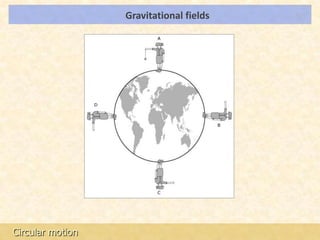
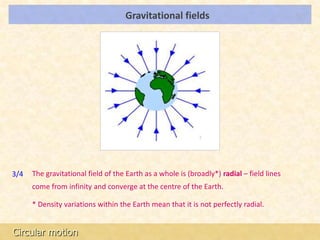
3/4   The gravitational field of the Earth as a whole is (broadly*) radial – field lines
      come from infinity and converge at the centre of the Earth.

      * Density variations within the Earth mean that it is not perfectly radial.


Circular motion
The Earth’s gravitational field   LOs


Circular motion
The Earth’s gravitational field                            LOs


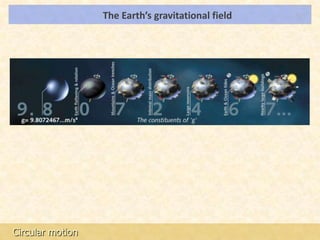
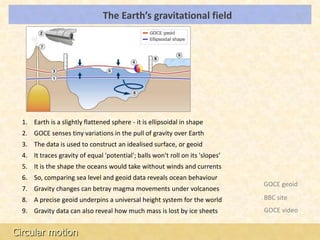
  1. Earth is a slightly flattened sphere - it is ellipsoidal in shape
  2. GOCE senses tiny variations in the pull of gravity over Earth
  3. The data is used to construct an idealised surface, or geoid
  4. It traces gravity of equal 'potential'; balls won't roll on its 'slopes‘
  5. It is the shape the oceans would take without winds and currents
  6. So, comparing sea level and geoid data reveals ocean behaviour
                                                                                GOCE geoid
  7. Gravity changes can betray magma movements under volcanoes
  8. A precise geoid underpins a universal height system for the world          BBC site
  9. Gravity data can also reveal how much mass is lost by ice sheets           GOCE video


Circular motion
Gravitational fields                LOs


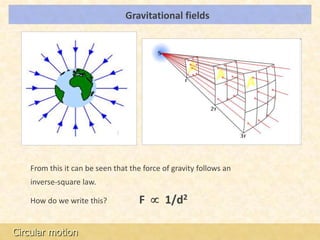
    From this it can be seen that the force of gravity follows an
    inverse-square law.

    How do we write this?            F  1/d2

Circular motion
What is the force of gravity?                            LOs


4/4   • The force of gravity is an attractive force between masses.

      • It is the weakest of the four fundamental forces.


      Gravitational field strength

      The strength of a gravitational field is found by placing a test mass in the
      field and is expressed as the force per unit mass, ‘g’

                               F       units: N
                        g =
                               m              kg

      The Earth has a gravitational field strength of approximately 9.81 N kg-1 .


Circular motion
Introductory Qs         LOs


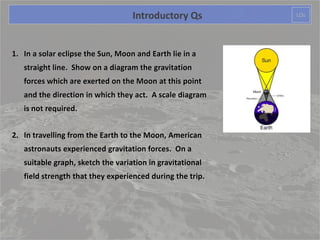
1. In a solar eclipse the Sun, Moon and Earth lie in a
   straight line. Show on a diagram the gravitation
   forces which are exerted on the Moon at this point
   and the direction in which they act. A scale diagram
   is not required.


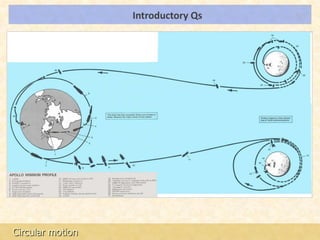
2. In travelling from the Earth to the Moon, American
   astronauts experienced gravitation forces. On a
   suitable graph, sketch the variation in gravitational
   field strength that they experienced during the trip.


Circular motion
Introductory Qs   LOs


Circular motion
Introductory Qs                          LOs


  3. If it were possible to position a huge mass of small size (e.g. a
     neutron ball) just above the Earth’s surface, what would be the
     shape of the gravitational field around the mass?


  4. A mass of 7 kg is placed on a spring balance 1 m above the
     surface of the Earth and experiences a force of 68.67 N.
     Calculate the gravitation field strength at that point.

  5. The gravitational force on a mass m on the Moon is 1.7m. Use
     this information to calculate the ratio of g on the Earth to that on
     the Moon.


Circular motion

Cm 5 gravitation introduction (shared)

  • 1.
    A-level Physics A-level Physics Unit G484: The Newtonian World Gravitation -- introduction Gravitation introduction Circular motion
  • 2.
    Gravitation LOs Write down anything and everything you know about ‘gravity’. Circular motion
  • 3.
    Lesson focus • Gravitation - introduction Learning objectives At the end of the lesson you will be able to: • describe how a mass creates a gravitational field in the space around it; • describe gravitational field strength as force per unit mass. Circular motion
  • 4.
    Learning outcomes All of you should be able to • explain the meaning of gravitational field; • use field lines to show the gravitational field in a small region of the Earth’s surface, and around the whole Earth; • explain the meaning of gravitational field strength. Most of you will be able to • solve problems involving the shape and strength of a gravitational field. Circular motion
  • 5.
    Fields of force LOs Draw a diagram to show the magnetic field around a bar magnet. Questions 1. Where is the field strongest? 3. How does your diagram show this? 4. How could you show that there is a ‘field’ around the magnet? Circular motion
  • 6.
    Fields of force LOs Circular motion
  • 7.
    Fields of force LOs 1/4 A field is a region where a specific test object experiences a force. A test object interacts with the field but is small enough not to change the field. Fields are represented with field lines. These show the direction of the force on the object. The strength of the field is shown by the spacing of the field lines (closer = stronger). Circular motion
  • 8.
    Gravitational fields LOs 1. What is the gravitational field like in this lab? 2. How can we test the field? Circular motion
  • 9.
    Gravitational fields LOs 2/4 A gravitational field is a region in which a mass experiences a force of gravity. Gravitational field lines show the direction of force on a test mass. Over small regions of the Earth’s surface they are vertical, parallel and evenly spaced. Circular motion
  • 10.
    Gravitational fields LOs Circular motion
  • 11.
    Gravitational fields LOs 3/4 The gravitational field of the Earth as a whole is (broadly*) radial – field lines come from infinity and converge at the centre of the Earth. * Density variations within the Earth mean that it is not perfectly radial. Circular motion
  • 12.
    The Earth’s gravitationalfield LOs Circular motion
  • 13.
    The Earth’s gravitationalfield LOs 1. Earth is a slightly flattened sphere - it is ellipsoidal in shape 2. GOCE senses tiny variations in the pull of gravity over Earth 3. The data is used to construct an idealised surface, or geoid 4. It traces gravity of equal 'potential'; balls won't roll on its 'slopes‘ 5. It is the shape the oceans would take without winds and currents 6. So, comparing sea level and geoid data reveals ocean behaviour GOCE geoid 7. Gravity changes can betray magma movements under volcanoes 8. A precise geoid underpins a universal height system for the world BBC site 9. Gravity data can also reveal how much mass is lost by ice sheets GOCE video Circular motion
  • 14.
    Gravitational fields LOs From this it can be seen that the force of gravity follows an inverse-square law. How do we write this? F  1/d2 Circular motion
  • 15.
    What is theforce of gravity? LOs 4/4 • The force of gravity is an attractive force between masses. • It is the weakest of the four fundamental forces. Gravitational field strength The strength of a gravitational field is found by placing a test mass in the field and is expressed as the force per unit mass, ‘g’ F units: N g = m kg The Earth has a gravitational field strength of approximately 9.81 N kg-1 . Circular motion
  • 16.
    Introductory Qs LOs 1. In a solar eclipse the Sun, Moon and Earth lie in a straight line. Show on a diagram the gravitation forces which are exerted on the Moon at this point and the direction in which they act. A scale diagram is not required. 2. In travelling from the Earth to the Moon, American astronauts experienced gravitation forces. On a suitable graph, sketch the variation in gravitational field strength that they experienced during the trip. Circular motion
  • 17.
    Introductory Qs LOs Circular motion
  • 18.
    Introductory Qs LOs 3. If it were possible to position a huge mass of small size (e.g. a neutron ball) just above the Earth’s surface, what would be the shape of the gravitational field around the mass? 4. A mass of 7 kg is placed on a spring balance 1 m above the surface of the Earth and experiences a force of 68.67 N. Calculate the gravitation field strength at that point. 5. The gravitational force on a mass m on the Moon is 1.7m. Use this information to calculate the ratio of g on the Earth to that on the Moon. Circular motion