A-level Physics


Unit G481:
Mechanics


Indices
More on units
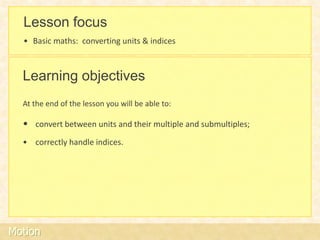
Lesson focus
  • Basic maths: converting units & indices


  Learning objectives
  At the end of the lesson you will be able to:

  • convert between units and their multiple and submultiples;
  • correctly handle indices.


Motion
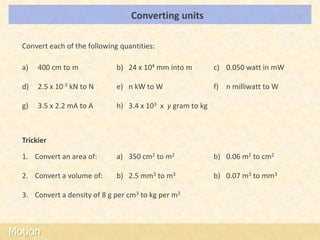
Converting units                                LOs


  Convert each of the following quantities:

  a)   400 cm to m             b) 24 x 104 mm into m         c) 0.050 watt in mW

  d)   2.5 x 10⁻³ kN to N      e) n kW to W                  f) n milliwatt to W

  g)   3.5 x 2.2 mA to A       h) 3.4 x 10³ x y gram to kg


  Trickier

  1. Convert an area of:       a) 350 cm2 to m2              b) 0.06 m2 to cm2

  2. Convert a volume of:      b) 2.5 mm3 to m3              b) 0.07 m3 to mm3

  3. Convert a density of 8 g per cm3 to kg per m3


Motion
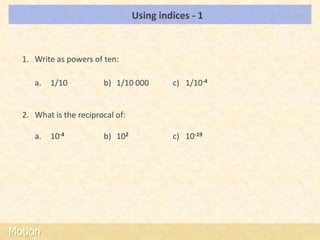
Using indices - 1    LOs


  1. Write as powers of ten:

     a.   1/10          b) 1/10 000        c) 1/10-4


  2. What is the reciprocal of:

     a.   10-4          b) 102             c) 10-19


Motion
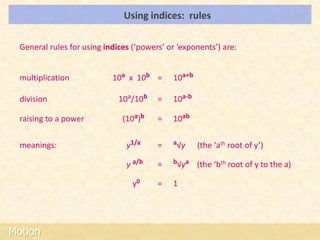
Using indices: rules                                  LOs


  General rules for using indices (‘powers’ or ‘exponents’) are:


  multiplication            10a x 10b =      10a+b

  division                    10a/10b    =   10a-b

  raising to a power           (10a)b    =   10ab

  meanings:                     y1/a     =   a√y     (the ‘ath root of y’)

                                y a/b    =   b√ya    (the ‘bth root of y to the a)

                                  y0     =   1


Motion
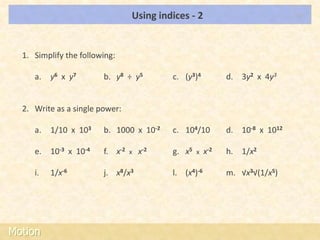
Using indices - 2                            LOs


  1. Simplify the following:

     a.   y6 x y7       b. y8 ÷ y5         c. (y3)4          d. 3y2 x 4y3


  2. Write as a single power:

     a.   1/10 x 103    b. 1000 x 10-2     c. 104/10         d. 10-8 x 10¹²

     e.   10-3 x 10⁻⁴   f. x-2   x   x-2   g. x5   x   x-2   h. 1/x2

     i.   1/x-6         j. x8/x3           l. (x4)-6         m. √x3√(1/x5)


Motion

Motion 3 intro maths indices & unit conversion (shared)

  • 1.
  • 2.
    Lesson focus • Basic maths: converting units & indices Learning objectives At the end of the lesson you will be able to: • convert between units and their multiple and submultiples; • correctly handle indices. Motion
  • 3.
    Converting units LOs Convert each of the following quantities: a) 400 cm to m b) 24 x 104 mm into m c) 0.050 watt in mW d) 2.5 x 10⁻³ kN to N e) n kW to W f) n milliwatt to W g) 3.5 x 2.2 mA to A h) 3.4 x 10³ x y gram to kg Trickier 1. Convert an area of: a) 350 cm2 to m2 b) 0.06 m2 to cm2 2. Convert a volume of: b) 2.5 mm3 to m3 b) 0.07 m3 to mm3 3. Convert a density of 8 g per cm3 to kg per m3 Motion
  • 4.
    Using indices -1 LOs 1. Write as powers of ten: a. 1/10 b) 1/10 000 c) 1/10-4 2. What is the reciprocal of: a. 10-4 b) 102 c) 10-19 Motion
  • 5.
    Using indices: rules LOs General rules for using indices (‘powers’ or ‘exponents’) are: multiplication 10a x 10b = 10a+b division 10a/10b = 10a-b raising to a power (10a)b = 10ab meanings: y1/a = a√y (the ‘ath root of y’) y a/b = b√ya (the ‘bth root of y to the a) y0 = 1 Motion
  • 6.
    Using indices -2 LOs 1. Simplify the following: a. y6 x y7 b. y8 ÷ y5 c. (y3)4 d. 3y2 x 4y3 2. Write as a single power: a. 1/10 x 103 b. 1000 x 10-2 c. 104/10 d. 10-8 x 10¹² e. 10-3 x 10⁻⁴ f. x-2 x x-2 g. x5 x x-2 h. 1/x2 i. 1/x-6 j. x8/x3 l. (x4)-6 m. √x3√(1/x5) Motion