A-level Physics


 Unit G484:
 The Newtonian
 World


 Solids, liquids & gases (1)

Thermal physics
Lesson focus
  • solids, liquids & gases - 1


  Learning objectives
  At the end of the lesson you will be able to:

  • describe a simple kinetic model for solids, liquids and gases;

  • describe solids, liquids and gases in terms of the spacing, ordering
     and motion of atoms or molecules.


Thermal physics
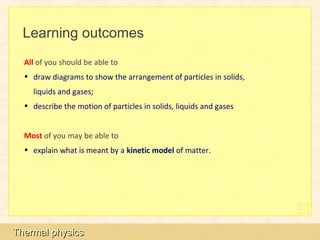
Learning outcomes
  All of you should be able to
  • draw diagrams to show the arrangement of particles in solids,
    liquids and gases;
  • describe the motion of particles in solids, liquids and gases


  Most of you may be able to
  • explain what is meant by a kinetic model of matter.


Thermal physics
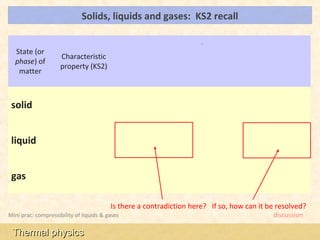
Solids, liquids and gases: KS2 recall                                       LOs


                                                                                          What does this tell
                                                   What does this         Can matter
  State (or                                                                                 us about the
                     Characteristic             property tell us about    in this state
  phase) of                                                                                  spacing of
                     property (KS2)              the forces between            be
   matter                                             particles?                           particles in this
                                                                         compressed?
                                                                                                state?
                       Has a fixed
 solid                 shape and
                        volume

                     Flows and fills
 liquid             the bottom of a
                       container


 gas               Fills its container


                                         Is there a contradiction here? If so, how can it be resolved?
Mini prac: compressibility of liquids & gases                                                     discussion

 Thermal physics
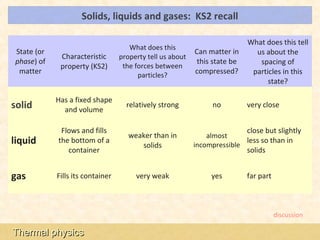
Solids, liquids and gases: KS2 recall                                     LOs


                                                                            What does this tell
                                     What does this
State (or                                                  Can matter in      us about the
             Characteristic       property tell us about
phase) of                                                   this state be      spacing of
             property (KS2)        the forces between
 matter                                 particles?
                                                           compressed?       particles in this
                                                                                  state?

            Has a fixed shape
solid         and volume
                                    relatively strong           no          very close


             Flows and fills                                                close but slightly
                                     weaker than in            almost
liquid      the bottom of a
                                        solids             incompressible
                                                                          less so than in
               container                                                    solids


gas         Fills its container        very weak                yes         far part


                                                                                       discussion

Thermal physics
The kinetic theory of matter                                        LOs


  The kinetic theory of matter states that matter is composed of a very large
  number of very small particles that are in constant, random motion.


  To answer (pairs)

  1. Why is this a useful model?

  2. What observations does it explain? (e.g. the expansion of solids,
  liquids and gases when heated)


  The kinetic theory is useful because it explains a wide range of phenomena,
  including expansion, thermal conduction, diffusion and gas pressure.


Thermal physics                LO1: describe a simple kinetic model for solids, liquids and gases
The kinetic theory of matter                                                   LOs


   To do

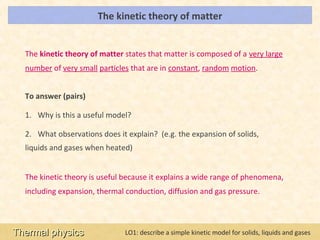
   Make sketches to show particles in solids, liquids and gases.
   Pay particular attention to the
   • spacing
   • ordering of particles

   You probably drew something like this:


Thermal physics              LO2: describe s, l & g in terms of the spacing, ordering and motion of particles
The kinetic theory of matter                                                  LOs


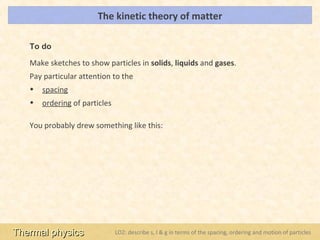
 What evidence is there for this ordering in solids?

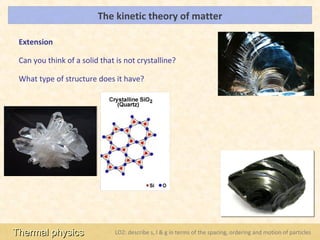
 Many solids are crystalline (crystal = solid with ‘long range’
 ordering of its particles).


                               galvanised (zinc plated) surfaces


Thermal physics                LO2: describe s, l & g in terms of the spacing, ordering and motion of particles
The kinetic theory of matter                                                  LOs


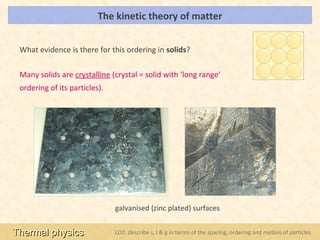
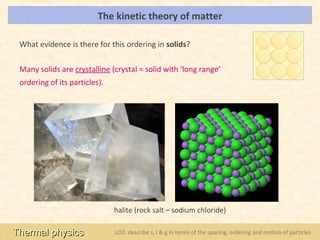
 What evidence is there for this ordering in solids?

 Many solids are crystalline (crystal = solid with ‘long range’
 ordering of its particles).


                               halite (rock salt – sodium chloride)

Thermal physics                LO2: describe s, l & g in terms of the spacing, ordering and motion of particles
The kinetic theory of matter                                                   LOs


 Extension

 Can you think of a solid that is not crystalline?

 What type of structure does it have?


Thermal physics                LO2: describe s, l & g in terms of the spacing, ordering and motion of particles
Lesson focus
  • solids, liquids & gases - 1


  Learning objectives
  At the end of the lesson you will be able to:

  • describe a simple kinetic model for solids, liquids and gases;

  • describe solids, liquids and gases in terms of the spacing, ordering and
     motion of atoms or molecules.


Thermal physics
Particle spacing: refining our ideas                                               LOs


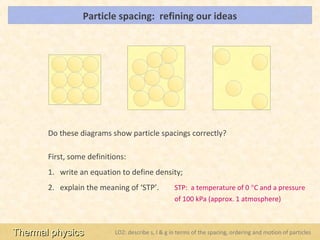
       Do these diagrams show particle spacings correctly?

       First, some definitions:
       1. write an equation to define density;
       2. explain the meaning of ‘STP’.            STP: a temperature of 0 °C and a pressure
                                                   of 100 kPa (approx. 1 atmosphere)


Thermal physics            LO2: describe s, l & g in terms of the spacing, ordering and motion of particles
Particle spacing: refining our ideas                                                 LOs


                         solid / kg m-3              liquid / kg m-3              gas / kg m-3
     Density of
      water                    920                         1000                       0.59 *


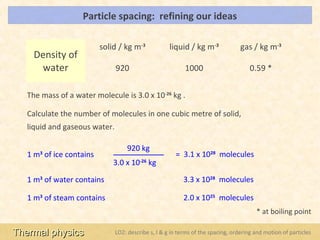
   The mass of a water molecule is 3.0 x 10⁻²⁶ kg .

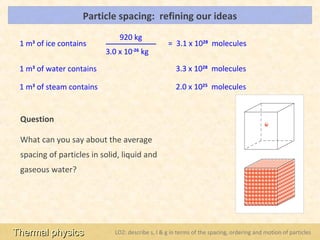
   Calculate the number of molecules in one cubic metre of solid,
   liquid and gaseous water.

                                   920 kg
   1 m of ice contains
      3                                                = 3.1 x 1028 molecules
                             3.0 x 10⁻²⁶ kg

   1 m3 of water contains                                 3.3 x 1028 molecules

   1 m3 of steam contains                                 2.0 x 1025 molecules
                                                                                        * at boiling point

Thermal physics                LO2: describe s, l & g in terms of the spacing, ordering and motion of particles
Particle spacing: refining our ideas                                               LOs


                              920 kg
 1 m3 of ice contains                             = 3.1 x 1028 molecules
                          3.0 x 10⁻²⁶ kg

 1 m3 of water contains                              3.3 x 1028 molecules

 1 m3 of steam contains                              2.0 x 1025 molecules


 Question

 What can you say about the average
 spacing of particles in solid, liquid and
 gaseous water?


Thermal physics              LO2: describe s, l & g in terms of the spacing, ordering and motion of particles
Particle spacing: refining our ideas                                               LOs


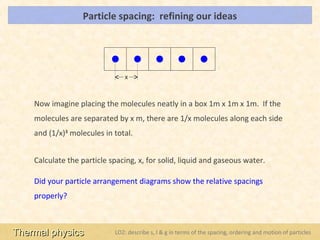
                               x


    Now imagine placing the molecules neatly in a box 1m x 1m x 1m. If the
    molecules are separated by x m, there are 1/x molecules along each side
    and (1/x)3 molecules in total.


    Calculate the particle spacing, x, for solid, liquid and gaseous water.

    Did your particle arrangement diagrams show the relative spacings
    properly?


Thermal physics             LO2: describe s, l & g in terms of the spacing, ordering and motion of particles
Particle spacing: refining our ideas                                              LOs


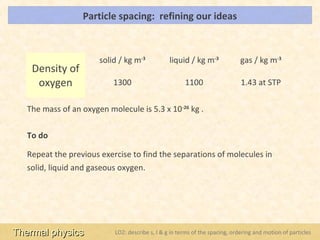
                       solid / kg m-3            liquid / kg m-3              gas / kg m-3
    Density of
     oxygen                1300                        1100                   1.43 at STP

   The mass of an oxygen molecule is 5.3 x 10⁻²⁶ kg .

   To do

   Repeat the previous exercise to find the separations of molecules in
   solid, liquid and gaseous oxygen.


Thermal physics            LO2: describe s, l & g in terms of the spacing, ordering and motion of particles
Particle in solids, liquids and gases                                     LOs


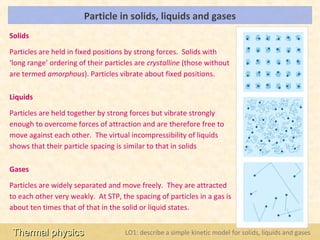
Solids

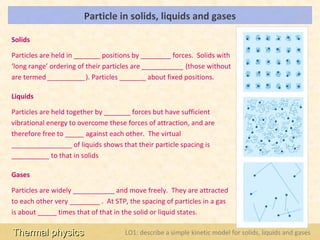
Particles are held in _______ positions by ________ forces. Solids with
‘long range’ ordering of their particles are ___________ (those without
are termed __________). Particles _______ about fixed positions.

Liquids

Particles are held together by _______ forces but have sufficient
vibrational energy to overcome these forces of attraction, and are
therefore free to _____ against each other. The virtual
________________ of liquids shows that their particle spacing is
__________ to that in solids

Gases

Particles are widely ___________ and move freely. They are attracted
to each other very ________ . At STP, the spacing of particles in a gas
is about _____ times that of that in the solid or liquid states.

Thermal physics                      LO1: describe a simple kinetic model for solids, liquids and gases
Particle in solids, liquids and gases                                    LOs


Solids

Particles are held in fixed positions by strong forces. Solids with
‘long range’ ordering of their particles are crystalline (those without
are termed amorphous). Particles vibrate about fixed positions.

Liquids

Particles are held together by strong forces but vibrate strongly
enough to overcome forces of attraction and are therefore free to
move against each other. The virtual incompressibility of liquids
shows that their particle spacing is similar to that in solids

Gases

Particles are widely separated and move freely. They are attracted
to each other very weakly. At STP, the spacing of particles in a gas is
about ten times that of that in the solid or liquid states.


 Thermal physics                     LO1: describe a simple kinetic model for solids, liquids and gases
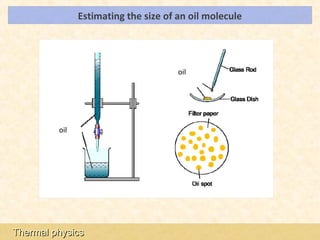
Estimating the size of an oil molecule   LOs


                                      oil


         oil


Thermal physics
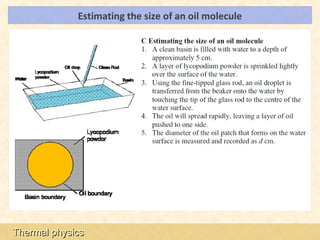
Estimating the size of an oil molecule   LOs


Thermal physics

Tp 1 solids, liquids & gases (shared)

  • 1.
    A-level Physics UnitG484: The Newtonian World Solids, liquids & gases (1) Thermal physics
  • 2.
    Lesson focus • solids, liquids & gases - 1 Learning objectives At the end of the lesson you will be able to: • describe a simple kinetic model for solids, liquids and gases; • describe solids, liquids and gases in terms of the spacing, ordering and motion of atoms or molecules. Thermal physics
  • 3.
    Learning outcomes All of you should be able to • draw diagrams to show the arrangement of particles in solids, liquids and gases; • describe the motion of particles in solids, liquids and gases Most of you may be able to • explain what is meant by a kinetic model of matter. Thermal physics
  • 4.
    Solids, liquids andgases: KS2 recall LOs What does this tell What does this Can matter State (or us about the Characteristic property tell us about in this state phase) of spacing of property (KS2) the forces between be matter particles? particles in this compressed? state? Has a fixed solid shape and volume Flows and fills liquid the bottom of a container gas Fills its container Is there a contradiction here? If so, how can it be resolved? Mini prac: compressibility of liquids & gases discussion Thermal physics
  • 5.
    Solids, liquids andgases: KS2 recall LOs What does this tell What does this State (or Can matter in us about the Characteristic property tell us about phase) of this state be spacing of property (KS2) the forces between matter particles? compressed? particles in this state? Has a fixed shape solid and volume relatively strong no very close Flows and fills close but slightly weaker than in almost liquid the bottom of a solids incompressible less so than in container solids gas Fills its container very weak yes far part discussion Thermal physics
  • 6.
    The kinetic theoryof matter LOs The kinetic theory of matter states that matter is composed of a very large number of very small particles that are in constant, random motion. To answer (pairs) 1. Why is this a useful model? 2. What observations does it explain? (e.g. the expansion of solids, liquids and gases when heated) The kinetic theory is useful because it explains a wide range of phenomena, including expansion, thermal conduction, diffusion and gas pressure. Thermal physics LO1: describe a simple kinetic model for solids, liquids and gases
  • 7.
    The kinetic theoryof matter LOs To do Make sketches to show particles in solids, liquids and gases. Pay particular attention to the • spacing • ordering of particles You probably drew something like this: Thermal physics LO2: describe s, l & g in terms of the spacing, ordering and motion of particles
  • 8.
    The kinetic theoryof matter LOs What evidence is there for this ordering in solids? Many solids are crystalline (crystal = solid with ‘long range’ ordering of its particles). galvanised (zinc plated) surfaces Thermal physics LO2: describe s, l & g in terms of the spacing, ordering and motion of particles
  • 9.
    The kinetic theoryof matter LOs What evidence is there for this ordering in solids? Many solids are crystalline (crystal = solid with ‘long range’ ordering of its particles). halite (rock salt – sodium chloride) Thermal physics LO2: describe s, l & g in terms of the spacing, ordering and motion of particles
  • 10.
    The kinetic theoryof matter LOs Extension Can you think of a solid that is not crystalline? What type of structure does it have? Thermal physics LO2: describe s, l & g in terms of the spacing, ordering and motion of particles
  • 11.
    Lesson focus • solids, liquids & gases - 1 Learning objectives At the end of the lesson you will be able to: • describe a simple kinetic model for solids, liquids and gases; • describe solids, liquids and gases in terms of the spacing, ordering and motion of atoms or molecules. Thermal physics
  • 12.
    Particle spacing: refiningour ideas LOs Do these diagrams show particle spacings correctly? First, some definitions: 1. write an equation to define density; 2. explain the meaning of ‘STP’. STP: a temperature of 0 °C and a pressure of 100 kPa (approx. 1 atmosphere) Thermal physics LO2: describe s, l & g in terms of the spacing, ordering and motion of particles
  • 13.
    Particle spacing: refiningour ideas LOs solid / kg m-3 liquid / kg m-3 gas / kg m-3 Density of water 920 1000 0.59 * The mass of a water molecule is 3.0 x 10⁻²⁶ kg . Calculate the number of molecules in one cubic metre of solid, liquid and gaseous water. 920 kg 1 m of ice contains 3 = 3.1 x 1028 molecules 3.0 x 10⁻²⁶ kg 1 m3 of water contains 3.3 x 1028 molecules 1 m3 of steam contains 2.0 x 1025 molecules * at boiling point Thermal physics LO2: describe s, l & g in terms of the spacing, ordering and motion of particles
  • 14.
    Particle spacing: refiningour ideas LOs 920 kg 1 m3 of ice contains = 3.1 x 1028 molecules 3.0 x 10⁻²⁶ kg 1 m3 of water contains 3.3 x 1028 molecules 1 m3 of steam contains 2.0 x 1025 molecules Question What can you say about the average spacing of particles in solid, liquid and gaseous water? Thermal physics LO2: describe s, l & g in terms of the spacing, ordering and motion of particles
  • 15.
    Particle spacing: refiningour ideas LOs x Now imagine placing the molecules neatly in a box 1m x 1m x 1m. If the molecules are separated by x m, there are 1/x molecules along each side and (1/x)3 molecules in total. Calculate the particle spacing, x, for solid, liquid and gaseous water. Did your particle arrangement diagrams show the relative spacings properly? Thermal physics LO2: describe s, l & g in terms of the spacing, ordering and motion of particles
  • 16.
    Particle spacing: refiningour ideas LOs solid / kg m-3 liquid / kg m-3 gas / kg m-3 Density of oxygen 1300 1100 1.43 at STP The mass of an oxygen molecule is 5.3 x 10⁻²⁶ kg . To do Repeat the previous exercise to find the separations of molecules in solid, liquid and gaseous oxygen. Thermal physics LO2: describe s, l & g in terms of the spacing, ordering and motion of particles
  • 17.
    Particle in solids,liquids and gases LOs Solids Particles are held in _______ positions by ________ forces. Solids with ‘long range’ ordering of their particles are ___________ (those without are termed __________). Particles _______ about fixed positions. Liquids Particles are held together by _______ forces but have sufficient vibrational energy to overcome these forces of attraction, and are therefore free to _____ against each other. The virtual ________________ of liquids shows that their particle spacing is __________ to that in solids Gases Particles are widely ___________ and move freely. They are attracted to each other very ________ . At STP, the spacing of particles in a gas is about _____ times that of that in the solid or liquid states. Thermal physics LO1: describe a simple kinetic model for solids, liquids and gases
  • 18.
    Particle in solids,liquids and gases LOs Solids Particles are held in fixed positions by strong forces. Solids with ‘long range’ ordering of their particles are crystalline (those without are termed amorphous). Particles vibrate about fixed positions. Liquids Particles are held together by strong forces but vibrate strongly enough to overcome forces of attraction and are therefore free to move against each other. The virtual incompressibility of liquids shows that their particle spacing is similar to that in solids Gases Particles are widely separated and move freely. They are attracted to each other very weakly. At STP, the spacing of particles in a gas is about ten times that of that in the solid or liquid states. Thermal physics LO1: describe a simple kinetic model for solids, liquids and gases
  • 19.
    Estimating the sizeof an oil molecule LOs oil oil Thermal physics
  • 20.
    Estimating the sizeof an oil molecule LOs Thermal physics

Editor's Notes

  • #3 Learning outcomes: pupils should 1)
  • #12 Learning outcomes: pupils should 1)
  • #18 Video clip: BBC Absolute zero, prog 1: 10’10” – 29’15”
  • #19 Video clip: BBC Absolute zero, prog 1: 10’10” – 29’15”