Toxoplasmosis
Prepared by
Ara Hiwa
Siva Dler
Introduction
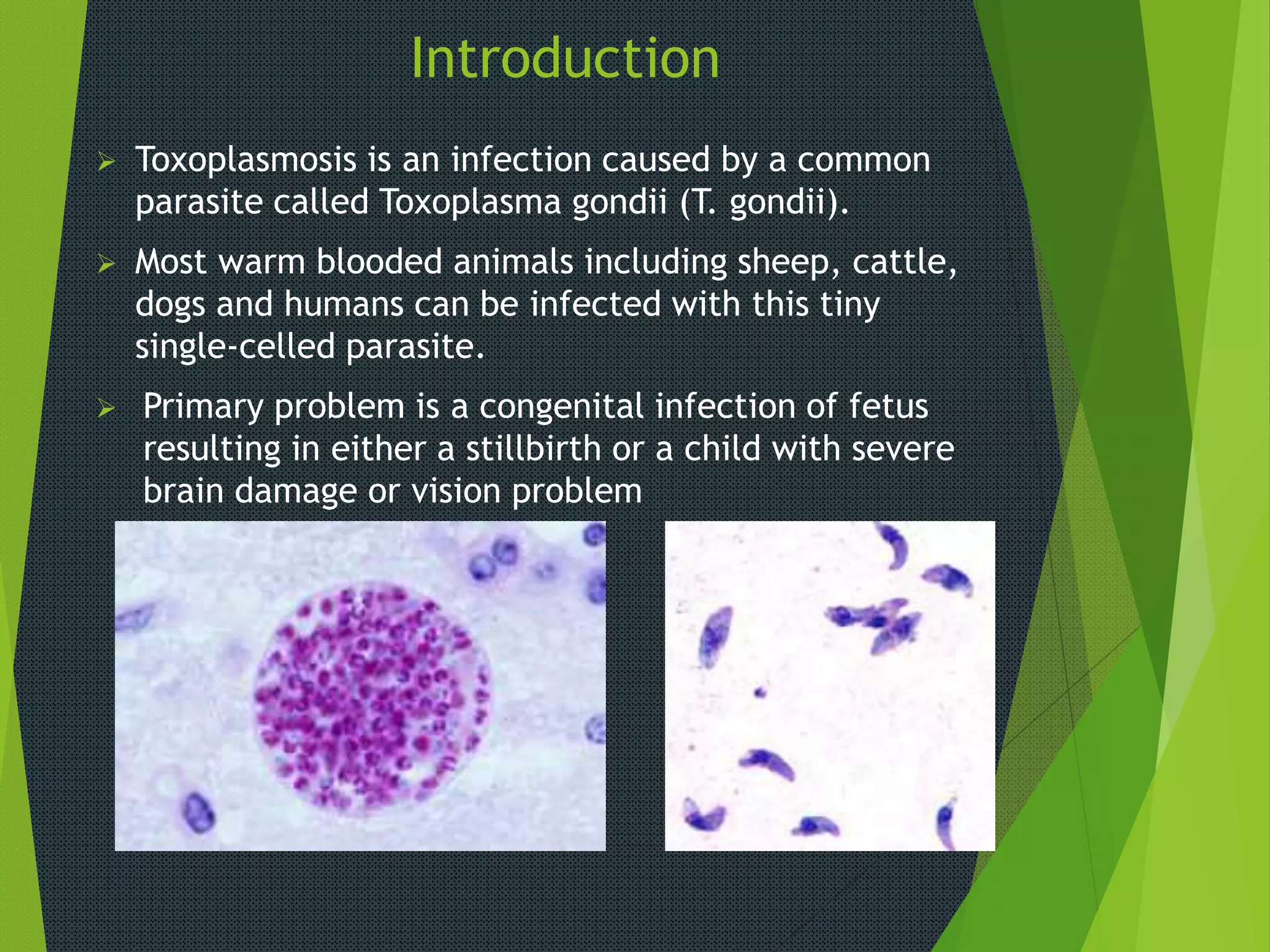
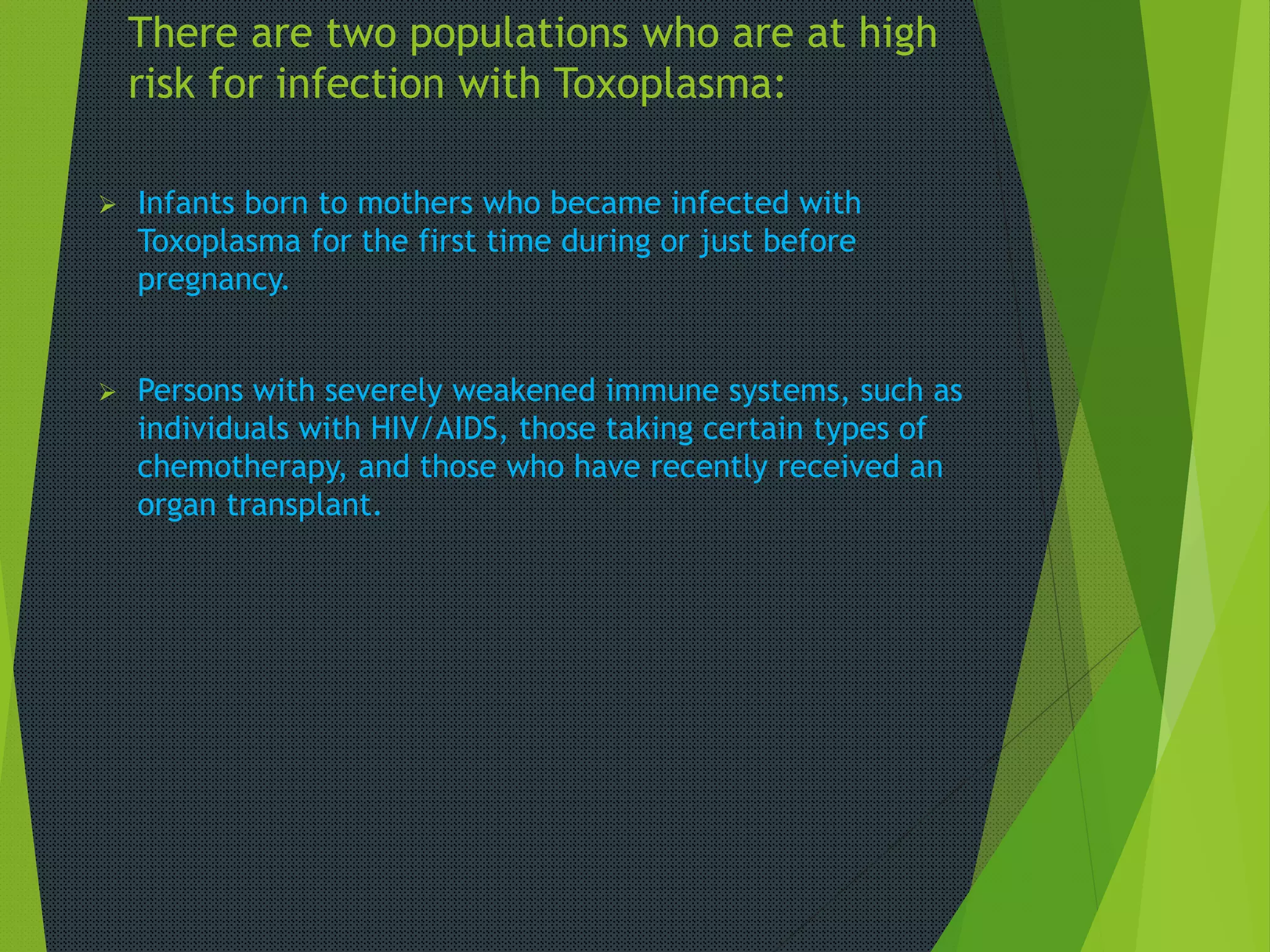
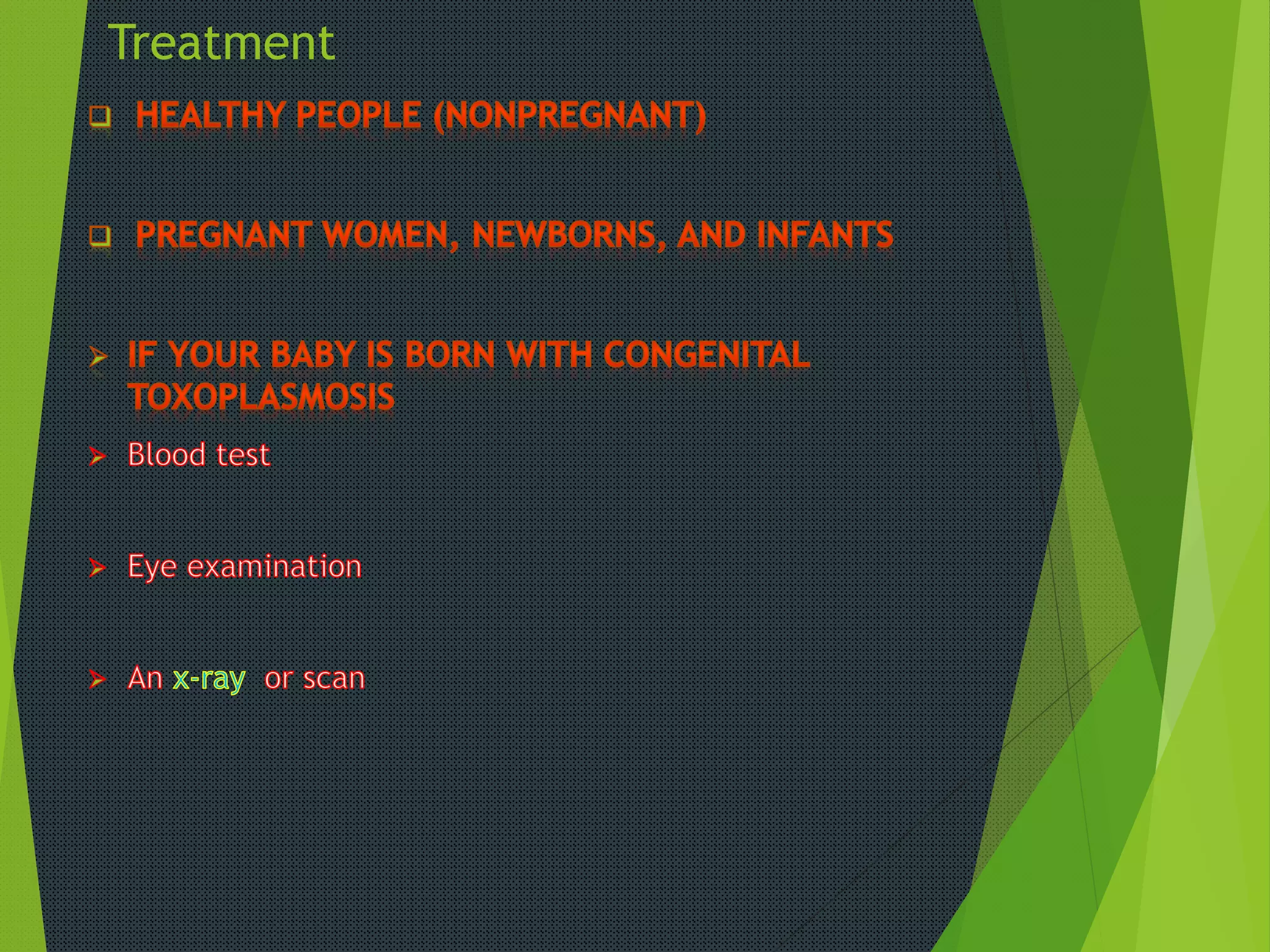
 Toxoplasmosis is an infection caused by a common
parasite called Toxoplasma gondii (T. gondii).
 Most warm blooded animals including sheep, cattle,
dogs and humans can be infected with this tiny
single-celled parasite.
 Primary problem is a congenital infection of fetus
resulting in either a stillbirth or a child with severe
brain damage or vision problem
There are two populations who are at high
risk for infection with Toxoplasma:
 Infants born to mothers who became infected with
Toxoplasma for the first time during or just before
pregnancy.
 Persons with severely weakened immune systems, such as
individuals with HIV/AIDS, those taking certain types of
chemotherapy, and those who have recently received an
organ transplant.
Content
symptoms
T. gondii survival mechanisms
Transmission
Treatment
symptoms
If you're healthy, you probably won't know you've
contracted toxoplasmosis. Some people, however,
develop signs and symptoms similar to those of the flu,
including:
In people with weakened immune systems
 Headache
 Confusion
 Poor coordination
 Seizures
 Lung problems that may resemble tuberculosis or
Pneumocystis jiroveci pneumonia, a common opportunistic
infection that occurs in people with AIDS
 Blurred vision caused by severe inflammation of your
retina (ocular toxoplasmosis)
T. gondii survival mechanisms
 Once the parasite T. gondii infects a normal host
cell, it resists damage caused by the host’s immune
system, as well as changing the host's immune
processes.
 One way is by an anti-apoptotic mechanism, allowing
the infected host cells to persist and replicate.
 T. gondii causes conformational changes to the
proteins
 T. gondii also has the ability to initiate autophagy of
the host’s cells
Transmission
 Eating undercooked, contaminated meat (especially pork, lamb,
and venison).
 Accidental ingestion of undercooked, contaminated meat after
handling it and not washing hands thoroughly (Toxoplasma
cannot be absorbed through intact skin).
 Eating food that was contaminated by knives, utensils, cutting
boards and other foods that have had contact with raw,
contaminated meat.
 Drinking water contaminated with Toxoplasma gondii.
 Accidentally swallowing the parasite through contact with cat
feces that contain Toxoplasma. This might happen by
1. cleaning a cat's litter box when the cat has shed Toxoplasma
in its feces
2. touching or ingesting anything that has come into contact with
cat feces that contain Toxoplasma
3. accidentally ingesting contaminated soil (e.g., not washing
hands after gardening or eating unwashed fruits or vegetables
from a garden)
 Mother-to-child (congenital) transmission.
 Receiving an infected organ transplant or infected blood via
transfusion, though this is rare.
Treatment
Thanks for watching
REFERENCES
1. http://www.webmd.boots.com/a-to-z-guides/tc/toxoplasmosis-
introduction
2. http://www.mayoclinic.org/diseases-
conditions/toxoplasmosis/basics/symptoms/con-20025859
3. http://www.cdc.gov/parasites/toxoplasmosis/gen_info/faqs.h
tml
4. http://www.ncbi.nlm.nih.gov/pmc/articles/PMC3498595
5. http://www.nhs.uk/Conditions/Toxoplasmosis/Pages/Treatment.aspx

Toxoplasmosis

  • 1.
  • 2.
    Introduction  Toxoplasmosis isan infection caused by a common parasite called Toxoplasma gondii (T. gondii).  Most warm blooded animals including sheep, cattle, dogs and humans can be infected with this tiny single-celled parasite.  Primary problem is a congenital infection of fetus resulting in either a stillbirth or a child with severe brain damage or vision problem
  • 3.
    There are twopopulations who are at high risk for infection with Toxoplasma:  Infants born to mothers who became infected with Toxoplasma for the first time during or just before pregnancy.  Persons with severely weakened immune systems, such as individuals with HIV/AIDS, those taking certain types of chemotherapy, and those who have recently received an organ transplant.
  • 4.
    Content symptoms T. gondii survivalmechanisms Transmission Treatment
  • 5.
    symptoms If you're healthy,you probably won't know you've contracted toxoplasmosis. Some people, however, develop signs and symptoms similar to those of the flu, including:
  • 6.
    In people withweakened immune systems  Headache  Confusion  Poor coordination  Seizures  Lung problems that may resemble tuberculosis or Pneumocystis jiroveci pneumonia, a common opportunistic infection that occurs in people with AIDS  Blurred vision caused by severe inflammation of your retina (ocular toxoplasmosis)
  • 7.
    T. gondii survivalmechanisms  Once the parasite T. gondii infects a normal host cell, it resists damage caused by the host’s immune system, as well as changing the host's immune processes.  One way is by an anti-apoptotic mechanism, allowing the infected host cells to persist and replicate.  T. gondii causes conformational changes to the proteins  T. gondii also has the ability to initiate autophagy of the host’s cells
  • 8.
    Transmission  Eating undercooked,contaminated meat (especially pork, lamb, and venison).  Accidental ingestion of undercooked, contaminated meat after handling it and not washing hands thoroughly (Toxoplasma cannot be absorbed through intact skin).  Eating food that was contaminated by knives, utensils, cutting boards and other foods that have had contact with raw, contaminated meat.  Drinking water contaminated with Toxoplasma gondii.
  • 9.
     Accidentally swallowingthe parasite through contact with cat feces that contain Toxoplasma. This might happen by 1. cleaning a cat's litter box when the cat has shed Toxoplasma in its feces 2. touching or ingesting anything that has come into contact with cat feces that contain Toxoplasma 3. accidentally ingesting contaminated soil (e.g., not washing hands after gardening or eating unwashed fruits or vegetables from a garden)  Mother-to-child (congenital) transmission.  Receiving an infected organ transplant or infected blood via transfusion, though this is rare.
  • 10.
  • 11.
  • 12.
    REFERENCES 1. http://www.webmd.boots.com/a-to-z-guides/tc/toxoplasmosis- introduction 2. http://www.mayoclinic.org/diseases- conditions/toxoplasmosis/basics/symptoms/con-20025859 3.http://www.cdc.gov/parasites/toxoplasmosis/gen_info/faqs.h tml 4. http://www.ncbi.nlm.nih.gov/pmc/articles/PMC3498595 5. http://www.nhs.uk/Conditions/Toxoplasmosis/Pages/Treatment.aspx