Antonella Giannantoni
Dipartimento di Scienze Chirurgiche e Biomediche
Clinica Urologica e Andrologica
Università degli studi di Perugia
Tossina botulinica A:
indicazioni, risultati e limiti
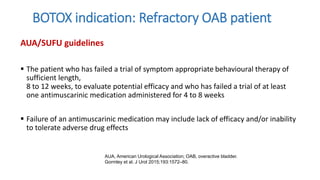
BOTOX indication: Refractory OAB patient
AUA/SUFU guidelines
 The patient who has failed a trial of symptom appropriate behavioural therapy of
sufficient length,
8 to 12 weeks, to evaluate potential efficacy and who has failed a trial of at least
one antimuscarinic medication administered for 4 to 8 weeks
 Failure of an antimuscarinic medication may include lack of efficacy and/or inability
to tolerate adverse drug effects
AUA, American Urological Association; OAB, overactive bladder.
Gormley et al. J Urol 2015;193:1572–80.
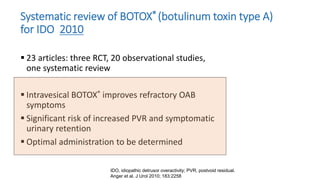
Systematic review of BOTOX® (botulinum toxin type A)
for IDO 2010
 23 articles: three RCT, 20 observational studies,
one systematic review
 Intravesical BOTOX® improves refractory OAB
symptoms
 Significant risk of increased PVR and symptomatic
urinary retention
 Optimal administration to be determined
IDO, idiopathic detrusor overactivity; PVR, postvoid residual.
Anger et al. J Urol 2010; 183:2258
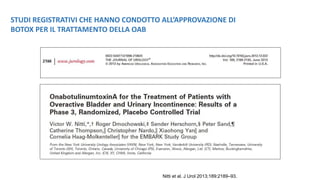
Nitti et al. J Urol 2013;189:2189–93.
STUDI REGISTRATIVI CHE HANNO CONDOTTO ALL’APPROVAZIONE DI
BOTOX PER IL TRATTAMENTO DELLA OAB
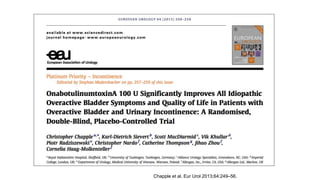
Chapple et al. Eur Urol 2013;64:249–56.
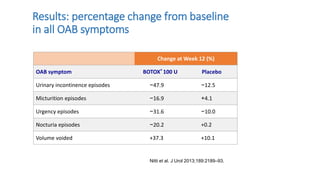
Results: percentage change from baseline
in all OAB symptoms
Change at Week 12 (%)
OAB symptom BOTOX® 100 U Placebo
Urinary incontinence episodes −47.9 −12.5
Micturition episodes −16.9 +4.1
Urgency episodes −31.6 −10.0
Nocturia episodes −20.2 +0.2
Volume voided +37.3 +10.1
Nitti et al. J Urol 2013;189:2189–93.
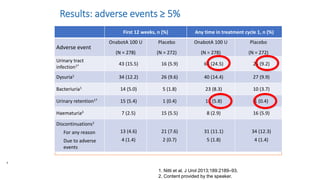
Results: adverse events ≥ 5%
First 12 weeks, n (%) Any time in treatment cycle 1, n (%)
Adverse event
OnabotA 100 U
(N = 278)
Placebo
(N = 272)
OnabotA 100 U
(N = 278)
Placebo
(N = 272)
Urinary tract
infection1* 43 (15.5) 16 (5.9) 68 (24.5) 25 (9.2)
Dysuria1 34 (12.2) 26 (9.6) 40 (14.4) 27 (9.9)
Bacteriuria1 14 (5.0) 5 (1.8) 23 (8.3) 10 (3.7)
Urinary retention1† 15 (5.4) 1 (0.4) 16 (5.8) 1 (0.4)
Haematuria2 7 (2.5) 15 (5.5) 8 (2.9) 16 (5.9)
Discontinuations1
For any reason
Due to adverse
events
13 (4.6)
4 (1.4)
21 (7.6)
2 (0.7)
31 (11.1)
5 (1.8)
34 (12.3)
4 (1.4)
*Defined as positive urine culture with bacteriuria count of > 105 CFU/mL and leukocyturia of > 5/high-power fields.
†Defined as PVR ≥ 200 mL with symptoms that required clean intermittent catheterisation (CIC), or PVR ≥ 350 mL with
CIC regardless of symptoms.
1. Nitti et al. J Urol 2013;189:2189–93.
2. Content provided by the speaker.
Long-term Extension Trial
Final Data
De Ridder D, Nitti V, Sussman D, Sand P, Sievert K, Radomski S, Jenkins B,
Zheng Y, Chapple C
Posters presented at EAU 2015, AUA 2015, ICS 2015.
BOTOX and Overactive bladder
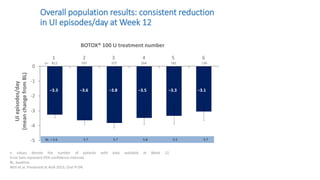
-5
-4
-3
-2
-1
0
BOTOX® 100 U treatment number
1 2 3 4 5 6
UIepisodes/day
(meanchangefromBL)
−3.3 −3.6 −3.8 −3.5 −3.3 −3.1
n= 812 597 372 264 181 136
BL = 5.6 5.7 5.7 5.8 5.5 5.7
Overall population results: consistent reduction
in UI episodes/day at Week 12
n values denote the number of patients with data available at Week 12.
Error bars represent 95% confidence intervals.
BL, baseline.
Nitti et al. Presented at AUA 2015; Oral PI-04.
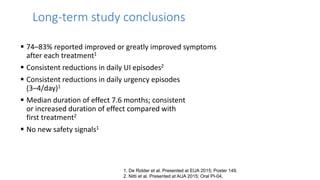
Long-term study conclusions
 74–83% reported improved or greatly improved symptoms
after each treatment1
 Consistent reductions in daily UI episodes2
 Consistent reductions in daily urgency episodes
(3–4/day)1
 Median duration of effect 7.6 months; consistent
or increased duration of effect compared with
first treatment2
 No new safety signals1
1. De Ridder et al. Presented at EUA 2015; Poster 149.
2. Nitti et al. Presented at AUA 2015; Oral PI-04.
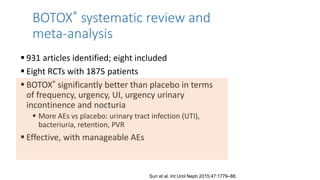
BOTOX® systematic review and
meta-analysis
 931 articles identified; eight included
 Eight RCTs with 1875 patients
 BOTOX® significantly better than placebo in terms
of frequency, urgency, UI, urgency urinary
incontinence and nocturia
 More AEs vs placebo: urinary tract infection (UTI),
bacteriuria, retention, PVR
 Effective, with manageable AEs
Sun et al. Int Urol Neph 2015;47:1779–88.
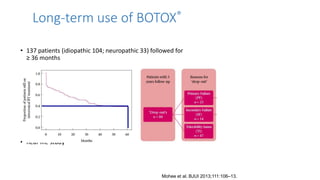
Long-term use of BOTOX®
• 137 patients (idiopathic 104; neuropathic 33) followed for
≥ 36 months
• Real-life study
Mohee et al. BJUI 2013;111:106–13.
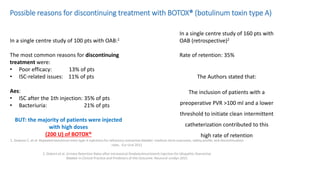
Possible reasons for discontinuing treatment with BOTOX® (botulinum toxin type A)
1. Dowson C. et al: Repeated botulinum toxin type A injections for refractory overactive bladder: medium-term outcomes, safety profile, and discontinuation
rates. Eur Urol 2012
2. Osborn et al. Urinary Retention Rates after Intravesical OnabotulinumtoxinA Injection for Idiopathic Overactive
Bladder in Clinical Practice and Predictors of this Outcome. Neururol urodyn 2015
In a single centre study of 100 pts with OAB:1
The most common reasons for discontinuing
treatment were:
• Poor efficacy: 13% of pts
• ISC-related issues: 11% of pts
Aes:
• ISC after the 1th injection: 35% of pts
• Bacteriuria: 21% of pts
BUT: the majority of patients were injected
with high doses
(200 U) of BOTOX®
In a single centre study of 160 pts with
OAB (retrospective)2
Rate of retention: 35%
The Authors stated that:
The inclusion of patients with a
preoperative PVR >100 ml and a lower
threshold to initiate clean intermittent
catheterization contributed to this
high rate of retention
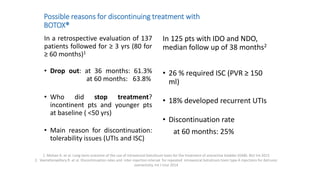
Possible reasons for discontinuing treatment with
BOTOX®
In a retrospective evaluation of 137
patients followed for ≥ 3 yrs (80 for
≥ 60 months)1
• Drop out: at 36 months: 61.3%
at 60 months: 63.8%
• Who did stop treatment?
incontinent pts and younger pts
at baseline ( <50 yrs)
• Main reason for discontinuation:
tolerability issues (UTIs and ISC)
In 125 pts with IDO and NDO,
median follow up of 38 months2
• 26 % required ISC (PVR ≥ 150
ml)
• 18% developed recurrent UTIs
• Discontinuation rate
at 60 months: 25%
1. Mohee A. et al. Long-term outcome of the use of intravesical botulinum toxin for the treatment of overactive bladder (OAB). BJU Int 2013
2. Veeratterapillary R. et al. Discontinuation rates and inter-injection interval for repeated intravesical botulinum toxin type A injections for detrusor
overactivity. Int J Urol 2014
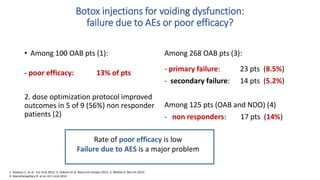
Botox injections for voiding dysfunction:
failure due to AEs or poor efficacy?
• Among 100 OAB pts (1):
- poor efficacy: 13% of pts
2. dose optimization protocol improved
outcomes in 5 of 9 (56%) non responder
patients (2)
Among 268 OAB pts (3):
- primary failure: 23 pts (8.5%)
- secondary failure: 14 pts (5.2%)
Among 125 pts (OAB and NDO) (4)
- non responders: 17 pts (14%)
1. Dowson C. et al. Eur Urol 2012; 2. Osborn et al. Neururol Urodyn 2015; 3. Mohee A. BJU Int 2013;
4. Veeratterapillary R. et al. Int J Urol 2014
Rate of poor efficacy is low
Failure due to AES is a major problem
Possible reasons for intra-patient variation
in response to treatment
1. Procedure-related factors that may affect response to
treatment
2. Possible antibodies production against the neurotoxin
3. Mistakes during the injection procedure
Long-term follow-up of repeated BOTOX® injections in patients with refractory OAB –
personal experience
Since 2001: total No. of patients= 84
Patients persisting with treatment= 69 pts (82.1%)
ISC= none
Bacteriuria: 7 pts (10.1%)
Discontinuation rate: 15 pts (17.8%)
• 8 cases: lack of efficacy (after 3 and 4 repeat injections);
• These patients with reduced efficacy after repeat injections were treated again with Botox
injections performing a different injection modality, as follows in the next slide
Giannantoni et al. Urologia 2015
3. Mistakes during the injection procedure
New Botox injection’s technique:
personal experience
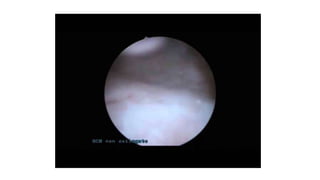
 when injecting the blue solution into the detrusor muscle, wait longer (at least five seconds)
before removing the needle; in this way you do not observe any leakage of the solution;
 perform each single injection deeper and perpendicular into the bladder wall; when injecting the
solution into the sub-mucosa, try to be deeper (into the detrusor muscle)
 the injected solutions spread about 2 cm of diameter from the injection site within the bladder
wall.
At 1 month follow up, all the 8 patients were completely continent and the frequency of daily
urgency episodes was substantially reduced.
These benefits persisted along the whole follow up.
Italian Urological Association Annual Meeting 2015
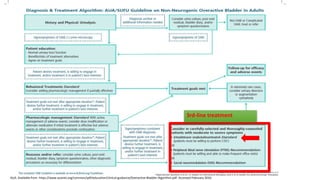
3rd-line treatment
AUA. Available from https://www.auanet.org/common/pdf/education/clinical-guidance/Overactive-Bladder-Algorithm.pdf. Accessed February 2016.

Tossina botulinica: indicazioni, risultati e limiti

  • 1.
    Antonella Giannantoni Dipartimento diScienze Chirurgiche e Biomediche Clinica Urologica e Andrologica Università degli studi di Perugia Tossina botulinica A: indicazioni, risultati e limiti
  • 2.
    BOTOX indication: RefractoryOAB patient AUA/SUFU guidelines  The patient who has failed a trial of symptom appropriate behavioural therapy of sufficient length, 8 to 12 weeks, to evaluate potential efficacy and who has failed a trial of at least one antimuscarinic medication administered for 4 to 8 weeks  Failure of an antimuscarinic medication may include lack of efficacy and/or inability to tolerate adverse drug effects AUA, American Urological Association; OAB, overactive bladder. Gormley et al. J Urol 2015;193:1572–80.
  • 3.
    Systematic review ofBOTOX® (botulinum toxin type A) for IDO 2010  23 articles: three RCT, 20 observational studies, one systematic review  Intravesical BOTOX® improves refractory OAB symptoms  Significant risk of increased PVR and symptomatic urinary retention  Optimal administration to be determined IDO, idiopathic detrusor overactivity; PVR, postvoid residual. Anger et al. J Urol 2010; 183:2258
  • 4.
    Nitti et al.J Urol 2013;189:2189–93. STUDI REGISTRATIVI CHE HANNO CONDOTTO ALL’APPROVAZIONE DI BOTOX PER IL TRATTAMENTO DELLA OAB
  • 5.
    Chapple et al.Eur Urol 2013;64:249–56.
  • 6.
    Results: percentage changefrom baseline in all OAB symptoms Change at Week 12 (%) OAB symptom BOTOX® 100 U Placebo Urinary incontinence episodes −47.9 −12.5 Micturition episodes −16.9 +4.1 Urgency episodes −31.6 −10.0 Nocturia episodes −20.2 +0.2 Volume voided +37.3 +10.1 Nitti et al. J Urol 2013;189:2189–93.
  • 7.
    Results: adverse events≥ 5% First 12 weeks, n (%) Any time in treatment cycle 1, n (%) Adverse event OnabotA 100 U (N = 278) Placebo (N = 272) OnabotA 100 U (N = 278) Placebo (N = 272) Urinary tract infection1* 43 (15.5) 16 (5.9) 68 (24.5) 25 (9.2) Dysuria1 34 (12.2) 26 (9.6) 40 (14.4) 27 (9.9) Bacteriuria1 14 (5.0) 5 (1.8) 23 (8.3) 10 (3.7) Urinary retention1† 15 (5.4) 1 (0.4) 16 (5.8) 1 (0.4) Haematuria2 7 (2.5) 15 (5.5) 8 (2.9) 16 (5.9) Discontinuations1 For any reason Due to adverse events 13 (4.6) 4 (1.4) 21 (7.6) 2 (0.7) 31 (11.1) 5 (1.8) 34 (12.3) 4 (1.4) *Defined as positive urine culture with bacteriuria count of > 105 CFU/mL and leukocyturia of > 5/high-power fields. †Defined as PVR ≥ 200 mL with symptoms that required clean intermittent catheterisation (CIC), or PVR ≥ 350 mL with CIC regardless of symptoms. 1. Nitti et al. J Urol 2013;189:2189–93. 2. Content provided by the speaker.
  • 8.
    Long-term Extension Trial FinalData De Ridder D, Nitti V, Sussman D, Sand P, Sievert K, Radomski S, Jenkins B, Zheng Y, Chapple C Posters presented at EAU 2015, AUA 2015, ICS 2015. BOTOX and Overactive bladder
  • 9.
    -5 -4 -3 -2 -1 0 BOTOX® 100 Utreatment number 1 2 3 4 5 6 UIepisodes/day (meanchangefromBL) −3.3 −3.6 −3.8 −3.5 −3.3 −3.1 n= 812 597 372 264 181 136 BL = 5.6 5.7 5.7 5.8 5.5 5.7 Overall population results: consistent reduction in UI episodes/day at Week 12 n values denote the number of patients with data available at Week 12. Error bars represent 95% confidence intervals. BL, baseline. Nitti et al. Presented at AUA 2015; Oral PI-04.
  • 10.
    Long-term study conclusions 74–83% reported improved or greatly improved symptoms after each treatment1  Consistent reductions in daily UI episodes2  Consistent reductions in daily urgency episodes (3–4/day)1  Median duration of effect 7.6 months; consistent or increased duration of effect compared with first treatment2  No new safety signals1 1. De Ridder et al. Presented at EUA 2015; Poster 149. 2. Nitti et al. Presented at AUA 2015; Oral PI-04.
  • 11.
    BOTOX® systematic reviewand meta-analysis  931 articles identified; eight included  Eight RCTs with 1875 patients  BOTOX® significantly better than placebo in terms of frequency, urgency, UI, urgency urinary incontinence and nocturia  More AEs vs placebo: urinary tract infection (UTI), bacteriuria, retention, PVR  Effective, with manageable AEs Sun et al. Int Urol Neph 2015;47:1779–88.
  • 12.
    Long-term use ofBOTOX® • 137 patients (idiopathic 104; neuropathic 33) followed for ≥ 36 months • Real-life study Mohee et al. BJUI 2013;111:106–13.
  • 13.
    Possible reasons fordiscontinuing treatment with BOTOX® (botulinum toxin type A) 1. Dowson C. et al: Repeated botulinum toxin type A injections for refractory overactive bladder: medium-term outcomes, safety profile, and discontinuation rates. Eur Urol 2012 2. Osborn et al. Urinary Retention Rates after Intravesical OnabotulinumtoxinA Injection for Idiopathic Overactive Bladder in Clinical Practice and Predictors of this Outcome. Neururol urodyn 2015 In a single centre study of 100 pts with OAB:1 The most common reasons for discontinuing treatment were: • Poor efficacy: 13% of pts • ISC-related issues: 11% of pts Aes: • ISC after the 1th injection: 35% of pts • Bacteriuria: 21% of pts BUT: the majority of patients were injected with high doses (200 U) of BOTOX® In a single centre study of 160 pts with OAB (retrospective)2 Rate of retention: 35% The Authors stated that: The inclusion of patients with a preoperative PVR >100 ml and a lower threshold to initiate clean intermittent catheterization contributed to this high rate of retention
  • 14.
    Possible reasons fordiscontinuing treatment with BOTOX® In a retrospective evaluation of 137 patients followed for ≥ 3 yrs (80 for ≥ 60 months)1 • Drop out: at 36 months: 61.3% at 60 months: 63.8% • Who did stop treatment? incontinent pts and younger pts at baseline ( <50 yrs) • Main reason for discontinuation: tolerability issues (UTIs and ISC) In 125 pts with IDO and NDO, median follow up of 38 months2 • 26 % required ISC (PVR ≥ 150 ml) • 18% developed recurrent UTIs • Discontinuation rate at 60 months: 25% 1. Mohee A. et al. Long-term outcome of the use of intravesical botulinum toxin for the treatment of overactive bladder (OAB). BJU Int 2013 2. Veeratterapillary R. et al. Discontinuation rates and inter-injection interval for repeated intravesical botulinum toxin type A injections for detrusor overactivity. Int J Urol 2014
  • 15.
    Botox injections forvoiding dysfunction: failure due to AEs or poor efficacy? • Among 100 OAB pts (1): - poor efficacy: 13% of pts 2. dose optimization protocol improved outcomes in 5 of 9 (56%) non responder patients (2) Among 268 OAB pts (3): - primary failure: 23 pts (8.5%) - secondary failure: 14 pts (5.2%) Among 125 pts (OAB and NDO) (4) - non responders: 17 pts (14%) 1. Dowson C. et al. Eur Urol 2012; 2. Osborn et al. Neururol Urodyn 2015; 3. Mohee A. BJU Int 2013; 4. Veeratterapillary R. et al. Int J Urol 2014 Rate of poor efficacy is low Failure due to AES is a major problem
  • 16.
    Possible reasons forintra-patient variation in response to treatment 1. Procedure-related factors that may affect response to treatment 2. Possible antibodies production against the neurotoxin 3. Mistakes during the injection procedure
  • 17.
    Long-term follow-up ofrepeated BOTOX® injections in patients with refractory OAB – personal experience Since 2001: total No. of patients= 84 Patients persisting with treatment= 69 pts (82.1%) ISC= none Bacteriuria: 7 pts (10.1%) Discontinuation rate: 15 pts (17.8%) • 8 cases: lack of efficacy (after 3 and 4 repeat injections); • These patients with reduced efficacy after repeat injections were treated again with Botox injections performing a different injection modality, as follows in the next slide Giannantoni et al. Urologia 2015 3. Mistakes during the injection procedure
  • 18.
    New Botox injection’stechnique: personal experience  when injecting the blue solution into the detrusor muscle, wait longer (at least five seconds) before removing the needle; in this way you do not observe any leakage of the solution;  perform each single injection deeper and perpendicular into the bladder wall; when injecting the solution into the sub-mucosa, try to be deeper (into the detrusor muscle)  the injected solutions spread about 2 cm of diameter from the injection site within the bladder wall. At 1 month follow up, all the 8 patients were completely continent and the frequency of daily urgency episodes was substantially reduced. These benefits persisted along the whole follow up. Italian Urological Association Annual Meeting 2015
  • 20.
    3rd-line treatment AUA. Availablefrom https://www.auanet.org/common/pdf/education/clinical-guidance/Overactive-Bladder-Algorithm.pdf. Accessed February 2016.