Pharmaceutical Care Plan

Hypercholesterolemia Cases Presentation


          Prepared By:

        Marwah Mamoon

             2011-2012
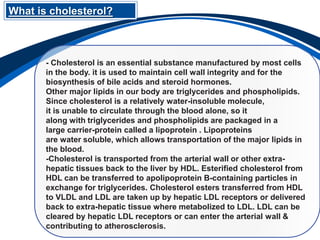
What is cholesterol?


       - Cholesterol is an essential substance manufactured by most cells
       in the body. it is used to maintain cell wall integrity and for the
       biosynthesis of bile acids and steroid hormones.
       Other major lipids in our body are triglycerides and phospholipids.
       Since cholesterol is a relatively water-insoluble molecule,
       it is unable to circulate through the blood alone, so it
       along with triglycerides and phospholipids are packaged in a
       large carrier-protein called a lipoprotein . Lipoproteins
       are water soluble, which allows transportation of the major lipids in
       the blood.
       -Cholesterol is transported from the arterial wall or other extra-
       hepatic tissues back to the liver by HDL. Esterified cholesterol from
       HDL can be transferred to apolipoprotein B-containing particles in
       exchange for triglycerides. Cholesterol esters transferred from HDL
       to VLDL and LDL are taken up by hepatic LDL receptors or delivered
       back to extra-hepatic tissue where metabolized to LDL. LDL can be
       cleared by hepatic LDL receptors or can enter the arterial wall &
       contributing to atherosclerosis.
Hypercholesterolemia


- Defined as elevated total cholesterol, low-density
lipoprotein (LDL) cholesterol, or triglycerides; a low high-
density lipoprotein (HDL) cholesterol; or a combination of
these abnormalities.


- Hypercholesterolemia is typically due to a combination
  of environmental and genetic factors.
- Environmental factors include: obesity and dietary
  choices.
- Genetic contributions are usually due to the additive
  effects of multiple genes however occasionally may be
  due to a single gene defect .
Case Presentation
Step no.1: Gathering information & creating patient database


      A.H. male patient is 69 years old , weight 85 kg,
      height 163cm ,BMI (31.9 “he is obese”) ,married; has
      3 boys & 2 girls, his work is farmer, he lives in
      Hawler –Shortan, he admitted to Rizgari hospital in
      31/10/2011 ,his phone number is 07502747735, the
      name of his physician is Mohammad Sader aldin
      Mahmoud, Complain of chest pain on exertion for 1
      week duration.
       Present illness: A known case of Diabetes mellitus of
      4 years duration , Ischemic heart disease of 2
      years,Hypertension of 1.5 year , present with chest
      pain on exertion lasted for 5-10 min associated with
      sweating ,relived by rest & sublingual nitroglycerin.
PAST MEDIACL HISTORY

           1- Illness:

Item 1     - Diabetes Mellitus.


Item 2    - Ischemic heart disease.


Item 3    - hypertension.


           - Heavy Smoker for 17 years duration, quit
Item 4
           smoking since 2003, 2pockets/ day.

         2-Surgical history: Nil
         3- Family history:+ ve family history of
         Diabetus mellitus and IHD
         4- Social history: ex-smoker,
         not drinker.
Drug History (dhx)
 1-clopidogrel          75 mg      1X1
                         tab.

 2- Atorvastatin         10mg      1X1

 3- bisoprolol           5mg       1X1

  4- lisinopril          5mg       1X1

  5- Metformin          850mg      1x2

6- Glibenclamide         5mg       1x1

   7- Aspirin           100mg      1x1


     * Drug related problem: Nil
Lab. Investigation
 1- Chemical examination:
- Blood Urea          *76.9 mg/dl       (15-55)mg/dl
- serum creatinine     *1.44mg/dl        (0.6-1.4)mg/dl
- Glucose             *152mg/dl        (70-105) mg/dl
-Troponin T           *0.155ng/ml      (0.0-0.03)ng/ml
- CK-MB               * 9.47ng/ml      (1.35-6.73)ng/ml
Lipids profile:
- Cholesterol          *280mg/dl    ( less than 200 mg/dl)
- S. HDL              *29mg/dl     ( more than 35 mg/dl)
- T.G                  *210mg/dl (less than 150mg/dl)
- LDL                  * 209 mg/dl        (less than 100)
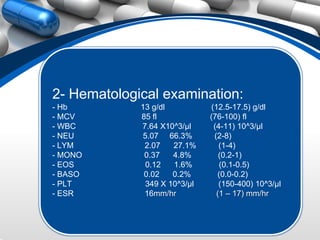
2- Hematological examination:
- Hb         13 g/dl           (12.5-17.5) g/dl
- MCV        85 fl             (76-100) fl
- WBC        7.64 X10^3/µl      (4-11) 10^3/µl
- NEU         5.07 66.3%        (2-8)
- LYM         2.07    27.1%       (1-4)
- MONO        0.37    4.8%        (0.2-1)
- EOS          0.12   1.6%        (0.1-0.5)
- BASO        0.02    0.2%       (0.0-0.2)
- PLT          349 X 10^3/µl      (150-400) 10^3/µl
- ESR         16mm/hr            (1 – 17) mm/hr
3- Other examination:
- Chest X-ray      normal.
- ECG             *T inversion V2-V6.
- Echo             normal Left
                   Ventricular Systolic
                   function.
- Ejection Fraction 61% (normal more
                            than 50%)

- Ultrasound        -ve ( normal gall
  bladder, spleen & liver, small renal
  cyst)
Name of         Data from data   Additional data for    Present
problem         base problem     better supporting      medication
                                 problem
- Ischemic      - Coronary
  Heart         artery disease
  disease       - High blood     1- Control blood       1-clopidogrel
- Diabetic      Sugar            pressure.              2- bisoprolol.
- Hypertensio   -                2- Control             3-atorvastatin
  n             Hypercholeste    symptoms.              4-lisinopril
                rolemia.         3- Control DM          5- aspirin.
                - High blood     4- Stop smoking        6-metformin
                pressure.        5- Avoid salty diet.   7-
                                 6- Control lipid       Glibenclamide
                                 profile.
Current treatment (Regimen)
Name of drug     Strength (Regimen)    Indication       Notes


- Lisinopril           10mg            Tablet X1

 - Bisprolol            5mg            Tablet X1    Morning before
                                                        meal
- Clopidogrel          75mg            Tablet X1
 - Heparin          1cc (5000 IU)        IV X4
  -Aspirin             100mg           Tablet X1      After meal
- atorvastatin         *20 mg          Tablet X1

  - Insulin           10 units            1X3       Subcutaneousl
                                                    y ,before meal

- metformin            500mg              1X3        Orally, after
                                                        meal
     O2          2-4L / min                          Nasal canal
nitroglycerin    0.4mg/ metered       Repeated as    Sublingual
                 dose                  required
Step no.2: Identify the Problem


*Subjective data: easy fatigue, palpitation,
epigastric pain.


*Objective data:
-Observation: looking ill, sweating.
-Vital signs: blood pressure 179/95 mmHg,
Pulse rate: 100 BPM, temperature:37c ,respiratory
rate: 14 breaths/min.
- Physical examination : well built, tachycardia,old
male .
- CNS: intact
Step no.3: Assessing the problem:

* We should investigated the factors cause diseases
& severity of diseases.
Factors cause            IHD Hyperchole diabetes hypertens
                             sterolemia          ion
diseases
1-diabetes               √    √
2-Obesity                √    √         √        √
3-Physical inactivity    √    √         √        √

4-High blood pressure.   √√   √
5-Smoking                √√   √                  √
6-Family history         √√   √         √
7-Age                    √√             √
8-Gender                 √√
9-Hypercholesterolemia   √√
Severity of diseases


* Hypercholestrolemia: uncontrolled even taken
atorvastatin 10mg/day
* DM: uncontrolled even taken metformin & Glibenclamide
* Hypertension: he’s in stage II even taken lisinopril
5mg/day.
* IHD: low severity of unstable angina.

(These are due to precipitation by smoking ,obesity
and drugs).
Step no.4: Devloping the plan & Therapeutic goal:


 (1)- Essential Components of Therapeutic Lifestyle Changes (TLC)
 Component                                Recommendation
 LDL-raising nutrients            Total fat range should be 25–35% for most cases.
 Saturated fats                   Less than 7% of total calories.
 Dietary cholesterol              Less than 200 mg/day.
 Therapeutic options for
 LDL lowering
 Plant stanols/sterols            2 g/day
 Increased viscous                10–25 g/day
 (soluble) fiber
 Total calories                 Adjust caloric intake to maintain desirable body
                                weight and prevent weight gain
 Physical activity              Include enough moderate exercise
                                to expend at least 200 kcal/day
 (2)- Control blood pressure (Less than 130/80 mm Hg)
 (3)- Control blood sugar (even with combination of 2 drugs but he’s uncontrolled)
(4) Monitoring
             Aspirin          lisinopril         bisoprolol        clopidogrel
Efficacy     - Behring        -blood             - BP &HR.         Behring
parameter    Coagulation      pressure.          - Glucose         Coagulation
monitoring   Timer (BCT)      -renal function      level .         Timer (BCT)
             - platelet       test.              - Lipid profile
             function         -monitor K-        - Wt. of Pat.
             analyzer         level              - LFT& RFT
             (PFA-100)
Toxicity     -epigastric      - hypotension.     -bradycardia      - Bleeding
Parameter    pain.            - renal function   - Hypotension     - Vertigo
monitoring   -peptic ulcer.   impairment.        - insulin         - diarrhea
             -GIT             - change the       release &         - Fatigue
             bleeding.        taste.             mask the
             -Headache.       - cough            symptoms of
             -Muscle          - hypokalemia      hypoglycemia.
             aches.           -angioedema        - lipidemia
                              -GIT symptoms.     - nightmares
                                                 - depression
                                                 - fatigue
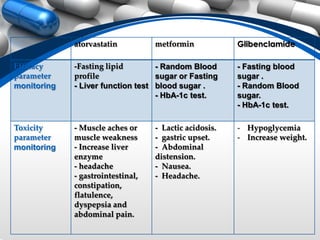
atorvastatin          metformin            Glibenclamide

Efficacy     -Fasting lipid        - Random Blood       - Fasting blood
parameter    profile               sugar or Fasting     sugar .
monitoring   - Liver function test blood sugar .        - Random Blood
                                   - HbA-1c test.       sugar.
                                                        - HbA-1c test.

Toxicity     - Muscle aches or     - Lactic acidosis.   - Hypoglycemia
parameter    muscle weakness       - gastric upset.     - Increase weight.
monitoring   - Increase liver      - Abdominal
             enzyme                distension.
             - headache            - Nausea.
             - gastrointestinal,   - Headache.
             constipation,
             flatulence,
             dyspepsia and
             abdominal pain.
- Monitoring for Complications
Eyes Dilated eye exam yearly
Feet should be examined at every visit
Urinary microalbumin Yearly


     (5)Patient Education

 -   Decrease salt intake.
 -   Regular Exercise .
 -   Avoid red meat.
 -   Take your medication regularly.
 -   Consult your physician if any
     problem occur.
Therapeutic goal (Objective)

• Short Time Goal:

- Control blood pressure.
- Control blood sugar.
- Control lipid profile. (LDL) Less than 100 mg/dL ,
                         (HDL) Greater than 35 mg/dL,
                         TG Less than 150 mg/dL.
- Increase exercise tolerance near normal daily activity.
- decrease attack of ischemia .

• Long Time Goal:

- prevent complication of Ischemic diseases.
- Maintain normal daily activity.
Step no.5: Evaluation the achievement of
outcomes:


1. Blood pressure & blood sugar control.

2. Weight reduction.

3. Fewer physician office visit.

4. Elimination of adverse effects.

5. Maintain activity which enhanced patient
quality of life that limited by disease.

6. Cost of medication control.
References:

1- Patient information file from Rizgari hospital.
2- pharmaceutical care plan arrangement from
our hospital ward lectures.
3- Pharmacotherapy principles and practice,
MacGraw-Hill-medical book ,ed.2008,ch9.
4- BNF formulary57,march 2009.
5- Pharmacotherapy handbook, 7th edition, ch9.
6- American diabetes association,
http://spectrum.diabetesjournals.org/content/16/1/
41.full
7- http://srspharma,Indian manufacturing
company.
Prescription Line 2012

Prescription Line 2012

  • 1.
    Pharmaceutical Care Plan HypercholesterolemiaCases Presentation Prepared By: Marwah Mamoon 2011-2012
  • 2.
    What is cholesterol? - Cholesterol is an essential substance manufactured by most cells in the body. it is used to maintain cell wall integrity and for the biosynthesis of bile acids and steroid hormones. Other major lipids in our body are triglycerides and phospholipids. Since cholesterol is a relatively water-insoluble molecule, it is unable to circulate through the blood alone, so it along with triglycerides and phospholipids are packaged in a large carrier-protein called a lipoprotein . Lipoproteins are water soluble, which allows transportation of the major lipids in the blood. -Cholesterol is transported from the arterial wall or other extra- hepatic tissues back to the liver by HDL. Esterified cholesterol from HDL can be transferred to apolipoprotein B-containing particles in exchange for triglycerides. Cholesterol esters transferred from HDL to VLDL and LDL are taken up by hepatic LDL receptors or delivered back to extra-hepatic tissue where metabolized to LDL. LDL can be cleared by hepatic LDL receptors or can enter the arterial wall & contributing to atherosclerosis.
  • 3.
    Hypercholesterolemia - Defined aselevated total cholesterol, low-density lipoprotein (LDL) cholesterol, or triglycerides; a low high- density lipoprotein (HDL) cholesterol; or a combination of these abnormalities. - Hypercholesterolemia is typically due to a combination of environmental and genetic factors. - Environmental factors include: obesity and dietary choices. - Genetic contributions are usually due to the additive effects of multiple genes however occasionally may be due to a single gene defect .
  • 4.
    Case Presentation Step no.1:Gathering information & creating patient database A.H. male patient is 69 years old , weight 85 kg, height 163cm ,BMI (31.9 “he is obese”) ,married; has 3 boys & 2 girls, his work is farmer, he lives in Hawler –Shortan, he admitted to Rizgari hospital in 31/10/2011 ,his phone number is 07502747735, the name of his physician is Mohammad Sader aldin Mahmoud, Complain of chest pain on exertion for 1 week duration. Present illness: A known case of Diabetes mellitus of 4 years duration , Ischemic heart disease of 2 years,Hypertension of 1.5 year , present with chest pain on exertion lasted for 5-10 min associated with sweating ,relived by rest & sublingual nitroglycerin.
  • 5.
    PAST MEDIACL HISTORY 1- Illness: Item 1 - Diabetes Mellitus. Item 2 - Ischemic heart disease. Item 3 - hypertension. - Heavy Smoker for 17 years duration, quit Item 4 smoking since 2003, 2pockets/ day. 2-Surgical history: Nil 3- Family history:+ ve family history of Diabetus mellitus and IHD 4- Social history: ex-smoker, not drinker.
  • 6.
    Drug History (dhx) 1-clopidogrel 75 mg 1X1 tab. 2- Atorvastatin 10mg 1X1 3- bisoprolol 5mg 1X1 4- lisinopril 5mg 1X1 5- Metformin 850mg 1x2 6- Glibenclamide 5mg 1x1 7- Aspirin 100mg 1x1 * Drug related problem: Nil
  • 7.
    Lab. Investigation 1-Chemical examination: - Blood Urea *76.9 mg/dl (15-55)mg/dl - serum creatinine *1.44mg/dl (0.6-1.4)mg/dl - Glucose *152mg/dl (70-105) mg/dl -Troponin T *0.155ng/ml (0.0-0.03)ng/ml - CK-MB * 9.47ng/ml (1.35-6.73)ng/ml Lipids profile: - Cholesterol *280mg/dl ( less than 200 mg/dl) - S. HDL *29mg/dl ( more than 35 mg/dl) - T.G *210mg/dl (less than 150mg/dl) - LDL * 209 mg/dl (less than 100)
  • 8.
    2- Hematological examination: -Hb 13 g/dl (12.5-17.5) g/dl - MCV 85 fl (76-100) fl - WBC 7.64 X10^3/µl (4-11) 10^3/µl - NEU 5.07 66.3% (2-8) - LYM 2.07 27.1% (1-4) - MONO 0.37 4.8% (0.2-1) - EOS 0.12 1.6% (0.1-0.5) - BASO 0.02 0.2% (0.0-0.2) - PLT 349 X 10^3/µl (150-400) 10^3/µl - ESR 16mm/hr (1 – 17) mm/hr
  • 9.
    3- Other examination: -Chest X-ray normal. - ECG *T inversion V2-V6. - Echo normal Left Ventricular Systolic function. - Ejection Fraction 61% (normal more than 50%) - Ultrasound -ve ( normal gall bladder, spleen & liver, small renal cyst)
  • 10.
    Name of Data from data Additional data for Present problem base problem better supporting medication problem - Ischemic - Coronary Heart artery disease disease - High blood 1- Control blood 1-clopidogrel - Diabetic Sugar pressure. 2- bisoprolol. - Hypertensio - 2- Control 3-atorvastatin n Hypercholeste symptoms. 4-lisinopril rolemia. 3- Control DM 5- aspirin. - High blood 4- Stop smoking 6-metformin pressure. 5- Avoid salty diet. 7- 6- Control lipid Glibenclamide profile.
  • 11.
    Current treatment (Regimen) Nameof drug Strength (Regimen) Indication Notes - Lisinopril 10mg Tablet X1 - Bisprolol 5mg Tablet X1 Morning before meal - Clopidogrel 75mg Tablet X1 - Heparin 1cc (5000 IU) IV X4 -Aspirin 100mg Tablet X1 After meal - atorvastatin *20 mg Tablet X1 - Insulin 10 units 1X3 Subcutaneousl y ,before meal - metformin 500mg 1X3 Orally, after meal O2 2-4L / min Nasal canal nitroglycerin 0.4mg/ metered Repeated as Sublingual dose required
  • 12.
    Step no.2: Identifythe Problem *Subjective data: easy fatigue, palpitation, epigastric pain. *Objective data: -Observation: looking ill, sweating. -Vital signs: blood pressure 179/95 mmHg, Pulse rate: 100 BPM, temperature:37c ,respiratory rate: 14 breaths/min. - Physical examination : well built, tachycardia,old male . - CNS: intact
  • 13.
    Step no.3: Assessingthe problem: * We should investigated the factors cause diseases & severity of diseases. Factors cause IHD Hyperchole diabetes hypertens sterolemia ion diseases 1-diabetes √ √ 2-Obesity √ √ √ √ 3-Physical inactivity √ √ √ √ 4-High blood pressure. √√ √ 5-Smoking √√ √ √ 6-Family history √√ √ √ 7-Age √√ √ 8-Gender √√ 9-Hypercholesterolemia √√
  • 14.
    Severity of diseases *Hypercholestrolemia: uncontrolled even taken atorvastatin 10mg/day * DM: uncontrolled even taken metformin & Glibenclamide * Hypertension: he’s in stage II even taken lisinopril 5mg/day. * IHD: low severity of unstable angina. (These are due to precipitation by smoking ,obesity and drugs).
  • 15.
    Step no.4: Devlopingthe plan & Therapeutic goal: (1)- Essential Components of Therapeutic Lifestyle Changes (TLC) Component Recommendation LDL-raising nutrients Total fat range should be 25–35% for most cases. Saturated fats Less than 7% of total calories. Dietary cholesterol Less than 200 mg/day. Therapeutic options for LDL lowering Plant stanols/sterols 2 g/day Increased viscous 10–25 g/day (soluble) fiber Total calories Adjust caloric intake to maintain desirable body weight and prevent weight gain Physical activity Include enough moderate exercise to expend at least 200 kcal/day (2)- Control blood pressure (Less than 130/80 mm Hg) (3)- Control blood sugar (even with combination of 2 drugs but he’s uncontrolled)
  • 16.
    (4) Monitoring Aspirin lisinopril bisoprolol clopidogrel Efficacy - Behring -blood - BP &HR. Behring parameter Coagulation pressure. - Glucose Coagulation monitoring Timer (BCT) -renal function level . Timer (BCT) - platelet test. - Lipid profile function -monitor K- - Wt. of Pat. analyzer level - LFT& RFT (PFA-100) Toxicity -epigastric - hypotension. -bradycardia - Bleeding Parameter pain. - renal function - Hypotension - Vertigo monitoring -peptic ulcer. impairment. - insulin - diarrhea -GIT - change the release & - Fatigue bleeding. taste. mask the -Headache. - cough symptoms of -Muscle - hypokalemia hypoglycemia. aches. -angioedema - lipidemia -GIT symptoms. - nightmares - depression - fatigue
  • 17.
    atorvastatin metformin Glibenclamide Efficacy -Fasting lipid - Random Blood - Fasting blood parameter profile sugar or Fasting sugar . monitoring - Liver function test blood sugar . - Random Blood - HbA-1c test. sugar. - HbA-1c test. Toxicity - Muscle aches or - Lactic acidosis. - Hypoglycemia parameter muscle weakness - gastric upset. - Increase weight. monitoring - Increase liver - Abdominal enzyme distension. - headache - Nausea. - gastrointestinal, - Headache. constipation, flatulence, dyspepsia and abdominal pain.
  • 18.
    - Monitoring forComplications Eyes Dilated eye exam yearly Feet should be examined at every visit Urinary microalbumin Yearly (5)Patient Education - Decrease salt intake. - Regular Exercise . - Avoid red meat. - Take your medication regularly. - Consult your physician if any problem occur.
  • 19.
    Therapeutic goal (Objective) •Short Time Goal: - Control blood pressure. - Control blood sugar. - Control lipid profile. (LDL) Less than 100 mg/dL , (HDL) Greater than 35 mg/dL, TG Less than 150 mg/dL. - Increase exercise tolerance near normal daily activity. - decrease attack of ischemia . • Long Time Goal: - prevent complication of Ischemic diseases. - Maintain normal daily activity.
  • 20.
    Step no.5: Evaluationthe achievement of outcomes: 1. Blood pressure & blood sugar control. 2. Weight reduction. 3. Fewer physician office visit. 4. Elimination of adverse effects. 5. Maintain activity which enhanced patient quality of life that limited by disease. 6. Cost of medication control.
  • 21.
    References: 1- Patient informationfile from Rizgari hospital. 2- pharmaceutical care plan arrangement from our hospital ward lectures. 3- Pharmacotherapy principles and practice, MacGraw-Hill-medical book ,ed.2008,ch9. 4- BNF formulary57,march 2009. 5- Pharmacotherapy handbook, 7th edition, ch9. 6- American diabetes association, http://spectrum.diabetesjournals.org/content/16/1/ 41.full 7- http://srspharma,Indian manufacturing company.