Drug exposure and adherence in the elderly March 16 th  2010 Dr. E.R. Heerdink
Case Male, 68, hospitalized for serious depression with psychotic symptoms  History of psychotic depression, atrial fibrillation, myocardial infarction (2002), arthritis digoxin: 0.25 mg od,  acenocoumarol  nortriptyline 25 mg qid,  sotalol 40 mg bid  amiodarone 200 mg od,  enalapril 10 mg od  furosemide 40 mg bid,  oxazepam 10 mg tid methotrexate 7.5 mg/week,  olanzapine 2.5 mg od
Case 2 weeks after admission, acute transfer to ICU due to suspected digoxin intoxication Digoxin: 3.6 microg/l  (was: 2.5) Nortryptiline: 250 microg/l (was:84) INR: 8.5 (was: 1.5) Non-adherence -> “hospital induced intoxication”
Source: Manhattan Research 2004 data Disease Prevalence Reported rate of non-compliance
Medication non-adherence drives up healthcare costs Failure to take medication as prescribed: Causes  10%  of total hospital admissions Causes  33%  of CHF hospital admissions Causes  75%  of Schizophrenia admissions Causes  68%  of NNRTI resistant/mutated HIV virus  Results in  $100 billion/year  in unnecessary hospital costs Causes  22%  of nursing home admissions Costs the U.S. economy  $300 billion/year (N Engl. J Med 8/4/05, National Pharmaceutical Council, Archives of Internal Medicine, NCPIE,  American Public Health Association,  AIDS 2006 20:223-232 )
Rebound effects When the compensating effect fades more slowly than the pharmacological effect Benzodiazepines SSRIs
Meijer et al Br J Psychiatry 2001
Rebound effects When the compensating effect fades more slowly than the pharmacological effect Benzodiazepines SSRIs Repeated first-dose effects Toxicity in first dose of a medication antihypertensives
“ Adherence <50%”


Infobesity
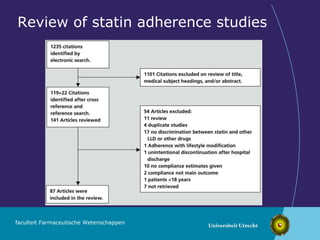
Review of statin adherence studies
 
 
initiation discontinuation EXECUTION of the drug regimen Three phases in adherence: Persistence  (days) dichotomous dichotomous continuous
Initiation 10% of all prescriptions is never filled (NIVEL 2000) 30% of all antidepressant users do not fill a second precription (Van Geffen et al 2007)
Initiation phase 965 patients with a first prescription for a treatment with an antidepressant:  4.2% (42) do not pick up the antidepressant 23.7% (229) picks up only 1 prescription
Characteristics of non-starters Van Geffen et al Br J Gen Pract (2009)  OR * 95% CI Non-specific indication 2.67 1.82-3.91 Non-western immigrants 4.80 2.05-11.3 >60 years of age  1.81 1.18-2.78 Precollege education level 1.40 0.83-2.36 Poor/moderate self-rated health 1.11 0.76-1.63 Paroxetine  0.78 0.53-1.13
Reasons for not starting therapy 57 patients with a single prescription 17 non-starters (29,8%) Fear of side effects (8) Aversion towards medication use (3) Pregnancy (2) Feeling better (2) Fear of addiction (1) Practical reasons (1) 40 (70,2%) stopped within 14 days Side effect (25) Aversion towards medication use (7) Feeling better (6) Medication ineffective (1) disagree with diagnosis (1) Ann Pharmacother  2008; 42:218-25
initiation discontinuation EXECUTION of the drug regimen Three phases in adherence: Persistence  (days) dichotomous dichotomous continuous
Separate quality of execution and persistence
Ann Pharmacother 2006
 
 time Adherence rate  = 80% time Adherence rate  = 80%
Returned medications 4.8 % of all prescriptions are returned to the pharmacy 2 weeks 51 pharmacies Prescriptions Different drugs Dosing units 6,217 9,879 375,859
 
Perfect refill patterns    perfect adherence Erratic refill patterns    non-adherence
Separate quality of execution and persistence Quality of execution influences persistence
Wijk BLG van, Klungel OH, Heerdink ER, Boer A de Initial non-compliance with antihypertensive monotherapy is followed by complete discontinuation of antihypertensive therapy “ Poor refill compliance in first 90 days determines persistence” Pharmacoepidemiology and Drug Safety (2008)
time Discontinuation is often preceded by a period of dwindling execution
Separate quality of execution and persistence Quality of execution influences persistence Intervals between dosing determine consequences of poor execution
Vrijens/Urquhart  Basic Clin Pharmacol Toxicol 2005
We can measure quality of execution to predict discontinuation to assess the effect of timing errors
initiation discontinuation EXECUTION of the drug regimen Three phases in adherence: Persistence  (days) dichotomous dichotomous continuous
Beyond databases
Accepting Ambivalent Indifferent Skeptical Necessity Concerns High High Low Low Menckeberg et al 2008
Medication adherence is an important problem, especially in the elderly Initiation. Execution. Persistence Databases are great to assess persistence.  Execution, not so much.
email: e.r.heerdink@uu.nl slides: slideshare.net/robheerdink twitter: @robheerdink

Adherence in elderly

  • 1.
    Drug exposure andadherence in the elderly March 16 th 2010 Dr. E.R. Heerdink
  • 2.
    Case Male, 68,hospitalized for serious depression with psychotic symptoms History of psychotic depression, atrial fibrillation, myocardial infarction (2002), arthritis digoxin: 0.25 mg od, acenocoumarol nortriptyline 25 mg qid, sotalol 40 mg bid amiodarone 200 mg od, enalapril 10 mg od furosemide 40 mg bid, oxazepam 10 mg tid methotrexate 7.5 mg/week, olanzapine 2.5 mg od
  • 3.
    Case 2 weeksafter admission, acute transfer to ICU due to suspected digoxin intoxication Digoxin: 3.6 microg/l (was: 2.5) Nortryptiline: 250 microg/l (was:84) INR: 8.5 (was: 1.5) Non-adherence -> “hospital induced intoxication”
  • 4.
    Source: Manhattan Research2004 data Disease Prevalence Reported rate of non-compliance
  • 5.
    Medication non-adherence drivesup healthcare costs Failure to take medication as prescribed: Causes 10% of total hospital admissions Causes 33% of CHF hospital admissions Causes 75% of Schizophrenia admissions Causes 68% of NNRTI resistant/mutated HIV virus Results in $100 billion/year in unnecessary hospital costs Causes 22% of nursing home admissions Costs the U.S. economy $300 billion/year (N Engl. J Med 8/4/05, National Pharmaceutical Council, Archives of Internal Medicine, NCPIE, American Public Health Association, AIDS 2006 20:223-232 )
  • 6.
    Rebound effects Whenthe compensating effect fades more slowly than the pharmacological effect Benzodiazepines SSRIs
  • 7.
    Meijer et alBr J Psychiatry 2001
  • 8.
    Rebound effects Whenthe compensating effect fades more slowly than the pharmacological effect Benzodiazepines SSRIs Repeated first-dose effects Toxicity in first dose of a medication antihypertensives
  • 9.
  • 10.
  • 11.
  • 12.
  • 13.
  • 14.
  • 15.
  • 16.
  • 17.
    Review of statinadherence studies
  • 18.
  • 19.
  • 20.
    initiation discontinuation EXECUTIONof the drug regimen Three phases in adherence: Persistence (days) dichotomous dichotomous continuous
  • 21.
    Initiation 10% ofall prescriptions is never filled (NIVEL 2000) 30% of all antidepressant users do not fill a second precription (Van Geffen et al 2007)
  • 22.
    Initiation phase 965patients with a first prescription for a treatment with an antidepressant: 4.2% (42) do not pick up the antidepressant 23.7% (229) picks up only 1 prescription
  • 23.
    Characteristics of non-startersVan Geffen et al Br J Gen Pract (2009) OR * 95% CI Non-specific indication 2.67 1.82-3.91 Non-western immigrants 4.80 2.05-11.3 >60 years of age 1.81 1.18-2.78 Precollege education level 1.40 0.83-2.36 Poor/moderate self-rated health 1.11 0.76-1.63 Paroxetine 0.78 0.53-1.13
  • 24.
    Reasons for notstarting therapy 57 patients with a single prescription 17 non-starters (29,8%) Fear of side effects (8) Aversion towards medication use (3) Pregnancy (2) Feeling better (2) Fear of addiction (1) Practical reasons (1) 40 (70,2%) stopped within 14 days Side effect (25) Aversion towards medication use (7) Feeling better (6) Medication ineffective (1) disagree with diagnosis (1) Ann Pharmacother 2008; 42:218-25
  • 25.
    initiation discontinuation EXECUTIONof the drug regimen Three phases in adherence: Persistence (days) dichotomous dichotomous continuous
  • 26.
    Separate quality ofexecution and persistence
  • 27.
  • 28.
  • 29.
     time Adherencerate = 80% time Adherence rate = 80%
  • 30.
    Returned medications 4.8% of all prescriptions are returned to the pharmacy 2 weeks 51 pharmacies Prescriptions Different drugs Dosing units 6,217 9,879 375,859
  • 31.
  • 32.
    Perfect refill patterns  perfect adherence Erratic refill patterns  non-adherence
  • 33.
    Separate quality ofexecution and persistence Quality of execution influences persistence
  • 34.
    Wijk BLG van,Klungel OH, Heerdink ER, Boer A de Initial non-compliance with antihypertensive monotherapy is followed by complete discontinuation of antihypertensive therapy “ Poor refill compliance in first 90 days determines persistence” Pharmacoepidemiology and Drug Safety (2008)
  • 35.
    time Discontinuation isoften preceded by a period of dwindling execution
  • 36.
    Separate quality ofexecution and persistence Quality of execution influences persistence Intervals between dosing determine consequences of poor execution
  • 37.
    Vrijens/Urquhart BasicClin Pharmacol Toxicol 2005
  • 38.
    We can measurequality of execution to predict discontinuation to assess the effect of timing errors
  • 39.
    initiation discontinuation EXECUTIONof the drug regimen Three phases in adherence: Persistence (days) dichotomous dichotomous continuous
  • 40.
  • 41.
    Accepting Ambivalent IndifferentSkeptical Necessity Concerns High High Low Low Menckeberg et al 2008
  • 42.
    Medication adherence isan important problem, especially in the elderly Initiation. Execution. Persistence Databases are great to assess persistence. Execution, not so much.
  • 43.
    email: e.r.heerdink@uu.nl slides:slideshare.net/robheerdink twitter: @robheerdink

Editor's Notes

  • #6 National Pharmaceutical Counsel