Chirurgia del Prolasso
Conservazione dell’utero
Con
Michele Meschia
Magenta
Chirurgia del prolassoChirurgia del prolasso
Ruolo dell’isterectomia?
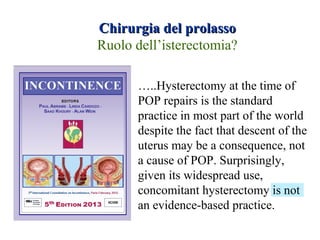
…..Hysterectomy at the time of
POP repairs is the standard
practice in most part of the world
despite the fact that descent of the
uterus may be a consequence, not
a cause of POP. Surprisingly,
given its widespread use,
concomitant hysterectomy is not
an evidence-based practice.
Hysterectomy and prolapse surgeryHysterectomy and prolapse surgery
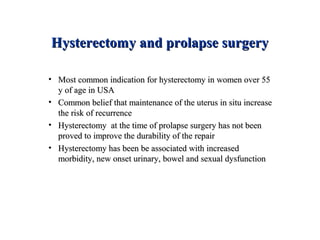
• Most common indication for hysterectomy in women over 55Most common indication for hysterectomy in women over 55
y of age in USAy of age in USA
• Common belief that maintenance of the uterus in situ increaseCommon belief that maintenance of the uterus in situ increase
the risk of recurrencethe risk of recurrence
• Hysterectomy at the time of prolapse surgery has not beenHysterectomy at the time of prolapse surgery has not been
proved to improve the durability of the repairproved to improve the durability of the repair
• Hysterectomy has been be associated with increasedHysterectomy has been be associated with increased
morbidity, new onset urinary, bowel and sexual dysfunctionmorbidity, new onset urinary, bowel and sexual dysfunction
Prolapse surgeryProlapse surgery
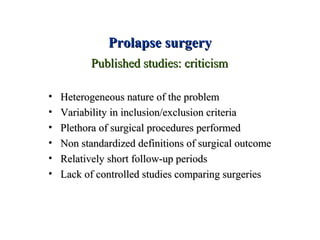
• Heterogeneous nature of the problemHeterogeneous nature of the problem
• Variability in inclusion/exclusion criteriaVariability in inclusion/exclusion criteria
• Plethora of surgical procedures performedPlethora of surgical procedures performed
• Non standardized definitions of surgical outcomeNon standardized definitions of surgical outcome
• Relatively short follow-up periodsRelatively short follow-up periods
• Lack of controlled studies comparing surgeriesLack of controlled studies comparing surgeries
Published studies: criticismPublished studies: criticism
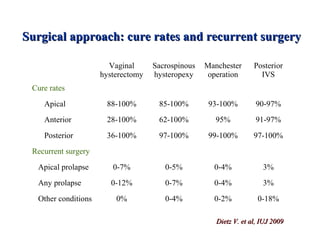
Vaginal
hysterectomy
Sacrospinous
hysteropexy
Manchester
operation
Posterior
IVS
Cure rates
Apical 88-100% 85-100% 93-100% 90-97%
Anterior 28-100% 62-100% 95% 91-97%
Posterior 36-100% 97-100% 99-100% 97-100%
Recurrent surgery
Apical prolapse 0-7% 0-5% 0-4% 3%
Any prolapse 0-12% 0-7% 0-4% 3%
Other conditions 0% 0-4% 0-2% 0-18%
Surgical approach: cure rates and recurrent surgerySurgical approach: cure rates and recurrent surgery
Dietz V. et al, IUJ 2009Dietz V. et al, IUJ 2009
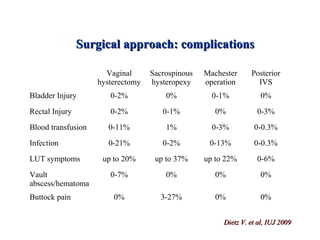
Vaginal
hysterectomy
Sacrospinous
hysteropexy
Machester
operation
Posterior
IVS
Bladder Injury 0-2% 0% 0-1% 0%
Rectal Injury 0-2% 0-1% 0% 0-3%
Blood transfusion 0-11% 1% 0-3% 0-0.3%
Infection 0-21% 0-2% 0-13% 0-0.3%
LUT symptoms up to 20% up to 37% up to 22% 0-6%
Vault
abscess/hematoma
0-7% 0% 0% 0%
Buttock pain 0% 3-27% 0% 0%
Surgical approach: complicationsSurgical approach: complications
Dietz V. et al, IUJ 2009Dietz V. et al, IUJ 2009
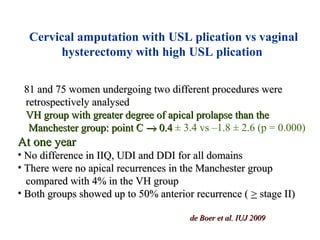
• 81 and 75 women undergoing two different procedures were81 and 75 women undergoing two different procedures were
retrospectively analysedretrospectively analysed
VH group with greater degree of apical prolapse than theVH group with greater degree of apical prolapse than the
Manchester group: point CManchester group: point C →→ 0.40.4 ± 3.4 vs –1.8 ± 2.6 (p = 0.000)
At one yearAt one year
• No difference in IIQ, UDI and DDI for all domainsNo difference in IIQ, UDI and DDI for all domains
• There were no apical recurrences in the Manchester groupThere were no apical recurrences in the Manchester group
compared with 4% in the VH groupcompared with 4% in the VH group
• Both groups showed up to 50% anterior recurrence (Both groups showed up to 50% anterior recurrence ( >> stage II)stage II)
de Boer et al. IUJ 2009de Boer et al. IUJ 2009
Cervical amputation with USL plication vs vaginal
hysterectomy with high USL plication
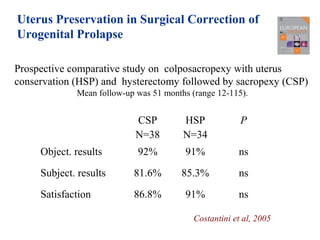
Uterus Preservation in Surgical Correction of
Urogenital Prolapse
CSP
N=38
HSP
N=34
P
Object. results 92% 91% ns
Subject. results 81.6% 85.3% ns
Satisfaction 86.8% 91% ns
Prospective comparative study on colposacropexy with uterus
conservation (HSP) and hysterectomy followed by sacropexy (CSP)
Mean follow-up was 51 months (range 12-115).
Costantini et al, 2005
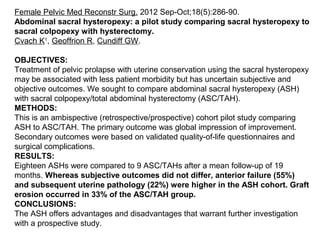
Female Pelvic Med Reconstr Surg. 2012 Sep-Oct;18(5):286-90.
Abdominal sacral hysteropexy: a pilot study comparing sacral hysteropexy to
sacral colpopexy with hysterectomy.
Cvach K1
, Geoffrion R, Cundiff GW.
OBJECTIVES:
Treatment of pelvic prolapse with uterine conservation using the sacral hysteropexy
may be associated with less patient morbidity but has uncertain subjective and
objective outcomes. We sought to compare abdominal sacral hysteropexy (ASH)
with sacral colpopexy/total abdominal hysterectomy (ASC/TAH).
METHODS:
This is an ambispective (retrospective/prospective) cohort pilot study comparing
ASH to ASC/TAH. The primary outcome was global impression of improvement.
Secondary outcomes were based on validated quality-of-life questionnaires and
surgical complications.
RESULTS:
Eighteen ASHs were compared to 9 ASC/TAHs after a mean follow-up of 19
months. Whereas subjective outcomes did not differ, anterior failure (55%)
and subsequent uterine pathology (22%) were higher in the ASH cohort. Graft
erosion occurred in 33% of the ASC/TAH group.
CONCLUSIONS:
The ASH offers advantages and disadvantages that warrant further investigation
with a prospective study.
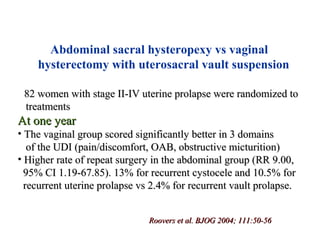
• 82 women with stage II-IV uterine prolapse were randomized to82 women with stage II-IV uterine prolapse were randomized to
treatmentstreatments
At one yearAt one year
• The vaginal group scored significantly better in 3 domainsThe vaginal group scored significantly better in 3 domains
of the UDI (pain/discomfort, OAB, obstructive micturition)of the UDI (pain/discomfort, OAB, obstructive micturition)
• Higher rate of repeat surgery in the abdominal group (RR 9.00,Higher rate of repeat surgery in the abdominal group (RR 9.00,
95% CI 1.19-67.85). 13% for recurrent cystocele and 10.5% for95% CI 1.19-67.85). 13% for recurrent cystocele and 10.5% for
recurrent uterine prolapse vs 2.4% for recurrent vault prolapse.recurrent uterine prolapse vs 2.4% for recurrent vault prolapse.
Roovers et al. BJOG 2004; 111:50-56Roovers et al. BJOG 2004; 111:50-56
Abdominal sacral hysteropexy vs vaginal
hysterectomy with uterosacral vault suspension
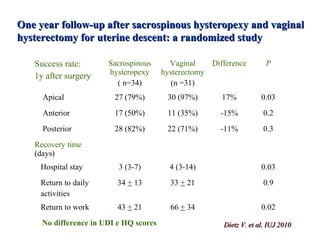
Success rate:
1y after surgery
Sacrospinous
hysteropexy
( n=34)
Vaginal
hysterectomy
(n =31)
Difference P
Apical 27 (79%) 30 (97%) 17% 0.03
Anterior 17 (50%) 11 (35%) -15% 0.2
Posterior 28 (82%) 22 (71%) -11% 0.3
Recovery time
(days)
Hospital stay 3 (3-7) 4 (3-14) 0.03
Return to daily
activities
34 + 13 33 + 21 0.9
Return to work 43 + 21 66 + 34 0.02
One year follow-up after sacrospinous hysteropexy and vaginalOne year follow-up after sacrospinous hysteropexy and vaginal
hysterectomy for uterine descent: a randomized studyhysterectomy for uterine descent: a randomized study
Dietz V. et al, IUJ 2010Dietz V. et al, IUJ 2010No difference in UDI e IIQ scores
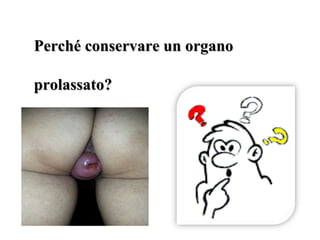
Perché conservare un organoPerché conservare un organo
prolassato?prolassato?
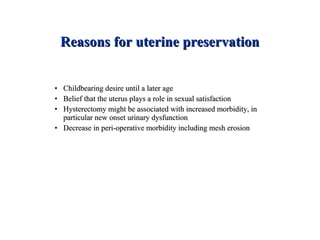
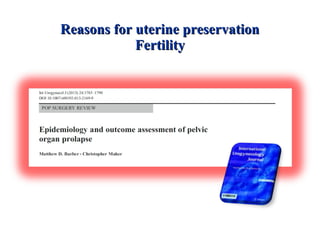
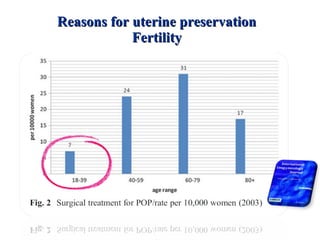
Reasons for uterine preservationReasons for uterine preservation
• Childbearing desire until a later ageChildbearing desire until a later age
• Belief that the uterus plays a role in sexual satisfactionBelief that the uterus plays a role in sexual satisfaction
• Hysterectomy might be associated with increased morbidity, inHysterectomy might be associated with increased morbidity, in
particular new onset urinary dysfunctionparticular new onset urinary dysfunction
• Decrease in peri-operative morbidity including mesh erosionDecrease in peri-operative morbidity including mesh erosion
Reasons for uterine preservationReasons for uterine preservation
FertilityFertility
Reasons for uterine preservationReasons for uterine preservation
FertilityFertility
Reasons for uterine preservationReasons for uterine preservation
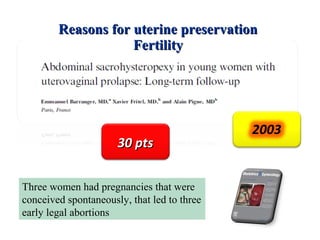
FertilityFertility
30 pts30 pts
Three women had pregnancies that were
conceived spontaneously, that led to three
early legal abortions
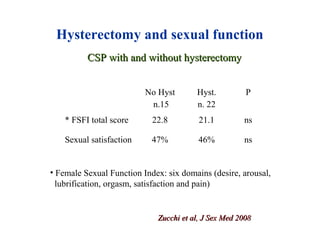
Hysterectomy and sexual function
No Hyst
n.15
Hyst.
n. 22
P
* FSFI total score 22.8 21.1 ns
Sexual satisfaction 47% 46% ns
• Female Sexual Function Index: six domains (desire, arousal,
lubrification, orgasm, satisfaction and pain)
CSP with and without hysterectomyCSP with and without hysterectomy
Zucchi et al, J Sex Med 2008Zucchi et al, J Sex Med 2008
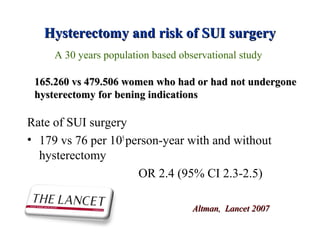
Hysterectomy and risk of SUI surgeryHysterectomy and risk of SUI surgery
Rate of SUI surgery
• 179 vs 76 per 105
person-year with and without
hysterectomy
OR 2.4 (95% CI 2.3-2.5)
A 30 years population based observational study
165.260 vs 479.506 women who had or had not undergone165.260 vs 479.506 women who had or had not undergone
hysterectomy for bening indicationshysterectomy for bening indications
Altman, Lancet 2007Altman, Lancet 2007
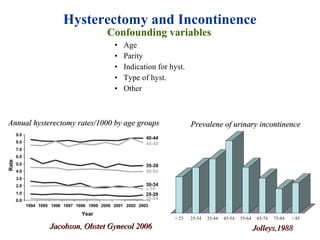
Hysterectomy and Incontinence
• Age
• Parity
• Indication for hyst.
• Type of hyst.
• Other
Confounding variables
Jolleys,1988Jolleys,1988
Prevalene of urinary incontinencePrevalene of urinary incontinence
0
10
20
30
40
50
60
< 25 25-34 35-44 45-54 55-64 65-74 75-84 > 85
Annual hysterectomy rates/1000 by age groupsAnnual hysterectomy rates/1000 by age groups
Jacobson, Obstet Gynecol 2006Jacobson, Obstet Gynecol 2006
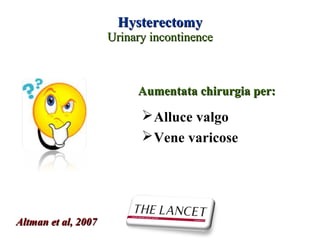
Alluce valgo
Vene varicose
Altman et al, 2007Altman et al, 2007
HysterectomyHysterectomy
Urinary incontinenceUrinary incontinence
Aumentata chirurgia per:Aumentata chirurgia per:
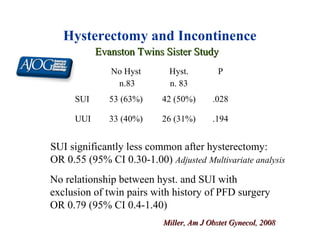
Hysterectomy and Incontinence
No Hyst
n.83
Hyst.
n. 83
P
SUI 53 (63%) 42 (50%) .028
UUI 33 (40%) 26 (31%) .194
SUI significantly less common after hysterectomy:
OR 0.55 (95% CI 0.30-1.00) Adjusted Multivariate analysis
No relationship between hyst. and SUI with
exclusion of twin pairs with history of PFD surgery
OR 0.79 (95% CI 0.4-1.40)
Evanston Twins Sister StudyEvanston Twins Sister Study
Miller, Am J Obstet Gynecol, 2008Miller, Am J Obstet Gynecol, 2008
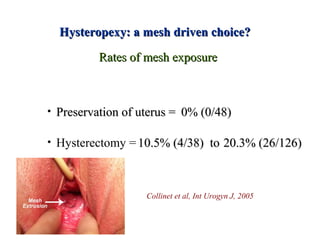
• Preservation of uterus =Preservation of uterus = 0% (0/48)0% (0/48)
20.3% (26/126)20.3% (26/126)10.5% (4/38) to10.5% (4/38) to
Hysteropexy: a mesh driven choice?Hysteropexy: a mesh driven choice?
Collinet et al, Int Urogyn J, 2005
Rates of mesh exposureRates of mesh exposure
• Hysterectomy =
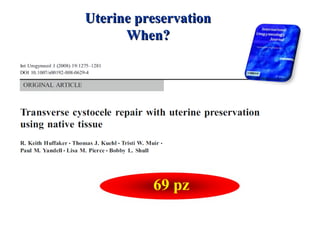
69 pz
Uterine preservationUterine preservation
When?When?
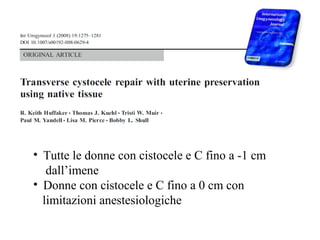
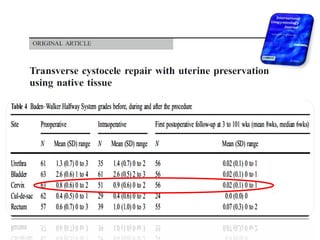
• Tutte le donne con cistocele e C fino a -1 cm
dall’imene
• Donne con cistocele e C fino a 0 cm con
limitazioni anestesiologiche
To evaluate the rate of pre-cancerous and cancerous
endometrial lesions in patients undergoing hysterectomy
In the analysis of 136 cases, precancerous and cancerous lesions have been
diagnosed while ultrasonography or cervical smear were normal
• 2 (1.4%) endocervical dysplasia,
• 1 (0.7%) cervical epidermoid carcinoma
• 10 (7.35%) endometrial complex non-atypical hyperplasia,
• 7 (5.1%) endometrial atypical hyperplasia
• 2 (1.4%) endometrioid endometrial carcinoma.
16% cervical and endometrial pathology
Risk of malignancy
Mansoor et al, 2013
• The role of hysterectomy remains controversial
in the surgical strategy for POP
ConclusionsConclusions
ICI 2005
• There is little evidence to suggest that hysterectomy
for benign conditions may place a woman at risk for
UI
• Hysterectomy alone does not contribute to sexual
dysfunction
• Hysteropexy with or without cervical amputation
must be offered in young women
• Selection bias have to be considered when
analysing existing data

Chirurgia del Prolasso Conservazione dell’utero

  • 1.
    Chirurgia del Prolasso Conservazionedell’utero Con Michele Meschia Magenta
  • 2.
    Chirurgia del prolassoChirurgiadel prolasso Ruolo dell’isterectomia? …..Hysterectomy at the time of POP repairs is the standard practice in most part of the world despite the fact that descent of the uterus may be a consequence, not a cause of POP. Surprisingly, given its widespread use, concomitant hysterectomy is not an evidence-based practice.
  • 3.
    Hysterectomy and prolapsesurgeryHysterectomy and prolapse surgery • Most common indication for hysterectomy in women over 55Most common indication for hysterectomy in women over 55 y of age in USAy of age in USA • Common belief that maintenance of the uterus in situ increaseCommon belief that maintenance of the uterus in situ increase the risk of recurrencethe risk of recurrence • Hysterectomy at the time of prolapse surgery has not beenHysterectomy at the time of prolapse surgery has not been proved to improve the durability of the repairproved to improve the durability of the repair • Hysterectomy has been be associated with increasedHysterectomy has been be associated with increased morbidity, new onset urinary, bowel and sexual dysfunctionmorbidity, new onset urinary, bowel and sexual dysfunction
  • 4.
    Prolapse surgeryProlapse surgery •Heterogeneous nature of the problemHeterogeneous nature of the problem • Variability in inclusion/exclusion criteriaVariability in inclusion/exclusion criteria • Plethora of surgical procedures performedPlethora of surgical procedures performed • Non standardized definitions of surgical outcomeNon standardized definitions of surgical outcome • Relatively short follow-up periodsRelatively short follow-up periods • Lack of controlled studies comparing surgeriesLack of controlled studies comparing surgeries Published studies: criticismPublished studies: criticism
  • 5.
    Vaginal hysterectomy Sacrospinous hysteropexy Manchester operation Posterior IVS Cure rates Apical 88-100%85-100% 93-100% 90-97% Anterior 28-100% 62-100% 95% 91-97% Posterior 36-100% 97-100% 99-100% 97-100% Recurrent surgery Apical prolapse 0-7% 0-5% 0-4% 3% Any prolapse 0-12% 0-7% 0-4% 3% Other conditions 0% 0-4% 0-2% 0-18% Surgical approach: cure rates and recurrent surgerySurgical approach: cure rates and recurrent surgery Dietz V. et al, IUJ 2009Dietz V. et al, IUJ 2009
  • 6.
    Vaginal hysterectomy Sacrospinous hysteropexy Machester operation Posterior IVS Bladder Injury 0-2%0% 0-1% 0% Rectal Injury 0-2% 0-1% 0% 0-3% Blood transfusion 0-11% 1% 0-3% 0-0.3% Infection 0-21% 0-2% 0-13% 0-0.3% LUT symptoms up to 20% up to 37% up to 22% 0-6% Vault abscess/hematoma 0-7% 0% 0% 0% Buttock pain 0% 3-27% 0% 0% Surgical approach: complicationsSurgical approach: complications Dietz V. et al, IUJ 2009Dietz V. et al, IUJ 2009
  • 7.
    • 81 and75 women undergoing two different procedures were81 and 75 women undergoing two different procedures were retrospectively analysedretrospectively analysed VH group with greater degree of apical prolapse than theVH group with greater degree of apical prolapse than the Manchester group: point CManchester group: point C →→ 0.40.4 ± 3.4 vs –1.8 ± 2.6 (p = 0.000) At one yearAt one year • No difference in IIQ, UDI and DDI for all domainsNo difference in IIQ, UDI and DDI for all domains • There were no apical recurrences in the Manchester groupThere were no apical recurrences in the Manchester group compared with 4% in the VH groupcompared with 4% in the VH group • Both groups showed up to 50% anterior recurrence (Both groups showed up to 50% anterior recurrence ( >> stage II)stage II) de Boer et al. IUJ 2009de Boer et al. IUJ 2009 Cervical amputation with USL plication vs vaginal hysterectomy with high USL plication
  • 8.
    Uterus Preservation inSurgical Correction of Urogenital Prolapse CSP N=38 HSP N=34 P Object. results 92% 91% ns Subject. results 81.6% 85.3% ns Satisfaction 86.8% 91% ns Prospective comparative study on colposacropexy with uterus conservation (HSP) and hysterectomy followed by sacropexy (CSP) Mean follow-up was 51 months (range 12-115). Costantini et al, 2005
  • 9.
    Female Pelvic MedReconstr Surg. 2012 Sep-Oct;18(5):286-90. Abdominal sacral hysteropexy: a pilot study comparing sacral hysteropexy to sacral colpopexy with hysterectomy. Cvach K1 , Geoffrion R, Cundiff GW. OBJECTIVES: Treatment of pelvic prolapse with uterine conservation using the sacral hysteropexy may be associated with less patient morbidity but has uncertain subjective and objective outcomes. We sought to compare abdominal sacral hysteropexy (ASH) with sacral colpopexy/total abdominal hysterectomy (ASC/TAH). METHODS: This is an ambispective (retrospective/prospective) cohort pilot study comparing ASH to ASC/TAH. The primary outcome was global impression of improvement. Secondary outcomes were based on validated quality-of-life questionnaires and surgical complications. RESULTS: Eighteen ASHs were compared to 9 ASC/TAHs after a mean follow-up of 19 months. Whereas subjective outcomes did not differ, anterior failure (55%) and subsequent uterine pathology (22%) were higher in the ASH cohort. Graft erosion occurred in 33% of the ASC/TAH group. CONCLUSIONS: The ASH offers advantages and disadvantages that warrant further investigation with a prospective study.
  • 10.
    • 82 womenwith stage II-IV uterine prolapse were randomized to82 women with stage II-IV uterine prolapse were randomized to treatmentstreatments At one yearAt one year • The vaginal group scored significantly better in 3 domainsThe vaginal group scored significantly better in 3 domains of the UDI (pain/discomfort, OAB, obstructive micturition)of the UDI (pain/discomfort, OAB, obstructive micturition) • Higher rate of repeat surgery in the abdominal group (RR 9.00,Higher rate of repeat surgery in the abdominal group (RR 9.00, 95% CI 1.19-67.85). 13% for recurrent cystocele and 10.5% for95% CI 1.19-67.85). 13% for recurrent cystocele and 10.5% for recurrent uterine prolapse vs 2.4% for recurrent vault prolapse.recurrent uterine prolapse vs 2.4% for recurrent vault prolapse. Roovers et al. BJOG 2004; 111:50-56Roovers et al. BJOG 2004; 111:50-56 Abdominal sacral hysteropexy vs vaginal hysterectomy with uterosacral vault suspension
  • 11.
    Success rate: 1y aftersurgery Sacrospinous hysteropexy ( n=34) Vaginal hysterectomy (n =31) Difference P Apical 27 (79%) 30 (97%) 17% 0.03 Anterior 17 (50%) 11 (35%) -15% 0.2 Posterior 28 (82%) 22 (71%) -11% 0.3 Recovery time (days) Hospital stay 3 (3-7) 4 (3-14) 0.03 Return to daily activities 34 + 13 33 + 21 0.9 Return to work 43 + 21 66 + 34 0.02 One year follow-up after sacrospinous hysteropexy and vaginalOne year follow-up after sacrospinous hysteropexy and vaginal hysterectomy for uterine descent: a randomized studyhysterectomy for uterine descent: a randomized study Dietz V. et al, IUJ 2010Dietz V. et al, IUJ 2010No difference in UDI e IIQ scores
  • 12.
    Perché conservare unorganoPerché conservare un organo prolassato?prolassato?
  • 13.
    Reasons for uterinepreservationReasons for uterine preservation • Childbearing desire until a later ageChildbearing desire until a later age • Belief that the uterus plays a role in sexual satisfactionBelief that the uterus plays a role in sexual satisfaction • Hysterectomy might be associated with increased morbidity, inHysterectomy might be associated with increased morbidity, in particular new onset urinary dysfunctionparticular new onset urinary dysfunction • Decrease in peri-operative morbidity including mesh erosionDecrease in peri-operative morbidity including mesh erosion
  • 14.
    Reasons for uterinepreservationReasons for uterine preservation FertilityFertility
  • 15.
    Reasons for uterinepreservationReasons for uterine preservation FertilityFertility
  • 16.
    Reasons for uterinepreservationReasons for uterine preservation FertilityFertility 30 pts30 pts Three women had pregnancies that were conceived spontaneously, that led to three early legal abortions
  • 17.
    Hysterectomy and sexualfunction No Hyst n.15 Hyst. n. 22 P * FSFI total score 22.8 21.1 ns Sexual satisfaction 47% 46% ns • Female Sexual Function Index: six domains (desire, arousal, lubrification, orgasm, satisfaction and pain) CSP with and without hysterectomyCSP with and without hysterectomy Zucchi et al, J Sex Med 2008Zucchi et al, J Sex Med 2008
  • 18.
    Hysterectomy and riskof SUI surgeryHysterectomy and risk of SUI surgery Rate of SUI surgery • 179 vs 76 per 105 person-year with and without hysterectomy OR 2.4 (95% CI 2.3-2.5) A 30 years population based observational study 165.260 vs 479.506 women who had or had not undergone165.260 vs 479.506 women who had or had not undergone hysterectomy for bening indicationshysterectomy for bening indications Altman, Lancet 2007Altman, Lancet 2007
  • 19.
    Hysterectomy and Incontinence •Age • Parity • Indication for hyst. • Type of hyst. • Other Confounding variables Jolleys,1988Jolleys,1988 Prevalene of urinary incontinencePrevalene of urinary incontinence 0 10 20 30 40 50 60 < 25 25-34 35-44 45-54 55-64 65-74 75-84 > 85 Annual hysterectomy rates/1000 by age groupsAnnual hysterectomy rates/1000 by age groups Jacobson, Obstet Gynecol 2006Jacobson, Obstet Gynecol 2006
  • 20.
    Alluce valgo Vene varicose Altmanet al, 2007Altman et al, 2007 HysterectomyHysterectomy Urinary incontinenceUrinary incontinence Aumentata chirurgia per:Aumentata chirurgia per:
  • 21.
    Hysterectomy and Incontinence NoHyst n.83 Hyst. n. 83 P SUI 53 (63%) 42 (50%) .028 UUI 33 (40%) 26 (31%) .194 SUI significantly less common after hysterectomy: OR 0.55 (95% CI 0.30-1.00) Adjusted Multivariate analysis No relationship between hyst. and SUI with exclusion of twin pairs with history of PFD surgery OR 0.79 (95% CI 0.4-1.40) Evanston Twins Sister StudyEvanston Twins Sister Study Miller, Am J Obstet Gynecol, 2008Miller, Am J Obstet Gynecol, 2008
  • 22.
    • Preservation ofuterus =Preservation of uterus = 0% (0/48)0% (0/48) 20.3% (26/126)20.3% (26/126)10.5% (4/38) to10.5% (4/38) to Hysteropexy: a mesh driven choice?Hysteropexy: a mesh driven choice? Collinet et al, Int Urogyn J, 2005 Rates of mesh exposureRates of mesh exposure • Hysterectomy =
  • 23.
    69 pz Uterine preservationUterinepreservation When?When?
  • 24.
    • Tutte ledonne con cistocele e C fino a -1 cm dall’imene • Donne con cistocele e C fino a 0 cm con limitazioni anestesiologiche
  • 26.
    To evaluate therate of pre-cancerous and cancerous endometrial lesions in patients undergoing hysterectomy In the analysis of 136 cases, precancerous and cancerous lesions have been diagnosed while ultrasonography or cervical smear were normal • 2 (1.4%) endocervical dysplasia, • 1 (0.7%) cervical epidermoid carcinoma • 10 (7.35%) endometrial complex non-atypical hyperplasia, • 7 (5.1%) endometrial atypical hyperplasia • 2 (1.4%) endometrioid endometrial carcinoma. 16% cervical and endometrial pathology Risk of malignancy Mansoor et al, 2013
  • 27.
    • The roleof hysterectomy remains controversial in the surgical strategy for POP ConclusionsConclusions ICI 2005 • There is little evidence to suggest that hysterectomy for benign conditions may place a woman at risk for UI • Hysterectomy alone does not contribute to sexual dysfunction • Hysteropexy with or without cervical amputation must be offered in young women • Selection bias have to be considered when analysing existing data