Network Topology

ELEG 667-013 Spring 2003
Outline:
 Why Network Topology is Important ?
 Modeling Internet Topology
 Complex Networks
 Scale-free Networks
 Power-laws of the Web
 Search in power-law networks: GNUTELLA, a P2P
example.
Why Topology is Important ?
• Design Efficient Protocols
• Solve Internetworking Problems:
- routing
- resource reservation
- administration
• Create Accurate Model for Simulation
• Derive Estimates for Topological Parameters
• Study Fault Tolerance and Anti-Attack Properties
Modeling Internet Topology [1]:
 Graph representation
 Router-level modeling
- vertices are routers
-edges are one-hop IP connectivity
 Domain- (AS-) level model (high degree of abstraction)
- vertices are domains (ASes)
- edges are peering relationships
 Nodes can be assigned numbers rep. e.g. buffer
capacity
Edges migth have weights rep. e.g. – prop. delay,
bandwidth capacity.
Modeling Internet Topology [1]:
transit domains
domains/autonomous systems

exchange point
border routers

peering
hosts/endsystems
routers

stub domains
access networks

lowly worm
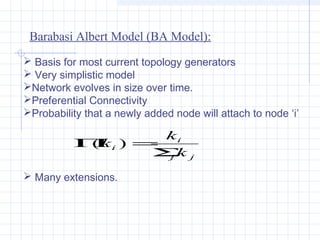
Barabasi Albert Model (BA Model):
 Basis for most current topology generators
 Very simplistic model
Network evolves in size over time.
Preferential Connectivity
Probability that a newly added node will attach to node ‘i’

ki
Πi ) =
(k
Σ j
jk
 Many extensions.
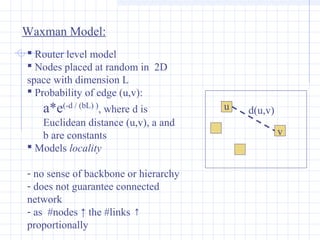
Waxman Model:
 Router level model
 Nodes placed at random in 2D
space with dimension L
 Probability of edge (u,v):

a*e(-d / (bL) ), where d is
Euclidean distance (u,v), a and
b are constants
 Models locality
- no sense of backbone or hierarchy
- does not guarantee connected
network
- as #nodes ↑ the #links ↑
proportionally

u

d(u,v)
v
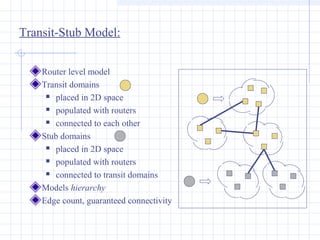
Transit-Stub Model:
Router level model
Transit domains
 placed in 2D space
 populated with routers
 connected to each other
Stub domains
 placed in 2D space
 populated with routers
 connected to transit domains
Models hierarchy
Edge count, guaranteed connectivity
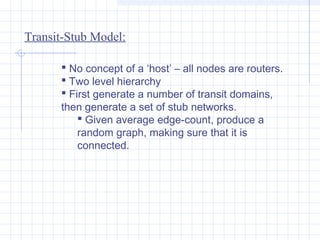
Transit-Stub Model:
 No concept of a ‘host’ – all nodes are routers.
 Two level hierarchy
 First generate a number of transit domains,
then generate a set of stub networks.
 Given average edge-count, produce a
random graph, making sure that it is
connected.
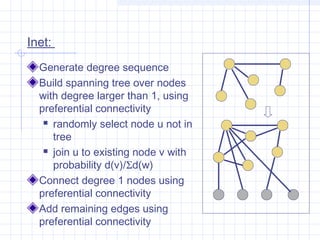
Inet:
Generate degree sequence
Build spanning tree over nodes
with degree larger than 1, using
preferential connectivity
 randomly select node u not in
tree
 join u to existing node v with
probability d(v)/Σd(w)
Connect degree 1 nodes using
preferential connectivity
Add remaining edges using
preferential connectivity
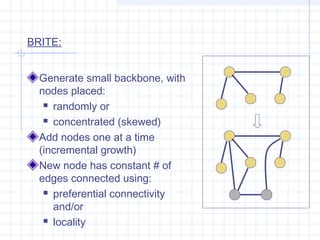
BRITE:
Generate small backbone, with
nodes placed:
 randomly or
 concentrated (skewed)
Add nodes one at a time
(incremental growth)
New node has constant # of
edges connected using:
 preferential connectivity
and/or
 locality
Complex Networks:
Two limiting-case topologies have been extensively considered in
the literature [4],[5].:
 regular network (lattice), the chosen topology of innumerable
physical models such as the Ising model or percolation.
 random graph, studied in mathematics and used both in
natural and social sciences. Properties studied in detail by Pal
Erdos.
 Most of Erdos’ work concentrated on the case in which the
number of vertices is kept constant but the total number of links
between vertices increases: the Erdös-Rényi result states that for
many important quantities there is a percolation-like transition
at a specific value of the average number of links per vertex.
Complex Networks:

 random networks are used in:
 Physics: in studies of dynamical problems, spin
models and thermodynamics, random walks, and
quantum chaos.
 Economics and social sciences: to model interacting
agents.
Complex Networks:
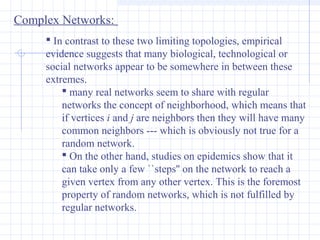
 In contrast to these two limiting topologies, empirical
evidence suggests that many biological, technological or
social networks appear to be somewhere in between these
extremes.
 many real networks seem to share with regular
networks the concept of neighborhood, which means that
if vertices i and j are neighbors then they will have many
common neighbors --- which is obviously not true for a
random network.
 On the other hand, studies on epidemics show that it
can take only a few ``steps'' on the network to reach a
given vertex from any other vertex. This is the foremost
property of random networks, which is not fulfilled by
regular networks.
Complex Networks:
Complex Networks:

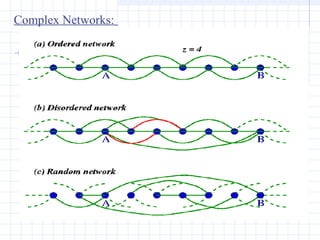
 The Watts-Strogatz model [5]. :
 To bridge the two limiting cases, Watts and Strogatz
[Nature 393, 440 (1998)] have introduced a new type of
network which is obtained by randomizing a fraction p of
the links of the regular network.
 Initial structure (p=0) is the one-dimensional regular
network where each vertex is connected to its z nearest
neighbors.
 For 0 < p < 1, we denote these networks disordered.
 for the case p=1, we have a completely random
network.
Complex Networks:
 Watts and Strogatz report that for a small value of the
parameter p, there is an onset of “small-world”
behavior.
 It is characterized by the fact that the distance between
any two vertices is of the order of that for a random
network and, at the same time, the concept of
neighborhood is preserved.
 The effect of a change in p is extremely nonlinear,
where a very small change in the connectivity of the
network leads to a dramatic change in the distance
between different pairs of vertices.
Complex Networks:

 The scientific question we are trying to answer is: Does
the onset of the small-world behavior occurs at a given value
of p or does it occur for a value of the system size n which
depends on p?
 To investigate this question, we need to look at the
behavior of the system as a function of p for different values
of n.
Complex Networks:
Complex Networks:

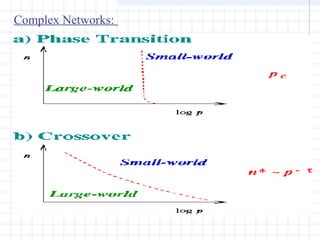
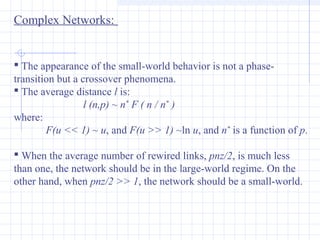
 The appearance of the small-world behavior is not a phasetransition but a crossover phenomena.
 The average distance l is:
                          l (n,p) ~ n* F ( n / n* ) 
where:
F(u << 1) ~ u, and F(u >> 1) ~ln u, and n* is a function of p.
 When the average number of rewired links, pnz/2, is much less
than one, the network should be in the large-world regime. On the
other hand, when pnz/2 >> 1, the network should be a small-world.
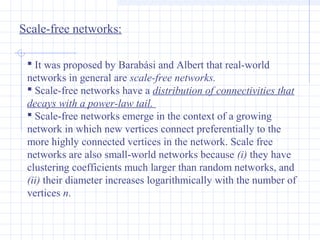
Scale-free networks:
 It was proposed by Barabási and Albert that real-world
networks in general are scale-free networks. 
 Scale-free networks have a distribution of connectivities that 
decays with a power-law tail. 
 Scale-free networks emerge in the context of a growing
network in which new vertices connect preferentially to the
more highly connected vertices in the network. Scale free
networks are also small-world networks because (i) they have
clustering coefficients much larger than random networks, and
(ii) their diameter increases logarithmically with the number of
vertices n.
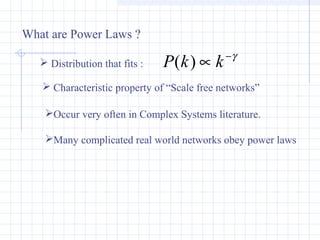
What are Power Laws ?
 Distribution that fits :

P(k ) ∝ k

−γ

 Characteristic property of “Scale free networks”
Occur very often in Complex Systems literature.
Many complicated real world networks obey power laws
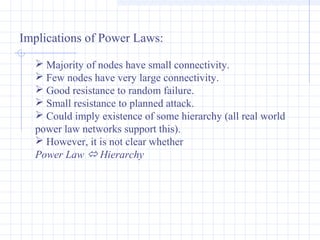
Implications of Power Laws:
 Majority of nodes have small connectivity.
 Few nodes have very large connectivity.
 Good resistance to random failure.
 Small resistance to planned attack.
 Could imply existence of some hierarchy (all real world
power law networks support this).
 However, it is not clear whether
Power Law  Hierarchy
Origin of Power Law:
Power laws are an observed (empirical)
phenomenon.
The mechanisms that produce these can only be
guessed at (for now!)
Very typical in self organizing systems and chaotic
systems.
Scale-free networks:
 Scale-free networks:
(a) the neuronal network of the worm C. elegans.
(b) world-wide web.
(c) the network of citations of scientific papers.
Scale-free networks:
 broad-scale networks: or truncated scale-free networks,
characterized by a connectivity distribution that has a powerlaw regime followed by a sharp cut-off, like an exponential or
Gaussian decay of the tail.
 single-scale networks: characterized by a connectivity
distribution with a fast decaying tail, such as exponential or
Gaussian
Aging of the vertices: The vertex is still part of the network
and contributing to network statistics, but it no longer receives
links. The aging of the vertices thus limits the preferential
attachment preventing a scale-free distribution of connectivities.
 Cost of adding links to the vertices or the limited capacity of
a vertex: physical costs of adding links and limited capacity of a
vertex will limit the number of possible links attaching to a
given vertex.
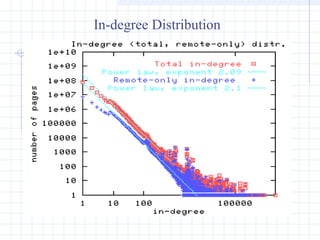
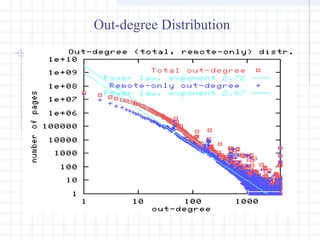
Power-laws of the Web [2].:
•How many links on a page (outdegree)?
• How many links to a page (indegree)?
•Probability that a random page has k other pages
pointing to it is ~k

-2.1

(Power law)

• Probability that a random page points to k other pages is
~k

-2.7 

(Power law)
In-degree Distribution
Out-degree Distribution
Search in power-law networks: GNUTELLA [3].
 Most of the P2P networks display a power-law
distribution in their node degree. This distribution
reflects the existence of a few nodes with very high
degree and many with low degree.
 In P2P networks, the name of the target file may be
known, but due to the network’s ad hoc nature, the node
holding the file may not be known until a real-time
search is performed.
 A simple strategy to locate files, implemented by
NAPSTER, is to use a central server that contains an
index of all the files every node is sharing as they join
the network.
 GNUTELLA and FREENET do not use a central
server.
Search in power-law networks: GNUTELLA [3].
 GNUTELLA is a peer-to-peer file-sharing system that treats
all client nodes as functionally equivalent and lacks a central
server that can store file location information. This is advantageous
because it presents no central point of failure.
 The obvious disadvantage is that the location of files is unknown.
When a user wants to download a file, he sends a query to
all the nodes within a neighborhood of size ttl, the time to
live assigned to the query. Every node passes on the query to
all of its neighbors and decrements the ttl by one. In this
way, all nodes within a given radius of the requesting node
will be queried for the file, and those who have matching
files will send back positive answers.
Search in power-law networks: GNUTELLA [3].

 This broadcast method will find the target file quickly,
given that it is located within a radius of ttl. However, broadcasting
is extremely costly in terms of bandwidth.
 Such a search strategy does not scale well. As query traffic
increases linearly with the size of GNUTELLA graph, nodes
become overloaded.
Search in power-law networks: GNUTELLA [3].
 Typically, a GNUTELLA client wishing to join the network
must find the IP address of an initial node to connect to.
Currently, ad hoc lists of ‘‘good’’ GNUTELLA clients exist.
 It is reasonable to suppose that this ad hoc method of
growth would bias new nodes to connect preferentially to
nodes that are already fairly well connected, since these
nodes are more likely to be ‘‘well known.’’
 Based on models of graph growth where the ‘‘rich get richer,’’
the power-law connectivity of ad hoc peer-to-peer networks may
be a fairly general topological feature.
Search in power-law networks: GNUTELLA [3].
 By passing the query to every single node in the network,
the GNUTELLA algorithm fails to take advantage of the
connectivity distribution [3].
 To take advantage of the power-law distribution, we can modify
each node to keep lists of files stored in first and second neighbor.
 Instead of passing the query to every node, now we can pass it
only to the nodes with highest connectivity.
 High degree nodes are presumably high bandwidth node that can
handle the query traffic.
Outline:

Internet Structure
&Organization
 Internet Hierarchical Structure
 ISPs, interconnection and organization [ref. 7].
 POP Architecture and Load Balancing
 ISP Architecture [ref. 7]. in detail
 Topology Mapping Tool: Rocketfuel[ref. 8]
 Discussion
ELEG 667-013 Spring 2003
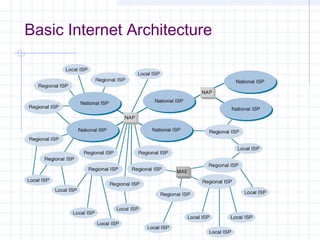
Basic Internet Architecture
Basic Architecture: NAPs and national
ISPs
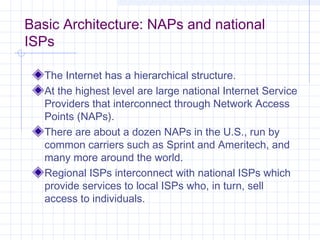
The Internet has a hierarchical structure.
At the highest level are large national Internet Service
Providers that interconnect through Network Access
Points (NAPs).
There are about a dozen NAPs in the U.S., run by
common carriers such as Sprint and Ameritech, and
many more around the world.
Regional ISPs interconnect with national ISPs which
provide services to local ISPs who, in turn, sell
access to individuals.
Basic Architecture: MAEs and local ISPs

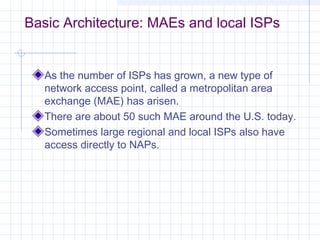
As the number of ISPs has grown, a new type of
network access point, called a metropolitan area
exchange (MAE) has arisen.
There are about 50 such MAE around the U.S. today.
Sometimes large regional and local ISPs also have
access directly to NAPs.
Internet Packet Exchange Charges

ISP at the same level usually do not charge each
other for exchanging messages.
This is called peering.
Higher level ISPs, however, charge lower level ones
(national ISPs charge regional ISPs which in turn
charge local ISPs) for carrying Internet traffic.
Local ISPs, of course, charge individuals and
corporate users for access.
Connecting to an ISP
ISPs provide access to the Internet through a Point of
Presence (POP).
Individual users access the POP through a dial-up
line using the PPP protocol.
The call connects the user to the ISP’s modem pool,
after which a remote access server (RAS) checks the
userid and password.
Once logged in, the user can send TCP/IP/[PPP]
packets over the telephone line which are then sent
out over the Internet through the ISP’s POP.
Connecting to an ISP (contd.)
Corporate users might access the POP using a T-1, T-3
or ATM OC-3 connections provided by a common carrier.
T-1 and T-3 lines connect to the ISP POP’s CSU/DSU
device. Channel Service Unit/Data Service Unit.
The CSU is a device that connects a terminal to a digital
line. The DSU is a device that performs protective and
diagnostic functions for a telecommunications line. .
Typically, the two devices are packaged as a single unit.
You can think of it as a very high-powered and
expensive modem. Such a device is required for both ends
of a T-1 or T-3 connection, and the units at both ends must
be set to the same communications standard.
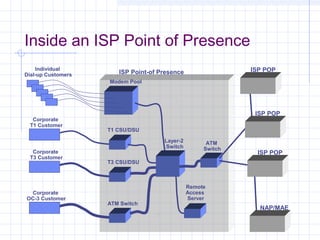
Inside an ISP Point of Presence
Individual
Dial-up Customers

ISP POP

ISP Point-of Presence
Modem Pool

Corporate
T1 Customer

Corporate
T3 Customer

Corporate
OC-3 Customer

ISP POP
T1 CSU/DSU
Layer-2
Switch

ATM
Switch

ISP POP

T3 CSU/DSU

ATM Switch

Remote
Access
Server

NAP/MAE
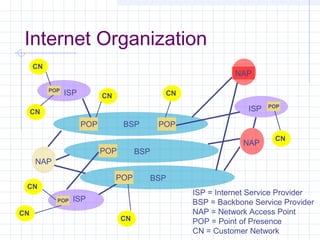
Internet Organization
CN

NAP
POP

ISP

CN

CN

ISP

CN

BSP

POP
POP

POP

POP

BSP

NAP

CN

NAP
POP
CN
POP

CN

ISP
CN

BSP
ISP = Internet Service Provider
BSP = Backbone Service Provider
NAP = Network Access Point
POP = Point of Presence
CN = Customer Network
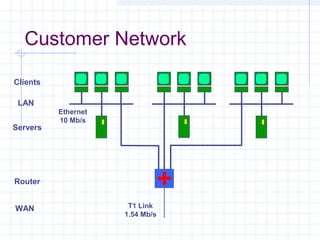
Customer Network
Clients
LAN
Servers

Ethernet
10 Mb/s

Router
WAN

T1 Link
1.54 Mb/s
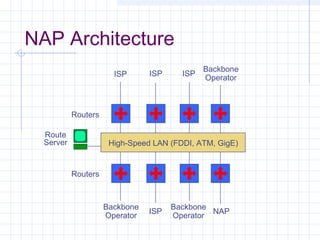
NAP Architecture
ISP

ISP

ISP

Backbone
Operator

Routers
Route
Server

High-Speed LAN (FDDI, ATM, GigE)

Routers

Backbone
Operator

ISP

Backbone
NAP
Operator
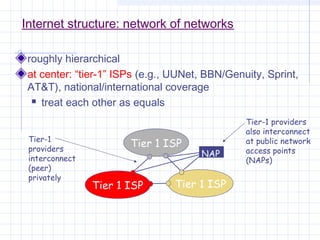
Internet structure: network of networks
roughly hierarchical
at center: “tier-1” ISPs (e.g., UUNet, BBN/Genuity, Sprint,
AT&T), national/international coverage
 treat each other as equals
Tier-1
providers
interconnect
(peer)
privately

Tier 1 ISP

Tier 1 ISP

NAP

Tier 1 ISP

Tier-1 providers
also interconnect
at public network
access points
(NAPs)
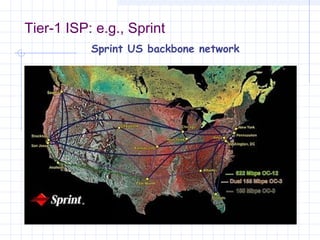
Tier-1 ISP: e.g., Sprint
Sprint US backbone network
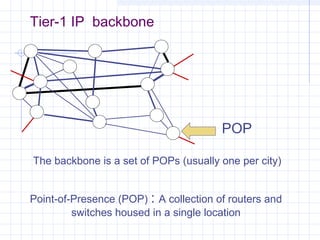
Tier-1 IP backbone

POP
The backbone is a set of POPs (usually one per city)
Point-of-Presence (POP) : A collection of routers and
switches housed in a single location
Internet structure: network of networks
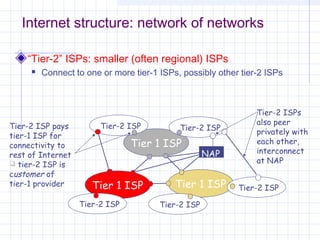
“Tier-2” ISPs: smaller (often regional) ISPs


Connect to one or more tier-1 ISPs, possibly other tier-2 ISPs

Tier-2 ISP pays
tier-1 ISP for
connectivity to
rest of Internet
 tier-2 ISP is
customer of
tier-1 provider

Tier-2 ISP

Tier-2 ISP

Tier 1 ISP

Tier 1 ISP
Tier-2 ISP

NAP

Tier 1 ISP
Tier-2 ISP

Tier-2 ISPs
also peer
privately with
each other,
interconnect
at NAP
Tier-2 ISP
Internet structure: network of networks
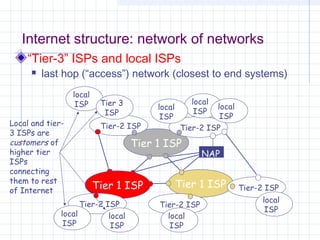
“Tier-3” ISPs and local ISPs


last hop (“access”) network (closest to end systems)
local
ISP

Local and tier3 ISPs are
customers of
higher tier
ISPs
connecting
them to rest
of Internet

Tier 3
ISP
Tier-2 ISP

local
ISP

local
ISP

local
ISP
Tier-2 ISP

Tier 1 ISP

Tier 1 ISP

Tier-2 ISP
local
local
ISP
ISP

NAP

Tier 1 ISP
Tier-2 ISP
local
ISP

Tier-2 ISP
local
ISP
Internet structure: network of networks
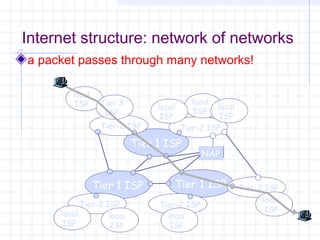
a packet passes through many networks!
local
ISP

Tier 3
ISP
Tier-2 ISP

local
ISP

local
ISP

local
ISP
Tier-2 ISP

Tier 1 ISP

Tier 1 ISP
Tier-2 ISP
local
local
ISP
ISP

NAP

Tier 1 ISP
Tier-2 ISP
local
ISP

Tier-2 ISP
local
ISP
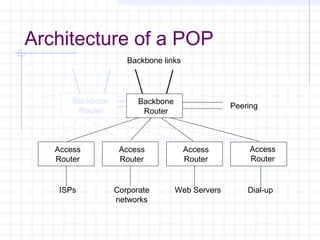
Architecture of a POP
Backbone links

Backbone
Router

Backbone
Router

Peering

Access
Router

Access
Router

Access
Router

Access
Router

ISPs

Corporate
networks

Web Servers

Dial-up
ISP Architecture
Access Network Architecture






Dial-up
ISDN
DSL
Dedicated Leased lines
Frame Relay Service
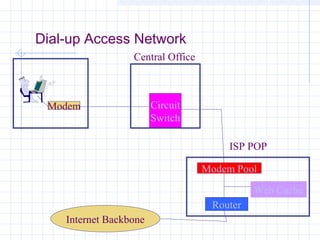
Dial-up Access Network
Central Office

Modem

Circuit
Switch
ISP POP
Modem Pool
Web Cache
Router

Internet Backbone
ISDN
ISDN service access links
terminate at the ISP POP
Digital signal. Due to signal
strength limitations, ISDN
subscribers must be within 18000
feet of the CO
At the customers end, an ISDN
adapter card is required.
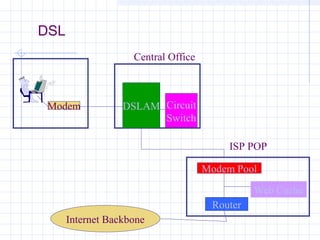
DSL
Central Office

Modem

DSLAM Circuit
Switch
ISP POP
Modem Pool
Web Cache
Router

Internet Backbone
DSL Access
DSL typically provisioned at 1.5Mbps
from ISP to customer and at 128kbs in
the reverse direction.
DSL Access Multiplexer (DSLAM) at
CO terminates DSL signals from
hundreds of customers.
The IP data is multiplexed into a single
ATM connection by DSLAM and
forwarded to the ISP POP
Dedicated Access
Leased lines from 56Kbs to
155Mbps.
No multiplexing of other customer’s
traffic. Can lead to higher
operational cost.
Lines terminate at routers in the
POP.
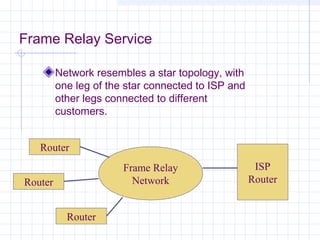
Frame Relay Service
Network resembles a star topology, with
one leg of the star connected to ISP and
other legs connected to different
customers.
Router
Frame Relay
Network

Router
Router

ISP
Router
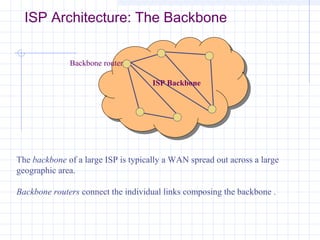
ISP Architecture: The Backbone
Backbone router
ISP Backbone

The backbone of a large ISP is typically a WAN spread out across a large
geographic area.
Backbone routers connect the individual links composing the backbone .
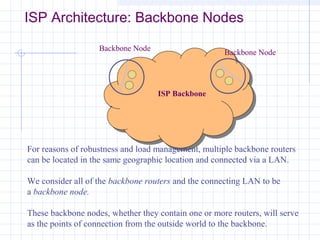
ISP Architecture: Backbone Nodes
Backbone Node

Backbone Node

ISP Backbone

For reasons of robustness and load management, multiple backbone routers
can be located in the same geographic location and connected via a LAN.
We consider all of the backbone routers and the connecting LAN to be
a backbone node.
These backbone nodes, whether they contain one or more routers, will serve
as the points of connection from the outside world to the backbone.
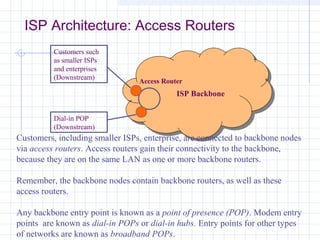
ISP Architecture: Access Routers
Customers such
as smaller ISPs
and enterprises
(Downstream)

Access Router

ISP Backbone
Dial-in POP
(Downstream)

Customers, including smaller ISPs, enterprise, are connected to backbone nodes
via access routers. Access routers gain their connectivity to the backbone,
because they are on the same LAN as one or more backbone routers.
Remember, the backbone nodes contain backbone routers, as well as these
access routers.
Any backbone entry point is known as a point of presence (POP). Modem entry
points are known as dial-in POPs or dial-in hubs. Entry points for other types
of networks are known as broadband POPs.
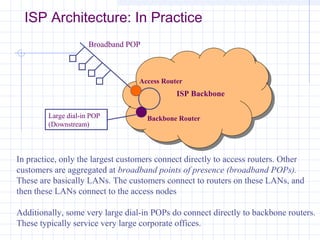
ISP Architecture: In Practice
Broadband POP

Access Router

ISP Backbone
Large dial-in POP
(Downstream)

Backbone Router

In practice, only the largest customers connect directly to access routers. Other
customers are aggregated at broadband points of presence (broadband POPs).
These are basically LANs. The customers connect to routers on these LANs, and
then these LANs connect to the access nodes
Additionally, some very large dial-in POPs do connect directly to backbone routers.
These typically service very large corporate offices.
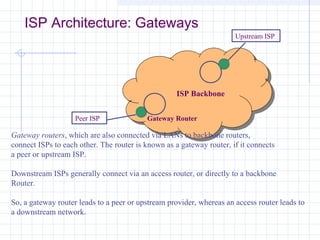
ISP Architecture: Gateways
Upstream ISP

ISP Backbone
Peer ISP

Gateway Router

Gateway routers, which are also connected via LANs to backbone routers,
connect ISPs to each other. The router is known as a gateway router, if it connects
a peer or upstream ISP.
Downstream ISPs generally connect via an access router, or directly to a backbone
Router.
So, a gateway router leads to a peer or upstream provider, whereas an access router leads to
a downstream network.
Measuring ISP Topologies with Rocketfuel[8]:
 Rocketfule – internet topology mapping engine
 The goal is to obtain realistic, router-level maps of ISP networks.
 Important influence on:
- The dynamics of routing protocols
- The scalability of multicast
- The efficacy of proposals for denial-of-service tracing and
response
- Other aspects of protocol performance (Internet path
selection)
 Real topologies are not publicly available
- Confidential
Mapping techniques
Three categories of mapping
techniques:


Selecting Measurements
 Directed probing
 Path reduction



Alias Resolution
 IP identifier



Router identification and Annotation
Selecting Measurements
Directed probing


To employ BGP tables to identify relevant
traceroutes and prune the remainder

Path reduction


To identify redundant traceroutes
 Only one traceroutes needs to be taken when

two traceroutes enter and leave the ISP
network at the same point
Alias resolution
Mercator method


Sending traceroute-like probe(to a highnumbered UDP port but with a TTL of 255)
directly to the potentially aliased IP
address
 Requirement: routers need to be configured to

send the “UDP port unreachable” response
with the address of the outgoing interface as
the source address: Two aliases should
respond with the same source
Alias method
Proposed methods by Spring etc.



Mercator’s IP address-based method
Comparing IP identifier field of the
responses
IP identifier hints
IP identifier helps to identify a packet for
reassembly after fragmentation
IP identifier is commonly implemented
using a counter that is incremented
after sending a packet
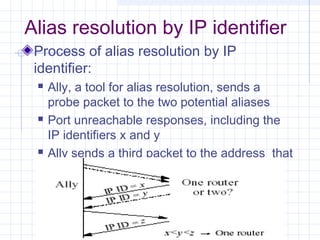
Alias resolution by IP identifier
Process of alias resolution by IP
identifier:






Ally, a tool for alias resolution, sends a
probe packet to the two potential aliases
Port unreachable responses, including the
IP identifiers x and y
Ally sends a third packet to the address that
responded first
Router Identification &
Annotation
Using DNS to determine routers owned
by mapped ISP, their geographical
location and role in the topology
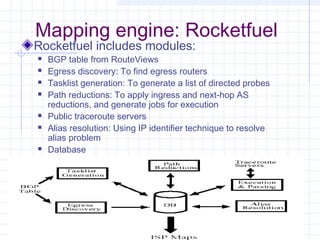
Mapping engine: Rocketfuel

Rocketfuel includes modules:










BGP table from RouteViews
Egress discovery: To find egress routers
Tasklist generation: To generate a list of directed probes
Path reductions: To apply ingress and next-hop AS
reductions, and generate jobs for execution
Public traceroute servers
Alias resolution: Using IP identifier technique to resolve
alias problem
Database
References:
[1] Kenneth Calvert, Matthew Doar, Ellen Zegura, “Modeling Internet
Topology”.
[2]. Michalis Faloudsos, Petros Faloudsos, Christos Faloudsos, “On
Power-law Relationships of the Internet Topology”
[3]. Lada A. Adamic,1, Rajan M. Lukose,1, Amit R. Puniyani,2, and
Bernardo A. Huberman1,” Search in power-law networks”.
[4]. L. A. N. Amaral, A. Scala, M. Barthélémy, & H. E. Stanley, 1997,
“Classes of small-world networks.”
http://polymer.bu.edu/~amaral/Content_network.html
[5]. Ellen Zegura, Kenneth Calvert, “How to model an Internetwork”
[6]. Stefan Bornholdt, Holger Ebel, “World Wide Web scaling
exponent from Simon’s 1955 model”
[7]. S. Halabi and D. McPherson, Internet Routing Architectures, 2nd
ed., Cisco Press, Indianapolis, 2000.
[8]. Neil Spring Ratul Mahajan David Wetherall, Measuring ISP
Topologies with Rocketfuel

Topology ppt

  • 1.
  • 2.
    Outline:  Why NetworkTopology is Important ?  Modeling Internet Topology  Complex Networks  Scale-free Networks  Power-laws of the Web  Search in power-law networks: GNUTELLA, a P2P example.
  • 3.
    Why Topology isImportant ? • Design Efficient Protocols • Solve Internetworking Problems: - routing - resource reservation - administration • Create Accurate Model for Simulation • Derive Estimates for Topological Parameters • Study Fault Tolerance and Anti-Attack Properties
  • 4.
    Modeling Internet Topology[1]:  Graph representation  Router-level modeling - vertices are routers -edges are one-hop IP connectivity  Domain- (AS-) level model (high degree of abstraction) - vertices are domains (ASes) - edges are peering relationships  Nodes can be assigned numbers rep. e.g. buffer capacity Edges migth have weights rep. e.g. – prop. delay, bandwidth capacity.
  • 5.
    Modeling Internet Topology[1]: transit domains domains/autonomous systems exchange point border routers peering hosts/endsystems routers stub domains access networks lowly worm
  • 6.
    Barabasi Albert Model(BA Model):  Basis for most current topology generators  Very simplistic model Network evolves in size over time. Preferential Connectivity Probability that a newly added node will attach to node ‘i’ ki Πi ) = (k Σ j jk  Many extensions.
  • 7.
    Waxman Model:  Routerlevel model  Nodes placed at random in 2D space with dimension L  Probability of edge (u,v): a*e(-d / (bL) ), where d is Euclidean distance (u,v), a and b are constants  Models locality - no sense of backbone or hierarchy - does not guarantee connected network - as #nodes ↑ the #links ↑ proportionally u d(u,v) v
  • 8.
    Transit-Stub Model: Router levelmodel Transit domains  placed in 2D space  populated with routers  connected to each other Stub domains  placed in 2D space  populated with routers  connected to transit domains Models hierarchy Edge count, guaranteed connectivity
  • 9.
    Transit-Stub Model:  Noconcept of a ‘host’ – all nodes are routers.  Two level hierarchy  First generate a number of transit domains, then generate a set of stub networks.  Given average edge-count, produce a random graph, making sure that it is connected.
  • 10.
    Inet: Generate degree sequence Buildspanning tree over nodes with degree larger than 1, using preferential connectivity  randomly select node u not in tree  join u to existing node v with probability d(v)/Σd(w) Connect degree 1 nodes using preferential connectivity Add remaining edges using preferential connectivity
  • 11.
    BRITE: Generate small backbone,with nodes placed:  randomly or  concentrated (skewed) Add nodes one at a time (incremental growth) New node has constant # of edges connected using:  preferential connectivity and/or  locality
  • 12.
    Complex Networks: Two limiting-casetopologies have been extensively considered in the literature [4],[5].:  regular network (lattice), the chosen topology of innumerable physical models such as the Ising model or percolation.  random graph, studied in mathematics and used both in natural and social sciences. Properties studied in detail by Pal Erdos.  Most of Erdos’ work concentrated on the case in which the number of vertices is kept constant but the total number of links between vertices increases: the Erdös-Rényi result states that for many important quantities there is a percolation-like transition at a specific value of the average number of links per vertex.
  • 13.
    Complex Networks:  randomnetworks are used in:  Physics: in studies of dynamical problems, spin models and thermodynamics, random walks, and quantum chaos.  Economics and social sciences: to model interacting agents.
  • 14.
    Complex Networks:  Incontrast to these two limiting topologies, empirical evidence suggests that many biological, technological or social networks appear to be somewhere in between these extremes.  many real networks seem to share with regular networks the concept of neighborhood, which means that if vertices i and j are neighbors then they will have many common neighbors --- which is obviously not true for a random network.  On the other hand, studies on epidemics show that it can take only a few ``steps'' on the network to reach a given vertex from any other vertex. This is the foremost property of random networks, which is not fulfilled by regular networks.
  • 15.
  • 16.
    Complex Networks:  TheWatts-Strogatz model [5]. :  To bridge the two limiting cases, Watts and Strogatz [Nature 393, 440 (1998)] have introduced a new type of network which is obtained by randomizing a fraction p of the links of the regular network.  Initial structure (p=0) is the one-dimensional regular network where each vertex is connected to its z nearest neighbors.  For 0 < p < 1, we denote these networks disordered.  for the case p=1, we have a completely random network.
  • 17.
    Complex Networks:  Wattsand Strogatz report that for a small value of the parameter p, there is an onset of “small-world” behavior.  It is characterized by the fact that the distance between any two vertices is of the order of that for a random network and, at the same time, the concept of neighborhood is preserved.  The effect of a change in p is extremely nonlinear, where a very small change in the connectivity of the network leads to a dramatic change in the distance between different pairs of vertices.
  • 18.
    Complex Networks:  Thescientific question we are trying to answer is: Does the onset of the small-world behavior occurs at a given value of p or does it occur for a value of the system size n which depends on p?  To investigate this question, we need to look at the behavior of the system as a function of p for different values of n.
  • 19.
  • 20.
    Complex Networks:  Theappearance of the small-world behavior is not a phasetransition but a crossover phenomena.  The average distance l is:                           l (n,p) ~ n* F ( n / n* )  where: F(u << 1) ~ u, and F(u >> 1) ~ln u, and n* is a function of p.  When the average number of rewired links, pnz/2, is much less than one, the network should be in the large-world regime. On the other hand, when pnz/2 >> 1, the network should be a small-world.
  • 21.
    Scale-free networks:  Itwas proposed by Barabási and Albert that real-world networks in general are scale-free networks.   Scale-free networks have a distribution of connectivities that  decays with a power-law tail.   Scale-free networks emerge in the context of a growing network in which new vertices connect preferentially to the more highly connected vertices in the network. Scale free networks are also small-world networks because (i) they have clustering coefficients much larger than random networks, and (ii) their diameter increases logarithmically with the number of vertices n.
  • 22.
    What are PowerLaws ?  Distribution that fits : P(k ) ∝ k −γ  Characteristic property of “Scale free networks” Occur very often in Complex Systems literature. Many complicated real world networks obey power laws
  • 23.
    Implications of PowerLaws:  Majority of nodes have small connectivity.  Few nodes have very large connectivity.  Good resistance to random failure.  Small resistance to planned attack.  Could imply existence of some hierarchy (all real world power law networks support this).  However, it is not clear whether Power Law  Hierarchy
  • 24.
    Origin of PowerLaw: Power laws are an observed (empirical) phenomenon. The mechanisms that produce these can only be guessed at (for now!) Very typical in self organizing systems and chaotic systems.
  • 25.
    Scale-free networks:  Scale-freenetworks: (a) the neuronal network of the worm C. elegans. (b) world-wide web. (c) the network of citations of scientific papers.
  • 26.
    Scale-free networks:  broad-scale networks: ortruncated scale-free networks, characterized by a connectivity distribution that has a powerlaw regime followed by a sharp cut-off, like an exponential or Gaussian decay of the tail.  single-scale networks: characterized by a connectivity distribution with a fast decaying tail, such as exponential or Gaussian Aging of the vertices: The vertex is still part of the network and contributing to network statistics, but it no longer receives links. The aging of the vertices thus limits the preferential attachment preventing a scale-free distribution of connectivities.  Cost of adding links to the vertices or the limited capacity of a vertex: physical costs of adding links and limited capacity of a vertex will limit the number of possible links attaching to a given vertex.
  • 27.
    Power-laws of theWeb [2].: •How many links on a page (outdegree)? • How many links to a page (indegree)? •Probability that a random page has k other pages pointing to it is ~k -2.1 (Power law) • Probability that a random page points to k other pages is ~k -2.7  (Power law)
  • 28.
  • 29.
  • 30.
    Search in power-lawnetworks: GNUTELLA [3].  Most of the P2P networks display a power-law distribution in their node degree. This distribution reflects the existence of a few nodes with very high degree and many with low degree.  In P2P networks, the name of the target file may be known, but due to the network’s ad hoc nature, the node holding the file may not be known until a real-time search is performed.  A simple strategy to locate files, implemented by NAPSTER, is to use a central server that contains an index of all the files every node is sharing as they join the network.  GNUTELLA and FREENET do not use a central server.
  • 31.
    Search in power-lawnetworks: GNUTELLA [3].  GNUTELLA is a peer-to-peer file-sharing system that treats all client nodes as functionally equivalent and lacks a central server that can store file location information. This is advantageous because it presents no central point of failure.  The obvious disadvantage is that the location of files is unknown. When a user wants to download a file, he sends a query to all the nodes within a neighborhood of size ttl, the time to live assigned to the query. Every node passes on the query to all of its neighbors and decrements the ttl by one. In this way, all nodes within a given radius of the requesting node will be queried for the file, and those who have matching files will send back positive answers.
  • 32.
    Search in power-lawnetworks: GNUTELLA [3].  This broadcast method will find the target file quickly, given that it is located within a radius of ttl. However, broadcasting is extremely costly in terms of bandwidth.  Such a search strategy does not scale well. As query traffic increases linearly with the size of GNUTELLA graph, nodes become overloaded.
  • 33.
    Search in power-lawnetworks: GNUTELLA [3].  Typically, a GNUTELLA client wishing to join the network must find the IP address of an initial node to connect to. Currently, ad hoc lists of ‘‘good’’ GNUTELLA clients exist.  It is reasonable to suppose that this ad hoc method of growth would bias new nodes to connect preferentially to nodes that are already fairly well connected, since these nodes are more likely to be ‘‘well known.’’  Based on models of graph growth where the ‘‘rich get richer,’’ the power-law connectivity of ad hoc peer-to-peer networks may be a fairly general topological feature.
  • 34.
    Search in power-lawnetworks: GNUTELLA [3].  By passing the query to every single node in the network, the GNUTELLA algorithm fails to take advantage of the connectivity distribution [3].  To take advantage of the power-law distribution, we can modify each node to keep lists of files stored in first and second neighbor.  Instead of passing the query to every node, now we can pass it only to the nodes with highest connectivity.  High degree nodes are presumably high bandwidth node that can handle the query traffic.
  • 35.
    Outline: Internet Structure &Organization  InternetHierarchical Structure  ISPs, interconnection and organization [ref. 7].  POP Architecture and Load Balancing  ISP Architecture [ref. 7]. in detail  Topology Mapping Tool: Rocketfuel[ref. 8]  Discussion ELEG 667-013 Spring 2003
  • 36.
  • 37.
    Basic Architecture: NAPsand national ISPs The Internet has a hierarchical structure. At the highest level are large national Internet Service Providers that interconnect through Network Access Points (NAPs). There are about a dozen NAPs in the U.S., run by common carriers such as Sprint and Ameritech, and many more around the world. Regional ISPs interconnect with national ISPs which provide services to local ISPs who, in turn, sell access to individuals.
  • 38.
    Basic Architecture: MAEsand local ISPs As the number of ISPs has grown, a new type of network access point, called a metropolitan area exchange (MAE) has arisen. There are about 50 such MAE around the U.S. today. Sometimes large regional and local ISPs also have access directly to NAPs.
  • 39.
    Internet Packet ExchangeCharges ISP at the same level usually do not charge each other for exchanging messages. This is called peering. Higher level ISPs, however, charge lower level ones (national ISPs charge regional ISPs which in turn charge local ISPs) for carrying Internet traffic. Local ISPs, of course, charge individuals and corporate users for access.
  • 40.
    Connecting to anISP ISPs provide access to the Internet through a Point of Presence (POP). Individual users access the POP through a dial-up line using the PPP protocol. The call connects the user to the ISP’s modem pool, after which a remote access server (RAS) checks the userid and password. Once logged in, the user can send TCP/IP/[PPP] packets over the telephone line which are then sent out over the Internet through the ISP’s POP.
  • 41.
    Connecting to anISP (contd.) Corporate users might access the POP using a T-1, T-3 or ATM OC-3 connections provided by a common carrier. T-1 and T-3 lines connect to the ISP POP’s CSU/DSU device. Channel Service Unit/Data Service Unit. The CSU is a device that connects a terminal to a digital line. The DSU is a device that performs protective and diagnostic functions for a telecommunications line. . Typically, the two devices are packaged as a single unit. You can think of it as a very high-powered and expensive modem. Such a device is required for both ends of a T-1 or T-3 connection, and the units at both ends must be set to the same communications standard.
  • 42.
    Inside an ISPPoint of Presence Individual Dial-up Customers ISP POP ISP Point-of Presence Modem Pool Corporate T1 Customer Corporate T3 Customer Corporate OC-3 Customer ISP POP T1 CSU/DSU Layer-2 Switch ATM Switch ISP POP T3 CSU/DSU ATM Switch Remote Access Server NAP/MAE
  • 43.
    Internet Organization CN NAP POP ISP CN CN ISP CN BSP POP POP POP POP BSP NAP CN NAP POP CN POP CN ISP CN BSP ISP =Internet Service Provider BSP = Backbone Service Provider NAP = Network Access Point POP = Point of Presence CN = Customer Network
  • 44.
  • 45.
    NAP Architecture ISP ISP ISP Backbone Operator Routers Route Server High-Speed LAN(FDDI, ATM, GigE) Routers Backbone Operator ISP Backbone NAP Operator
  • 46.
    Internet structure: networkof networks roughly hierarchical at center: “tier-1” ISPs (e.g., UUNet, BBN/Genuity, Sprint, AT&T), national/international coverage  treat each other as equals Tier-1 providers interconnect (peer) privately Tier 1 ISP Tier 1 ISP NAP Tier 1 ISP Tier-1 providers also interconnect at public network access points (NAPs)
  • 47.
    Tier-1 ISP: e.g.,Sprint Sprint US backbone network
  • 48.
    Tier-1 IP backbone POP Thebackbone is a set of POPs (usually one per city) Point-of-Presence (POP) : A collection of routers and switches housed in a single location
  • 49.
    Internet structure: networkof networks “Tier-2” ISPs: smaller (often regional) ISPs  Connect to one or more tier-1 ISPs, possibly other tier-2 ISPs Tier-2 ISP pays tier-1 ISP for connectivity to rest of Internet  tier-2 ISP is customer of tier-1 provider Tier-2 ISP Tier-2 ISP Tier 1 ISP Tier 1 ISP Tier-2 ISP NAP Tier 1 ISP Tier-2 ISP Tier-2 ISPs also peer privately with each other, interconnect at NAP Tier-2 ISP
  • 50.
    Internet structure: networkof networks “Tier-3” ISPs and local ISPs  last hop (“access”) network (closest to end systems) local ISP Local and tier3 ISPs are customers of higher tier ISPs connecting them to rest of Internet Tier 3 ISP Tier-2 ISP local ISP local ISP local ISP Tier-2 ISP Tier 1 ISP Tier 1 ISP Tier-2 ISP local local ISP ISP NAP Tier 1 ISP Tier-2 ISP local ISP Tier-2 ISP local ISP
  • 51.
    Internet structure: networkof networks a packet passes through many networks! local ISP Tier 3 ISP Tier-2 ISP local ISP local ISP local ISP Tier-2 ISP Tier 1 ISP Tier 1 ISP Tier-2 ISP local local ISP ISP NAP Tier 1 ISP Tier-2 ISP local ISP Tier-2 ISP local ISP
  • 52.
    Architecture of aPOP Backbone links Backbone Router Backbone Router Peering Access Router Access Router Access Router Access Router ISPs Corporate networks Web Servers Dial-up
  • 53.
    ISP Architecture Access NetworkArchitecture      Dial-up ISDN DSL Dedicated Leased lines Frame Relay Service
  • 54.
    Dial-up Access Network CentralOffice Modem Circuit Switch ISP POP Modem Pool Web Cache Router Internet Backbone
  • 55.
    ISDN ISDN service accesslinks terminate at the ISP POP Digital signal. Due to signal strength limitations, ISDN subscribers must be within 18000 feet of the CO At the customers end, an ISDN adapter card is required.
  • 56.
    DSL Central Office Modem DSLAM Circuit Switch ISPPOP Modem Pool Web Cache Router Internet Backbone
  • 57.
    DSL Access DSL typicallyprovisioned at 1.5Mbps from ISP to customer and at 128kbs in the reverse direction. DSL Access Multiplexer (DSLAM) at CO terminates DSL signals from hundreds of customers. The IP data is multiplexed into a single ATM connection by DSLAM and forwarded to the ISP POP
  • 58.
    Dedicated Access Leased linesfrom 56Kbs to 155Mbps. No multiplexing of other customer’s traffic. Can lead to higher operational cost. Lines terminate at routers in the POP.
  • 59.
    Frame Relay Service Networkresembles a star topology, with one leg of the star connected to ISP and other legs connected to different customers. Router Frame Relay Network Router Router ISP Router
  • 60.
    ISP Architecture: TheBackbone Backbone router ISP Backbone The backbone of a large ISP is typically a WAN spread out across a large geographic area. Backbone routers connect the individual links composing the backbone .
  • 61.
    ISP Architecture: BackboneNodes Backbone Node Backbone Node ISP Backbone For reasons of robustness and load management, multiple backbone routers can be located in the same geographic location and connected via a LAN. We consider all of the backbone routers and the connecting LAN to be a backbone node. These backbone nodes, whether they contain one or more routers, will serve as the points of connection from the outside world to the backbone.
  • 62.
    ISP Architecture: AccessRouters Customers such as smaller ISPs and enterprises (Downstream) Access Router ISP Backbone Dial-in POP (Downstream) Customers, including smaller ISPs, enterprise, are connected to backbone nodes via access routers. Access routers gain their connectivity to the backbone, because they are on the same LAN as one or more backbone routers. Remember, the backbone nodes contain backbone routers, as well as these access routers. Any backbone entry point is known as a point of presence (POP). Modem entry points are known as dial-in POPs or dial-in hubs. Entry points for other types of networks are known as broadband POPs.
  • 63.
    ISP Architecture: InPractice Broadband POP Access Router ISP Backbone Large dial-in POP (Downstream) Backbone Router In practice, only the largest customers connect directly to access routers. Other customers are aggregated at broadband points of presence (broadband POPs). These are basically LANs. The customers connect to routers on these LANs, and then these LANs connect to the access nodes Additionally, some very large dial-in POPs do connect directly to backbone routers. These typically service very large corporate offices.
  • 64.
    ISP Architecture: Gateways UpstreamISP ISP Backbone Peer ISP Gateway Router Gateway routers, which are also connected via LANs to backbone routers, connect ISPs to each other. The router is known as a gateway router, if it connects a peer or upstream ISP. Downstream ISPs generally connect via an access router, or directly to a backbone Router. So, a gateway router leads to a peer or upstream provider, whereas an access router leads to a downstream network.
  • 65.
    Measuring ISP Topologieswith Rocketfuel[8]:  Rocketfule – internet topology mapping engine  The goal is to obtain realistic, router-level maps of ISP networks.  Important influence on: - The dynamics of routing protocols - The scalability of multicast - The efficacy of proposals for denial-of-service tracing and response - Other aspects of protocol performance (Internet path selection)  Real topologies are not publicly available - Confidential
  • 66.
    Mapping techniques Three categoriesof mapping techniques:  Selecting Measurements  Directed probing  Path reduction  Alias Resolution  IP identifier  Router identification and Annotation
  • 67.
    Selecting Measurements Directed probing  Toemploy BGP tables to identify relevant traceroutes and prune the remainder Path reduction  To identify redundant traceroutes  Only one traceroutes needs to be taken when two traceroutes enter and leave the ISP network at the same point
  • 68.
    Alias resolution Mercator method  Sendingtraceroute-like probe(to a highnumbered UDP port but with a TTL of 255) directly to the potentially aliased IP address  Requirement: routers need to be configured to send the “UDP port unreachable” response with the address of the outgoing interface as the source address: Two aliases should respond with the same source
  • 69.
    Alias method Proposed methodsby Spring etc.   Mercator’s IP address-based method Comparing IP identifier field of the responses
  • 70.
    IP identifier hints IPidentifier helps to identify a packet for reassembly after fragmentation IP identifier is commonly implemented using a counter that is incremented after sending a packet
  • 71.
    Alias resolution byIP identifier Process of alias resolution by IP identifier:    Ally, a tool for alias resolution, sends a probe packet to the two potential aliases Port unreachable responses, including the IP identifiers x and y Ally sends a third packet to the address that responded first
  • 72.
    Router Identification & Annotation UsingDNS to determine routers owned by mapped ISP, their geographical location and role in the topology
  • 73.
    Mapping engine: Rocketfuel Rocketfuelincludes modules:        BGP table from RouteViews Egress discovery: To find egress routers Tasklist generation: To generate a list of directed probes Path reductions: To apply ingress and next-hop AS reductions, and generate jobs for execution Public traceroute servers Alias resolution: Using IP identifier technique to resolve alias problem Database
  • 74.
    References: [1] Kenneth Calvert,Matthew Doar, Ellen Zegura, “Modeling Internet Topology”. [2]. Michalis Faloudsos, Petros Faloudsos, Christos Faloudsos, “On Power-law Relationships of the Internet Topology” [3]. Lada A. Adamic,1, Rajan M. Lukose,1, Amit R. Puniyani,2, and Bernardo A. Huberman1,” Search in power-law networks”. [4]. L. A. N. Amaral, A. Scala, M. Barthélémy, & H. E. Stanley, 1997, “Classes of small-world networks.” http://polymer.bu.edu/~amaral/Content_network.html [5]. Ellen Zegura, Kenneth Calvert, “How to model an Internetwork” [6]. Stefan Bornholdt, Holger Ebel, “World Wide Web scaling exponent from Simon’s 1955 model” [7]. S. Halabi and D. McPherson, Internet Routing Architectures, 2nd ed., Cisco Press, Indianapolis, 2000. [8]. Neil Spring Ratul Mahajan David Wetherall, Measuring ISP Topologies with Rocketfuel

Editor's Notes