IX. Error andAttack Tolerance 86
A. Numerical results 86
1. Random network, random node removal 87
2. Scale-free network, random node removal 87
3. Preferential node removal 87
B. Error tolerance: analytical results 88
C. Attack tolerance: Analytical results 89
D. The robustness of real networks 90
1. Communication networks 90
2. Cellular networks 91
3. Ecological networks 91
X. Outlook 91
A. Dynamical processes on networks 91
B. Directed networks 92
C. Weighted networks, optimization, allometric
scaling 92
D. Internet and World Wide Web 93
E. General questions 93
F. Conclusions 94
Acknowledgments 94
References 94
I. INTRODUCTION
Complex weblike structures describe a wide variety of
systems of high technological and intellectual impor-
tance. For example, the cell is best described as a com-
plex network of chemicals connected by chemical reac-
tions; the Internet is a complex network of routers and
computers linked by various physical or wireless links;
fads and ideas spread on the social network, whose
nodes are human beings and whose edges represent
various social relationships; the World Wide Web is an
enormous virtual network of Web pages connected by
hyperlinks. These systems represent just a few of the
many examples that have recently prompted the scien-
tific community to investigate the mechanisms that de-
termine the topology of complex networks. The desire
to understand such interwoven systems has encountered
significant challenges as well. Physics, a major benefi-
ciary of reductionism, has developed an arsenal of suc-
cessful tools for predicting the behavior of a system as a
whole from the properties of its constituents. We now
understand how magnetism emerges from the collective
behavior of millions of spins, or how quantum particles
lead to such spectacular phenomena as Bose-Einstein
condensation or superfluidity. The success of these mod-
eling efforts is based on the simplicity of the interactions
between the elements: there is no ambiguity as to what
interacts with what, and the interaction strength is
uniquely determined by the physical distance. We are at
a loss, however, to describe systems for which physical
distance is irrelevant or for which there is ambiguity as
to whether two components interact. While for many
complex systems with nontrivial network topology such
ambiguity is naturally present, in the past few years we
have increasingly recognized that the tools of statistical
mechanics offer an ideal framework for describing these
interwoven systems as well. These developments have
introduced new and challenging problems for statistical
physics and unexpected links to major topics in
condensed-matter physics, ranging from percolation to
Bose-Einstein condensation.
Traditionally the study of complex networks has been
the territory of graph theory. While graph theory ini-
tially focused on regular graphs, since the 1950s large-
scale networks with no apparent design principles have
been described as random graphs, proposed as the sim-
plest and most straightforward realization of a complex
network. Random graphs were first studied by the Hun-
garian mathematicians Paul Erdős and Alfréd Rényi.
According to the Erdős-Rényi model, we start with N
nodes and connect every pair of nodes with probability
p, creating a graph with approximately pN(N21)/2
edges distributed randomly. This model has guided our
thinking about complex networks for decades since its
introduction. But the growing interest in complex sys-
tems has prompted many scientists to reconsider this
modeling paradigm and ask a simple question: are the
real networks behind such diverse complex systems as
the cell or the Internet fundamentally random? Our in-
tuition clearly indicates that complex systems must dis-
play some organizing principles, which should be at
some level encoded in their topology. But if the topology
of these networks indeed deviates from a random graph,
we need to develop tools and measurements to capture
in quantitative terms the underlying organizing prin-
ciples.
In the past few years we have witnessed dramatic ad-
vances in this direction, prompted by several parallel de-
velopments. First, the computerization of data acquisi-
tion in all fields led to the emergence of large databases
on the topology of various real networks. Second, the
increased computing power allowed us to investigate
networks containing millions of nodes, exploring ques-
tions that could not be addressed before. Third, the slow
but noticeable breakdown of boundaries between disci-
plines offered researchers access to diverse databases,
allowing them to uncover the generic properties of com-
plex networks. Finally, there is an increasingly voiced
need to move beyond reductionist approaches and try to
understand the behavior of the system as a whole. Along
this route, understanding the topology of the interac-
tions between the components, i.e., networks, is un-
avoidable.
Motivated by these converging developments and cir-
cumstances, many new concepts and measures have
been proposed and investigated in depth in the past few
years. However, three concepts occupy a prominent
place in contemporary thinking about complex net-
works. Here we define and briefly discuss them, a discus-
sion to be expanded in the coming sections.
Small worlds: The small-world concept in simple
terms describes the fact that despite their often large
size, in most networks there is a relatively short path
between any two nodes. The distance between two
nodes is defined as the number of edges along the short-
est path connecting them. The most popular manifesta-
tion of small worlds is the ‘‘six degrees of separation’’
concept, uncovered by the social psychologist Stanley
Milgram (1967), who concluded that there was a path of
48 R. Albert and A.-L. Barabási: Statistical mechanics of complex networks
Rev. Mod. Phys., Vol. 74, No. 1, January 2002
3.
acquaintances with atypical length of about six between
most pairs of people in the United States (Kochen,
1989). The small-world property appears to characterize
most complex networks: the actors in Hollywood are on
average within three co-stars from each other, or the
chemicals in a cell are typically separated by three reac-
tions. The small-world concept, while intriguing, is not
an indication of a particular organizing principle. In-
deed, as Erdős and Rényi have demonstrated, the typi-
cal distance between any two nodes in a random graph
scales as the logarithm of the number of nodes. Thus
random graphs are small worlds as well.
Clustering: A common property of social networks is
that cliques form, representing circles of friends or ac-
quaintances in which every member knows every other
member. This inherent tendency to cluster is quantified
by the clustering coefficient (Watts and Strogatz, 1998),
a concept that has its roots in sociology, appearing under
the name ‘‘fraction of transitive triples’’ (Wassermann
and Faust, 1994). Let us focus first on a selected node i
in the network, having ki edges which connect it to ki
other nodes. If the nearest neighbors of the original
node were part of a clique, there would be ki(ki21)/2
edges between them. The ratio between the number Ei
of edges that actually exist between these ki nodes and
the total number ki(ki21)/2 gives the value of the clus-
tering coefficient of node i,
Ci5
2Ei
ki~ki21!
. (1)
The clustering coefficient of the whole network is the
average of all individual Ci’s. An alternative definition
of C that is often used in the literature is discussed in
Sec. VI.B.2 (Barrat and Weigt, 2000; Newman, Strogatz,
and Watts, 2000).
In a random graph, since the edges are distributed
randomly, the clustering coefficient is C5p (Sec. III.F).
However, in most, if not all, real networks the clustering
coefficient is typically much larger than it is in a compa-
rable random network (i.e., having the same number of
nodes and edges as the real network).
Degree distribution: Not all nodes in a network have
the same number of edges (same node degree). The
spread in the node degrees is characterized by a distri-
bution function P(k), which gives the probability that a
randomly selected node has exactly k edges. Since in a
random graph the edges are placed randomly, the major-
ity of nodes have approximately the same degree, close
to the average degree ^k& of the network. The degree
distribution of a random graph is a Poisson distribution
with a peak at P(^k&). One of the most interesting de-
velopments in our understanding of complex networks
was the discovery that for most large networks the de-
gree distribution significantly deviates from a Poisson
distribution. In particular, for a large number of net-
works, including the World Wide Web (Albert, Jeong,
and Barabási, 1999), the Internet (Faloutsos et al., 1999),
or metabolic networks (Jeong et al., 2000), the degree
distribution has a power-law tail,
P~k!;k2g
. (2)
Such networks are called scale free (Barabási and Al-
bert, 1999). While some networks display an exponential
tail, often the functional form of P(k) still deviates sig-
nificantly from the Poisson distribution expected for a
random graph.
These discoveries have initiated a revival of network
modeling in the past few years, resulting in the introduc-
tion and study of three main classes of modeling para-
digms. First, random graphs, which are variants of the
Erdős-Rényi model, are still widely used in many fields
and serve as a benchmark for many modeling and em-
pirical studies. Second, motivated by clustering, a class
of models, collectively called small-world models, has
been proposed. These models interpolate between the
highly clustered regular lattices and random graphs. Fi-
nally, the discovery of the power-law degree distribution
has led to the construction of various scale-free models
that, by focusing on the network dynamics, aim to offer
a universal theory of network evolution.
The purpose of this article is to review each of these
modeling efforts, focusing on the statistical mechanics of
complex networks. Our main goal is to present the the-
oretical developments in parallel with the empirical data
that initiated and support the various models and theo-
retical tools. To achieve this, we start with a brief de-
scription of the real networks and databases that repre-
sent the testing ground for most current modeling
efforts.
II. THE TOPOLOGY OF REAL NETWORKS: EMPIRICAL
RESULTS
The study of most complex networks has been initi-
ated by a desire to understand various real systems,
ranging from communication networks to ecological
webs. Thus the databases available for study span sev-
eral disciplines. In this section we review briefly those
that have been studied by researchers aiming to uncover
the general features of complex networks. Beyond a de-
scription of the databases, we shall focus on three robust
measures of a network’s topology: average path length,
clustering coefficient, and degree distribution. Other
quantities, as discussed in the following sections, will
again be tested on these databases. The properties of the
investigated databases, as well as the obtained expo-
nents, are summarized in Tables I and II.
A. World Wide Web
The World Wide Web represents the largest network
for which topological information is currently available.
The nodes of the network are the documents (web
pages) and the edges are the hyperlinks (URL’s) that
point from one document to another (see Fig. 1). The
size of this network was close to one billion nodes at the
end of 1999 (Lawrence and Giles, 1998, 1999). The in-
terest in the World Wide Web as a network boomed
after it was discovered that the degree distribution of the
web pages follows a power law over several orders of
magnitude (Albert, Jeong, and Barabási, 1999; Kumar
49
R. Albert and A.-L. Barabási: Statistical mechanics of complex networks
Rev. Mod. Phys., Vol. 74, No. 1, January 2002
4.
et al., 1999).Since the edges of the World Wide Web are
directed, the network is characterized by two degree dis-
tributions: the distribution of outgoing edges, Pout(k),
signifies the probability that a document has k outgoing
hyperlinks, and the distribution of incoming edges,
Pin(k), is the probability that k hyperlinks point to a
certain document. Several studies have established that
both Pout(k) and Pin(k) have power-law tails:
Pout~k!;k2gout and Pin~k!;k2gin. (3)
Albert, Jeong, and Barabási (1999) have studied a
subset of the World Wide Web containing 325 729 nodes
and have found gout52.45 and gin52.1. Kumar et al.
(1999) used a 40-million-document crawl by Alexa Inc.,
obtaining gout52.38 and gin52.1 (see also Kleinberg
et al., 1999). A later survey of the World Wide Web to-
pology by Broder et al. (2000) used two 1999 Altavista
crawls containing in total 200 million documents, obtain-
ing gout52.72 and gin52.1 with scaling holding close to
five orders of magnitude (Fig. 2). Adamic and Huber-
man (2000) used a somewhat different representation of
the World Wide Web, with each node representing a
separate domain name and two nodes being connected if
any of the pages in one domain linked to any page in the
other. While this method lumped together pages that
were on the same domain, representing a nontrivial ag-
gregation of the nodes, the distribution of incoming
edges still followed a power law with gin
dom
51.94.
Note that gin is the same for all measurements at the
document level despite the two-years’ time delay be-
tween the first and last web crawl, during which the
World Wide Web had grown at least five times larger.
However, gout has a tendency to increase with the
sample size or time (see Table II).
Despite the large number of nodes, the World Wide
Web displays the small-world property. This was first re-
ported by Albert, Jeong, and Barabási (1999), who
found that the average path length for a sample of
325 729 nodes was 11.2 and predicted, using finite size
scaling, that for the full World Wide Web of 800 million
nodes that would be a path length of around 19. Subse-
quent measurements by Broder et al. (2000) found that
the average path length between nodes in a 50-million-
node sample of the World Wide Web is 16, in agreement
with the finite size prediction for a sample of this size.
Finally, the domain-level network displays an average
path length of 3.1 (Adamic, 1999).
The directed nature of the World Wide Web does not
allow us to measure the clustering coefficient using Eq.
(1). One way to avoid this difficulty is to make the net-
work undirected, making each edge bidirectional. This
was the path followed by Adamic (1999), who studied
the World Wide Web at the domain level using a 1997
Alexa crawl of 50 million web pages distributed among
259 794 sites. Adamic removed the nodes that had have
only one edge, focusing on a network of 153 127 sites.
While these modifications are expected to increase the
clustering coefficient somewhat, she found C50.1078,
orders of magnitude higher than Crand50.000 23 corre-
sponding to a random graph of the same size and aver-
age degree.
B. Internet
The Internet is a network of physical links between
computers and other telecommunication devices (Fig.
TABLE I. The general characteristics of several real networks. For each network we have indicated the number of nodes, the
average degree ^k&, the average path length l , and the clustering coefficient C. For a comparison we have included the average
path length l rand and clustering coefficient Crand of a random graph of the same size and average degree. The numbers in the last
column are keyed to the symbols in Figs. 8 and 9.
Network Size ^k& l l rand C Crand Reference Nr.
WWW, site level, undir. 153 127 35.21 3.1 3.35 0.1078 0.00023 Adamic, 1999 1
Internet, domain level 3015–6209 3.52–4.11 3.7–3.76 6.36–6.18 0.18–0.3 0.001 Yook et al., 2001a,
Pastor-Satorras et al., 2001
2
Movie actors 225 226 61 3.65 2.99 0.79 0.00027 Watts and Strogatz, 1998 3
LANL co-authorship 52 909 9.7 5.9 4.79 0.43 1.831024
Newman, 2001a, 2001b, 2001c 4
MEDLINE co-authorship 1 520 251 18.1 4.6 4.91 0.066 1.131025
Newman, 2001a, 2001b, 2001c 5
SPIRES co-authorship 56 627 173 4.0 2.12 0.726 0.003 Newman, 2001a, 2001b, 2001c 6
NCSTRL co-authorship 11 994 3.59 9.7 7.34 0.496 331024
Newman, 2001a, 2001b, 2001c 7
Math. co-authorship 70 975 3.9 9.5 8.2 0.59 5.431025
Barabási et al., 2001 8
Neurosci. co-authorship 209 293 11.5 6 5.01 0.76 5.531025
Barabási et al., 2001 9
E. coli, substrate graph 282 7.35 2.9 3.04 0.32 0.026 Wagner and Fell, 2000 10
E. coli, reaction graph 315 28.3 2.62 1.98 0.59 0.09 Wagner and Fell, 2000 11
Ythan estuary food web 134 8.7 2.43 2.26 0.22 0.06 Montoya and Solé, 2000 12
Silwood Park food web 154 4.75 3.40 3.23 0.15 0.03 Montoya and Solé, 2000 13
Words, co-occurrence 460.902 70.13 2.67 3.03 0.437 0.0001 Ferrer i Cancho and Solé, 2001 14
Words, synonyms 22 311 13.48 4.5 3.84 0.7 0.0006 Yook et al., 2001b 15
Power grid 4941 2.67 18.7 12.4 0.08 0.005 Watts and Strogatz, 1998 16
C. Elegans 282 14 2.65 2.25 0.28 0.05 Watts and Strogatz, 1998 17
50 R. Albert and A.-L. Barabási: Statistical mechanics of complex networks
Rev. Mod. Phys., Vol. 74, No. 1, January 2002
5.
1). The topologyof the Internet is studied at two differ-
ent levels. At the router level, the nodes are the routers,
and edges are the physical connections between them.
At the interdomain (or autonomous system) level, each
FIG. 1. Network structure of the World Wide Web and the
Internet. Upper panel: the nodes of the World Wide Web are
web documents, connected with directed hyperlinks (URL’s).
Lower panel: on the Internet the nodes are the routers and
computers, and the edges are the wires and cables that physi-
cally connect them. Figure courtesy of István Albert.
TABLE II. The scaling exponents characterizing the degree distribution of several scale-free networks, for which P(k) follows a
power law (2). We indicate the size of the network, its average degree ^k&, and the cutoff k for the power-law scaling. For directed
networks we list separately the indegree (gin) and outdegree (gout) exponents, while for the undirected networks, marked with an
asterisk (*), these values are identical. The columns lreal , lrand , and lpow compare the average path lengths of real networks with
power-law degree distribution and the predictions of random-graph theory (17) and of Newman, Strogatz, and Watts (2001) [also
see Eq. (63) above], as discussed in Sec. V. The numbers in the last column are keyed to the symbols in Figs. 8 and 9.
Network Size ^k& k gout gin l real l rand l pow Reference Nr.
WWW 325 729 4.51 900 2.45 2.1 11.2 8.32 4.77 Albert, Jeong, and Barabási 1999 1
WWW 43107
7 2.38 2.1 Kumar et al., 1999 2
WWW 23108
7.5 4000 2.72 2.1 16 8.85 7.61 Broder et al., 2000 3
WWW, site 260 000 1.94 Huberman and Adamic, 2000 4
Internet, domain* 3015–4389 3.42–3.76 30–40 2.1–2.2 2.1–2.2 4 6.3 5.2 Faloutsos, 1999 5
Internet, router* 3888 2.57 30 2.48 2.48 12.15 8.75 7.67 Faloutsos, 1999 6
Internet, router* 150 000 2.66 60 2.4 2.4 11 12.8 7.47 Govindan, 2000 7
Movie actors* 212 250 28.78 900 2.3 2.3 4.54 3.65 4.01 Barabási and Albert, 1999 8
Co-authors, SPIRES* 56 627 173 1100 1.2 1.2 4 2.12 1.95 Newman, 2001b 9
Co-authors, neuro.* 209 293 11.54 400 2.1 2.1 6 5.01 3.86 Barabási et al., 2001 10
Co-authors, math.* 70 975 3.9 120 2.5 2.5 9.5 8.2 6.53 Barabási et al., 2001 11
Sexual contacts* 2810 3.4 3.4 Liljeros et al., 2001 12
Metabolic, E. coli 778 7.4 110 2.2 2.2 3.2 3.32 2.89 Jeong et al., 2000 13
Protein, S. cerev.* 1870 2.39 2.4 2.4 Jeong, Mason, et al., 2001 14
Ythan estuary* 134 8.7 35 1.05 1.05 2.43 2.26 1.71 Montoya and Solé, 2000 14
Silwood Park* 154 4.75 27 1.13 1.13 3.4 3.23 2 Montoya and Solé, 2000 16
Citation 783 339 8.57 3 Redner, 1998 17
Phone call 533106
3.16 2.1 2.1 Aiello et al., 2000 18
Words, co-occurrence* 460 902 70.13 2.7 2.7 Ferrer i Cancho and Solé, 2001 19
Words, synonyms* 22 311 13.48 2.8 2.8 Yook et al., 2001b 20
FIG. 2. Degree distribution of the World Wide Web from two
different measurements: h, the 325 729-node sample of Albert
et al. (1999); s, the measurements of over 200 million pages by
Broder et al. (2000); (a) degree distribution of the outgoing
edges; (b) degree distribution of the incoming edges. The data
have been binned logarithmically to reduce noise. Courtesy of
Altavista and Andrew Tomkins. The authors wish to thank
Luis Amaral for correcting a mistake in a previous version of
this figure (see Mossa et al., 2001).
51
R. Albert and A.-L. Barabási: Statistical mechanics of complex networks
Rev. Mod. Phys., Vol. 74, No. 1, January 2002
6.
domain, composed ofhundreds of routers and comput-
ers, is represented by a single node, and an edge is
drawn between two domains if there is at least one route
that connects them. Faloutsos et al. (1999) have studied
the Internet at both levels, concluding that in each case
the degree distribution follows a power law. The inter-
domain topology of the Internet, captured at three dif-
ferent dates between 1997 and the end of 1998, resulted
in degree exponents between gI
as
52.15 and gI
as
52.2.
The 1995 survey of Internet topology at the router level,
containing 3888 nodes, found gI
r
52.48 (Faloutsos et al.,
1999). Recently Govindan and Tangmunarunkit (2000)
mapped the connectivity of nearly 150 000 router inter-
faces and nearly 200 000 router adjacencies, confirming
the power-law scaling with gI
r
.2.3 [see Fig. 3(a)].
The Internet as a network does display clustering and
small path length as well. Yook et al. (2001a) and Pastor-
Satorras et al. (2001), studying the Internet at the do-
main level between 1997 and 1999, found that its clus-
tering coefficient ranged between 0.18 and 0.3, to be
compared with Crand.0.001 for random networks with
similar parameters. The average path length of the In-
ternet at the domain level ranged between 3.70 and 3.77
(Pastor-Satorras et al., 2001; Yook et al. 2001a) and at
the router level it was around 9 (Yook et al., 2001a),
indicating its small-world character.
C. Movie actor collaboration network
A much-studied database is the movie actor collabo-
ration network, based on the Internet Movie Database,
which contains all movies and their casts since the 1890s.
In this network the nodes are the actors, and two nodes
have a common edge if the corresponding actors have
acted in a movie together. This is a continuously expand-
ing network, with 225 226 nodes in 1998 (Watts and Stro-
gatz, 1998), which grew to 449 913 nodes by May 2000
(Newman, Strogatz, and Watts, 2000). The average path
length of the actor network is close to that of a random
graph with the same size and average degree, 3.65 com-
pared with 2.9, but its clustering coefficient is more than
100 times higher than a random graph (Watts and Stro-
gatz, 1998). The degree distribution of the movie actor
network has a power-law tail for large k [see Fig. 3(b)],
following P(k);k2gactor, where gactor52.360.1 (Bara-
bási and Albert, 1999; Albert and Barabási, 2000; Ama-
ral et al., 2000).
D. Science collaboration graph
A collaboration network similar to that of the movie
actors can be constructed for scientists, where the nodes
are the scientists and two nodes are connected if the two
scientists have written an article together. To uncover
the topology of this complex graph, Newman (2001a,
2001b, 2001c) studied four databases spanning physics,
biomedical research, high-energy physics, and computer
science over a five-year window (1995–1999). All these
networks show a small average path length but a high
clustering coefficient, as summarized in Table I. The de-
gree distribution of the collaboration network of high-
energy physicists is an almost perfect power law with an
exponent of 1.2 [Fig. 3(c)], while the other databases
display power laws with a larger exponent in the tail.
Barabási et al. (2001) investigated the collaboration
graph of mathematicians and neuroscientists publishing
between 1991 and 1998. The average path length of
these networks is around l math59.5 and l nsci56, their
clustering coefficient being Cmath50.59 and Cnsci
50.76. The degree distributions of these collaboration
networks are consistent with power laws with degree ex-
ponents 2.1 and 2.5, respectively [see Fig. 3(d)].
E. The web of human sexual contacts
Many sexually transmitted diseases, including AIDS,
spread on a network of sexual relationships. Liljeros
et al. (2001) have studied the web constructed from the
sexual relations of 2810 individuals, based on an exten-
sive survey conducted in Sweden in 1996. Since the
edges in this network are relatively short lived, they ana-
lyzed the distribution of partners over a single year, ob-
taining for both females and males a power-law degree
distribution with an exponent gf53.560.2 and gm53.3
60.2, respectively.
F. Cellular networks
Jeong et al. (2000) studied the metabolism of 43 or-
ganisms representing all three domains of life, recon-
structing them in networks in which the nodes are the
FIG. 3. The degree distribution of several real networks: (a)
Internet at the router level. Data courtesy of Ramesh Govin-
dan; (b) movie actor collaboration network. After Barabási
and Albert 1999. Note that if TV series are included as well,
which aggregate a large number of actors, an exponential cut-
off emerges for large k (Amaral et al., 2000); (c) co-authorship
network of high-energy physicists. After Newman (2001a,
2001b); (d) co-authorship network of neuroscientists. After
Barabási et al. (2001).
52 R. Albert and A.-L. Barabási: Statistical mechanics of complex networks
Rev. Mod. Phys., Vol. 74, No. 1, January 2002
7.
substrates (such asATP, ADP, H2O) and the edges rep-
resent the predominantly directed chemical reactions in
which these substrates can participate. The distributions
of the outgoing and incoming edges have been found to
follow power laws for all organisms, with the degree ex-
ponents varying between 2.0 and 2.4. While due to the
network’s directedness the clustering coefficient has not
been determined, the average path length was found to
be approximately the same in all organisms, with a value
of 3.3.
The clustering coefficient was studied by Wagner and
Fell (2000; see also Fell and Wagner, 2000), focusing on
the energy and biosynthesis metabolism of the Escheri-
chia coli bacterium. They found that, in addition to the
power law degree distribution, the undirected version of
this substrate graph has a small average path length and
a large clustering coefficient (see Table I).
Another important network characterizing the cell de-
scribes protein-protein interactions, where the nodes are
proteins and they are connected if it has been experi-
mentally demonstrated that they bind together. A study
of these physical interactions shows that the degree dis-
tribution of the physical protein interaction map for
yeast follows a power law with an exponential cutoff
P(k);(k1k0)2g
e2(k1k0)/kc with k051, kc520, and g
52.4 (Jeong, Mason, et al., 2001).
G. Ecological networks
Food webs are used regularly by ecologists to quantify
the interaction between various species (Pimm, 1991). In
a food web the nodes are species and the edges repre-
sent predator-prey relationships between them. In a re-
cent study, Williams et al. (2000) investigated the topol-
ogy of the seven most documented and largest food
webs, namely, those of Skipwith Pond, Little Rock Lake,
Bridge Brook Lake, Chesapeake Bay, Ythan Estuary,
Coachella Valley, and St. Martin Island. While these
webs differ widely in the number of species or their av-
erage degree, they all indicate that species in habitats
are three or fewer edges from each other. This result was
supported by the independent investigations of Montoya
and Solé (2000) and Camacho et al. (2001a), who
showed that food webs are highly clustered as well. The
degree distribution was first addressed by Montoya and
Solé (2000), focusing on the food webs of Ythan Estuary,
Silwood Park, and Little Rock Lake, considering these
networks as being nondirected. Although the size of
these webs is small (the largest of them has 186 nodes),
they appear to share the nonrandom properties of their
larger counterparts. In particular, Montoya and Solé
(2000) concluded that the degree distribution is consis-
tent with a power law with an unusually small exponent
of g.1.1. The small size of these webs does leave room,
however, for some ambiguity in P(k). Camacho et al.
(2001a, 2001b) find that for some food webs an exponen-
tial fit works equally well. While the well-documented
existence of key species that play an important role in
food web topology points towards the existence of hubs
(a common feature of scale-free networks), an unam-
biguous determination of the network’s topology could
benefit from larger datasets. Due to the inherent diffi-
culty in the data collection process (Williams et al.,
2000), this is not expected anytime soon.
H. Phone call network
A large directed graph has been constructed from
long-distance telephone call patterns, where nodes are
phone numbers and every completed phone call is an
edge, directed from the caller to the receiver. Abello,
Pardalos, and Resende (1999) and Aiello, Chung, and
Lu (2000) studied the call graph of long-distance tele-
phone calls made during a single day, finding that the
degree distributions of the outgoing and incoming edges
followed a power law with exponent gout5gin52.1.
I. Citation networks
A rather complex network is formed by the citation
patterns of scientific publications, the nodes standing for
published articles and a directed edge representing a ref-
erence to a previously published article. Redner (1998),
studying the citation distribution of 783 339 papers cata-
loged by the Institute for Scientific Information and
24 296 papers published in Physical Review D between
1975 and 1994, has found that the probability that a pa-
per is cited k times follows a power law with exponent
gcite53, indicating that the incoming degree distribution
of the citation network follows a power law. A recent
study by Vázquez (2001) extended these studies to the
outgoing degree distribution as well, finding that it has
an exponential tail.
J. Networks in linguistics
The complexity of human languages offers several
possibilities for defining and studying complex networks.
Recently Ferrer i Cancho and Solé (2001) have con-
structed such a network for the English language, based
on the British National Corpus, with words as nodes;
these nodes are linked if they appear next to or one
word apart from each other in sentences. They have
found that the resulting network of 440 902 words dis-
plays a small average path length l 52.67, a high clus-
tering coefficient C50.437, and a two-regime power-law
degree distribution. Words with degree k<103
decay
with a degree exponent g,51.5, while words with 103
,k,105
follow a power law with g..2.7.
A different study (Yook, Jeong, and Barabási, 2001b)
linked words based on their meanings, i.e., two words
were connected to each other if they were known to be
synonyms according to the Merriam-Webster Dictio-
nary. The results indicate the existence of a giant cluster
of 22 311 words from the total of 23 279 words that have
synonyms, with an average path length l 54.5, and a
rather high clustering coefficient C50.7 compared to
Crand50.0006 for an equivalent random network. In ad-
dition, the degree distribution followed had a power-law
53
R. Albert and A.-L. Barabási: Statistical mechanics of complex networks
Rev. Mod. Phys., Vol. 74, No. 1, January 2002
8.
tail with gsyn52.8.These results indicate that in many
respects language also forms a complex network with
organizing principles not so different from the examples
discussed earlier (see also Steyvers and Tenenbaum,
2001).
K. Power and neural networks
The power grid of the western United States is de-
scribed by a complex network whose nodes are genera-
tors, transformers, and substations, and the edges are
high-voltage transmission lines. The number of nodes in
the power grid is N54941, and ^k&52.67. In the tiny
(N5282) neural network of the nematode worm C. el-
egans, the nodes are the neurons, and an edge joins two
neurons if they are connected by either a synapse or a
gap junction. Watts and Strogatz (1998) found that,
while for both networks the average path length was
approximately equal to that of a random graph of the
same size and average degree, their clustering coefficient
was much higher (Table I). The degree distribution of
the power grid is consistent with an exponential, while
for the C. elegans neural network it has a peak at an
intermediate k after which it decays following an expo-
nential (Amaral et al., 2000).
L. Protein folding
During folding a protein takes up consecutive confor-
mations. Representing with a node each distinct state,
two conformations are linked if they can be obtained
from each other by an elementary move. Scala, Amaral,
and Barthélémy (2001) studied the network formed by
the conformations of a two-dimensional (2D) lattice
polymer, finding that it has small-world properties. Spe-
cifically, the average path length increases logarithmi-
cally when the size of the polymer (and consequently the
size of the network) increases, similarly to the behavior
seen in a random graph. The clustering coefficient, how-
ever, is much larger than Crand , a difference that in-
creases with the network size. The degree distribution of
this conformation network is consistent with a Gaussian
(Amaral et al., 2000).
The databases discussed above served as motivation
and a source of inspiration for uncovering the topologi-
cal properties of real networks. We shall refer to them
frequently to validate various theoretical predictions or
to understand the limitations of the modeling efforts. In
the remainder of this review we discuss the various the-
oretical tools developed to model these complex net-
works. In this respect, we need to start with the mother
of all network models: the random-graph theory of
Erdős and Rényi.
III. RANDOM-GRAPH THEORY
In mathematical terms a network is represented by a
graph. A graph is a pair of sets G5$P,E%, where P is a
set of N nodes (or vertices or points) P1 ,P2 ,...,PN and
E is a set of edges (or links or lines) that connect two
elements of P. Graphs are usually represented as a set
of dots, each corresponding to a node, two of these dots
being joined by a line if the corresponding nodes are
connected (see Fig. 4).
Graph theory has its origins in the eighteenth century
in the work of Leonhard Euler, the early work concen-
trating on small graphs with a high degree of regularity.
In the twentieth century graph theory has become more
statistical and algorithmic. A particularly rich source of
ideas has been the study of random graphs, graphs in
which the edges are distributed randomly. Networks
with a complex topology and unknown organizing prin-
ciples often appear random; thus random-graph theory
is regularly used in the study of complex networks.
The theory of random graphs was introduced by Paul
Erdős and Alfréd Rényi (1959, 1960, 1961) after Erdős
discovered that probabilistic methods were often useful
in tackling problems in graph theory. A detailed review
of the field is available in the classic book of Bollobás
(1985), complemented by Cohen’s (1988) review of the
parallels between phase transitions and random-graph
theory, and by Karoński and Rućinski’s (1997) guide to
the history of the Erdős-Rényi approach. Here we
briefly describe the most important results of random-
graph theory, focusing on the aspects that are of direct
relevance to complex networks.
A. The Erdős-Rényi model
In their classic first article on random graphs, Erdős
and Rényi define a random graph as N labeled nodes
connected by n edges, which are chosen randomly from
the N(N21)/2 possible edges (Erdős and Rényi, 1959).
In total there are C@N(N21)/2#
n
graphs with N nodes and n
edges, forming a probability space in which every real-
ization is equiprobable.
An alternative and equivalent definition of a random
graph is the binomial model. Here we start with N
nodes, every pair of nodes being connected with prob-
ability p (see Fig. 5). Consequently the total number
of edges is a random variable with the expectation value
E(n)5p @N(N21)/2#. If G0 is a graph with nodes
P1 ,P2 ,...,PN and n edges, the probability of obtaining it
by this graph construction process is P(G0)5pn
(1
2p)N(N21)/2 2n
.
FIG. 4. Illustration of a graph with N55 nodes and n54
edges. The set of nodes is P5$1,2,3,4,5% and the edge set is
E5$$1,2%,$1,5%,$2,3%,$2,5%%.
54 R. Albert and A.-L. Barabási: Statistical mechanics of complex networks
Rev. Mod. Phys., Vol. 74, No. 1, January 2002
9.
Random-graph theory studiesthe properties of the
probability space associated with graphs with N nodes as
N→`. Many properties of such random graphs can be
determined using probabilistic arguments. In this respect
Erdős and Rényi used the definition that almost every
graph has a property Q if the probability of having Q
approaches 1 as N→`. Among the questions addressed
by Erdős and Rényi, some have direct relevance to an
understanding of complex networks as well, such as: Is a
typical graph connected? Does it contain a triangle of
connected nodes? How does its diameter depend on its
size?
In the mathematical literature the construction of a
random graph is often called an evolution: starting with
a set of N isolated vertices, the graph develops by the
successive addition of random edges. The graphs ob-
tained at different stages of this process correspond to
larger and larger connection probabilities p, eventually
obtaining a fully connected graph [having the maximum
number of edges n5N(N21)/2] for p→1. The main
goal of random-graph theory is to determine at what
connection probability p a particular property of a graph
will most likely arise. The greatest discovery of Erdős
and Rényi was that many important properties of ran-
dom graphs appear quite suddenly. That is, at a given
probability either almost every graph has some property
Q (e.g., every pair of nodes is connected by a path of
consecutive edges) or, conversely, almost no graph has it.
The transition from a property’s being very unlikely to
its being very likely is usually swift. For many such prop-
erties there is a critical probability pc(N). If p(N)
grows more slowly than pc(N) as N→`, then almost
every graph with connection probability p(N) fails to
have Q. If p(N) grows somewhat faster than pc(N),
then almost every graph has the property Q. Thus the
probability that a graph with N nodes and connection
probability p5p(N) has property Q satisfies
lim
N→`
PN,p~Q!5
H0 if
p~N!
pc~N!
→0
1 if
p~N!
pc~N!
→`.
(4)
An important note is in order here. Physicists trained
in critical phenomena will recognize in pc(N) the critical
probability familiar in percolation. In the physics litera-
ture the system is usually viewed at a fixed system size N
and then the different regimes in Eq. (4) reduce to the
question of whether p is smaller or larger than pc . The
proper value of pc , that is, the limit pc5pc(N→`), is
obtained by finite size scaling. The basis of this proce-
dure is the assumption that this limit exists, reflecting
the fact that ultimately the percolation threshold is inde-
pendent of the system size. This is usually the case in
finite-dimensional systems, which include most physical
systems of interest for percolation theory and critical
phenomena. In contrast, networks are by definition infi-
nite dimensional: the number of neighbors a node can
have increases with the system size. Consequently in
random-graph theory the occupation probability is de-
fined as a function of the system size: p represents the
fraction of the edges that are present from the possible
N(N21)/2. Larger graphs with the same p will contain
more edges, and consequently properties like the ap-
pearance of cycles could occur for smaller p in large
graphs than in smaller ones. This means that for many
properties Q in random graphs there is no unique,
N-independent threshold, but we have to define a
threshold function that depends on the system size, and
pc(N→`)→0. However, we shall see that the average
degree of the graph
^k&52n/N5p~N21!.pN (5)
does have a critical value that is independent of the sys-
tem size. In the coming subsection we illustrate these
ideas by looking at the emergence of various subgraphs
in random graphs.
B. Subgraphs
The first property of random graphs to be studied by
Erdős and Rényi (1959) was the appearance of sub-
graphs. A graph G1 consisting of a set P1 of nodes and a
set E1 of edges is a subgraph of a graph G5$P,E% if all
nodes in P1 are also nodes of P and all edges in E1 are
also edges of E. The simplest examples of subgraphs are
cycles, trees, and complete subgraphs (see Fig. 5). A
cycle of order k is a closed loop of k edges such that
every two consecutive edges and only those have a com-
mon node. That is, graphically a triangle is a cycle of
order 3, while a rectangle is a cycle of order 4. The av-
erage degree of a cycle is equal to 2, since every node
has two edges. The opposite of cycles are the trees,
which cannot form closed loops. More precisely, a graph
is a tree of order k if it has k nodes and k21 edges,
FIG. 5. Illustration of the graph evolution process for the
Erdős-Rényi model. We start with N510 isolated nodes (up-
per panel), then connect every pair of nodes with probability
p. The lower panel of the figure shows two different stages in
the graph’s development, corresponding to p50.1 and p
50.15. We can notice the emergence of trees (a tree of order 3,
drawn with long-dashed lines) and cycles (a cycle of order 3,
drawn with short-dashed lines) in the graph, and a connected
cluster that unites half of the nodes at p50.1551.5/N.
55
R. Albert and A.-L. Barabási: Statistical mechanics of complex networks
Rev. Mod. Phys., Vol. 74, No. 1, January 2002
10.
and none ofits subgraphs is a cycle. The average degree
of a tree of order k is ^k&5222/k, approaching 2 for
large trees. Complete subgraphs of order k contain k
nodes and all the possible k(k21)/2 edges—in other
words, they are completely connected.
Let us consider the evolution process described in Fig.
5 for a graph G5GN,p . We start from N isolated nodes,
then connect every pair of nodes with probability p. For
small connection probabilities the edges are isolated, but
as p, and with it the number of edges, increases, two
edges can attach at a common node, forming a tree of
order 3. An interesting problem is to determine the criti-
cal probability pc(N) at which almost every graph G
contains a tree of order 3. Most generally we can ask
whether there is a critical probability that marks the ap-
pearance of arbitrary subgraphs consisting of k nodes
and l edges.
In random-graph theory there is a rigorously proven
answer to this question (Bollobás, 1985). Consider a ran-
dom graph G5GN,p . In addition, consider a small
graph F consisting of k nodes and l edges. In principle,
the random graph G can contain several such subgraphs
F. Our first goal is to determine how many such sub-
graphs exist. The k nodes can be chosen from the total
number of nodes N in CN
k
ways and the l edges are
formed with probability pl
. In addition, we can permute
the k nodes and potentially obtain k! new graphs (the
correct value is k!/a, where a is the number of graphs
that are isomorphic to each other). Thus the expected
number of subgraphs F contained in G is
E~X!5CN
k
k!
a
pl
.
Nk
pl
a
. (6)
This notation suggests that the actual number of such
subgraphs, X, can be different from E(X), but in the
majority of cases it will be close to it. Note that the
subgraphs do not have to be isolated, i.e., there can exist
edges with one node inside the subgraph but the other
outside of it.
Equation (6) indicates that if p(N) is such that
p(N)Nk/l
→0 as N→0, the expected number of sub-
graphs E(X)→0, i.e., almost none of the random graphs
contains a subgraph F. However, if p(N)5cN2k/l
, the
mean number of subgraphs is a finite number, denoted
by l5cl
/a, indicating that this function might be the
critical probability. The validity of this finding can be
tested by calculating the distribution of subgraph num-
bers, Pp(X5r), obtaining (Bollobás, 1985)
lim
N→`
Pp~X5r!5e2l
lr
r!
. (7)
The probability that G contains at least one subgraph F
is then
Pp~G.F!5 (
r51
`
Pp~X5r!512e2l
, (8)
which converges to 1 as c increases. For p values satis-
fying pNk/l
→` the probability Pp(G.F) converges to
1. Thus, indeed, the critical probability at which almost
every graph contains a subgraph with k nodes and l
edges is pc(N)5cN2k/l
.
A few important special cases directly follow from Eq.
(8):
(a) The critical probability of having a tree of order k
is pc(N)5cN2k/(k21)
;
(b) The critical probability of having a cycle of order
k is pc(N)5cN21
;
(c) The critical probability of having a complete sub-
graph of order k is pc(N)5cN22/(k21)
.
C. Graph evolution
It is instructive to look at the results discussed above
from a different point of view. Consider a random graph
with N nodes and assume that the connection probabil-
ity p(N) scales as Nz
, where z is a tunable parameter
that can take any value between 2` and 0 (Fig. 6). For
z less than 23/2 almost all graphs contain only isolated
nodes and edges. When z passes through 23/2, trees of
order 3 suddenly appear. When z reaches 24/3, trees of
order 4 appear, and as z approaches 21, the graph con-
tains trees of larger and larger order. However, as long
as z,21, such that the average degree of the graph
^k&5pN→0 as N→`, the graph is a union of disjoint
trees, and cycles are absent. Exactly when z passes
through 21, corresponding to ^k&5const, even though z
is changing smoothly, the asymptotic probability of
cycles of all orders jumps from 0 to 1. Cycles of order 3
can also be viewed as complete subgraphs of order 3.
Complete subgraphs of order 4 appear at z522/3, and
as z continues to increase, complete subgraphs of larger
and larger order continue to emerge. Finally, as z ap-
proaches 0, the graph contains complete subgraphs of all
finite order.
Further results can be derived for z521, i.e., when
we have p}N21
and the average degree of the nodes is
^k&5const. For p}N21
a random graph contains trees
and cycles of all order, but so far we have not discussed
the size and structure of a typical graph component. A
component of a graph is by definition a connected, iso-
FIG. 6. The threshold probabilities at which different sub-
graphs appear in a random graph. For pN3/2
→0 the graph
consists of isolated nodes and edges. For p;N23/2
trees of
order 3 appear, while for p;N24/3
trees of order 4 appear. At
p;N21
trees of all orders are present, and at the same time
cycles of all orders appear. The probability p;N22/3
marks the
appearance of complete subgraphs of order 4 and p;N21/2
corresponds to complete subgraphs of order 5. As z ap-
proaches 0, the graph contains complete subgraphs of increas-
ing order.
56 R. Albert and A.-L. Barabási: Statistical mechanics of complex networks
Rev. Mod. Phys., Vol. 74, No. 1, January 2002
11.
lated subgraph, alsocalled a cluster in network research
and percolation theory. As Erdős and Rényi (1960)
show, there is an abrupt change in the cluster structure
of a random graph as ^k& approaches 1.
If 0,^k&,1, almost surely all clusters are either trees
or clusters containing exactly one cycle. Although cycles
are present, almost all nodes belong to trees. The mean
number of clusters is of order N2n, where n is the
number of edges, i.e., in this range when a new edge is
added the number of clusters decreases by 1. The largest
cluster is a tree, and its size is proportional to ln N.
When ^k& passes the threshold ^k&c51, the structure
of the graph changes abruptly. While for ^k&,1 the
greatest cluster is a tree, for ^k&c51 it has approxi-
mately N2/3
nodes and has a rather complex structure.
Moreover for ^k&.1 the greatest (giant) cluster has @1
2f(^k&)#N nodes, where f(x) is a function that de-
creases exponentially from f(1)51 to 0 for x→`. Thus
a finite fraction S512f(^k&) of the nodes belongs to
the largest cluster. Except for this giant cluster, all other
clusters are relatively small, most of them being trees,
the total number of nodes belonging to trees being
Nf(^k&). As ^k& increases, the small clusters coalesce
and join the giant cluster, the smaller clusters having the
higher chance of survival.
Thus at pc.1/N the random graph changes its topol-
ogy abruptly from a loose collection of small clusters to
a system dominated by a single giant cluster. The begin-
ning of the supercritical phase was studied by Bollobás
(1984), Kolchin (1986), and Luczak (1990). Their results
show that in this region the largest cluster clearly sepa-
rates from the rest of the clusters, its size S increasing
proportionally with the separation from the critical
probability,
S}~p2pc!. (9)
As we shall see in Sec. IV.F, this dependence is analo-
gous to the scaling of the percolation probability in
infinite-dimensional percolation.
D. Degree distribution
Erdős and Rényi (1959) were the first to study the
distribution of the maximum and minimum degree in a
random graph, the full degree distribution being derived
later by Bollobás (1981).
In a random graph with connection probability p the
degree ki of a node i follows a binomial distribution
with parameters N21 and p:
P~ki5k!5CN21
k
pk
~12p!N212k
. (10)
This probability represents the number of ways in which
k edges can be drawn from a certain node: the probabil-
ity of k edges is pk
, the probability of the absence of
additional edges is (12p)N212k
, and there are CN21
k
equivalent ways of selecting the k end points for these
edges. Furthermore, if i and j are different nodes, P(ki
5k) and P(kj5k) are close to being independent ran-
dom variables. To find the degree distribution of the
graph, we need to study the number of nodes with de-
gree k,Xk . Our main goal is to determine the probabil-
ity that Xk takes on a given value, P(Xk5r).
According to Eq. (10), the expectation value of the
number of nodes with degree k is
E~Xk!5NP~ki5k!5lk , (11)
where
lk5NCN21
k
pk
~12p!N212k
. (12)
As in the derivation of the existence conditions of
subgraphs (see Sec. III.B), the distribution of the Xk
values, P(Xk5r), approaches a Poisson distribution,
P~Xk5r!5e2lk
lk
r
r!
. (13)
Thus the number of nodes with degree k follows a Pois-
son distribution with mean value lk . Note that the ex-
pectation value of the distribution (13) is the function lk
given by Eq. (12) and not a constant. The Poisson dis-
tribution decays rapidly for large values of r, the stan-
dard deviation of the distribution being sk5Alk. With a
bit of simplification we could say that Eq. (13) implies
that Xk does not diverge much from the approximative
result Xk5NP(ki5k), valid only if the nodes are inde-
pendent (see Fig. 7). Thus with a good approximation
the degree distribution of a random graph is a binomial
distribution,
P~k!5CN21
k
pk
~12p!N212k
, (14)
which for large N can be replaced by a Poisson distribu-
tion,
P~k!.e2pN
~pN!k
k!
5e2^k&
^k&k
k!
. (15)
Since the pioneering paper of Erdős and Rényi, much
work has concentrated on the existence and uniqueness
FIG. 7. The degree distribution that results from the numerical
simulation of a random graph. We generated a single random
graph with N510 000 nodes and connection probability p
50.0015, and calculated the number of nodes with degree
k,Xk . The plot compares Xk /N with the expectation value of
the Poisson distribution (13), E(Xk)/N5P(ki5k), and we
can see that the deviation is small.
57
R. Albert and A.-L. Barabási: Statistical mechanics of complex networks
Rev. Mod. Phys., Vol. 74, No. 1, January 2002
12.
of the minimumand maximum degree of a random
graph. The results indicate that for a large range of p
values both the maximum and the minimum degrees are
determined and finite. For example, if p(N);N2121/k
(and thus the graph is a set of isolated trees of order at
most k11), almost no graph has nodes with degree
higher than k. At the other extreme, if p5$ln(N)
1k ln@ln(N)#1c%/N, almost every random graph has a
minimum degree of at least k. Furthermore, for a suffi-
ciently high p, respectively, if pN/ln(N)→`, the maxi-
mum degree of almost all random graphs has the same
order of magnitude as the average degree. Thus, despite
the fact that the position of the edges is random, a typi-
cal random graph is rather homogeneous, the majority
of the nodes having the same number of edges.
E. Connectedness and diameter
The diameter of a graph is the maximal distance be-
tween any pair of its nodes. Strictly speaking, the diam-
eter of a disconnected graph (i.e., one made up of sev-
eral isolated clusters) is infinite, but it can be defined as
the maximum diameter of its clusters. Random graphs
tend to have small diameters, provided p is not too
small. The reason for this is that a random graph is likely
to be spreading: with large probability the number of
nodes at a distance l from a given node is not much
smaller than ^k&l
. Equating ^k&l
with N we find that the
diameter is proportional to ln(N)/ln(^k&); thus it depends
only logarithmically on the number of nodes.
The diameter of a random graph has been studied by
many authors (see Chung and Lu, 2001). A general con-
clusion is that for most values of p, almost all graphs
with the same N and p have precisely the same diameter.
This means that when we consider all graphs with N
nodes and connection probability p, the range of values
in which the diameters of these graphs can vary is very
small, usually concentrated around
d5
ln~N!
ln~pN!
5
ln~N!
ln~^k&!
. (16)
Below we summarize a few important results:
• If ^k&5pN,1, a typical graph is composed of isolated
trees and its diameter equals the diameter of a tree.
• If ^k&.1, a giant cluster appears. The diameter of the
graph equals the diameter of the giant cluster if ^k&
>3.5, and is proportional to ln(N)/ln(^k&).
• If ^k&>ln(N), almost every graph is totally connected.
The diameters of the graphs having the same N and
^k& are concentrated on a few values around
ln(N)/ln(^k&).
Another way to characterize the spread of a random
graph is to calculate the average distance between any
pair of nodes, or the average path length. One expects
that the average path length scales with the number of
nodes in the same way as the diameter,
l rand;
ln~N!
ln~^k&!
. (17)
In Sec. II we presented evidence that the average path
length of real networks is close to the average path
length of random graphs with the same size. Equation
(17) gives us an opportunity to better compare random
graphs and real networks (see Newman 2001a, 2001c).
According to Eq. (17), the product l rand ln(^k&) is equal
to ln(N), so plotting l rand ln(^k&) as a function of ln(N)
for random graphs of different sizes gives a straight line
of slope 1. In Fig. 8 we plot a similar product for several
real networks, l real log(^k&), as a function of the net-
work size, comparing it with the prediction of Eq. (17).
We can see that the trend of the data is similar to the
theoretical prediction, and with several exceptions Eq.
(17) gives a reasonable first estimate.
F. Clustering coefficient
As we mentioned in Sec. II, complex networks exhibit
a large degree of clustering. If we consider a node in a
random graph and its nearest neighbors, the probability
that two of these neighbors are connected is equal to the
probability that two randomly selected nodes are con-
nected. Consequently the clustering coefficient of a ran-
dom graph is
Crand5p5
^k&
N
. (18)
According to Eq. (18), if we plot the ratio Crand /^k&
as a function of N for random graphs of different sizes,
on a log-log plot they will align along a straight line of
slope 21. In Fig. 9 we plot the ratio of the clustering
coefficient of real networks and their average degree as
a function of their size, comparing it with the prediction
of Eq. (18). The plot convincingly indicates that real net-
works do not follow the prediction of random graphs.
The fraction C/^k& does not decrease as N21
; instead, it
appears to be independent of N. This property is char-
FIG. 8. Comparison between the average path lengths of real
networks and the prediction (17) of random-graph theory
(dashed line). For each symbol we indicate the corresponding
number in Table I or Table II: small s, I.12; large s, I.13; !,
I.17; small h, I.10; medium h, I.11; large h, II.13; small d, II.6;
medium d, I.2; 3, I.16; small n, I.7; small j, I.15; large n, I.4;
small v, I.5; large v, I.6; large d, II.6; small l, I.1; small x,
I.7; ,, I.3; medium l, II.1; large j, I.14; large x, I.5; large l,
II.3.
58 R. Albert and A.-L. Barabási: Statistical mechanics of complex networks
Rev. Mod. Phys., Vol. 74, No. 1, January 2002
13.
acteristic of largeordered lattices, whose clustering co-
efficient depends only on the coordination number of
the lattice and not their size (Watts and Strogatz, 1998).
G. Graph spectra
Any graph G with N nodes can be represented by its
adjacency matrix A(G) with N3N elements Aij , whose
value is Aij5Aji51 if nodes i and j are connected, and
0 otherwise. The spectrum of graph G is the set of ei-
genvalues of its adjacency matrix A(G). A graph with
N nodes has N eigenvalues lj , and it is useful to define
its spectral density as
r~l!5
1
N (
j51
N
d~l2lj!, (19)
which approaches a continuous function if N→`. The
interest in spectral properties is related to the fact that
the spectral density can be directly linked to the graph’s
topological features, since its kth moment can be written
as
1
N (
j51
N
~lj!k
5
1
N (
i1 ,i2 ,...,ik
Ai1 ,i2
Ai2i3
¯Aiki1
, (20)
i.e., the number of paths returning to the same node in
the graph. Note that these paths can contain nodes that
were already visited.
Let us consider a random graph GN,p satisfying
p(N)5cN2z
. For z,1 there is an infinite cluster in the
graph (see Sec. III.C), and as N→`, any node belongs
almost surely to the infinite cluster. In this case the spec-
tral density of the random graph converges to a semicir-
cular distribution (Fig. 10),
r~l!5HA4Np~12p!2l2
2pNp~12p!
if ulu,2ANp~12p!
0 otherwise.
(21)
Known as Wigner’s law (see Wigner, 1955, 1957, 1958) or
the semicircle law, Eq. (21) has many applications in
quantum, statistical, and solid-state physics (Mehta,
1991; Crisanti et al., 1993; Guhr et al., 1998). The largest
(principal) eigenvalue, l1 , is isolated from the bulk of
the spectrum, and it increases with the network size as
pN.
When z.1 the spectral density deviates from the
semicircle law. The most striking feature of r(l) is that
its odd moments are equal to zero, indicating that the
only way that a path comes back to the original node is
if it returns following exactly the same nodes. This is a
salient feature of a tree structure, and, indeed, in Sec.
III.B we have seen that in this case the random graph is
composed of trees.
IV. PERCOLATION THEORY
One of the most interesting findings of random-graph
theory is the existence of a critical probability at which a
giant cluster forms. Translated into network language,
the theory indicates the existence of a critical probability
pc such that below pc the network is composed of iso-
lated clusters but above pc a giant cluster spans the en-
tire network. This phenomenon is markedly similar to a
percolation transition, a topic much studied both in
mathematics and in statistical mechanics (Stauffer and
Aharony, 1992; Bunde and Havlin, 1994, 1996; Grim-
mett, 1999; ben Avraham and Havlin, 2000). Indeed, a
percolation transition and the emergence of a giant clus-
ter are the same phenomenon expressed in different lan-
guages. Percolation theory, however, does not simply re-
produce the predictions of random-graph theory. Asking
questions from a different perspective, it addresses sev-
eral issues that are crucial for understanding real net-
works but are not discussed by random graph theory.
Consequently it is important to review the predictions of
FIG. 9. Comparison between the clustering coefficients of real
networks and random graphs. All networks from Table I are
included in the figure, the symbols being the same as in Fig. 8.
The dashed line corresponds to Eq. (18).
FIG. 10. Rescaled spectral density of three random graphs
having p50.05 and size N5100 (solid line), N5300 (long-
dashed line), and N51000 (short-dashed line). The isolated
peak corresponds to the principal eigenvalue. After Farkas
et al. (2001).
59
R. Albert and A.-L. Barabási: Statistical mechanics of complex networks
Rev. Mod. Phys., Vol. 74, No. 1, January 2002
14.
percolation theory relevantto networks, as they are cru-
cial for an understanding of important aspects of the
network topology.
A. Quantities of interest in percolation theory
Consider a regular d-dimensional lattice whose edges
are present with probability p and absent with probabil-
ity 12p. Percolation theory studies the emergence of
paths that percolate through the lattice (starting at one
side and ending at the opposite side). For small p only a
few edges are present, thus only small clusters of nodes
connected by edges can form, but at a critical probability
pc , called the percolation threshold, a percolating cluster
of nodes connected by edges appears (see Fig. 11). This
cluster is also called an infinite cluster, because its size
diverges as the size of the lattice increases. There are
several much-studied versions of percolation, the one
presented above being ‘‘bond percolation.’’ The best-
known alternative is site percolation, in which all bonds
are present and the nodes of the lattice are occupied
with probability p. In a manner similar to bond perco-
lation, for small p only finite clusters of occupied nodes
are present, but for p.pc an infinite cluster appears.
The main quantities of interest in percolation are the
following:
(1) The percolation probability P, denoting the prob-
ability that a given node belongs to the infinite clus-
ter:
P5Pp~uCu5`!512(
s,`
Pp~uCu5s!, (22)
where Pp(uCu5s) denotes the probability that the
cluster at the origin has size s. Obviously
P5H 0 if p,pc
.0 if p.pc .
(23)
(2) The average cluster size ^s&, defined as
^s&5Ep~uCu!5(
s51
`
sPp~uCu5s!, (24)
giving the expectation value of cluster sizes. Because
^s& is infinite when P.0, in this case it is useful to
work with the average size of the finite clusters by
taking away from the system the infinite (uCu5`)
cluster
^s&f
5Ep~uCu,uCu,`!5(
s,`
sPp~uCu5s!. (25)
(3) The cluster size distribution ns , defined as the prob-
ability of a node’s having a fixed position in a cluster
of size s (for example, being its left-hand end, if this
position is uniquely defined),
ns5
1
s
Pp~uCu5s!. (26)
Note that ns does not coincide with the probability
that a node is part of a cluster of size s. By fixing the
position of the node in the cluster we are choosing
only one of the s possible nodes, reflected in the fact
that Pp(uCu5s) is divided by s, guaranteeing that
we count every cluster only once.
These quantities are of interest in random networks as
well. There is, however, an important difference be-
tween percolation theory and random networks: perco-
lation theory is defined on a regular d-dimensional lat-
tice. In a random network (or graph) we can define a
nonmetric distance along the edges, but since any node
can be connected by an edge to any other node in the
network, there is no regular small-dimensional lattice in
which a network can be embedded. However, as we dis-
cuss below, random networks and percolation theory
meet exactly in the infinite-dimensional limit (d→`) of
percolation. Fortunately many results in percolation
theory can be generalized to infinite dimensions. Conse-
quently the results obtained within the context of perco-
lation apply directly to random networks as well.
B. General results
1. The subcritical phase (p,pc)
When p,pc , only small clusters of nodes connected
by edges are present in the system. The questions asked
in this phase are (i) what is the probability that there
exists a path x↔y joining two randomly chosen nodes x
and y? and (ii) what is the rate of decay of Pp(uCu5s)
when s→`? The first result of this type was obtained by
Hammersley (1957), who showed that the probability of
a path’s joining the origin with a node on the surface,
]B(r), of a box centered at the origin and with side
length 2r decays exponentially if P,`. We can define a
correlation length j as the characteristic length of the
exponential decay
Pp@0↔]B~r!#;e2 r/j
, (27)
where 0↔]B(r) means that there is a path from the
origin to an arbitrary node on ]B(r). Equation (27) in-
dicates that the radius of the finite clusters in the sub-
critical region has an exponentially decaying tail, and the
correlation length represents the mean radius of a finite
cluster. It was shown (see Grimmett, 1999) that j is
equal to 0 for p50 and goes to infinity as p→pc .
FIG. 11. Illustration of bond percolation in 2D. The nodes are
placed on a 25325 square lattice, and two nodes are connected
by an edge with probability p. For p50.315 (left), which is
below the percolation threshold pc50.5, the connected nodes
form isolated clusters. For p50.525 (right), which is above the
percolation threshold, the largest cluster percolates.
60 R. Albert and A.-L. Barabási: Statistical mechanics of complex networks
Rev. Mod. Phys., Vol. 74, No. 1, January 2002
15.
The exponential decayof cluster radii implies that the
probability that a cluster has size s, Pp(uCu5s), also
decays exponentially for large s:
Pp~uCu5s!;e2a(p)s
as s→`, (28)
where a(p)→` as p→0 and a(pc)50.
2. The supercritical phase (p.pc)
For P.0 there is exactly one infinite cluster (Burton
and Keane, 1989). In this supercritical phase the previ-
ously studied quantities are dominated by the contribu-
tion of the infinite cluster; thus it is useful to study the
corresponding probabilities in terms of finite clusters.
The probability that there is a path from the origin to
the surface of a box of edge length 2r that is not part of
the infinite cluster decays exponentially as
Pp@0↔]B~r!,uCu,`#;e2 r/j
. (29)
Unlike the subcritical phase, though, the decay of the
cluster sizes, Pp(uCu5s,`), follows a stretch exponen-
tial, e2b(p)s(d21)/d
, offering the first important quantity
that depends on the dimensionality of the lattice, but
even this dependence vanishes as d→`, and the cluster
size distribution decays exponentially as in the subcriti-
cal phase.
C. Exact solutions: Percolation on a Cayley tree
The Cayley tree (or Bethe lattice) is a loopless struc-
ture (see Fig. 12) in which every node has z neighbors,
with the exception of the nodes at the surface. While the
surface and volume of a regular d-dimensional object
obey the scaling relation surface}volume121/d
, and only
in the limit d→` is the surface proportional with the
volume, for a Cayley tree the number of nodes on the
surface is proportional to the total number of nodes (i.e.,
the volume of the tree). Thus in this respect a Cayley
tree represents an infinite-dimensional object. Another
argument for the infinite dimensionality of a Cayley tree
is that it has no loops (cycles in graph-theoretic lan-
guage). Thus, despite its regular topology, the Cayley
tree represents a reasonable approximation of the topol-
ogy of a random network in the subcritical phase, where
all the clusters are trees. This is no longer true in the
supercritical phase, because at the critical probability
pc(N), cycles of all order appear in the graph (see Sec.
III.C).
To investigate percolation on a Cayley tree, we as-
sume that each edge is present with probability p. Next
we discuss the main quantities of interest for this system.
(a) Percolation threshold: The condition for the exis-
tence of an infinite path starting from the origin is
that at least one of the z21 possible outgoing
edges of a node is present, i.e., (z21)p>1. There-
fore the percolation threshold is
pc5
1
z21
. (30)
(b) Percolation probability: For a Cayley tree with z
53, for which pc51/2, the percolation probability
is given by (Stauffer and Aharony, 1992)
P5
H0 if p,pc5
1
2
~2p21!/p2
if p.pc5
1
2
.
(31)
The Taylor series expansion around pc5 1
2 gives P
.8(p2 1
2 ), thus the percolation probability is pro-
portional to the deviation from the percolation
threshold
P}~p2pc! as p→pc . (32)
(c) Mean cluster size: The average cluster size is given
by
^s&5(
n51
`
332n21
pn
5
3
2
1
122p
5
3
4
~pc2p!21
. (33)
Note that ^s& diverges as p→pc , and it depends on
p as a power of the distance pc2p from the perco-
lation threshold. This behavior is an example of
critical phenomena: an order parameter goes to
zero following a power law in the vicinity of the
critical point (Stanley, 1971; Ma, 1976).
(d) Cluster size distribution: The probability of having
a cluster of size s is (Durett, 1985)
Pp~uCu5s!5
1
s
C2s
s21
ps21
~12p!s11
. (34)
Here the number of edges surrounding the s nodes
is 2s, from which the s21 inside edges have to be
present and the s11 external ones absent. The fac-
tor C2s
s21
takes into account the different cases that
FIG. 12. Example of a Cayley tree with coordination number
z53. All of the nodes have three edges, with the exception of
those on the surface, which have only one edge. The ratio
between the number of nodes on the surface and the total
number of nodes approaches a constant, (z22)/(z21), a
property valid only for infinite-dimensional objects. The aver-
age degree approaches ^k&52 as the size of the tree goes to
infinity, a property held in common with random trees (see
Sec. III.B).
61
R. Albert and A.-L. Barabási: Statistical mechanics of complex networks
Rev. Mod. Phys., Vol. 74, No. 1, January 2002
16.
can be obtainedwhen permuting the edges, and
the 1/s is a normalization factor. Since ns
5(1/s) Pp(uCu5s), after using Stirling’s formula
we obtain
ns}s25/2
ps21
~12p!s11
. (35)
In the vicinity of the percolation threshold this ex-
pression can be approximated as
ns;s25/2
e2cs
with c}~p2pc!2
. (36)
Thus the cluster size distribution follows a power
law with an exponential cutoff: only clusters with
size s,sj51/c}(p2pc)22
contribute significantly
to cluster averages. For these clusters, ns is effec-
tively equal to ns(pc)}s25/2
. Clusters with s@sj
are exponentially rare, and their properties are no
longer dominated by the behavior at pc . The no-
tation sj illustrates that as the correlation length j
is the characteristic length scale for the cluster di-
ameters, sj is an intrinsic characteristic of cluster
sizes. The correlation length of a tree is not well
defined, but we shall see in the more general cases
that sj and j are related by a simple power law.
D. Scaling in the critical region
The principal ansatz of percolation theory is that even
the most general percolation problem in any dimension
obeys a scaling relation similar to Eq. (36) near the per-
colation threshold. Thus in general the cluster size dis-
tribution can be written as
ns~p!;Hs2t
f2~up2pcu1/s
s! as p<pc
s2t
f1~up2pcu1/s
s! as p>pc .
(37)
Here t and s are critical exponents whose numerical
value needs to be determined, f2 and f1 are smooth
functions on [0,`), and f2(0)5f1(0). The results of
Sec. IV.B suggest that f2(x).e2Ax
and f1(x)
.e2Bx(d21)/d
for x@1. This ansatz indicates that the role
of sj}up2pcu21/s
as a cutoff is the same as in a Cayley
tree. The general form (37) contains as a special case the
Cayley tree (36) with t55/2, s51/2, and f6(x)5e2x
.
Another element of the scaling hypothesis is that the
correlation length diverges near the percolation thresh-
old following a power law:
j~p!;up2pcu2n
as p→pc . (38)
This ansatz introduces the correlation exponent n and
indicates that j and sj are related by a power law sj
5j1/sn
. From these two hypotheses we find that the per-
colation probability (22) is given by
P;~p2pc!b
with b5
t22
s
, (39)
which scales as a positive power of p2pc for p>pc ;
thus it is 0 for p5pc and increases when p.pc . The
average size of finite clusters, ^s&f
, which can be calcu-
lated on both sides of the percolation threshold, obeys
^s&f
;up2pcu2g
with g5
32t
s
, (40)
diverging for p→pc . The exponents b and g are called
the critical exponents of the percolation probability and
average cluster size, respectively.
E. Cluster structure
Until now we have discussed cluster sizes and radii,
ignoring their internal structure. Let us now consider the
perimeter of a cluster t denoting the number of nodes
situated on the most external edges (the leaf nodes).
The perimeter ts of a very large but finite cluster of size
s scales as (Leath, 1976)
ts5s
12p
p
1Asz
as s→`, (41)
where z51 for p,pc and z5121/d for p.pc . Thus
below pc the perimeter of a cluster is proportional to its
volume, a highly irregular property, which is neverthe-
less true for trees, including the Cayley tree.
Another way of understanding the unusual structure
of finite clusters is by looking at the relation between
their radii and volume. The correlation length j is a
measure of the mean cluster radius, and we know that j
scales with the cutoff cluster size sj as j}sj
1/ns
. Thus
finite clusters are fractals (see Mandelbrot, 1982) be-
cause their size does not scale as their radius to the dth
power, but as
s~r!;rdf, (42)
where df51/sn. It can also be shown that at the perco-
lation threshold an infinite cluster is still a fractal, but for
p.pc it becomes a normal d-dimensional object.
While the cluster radii and the correlation length j are
defined using Euclidian distances on the lattice, the
chemical distance is defined as the length of the shortest
path between two arbitrary sites on a cluster (Havlin
and Nossal, 1984). Thus the chemical distance is the
equivalent of the distance on random graphs. The num-
ber of nodes within chemical distance l scales as
s~l !;l dl , (43)
where dl is called the graph dimension of the cluster.
While the fractal dimension df of the Euclidian distances
has been related to the other critical exponents, no such
relation has yet been found for the graph dimension dl .
F. Infinite-dimensional percolation
Percolation is known to have a critical dimension dc ,
below which some exponents depend on d, but for any
dimension above dc the exponents are the same. While
it is generally believed that the critical dimension of per-
colation is dc56, the dimension independence of the
critical exponents is proven rigorously only for d>19
(see Hara and Slade, 1990). Thus for d.dc the results of
infinite-dimensional percolation theory apply, which pre-
dict that
62 R. Albert and A.-L. Barabási: Statistical mechanics of complex networks
Rev. Mod. Phys., Vol. 74, No. 1, January 2002
17.
• P;(p2pc) asp→pc ;
• ^s&;(pc2p)21
as p→pc ;
• ns;s25/2
e2up2pcu2s
as p→pc ;
• j;up2pcu21/2
as p→pc .
Consequently the critical exponents of infinite-
dimensional percolation are t`55/2, s`51/2, and n`
51/2. The fractal dimension of an infinite cluster at the
percolation threshold is df54, while the graph dimen-
sion is dl 52 (Bunde and Havlin, 1996). Thus the char-
acteristic chemical distance on a finite cluster or infinite
cluster at the percolation threshold scales with its size as
l ;s2/df5s1/2
. (44)
G. Parallels between random-graph theory and percolation
In random-graph theory we study a graph of N nodes,
each pair of nodes being connected with probability p.
This corresponds to percolation in at most N dimen-
sions, such that each two connected nodes are neigh-
bors, and the edges between graph nodes are the edges
in the percolation problem. Since random-graph theory
investigates the N→` regime, it is analogous to infinite-
dimensional percolation.
We have seen in Sec. IV.C that infinite-dimensional
percolation is similar to percolation on a Cayley tree.
The percolation threshold of a Cayley tree is pc51/(z
21), where z is the coordination number of the tree. In
a random graph of N nodes the coordination number is
N21; thus the ‘‘percolation threshold,’’ denoting the
connection probability at which a giant cluster appears,
should be pc.1/N. Indeed, this is exactly the probability
at which the phase transition leading to a giant compo-
nent appears in random graphs, as Erdős and Rényi
showed (see Sec. III.C).
Compare the predictions of random-graph theory and
infinite-dimensional percolation, some of which reflect a
complete analogy:
(1) For p,pc51/N
• The probability of a giant cluster in a graph, and of an
infinite cluster in percolation, is equal to 0.
• The clusters of a random graph are trees, while the
clusters in percolation have a fractal structure and a
perimeter proportional with their volume.
• The largest cluster in a random graph is a tree with
ln(N) nodes, while in general for percolation Pp(uCu
5s);e2s/sj [see Eq. (28) in Sec. IV.B], suggesting that
the size of the largest cluster scales as ln(N).
(2) For p5pc51/N
• A unique giant cluster or an infinite cluster appears.
• The size of the giant cluster is N2/3
; while for infinite-
dimensional percolation Pp(uCu5s);s23/2
, thus the
size of the largest cluster scales as N2/3
.
(3) For p.pc51/N
• The size of the giant cluster is „f(pcN)2f(pN)…N,
where f is an exponentially decreasing function with
f(1)51. The size of the infinite cluster is PN}(p
2pc)N.
• The giant cluster has a complex structure containing
cycles, while the infinite cluster is no longer fractal,
but compact.
All these correspondences indicate that the phase
transition in random graphs belongs in the same univer-
sality class as mean-field percolation. Numerical simula-
tions of random graphs (see, for example, Christensen
et al., 1998) have confirmed that the critical exponents of
the phase transition are equal to the critical exponents
of infinite-dimensional percolation. The equivalence of
these two theories is very important because it offers us
different perspectives on the same problem. For ex-
ample, it is often of interest to look at the cluster size
distribution of a random network with a fixed number of
nodes. This question is answered in a simpler way in
percolation theory. However, random-graph theory an-
swers questions of major importance for networks, such
as the appearance of trees and cycles, which are largely
ignored by percolation theory.
In some cases there is an apparent discrepancy be-
tween the predictions of random-graph theory and per-
colation theory. For example, percolation theory pre-
dicts that the chemical distance between two nodes in an
infinite cluster scales as a power of the size of the cluster
[see Eq. (44)]. However, random-graph theory predicts
[Eq. (16)] that the diameter of an infinite cluster scales
logarithmically with its size (see Chung and Lu, 2001).
The origin of the apparent discrepancy is that these two
predictions refer to different regimes. While Eq. (44) is
valid only when the infinite cluster is barely formed [i.e.,
p5pc and ^k&51] and is still a fractal, the prediction of
random-graph theory is valid only well beyond the per-
colation transition, when ^k&@1. Consequently, by using
these two limits we can address the evolution of the
chemical distance in an infinite cluster (see Cohen et al.,
2001). Thus for a full characterization of random net-
works we need to be aware of both of these complemen-
tary approaches.
V. GENERALIZED RANDOM GRAPHS
In Sec. II we have seen that real networks differ from
random graphs in that often their degree distribution
follows a power law P(k);k2g
. Since power laws are
free of a characteristic scale, these networks are called
‘‘scale-free networks’’ (Barabási and Albert, 1999; Bara-
bási, Albert, and Jeong, 1999). As random graphs do not
capture the scale-free character of real networks, we
need a different model to describe these systems. One
approach is to generalize random graphs by constructing
a model that has the degree distribution as an input but
is random in all other respects. In other words, the edges
connect randomly selected nodes, with the constraint
that the degree distribution is restricted to a power law.
The theory of such semirandom graphs should answer
similar questions to those asked by Erdős and Rényi and
percolation theory (see Secs. III, IV): Is there a thresh-
old at which a giant cluster appears? How do the size
and topology of the clusters evolve? When does the
63
R. Albert and A.-L. Barabási: Statistical mechanics of complex networks
Rev. Mod. Phys., Vol. 74, No. 1, January 2002
18.
graph become connected?In addition, we need to deter-
mine the average path length and clustering coefficient
of such graphs.
The first step in developing such a theory is to identify
the relevant parameter that, together with the network
size, gives a statistically complete characterization of the
network. In the case of random graphs this parameter is
the connection probability (see Sec. III.A); for percola-
tion theory it is the bond occupation probability (see
Sec. IV). Since the only restriction for these graphs is
that their degree distribution follow a power law, the
exponent g of the degree distribution could play the role
of the control parameter. Accordingly, we study scale-
free random networks by systematically varying g and
see if there is a threshold value of g at which the net-
works’ important properties abruptly change.
We start by sketching a few intuitive expectations.
Consider a large network with degree distribution
P(k);k2g
, in which g decreases from ` to 0. The av-
erage degree of the network, or equivalently, the num-
ber of edges, increases as g decreases, since ^k&
;kmax
2g12
, where kmax,N is the maximum degree of the
graph. This is very similar to the graph evolution process
described by Erdős and Rényi (see Sec. III.C). Conse-
quently we expect that, while at large g the network
consists of isolated small clusters, there is a critical value
of g at which a giant cluster forms, and at an even
smaller g the network becomes completely connected.
The theory of random graphs with given degree se-
quence is relatively recent. One of the first results is due
to Luczak (1992), who showed that almost all random
graphs with a fixed degree distribution and no nodes of
degree smaller than 2 have a unique giant cluster. Mol-
loy and Reed (1995, 1998) have proven that for a ran-
dom graph with degree distribution P(k) an infinite
cluster emerges almost surely when
Q[ (
k>1
k~k22!P~k!.0, (45)
provided that the maximum degree is less than N1/4
. The
method of Molloy and Reed was applied to random
graphs with power-law degree distributions by Aiello,
Chung, and Lu (2000). As we show next, their results are
in excellent agreement with the expectations outlined
above.
A. Thresholds in a scale-free random graph
Aiello, Chung, and Lu (2000) introduce a two-
parameter random-graph model P(a,g) defined as fol-
lows: Let Nk be the number of nodes with degree k.
P(a,g) assigns uniform probability to all graphs with
Nk5ea
k2g
. Thus in this model it is not the total number
of nodes that is specified—along with the exponent
g—from the beginning, but the number of nodes with
degree 1. Nevertheless the number of nodes and edges
in the graph can be deduced, noting that the maximum
degree of the graph is ea/g
. To find the condition for the
appearance of a giant cluster in this model, we insert
P(a,g) into Eq. (45), finding as a solution g0
53.478 75 . . . . Thus when g.g0 the random graph al-
most surely has no infinite cluster. On the other hand,
when g,g0 there is almost surely a unique infinite clus-
ter.
An important question is whether the graph is con-
nected or not. Certainly for g.g0 the graph is discon-
nected as it is made of independent finite clusters. In the
0,g,g0 regime Aiello, Chung, and Lu (2000) study the
size of the second-largest cluster, finding that for 2<g
<g0 the second-largest cluster almost surely has a size
of the order of ln N; thus it is relatively small. However,
for 1,g,2 almost surely every node with degree
greater than ln(N) belongs to the infinite cluster. The
second-largest cluster has a size of order 1, i.e., its size
does not increase as the size of the graph goes to infinity.
This means that the fraction of nodes in the infinite clus-
ter approaches 1 as the system size increases; thus the
graph becomes totally connected in the limit of infinite
system size. Finally, for 0,g,1 the graph is almost
surely connected.
B. Generating function formalism
A general approach to random graphs with given de-
gree distribution was developed by Newman, Strogatz,
and Watts (2001) using a generating function formalism
(Wilf, 1990). The generating function of the degree dis-
tribution,
G0~x!5 (
k50
`
P~k!xk
, (46)
encapsulates all the information contained in P(k),
since
P~k!5
1
k!
dk
G0
dxk Ux50
. (47)
An important quantity for studying cluster structure is
the generating function for the degree distribution of the
nearest neighbors of a randomly selected node. This can
be obtained in the following way: a randomly selected
edge reaches a node with degree k with probability pro-
portional to kP(k) (i.e., it is easier to find a well-
connected node). If we start from a randomly chosen
node and follow each of the edges starting from it, then
the nodes we visit have their degree distribution gener-
ated by kP(k). In addition, the generating function will
contain a term xk21
[instead of xk
as in Eq. (46)] be-
cause we have to discount the edge through which we
reached the node. Thus the distribution of outgoing
edges is generated by the function
G1~x!5
(
k
kP~k!xk21
(
k
kP~k!
5
1
^k&
G0
8~x!. (48)
The average number of first neighbors is equal to the
average degree of the graph,
z15^k&5(
k
kP~k!5G0
8~1!. (49)
64 R. Albert and A.-L. Barabási: Statistical mechanics of complex networks
Rev. Mod. Phys., Vol. 74, No. 1, January 2002
19.
1. Component sizesand phase transitions
When we identify a cluster using a burning (breadth-
first-search) algorithm, we start from an arbitrary node
and follow its edges until we reach its nearest neighbors.
We record these nodes as part of the cluster, then follow
their outside edges (avoiding the already recorded
nodes) and record the nodes we arrive at as next-nearest
neighbors of the starting node. This process is repeated
until no new nodes are found, the set of identified nodes
forming an isolated cluster. This algorithm is implicitly
incorporated into the generating function method. The
generating function, H1(x), for the size distribution of
the clusters reached by following a random edge satisfies
the iterative equation
H1~x!5
(
k
kP~k!@H1~x!#k
(
k
kP~k!
5xG1@H1~x!#. (50)
Here kP(k) is proportional to the probability that a
random edge arrives at a node with degree k, and
@H1(x)#k
represents the k ways in which the cluster can
be continued recursively (i.e., by finding the nearest
neighbors of a previously found node). If we start at a
randomly chosen node then we have one such cluster at
the end of each edge leaving that node, and hence the
generating function for the size of the whole cluster is
H0~x!5x(
k
P~k!@H1~x!#k
5xG0@H1~x!#. (51)
When there is no giant cluster present in the graph,
the average cluster size is given by
^s&5H0
8~1!511
G0
8~1!
12G1
8~1!
. (52)
This expression diverges when G1
8(1)51, indicating the
appearance of a giant cluster. Substituting the definition
of G0(x) we can write the condition of the emergence of
the giant cluster as
(
k
k~k22!P~k!50, (53)
identical to Eq. (45) derived by Molloy and Reed (1995).
Equation (53) gives an implicit relation for the critical
degree distribution of a random graph: For any degree
distribution for which the sum on the left-hand side is
negative, no giant cluster is present in the graph, but
degree distributions that give a positive sum lead to the
appearance of a giant cluster.
When a giant cluster is present, H0(x) generates the
probability distribution of the finite clusters. This means
that H0(1) is no longer unity but instead takes on the
value 12S, where S is the fraction of nodes in the giant
cluster. We can use this to calculate the size of the giant
cluster S as (Molloy and Reed, 1998)
S512G0~u!, (54)
where u is the smallest non-negative real solution of the
equation u5G1(u).
Since we are dealing with random graphs (although
with an arbitrary degree distribution), percolation
theory (see Sec. IV) indicates that close to the phase
transition the tail of cluster size distribution, ns , behaves
as
ns;s2t
e2s/sj. (55)
The characteristic cluster size sj can be related to the
first singularity of H0(x), x*, and at the phase transition
x*51 and sj→`. Using a Taylor expansion around the
critical point, we find that H0(x) scales as
H0~x!;~12x!a
as x→1, (56)
with a5 1
2 . This exponent can be related to the exponent
t by using the connection between ns and H0(x), ob-
taining t5a125 5
2 , regardless of degree distribution.
Thus close to the critical point the cluster size distribu-
tion follows ns
c
;s25/2
, as predicted by infinite-
dimensional percolation (Sec. IV.F), but now extended
to a large family of random graphs with arbitrary degree
distribution.
2. Average path length
Extending the method of calculating the average num-
ber of nearest neighbors, we find the average number of
mth neighbors,
zm5@G1
8~1!#m21
G0
8~1!5Fz2
z1
Gm21
z1 , (57)
where z1 and z2 are the numbers of nearest and next-
nearest neighbors. Using this expression, we can derive
an approximative relation for the average path length of
the graph. Let us start from a given node and find the
number of its nearest, next-nearest, . . . , mth neighbors.
Assuming that all nodes in the graph can be reached
within l steps, we have
11 (
m51
l
n~m!5N, (58)
where n(m) is the number of mth neighbors of the ini-
tial node. To estimate the average path length, we can
replace n(m) with zm , obtaining
11 (
m51
l
zm5N. (59)
As for most graphs N@z1 and z2@z1 , we obtain
l 5
ln~N/z1!
ln~z2 /z1!
11. (60)
A more rigorous method exists in the case of connected
tree graphs (Ambjorn, Durhuus, and Jonsson, 1990;
Burda, Correia, and Krzywicki, 2001), yielding that the
average pathlength of connected trees with power-law
degree distribution scales as N(g22)/(g21)
, where g is the
degree exponent. Although this scaling has a different
functional form, for g approaching 2 the dependence on
the system size becomes very weak and practically indis-
tinguishable from a logarithmic dependence.
65
R. Albert and A.-L. Barabási: Statistical mechanics of complex networks
Rev. Mod. Phys., Vol. 74, No. 1, January 2002
20.
C. Random graphswith power-law degree distribution
As an application of the generating function formal-
ism, Newman, Strogatz, and Watts (2001) consider the
case of a degree distribution of type
P~k!5Ck2g
e2k/k
for k>1, (61)
where C, g, and k are constants. The exponential cutoff,
present in some social and biological networks (see
Amaral et al., 2000; Jeong, Mason, et al., 2001; Newman
2001a), has the technical advantage of making the distri-
bution normalizable for all g, not just g>2, as in the
case of a pure power law. The constant C is fixed by
normalization, giving C5@Lig(e21/k
)#21
, where Lin(x)
is the nth polylogarithm of x. Thus the degree distribu-
tion is characterized by two independent parameters,
the exponent g and the cutoff k. Following the formal-
ism described above, we find that the size of an infinite
cluster is
S512
Lig~ue21/k
!
Lig~e21/k
!
, (62)
where u is the smallest non-negative real solution of the
equation u5Lig21(ue21/k
)/@uLig21(e21/k
)#. For
graphs with purely power-law distribution (k→`), the
above equation becomes u5Lig21(u)/@uz(g21)#,
where z(x) is the Riemann z function. For all g<2 this
gives u50, and hence S51, implying that a randomly
chosen node belongs to the giant cluster with probability
converging to 1 as k→`. For graphs with g.2 this is
never the case, even for infinite k, indicating that such a
graph contains finite clusters, i.e., it is not connected, in
agreement with the conclusions of Aiello, Chung, and
Lu (2000).
The average path length is
l 5
ln N1ln@Lig~e21/k
!/Lig21~e21/k
!#
ln@Lig22~e21/k
!/Lig21~e21/k
!21#
11, (63)
which in the limit k→` becomes
l 5
ln N1ln@z~g!/z~g21!#
ln@z~g22!/z~g21!21#
11. (64)
Note that this expression does not have a finite positive
real value for any g,3, indicating that one must specify
a finite cutoff k for the degree distribution to get a well-
defined average path length. Equations (60) and (63)
reproduce the result of finite size scaling simulations of
the World Wide Web, indicating that its average path
length scales logarithmically with its size (Albert, Jeong,
and Barabási, 1999). But do they offer a good estimate
for the average path lengths of real networks? In Sec. II
we saw that the prediction of random-graph theory is in
qualitative agreement with the average path lengths of
real networks, but that there also are significant devia-
tions from it. It is thus important to see if taking into
account the correct degree distribution gives a better fit.
In Fig. 13 we compare the prediction of Eq. (63)
with the average path length of a real network by
plotting A(l 21)2B as a function of the network size
N, where A5log@Lig22(e21/k
)/Lig21(e21/k
)21# and B
5log@Lig(e21/k
)/Lig21(e21/k
)#, and we use the cutoff
length k as obtained from the empirical degree distribu-
tions. For directed networks we used the gout values.
For random networks with the same N, g, and k as the
real networks, the Al 2B values would align along a
straight line with slope 1 in a log-linear plot, given by the
dashed line on the figure. The actual values for real net-
works obey the trend, but they seem to be systematically
larger than the prediction of Eq. (63), indicating that the
average path lengths of real networks are larger than
those of random graphs with power-law degree distribu-
tion. This conclusion is further supported by the last
three columns of Table II, which directly compare the
average path lengths of real networks with power-law
degree distribution l real , with the estimates of random-
graph theory l rand , and with scale-free random-graph
theory l pow . We can see that the general trend is for
l real to be larger than both l pow and l rand , an indica-
tion of the nonrandom aspects of the topology of real
networks.
D. Bipartite graphs and the clustering coefficient
The clustering coefficient of a scale-free random
graph has not yet been calculated in the literature, but
we can get some idea of its general characteristics if we
take into account that scale-free random graphs are
similar to Erdős-Rényi random graphs in the sense that
their edges are distributed randomly. Consequently the
clustering coefficients of scale-free random graphs con-
verge to 0 as the network size increases.
It is worth noting, however, that some of the real-
world networks presented in Sec. II, for example, the
collaboration networks, can be more completely de-
scribed by bipartite graphs (Newman, Strogatz, and
Watts, 2001). In a bipartite graph there are two kinds of
FIG. 13. Comparison between the average path lengths of real
scale-free networks and the prediction (63) of scale-free ran-
dom graphs (dashed line). For each network we have plotted
A(l 21)2B as a function of N, where A and B are given in
the text. The networks included in the figure, indicated by their
number in Table I or Table II, are small s, I.12; large s, I.13;
small h, I.10; medium h, I.11; large h, II.13; small d, II.6;
medium d, I.2; small v, I.6; large v, I.8; large d, II.7; ,, I.9;
x, I.3; medium l, II.1; large, l II.3.
66 R. Albert and A.-L. Barabási: Statistical mechanics of complex networks
Rev. Mod. Phys., Vol. 74, No. 1, January 2002
21.
nodes, and edgesconnect only nodes of different kinds.
For example, the collaboration network of movie actors
is in fact a projection of a bipartite actor-movie graph, in
which the two types of nodes are the actors and movies,
and an edge connects each movie with the actors playing
in it (see Fig. 14). The same approach is applicable to
the collaborations between scientists (where scientists
and papers are the two types of nodes) and metabolic
networks (where nodes can be the substrates or reac-
tions). The generating function method can be general-
ized to bipartite graphs (see Newman, Strogatz, and
Watts, 2001), and it results in a nonvanishing clustering
coefficient inherent to the bipartite structure,
C5
1
11
~m22m1!~n22n1!2
m1n1~2n123n21n3!
, (65)
where mn5(kkn
Pa(k) and nn5(kkn
Pm(k). In the
actor-movie framework, Pa(k) represents the fraction of
actors who appeared in k movies, while Pm(k) means
the fraction of movies in which k actors have appeared.
The prediction of Eq. (65) has been tested for several
collaboration graphs (Newman, Strogatz, and Watts,
2001). In some cases there is excellent agreement, but in
others it deviates by a factor of 2 from the clustering
coefficient of the real network. Consequently we can
conclude that the order present in real networks is not
due solely to the definition of the network, but an as yet
unknown organizing principle.
VI. SMALL-WORLD NETWORKS
In Secs. II and III.A we saw (Table I, Figs. 8 and 9)
that real-world networks have a small-world character
like random graphs, but they have unusually large clus-
tering coefficients. Furthermore, as Fig. 9 demonstrates,
the clustering coefficient appears to be independent of
the network size. This latter property is characteristic of
ordered lattices, whose clustering coefficient is size inde-
pendent and depends only on the coordination number.
For example, in a one-dimensional lattice with periodic
boundary conditions (i.e., a ring of nodes), in which each
node is connected to the K nodes closest to it (see Fig.
15), most of the immediate neighbors of any site are also
neighbors of one another, i.e., the lattice is clustered. For
such a lattice the clustering coefficient is
C5
3~K22!
4~K21!
, (66)
which converges to 3/4 in the limit of large K. Such
low-dimensional regular lattices, however, do not have
short path lengths: for a d-dimensional hypercubic lat-
tice the average node-node distance scales as N1/d
,
which increases much faster with N than the logarithmic
increase observed for random and real graphs. The first
successful attempt to generate graphs with high cluster-
ing coefficients and small l is that of Watts and Strogatz
(1998).
A. The Watts-Strogatz model
Watts and Strogatz (1998) proposed a one-parameter
model that interpolates between an ordered finite-
dimensional lattice and a random graph. The algorithm
behind the model is the following (Fig. 15):
(1) Start with order: Start with a ring lattice with N
nodes in which every node is connected to its first K
neighbors (K/2 on either side). In order to have a sparse
but connected network at all times, consider N@K
@ln(N)@1.
(2) Randomize: Randomly rewire each edge of the
lattice with probability p such that self-connections and
duplicate edges are excluded. This process introduces
pNK/2 long-range edges which connect nodes that oth-
FIG. 14. A schematic representation of a bipartite graph, such
as the graph of movies and the actors who have appeared in
them. In this small graph we have four movies, labeled 1 to 4,
and eleven actors, labeled A to K, with edges joining each
movie to the actors in its cast. The bottom figure shows the
one-mode projection of the graph for the eleven actors. After
Newman, Strogatz, and Watts (2001).
FIG. 15. The random rewiring procedure of the Watts-Strogatz
model, which interpolates between a regular ring lattice and a
random network without altering the number of nodes or
edges. We start with N520 nodes, each connected to its four
nearest neighbors. For p50 the original ring is unchanged; as
p increases the network becomes increasingly disordered until
for p51 all edges are rewired randomly. After Watts and Stro-
gatz, 1998.
67
R. Albert and A.-L. Barabási: Statistical mechanics of complex networks
Rev. Mod. Phys., Vol. 74, No. 1, January 2002
22.
erwise would bepart of different neighborhoods. By
varying p one can closely monitor the transition be-
tween order (p50) and randomness (p51).
This model has its roots in social systems in which
most people are friends with their immediate
neighbors—neighbors on the same street, colleagues,
people their friends introduce them to. However, every-
body has one or two friends who are a long way away—
people in other countries, old acquaintances—who are
represented by the long-range edges obtained by rewir-
ing in the Watts-Strogatz model.
To understand the coexistence of small path length
and clustering, we study the behavior of the clustering
coefficient C(p) and the average path length l (p) as a
function of the rewiring probability p. For a ring lattice
l (0).N/2K@1 and C(0).3/4; thus l scales linearly
with the system size, and the clustering coefficient is
large. On the other hand, for p→1 the model converges
to a random graph for which l (1);ln(N)/ln(K); and
C(1);K/N; thus l scales logarithmically with N, and
the clustering coefficient decreases with N. These limit-
ing cases might suggest that large C is always associated
with large l , and small C with small l . On the contrary,
Watts and Strogatz (1998) found that there is a broad
interval of p over which l (p) is close to l (1) yet
C(p)@C(1) (Fig. 16). This regime originates in a rapid
drop of l (p) for small values of p, while C(p) stays
almost unchanged, resulting in networks that are clus-
tered but have a small characteristic path length. This
coexistence of small l and large C is in excellent agree-
ment with the characteristics of real networks discussed
in Sec. II, prompting many to call such systems small-
world networks.
B. Properties of small-world networks
The pioneering article of Watts and Strogatz started
an avalanche of research on the properties of small-
world networks and the Watts-Strogatz (WS) model. A
much-studied variant of the WS model was proposed by
Newman and Watts (1999a, 1999b), in which edges are
added between randomly chosen pairs of sites, but no
edges are removed from the regular lattice. This model
is somewhat easier to analyze than the original Watts-
Strogatz model because it does not lead to the formation
of isolated clusters, whereas this can happen in the origi-
nal model. For sufficiently small p and large N this
model is equivalent to the WS model. In the following
we shall summarize the main results regarding the prop-
erties of small-world models.
1. Average path length
As we discussed above, in the Watts-Strogatz model
there is a change in the scaling of the characteristic path
length l as the fraction p of the rewired edges is in-
creased. For small p, l scales linearly with the system
size, while for large p the scaling is logarithmic. As dis-
cussed by Watts (1999) and Pandit and Amritkar (1999),
the origin of the rapid drop in l is the appearance of
shortcuts between nodes. Every shortcut, created at ran-
dom, is likely to connect widely separated parts of the
graph, and thus has a significant impact on the charac-
teristic path length of the entire graph. Even a relatively
low fraction of shortcuts is sufficient to drastically de-
crease the average path length, yet locally the network
remains highly ordered.
An important question regarding the average path
length is whether the onset of small-world behavior is
dependent on the system size. It was Watts (1999) who
first noticed that l does not begin to decrease until p
>2/NK, guaranteeing the existence of at least one
shortcut. This implies that the transition p depends on
the system size, or conversely, there exists a
p-dependent crossover length (size) N* such that if N
,N*, l ;N, but if N.N*, l ;ln(N). The concept of
the crossover size was introduced by Barthélémy and
Amaral (1999), who conjectured that the characteristic
path length scales as (see Fig. 17)
l ~N,p!;N*FS N
N*D, (67)
where
F~u!5Hu if u!1
ln~u! if u@1.
(68)
Numerical simulations and analytical arguments (Bar-
rat 1999; Barthélémy and Amaral, 1999; Newman and
Watts, 1999a; Argollo de Menezes et al., 2000; Barrat
and Weigt, 2000) concluded that the crossover size N*
scales with p as N*;p2t
, where t51/d and d is the
dimension of the original lattice to which the random
edges are added (Fig. 18). Thus for the original WS
model, defined on a circle (d51), we have t51, the
onset of small-world behavior taking place at the rewir-
ing probability p*;1/N.
It is now widely accepted that the characteristic path
length obeys the general scaling form
FIG. 16. Characteristic path length l (p) and clustering coef-
ficient C(p) for the Watts-Strogatz model. The data are nor-
malized by the values l (0) and C(0) for a regular lattice. A
logarithmic horizontal scale resolves the rapid drop in l (p),
corresponding to the onset of the small-world phenomenon.
During this drop C(p) remains almost constant, indicating
that the transition to a small world is almost undetectable at
the local level. After Watts and Strogatz, 1998.
68 R. Albert and A.-L. Barabási: Statistical mechanics of complex networks
Rev. Mod. Phys., Vol. 74, No. 1, January 2002
23.
l ~N,p!;
N1/d
K
f~pKN!, (69)
wheref(u) is a universal scaling function that obeys
f~u!5Hconst if u!1
ln~u!/u if u@1.
(70)
Newman, Moore, and Watts (2000) have calculated the
form of the scaling function f(u) for the one-
dimensional small-world model using a mean-field
method that is exact for small or large values of u, but
not in the regime in which u.1, obtaining
f~u!5
4
Au2
14u
tanh21
u
Au2
14u
. (71)
They also solved for the complete distribution of path
lengths within this mean-field approximation.
The scaling relation (69) has been confirmed by exten-
sive numerical simulations (Newman and Watts, 1999a;
Argollo de Menezes et al., 2000), renormalization-group
techniques (Newman and Watts, 1999a), and series ex-
pansions (Newman and Watts, 1999b). Equation (69)
tells us that although the average path length in a small-
world model appears at first glance to depend on three
parameters—p, K, and N—it is in fact entirely deter-
mined by a single scalar function f(u) of a single scalar
variable. Note that both the scaling function f(u) and
the scaling variable u5pKNd
have simple physical in-
terpretations. The variable u is two times the average
number of random links (shortcuts) on the graph for a
given p, and f(u) is the average of the fraction by which
the distance between two nodes is reduced for a given u.
Several attempts have been made to calculate exactly
the distribution of path lengths and the average path
length l . Dorogovtsev and Mendes (2000a) studied a
simpler model that contains a ring lattice with directed
edges of length 1 and a central node that is connected
with probability p to the nodes of the lattice by undi-
rected edges of length 0.5. They calculated exactly the
distribution of path lengths for this model, showing that
l /N depends only on the scaling variable pN, and the
functional form of this dependence is similar to the nu-
merically obtained l (p) in the WS model. Kulkarni
et al. (1999) calculated the probability P(mun) that two
nodes separated by a Euclidian distance n have a path
length m. They have shown that the average path length
l is simply related to the mean ^s& and the mean square
^s2
& of the shortest distance between two diametrically
opposite nodes (i.e., separated by the largest Euclidian
distance), according to
l
N
5
^s&
N21
2
^s2
&
L~N21!
. (72)
Unfortunately calculating the shortest distance between
opposite nodes is just as difficult as determining l di-
rectly.
2. Clustering coefficient
In addition to a short average path length, small-world
networks have a relatively high clustering coefficient.
The WS model displays this duality for a wide range of
the rewiring probabilities p. In a regular lattice (p50)
the clustering coefficient does not depend on the size of
the lattice but only on its topology. As the edges of the
network are randomized, the clustering coefficient re-
mains close to C(0) up to relatively large values of p.
FIG. 17. Data collapse l (N,p)/N*(p) versus N/N*(p) for
two different values of K: (a) log-linear scale showing the
logarithmic behavior at large N/N*; (b) linear scale showing
the linear behavior l(N,p);N/(4K) at small N/N*. After
Barrat and Weigt (2000).
FIG. 18. The dependence of the crossover size N* on the re-
wiring probability in one to four dimensions. The dashed lines
represent the scaling relation N*;p21/d
. After Argollo de
Menezes et al. (2000).
69
R. Albert and A.-L. Barabási: Statistical mechanics of complex networks
Rev. Mod. Phys., Vol. 74, No. 1, January 2002
24.
The dependence ofC(p) on p can be derived using a
slightly different but equivalent definition of C, intro-
duced by Barrat and Weigt (2000). According to this
definition, C8(p) is the fraction between the mean num-
ber of edges between the neighbors of a node and the
mean number of possible edges between those neigh-
bors. In a more graphic formulation (Newman, Strogatz,
and Watts, 2001),
C85
33number of triangles
number of connected triples
. (73)
Here triangles are trios of nodes in which each node is
connected to both of the others, and connected triples
are trios in which at least one is connected to both oth-
ers, the factor 3 accounting for the fact that each triangle
contributes to three connected triples. This definition
corresponds to the concept of the ‘‘fraction of transitive
triples’’ used in sociology (see Wasserman and Faust,
1994).
To calculate C8(p) for the WS model, let us start
with a regular lattice with a clustering coefficient C(0).
For p.0, two neighbors of a node i that were connected
at p50 are still neighbors of i and connected by an
edge with probability (12p)3
, since there are three
edges that need to remain intact. Consequently C8(p)
.C(0)(12p)3
. Barrat and Weigt (2000) have verified
that the deviation of C(p) from this expression is small
and goes to zero as N→`. The corresponding expres-
sion for the Newman-Watts model is (Newman, 2001e)
C8~p!5
3K~K21!
2K~2K21!18pK2
14p2
K2 . (74)
3. Degree distribution
In the WS model for p50 each node has the same
degree K. Thus the degree distribution is a delta func-
tion centered at K. A nonzero p introduces disorder in
the network, broadening the degree distribution while
maintaining the average degree equal to K. Since only a
single end of every edge is rewired (pNK/2 edges in
total), each node has at least K/2 edges after the rewir-
ing process. Consequently for K.2 there are no isolated
nodes and the network is usually connected, unlike a
random graph which consists of isolated clusters for a
wide range of connection probabilities.
For p.0, the degree ki of a vertex i can be written as
(Barrat and Weigt, 2000) ki5K/21ci , where ci can be
divided into two parts: ci
1
<K/2 edges have been left in
place (with probability 12p), while ci
2
5ci2ci
1
edges
have been rewired towards i, each with probability 1/N.
The probability distributions of ci
1
and ci
2
are
P1~ci
1
!5CK/2
ci
1
~12p!ci
1
pK/22ci
1
(75)
and
P2~ci
2
!5CpNK/2
ci
2
S1
NDci
2
S12
1
NDpNK/22ci
2
.
~pK/2!ci
2
ci
2
!
e2pK/2
(76)
for large N. Combining these two factors, the degree
distribution follows
P~k!5 (
n50
f(k,K)
CK/2
n
~12p!n
pK/22n
~pK/2!k2K/22n
~k2K/22n!!
e2pK/2
(77)
for k>K/2, where f(k,K)5min(k2K/2,K/2).
The shape of the degree distribution is similar to that
of a random graph. It has a pronounced peak at ^k&
5K and decays exponentially for large k (Fig. 19). Thus
the topology of the network is relatively homogeneous,
all nodes having approximately the same number of
edges.
4. Spectral properties
As discussed in Sec. III.G, the spectral density r(l) of
a graph reveals important information about its topol-
ogy. Specifically, we have seen that for large random
graphs r(l) converges to a semicircle. It comes as no
surprise that the spectrum of the Watts-Strogatz model
depends on the rewiring probability p (Farkas et al.,
2001). For p50 the network is regular and periodical;
consequently r(l) contains numerous singularities [Fig.
20(a)]. For intermediate values of p these singularities
become blurred, but r(l) retains a strong skewness
[Figs. 20(b) and (c)]. Finally, as p→1, r(l) approaches
the semicircle law characterizing random graphs [Fig.
20(d)]. While the details of the spectral density change
considerably with p, the third moment of r(l) is con-
sistently high, indicating a high number of triangles in
the network. Thus the results summarized in Fig. 20 al-
low us to conclude that a high number of triangles is a
basic property of the WS model (see also Gleis et al.,
2000). The high regularity of small-world models for a
FIG. 19. Degree distribution of the Watts-Strogatz model for
K53 and various p. We can see that only k>K/2 values are
present, and the mean degree is ^k&5K. The symbols are ob-
tained from numerical simulations of the Watts-Strogatz model
with N51000, and the lines correspond to Eq. (77). As a com-
parison, the degree distribution of a random graph with the
same parameters is plotted with filled symbols. After Barrat
and Weigt (2000).
70 R. Albert and A.-L. Barabási: Statistical mechanics of complex networks
Rev. Mod. Phys., Vol. 74, No. 1, January 2002
25.
broad range ofp is underlined by the results concerning
the spectral properties of the Laplacian operator, which
tell us about the time evolution of a diffusive field on the
graph (Monasson, 2000).
VII. SCALE-FREE NETWORKS
The empirical results discussed in Sec. II demonstrate
that many large networks are scale free, that is, their
degree distribution follows a power law for large k. Fur-
thermore, even for those networks for which P(k) has
an exponential tail, the degree distribution significantly
deviates from a Poisson distribution. We have seen in
Secs. III.D and VI.B.3 that random-graph theory and
the WS model cannot reproduce this feature. While it is
straightforward to construct random graphs that have a
power-law degree distribution (Sec. V), these construc-
tions only postpone an important question: what is the
mechanism responsible for the emergence of scale-free
networks? We shall see in this section that answering
this question will require a shift from modeling network
topology to modeling the network assembly and evolu-
tion. While at this point these two approaches do not
appear to be particularly distinct, we shall find that there
is a fundamental difference between the modeling ap-
proach we took in random graphs and the small-world
models, and the one required to reproduce the power-
law degree distribution. While the goal of the former
models is to construct a graph with correct topological
features, the modeling of scale-free networks will put
the emphasis on capturing the network dynamics. That
is, the underlying assumption behind evolving or dy-
namic networks is that if we capture correctly the pro-
cesses that assembled the networks that we see today,
then we will obtain their topology correctly as well. Dy-
namics takes the driving role, topology being only a by-
product of this modeling philosophy.
A. The Barabási-Albert model
The origin of the power-law degree distribution ob-
served in networks was first addressed by Barabási and
Albert (1999), who argued that the scale-free nature of
real networks is rooted in two generic mechanisms
shared by many real networks. The network models dis-
cussed thus far assume that we start with a fixed number
N of vertices that are then randomly connected or re-
wired, without modifying N. In contrast, most real-
world networks describe open systems that grow by the
continuous addition of new nodes. Starting from a small
nucleus of nodes, the number of nodes increases
throughout the lifetime of the network by the subse-
quent addition of new nodes. For example, the World
Wide Web grows exponentially in time by the addition
of new web pages, and the research literature constantly
grows by the publication of new papers.
Second, network models discussed so far assume that
the probability that two nodes are connected (or their
connection is rewired) is independent of the nodes’ de-
gree, i.e., new edges are placed randomly. Most real net-
works, however, exhibit preferential attachment, such
that the likelihood of connecting to a node depends on
the node’s degree. For example, a web page will more
likely include hyperlinks to popular documents with al-
ready high degrees, because such highly connected
documents are easy to find and thus well known, or a
new manuscript is more likely to cite well-known and
thus much-cited publications than less-cited and conse-
quently less-known papers.
These two ingredients, growth and preferential attach-
ment, inspired the introduction of the Barabási-Albert
model, which led for the first time to a network with a
power-law degree distribution. The algorithm of the
Barabási-Albert model is the following:
(1) Growth: Starting with a small number (m0) of
nodes, at every time step, we add a new node with
m(<m0) edges that link the new node to m different
nodes already present in the system.
(2) Preferential attachment: When choosing the nodes
to which the new node connects, we assume that the
probability P that a new node will be connected to node
i depends on the degree ki of node i, such that
P~ki!5
ki
(
j
kj
. (78)
After t time steps this procedure results in a network
with N5t1m0 nodes and mt edges. Numerical simula-
tions indicated that this network evolves into a scale-
invariant state with the probability that a node has k
edges following a power law with an exponent gBA53
(see Fig. 21). The scaling exponent is independent of m,
the only parameter in the model.
B. Theoretical approaches
The dynamical properties of the scale-free model can
be addressed using various analytic approaches. The
continuum theory proposed by Barabási and Albert
FIG. 20. Spectral density of small-world networks, compared
to the semicircle law corresponding to random graphs (solid
line). The rewiring probabilities are (a) p50; (b) p50.01; (c)
p50.3; and (d) p51. After Farkas et al. (2001).
71
R. Albert and A.-L. Barabási: Statistical mechanics of complex networks
Rev. Mod. Phys., Vol. 74, No. 1, January 2002
26.
(1999) focuses onthe dynamics of node degrees, fol-
lowed by the master-equation approach of Dorogovtsev,
Mendes, and Samukhin (2000a) and the rate-equation
approach introduced by Krapivsky, Redner, and Leyvraz
(2000). As these methods are often used interchange-
ably in the subsequent section, we briefly review each of
them.
Continuum theory: The continuum approach intro-
duced by Barabási and Albert (1999) and Barabási, Al-
bert, and Jeong (1999) calculates the time dependence
of the degree ki of a given node i. This degree will in-
crease every time a new node enters the system and
links to node i, the probability of this process being
P(ki). Assuming that ki is a continuous real variable,
the rate at which ki changes is expected to be propor-
tional to P(ki). Consequently ki satisfies the dynamical
equation
]ki
]t
5mP~ki!5m
ki
(
j51
N21
kj
. (79)
The sum in the denominator goes over all nodes in the
system except the newly introduced one; thus its value is
(jkj52mt2m, leading to
]ki
]t
5
ki
2t
. (80)
The solution of this equation, with the initial condition
that every node i at its introduction has ki(ti)5m, is
ki~t!5mSt
ti
Db
with b5
1
2
. (81)
Equation (81) indicates that the degree of all nodes
evolves the same way, following a power law, the only
difference being the intercept of the power law.
Using Eq. (81), one can write the probability that a
node has a degree ki(t) smaller than k, P@ki(t),k#, as
P@ki~t!,k#5PSti.
m1/b
t
k1/b D. (82)
Assuming that we add the nodes at equal time intervals
to the network, the ti values have a constant probability
density
P~ti!5
1
m01t
. (83)
Substituting this into Eq. (82) we obtain
PSti.
m1/b
t
k1/b D512
m1/b
t
k1/b
~t1m0!
. (84)
The degree distribution P(k) can be obtained using
P~k!5
]P@ki~t!,k#
]k
5
2m1/b
t
m01t
1
k1/b11 , (85)
predicting that asymptotically (t→`)
P~k!;2m1/b
k2g
with g5
1
b
1153 (86)
being independent of m, in agreement with the numeri-
cal results.
FIG. 21. Numerical simulations of network evolution: (a) Degree distribution of the Barabási-Albert model, with N5m01t
5300 000 and s, m05m51; h, m05m53; L, m05m55; and n, m05m57. The slope of the dashed line is g52.9, providing
the best fit to the data. The inset shows the rescaled distribution (see text) P(k)/2m2
for the same values of m, the slope of the
dashed line being g53; (b) P(k) for m05m55 and various system sizes, s, N5100 000; h, N5150 000; L, N5200 000. The
inset shows the time evolution for the degree of two vertices, added to the system at t155 and t2595. Here m05m55, and the
dashed line has slope 0.5, as predicted by Eq. (81). After Barabási, Albert, and Jeong (1999).
72 R. Albert and A.-L. Barabási: Statistical mechanics of complex networks
Rev. Mod. Phys., Vol. 74, No. 1, January 2002
27.
As the powerlaw observed for real networks de-
scribes systems of rather different sizes, it is expected
that a correct model should provide a time-independent
degree distribution. Indeed, Eq. (85) predicts that as-
ymptotically the degree distribution of the Barabási-
Albert model is independent of time (and subsequently
independent of the system size N5m01t), indicating
that, despite its continuous growth, the network reaches
a stationary scale-free state. Furthermore, Eq. (85) also
indicates that the coefficient of the power-law distribu-
tion is proportional to m2
. All these predictions are con-
firmed by numerical simulations (see Fig. 21).
Master-equation approach: The method introduced by
Dorogovtsev, Mendes, and Samukhin (2000a; see also
Kullmann and Kertész, 2001) studies the probability
p(k,ti ,t) that at time t a node i introduced at time ti has
a degree k. In the Barabási-Albert model, when a new
node with m edges enters the system, the degree of node
i increases by 1 with a probability mP(k)5k/2t; other-
wise it stays the same. Consequently the master equa-
tion governing p(k,ti ,t) for the Barabási-Albert model
has the form
p~k,ti ,t11!5
k21
2t
p~k21,ti ,t!1S12
k
2tDp~k,ti ,t!.
(87)
The degree distribution can be obtained as
P~k!5 lim
t→`
S(
ti
p~k,ti ,t!DYt. (88)
Equation (87) implies that P(k) is the solution of the
recursive equation
P~k!5Hk21
k12
P~k21! for k>m11
2/~m12! for k5m,
(89)
giving
P~k!5
2m~m11!
k~k11!~k12!
, (90)
very close to Eq. (86) obtained using the continuum
theory.
Rate-equation approach: The rate-equation approach,
introduced by Krapivsky, Redner, and Leyvraz (2000),
focuses on the average number Nk(t) of nodes with k
edges at time t. When a new node enters the network in
the scale-free model, Nk(t) changes as
dNk
dt
5m
~k21!Nk21~t!2kNk~t!
(
k
kNk~t!
1dk,m . (91)
Here the first term accounts for the new edges that con-
nect to nodes with k21 edges, thus increasing their de-
gree to k. The second term describes the new edges
connecting to nodes with k edges turning them into
nodes with k11 edges, decreasing the number of nodes
with k edges. The third term accounts for the new nodes
with m edges. In the asymptotic limit Nk(t)5tP(k) and
(kkNk(t)52mt, leading to the same recursive equation
(89), as predicted by the master-equation approach.
The master-equation and rate-equation approaches
are completely equivalent and offer the same asymptotic
results as the continuum theory. Thus for calculating the
scaling behavior of the degree distribution they can be
used interchangeably. In addition, these methods, not
using a continuum assumption, appear more suitable for
obtaining exact results in more challenging network
models.
C. Limiting cases of the Barabási-Albert model
The power-law scaling in the Barabási-Albert model
indicates that growth and preferential attachment play
important roles in network development. But are both
of them necessary for the emergence of power-law scal-
ing? To address this question, two limiting cases of the
Barabási-Albert model have been investigated, which
contain only one of these two mechanisms (Barabási
and Albert, 1999; Barabási, Albert, and Jeong, 1999).
Model A keeps the growing character of the network
without preferential attachment. Starting with a small
number of nodes (m0), at every time step we add a new
node with m(<m0) edges. We assume that the new
node connects with equal probability to the nodes al-
ready present in the system, i.e., P(ki)51/(m01t21),
independent of ki .
The continuum theory predicts that ki(t) follows a
logarithmic time dependence, and for t→` the degree
distribution decays exponentially, following [Fig. 22(a)]
P~k!5
e
m
expS2
k
mD. (92)
The exponential character of the distribution indicates
that the absence of preferential attachment eliminates
the scale-free character of the resulting network.
Model B starts with N nodes and no edges. At each
time step a node is selected randomly and connected
with probability P(ki)5ki /(jkj to a node i in the sys-
tem. Consequently model B eliminates the growth pro-
cess, the number of nodes being kept constant during
the network evolution. Numerical simulations indicate
that while at early times the model exhibits power-law
scaling, P(k) is not stationary (Fig. 22). Since N is con-
stant and the number of edges increases with time, after
T.N2
time steps the system reaches a state in which all
nodes are connected.
The time evolution of the individual degrees can be
calculated analytically using the continuum theory, indi-
cating that
ki~t!.
2
N
t, (93)
assuming N@1, in agreement with the numerical results
[Fig. 22(b)].
Since the continuum theory predicts that after a tran-
sient period the average degree of all nodes should have
the same value given by Eq. (93), we expect that the
73
R. Albert and A.-L. Barabási: Statistical mechanics of complex networks
Rev. Mod. Phys., Vol. 74, No. 1, January 2002
28.
degree distribution becomesa Gaussian around its mean
value. Indeed, Fig. 22(b) shows that the shape of P(k)
changes from the initial power law to a Gaussian.
Motivated by correlations between stocks in financial
markets and airline route maps, a prior model incorpo-
rating preferential attachment while keeping N constant
was independently proposed and studied by Amaral
et al. (1999).
The failure of models A and B to lead to a scale-free
distribution indicates that growth and preferential at-
tachment are needed simultaneously to reproduce the
stationary power-law distribution observed in real net-
works.
D. Properties of the Barabási-Albert model
While the Barabási-Albert model captures the power-
law tail of the degree distribution, it has other properties
that may or may not agree with empirical results on real
networks. As we discussed in Sec. I, a characteristic fea-
ture of real networks is the coexistence of clustering and
short path lengths. Thus we need to investigate whether
the network generated by the model has a small-world
character.
1. Average path length
Figure 23 shows the average path length of a
Barabási-Albert network with average degree ^k&54 as
a function of the network size N, compared with the
average path length of a random graph with the same
size and average degree. The figure indicates that the
average path length is smaller in the Barabási-Albert
network than in a random graph for any N, indicating
that the heterogeneous scale-free topology is more effi-
cient in bringing the nodes close than is the homoge-
neous topology of random graphs. We find that the av-
erage path length of the Barabási-Albert network
increases approximately logarithmically with N, the best
fit following a generalized logarithmic form
l 5A ln~N2B!1C. (94)
Recent analytical results indicate that there is a double
logarithmic correction to the logarithmic N dependence,
i.e., l ;ln(N)/lnln(N) (Bollobás and Riordan, 2001).
In Fig. 23 we also show the prediction of Eq. (60) for
these networks, using the numerically determined num-
ber of nearest and next-nearest neighbors. While the fit
is good for the random graph, Eq. (60) systematically
underestimates the average path length of the Barabási-
FIG. 22. Degree distribution
for two models: (a) Degree dis-
tribution for model A: s, m0
5m51; h, m05m53; L, m0
5m55; n, m05m57. The size
of the network is N5800 000.
Inset: time evolution for the de-
gree of two vertices added to
the system at t157 and t2597.
Here m05m53. The dashed
line follows ki(t)5mln(m01t
21); (b) the degree distribution
for model B for N510 000: s,
t5N; h, t55N; and L, t
540N. Inset: time dependence
of the degrees of two vertices.
The system size is N510 000.
After Barabási, Albert, and
Jeong (1999).
FIG. 23. Characteristic path length l versus network size N in
a Barabási-Albert (BA) network with ^k&54 (s), compared
with a random graph of the same size and average degree gen-
erated with the algorithm described in Sec. III.A (h). The
dashed line follows Eq. (94), and the solid lines represent Eq.
(60) with z15^k& and z2 the numerically obtained number of
next-nearest neighbors in the respective networks.
74 R. Albert and A.-L. Barabási: Statistical mechanics of complex networks
Rev. Mod. Phys., Vol. 74, No. 1, January 2002
29.
Albert network, asit does the average path length of
real networks (see Table II, last three columns).
The failure of Eq. (60) underlies the fact that the to-
pology of the network generated by the Barabási-Albert
model is different from the topology of a random net-
work with power-law degree distribution (Sec. V). The
dynamical process that generates the network intro-
duces nontrivial correlations that affect all topological
properties.
2. Node degree correlations
In random-graph models with arbitrary degree distri-
bution (see Aiello et al., 2000 and Newman, Strogatz,
and Watts, 2001), the node degrees are uncorrelated.
Krapivsky and Redner (2001) have shown that in the
Barabási-Albert model correlations develop spontane-
ously between the degrees of connected nodes.
Let us consider all node pairs with degree k and l
connected by an edge. Without loss of generality we as-
sume that the node with degree k was added later to the
system, implying that k,l since, according to Eq. (81),
older nodes have higher degree than younger ones, and
for simplicity we use m51. Denoting by Nkl(t) the
number of connected pairs of nodes with degree k and l,
we have
dNkl
dt
5
~k21!Nk21,l2kNkl
(
k
kN~k!
1
~l21!Nk,l212lNkl
(
k
kN~k!
1~l21!Nl21dk1 . (95)
The first term on the right-hand side accounts for the
change in Nkl due to the addition of an edge to a node
of degree k21 or k that is connected to a node of de-
gree l. Since the addition of a new edge increases the
node’s degree by 1, the first term in the numerator cor-
responds to a gain in Nkl , while the second corresponds
to a loss. The second term on the right-hand side incor-
porates the same effects as the first applied to the other
node. The last term takes into account the possibility
that k51; thus the edge that is added to the node with
degree l21 is the same edge that connects the two
nodes.
This equation can be transformed into a time-
independent recursion relation using the hypotheses
(kkN(k)→2t and Nkl(t)→tnkl . Solving for nkl we ob-
tain
nkl5
4~l21!
k~k11!~k1l!~k1l11!~k1l12!
1
12~l21!
k~k1l21!~k1l!~k1l11!~k1l12!
. (96)
For a network with an arbitrary degree distribution, if
the edges are placed randomly, nkl5nknl . The most im-
portant feature of the result (96) is that the joint distri-
bution does not factorize, i.e., nklÞnknl . This indicates
the spontaneous appearance of correlations between the
degrees of the connected nodes. The only case in which
nkl can be simplified to a factorized expression is when
1!k!l, and nkl becomes
nkl.k22
l22
, (97)
but even then it is different from nkl5k23
l23
, as ex-
pected if correlations are absent from the network. This
result offers the first explicit proof that the dynamical
process that creates a scale-free network builds up non-
trivial correlations between the nodes that are not
present in the uncorrelated models discussed in Sec. V.
3. Clustering coefficient
While the clustering coefficient has been much inves-
tigated for the Watts-Strogatz model (Sec. VI.B.2), there
is no analytical prediction for the Barabási-Albert
model. Figure 24 shows the clustering coefficient of a
Barabási-Albert network with average degree ^k&54
and different sizes, compared with the clustering coeffi-
cient Crand5^k&/N of a random graph. We find that the
clustering coefficient of the scale-free network is about
five times higher than that of the random graph, and this
factor slowly increases with the number of nodes. How-
ever, the clustering coefficient of the Barabási-Albert
model decreases with the network size, following ap-
proximately a power law C;N20.75
, which, while a
slower decay than the C5^k&N21
decay observed for
random graphs, is still different from the behavior of the
small-world models, where C is independent of N.
4. Spectral properties
The spectral density of the Barabási-Albert model is
continuous, but it has a markedly different shape from
the semicircular spectral density of random graphs (Far-
kas et al., 2001; Goh, Kahng, and Kim, 2001). Numerical
simulations indicate that the bulk of r(l) has a triangle-
like shape with the top lying well above the semicircle
and edges decaying as a power law (Fig. 25). This power-
FIG. 24. Clustering coefficient versus size of the Barabási-
Albert (BA) model with ^k&54, compared with the clustering
coefficient of a random graph, Crand.^k&/N.
75
R. Albert and A.-L. Barabási: Statistical mechanics of complex networks
Rev. Mod. Phys., Vol. 74, No. 1, January 2002
30.
law decay isdue to the eigenvectors localized on the
nodes with the highest degree. As in the case of random
graphs (and unlike small-world networks), the principal
eigenvalue, l1 , is clearly separated from the bulk of the
spectrum. A lower bound for l1 can be given as the
square root of the network’s largest degree k1 . The
node degrees in the Barabási-Albert model increase as
N1/2
; hence l1 increases approximately as N1/4
. Numeri-
cal results indicate that l1 deviates from the expected
behavior for small network sizes, reaching it asymptoti-
cally for N→`. This crossover indicates the presence of
correlations between the longest row vectors, offering
additional evidence for correlations in the Barabási-
Albert model.
The principal eigenvalue plays an important role in
the moments of r(l), determining the loop structure of
the network. In contrast with the subcritical random
graph (i.e., p,1/N), where the fraction of loops be-
comes negligible, in a Barabási-Albert network the frac-
tion of loops with more than four edges increases with
N, and the growth rate of the loops increases with their
size. Note that the fraction of triangles decreases as N
→` (Bianconi, 2000b; Gleiss et al., 2001).
While for random graphs r(l) follows the semicircle
law (Wigner, 1955, 1957, 1958), deriving a similarly
simple expression for small-world (see Sec. VI.B.4) and
scale-free networks remains a considerable challenge.
VIII. THE THEORY OF EVOLVING NETWORKS
The Barabási-Albert model discussed in the previous
section is a minimal model that captures the mechanisms
responsible for the power-law degree distribution. Com-
pared to real networks, it has evident limitations: it pre-
dicts a power-law degree distribution with a fixed expo-
nent, while the exponents measured for real networks
vary between 1 and 3 (see Table II). In addition, the
degree distribution of real networks can have non-
power-law features such as exponential cutoffs (see
Amaral et al., 2000; Jeong, Mason, et al. 2001; Newman
2001b, 2001c) or saturation for small k. These discrep-
ancies between the model and real networks led to a
surge of interest in addressing several basic questions of
network evolution: How can we change the scaling ex-
ponents? Are there universality classes similar to those
seen in critical phenomena, characterized by unique ex-
ponents? How do various microscopic processes, known
to be present in real networks, influence the network
topology? Are there quantities beyond the degree distri-
bution that could help in classifying networks? While
the community is still in the process of answering these
questions, several robust results are already available.
These results signal the emergence of a self-consistent
theory of evolving networks, offering unprecedented in-
sights into network evolution and topology.
A. Preferential attachment P(k)
A central ingredient of all models aiming to generate
scale-free networks is preferential attachment, i.e., the
assumption that the likelihood of receiving new edges
increases with the node’s degree. The Barabási-Albert
model assumes that the probability P(k) that a node
attaches to node i is proportional to the degree k of
node i [see Eq. (78)]. This assumption involves two hy-
potheses: first, that P(k) depends on k, in contrast to
random graphs in which P(k)5p, and second, that the
functional form of P(k) is linear in k. The precise form
of P(k) is more than a purely academic question, as
recent studies have demonstrated that the degree distri-
bution depends strongly on P(k). To review these de-
velopments we start by discussing the empirical results
on the functional form of P(k), followed by the theo-
retical work predicting the effect of P(k) on the net-
work topology.
1. Measuring P(k) for real networks
The functional form of P(k) can be determined for
networks for which we know the time at which each
node joined the network (Jeong, Néda, and Barabási,
2001; Newman 2001d; Pastor-Satorras et al., 2001). Such
dynamical data are available for the co-authorship net-
work of researchers, the citation network of articles, the
actor collaboration network, and the Internet at the do-
main level (see Sec. II).
Consider the state of the network at a given time, and
record the number of ‘‘old’’ nodes present in the net-
work and their degrees. Next measure the increase in
the degree of the ‘‘old’’ nodes over a time interval DT,
much shorter than the age of the network. Then, accord-
ing to Eq. (78), plotting the relative increase Dki /Dk as
a function of the earlier degree ki for every node gives
the P(k) function. Here Dk is the number of edges
FIG. 25. Rescaled spectral density of three Barabási-Albert
networks having m5m055 and various sizes N: solid line, N
5100; long-dashed line, N5300; short-dashed line, N51000.
The semicircle law corresponding to random graphs is drawn
for comparison. The isolated peak corresponds to the largest
eigenvalue, which increases as N1/4
. Inset: the edge of the spec-
tral density decays as a power law. After Farkas et al. (2001).
76 R. Albert and A.-L. Barabási: Statistical mechanics of complex networks
Rev. Mod. Phys., Vol. 74, No. 1, January 2002
31.
added to thenetwork in the time DT. We can reduce
fluctuations in the data by plotting the cumulative distri-
bution
k~k!5 (
ki50
k
P~ki!. (98)
As Fig. 26 shows, the obtained P(k) supports the ex-
istence of preferential attachment. Furthermore, it ap-
pears that in each case P(k) follows a power law, i.e.,
P~k!;ka
. (99)
In some cases, such as the Internet (Jeong, Néda, and
Barabási, 2001; Pastor-Satorras et al., 2001), the citation
network (Jeong, Néda, and Barabási, 2001), Medline,
and the Los Alamos archive (Newman, 2001d) we have
a.1, i.e., P(k) depends linearly on k as assumed in the
Barabási-Albert model. For other networks the depen-
dence is sublinear, with a50.860.1 for the neuroscience
co-authorship and the actor collaboration networks
(Jeong, Néda, and Barabási, 2001).
2. Nonlinear preferential attachment
The effect of a nonlinear P(k) on the network dy-
namics and topology was explained by Krapivsky, Red-
ner, and Leyvraz (2000). Replacing linear preferential
attachment [Eq. (78)] with Eq. (99) in a directed net-
work model, Krapivsky, Redner, and Leyvraz calculate
the average number Nk(t) of nodes with k21 incoming
edges at time t by the rate-equation approach (see Sec.
VII.B). The time evolution of Nk(t) follows
dNk
dt
5
1
Ma
@~k21!a
Nk212ka
Nk#1dk1 , (100)
where Ma(t)5(ka
Nk(t) is the ath moment of Nk(t).
In Eq. (100) the first term accounts for new nodes that
connect to nodes with k21 edges, thus increasing their
degree to k. The second term describes new nodes con-
necting to nodes with k edges, turning them into nodes
with k11 edges and hence decreasing the number of
nodes with k edges. The third term accounts for the con-
tinuous introduction of new nodes with a single outgoing
edge.
Depending on the value of a, distinct phases have
been identified:
(a) Sublinear case (a,1): In this regime in the long-
time limit Ma(t) satisfies Ma(t)5mt, with a pre-
factor 1<m5m(a)<2. Substituting Ma(t) and Nk
into Eq. (100), we obtain the degree distribution
P~k!5
m
ka )
j51
k
S11
m
jaD21
. (101)
This product can be expanded in series, and the
result is a stretch exponential in which a new term
arises whenever a decreases below 1/l, where l is
an arbitrary positive integer.
(b) Superlinear preferential attachment (a.1): In this
regime Eq. (100) has no analytical solution, but its
discretized version can be used to determine recur-
sively the leading behavior of each Nk as t→`. For
a.2 a ‘‘winner-takes-all’’ phenomenon emerges,
such that almost all nodes have a single edge, con-
necting them to a ‘‘gel’’ node that has the rest of
the edges of the network. For 3/2,a,2 the num-
ber of nodes with two edges grows as t22a
, while
the number of nodes with more than two edges is
again finite. Again, the rest of the edges belong to
the gel node. In general for (l11)/l,a,l/(l21)
the number of nodes with more than l edges is fi-
nite even in infinite systems, while Nk;tk2(k21)a
for k<l.
In conclusion, the analytical calculations of Krapivsky,
Redner, and Leyvraz demonstrate that the scale-free na-
ture of the network is destroyed for nonlinear preferen-
tial attachment. The only case in which the topology of
the network is scale free is that in which the preferential
attachment is asymptotically linear, i.e., P(ki);a`ki as
ki→`. In this case the rate equation leads to
P~k!;k2g
with g511
m
a`
. (102)
This way the exponent of the degree distribution can be
tuned to any value between 2 and `.
3. Initial attractiveness
Another general feature of P(k) in real networks is
that P(0)Þ0, i.e., there is a nonzero probability that a
FIG. 26. Cumulative preferential attachment for (a) the cita-
tion network; (b) the Internet; (c) the neuroscience scientific
collaboration network; (d) the actor collaboration network. In
all panels the dashed line corresponds to linear preferential
attachment, and the solid line to no preferential attachment.
After Jeong, Néda, and Barabási (2001).
77
R. Albert and A.-L. Barabási: Statistical mechanics of complex networks
Rev. Mod. Phys., Vol. 74, No. 1, January 2002
32.
new node attachesto an isolated node (Jeong, Néda,
and Barabási, 2001). Thus in general P(k) has the form
P~k!5A1ka
, (103)
where A is the initial attractiveness of the node i (Dor-
ogovtsev, Mendes, and Samukhin, 2000a). Indeed, if A
50, a node that has k50 can never increase its connec-
tivity according to Eq. (78). However, in real networks
every node has a finite chance to be ‘‘discovered’’ and
linked to, even if it has no edges to start with. Thus the
parameter A describes the likelihood that an isolated
node will be discovered, such as a new article’s being
cited the first time.
Dorogovtsev, Mendes, and Samukhin (2000a) gave an
exact solution for a class of growing network models
using the master-equation approach (see Sec. VII.B). In
their model at every time step a new node is added to
the network, followed by the addition of m directed
edges pointing from any node in the network to prefer-
entially chosen nodes. The probability that a node will
receive an incoming edge is proportional to the sum of
an initial attractiveness and the number of incoming
edges, i.e., P(kin)5A1kin . The calculations indicate
that the degree distribution follows P(k);k2g
with g
521 A/m. Consequently initial attractiveness does not
destroy the scale-free nature of the degree distribution;
it only changes the degree exponent. These results agree
with the conclusion of Krapivsky, Redner, and Leyvraz
(2000), who find that the power law P(k) is preserved
for a shifted linear P(k), since the effect of the initial
attractiveness diminishes as k→`. A generalization of
the Dorogovtsev-Mendes-Samukhin model (Dorogovt-
sev, Mendes, and Samukhin, 2000b) allows for the ran-
dom distribution of nr edges and an initial degree n of
every new node. These changes do not modify the as-
ymptotically linear scaling of the preferential attach-
ment; thus this model also gives a power-law degree dis-
tribution with g521(nr1n1A)/m.
B. Growth
In the Barabási-Albert model the number of nodes
and edges increases linearly in time, and consequently
the average degree of the network is constant. In this
section we discuss the effect of nonlinear growth rates
on the network dynamics and topology.
1. Empirical results
The ability of networks to follow different growth pat-
terns is supported by several recent measurements. For
example, the average degree of the Internet in Novem-
ber of 1997 was 3.42, but it increased to 3.96 by Decem-
ber of 1998 (Faloutsos et al., 1999). Similarly, the World
Wide Web has increased its average degree from 7.22 to
7.86 in the five months between the measurements of
Broder et al. (2000). The average degree of the co-
authorship network of scientists has been found to con-
tinuously increase over an eight-year period (Barabási
et al., 2001). Finally, comparison of metabolic networks
of organisms of different sizes indicates that the average
degree of the substrates increases approximately linearly
with the number of substrates involved in the metabo-
lism (Jeong et al., 2000). The increase of the average de-
gree indicates that in many real systems the number of
edges increases faster than the number of nodes, sup-
porting the presence of a phenomenon called accelerated
growth.
2. Analytical results
Dorogovtsev and Mendes (2001a) studied analytically
the effect of accelerated growth on the degree distribu-
tion, generalizing the directed model with the asymptoti-
cally linear preferential attachment of Dorogovtsev,
Mendes, and Samukhin (2000a; see also Sec. VIII.A). In
this model, at every step a new node is added to the
network, which receives n incoming edges from random
nodes in the system. Additionally c0tu
new edges are
distributed, each of them being directed from a ran-
domly selected node to a node with high incoming de-
gree, with asymptotically linear preferential attachment
P(kin)}A1kin . The authors show that accelerated
growth, controlled by the exponent u, does not change
the scale-free nature of the degree distribution, but it
modifies the degree exponent, which now becomes
g511
1
11u
. (104)
While the model of Dorogovtsev and Mendes (2001a)
is based on a directed network, Barabási et al. (2001)
discuss an undirected model motivated by measure-
ments on the evolution of the co-authorship network. In
the model new nodes are added to the system with a
constant rate, and these new nodes connect to b nodes
already in the system with preferential attachment
Pi5b
ki
(
j
kj
. (105)
Additionally, at every time step a linearly increasing
number of edges (constituting a fraction a of the nodes
that are present in the network) are distributed between
the nodes, the probability that an edge is added between
nodes i and j being
Pij5
kikj
(8
s,l
kskl
N~t!a. (106)
Here N(t) is the number of nodes in the system and
the summation goes over all nonequal values of s and l.
As a result of these two processes the average degree of
the network increases linearly in time, following ^k&
5at12b, in agreement with the measurements on the
real co-author network. The continuum theory predicts
that the time-dependent degree distribution displays a
crossover at a critical degree,
kc5Ab2
t~212at/b!3/2
, (107)
78 R. Albert and A.-L. Barabási: Statistical mechanics of complex networks
Rev. Mod. Phys., Vol. 74, No. 1, January 2002
33.
such that fork!kc , P(k) follows a power law with ex-
ponent g51.5 and for k@kc the exponent is g53. This
result explains the fast-decaying tail of the degree distri-
butions measured by Newman (2001a), and it indicates
that as time increases the scaling behavior with g51.5
becomes increasingly visible. An equivalent model, pro-
posed by Dorogovtsev and Mendes (2001c), was able to
reproduce the two separate power-law regimes in the
distribution of word combinations (Ferrer i Cancho and
Solé, 2001).
C. Local events
The Barabási-Albert model incorporates only one
mechanism for network growth: the addition of new
nodes that connect to the nodes already in the system. In
real systems, however, a series of microscopic events
shape the network evolution, including the addition or
rewiring of new edges or the removal of nodes or edges.
Lately several models have been proposed to investigate
the effect of selected processes on the scale-free nature
of the degree distribution, offering a more realistic de-
scription of various real networks. Any local change in
the network topology can be obtained through a combi-
nation of four elementary processes: addition or re-
moval of a node and addition or removal of an edge. But
in reality these events come jointly; for example, the
rewiring of an edge is a combination of an edge removal
and addition. Next we briefly review several studies that
address in general terms the effects of local events on
network topology.
1. Internal edges and rewiring
A model that incorporates new edges between exist-
ing nodes and the rewiring of edges was discussed by
Albert and Barabási (2000). Starting with m0 isolated
nodes, at each time step we perform one of the following
three operations:
(i) With probability p we add m(m<m0) new edges.
One end of a new edge is selected randomly, the
other with probability
P~ki!5
ki11
(
j
~kj11!
. (108)
(ii) With probability q we rewire m edges. For this we
randomly select a node i and remove an edge lij
connected to it, replacing it with a new edge lij8
that connects i with node j8 chosen with probabil-
ity P(kj
8) given by Eq. (108).
(iii) With probability 12p2q we add a new node.
The new node has m new edges that with prob-
ability P(ki) are connected to nodes i already
present in the system.
In the continuum theory the growth rate of the degree
of a node i is given by
]ki
]t
5~p2q!m
1
N
1m
ki11
(
j
~kj11!
. (109)
The first term on the right-hand side corresponds to the
random selection of node i as a starting point of a new
edge (with probability p) or as the end point from which
an edge is disconnected (with probability q). The second
term corresponds to the selection of node i as an end
point of an edge with the preferential attachment
present in all three of the possible processes.
The solution of Eq. (109) has the form
ki~t!5@A~p,q,m!1m11#St
ti
D1/B(p,q,m)
2A~p,q,m!21, (110)
where
A~p,q,m!5~p2q!S2m~12q!
12p2q
11D,
B~p,q,m!5
2m~12q!112p2q
m
. (111)
The corresponding degree distribution has the gener-
alized power-law form
P~k!}@k1k~p,q,m!#2g(p,q,m)
, (112)
where k(p,q,m)5A(p,q,m)11 and g(p,q,m)
5B(p,q,m)11.
Equation (112) is valid only when A(p,q,m)1m11
.0, which, for fixed p and m, translates into q,qmax
5min$12p,(12p1m)/(112m)%. Thus the (p,q) phase
diagram separates into two regions: For q,qmax the de-
gree distribution is given by Eq. (112), following a gen-
eralized power law. For q.qmax , however, Eq. (112) is
not valid, but numerical simulations indicate that P(k)
approaches an exponential.
While a power-law tail is present in any point of the
scale-free regime, for small k the probability saturates at
P@k(p,q,m)#, a feature seen in many real networks
[Figs. 3(b) and (d)]. In addition, the exponent g(p,q,m)
characterizing the tail of P(k) for k@k(p,q) changes
continuously with p, q, and m, predicting a range of
exponents between 2 and `. The realistic nature of P(k)
was confirmed by successfully fitting it to the degree dis-
tribution of the actor collaboration network (Albert and
Barabási, 2000).
2. Internal edges and edge removal
Dorogovtsev and Mendes (2000c) consider a class of
undirected models in which new edges are added be-
tween old sites and existing edges can be removed. In
the first variant of the model, called a developing net-
work, c new edges are introduced at every time step,
which connect two unconnected nodes i and j with a
probability proportional to the product of their degrees
[as in Eq. (106)], an assumption confirmed by empirical
measurements on the co-authorship network (Barabási
79
R. Albert and A.-L. Barabási: Statistical mechanics of complex networks
Rev. Mod. Phys., Vol. 74, No. 1, January 2002
34.
et al., 2001).It is assumed that c can be tuned continu-
ously, such that c.0 for a developing and c,0 for a
decaying network. The continuum theory predicts that
the rate of change of the node degrees has the form
]ki
]t
5
ki~t!
E0
t
kj~t!dtj
12c
ki~t!FE0
t
kj~t!dtj2ki~t!G
FE0
t
kj~t!dtjG2
2 E0
t
kj
2
~t!dtj
,
(113)
where the summation over all nodes (jkj has been ap-
proximated by an integral over all introduction times tj .
The first term on the right-hand side incorporates linear
preferential attachment, while the second term corre-
sponds to the addition of c new edges. Every node can
be at either end of the new edge, and the probability of
a node i becoming an end of the new edge is propor-
tional to the product of its degree ki and the sum of the
degrees kj of all other nodes. The normalization factor is
the sum of all products kikj with i different from j.
In the asymptotic limit the second term can be ne-
glected compared with the first term in both the numera-
tor and denominator, and Eq. (113) becomes
]ki
]t
5~112c!
ki~t!
E0
t
kj~t!dtj
, (114)
which predicts the dynamic exponent (81) as
b5
112c
2~11c!
(115)
and the degree exponent as
g521
1
112c
. (116)
The limiting cases of this developing network are c50
when the familiar Barabási-Albert values b51/2 and g
53 are obtained, and c→`, when b→1 and g→2.
In the decaying network at every time step ucu edges
are removed randomly. The decrease in the node de-
grees due to this process is proportional to their current
value, so Eq. (114) applies here as well, the only differ-
ence being that now c,0. A more rigorous calculation
accounting for the fact that only existing edges can be
removed confirms that the end result is identical with
Eqs. (115) and (116), only with negative c. The limiting
value of c is 21, since the rate of removal of edges
cannot be higher than the rate of addition of new nodes
and edges, leading to the limit exponents b→2` and
g→`.
D. Growth constraints
For many real networks the nodes have a finite life-
time (for example, in social networks) or a finite edge
capacity (Internet routers or nodes in the electrical
power grid). Recently several groups have addressed the
degree to which such constraints affect the degree distri-
bution.
1. Aging and cost
Amaral et al. (2000) suggested that while several net-
works do show deviations from the power-law behavior,
they are far from being random networks. For example,
the degree distribution of the electric power grid of
southern California and of the neural network of the
worm C. elegans is more consistent with a single-scale
exponential distribution. Other networks, like the ex-
tended actor collaboration network, in which TV films
and series are included, have a degree distribution in
which power-law scaling is followed by an exponential
cutoff for large k. In all these examples there are con-
straints limiting the addition of new edges. For example,
the actors have a finite active period during which they
are able to collect new edges, while for the electrical
power grid or neural networks there are constraints on
the total number of edges a particular node can have,
driven by economic, physical, or evolutionary reasons.
Amaral et al. propose that in order to explain these de-
viations from a pure power law we need to incorporate
FIG. 27. Deviation from a power law of the degree distribu-
tion due to adding (a) age and (b) capacity constraints to the
Barabási-Albert model. The constraints result in cutoffs of the
power-law scaling. After Amaral et al. (2000).
80 R. Albert and A.-L. Barabási: Statistical mechanics of complex networks
Rev. Mod. Phys., Vol. 74, No. 1, January 2002
35.
aging and costor capacity constraints. The model stud-
ied by them evolves following growth and preferential
attachment, but when a node reaches a certain age (ag-
ing) or has more than a critical number of edges (capac-
ity constraints), new edges cannot connect to it. In both
cases numerical simulations indicate that while for small
k the degree distribution still follows a power law, for
large k an exponential cutoff develops (Fig. 27).
2. Gradual aging
Dorogovtsev and Mendes (2000b) propose that in
some systems the probability that a new node connects
to a node i is not only proportional to the degree ki of
node i, but it also depends on its age, decaying as (t
2ti)2n
, where n is a tunable parameter. Papers or actors
gradually lose their ability to attract more edges, the
model assuming that this phaseout follows a power law.
The calculations predict that the degree distribution de-
pends on the exponent n: power-law scaling is present
only for n,1, and the degree exponent depends on n
(Fig. 28). Moreover, when n.1 power-law scaling com-
pletely disappears, the degree distribution approaching
an exponential.
E. Competition in evolving networks
The Barabási-Albert model assumes that all nodes in-
crease their degree following a power-law time depen-
dence with the same dynamic exponent b51/2 [Eq.
(81)]. As a consequence, the oldest nodes have the high-
est number of edges, since they had the longest lifetime
to accumulate them. However, numerous examples indi-
cate that in real networks a node’s degree and growth
rate do not depend on age alone. For example, on the
World Wide Web some documents acquire a large num-
ber of edges in a very short time through a combination
of good content and marketing (Adamic and Huberman,
2000), and some research papers acquire many more ci-
tations than their peers. Several studies have offered
models that address this phenomenon.
1. Fitness model
Bianconi and Barabási (2001a) argue that real net-
works have a competitive aspect, as each node has an
intrinsic ability to compete for edges at the expense of
other nodes. They propose a model in which each node
is assigned a fitness parameter hi which does not change
in time. Thus at every time step a new node j with a
fitness hj is added to the system, where hj is chosen from
a distribution r(h). Each new node connects with m
edges to the nodes already in the network, and the prob-
ability of connecting to a node i is proportional to the
degree and the fitness of node i,
Pi5
hiki
(
j
hjkj
. (117)
This generalized preferential attachment ensures that
even a relatively young node with a few edges can ac-
quire edges at a high rate if it has a high fitness param-
eter. The continuum theory predicts that the rate of
change of the degree of node i is
]ki
]t
5m
hiki
(
k
hjkj
. (118)
Assuming that the time evolution of ki follows Eq.
(81) with a fitness-dependent b(h),
khi
~t,ti!5mSt
ti
Db(hi)
, (119)
the dynamic exponent satisfies
FIG. 28. The dependence of the degree exponent g on the
aging exponent n in the model of Dorogovtsev and Mendes
(2000b). The points are obtained from simulations, while the
solid line is the prediction of the continuum theory. After Dor-
ogovtsev and Mendes (2000b).
FIG. 29. Time dependence of the degree kh(t), for nodes with
fitness h50.3, 0.6, and 0.9. Note that kh(t) follows a power
law in each case and the dynamic exponent b(h), given by the
slope of k(t), increases with h. After Bianconi and Barabási
(2000a).
81
R. Albert and A.-L. Barabási: Statistical mechanics of complex networks
Rev. Mod. Phys., Vol. 74, No. 1, January 2002
36.
b~h!5
h
C
with C5 Er~h!
h
12b~h!
dh.(120)
Thus b is described by a spectrum of values governed
by the fitness distribution (Fig. 29). Equation (119) indi-
cates that nodes with higher fitness increase their degree
faster than those with lower fitness. Thus the fitness
model allows for late but fit nodes to take a central role
in the network topology. The degree distribution of the
model is a weighted sum of different power laws,
P~k!; Er~h!
C
h Sm
k DC/h 11
, (121)
which depends on the choice of the fitness distribution
(see Sec. VIII.G.2). For example, for a uniform fitness
distribution Eq. (120) gives C51.255 and b(h)
5h/1.255, and the degree distribution is
P~k!;
k2C21
ln~k!
, (122)
i.e., a power law with a logarithmic correction. The fit-
ness model can be extended to incorporate additional
processes, such as internal edges, which affect the expo-
nents, a problem studied by Ergün and Rodgers (2001).
2. Edge inheritance
A different mechanism that gives individuality to the
new nodes is proposed by Dorogovtsev, Mendes, and
Samukhin (2000c). They build on the evolving directed-
network algorithm introduced in their earlier paper
(Dorogovtsev, Mendes, and Samukhin, 2000a), this time
assuming that the degree of the new nodes is not con-
stant but depends on the state of the network at the time
the new node is added to the system. Specifically, every
new node is assumed to be an ‘‘heir’’ of a randomly
chosen old node, and it inherits a fraction c of the old
node’s incoming edges (i.e., a fraction c of the nodes that
point to the parent node will also point to the heir). The
parameter c is assumed to be distributed with a prob-
ability density h(c).
The time-dependent degree distribution for uniformly
distributed c indicates that the fraction of nodes with no
incoming edges increases and tends to 1 asymptotically.
The distribution of nonzero incoming edges tends to a
distribution
P~kin ,kinÞ0!5
d
kin
&
ln~akin!, (123)
where d.0.174 and a.0.84.
F. Alternative mechanisms for preferential attachment
It is now established that highly connected nodes have
better chances of acquiring new edges than their less-
connected counterparts. The Barabási-Albert model re-
flects this fact by incorporating it explicitly through pref-
erential attachment (78). But where does preferential
attachment come from? We do not yet have a universal
answer to this question, and there is a growing suspicion
that the mechanisms responsible for preferential attach-
ment are system dependent. However, recently several
papers have offered promising proposals and models
that shed some light on this issue. The unifying theme of
these models is that while a preferential attachment is
not explicitly introduced, the mechanisms used to place
nodes and edges effectively induce one. The diversity of
the proposals vividly illustrates the wide range of micro-
scopic mechanisms that could effect the evolution of
growing networks and still lead to the observed scale-
free topologies.
1. Copying mechanism
Motivated by the desire to explain the power-law de-
gree distribution of the World Wide Web, Kleinberg
et al. (1999) and Kumar et al. (2000a, 2000b) assume that
new Web pages dedicated to a certain topic copy links
from existing pages on the same topic. In this model, at
each time step a new node is added to the network,
which connects to the rest of the nodes with a constant
number of directed edges. At the same time a ‘‘proto-
type’’ node is chosen randomly from the nodes already
in the system. The outgoing edges of the new node are
distributed in the following way: with probability p the
destination of the ith edge is selected randomly, and
with probability 12p it is taken to be the destination of
the ith edge of the prototype node. This second process
increases the probability of high-degree nodes’ receiving
new incoming edges. In fact, since the prototype nodes
are selected randomly, the probability that a Web page
with degree k will receive a new hyperlink is propor-
tional to (12p)k, indicating that the copying mecha-
nism effectively amounts to a linear preferential attach-
ment. Kumar et al. prove that the expectation of the
incoming degree distribution is
P~kin!5k2(22p)/(12p)
; (124)
thus P(k) follows a power law with an exponent that
varies between 2 (for p→0) and ` (for p→1).
2. Edge redirection
Although inspired by a different mechanism, the
growing network with the redirection model of Krapiv-
sky and Redner (2001) is mathematically equivalent
with the model of Kumar et al. (2000a, 2000b) discussed
above. In this model at every time step a new node is
added to the system and an earlier node i is selected
uniformly as a possible target for attachment. With
probability 12r a directed edge from the new node to i
is created; however, with probability r the edge is redi-
rected to the ancestor node j of node i (i.e., the node at
which i attached when it was first added to the network).
When the rate-equation approach (Sec. VII.B) is ap-
plied, the number of nodes N(k) with degree k evolves
as
82 R. Albert and A.-L. Barabási: Statistical mechanics of complex networks
Rev. Mod. Phys., Vol. 74, No. 1, January 2002
37.
dN~k!
dt
5dk11
12r
M0
~Nk212Nk!1
r
M0
@~k22!Nk21
2~k21!Nk#. (125)
The firstterm corresponds to nodes that are just added
to the network. The second term indicates the random
selection of a node to which the new node will attach.
This process affects N(k) if this node has a degree k
21 [in which case its degree will become k, increasing
N(k)] or k [in which case N(k) decreases by one]. The
normalization factor M0 is the sum of all degrees. The
third term corresponds to the rewiring process. Since the
initial node is chosen uniformly, if redirection does oc-
cur, the probability that a node with k21 preexisting
edges will receive the redirected edge is proportional to
k22, the number of preexisting incoming edges. Thus
redirection also leads to a linear preferential attach-
ment.
This rate equation is equivalent with Eq. (100) with an
asymptotically linear attachment P(k);k2211/r.
Thus this model leads to a power-law degree distribution
with degree exponent g5111/r, which can be tuned to
any value larger than 2.
3. Walking on a network
The walking mechanism proposed by Vázquez (2000)
was inspired by citation networks. Entering a new field,
we are usually aware of a few important papers and fol-
low the references included in these to find other rel-
evant articles. This process is continued recursively, such
that a manuscript will contain references to papers dis-
covered this way. Vázquez formulates the corresponding
network algorithm in the following way: We start with
an isolated node. At every time step a new node is
added that links with a directed edge to a randomly se-
lected node, and then it follows the edges starting from
this node and links to their end points with probability
p. This last step is repeated starting from the nodes to
which connections were established, until no new target
node is found. In fact, this algorithm is similar to the
breadth-first search used in determining the cluster
structure of a network, with the exception that not all
edges are followed, but only a fraction equal to p. In the
special case of p51 one can see that nodes of high de-
gree will be more likely to acquire new incoming edges,
leading to a preferential attachment P(k)5(11k)/N.
Consequently, the degree distribution follows a power
law with g52. If p varies between 0 and 1, numerical
simulations indicate a phase transition: for p,pc.0.4
the degree distribution decays exponentially, while for
p.pc it has a power-law tail with g very close to 2, the
value corresponding to p51. Thus, while the model
does not explicitly include preferential attachment, the
mechanism responsible for creation of the edges induces
one.
4. Attaching to edges
Perhaps the simplest model of a scale-free network
without explicit preferential attachment was proposed
by Dorogovtsev, Mendes, and Samukhin (2001a). In this
model at every time step a new node connects to both
ends of a randomly selected edge. Consequently the
probability that a node will receive a new edge is di-
rectly proportional to its degree; in other words, this
model has exactly the same preferential attachment as
the Barabási-Albert model. It readily follows that the
degree distribution has the same asymptotic form as the
Barabási-Albert model, i.e., P(k);k23
.
The evolving network models presented in this section
attempt to capture the mechanisms that govern the evo-
lution of network topology (see Table III), guided by the
information contained in the degree distribution. Less is
known, however, about the clustering coefficients of
these models. Notable exceptions are the models of
Barabási et al. (2001; see also Sec. VIII.B) and Dor-
ogovtsev, Mendes, and Samukhin (2001a; see also Sec.
VIII.F). The clustering coefficient of the model of Bara-
bási et al. displays a complex behavior as the network
increases, first decreasing, going through a minimum,
then increasing again, while the model of Dorogovtsev,
Mendes, and Samukhin (2000d) has a constant
asymptotic clustering coefficient. These results suggest
that evolving network models can capture the high clus-
tering coefficients of real networks.
G. Connection to other problems in statistical mechanics
The modeling of complex networks has offered fertile
ground for statistical mechanics. Indeed, many advances
in our understanding of the scaling properties of both
small-world and evolving networks have benefited from
concepts ranging from critical phenomena to nucleation
theory and gelation. On the other hand, there appears to
be another close link between statistical mechanics and
evolving networks: the continuum theories proposed to
predict the degree distribution can be mapped, often ex-
actly, onto some well-known problems investigated in
statistical physics. In the following we shall discuss two
such mappings, relating evolving networks to the Simon
model (Simon, 1955; see Amaral et al., 2000; Bornholdt
and Ebel, 2001) and to a Bose gas (Bianconi and Bara-
bási, 2001b).
1. The Simon model
Aiming to account for the wide range of empirical
distributions following a power law, such as the fre-
quency of word occurrences (Zipf, 1949), the number of
articles published by scientists (Lotka, 1926), the popu-
lations of cities (Zipf, 1949), or the distribution of in-
comes (Pareto, 1898), Simon (1955) proposed a class of
stochastic models that result in a power-law distribution
function. The simplest variant of the Simon model, de-
scribed in terms of word frequencies, has the following
algorithm: Consider a book that is being written and has
reached a length of N words. Denote by fN(i) the num-
ber of different words that each occurred exactly i times
in the text. Thus fN(1) denotes the number of different
words that have occurred only once. The text is contin-
83
R. Albert and A.-L. Barabási: Statistical mechanics of complex networks
Rev. Mod. Phys., Vol. 74, No. 1, January 2002
38.
ued by addinga new word. With probability p, this is a
new word. However, with probability 12p, this word is
already present. In this case Simon assumes that the
probability that the (N11)th word has already ap-
peared i times is proportional to ifN(i), i.e., the total
number of words that have occurred i times.
As noticed by Bornholdt and Ebel (2001), the Simon
model can be mapped exactly onto the following net-
work model: Starting from a small seed network, we
record the number of nodes that have exactly k incom-
ing edges, Nk . At every time step one of two processes
can happen:
TABLE III. Summary of the mechanisms behind the current evolving network models. For each model (beyond the Barabási-
Albert model) we list the concept or mechanism deviating from linear growth and preferential attachment, the two basic ingre-
dients of the Barabási-Albert model, and the interval in which the exponent g of the degree distribution can vary.
New concept or mechanism Limits of g Reference
Linear growth, linear pref. attachment g53 Barabási and Albert, 1999
Nonlinear preferential attachment
P(ki);ki
a
no scaling for aÞ1 Krapivsky, Redner, and Leyvraz, 2000
Asymptotically linear pref. attachment g→2 if a`→`
P(ki);a`ki as ki→` g→` if a`→0 Krapivsky, Redner, and Leyvraz, 2000
Initial attractiveness g52 if A50
P(ki);A1ki g→` if A→` Dorogovtsev, Mendes, and Samukhin, 2000a,
2000b
Accelerating growth ^k&;tu
g51.5 if u→1
constant initial attractiveness g→2 if u→0 Dorogovtsev and Mendes, 2001a
Accelerating growth g51.5 for k!kc(t) Barabási et al., 2001
^k&5at12b g53 for k@kc(t) Dorogovtsev and Mendes, 2001c
Internal edges with probab. p g52 if
q5
12p1m
112m
Rewiring of edges with probab. q g→` if p,q,m→0 Albert and Barabási, 2000
c internal edges g→2 if c→`
or removal of c edges g→` if c→21 Dorogovtsev and Mendes, 2000c
Gradual aging g→2 if n→2`
P(ki);ki(t2ti)2n
g→` if n→1 Dorogovtsev and Mendes, 2000b
Multiplicative node fitness P~k!;
k212C
ln~k!
Pi;hiki Bianconi and Barabási, 2001a
Additive-multiplicative fitness P~k!;
k212m
ln~k!
Pi;hi(ki21)1zi 1<m<2 Ergün and Rodgers, 2001
Edge inheritance P~kin!5
d
kin
&
ln~akin!
Dorogovtsev, Mendes, and Samukhin, 2000c
Copying with probab. p g5(22p)/(12p) Kumar et al., 2000a, 2000b
Redirection with probab. r g5111/r Krapivsky and Redner, 2001
Walking with probab. p g.2 for p.pc Vázquez, 2000
Attaching to edges g53 Dorogovtsev, Mendes, and Samukhin, 2001a
p directed internal edges gin521pl
P(ki ,kj)}(ki
in
1l)(kj
out
1m) gout511(12p)21
1mp/(12p) Krapivsky, Rodgers, and Redner, 2001
12p directed internal edges gin521p
Shifted linear pref. activity gout.213p Tadić, 2001a
84 R. Albert and A.-L. Barabási: Statistical mechanics of complex networks
Rev. Mod. Phys., Vol. 74, No. 1, January 2002
39.
(a) With probabilityp a new node is added, and a ran-
domly selected node will point to the new node.
(b) With probability 12p a directed edge between two
existing nodes is added. The starting point of this
edge is selected randomly, while its end point is
selected such that the probability that a node be-
longing to the Nk nodes with k incoming edges will
be chosen is
P~class k!}kNk . (126)
To appreciate the nature of this mapping, we need to
clarify several issues:
(1) While Eq. (126) represents a form of the ‘‘rich-get-
richer’’ phenomenon, it does not imply preferential
attachment [Eq. (78)] as used in various evolving
network models. However, Eq. (78) implies Eq.
(126). Thus the Simon model describes a general
class of stochastic processes that can result in a
power-law distribution, appropriate to capture
Pareto and Zipf’s laws.
(2) The interest in evolving network models comes from
their ability to describe the topology of complex net-
works. The Simon model does not have an underly-
ing network structure, as it was designed to describe
events whose frequency follows a power law. Thus
network measures going beyond the degree distribu-
tion, such as the average path length, spectral prop-
erties, or clustering coefficient, cannot be obtained
from this mapping.
(3) The mapping described above leads to a directed
network with internal edges, different from the
Barabási-Albert model. However, it is close to the
model proposed by Dorogovtsev, Mendes, and Sam-
ukhin (2000a, 2000b) discussed in Sec. VIII.A.3,
with the only difference being that here the initial
attractiveness is present only for the isolated nodes.
Since Eq. (126) corresponds to an asymptotically
linear preferential attachment, a correspondence
can be made with the model of Krapivsky, Redner,
and Leyvraz (2000) as well.
2. Bose-Einstein condensation
Bianconi and Barabási (2001b) show the existence of
a close link between evolving networks and an equilib-
rium Bose gas. Starting with the fitness model intro-
duced in Sec. VIII.E.1, the mapping to a Bose gas can be
done by assigning an energy ei to each node, determined
by its fitness through the relation
ei52
1
b
ln hi , (127)
where b51/T plays the role of inverse temperature. An
edge between two nodes i and j, having energies ei and
ej , corresponds to two noninteracting particles, one on
each energy level (see Fig. 30). Adding a new node l to
the network corresponds to adding a new energy level el
and 2m new particles to the system. Half of these par-
ticles are deposited on the level el (since all new edges
start from the new node), while the other half are dis-
tributed between the energy levels of the end points of
the new edges, the probability that a particle lands on
level i being given by
Pi5
e2beiki
( e2beiki
. (128)
The continuum theory predicts that the rate at which
particles accumulate on energy level ei is given by
]ki~ei ,t,ti!
]t
5m
e2beiki~ei ,t,ti!
Zt
, (129)
where ki(ei ,t,ti) is the occupation number of level i and
Zt is the partition function, defined as Zt
5(j51te2bejkj(ej ,t,tj). The solution of Eq. (129) is
ki~ei ,t,ti!5mSt
ti
Df(ei)
, (130)
where the dynamic exponent f(e) satisfies f(e)
5e2b(e2m)
, m plays the role of the chemical potential,
satisfying the equation
FIG. 30. Fitness and mapping between the network model and
the Bose gas: (a) On the left we have a network of five nodes,
each characterized by a fitness hi . Equation (127) assigns an
energy ei to each hi (right). An edge from node i to node j
corresponds to a particle at level ei and one at ej . The network
evolves by adding a new node (dashed circle, h6), which con-
nects to m52 other nodes (dashed lines), chosen following Eq.
(78). In the gas this results in the addition of a new energy
level (e6 , dashed) populated by m52 new particles (s), and
the deposition of m52 other particles to energy levels to
which the new node is connected (e2 and e5). (b) In the fit-
get-rich (FGR) phase we have a continuous degree distribu-
tion, the several high-degree nodes linking the low-degree
nodes together. In the energy diagram this corresponds to a
decreasing occupation number with increasing energy. (c) In
the Bose-Einstein condensate the fittest node attracts a finite
fraction of all edges, corresponding to a highly populated
ground level and sparsely populated higher energies. After Bi-
anconi and Barabási (2001b).
85
R. Albert and A.-L. Barabási: Statistical mechanics of complex networks
Rev. Mod. Phys., Vol. 74, No. 1, January 2002
40.
E deg~e!
1
eb(e2m)
21
51, (131)
anddeg(e) is the degeneracy of the energy level e.
Equation (131) suggests that in the t→` limit the occu-
pation number, giving the number of particles with en-
ergy e, follows the familiar Bose statistics
n~e!5
1
eb(e2m)
21
. (132)
The existence of the solution (130) depends on the
functional form of the distribution g(e) of the energy
levels, determined by the r(h) fitness distribution (see
Sec. VIII.E.1). Specifically, if Eq. (131) has no non-
negative solution for a given g(e) and b, we can observe
a Bose-Einstein condensation, indicating that a finite
fraction of the particles condens on the lowest energy
level [see Fig. 30(c)].
This mapping to a Bose gas predicts the existence of
two distinct phases as a function of the energy distribu-
tion. In the fit-get-rich phase, describing the case of uni-
form fitness discussed in Sec. VIII.E.1, the fitter nodes
acquire edges at a higher rate than older but less fit
nodes. In the end the fittest node will have the most
edges, but the richest node is not an absolute winner,
since its share of the edges (i.e., the ratio of its edges and
the total number of edges in the network) decays to zero
for large system sizes [Fig. 30(b)]. The unexpected out-
come of this mapping is the possibility of Bose-Einstein
condensation for T,TBE , when the fittest node ac-
quires a finite fraction of the edges and maintains this
share of edges over time [Fig. 30(c)]. A representative
fitness distribution that leads to condensation is r(h)
5(12h)l
with l.1.
The temperature in Eq. (127) plays the role of a
dummy variable, since if we define a fixed distribution
r(h), the existence of Bose-Einstein condensation or
the fit-get-rich phase depends only on the functional
form of r(h) and is independent of b. Indeed, b falls out
at the end from all topologically relevant quantities. As
Dorogovtsev and Mendes (2001b) have subsequently
shown, the existence of Bose-Einstein condensation can
be derived directly from the fitness model, without em-
ploying the mapping to a Bose gas. While the condensa-
tion phenomenon appears to be similar to the gelation
process observed by Krapivsky, Redner, and Leyvraz,
(2000) in the case of superlinear preferential attach-
ment, it is not clear at this point if this similarity is
purely accidental or if there is a deeper connection be-
tween the fitness model and the fitness-free superlinear
model.
IX. ERROR AND ATTACK TOLERANCE
Many complex systems display a surprising degree of
tolerance for errors (Albert, Jeong, and Barabási, 2000).
For example, relatively simple organisms grow, persist,
and reproduce despite drastic pharmaceutical or envi-
ronmental interventions, an error tolerance attributed to
the robustness of the underlying metabolic and genetic
network (Jeong et al., 2000; Jeong, Mason, et al., 2001).
Complex communication networks display a high degree
of robustness: while key components regularly malfunc-
tion, local failures rarely lead to loss of the global
information-carrying ability of the network. The stability
of these and other complex systems is often attributed to
the redundant wiring of their underlying network struc-
ture. But could the network topology, beyond redun-
dancy, play a role in the error tolerance of such complex
systems?
While error tolerance and robustness almost always
have a dynamical component, here we shall focus only
on the topological aspects of robustness, caused by edge
and/or node removal. The first results regarding network
reliability when subjected to edge removal came from
random-graph theory (Moore and Shannon, 1956a,
1956b; Margulis, 1974; Bollobás, 1985). Consider an ar-
bitrary connected graph HN of N nodes, and assume
that a p fraction of the edges have been removed. What
is the probability that the resulting subgraph is con-
nected, and how does it depend on the removal prob-
ability p? For a broad class of starting graphs HN (Mar-
gulis, 1974) there exists a threshold probability pc(N)
such that if p,pc(N) the subgraph is connected, but if
p.pc(N) it is disconnected. This phenomenon is in fact
an inverse bond percolation problem defined on a graph,
with the slight difference (already encountered in the
evolution of a random graph) that the critical probabil-
ity depends on N.
As the removal of a node implies the malfunctioning
of all of its edges as well, node removal inflicts more
damage than edge removal. Does a threshold phenom-
enon appear for node removal too? And to what degree
does the topology of the network determine the net-
work’s robustness? In the following we shall call a net-
work error tolerant (or robust) if it contains a giant clus-
ter comprised of most of the nodes even after a fraction
of its nodes are removed. The results indicate a strong
correlation between robustness and network topology.
In particular, scale-free networks are more robust than
random networks against random node failures, but are
more vulnerable when the most connected nodes are
targeted (Albert, Jeong, and Barabási, 2000).
A. Numerical results
In the first study comparing the robustness of the
Erdős-Rényi random graph and a scale-free network
generated by the Barabási-Albert model, Albert, Jeong,
and Barabási (2000) investigated networks that have the
same number of nodes and edges, differing only in the
degree distribution. Two types of node removal were
considered. Random perturbations can cause the failure
of some nodes; thus the first mechanism studied was the
removal of randomly selected nodes. The second mecha-
nism, in which the most highly connected nodes are re-
moved at each step, was selected because it is the most
damaging to the integrity of the system. This second
choice emulates an intentional attack on the network.
86 R. Albert and A.-L. Barabási: Statistical mechanics of complex networks
Rev. Mod. Phys., Vol. 74, No. 1, January 2002
41.
Let us startfrom a connected network, and at each
time step remove a node. The disappearance of the node
implies the removal of all edges that connect to it, dis-
rupting some of the paths between the remaining nodes
(Fig. 31). One way to monitor the disruption of an ini-
tially connected network is to study the relative size of
the largest cluster that remains connected, S, and the
average path length l of this cluster, as a function of the
fraction f of the nodes removed from the system. We
expect that the size of the largest cluster will decrease
and its average path length increase as an increasing
number of nodes are removed from the network.
1. Random network, random node removal
We start by investigating the response of a random
network to the random removal of its nodes [see Fig.
32(a), h], looking at the changes in the relative size of
the largest cluster S (i.e., the fraction of nodes contained
in the largest cluster) and its average path length l as an
increasing number of nodes are randomly removed.
As expected, for a random network, the size S of the
largest cluster decreases from S51 as f increases. If only
the removed nodes were missing from the largest cluster,
S would follow the diagonal corresponding to S51 for
f50 and S50 for f51. While for small f, S follows this
line, as f increases the decrease becomes more rapid,
indicating that clusters of nodes become isolated from
the main cluster. At a critical fraction fc , S drops to 0,
indicating that the network breaks into tiny isolated
clusters. These numerical results indicate an inverse per-
colation transition. Indeed, percolation theory can be
used to calculate the critical fraction fc (Sec. IX.B).
The behavior of the average path length l also con-
firms this percolationlike transition: it starts from a value
characteristic of an unperturbed random graph, in-
creases with f as paths are disrupted in the network, and
peaks at fc [Fig. 32(c), filled squares]. After the network
breaks into isolated clusters, l decreases as well, since in
this regime the size of the largest cluster decreases very
rapidly.
When f is small we can use the prediction of random-
graph theory, Eq. (16), indicating that l scales as
ln(SN)/ln(^k&), where ^k& is the average degree of the
largest cluster (Sec. IV.G). Since the number of edges
decreases more rapidly than the number of nodes during
node removal (the disruption of each node inducing the
disruption of several edges), ^k& decreases faster with
increasing f than SN, and consequently l increases.
However, for f.fc the prediction of percolation theory
becomes valid, and Eq. (44) indicates that l no longer
depends on ^k& and decreases with S.
2. Scale-free network, random node removal
While a random network undergoes an inverse perco-
lation transition when a critical fraction of its nodes are
randomly removed, the situation is dramatically differ-
ent for a Barabási-Albert network [Figs. 32(b) and (d),
square datapoints]. Simulations indicate that while the
size of the largest cluster decreases, it reaches 0 at a
higher f. At the same time, l increases much more
slowly than in the random case, and its peak is much less
prominent. The behavior of the system still suggests a
percolation transition, but analytical calculations indi-
cate that this is merely a finite size effect, and fc→1 for
a scale-free network as the size of the network increases
(Sec. IX.B). In simple terms, scale-free networks display
an exceptional robustness against random node failures.
3. Preferential node removal
In the case of an intentional attack, when the nodes
with the highest number of edges are targeted, the net-
work breaks down faster than in the case of random
node removal. The general breakdown scenario again
follows an inverse percolation transition, but now the
critical fraction is much lower than in the random case.
FIG. 31. Illustration of the effects of node removal on an ini-
tially connected network. In the unperturbed state the distance
between nodes A and B is 2, but after two nodes are removed
from the system, it increases to 6. At the same time the net-
work breaks into five isolated clusters.
FIG. 32. The relative size S (a),(b) and average path length l
(c),(d) of the largest cluster in an initially connected network
when a fraction f of the nodes are removed. (a),(c) Erdős-
Rényi random network with N510 000 and ^k&54; (b),(d)
scale-free network generated by the Barabási-Albert model
with N510 000 and ^k&54. h, random node removal; s, pref-
erential removal of the most connected nodes. After Albert,
Jeong, and Barabási (2000).
87
R. Albert and A.-L. Barabási: Statistical mechanics of complex networks
Rev. Mod. Phys., Vol. 74, No. 1, January 2002
42.
This is understandable,since at every step the highest
possible number of edges are removed from the system.
Again, the two network topologies respond differently
to attacks (Fig. 32, circular datapoints): the scale-free
network, due to its reliance on the highly connected
nodes, breaks down earlier than the random network.
In conclusion, numerical simulations indicate that
scale-free networks display a topological robustness
against random node failures. The origin of this error
tolerance lies in their heterogeneous topology: low-
degree nodes are far more abundant than nodes with
high degree, so random node selection will more likely
affect the nodes that play a marginal role in the overall
network topology. But the same heterogeneity makes
scale-free networks fragile to intentional attacks, since
the removal of the highly connected nodes has a dra-
matic disruptive effect on the network.
B. Error tolerance: analytical results
The first analytical approach to calculating the critical
threshold for fragmentation, fc , of a network under ran-
dom node failures was developed by Cohen et al. (2000).
An alternative approach was proposed independently by
Callaway et al. (2000). Cohen et al. (2000) argue that for
a random network with a given degree distribution, fc
can be determined using the following criterion: a giant
cluster, with size proportional to the size of the original
network, exists if an arbitrary node i, connected to a
node j in the giant cluster, is also connected to at least
one other node. If i is connected only to j, the network
is fragmented. If we assume that loops can be neglected
(true for large fragmented systems) and use the Baye-
sian rules for conditional probabilities (see Cohen et al.,
2000), this criterion can be written as
^k2
&
^k&
52. (133)
Consider a node with initial degree k0 chosen from an
initial distribution P(k0). After the random removal of
a fraction f of the nodes, the probability that the degree
of that node becomes k is Ck0
k
(12f )k
fk02k
, and the new
degree distribution is
P~k!5 (
k05k
`
P~k0!Ck0
k
~12f !k
fk02k
. (134)
Thus the average degree and its second moment for the
new system follows ^k&5^k0&(12f ) and ^k2
&5^k0
2
&(1
2f )2
1^k0&f(12f ), allowing us to rewrite the criterion
(133) for criticality as
fc512
1
^k0
2
&
^k0&
21
, (135)
where fc is the critical fraction of removed nodes and
^k0
2
&,^k0& are computed from the original distribution
before the node removal.
As a test of the applicability of Eq. (133), let us re-
move a fraction f of the nodes from a random graph.
Since in the original graph k05pN and k0
2
5(pN)2
1pN (see Sec. III.C), Eq. (135) implies that fc51
21/(pN). If in the original system ^k0
2
&/^k0&52, mean-
ing that pN5^k&51 (the familiar condition for the ap-
pearance of the giant cluster in a random graph), the
above equation indicates that fc50, i.e., any amount of
node removal leads to the network’s fragmentation. The
higher the original degree ^k0& of the network, the
larger the damage it can survive without breaking apart.
The critical probability is rather different for a scale-
free networks. If the degree distribution follows a power
law
P~k!5ck2g
, k5m,m11, . . . ,K, (136)
where m and K.mN1/g21
are the smallest and the larg-
est degree values, respectively, using a continuum ap-
proximation valid in the limit K@m@1, we obtain
^k0
2
&
^k0&
→
u22gu
u32gu
3Hm if g.3
mg22
K32g
if 2,g,3
K if 1,g,2.
(137)
We can see that for g.3 the ratio is finite and there is
a transition at
fc512
1
g22
g23
m21
(138)
(see Fig. 33).
However, for g,3 Eq. (137) indicates that the ratio
diverges with K. For example, in the case 2,g,3,
fc512
1
g22
32g
mg22
K32g
21
(139)
(Fig. 33), and thus fc→1 when N→`, true also for g
,2. This result implies that infinite systems with g,3 do
not break down under random failures, as a spanning
FIG. 33. The fraction of nodes in a giant cluster S as a function
of the fraction of randomly removed nodes for scale-free ran-
dom networks with g53.5 (3) and g52.5 (s,h,n). In the
latter case three different system sizes were used, with corre-
sponding largest degree values K: s, K525; h, K5100; n,
K5400. The different curves illustrate that the fragmentation
transition exists only for finite networks, while fc→1 as N
→`. After Cohen et al. (2000).
88 R. Albert and A.-L. Barabási: Statistical mechanics of complex networks
Rev. Mod. Phys., Vol. 74, No. 1, January 2002
43.
cluster exists forarbitrarily large f. In finite systems a
transition is observed, although the transition threshold
is very high. This result is in agreement with the numeri-
cal results discussed in the previous subsection (Albert,
Jeong, and Barabási, 2000) indicating a delayed and very
small peak in the l curve for the failure of the Barabási-
Albert model (having g53).
Callaway et al. (2000) investigate percolation on gen-
eralized random networks, considering that the occupa-
tion probability of nodes is coupled to the node degree.
The authors use the method of generating functions dis-
cussed in Sec. V.B and generalize it to include the prob-
ability of occupancy of a certain node. The generating
function for the degree distribution, corresponding to
Eq. (46) in Sec. V.B, becomes
F0~x!5 (
k50
`
P~k!qkxk
, (140)
where qk stands for the probability that a node with
degree k is present. The overall fraction of nodes that
are present in the network is q5F0(1), which is also
equal to 12f where f is the fraction of nodes missing
from the system. This formulation includes the random
occupancy (or conversely, random failure) case as the
special case of uniform occupation probability qk5q.
The authors consider random networks with a trun-
cated power-law degree distribution
P~k!5H0 for k50
Ck2g
e2k/k
for k>1.
(141)
The exponential cutoff of this distribution has the role of
regularizing the calculations in the same way as the larg-
est degree K in the study of Cohen et al. (2000).
In the case of uniform occupation probability q corre-
sponding to the random breakdown of a fraction f51
2q of the nodes, the critical occupation probability fol-
lows
qc512fc5
1
Lig22~e21/k
!
Lig21~e21/k
!
21
. (142)
Here Lin(x) is the nth polylogarithm of x, defined as
Lin(x)5(k51
`
xk
/kn
. This expression is similar to Eqs.
(138) and (139) derived by Cohen et al. (2000). In the
case of infinite network size we can take k→`, and the
expression for the critical occupation probability be-
comes
qc5
1
z~g22!
z~g21!
21
, (143)
where z(x) is the Riemann z function defined in the
region x.1; thus this expression is valid only for g.3.
Since z(x)→` as x→1, qc becomes zero as g ap-
proaches 3, indicating that for infinite scale-free net-
works even infinitesimal occupation probabilities can
ensure the presence of an infinite cluster.
C. Attack tolerance: Analytical results
In the general framework of Callaway et al. (2000), an
intentional attack targeting the nodes with the highest
degree is equivalent to setting
qk5u~kmax2k!5H1 if k<kmax
0 if k.kmax.
(144)
This way only the nodes with degree k<kmax are occu-
pied, which is equivalent to removing all nodes with k
.kmax . The number of removed nodes can be increased
by lowering the value of kmax . Callaway et al. (2000) cal-
culate the fraction of nodes in the largest cluster S as a
function of f and kmax (Fig. 34). This figure is in agree-
ment with the results of Albert, Jeong, and Barabási
(2000) indicating that scale-free networks become frag-
mented after a small fraction fc of highly connected
nodes is removed. It also indicates that a small percent-
age of the most highly connected nodes can contain
nodes with surprisingly low degree, agreeing also with
the finding of Broder et al. (2000) that the World Wide
Web is resilient to the removal of all nodes with degree
higher than 5.
The theoretical framework of Cohen et al. (2000) can
also be extended to the case of intentional attack on a
scale-free network with degree distribution (136) (Co-
hen et al., 2001). Under attack two things happen: (a)
the cutoff degree K is reduced to a new value K̃,K,
and (b) the degree distribution of the remaining nodes is
changed. The new cutoff can be estimated from the re-
lation
(
k5K
˜
K
P~k!5 (
k5K
˜
`
P~k!2
1
N
5f, (145)
which for large N implies
K̃5mf1/(12g)
. (146)
FIG. 34. Fraction of nodes in a spanning cluster in a scale-free
random network with all nodes of degree greater than kmax
unoccupied: s, g52.4, h, g52.7; n, g53.0. The solid lines
are the analytical prediction. Upper frame: as a function of f.
Lower frame: as a function of the cutoff kmax . After Callaway
et al. (2000).
89
R. Albert and A.-L. Barabási: Statistical mechanics of complex networks
Rev. Mod. Phys., Vol. 74, No. 1, January 2002
44.
The removal ofa fraction f of the most connected nodes
results in a random removal of a fraction f̃ of edges from
the remaining nodes. The probability that an edge leads
to a deleted node equals the fraction of edges belonging
to deleted nodes,
f̃5
(
k5K
˜
K
kP~k!
^k0&
5f(22g)/(12g)
, (147)
for g.2. We can see that in the limit g→2 any nonzero
f will lead to f̃→1 and thus to the breakdown of the
whole network. Even in a finite network, where the up-
per cutoff of Eq. (145) is K.N, in the limit g52, f̃
5ln(Nf/m), thus very small f values can lead to the de-
struction of a large fraction of the edges.
Since for random node deletion the probability of an
edge’s leading to a deleted node equals the fraction of
deleted nodes, Cohen et al. (2001) argue that the net-
work after undergoing an attack is equivalent to a scale-
free network with cutoff K̃ that has undergone random
removal of a fraction f̃ of its nodes. Replacing f with f̃
and K with K̃ in Eq. (135), we obtain the following
equation for K̃:
SK̃
m
D22g
225
22g
32g
mFSK̃
m
D32g
21G. (148)
This equation can be solved numerically to obtain K̃
as a function of m and g, and fc(m,g) can then be de-
termined from Eq. (146). The results indicate that a
breakdown phase transition exists for g.2, and fc is
very small for all g values, on the order of a few percent.
An interesting feature of the fc(g) curve is that it has a
maximum around g52.25. It is not surprising that
smaller g values lead to increased vulnerability to at-
tacks due to the special role the highly connected nodes
play in connecting the system. However, Cohen et al.
(2001) argue that the cause of the increased susceptibil-
ity of high g networks is that for these even the original
network is formed by several independent clusters, and
the size of the largest cluster decreases with increasing g.
Indeed, the results of Aiello, Chung, and Lu (2000; see
also Sec. V) indicate that for 2,g,3.478 the original
network contains an infinite cluster and several smaller
clusters of size at most ln N, and for g.3.478 the origi-
nal network has no infinite cluster.
D. The robustness of real networks
Systematic studies of the error and attack tolerance of
real networks are available for three systems highly rel-
evant to science and technology.
1. Communication networks
The error and attack tolerance of the Internet and the
World Wide Web was investigated by Albert, Jeong, and
Barabási (2000). Of the two networks, the Internet’s ro-
bustness has more practical significance, as about 0.3%
of the routers regularly malfunction (random errors),
and the Internet is occasionally subject to hacker attacks
targeting some of the most connected nodes. The re-
sults, based on the latest map of the Internet topology at
the interdomain (autonomous system) level, indicate
that the average path length on the Internet is unaf-
fected by the random removal of as many as 60% of the
nodes, while if the most connected nodes are eliminated
(attack), l peaks at a very small f [Fig. 35(a)]. Similarly,
the large connected cluster persists for high rates of ran-
dom node removal, but if nodes are removed in the at-
tack mode, the size of the fragments that break off in-
creases rapidly, the critical point appearing at a very
small threshold, fc
I
.0.03 [Fig. 35(c)].
The World Wide Web study was limited to a subset of
the web containing 325 729 nodes, the sample investi-
gated in Albert, Jeong, and Barabási (1999). As the
World Wide Web is directed, not all nodes can be
reached from all nodes, even for the starting network.
To resolve this problem, only distances between nodes
that had a path between them were included in the av-
erage distance between nodes. Second, directed net-
works cannot be separated into clusters unambiguously:
two nodes can be seen as part of the same cluster when
starting from a certain node, yet they appear to be in
separate clusters when starting from another. Hence the
number of independent clusters was ambiguous, but the
largest cluster could still be determined. Third, when
simulating an attack on the World Wide Web, the nodes
with the highest number of outgoing edges were re-
moved, since kout can be readily obtained by looking at
a web document, while kin can only be determined from
FIG. 35. The relative size S (a),(b) and average path length l
(c),(d) of the largest cluster in two communication networks
when a fraction f of the nodes are removed: (a),(c) Internet at
the domain level, N56209, ^k&53.93; (b),(d) subset of the
World Wide Web (WWW) with N5325 729 and ^k&54.59. h,
random node removal; s, preferential removal of the most
connected nodes. After Albert, Jeong, and Barabási (2000).
90 R. Albert and A.-L. Barabási: Statistical mechanics of complex networks
Rev. Mod. Phys., Vol. 74, No. 1, January 2002
45.
a map ofthe whole web. Despite these methodological
differences, the response of the World Wide Web is simi-
lar to that of the undirected networks: after a slight ini-
tial increase, l remains constant in the case of random
failures [Fig. 35(b)], while it increases for attacks. The
network survives as a large cluster under high rates of
failure, but under attack the system abruptly falls apart
at fc
w
50.067 [Fig. 35(d)].
2. Cellular networks
Cellular networks can be subject to random errors as
a result of mutations or protein misfolding, as well as
harsh external conditions eliminating essential metabo-
lites. Jeong et al. (2000) studied the responses of the
metabolic networks of several organisms to random and
preferential node removal. Removing up to 8% of the
substrates, they found that the average path length did
not increase when nodes were removed randomly, but it
increased rapidly upon removal of the most-connected
nodes, attaining a 500% increase with the removal of
only 8% of the nodes. Similar results have been ob-
tained for the protein network of yeast as well (Jeong,
Mason, et al., 2001; see also Vogelstein, Lane, and Le-
vine 2000).
3. Ecological networks
As a result of human actions or environmental
changes, species are deleted from food webs, an issue of
major concern for ecology and environmental science.
Solé and Montoya (2001) studied the response of the
food webs discussed in Sec. II to the removal of species
(nodes; Montoya and Solé, 2000). The authors measured
the relative size S of the largest cluster, the average size
^s& of the rest of the species clusters, and the fraction of
species becoming isolated due to the removal of other
species on whom their survival depended (secondary ex-
tinctions). The results indicate that random species re-
moval causes the fraction of species contained in the
largest cluster to decrease linearly. At the same time the
values of ^s& remain 0 or 1, and the secondary extinction
rates remain very low (smaller than 0.1) even when a
high fraction of the nodes is removed. The estimate of
Eq. (135) for the critical fraction at which the network
fragments gives fc
fail
values around 0.95 for all networks,
indicating that these networks are error tolerant. How-
ever, when the most connected (keystone) species are
successively removed, S decays quickly and becomes
zero at fc
attack
.0.2, while ^s& peaks. The secondary ex-
tinctions increase dramatically, reaching 1 at relatively
low values of f (f.0.16 for the Silwood Park web).
The results presented in this section offer a simple but
compelling picture: scale-free networks display a high
degree of robustness against random errors, coupled
with a susceptibility to attacks. This double feature is the
result of the heterogeneity of the network topology, en-
coded by the power-law degree distribution. While we
focused on two measures only, S and l , it is likely that
most network measures will show distinct behavior for
scale-free and random networks.
The types of disturbances we considered were static,
that is, the removal of a node affected other nodes only
in the topological sense. However, in many networks
there is a dynamical aspect to error tolerance: the re-
moval of a node could affect the functionality of other
nodes as well. For example, the removal of a highly con-
nected router on the Internet will redirect traffic to
other routers that may not have the capacity to handle
the increased traffic, creating an effective denial of ser-
vice. Thus in many systems errors lead to cascading fail-
ures, affecting a large fraction of the network. While
little is known about such events, Watts (2000) has re-
cently shown that the network topology makes a big dif-
ference under cascading failures as well. He investigated
a binary model in which the state of a node changed
from off to on if a threshold fraction of its neighbors
were on. In this model the probability that a perturba-
tion in an initially all-off state will spread to the entire
network can be connected to the existence of a giant
cluster of vulnerable nodes. Using the method of gener-
ating functions, Watts (2000) showed that scale-free ran-
dom graphs are much less vulnerable to random pertur-
bations than are Erdős-Rényi random graphs with the
same average degree.
It is often assumed that the robustness of many com-
plex systems is rooted in their redundancy, which for
networks represents the existence of many alternative
paths that can preserve communication between nodes
even if some nodes are absent. We are not aware of any
research that would attempt to address this issue in
quantitative terms, uncovering the degree to which re-
dundancy plays a role.
X. OUTLOOK
The field of complex networks is rapidly evolving.
While the potential for new and important discoveries is
high, the field has attained a degree of coherence that
made a review necessary and appropriate. The fact that
the obtained results have reached a critical mass is best
illustrated by the amount of work that had to be omitted
from this review for lack of space. Being forced to make
a choice, we focused on the mechanisms and models that
describe network topology. In the following we briefly
discuss some results that could not be covered in this
approach but that are important for the field. In many
ways work in these areas is as important as the work
covered so far.
A. Dynamical processes on networks
Most networks offer support for various dynamical
processes, and often the topology plays a crucial role in
determining the system’s dynamical features. The range
of possible dynamical processes is wide. Watts (1999)
studied the impact of clustering on several processes,
including games, cooperation, the Prisoner’s Dilemma,
cellular automata, and synchronization (see also Lago-
Fernández et al., 2001). Wang and Chen (2001) have
shown that the inhomogeneous scale-free topology plays
91
R. Albert and A.-L. Barabási: Statistical mechanics of complex networks
Rev. Mod. Phys., Vol. 74, No. 1, January 2002
46.
an important rolein determining synchronization in a
complex network, but search and random walks in com-
plex networks is also a much investigated topic (Huber-
man et al., 1998; Kleinberg, 2000; Adamic et al., 2001;
Bilke and Peterson, 2001; Burda et al., 2001; Walsh,
2001). Modeling dynamics on a fixed topology is legiti-
mate when the time scales describing the network topol-
ogy and the dynamical process superposed to the net-
work differ widely. A good example is Internet traffic,
whose modeling requires time resolutions from millisec-
onds up to a day (Crovella and Bestavros, 1997; Will-
inger et al., 1997; Solé and Valverde, 2001), compared
with the months required for significant topological
changes. Similarly, within a cell the concentrations of
different chemicals change much faster than the cellular
network topology (Savageau, 1998; Schilling and Pals-
son, 1998; Elowitz and Leibler, 2000; Gardner et al.,
2000), which is shaped by evolution over many genera-
tions.
The network structure plays a crucial role in deter-
mining the spread of ideas, innovations, or computer vi-
ruses (Coleman, Menzel, and Katz, 1957; Valente, 1995).
In this light, spreading and diffusion has been studied on
several types of networks regular (Kauffman, 1993;
Keeling, 1999), random (Solomonoff and Rapoport,
1951; Rapoport, 1957; Weigt and Hartmann, 2001),
small-world (Moukarzel, 1999; Newman and Watts,
1999a, 1999b; Moore and Newman, 2000a, 2000b; New-
man, Moore, and Watts, 2000; Kuperman and Abram-
son, 2001), and scale-free (Johansen and Sornette, 2000;
Bilke and Peterson, 2001; Tadić, 2001b; Watts, 2000). A
particularly surprising result was offered recently by
Pastor-Satorras and Vespignani (2001a, 2001b), who
studied the effect of network topology on the spead of
disease. They showed that while for random networks a
local infection spreads to the whole network only if the
spreading rate is larger than a critical value lc , for scale-
free networks any spreading rate leads to the infection
of the whole network. That is, for scale-free networks
the critical spreading rate reduces to zero, a highly un-
expected result that goes against volumes of particles
written on this topic.
When the time scales governing the dynamics on the
network are comparable to that characterizing the net-
work assembly, the dynamical processes can influence
the topological evolution. This appears to be the case in
various biological models inspired by the evolution of
communities or the emergence of the cellular topology
(Slanina and Kotrla, 1999, 2000; Bornholdt and
Sneppen, 2000; Hornquist, 2001; Jain and Krishna, 2001;
Lässig et al., 2001). In the current models these systems
are often not allowed to ‘‘grow,’’ but they exist in a sta-
tionary state that gives room for diverse network topolo-
gies (Slanina and Kotrla, 1999, 2000). Interestingly, these
models do not lead to scale-free networks in the station-
ary state, although it is known that cellular networks are
scale free (Jeong et al., 2000; Wagner and Fell, 2000;
Jeong, Mason, et al., 2001). Thus it is an open challenge
to design evolutionary models that, based on selection
or optimization mechanisms, could produce topologies
similar to those seen in the real world.
In general, when it comes to understanding the dy-
namics of networks, as well as the coupling between the
dynamics and network assembly, we are only at the be-
ginning of a promising journey (Strogatz, 2001). So far
we lack simple organizing principles that would match
the coherence and universality characterizing network
topology. Due to the importance of the problem and the
rapid advances we have witnessed in describing network
topology, we foresee it as being a rapidly growing area.
B. Directed networks
Many important networks, including the World Wide
Web or metabolic networks, have directed edges. In di-
rected networks, however, not all nodes can be reached
from a given node. This leads to a fragmented cluster
structure in which the clusters are not unique, but de-
pend on the starting point of the inquiry. Beyond some
general aspects, little is known about such directed net-
works, but important insights could emerge in the near
future. A promising step in this direction is the empirical
study of the cluster structure of the World Wide Web
(Broder et al., 2000), finding that the web can be parti-
tioned into several qualitatively different domains. The
results indicate that 28% of the nodes are part of the
strongly connected component, in which any pair of
nodes is connected by paths in either direction. Another
23% of the nodes can be reached from the strongly con-
nected component but cannot connect to it in the other
direction, while a roughly equal fraction of the nodes
have paths leading to the strongly connected component
but cannot be reached from it. As several groups have
pointed out, this structure is not specific to the World
Wide Web but is common to all directed networks, rang-
ing from cell metabolism to citation networks (Newman,
Strogatz, and Watts, 2000; Dorogovtsev, Mendes, and
Samukhin, 2001b).
Most network models (including small-world and
evolving networks) ignore the network’s directedness.
However, as the World Wide Web measurements have
shown, incoming and outgoing edges could follow differ-
ent scaling laws. In this respect, the Barabási-Albert
model (Barabási and Albert, 1999) explains only the in-
coming degree distribution, as, due to its construction,
each node has exactly m outgoing edges; thus the out-
going degree distribution is a delta function (Sec.
VII.A). While several models have recently investigated
directed evolving networks, obtaining a power law for
both outgoing and incoming edges (Krapivsky, Rodgers,
and Redner, 2001; Tadić, 2001a, 2001b). The generic fea-
tures of such complex directed models could hold fur-
ther surprises.
C. Weighted networks, optimization, allometric scaling
Many real networks are weighted networks, in con-
trast with the binary networks investigated so far, in
which the edge weights can have only two values 0 and 1
92 R. Albert and A.-L. Barabási: Statistical mechanics of complex networks
Rev. Mod. Phys., Vol. 74, No. 1, January 2002
47.
(absent or present).Indeed, in social networks it is often
important to assign a strength to each acquaintance
edge, indicating how well the two individuals know each
other (Newman, 2001b, 2001c). Similarly, cellular net-
works are characterized by reaction rates, and the edges
on the Internet by bandwidth. What are the mechanisms
that determine these weights? Do they obey nontrivial
scaling behavior? To what degree are they determined
by the network topology? Most answers to these ques-
tions come from two directions: theoretical biology and
ecology, concerned with issues related to allometric scal-
ing, and random resistor networks (Derrida and Vanni-
menus, 1982; Duxbury, Beale, and Moukarzel, 1995), a
topic much studied in statistical mechanics. Allometric
scaling describes the transport of material through the
underlying network characterizing various biological
systems. Most of these systems have a branching, tree-
like topology. The combination of the tree topology with
the desire to minimize the cost of transportation leads to
nontrivial scaling in the weights of the edges (West et al.,
1997; Enquist et al., 1998, 1999).
In a more general context, Banavar and collaborators
have shown that when the aim is to minimize the cost of
transportation, the optimal network topology can vary
widely, ranging from treelike structures to spirals or
loop-dominated highly interconnected networks (Bana-
var et al., 1999, 2000). Beyond giving systematic methods
and principles to predict the topology of transportation
networks, these studies raise some important questions
that need to be addressed in the future. For example, to
what degree is the network topology shaped by global
optimization, or the local processes seen in scale-free
networks? There are fundamental differences between
transportation and evolving networks. In transportation
models the network topology is determined by a global
optimization process, in which edges are positioned to
minimize, over the whole network, some predefined
quantity, such as cost or energy of transportation. In
contrast, for evolving networks such global optimization
is absent, as the decision about where to link is del-
egated to the node level. However, this decision is not
entirely local in scale-free networks either, as the node
has information about the degree of all nodes in the
network, from which it chooses one following Eq. (78),
the normalization factor making the system fully
coupled. The interplay between such local and global
optimization processes is far from being fully under-
stood (Carlson and Doyle, 1999, 2000; Doyle and Carl-
son, 2000).
While edge weights are well understood for trees and
some much-studied physical networks, ranging from
river networks (Banavar et al., 1997; Rodrı́guez-Iturbe
and Rinaldo, 1997) to random resistor networks (Der-
rida and Vannimenus, 1982; Duxbury, Beale, and
Moukarzel, 1995), little work has been done on these
problems in the case of small-world or scale-free net-
works. Recently Yook et al. (2001) have investigated an
evolving network model in which the weights were
added dynamically, resulting in unexpected scaling be-
havior. Newman (2001b) has also assigned weights to
characterize the collaboration strength between scien-
tists. These studies make an important point, however:
despite the practical relevance and potential phenom-
enological richness, the understanding of weighted net-
works is still in its infancy.
D. Internet and World Wide Web
A few real networks, with high technological or intel-
lectual importance, have received special attention. In
these studies the goal is to develop models that go be-
yond the basic growth mechanisms and incorporate the
specific and often unique details of a given system.
Along these lines much attention has focused on devel-
oping realistic World Wide Web models that explain ev-
erything from the average path length to incoming and
outgoing degree distribution (Adamic and Huberman,
1999; Flake et al., 2000; Krapivsky, Rodgers, and Redner,
2001; Tadić, 2001a). Many studies focus on the identifi-
cation of web communities as well, representing clusters
of nodes that are highly connected to each other (Gib-
son et al., 1998; Adamic and Adar, 2000; Flake et al.,
2000; Pennock et al., 2000).
There is a race in computer science to create good
Internet topology generators (Paxson and Floyd, 1997;
Comellas et al., 2000). New Internet protocols are tested
on model networks before their implementation, and
protocol optimization is sensitive to the underlying net-
work topology (Labovitz et al., 2000). Prompted by the
discovery that the Internet is a scale-free network, all
topology generators are being reviewed and redesigned.
These studies have resulted in careful investigations into
what processes could contribute to the correct topology,
reaffirming that growth and preferential attachment are
necessary conditions for realistic Internet models (Me-
dina et al., 2000; Palmer and Steffan, 2000; Jeong, Néda,
and Barabási, 2001; Pastor-Satorras et al., 2001; Yook,
Jeong, and Barabási, 2001b). In addition, an interesting
link has recently been found (Caldarelli et al., 2000) to
river networks, a much-studied topic in statistical me-
chanics (see Banavar et al., 1999; Dodds and Rothman
2000, 2001a, 2001b, 2001c).
E. General questions
The high interest in scale-free networks might give the
impression that all complex networks in nature have
power-law degree distributions. As we discussed in Sec.
II, that is far from being the case. It is true that several
complex networks of high interest for the scientific com-
munity, such as the World Wide Web, cellular networks,
the Internet, some social networks, and the citation net-
work, are scale free. However, others, such as the power
grid or the neural network of C. elegans, appear to be
exponential. Does that mean that they are random? Far
from it. These systems are best described as evolving
networks. As we have seen in many examples in Sec.
VIII, evolving networks can develop both power-law
and exponential degree distributions. While the power-
law regime appears to be robust, sublinear preferential
93
R. Albert and A.-L. Barabási: Statistical mechanics of complex networks
Rev. Mod. Phys., Vol. 74, No. 1, January 2002
48.
attachment, aging effects,and growth constraints lead to
crossovers to exponential decay. Thus, while evolving
networks are rather successful at describing a wide
range of systems, the functional form of P(k) cannot be
guessed until the microscopic details of the network evo-
lution are fully understood. If all processes shaping the
topology of a certain network are properly incorporated,
the resulting P(k) often has a rather complex form, de-
scribed by a combination of power laws and exponen-
tials.
In critical phenomena we are accustomed to unique
scaling exponents that characterize complex systems. In-
deed, the critical exponents are uniquely determined by
robust factors, such as the dimension of the space or
conservation laws (Stanley, 1971; Ma, 1976; Hohenberg
and Halperin, 1977). The most studied exponents in
terms of evolving networks are the dynamic exponent b
and the degree exponent g. While the former character-
izes the network dynamics, the latter is a measure of the
network topology. The inseparability of the topology
and dynamics of evolving networks is shown by the fact
that these exponents are related by the scaling relation
(86) (Dorogovtsev, Mendes, and Samukhin, 2000a), un-
derlying the fact that a network’s assembly uniquely de-
termines its topology. However, in no case are these ex-
ponents unique. They can be tuned continuously by such
parameters as the frequency of internal edges, rewiring
rates, initial node attractiveness, and so on. While it is
difficult to search for universality in the value of the
exponents, this does not imply that the exponents are
not uniquely defined. Indeed, if all processes contribut-
ing to the network assembly and evolution are known,
the exponents can be calculated exactly. But they do not
assume the discrete values we are accustomed to in criti-
cal phenomena.
Some real networks have an underlying bipartite
structure (Sec. V.D). For example, the actor network can
be represented as a graph consisting of two types of
nodes: actors and movies, the edges always connecting
two nodes of different types. These networks can be de-
scribed as generalized random graphs (Newman, Stro-
gatz, and Watts, 2001). It is important to note, however,
that both subsets of these bipartite graphs are growing in
time. While it has not yet been attempted, the theoreti-
cal methods developed for evolving networks can be
generalized for bipartite networks as well, leading to
coupled continuum equations. We expect that extending
these methods, whenever appropriate, would lead to a
much more realistic description of several real systems.
The classical thinking on complex networks, rooted in
percolation and random-graph theory (see Aldous,
1999), is that they appear as a result of a percolation
process in which isolated nodes eventually join a giant
cluster as the number of edges increases between them.
Thus a much-studied question concerns the threshold at
which the giant cluster appears. With a few exceptions
(Callaway et al., 2001), evolving networks do not follow
this percolation picture, since they are connected from
their construction. Naturally, if node or edge removal is
allowed, percolation-type questions do emerge (Sec.
IX).
F. Conclusions
The shift that we have experienced in the past three
years in our understanding of networks was swift and
unexpected. We have learned through empirical studies,
models, and analytic approaches that real networks are
far from being random, but display generic organizing
principles shared by rather different systems. These ad-
vances have created a prolific branch of statistical me-
chanics, followed with equal interest by sociologists, bi-
ologists, and computer scientists. Our goal here was to
summarize, in a coherent fashion, what is known so far.
Yet we believe that these results are only the tip of the
iceberg. We have uncovered some generic topological
and dynamical principles, but the answers to the open
questions could hide new concepts and ideas that might
turn out to be just as exciting as those we have encoun-
tered so far. The future could bring new tools as well, as
the recent importation of ideas from field theory (Burda
et al., 2001) and quantum statistics (Bianconi, 2000a,
2001; Bianconi and Barabási, 2001b; Zizzi, 2001) indi-
cates. Consequently this article is intended to be as
much a review as a catalyst for further advances. We
hope that the latter aspect will dominate.
ACKNOWLEDGMENTS
We wish to thank István Albert, Alain Barrat,
Ginestra Bianconi, Duncan Callaway, Reuven Cohen,
Ramesh Govindan, José Mendes, Christian Moukarzel,
Zoltán Néda, Mark Newman, Steven Strogatz, Andrew
Tomkins, Duncan Watts, and Altavista for allowing us to
reproduce their figures. We are grateful to Luis N. Ama-
ral, Alain Barrat, Duncan Callaway, Reuven Cohen,
Imre Derényi, Sergei Dorogovtsev, Illés Farkas, Shlomo
Havlin, Miroslav Kotrla, Paul Krapivsky, José Mendes,
Christian Moukarzel, Mark Newman, Sidney Redner,
Frantisek Slanina, Ricard Solé, Steven Strogatz, Bosiljka
Tadić, Tamás Vicsek, and Duncan Watts for reading our
manuscript and providing helpful suggestions. We have
benefited from discussions with István Albert, Ginestra
Bianconi, Zoltán Dezső, Hawoong Jeong, Zoltán Néda,
Erzsébet Ravasz, and Soon-Hyung Yook. This research
was supported by NSF-DMR-9710998 and NSF-PHYS-
9988674.
REFERENCES
Abello, J., P. M. Pardalos, and M. G. C. Resende, 1999, in
External Memory Algorithms, edited by J. Abello and J. Vit-
ter, DIMACS Series in Discrete Mathematics Theoretical
Computer Science (American Mathematical Society), p. 119.
Adamic, L. A., 1999, Proceedings of the Third European Con-
ference, ECDL’99 (Springer-Verlag, Berlin), p. 443.
Adamic, L. A., and E. Adar, 2000, preprint, www.hpl.hp.com/
shl/papers/web10/index.html
94 R. Albert and A.-L. Barabási: Statistical mechanics of complex networks
Rev. Mod. Phys., Vol. 74, No. 1, January 2002
49.
Adamic, L. A.,and B. A. Huberman, 1999, Nature (London)
401, 131.
Adamic, L. A., and B. A. Huberman, 2000, Science 287, 2115.
Adamic, L. A., R. M. Lukose, A. R. Puniyani, and B. A. Hu-
berman, 2001, Phys. Rev. E 64, 046135.
Aiello, W., F. Chung, and L. Lu, 2000, Proceedings of the 32nd
ACM Symposium on the Theory of Computing (ACM, New
York), p. 171.
Albert, R., and A.-L. Barabási, 2000, Phys. Rev. Lett. 85, 5234.
Albert, R., H. Jeong, and A.-L. Barabási, 1999, Nature (Lon-
don) 401, 130.
Albert, R., H. Jeong, and A.-L. Barabási, 2000, Nature (Lon-
don) 406, 378; 2001, 409, 542(E).
Aldous, D., 1999, Bernoulli 5, 3.
Amaral, L. A. N., M. Barthélémy, and P. Gopikrishnan, 1999,
unpublished.
Amaral, L. A. N., A. Scala, M. Barthélémy, and H. E. Stanley,
2000, Proc. Natl. Acad. Sci. U.S.A. 97, 11 149.
Ambjorn, J., B. Durhuus, and T. Jonsson, 1990, Phys. Lett. B
244, 403.
Argollo de Menezes, M., C. F. Moukarzel, and T. J. P. Penna,
2000, Europhys. Lett. 50, 574.
Banavar, J. R., F. Colaiori, A. Flammini, A. Giacometti, A.
Maritan, and A. Rinaldo, 1997, Phys. Rev. Lett. 78, 4522.
Banavar, J. R., F. Colaiori, A. Flammini, A. Maritan, and A.
Rinaldo, 2000, Phys. Rev. Lett. 84, 4745.
Banavar, J. R., A. Maritan, and A. Rinaldo, 1999, Nature
(London) 399, 130.
Barabási, A.-L., and R. Albert, 1999, Science 286, 509.
Barabási, A.-L., R. Albert, and H. Jeong, 1999, Physica A 272,
173.
Barabási, A.-L., H. Jeong, E. Ravasz, Z. Néda, A. Schubert,
and T. Vicsek, 2001, preprint cond-mat/0104162.
Barrat, A., 1999, e-print cond-mat/9903323.
Barrat, A., and M. Weigt, 2000, Eur. Phys. J. B 13, 547.
Barthélémy, M., and L. A. N. Amaral, 1999, Phys. Rev. Lett.
82, 3180; 82, 5180(E).
ben Avraham, D., and S. Havlin, 2000, Diffusion and Reactions
in Fractals and Disordered Systems (Cambridge University
Press, Cambridge/New York).
Bianconi, G., 2000a, Int. J. Mod. Phys. B 14, 3356.
Bianconi, G., 2000b, unpublished.
Bianconi, G., 2001, Int. J. Mod. Phys. B 15, 313.
Bianconi, G., and A.-L. Barabási, 2001a, Europhys. Lett. 54,
436.
Bianconi, G., and A.-L. Barabási, 2001b, Phys. Rev. Lett. 86,
5632.
Bilke, S., and C. Peterson, 2001, Phys. Rev. E 64, 036106.
Bollobás, B., 1981, Discrete Math. 33, 1.
Bollobás, B., 1984, Trans. Am. Math. Soc. 286, 257.
Bollobás, B., 1985, Random Graphs (Academic, London).
Bollobás, B., and O. Riordan, 2001, ‘‘The diameter of a scale-
free random graph,’’ preprint.
Bornholdt, S., and H. Ebel, 2001, Phys. Rev. E 64, 035104(R).
Bornholdt, S., and K. Sneppen, 2000, Proc. R. Soc. London,
Ser. B 267, 2281.
Broder, A., R. Kumar, F. Maghoul, P. Raghavan, S. Rajalopa-
gan, R. Stata, A. Tomkins, and J. Wiener, 2000, Comput.
Netw. 33, 309.
Bunde, A., and S. Havlin, 1994, Eds., Fractals in Science
(Springer, Berlin).
Bunde, A., and S. Havlin, 1996, Eds., Fractals and Disordered
Systems (Springer, Berlin).
Burda, Z., J. D. Correira, and A. Krzywicki, 2001, Phys. Rev. E
64, 046118.
Burton, R. M., and M. Keane, 1989, Commun. Math. Phys.
121, 501.
Caldarelli, G., R. Marchetti, and L. Pietronero, 2000, Euro-
phys. Lett. 52, 386.
Callaway, D. S., J. E. Hopcroft, J. M. Kleinberg, M. E. J. New-
man, and S. H. Strogatz, 2001, Phys. Rev. E 64, 041902.
Callaway, D. S., M. E. J. Newman, S. H. Strogatz, and D. J.
Watts, 2000, Phys. Rev. Lett. 85, 5468.
Camacho, J., R. Guimerà, and L. A. N. Amaral, 2001a, pre-
print cond-mat/0102127.
Camacho, J., R. Guimerà, and L. A. N. Amaral, 2001b, pre-
print cond-mat/0103114.
Carlson, J. M., and J. Doyle, 1999, Phys. Rev. E 60, 1412.
Carlson, J. M., and J. Doyle, 2000, Phys. Rev. Lett. 84, 2529.
Christensen, K., R. Donangelo, B. Koiler, and K. Sneppen,
1998, Phys. Rev. Lett. 81, 2380.
Chung, F., and L. Lu, 2001, Adv. Appl. Math. 26, 257.
Cohen, J. E., 1988, Discrete Appl. Math. 19, 113.
Cohen, R., K. Erez, D. ben-Avraham, and S. Havlin, 2000,
Phys. Rev. Lett. 85, 4626.
Cohen, R., K. Erez, D. ben-Avraham, and S. Havlin, 2001,
Phys. Rev. Lett. 86, 3682.
Coleman, J. S., H. Menzel, and E. Katz, 1957, Sociometry 20,
253.
Comellas, F., J. Ozon, and J. G. Peters, 2000, Inf. Process. Lett.
76, 83.
Crisanti, A., G. Paladin, and A. Vulpiani, 1993, Products of
Random Matrices in Statistical Physics (Springer, Berlin).
Crovella, M. E., and A. Bestavros, 1997, IEEE/ACM Trans.
Netw. 5, 835.
Derrida, B., and J. Vannimenus, 1982, J. Phys. A 15, L557.
Dodds, P. S., and D. H. Rothman, 2000, Annu. Rev. Earth
Planet Sci. 28, 571.
Dodds, P. S., and D. H. Rothman, 2001a, Phys. Rev. E 63,
016115.
Dodds, P. S., and D. H. Rothman, 2001b, Phys. Rev. E 63,
016116.
Dodds, P. S., and D. H. Rothman, 2001c, Phys. Rev. E 63,
016117.
Dorogovtsev, S. N., and J. F. F. Mendes, 2000a, Europhys. Lett.
50, 1.
Dorogovtsev, S. N., and J. F. F. Mendes, 2000b, Phys. Rev. E
62, 1842.
Dorogovtsev, S. N., and J. F. F. Mendes, 2000c, Europhys. Lett.
52, 33.
Dorogovtsev, S. N., and J. F. F. Mendes, 2001a, Phys. Rev. E 63,
025101.
Dorogovtsev, S. N., and J. F. F. Mendes, 2001b, Phys. Rev. E
63, 056125.
Dorogovtsev, S. N., and J. F. F. Mendes, 2001c, Proc. R. Soc.
London Ser. B 268, 2603.
Dorogovtsev, S. N., J. F. F. Mendes, and A. N. Samukhin,
2000a Phys. Rev. Lett. 85, 4633.
Dorogovtsev, S. N., J. F. F. Mendes, and A. N. Samukhin,
2000b, preprint cond-mat/0009090.
Dorogovtsev, S. N., J. F. F. Mendes, and A. N. Samukhin,
2001c, preprint cond-mat/0011077.
Dorogovtsev, S. N., J. F. F. Mendes, and A. N. Samukhin,
2001a, Phys. Rev. E 63, 056125.
Dorogovtsev, S. N., J. F. F. Mendes, and A. N. Samukhin,
2001b, Phys. Rev. E 64, R025101.
95
R. Albert and A.-L. Barabási: Statistical mechanics of complex networks
Rev. Mod. Phys., Vol. 74, No. 1, January 2002
50.
Doyle, J., andJ. M. Carlson, 2000, Phys. Rev. Lett. 84, 5656.
Durrett, R. T., 1985, Z. Wahrscheinlichkeitstheor. Verwandte
Geb. 69, 421.
Duxbury, P. M., P. D. Beale, and C. Moukarzel, 1995, Phys.
Rev. B 51, 3476.
Elowitz, M. B., and S. Leibler, 2000, Nature (London) 403, 335.
Enquist, B. J., J. H. Brown, and G. B. West, 1998, Nature
(London) 395, 163.
Enquist, B. J., G. B. West, E. L. Charnov, and J. H. Brown,
1999, Nature (London) 401, 907.
Erdős, P., and A. Rényi, 1959, Publ. Math. (Debrecen) 6, 290.
Erdős, P., and A. Rényi, 1960, Publ. Math. Inst. Hung. Acad.
Sci. 5, 17.
Erdős, P., and A. Rényi, 1961, Bull. Inst. Int. Stat. 38, 343.
Ergün, G., and G. J. Rodgers, 2001, preprint
cond-mat/0103423.
Faloutsos, M., P. Faloutsos, and C. Faloutsos, 1999, Comput.
Commun. Rev. 29, 251.
Farkas, I. J., I. Derényi, A.-L. Barabási, and T. Vicsek, 2001,
Phys. Rev. E 64, 026704.
Fell, D. A., and A. Wagner, 2000, Nat. Biotechnol. 18, 1121.
Ferrer i Cancho, R., and R. V. Solé, 2001, Santa Fe Institute
working paper 01-03-016.
Flake, G., S. Lawrence, and C. L. Giles, 2000, Proceedings of
the 6th ACM SIGKDD International Conference on Knowl-
edge Discovery and Data Mining, Boston, MA, August 2000
(ACM, New York), p. 150.
Gardner, T. S., C. R. Cantor, and J. J. Collins, 2000, Nature
(London) 403, 520.
Gibson, D., J. Kleinberg, and P. Raghavan, 1998, Proceedings
of the 9th ACM Conference on Hypertext and Hypermedia,
New York, 1998 (ACM, New York), p. 225.
Gleiss, P. M., P. F. Stadler, A. Wagner, and D. Fell, 2001, Adv.
Complex Syst. 4, 207.
Goh, K.-I., B. Kahng, and D. Kim, 2001, Phys. Rev. E 64,
051903.
Govindan, R., and H. Tangmunarunkit, 2000, in Proceedings of
IEEE INFOCOM 2000, Tel Aviv, Israel (IEEE, Piscataway,
N.J.), Vol. 3, p. 1371.
Granovetter, M. S., 1973, Am. J. Sociol. 78, 1360.
Grimmett, G., 1999, Percolation (Springer, Berlin).
Guhr, T., A. Müller-Groeling, and H. A. Weidenmüller, 1998,
Phys. Rep. 299, 189.
Guimerà, R., A. Arenas, and A. Dı́az-Guilera, 2001, Physica A
299, 247.
Hammersley, J. M., 1957, Ann. Math. Stat. 28, 790.
Hara, T., and G. Slade, 1990, Commun. Math. Phys. 128, 333.
Hartwell, L. H., J. J. Hopfield, S. Leibler, and A. W. Murray,
1999, Nature (London) 402, C47.
Havlin, S., and R. Nossal, 1984, J. Phys. A 17, L427.
Hohenberg, P. C., and B. I. Halperin, 1977, Rev. Mod. Phys. 49,
435.
Hornquist, M., 2001, preprint nlin.AO/0104016.
Hubermann, B. A., P. L. T. Pirolli, J. E. Pitkow, and R. M.
Lukose, 1998, Science 280, 95.
Jain, S., and S. Krishna, 2001, Proc. Natl. Acad. Sci. U.S.A. 98,
543.
Jeong, H., S. P. Mason, Z. N. Oltvai, and A.-L. Barabási, 2001,
Nature (London) 411, 41.
Jeong, H., Z. Néda, and A.-L. Barabási, 2001, preprint
cond-mat/0104131.
Jeong, H., B. Tombor, R. Albert, Z. N. Oltvai, and A.-L. Bara-
bási, 2000, Nature (London) 407, 651.
Jespersen, S., and A. Blumen, 2000, Phys. Rev. E 62, 6270.
Johansen, A., and D. Sornette, 2000, Physica A 276, 338.
Karonski, M., and A. Ruciński, 1997, in The Mathematics of
Paul Erdős, edited by R. L. Graham and J. Nešetřil (Springer,
Berlin).
Kasturirangan, R., 1999, e-print cond-mat/9904419.
Kauffman, S. A., 1993, The Origins of Order (Oxford Univer-
sity, New York).
Kauffman, S. A., 1995, At Home in the Universe: The Search
for Laws of Self-Organization and Complexity (Oxford Uni-
versity, New York).
Keeling, M. J., 1999, Proc. R. Soc. London, Ser. B 266, 859.
Kleinberg, J. M., 2000, Nature (London) 406, 845.
Kleinberg, J. M., R. Kumar, P. Raghavan, S. Rajagopalan, and
A. Tomkins, 1999, Proceedings of the 5th Annual Interna-
tional Conference, COCOON’99, Tokyo, July 1999 (Springer-
Verlag, Berlin), p. 1.
Kochen, M., 1989, Ed., The Small World (Ablex, Norwood,
NJ).
Kolchin, V. F., 1986, Theor. Probab. Appl. 31, 439.
Krapivsky, P. L., and S. Redner, 2001, Phys. Rev. E 63, 066123.
Krapivsky, P. L., S. Redner, and F. Leyvraz, 2000, Phys. Rev.
Lett. 85, 4629.
Krapivsky, P. L., G. J. Rodgers, and S. Redner, 2001, Phys. Rev.
Lett. 86, 5401.
Kulkarni, R. V., E. Almaas, and D. Stroud, 2000, Phys. Rev. E
61, 4268.
Kullmann, L., and J. Kertész, 2001, Phys. Rev. E 63, 051112.
Kumar, R., P. Raghavan, S. Rajalopagan, D. Sivakumar, A. S.
Tomkins, and E. Upfal, 2000a, Proceedings of the 19th Sym-
posium on Principles of Database Systems, p. 1.
Kumar, R., P. Raghavan, S. Rajalopagan, D. Sivakumar, A. S.
Tomkins, and E. Upfal, 2000b, Proceedings of the 41st IEEE
Symposium on Foundations of Computer Science (IEEE
Computing Society, Los Alamitos, Calif.), p. 57.
Kumar, R., P. Raghavan, S. Rajalopagan, and A. Tomkins,
1999, Proceedings of the 9th ACM Symposium on Principles
of Database Systems, p. 1.
Kuperman, M., and G. Abramson, 2001, Phys. Rev. Lett. 86,
2909.
Labovitz, C., R. Wattenhofer, S. Venkatachar y, and A. Ahuja,
2000, Technical Report MSR-TR-2000-74, Microsoft Re-
search.
Lago-Fernández, L. F., R. Huerta, F. Corbacho, and J. A.
Sigüenza, 2000, Phys. Rev. Lett. 84, 2758.
Lässig, M., U. Bastolla, S. C. Manrubia, and A. Valleriani,
2001, Phys. Rev. Lett. 86, 4418.
Lawrence, S., and C. L. Giles, 1998, Science 280, 98.
Lawrence, S., and C. L. Giles, 1999, Nature (London) 400, 107.
Leath, P. L., 1976, Phys. Rev. B 14, 5064.
Liljeros, F., C. R. Edling, L. A. N. Amaral, H. E. Stanley, and
Y. Aberg, 2001, Nature (London) 411, 907.
Lotka, A. J., 1926, J. Wash. Acad. Sci. 16, 317.
Luczak, T., 1990, Random Struct. Algorithms 1, 287.
Ma, S. K., 1976, Modern Theory of Critical Phenomena
(Benjamin/Cummings, Reading).
Mandelbrot, B. B., 1982, The Fractal Geometry of Nature
(Freeman, New York).
Margulis, G. A., 1974, Probl. Inf. Transm. 10, 101.
Medina, A., I. Matta, and J. Byers, 2000, Comput. Commun.
Rev. 30, 18.
Mehta, M. L., 1991, Random Matrices, 2nd ed. (Academic,
New York).
96 R. Albert and A.-L. Barabási: Statistical mechanics of complex networks
Rev. Mod. Phys., Vol. 74, No. 1, January 2002
51.
Milgram, S., 1967,Psychol. Today 1, 60.
Molloy, M., and B. Reed, 1995, Random Struct. Algorithms 6,
161.
Molloy, M., and B. Reed, 1998, Combinatorics, Probab. Com-
put. 7, 295.
Monasson, R., 2000, Eur. Phys. J. B 12, 555.
Montoya, J. M., and R. V. Solé, 2000, preprint
cond-mat/0011195.
Moore, C., and M. E. J. Newman, 2000a, Phys. Rev. E 61, 5678.
Moore, C., and M. E. J. Newman, 2000b, Phys. Rev. E 62, 7059.
Moore, E. F., and C. E. Shannon, 1956a, J. Franklin Inst. 262,
201.
Moore, E. F., and C. E. Shannon, 1956b, J. Franklin Inst. 262,
281.
Morra, S., M. Barthélémy, S. H. Stanley, and L. A. N. Amaral,
2001, ‘‘Information filtering and the growth of scale-free net-
works: Power law with exponential tail,’’ preprint.
Moukarzel, C., 1999, Phys. Rev. E 60, R6263.
Newman, M. E. J., 2000, J. Stat. Phys. 101, 819.
Newman, M. E. J., 2001a, Proc. Natl. Acad. Sci. U.S.A. 98, 404.
Newman, M. E. J., 2001b, Phys. Rev. E 64, 016131.
Newman, M. E. J., 2001c, Phys. Rev. E 64, 016132.
Newman, M. E. J., 2001d, Phys. Rev. E 64, 025102(R).
Newman, M. E. J., 2001e, unpublished.
Newman, M. E. J., C. Moore, and D. J. Watts, 2000, Phys. Rev.
Lett. 84, 3201.
Newman, M. E. J., and D. J. Watts, 1999a, Phys. Lett. A 263,
341.
Newman, M. E. J., and D. J. Watts, 1999b, Phys. Rev. E 60,
7332.
Newman, M. E. J., S. H. Strogatz, and D. J. Watts, 2001, Phys.
Rev. E 64, 026118.
Palmer, C. R., and J. G. Steffan, 2000, in Proceedings of IEEE
Globecom’00, San Francisco, Calif. (IEEE, Piscataway, N.J.),
Vol. 1, p. 434.
Pandit, S. A., and R. A. Amritkar, 1999, Phys. Rev. E 60,
R1119.
Pareto, V., 1897, Cours d’Economie Politique, Vol. 2 (Univer-
sité de Lausanne, Lausanne).
Pastor-Satorras, R., A. Vázquez and A. Vespignani, 2001, pre-
print cond-mat/0105161.
Pastor-Satorras, R., and A. Vespignani, 2001a, Phys. Rev. Lett.
86, 3200.
Pastor-Satorras, R., and A. Vespignani, 2001b, preprint
cond-mat/0102028.
Paxson, V., and S. Floyd, 1997, Proceedings of the 1997 Winter
Simulation Conference, San Diego (Conference Board of Di-
rectors, San Diego), p. 1037.
Pennock, D. M., C. L. Giles, G. W. Flake, S. Lawrence, and E.
Glover, 2000, NEC Research Institute Technical Report 2000-
164.
Pimm, S. L., 1991, The Balance of Nature (University of Chi-
cago, Chicago).
Rapoport, A., 1957, Bull. Math. Biophys. 19, 257.
Redner, S., 1998, Eur. Phys. J. B 4, 131.
Rodrı́guez-Iturbe, I., and A. Rinaldo, 1997, Fractal River Ba-
sins (Cambridge University, Cambridge/New York).
Savageau, M. A., 1998, BioSystems 47, 9.
Scala, A., L. A. N. Amaral, and M. Barthélémy, 2000, Euro-
phys. Lett. 55, 594.
Schilling, C. H., and B. O. Palsson, 1998, Proc. Natl. Acad. Sci.
U.S.A. 95, 4193.
Simon, H. A., 1955, Biometrika 42, 425.
Slanina, F., and M. Kotrla, 1999, Phys. Rev. Lett. 83, 5587.
Slanina, F., and M. Kotrla, 2000, Phys. Rev. E 62, 6170.
Solé, R. V., and J. M. Montoya, 2001, Proc. R. Soc. London
Ser. B 268, 2039.
Solé, R. V., and S. Valverde, 2001, Physica A 289, 595.
Solomonoff, R., and A. Rapoport, 1951, Bull. Math. Biophys.
13, 107.
Stanley, H. E., 1971, Introduction to Phase Transitions and
Critical Phenomena (Oxford University, New York).
Stauffer, D., and A. Aharony, 1992, Introduction to Percolation
Theory (Taylor & Francis, London).
Steyvers, M., and J. B. Tenenbaum, 2001, preprint, www-
psych.stanford.edu/;jbt/
Strogatz, S. H., 2001, Nature (London) 410, 268.
Tadić, B., 2001a, Physica A 293, 273.
Tadić, B., 2001b, preprint cond-mat/0104029.
Valente, T., 1995, Network Models of the Diffusion of Innova-
tions (Hampton, Cresskill, NJ).
Vázquez, A., 2000, preprint cond-mat/0006132.
Vázquez, A., 2001, preprint cond-mat/0105031.
Vogelstein, B., D. Lane, and A. J. Levine, 2000, Nature (Lon-
don) 408, 307.
Wagner, A., and D. Fell, 2000, Technical Report No. 00-07-041,
Santa Fe Institute.
Walsh, T., 2001, in Proceedings of the Seventeenth International
Joint Conference on Artificial Intelligence, August 2001, Se-
attle.
Wang, X. F., and G. Chen, 2001, preprint cond-mat/0105014.
Wasserman, S., and K. Faust, 1994, Social Network Analysis:
Methods and Applications (Cambridge University, Cam-
bridge).
Watts, D. J., 1999, Small Worlds: The Dynamics of Networks
between Order and Randomness (Princeton University, Prin-
ceton, NJ).
Watts, D. J., 2000, Santa Fe Working Paper No. 00-12-062.
Watts, D. J., and S. H. Strogatz, 1998, Nature (London) 393,
440.
Weigt, M., and A. K. Hartmann, 2001, Phys. Rev. Lett. 86,
1658.
West, G. B., J. H. Brown, and B. J. Enquist, 1997, Science 276,
122.
Wigner, E. P., 1955, Ann. Math. 62, 548.
Wigner, E. P., 1957, Ann. Math. 65, 203.
Wigner, E. P., 1958, Ann. Math. 67, 325.
Wilf, H. S., 1990, Generating Functionology (Academic, Bos-
ton).
Williams, R. J., N. D. Martinez, E. L. Berlow, J. A. Dunne,
and A.-L. Barabási, 2000, Santa Fe Institute Working Paper
01-07-036.
Willinger, W., M. S. Taqqu, R. Sherman, and D. V. Wilson,
1997, IEEE/ACM Trans. Netw. 5, 71.
Yook, S., H. Jeong, and A.-L. Barabási, 2001a, preprint
cond-mat/0107417.
Yook, S., H. Jeong, and A.-L. Barabási, 2001b, unpublished.
Yook, S., H. Jeong, A.-L. Barabási, and Y. Tu, 2001, Phys. Rev.
Lett. 86, 5835.
Zipf, G. K., 1949, Human Behavior and the Principle of Least
Effort: An Introduction to Human Ecology (Addison-Wesley,
Cambridge, MA).
Zizzi, P. A., 2001, preprint gr-qc/0103002.
97
R. Albert and A.-L. Barabási: Statistical mechanics of complex networks
Rev. Mod. Phys., Vol. 74, No. 1, January 2002
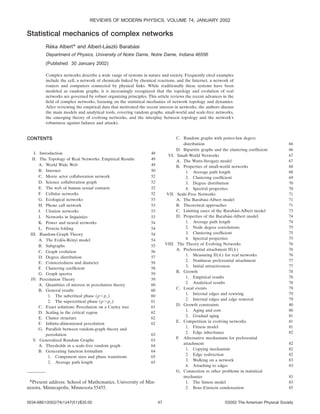
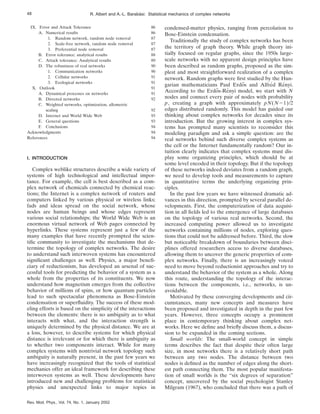


![1). The topology of the Internet is studied at two differ-
ent levels. At the router level, the nodes are the routers,
and edges are the physical connections between them.
At the interdomain (or autonomous system) level, each
FIG. 1. Network structure of the World Wide Web and the
Internet. Upper panel: the nodes of the World Wide Web are
web documents, connected with directed hyperlinks (URL’s).
Lower panel: on the Internet the nodes are the routers and
computers, and the edges are the wires and cables that physi-
cally connect them. Figure courtesy of István Albert.
TABLE II. The scaling exponents characterizing the degree distribution of several scale-free networks, for which P(k) follows a
power law (2). We indicate the size of the network, its average degree ^k&, and the cutoff k for the power-law scaling. For directed
networks we list separately the indegree (gin) and outdegree (gout) exponents, while for the undirected networks, marked with an
asterisk (*), these values are identical. The columns lreal , lrand , and lpow compare the average path lengths of real networks with
power-law degree distribution and the predictions of random-graph theory (17) and of Newman, Strogatz, and Watts (2001) [also
see Eq. (63) above], as discussed in Sec. V. The numbers in the last column are keyed to the symbols in Figs. 8 and 9.
Network Size ^k& k gout gin l real l rand l pow Reference Nr.
WWW 325 729 4.51 900 2.45 2.1 11.2 8.32 4.77 Albert, Jeong, and Barabási 1999 1
WWW 43107
7 2.38 2.1 Kumar et al., 1999 2
WWW 23108
7.5 4000 2.72 2.1 16 8.85 7.61 Broder et al., 2000 3
WWW, site 260 000 1.94 Huberman and Adamic, 2000 4
Internet, domain* 3015–4389 3.42–3.76 30–40 2.1–2.2 2.1–2.2 4 6.3 5.2 Faloutsos, 1999 5
Internet, router* 3888 2.57 30 2.48 2.48 12.15 8.75 7.67 Faloutsos, 1999 6
Internet, router* 150 000 2.66 60 2.4 2.4 11 12.8 7.47 Govindan, 2000 7
Movie actors* 212 250 28.78 900 2.3 2.3 4.54 3.65 4.01 Barabási and Albert, 1999 8
Co-authors, SPIRES* 56 627 173 1100 1.2 1.2 4 2.12 1.95 Newman, 2001b 9
Co-authors, neuro.* 209 293 11.54 400 2.1 2.1 6 5.01 3.86 Barabási et al., 2001 10
Co-authors, math.* 70 975 3.9 120 2.5 2.5 9.5 8.2 6.53 Barabási et al., 2001 11
Sexual contacts* 2810 3.4 3.4 Liljeros et al., 2001 12
Metabolic, E. coli 778 7.4 110 2.2 2.2 3.2 3.32 2.89 Jeong et al., 2000 13
Protein, S. cerev.* 1870 2.39 2.4 2.4 Jeong, Mason, et al., 2001 14
Ythan estuary* 134 8.7 35 1.05 1.05 2.43 2.26 1.71 Montoya and Solé, 2000 14
Silwood Park* 154 4.75 27 1.13 1.13 3.4 3.23 2 Montoya and Solé, 2000 16
Citation 783 339 8.57 3 Redner, 1998 17
Phone call 533106
3.16 2.1 2.1 Aiello et al., 2000 18
Words, co-occurrence* 460 902 70.13 2.7 2.7 Ferrer i Cancho and Solé, 2001 19
Words, synonyms* 22 311 13.48 2.8 2.8 Yook et al., 2001b 20
FIG. 2. Degree distribution of the World Wide Web from two
different measurements: h, the 325 729-node sample of Albert
et al. (1999); s, the measurements of over 200 million pages by
Broder et al. (2000); (a) degree distribution of the outgoing
edges; (b) degree distribution of the incoming edges. The data
have been binned logarithmically to reduce noise. Courtesy of
Altavista and Andrew Tomkins. The authors wish to thank
Luis Amaral for correcting a mistake in a previous version of
this figure (see Mossa et al., 2001).
51
R. Albert and A.-L. Barabási: Statistical mechanics of complex networks
Rev. Mod. Phys., Vol. 74, No. 1, January 2002](https://image.slidesharecdn.com/statisticalmechanicsofcomplexnetwork-250217073821-07ec0d15/85/Statistical_mechanics_of_complex_network-pdf-5-320.jpg)
![domain, composed of hundreds of routers and comput-
ers, is represented by a single node, and an edge is
drawn between two domains if there is at least one route
that connects them. Faloutsos et al. (1999) have studied
the Internet at both levels, concluding that in each case
the degree distribution follows a power law. The inter-
domain topology of the Internet, captured at three dif-
ferent dates between 1997 and the end of 1998, resulted
in degree exponents between gI
as
52.15 and gI
as
52.2.
The 1995 survey of Internet topology at the router level,
containing 3888 nodes, found gI
r
52.48 (Faloutsos et al.,
1999). Recently Govindan and Tangmunarunkit (2000)
mapped the connectivity of nearly 150 000 router inter-
faces and nearly 200 000 router adjacencies, confirming
the power-law scaling with gI
r
.2.3 [see Fig. 3(a)].
The Internet as a network does display clustering and
small path length as well. Yook et al. (2001a) and Pastor-
Satorras et al. (2001), studying the Internet at the do-
main level between 1997 and 1999, found that its clus-
tering coefficient ranged between 0.18 and 0.3, to be
compared with Crand.0.001 for random networks with
similar parameters. The average path length of the In-
ternet at the domain level ranged between 3.70 and 3.77
(Pastor-Satorras et al., 2001; Yook et al. 2001a) and at
the router level it was around 9 (Yook et al., 2001a),
indicating its small-world character.
C. Movie actor collaboration network
A much-studied database is the movie actor collabo-
ration network, based on the Internet Movie Database,
which contains all movies and their casts since the 1890s.
In this network the nodes are the actors, and two nodes
have a common edge if the corresponding actors have
acted in a movie together. This is a continuously expand-
ing network, with 225 226 nodes in 1998 (Watts and Stro-
gatz, 1998), which grew to 449 913 nodes by May 2000
(Newman, Strogatz, and Watts, 2000). The average path
length of the actor network is close to that of a random
graph with the same size and average degree, 3.65 com-
pared with 2.9, but its clustering coefficient is more than
100 times higher than a random graph (Watts and Stro-
gatz, 1998). The degree distribution of the movie actor
network has a power-law tail for large k [see Fig. 3(b)],
following P(k);k2gactor, where gactor52.360.1 (Bara-
bási and Albert, 1999; Albert and Barabási, 2000; Ama-
ral et al., 2000).
D. Science collaboration graph
A collaboration network similar to that of the movie
actors can be constructed for scientists, where the nodes
are the scientists and two nodes are connected if the two
scientists have written an article together. To uncover
the topology of this complex graph, Newman (2001a,
2001b, 2001c) studied four databases spanning physics,
biomedical research, high-energy physics, and computer
science over a five-year window (1995–1999). All these
networks show a small average path length but a high
clustering coefficient, as summarized in Table I. The de-
gree distribution of the collaboration network of high-
energy physicists is an almost perfect power law with an
exponent of 1.2 [Fig. 3(c)], while the other databases
display power laws with a larger exponent in the tail.
Barabási et al. (2001) investigated the collaboration
graph of mathematicians and neuroscientists publishing
between 1991 and 1998. The average path length of
these networks is around l math59.5 and l nsci56, their
clustering coefficient being Cmath50.59 and Cnsci
50.76. The degree distributions of these collaboration
networks are consistent with power laws with degree ex-
ponents 2.1 and 2.5, respectively [see Fig. 3(d)].
E. The web of human sexual contacts
Many sexually transmitted diseases, including AIDS,
spread on a network of sexual relationships. Liljeros
et al. (2001) have studied the web constructed from the
sexual relations of 2810 individuals, based on an exten-
sive survey conducted in Sweden in 1996. Since the
edges in this network are relatively short lived, they ana-
lyzed the distribution of partners over a single year, ob-
taining for both females and males a power-law degree
distribution with an exponent gf53.560.2 and gm53.3
60.2, respectively.
F. Cellular networks
Jeong et al. (2000) studied the metabolism of 43 or-
ganisms representing all three domains of life, recon-
structing them in networks in which the nodes are the
FIG. 3. The degree distribution of several real networks: (a)
Internet at the router level. Data courtesy of Ramesh Govin-
dan; (b) movie actor collaboration network. After Barabási
and Albert 1999. Note that if TV series are included as well,
which aggregate a large number of actors, an exponential cut-
off emerges for large k (Amaral et al., 2000); (c) co-authorship
network of high-energy physicists. After Newman (2001a,
2001b); (d) co-authorship network of neuroscientists. After
Barabási et al. (2001).
52 R. Albert and A.-L. Barabási: Statistical mechanics of complex networks
Rev. Mod. Phys., Vol. 74, No. 1, January 2002](https://image.slidesharecdn.com/statisticalmechanicsofcomplexnetwork-250217073821-07ec0d15/85/Statistical_mechanics_of_complex_network-pdf-6-320.jpg)


![Random-graph theory studies the properties of the
probability space associated with graphs with N nodes as
N→`. Many properties of such random graphs can be
determined using probabilistic arguments. In this respect
Erdős and Rényi used the definition that almost every
graph has a property Q if the probability of having Q
approaches 1 as N→`. Among the questions addressed
by Erdős and Rényi, some have direct relevance to an
understanding of complex networks as well, such as: Is a
typical graph connected? Does it contain a triangle of
connected nodes? How does its diameter depend on its
size?
In the mathematical literature the construction of a
random graph is often called an evolution: starting with
a set of N isolated vertices, the graph develops by the
successive addition of random edges. The graphs ob-
tained at different stages of this process correspond to
larger and larger connection probabilities p, eventually
obtaining a fully connected graph [having the maximum
number of edges n5N(N21)/2] for p→1. The main
goal of random-graph theory is to determine at what
connection probability p a particular property of a graph
will most likely arise. The greatest discovery of Erdős
and Rényi was that many important properties of ran-
dom graphs appear quite suddenly. That is, at a given
probability either almost every graph has some property
Q (e.g., every pair of nodes is connected by a path of
consecutive edges) or, conversely, almost no graph has it.
The transition from a property’s being very unlikely to
its being very likely is usually swift. For many such prop-
erties there is a critical probability pc(N). If p(N)
grows more slowly than pc(N) as N→`, then almost
every graph with connection probability p(N) fails to
have Q. If p(N) grows somewhat faster than pc(N),
then almost every graph has the property Q. Thus the
probability that a graph with N nodes and connection
probability p5p(N) has property Q satisfies
lim
N→`
PN,p~Q!5
H0 if
p~N!
pc~N!
→0
1 if
p~N!
pc~N!
→`.
(4)
An important note is in order here. Physicists trained
in critical phenomena will recognize in pc(N) the critical
probability familiar in percolation. In the physics litera-
ture the system is usually viewed at a fixed system size N
and then the different regimes in Eq. (4) reduce to the
question of whether p is smaller or larger than pc . The
proper value of pc , that is, the limit pc5pc(N→`), is
obtained by finite size scaling. The basis of this proce-
dure is the assumption that this limit exists, reflecting
the fact that ultimately the percolation threshold is inde-
pendent of the system size. This is usually the case in
finite-dimensional systems, which include most physical
systems of interest for percolation theory and critical
phenomena. In contrast, networks are by definition infi-
nite dimensional: the number of neighbors a node can
have increases with the system size. Consequently in
random-graph theory the occupation probability is de-
fined as a function of the system size: p represents the
fraction of the edges that are present from the possible
N(N21)/2. Larger graphs with the same p will contain
more edges, and consequently properties like the ap-
pearance of cycles could occur for smaller p in large
graphs than in smaller ones. This means that for many
properties Q in random graphs there is no unique,
N-independent threshold, but we have to define a
threshold function that depends on the system size, and
pc(N→`)→0. However, we shall see that the average
degree of the graph
^k&52n/N5p~N21!.pN (5)
does have a critical value that is independent of the sys-
tem size. In the coming subsection we illustrate these
ideas by looking at the emergence of various subgraphs
in random graphs.
B. Subgraphs
The first property of random graphs to be studied by
Erdős and Rényi (1959) was the appearance of sub-
graphs. A graph G1 consisting of a set P1 of nodes and a
set E1 of edges is a subgraph of a graph G5$P,E% if all
nodes in P1 are also nodes of P and all edges in E1 are
also edges of E. The simplest examples of subgraphs are
cycles, trees, and complete subgraphs (see Fig. 5). A
cycle of order k is a closed loop of k edges such that
every two consecutive edges and only those have a com-
mon node. That is, graphically a triangle is a cycle of
order 3, while a rectangle is a cycle of order 4. The av-
erage degree of a cycle is equal to 2, since every node
has two edges. The opposite of cycles are the trees,
which cannot form closed loops. More precisely, a graph
is a tree of order k if it has k nodes and k21 edges,
FIG. 5. Illustration of the graph evolution process for the
Erdős-Rényi model. We start with N510 isolated nodes (up-
per panel), then connect every pair of nodes with probability
p. The lower panel of the figure shows two different stages in
the graph’s development, corresponding to p50.1 and p
50.15. We can notice the emergence of trees (a tree of order 3,
drawn with long-dashed lines) and cycles (a cycle of order 3,
drawn with short-dashed lines) in the graph, and a connected
cluster that unites half of the nodes at p50.1551.5/N.
55
R. Albert and A.-L. Barabási: Statistical mechanics of complex networks
Rev. Mod. Phys., Vol. 74, No. 1, January 2002](https://image.slidesharecdn.com/statisticalmechanicsofcomplexnetwork-250217073821-07ec0d15/85/Statistical_mechanics_of_complex_network-pdf-9-320.jpg)


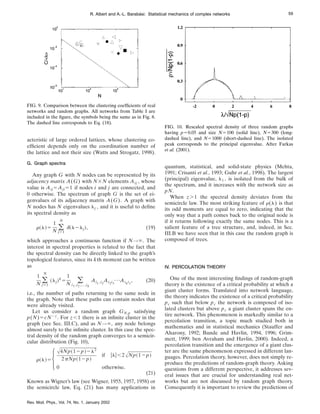
![percolation theory relevant to networks, as they are cru-
cial for an understanding of important aspects of the
network topology.
A. Quantities of interest in percolation theory
Consider a regular d-dimensional lattice whose edges
are present with probability p and absent with probabil-
ity 12p. Percolation theory studies the emergence of
paths that percolate through the lattice (starting at one
side and ending at the opposite side). For small p only a
few edges are present, thus only small clusters of nodes
connected by edges can form, but at a critical probability
pc , called the percolation threshold, a percolating cluster
of nodes connected by edges appears (see Fig. 11). This
cluster is also called an infinite cluster, because its size
diverges as the size of the lattice increases. There are
several much-studied versions of percolation, the one
presented above being ‘‘bond percolation.’’ The best-
known alternative is site percolation, in which all bonds
are present and the nodes of the lattice are occupied
with probability p. In a manner similar to bond perco-
lation, for small p only finite clusters of occupied nodes
are present, but for p.pc an infinite cluster appears.
The main quantities of interest in percolation are the
following:
(1) The percolation probability P, denoting the prob-
ability that a given node belongs to the infinite clus-
ter:
P5Pp~uCu5`!512(
s,`
Pp~uCu5s!, (22)
where Pp(uCu5s) denotes the probability that the
cluster at the origin has size s. Obviously
P5H 0 if p,pc
.0 if p.pc .
(23)
(2) The average cluster size ^s&, defined as
^s&5Ep~uCu!5(
s51
`
sPp~uCu5s!, (24)
giving the expectation value of cluster sizes. Because
^s& is infinite when P.0, in this case it is useful to
work with the average size of the finite clusters by
taking away from the system the infinite (uCu5`)
cluster
^s&f
5Ep~uCu,uCu,`!5(
s,`
sPp~uCu5s!. (25)
(3) The cluster size distribution ns , defined as the prob-
ability of a node’s having a fixed position in a cluster
of size s (for example, being its left-hand end, if this
position is uniquely defined),
ns5
1
s
Pp~uCu5s!. (26)
Note that ns does not coincide with the probability
that a node is part of a cluster of size s. By fixing the
position of the node in the cluster we are choosing
only one of the s possible nodes, reflected in the fact
that Pp(uCu5s) is divided by s, guaranteeing that
we count every cluster only once.
These quantities are of interest in random networks as
well. There is, however, an important difference be-
tween percolation theory and random networks: perco-
lation theory is defined on a regular d-dimensional lat-
tice. In a random network (or graph) we can define a
nonmetric distance along the edges, but since any node
can be connected by an edge to any other node in the
network, there is no regular small-dimensional lattice in
which a network can be embedded. However, as we dis-
cuss below, random networks and percolation theory
meet exactly in the infinite-dimensional limit (d→`) of
percolation. Fortunately many results in percolation
theory can be generalized to infinite dimensions. Conse-
quently the results obtained within the context of perco-
lation apply directly to random networks as well.
B. General results
1. The subcritical phase (p,pc)
When p,pc , only small clusters of nodes connected
by edges are present in the system. The questions asked
in this phase are (i) what is the probability that there
exists a path x↔y joining two randomly chosen nodes x
and y? and (ii) what is the rate of decay of Pp(uCu5s)
when s→`? The first result of this type was obtained by
Hammersley (1957), who showed that the probability of
a path’s joining the origin with a node on the surface,
]B(r), of a box centered at the origin and with side
length 2r decays exponentially if P,`. We can define a
correlation length j as the characteristic length of the
exponential decay
Pp@0↔]B~r!#;e2 r/j
, (27)
where 0↔]B(r) means that there is a path from the
origin to an arbitrary node on ]B(r). Equation (27) in-
dicates that the radius of the finite clusters in the sub-
critical region has an exponentially decaying tail, and the
correlation length represents the mean radius of a finite
cluster. It was shown (see Grimmett, 1999) that j is
equal to 0 for p50 and goes to infinity as p→pc .
FIG. 11. Illustration of bond percolation in 2D. The nodes are
placed on a 25325 square lattice, and two nodes are connected
by an edge with probability p. For p50.315 (left), which is
below the percolation threshold pc50.5, the connected nodes
form isolated clusters. For p50.525 (right), which is above the
percolation threshold, the largest cluster percolates.
60 R. Albert and A.-L. Barabási: Statistical mechanics of complex networks
Rev. Mod. Phys., Vol. 74, No. 1, January 2002](https://image.slidesharecdn.com/statisticalmechanicsofcomplexnetwork-250217073821-07ec0d15/85/Statistical_mechanics_of_complex_network-pdf-14-320.jpg)
![The exponential decay of cluster radii implies that the
probability that a cluster has size s, Pp(uCu5s), also
decays exponentially for large s:
Pp~uCu5s!;e2a(p)s
as s→`, (28)
where a(p)→` as p→0 and a(pc)50.
2. The supercritical phase (p.pc)
For P.0 there is exactly one infinite cluster (Burton
and Keane, 1989). In this supercritical phase the previ-
ously studied quantities are dominated by the contribu-
tion of the infinite cluster; thus it is useful to study the
corresponding probabilities in terms of finite clusters.
The probability that there is a path from the origin to
the surface of a box of edge length 2r that is not part of
the infinite cluster decays exponentially as
Pp@0↔]B~r!,uCu,`#;e2 r/j
. (29)
Unlike the subcritical phase, though, the decay of the
cluster sizes, Pp(uCu5s,`), follows a stretch exponen-
tial, e2b(p)s(d21)/d
, offering the first important quantity
that depends on the dimensionality of the lattice, but
even this dependence vanishes as d→`, and the cluster
size distribution decays exponentially as in the subcriti-
cal phase.
C. Exact solutions: Percolation on a Cayley tree
The Cayley tree (or Bethe lattice) is a loopless struc-
ture (see Fig. 12) in which every node has z neighbors,
with the exception of the nodes at the surface. While the
surface and volume of a regular d-dimensional object
obey the scaling relation surface}volume121/d
, and only
in the limit d→` is the surface proportional with the
volume, for a Cayley tree the number of nodes on the
surface is proportional to the total number of nodes (i.e.,
the volume of the tree). Thus in this respect a Cayley
tree represents an infinite-dimensional object. Another
argument for the infinite dimensionality of a Cayley tree
is that it has no loops (cycles in graph-theoretic lan-
guage). Thus, despite its regular topology, the Cayley
tree represents a reasonable approximation of the topol-
ogy of a random network in the subcritical phase, where
all the clusters are trees. This is no longer true in the
supercritical phase, because at the critical probability
pc(N), cycles of all order appear in the graph (see Sec.
III.C).
To investigate percolation on a Cayley tree, we as-
sume that each edge is present with probability p. Next
we discuss the main quantities of interest for this system.
(a) Percolation threshold: The condition for the exis-
tence of an infinite path starting from the origin is
that at least one of the z21 possible outgoing
edges of a node is present, i.e., (z21)p>1. There-
fore the percolation threshold is
pc5
1
z21
. (30)
(b) Percolation probability: For a Cayley tree with z
53, for which pc51/2, the percolation probability
is given by (Stauffer and Aharony, 1992)
P5
H0 if p,pc5
1
2
~2p21!/p2
if p.pc5
1
2
.
(31)
The Taylor series expansion around pc5 1
2 gives P
.8(p2 1
2 ), thus the percolation probability is pro-
portional to the deviation from the percolation
threshold
P}~p2pc! as p→pc . (32)
(c) Mean cluster size: The average cluster size is given
by
^s&5(
n51
`
332n21
pn
5
3
2
1
122p
5
3
4
~pc2p!21
. (33)
Note that ^s& diverges as p→pc , and it depends on
p as a power of the distance pc2p from the perco-
lation threshold. This behavior is an example of
critical phenomena: an order parameter goes to
zero following a power law in the vicinity of the
critical point (Stanley, 1971; Ma, 1976).
(d) Cluster size distribution: The probability of having
a cluster of size s is (Durett, 1985)
Pp~uCu5s!5
1
s
C2s
s21
ps21
~12p!s11
. (34)
Here the number of edges surrounding the s nodes
is 2s, from which the s21 inside edges have to be
present and the s11 external ones absent. The fac-
tor C2s
s21
takes into account the different cases that
FIG. 12. Example of a Cayley tree with coordination number
z53. All of the nodes have three edges, with the exception of
those on the surface, which have only one edge. The ratio
between the number of nodes on the surface and the total
number of nodes approaches a constant, (z22)/(z21), a
property valid only for infinite-dimensional objects. The aver-
age degree approaches ^k&52 as the size of the tree goes to
infinity, a property held in common with random trees (see
Sec. III.B).
61
R. Albert and A.-L. Barabási: Statistical mechanics of complex networks
Rev. Mod. Phys., Vol. 74, No. 1, January 2002](https://image.slidesharecdn.com/statisticalmechanicsofcomplexnetwork-250217073821-07ec0d15/85/Statistical_mechanics_of_complex_network-pdf-15-320.jpg)

![• P;(p2pc) as p→pc ;
• ^s&;(pc2p)21
as p→pc ;
• ns;s25/2
e2up2pcu2s
as p→pc ;
• j;up2pcu21/2
as p→pc .
Consequently the critical exponents of infinite-
dimensional percolation are t`55/2, s`51/2, and n`
51/2. The fractal dimension of an infinite cluster at the
percolation threshold is df54, while the graph dimen-
sion is dl 52 (Bunde and Havlin, 1996). Thus the char-
acteristic chemical distance on a finite cluster or infinite
cluster at the percolation threshold scales with its size as
l ;s2/df5s1/2
. (44)
G. Parallels between random-graph theory and percolation
In random-graph theory we study a graph of N nodes,
each pair of nodes being connected with probability p.
This corresponds to percolation in at most N dimen-
sions, such that each two connected nodes are neigh-
bors, and the edges between graph nodes are the edges
in the percolation problem. Since random-graph theory
investigates the N→` regime, it is analogous to infinite-
dimensional percolation.
We have seen in Sec. IV.C that infinite-dimensional
percolation is similar to percolation on a Cayley tree.
The percolation threshold of a Cayley tree is pc51/(z
21), where z is the coordination number of the tree. In
a random graph of N nodes the coordination number is
N21; thus the ‘‘percolation threshold,’’ denoting the
connection probability at which a giant cluster appears,
should be pc.1/N. Indeed, this is exactly the probability
at which the phase transition leading to a giant compo-
nent appears in random graphs, as Erdős and Rényi
showed (see Sec. III.C).
Compare the predictions of random-graph theory and
infinite-dimensional percolation, some of which reflect a
complete analogy:
(1) For p,pc51/N
• The probability of a giant cluster in a graph, and of an
infinite cluster in percolation, is equal to 0.
• The clusters of a random graph are trees, while the
clusters in percolation have a fractal structure and a
perimeter proportional with their volume.
• The largest cluster in a random graph is a tree with
ln(N) nodes, while in general for percolation Pp(uCu
5s);e2s/sj [see Eq. (28) in Sec. IV.B], suggesting that
the size of the largest cluster scales as ln(N).
(2) For p5pc51/N
• A unique giant cluster or an infinite cluster appears.
• The size of the giant cluster is N2/3
; while for infinite-
dimensional percolation Pp(uCu5s);s23/2
, thus the
size of the largest cluster scales as N2/3
.
(3) For p.pc51/N
• The size of the giant cluster is „f(pcN)2f(pN)…N,
where f is an exponentially decreasing function with
f(1)51. The size of the infinite cluster is PN}(p
2pc)N.
• The giant cluster has a complex structure containing
cycles, while the infinite cluster is no longer fractal,
but compact.
All these correspondences indicate that the phase
transition in random graphs belongs in the same univer-
sality class as mean-field percolation. Numerical simula-
tions of random graphs (see, for example, Christensen
et al., 1998) have confirmed that the critical exponents of
the phase transition are equal to the critical exponents
of infinite-dimensional percolation. The equivalence of
these two theories is very important because it offers us
different perspectives on the same problem. For ex-
ample, it is often of interest to look at the cluster size
distribution of a random network with a fixed number of
nodes. This question is answered in a simpler way in
percolation theory. However, random-graph theory an-
swers questions of major importance for networks, such
as the appearance of trees and cycles, which are largely
ignored by percolation theory.
In some cases there is an apparent discrepancy be-
tween the predictions of random-graph theory and per-
colation theory. For example, percolation theory pre-
dicts that the chemical distance between two nodes in an
infinite cluster scales as a power of the size of the cluster
[see Eq. (44)]. However, random-graph theory predicts
[Eq. (16)] that the diameter of an infinite cluster scales
logarithmically with its size (see Chung and Lu, 2001).
The origin of the apparent discrepancy is that these two
predictions refer to different regimes. While Eq. (44) is
valid only when the infinite cluster is barely formed [i.e.,
p5pc and ^k&51] and is still a fractal, the prediction of
random-graph theory is valid only well beyond the per-
colation transition, when ^k&@1. Consequently, by using
these two limits we can address the evolution of the
chemical distance in an infinite cluster (see Cohen et al.,
2001). Thus for a full characterization of random net-
works we need to be aware of both of these complemen-
tary approaches.
V. GENERALIZED RANDOM GRAPHS
In Sec. II we have seen that real networks differ from
random graphs in that often their degree distribution
follows a power law P(k);k2g
. Since power laws are
free of a characteristic scale, these networks are called
‘‘scale-free networks’’ (Barabási and Albert, 1999; Bara-
bási, Albert, and Jeong, 1999). As random graphs do not
capture the scale-free character of real networks, we
need a different model to describe these systems. One
approach is to generalize random graphs by constructing
a model that has the degree distribution as an input but
is random in all other respects. In other words, the edges
connect randomly selected nodes, with the constraint
that the degree distribution is restricted to a power law.
The theory of such semirandom graphs should answer
similar questions to those asked by Erdős and Rényi and
percolation theory (see Secs. III, IV): Is there a thresh-
old at which a giant cluster appears? How do the size
and topology of the clusters evolve? When does the
63
R. Albert and A.-L. Barabási: Statistical mechanics of complex networks
Rev. Mod. Phys., Vol. 74, No. 1, January 2002](https://image.slidesharecdn.com/statisticalmechanicsofcomplexnetwork-250217073821-07ec0d15/85/Statistical_mechanics_of_complex_network-pdf-17-320.jpg)
![graph become connected? In addition, we need to deter-
mine the average path length and clustering coefficient
of such graphs.
The first step in developing such a theory is to identify
the relevant parameter that, together with the network
size, gives a statistically complete characterization of the
network. In the case of random graphs this parameter is
the connection probability (see Sec. III.A); for percola-
tion theory it is the bond occupation probability (see
Sec. IV). Since the only restriction for these graphs is
that their degree distribution follow a power law, the
exponent g of the degree distribution could play the role
of the control parameter. Accordingly, we study scale-
free random networks by systematically varying g and
see if there is a threshold value of g at which the net-
works’ important properties abruptly change.
We start by sketching a few intuitive expectations.
Consider a large network with degree distribution
P(k);k2g
, in which g decreases from ` to 0. The av-
erage degree of the network, or equivalently, the num-
ber of edges, increases as g decreases, since ^k&
;kmax
2g12
, where kmax,N is the maximum degree of the
graph. This is very similar to the graph evolution process
described by Erdős and Rényi (see Sec. III.C). Conse-
quently we expect that, while at large g the network
consists of isolated small clusters, there is a critical value
of g at which a giant cluster forms, and at an even
smaller g the network becomes completely connected.
The theory of random graphs with given degree se-
quence is relatively recent. One of the first results is due
to Luczak (1992), who showed that almost all random
graphs with a fixed degree distribution and no nodes of
degree smaller than 2 have a unique giant cluster. Mol-
loy and Reed (1995, 1998) have proven that for a ran-
dom graph with degree distribution P(k) an infinite
cluster emerges almost surely when
Q[ (
k>1
k~k22!P~k!.0, (45)
provided that the maximum degree is less than N1/4
. The
method of Molloy and Reed was applied to random
graphs with power-law degree distributions by Aiello,
Chung, and Lu (2000). As we show next, their results are
in excellent agreement with the expectations outlined
above.
A. Thresholds in a scale-free random graph
Aiello, Chung, and Lu (2000) introduce a two-
parameter random-graph model P(a,g) defined as fol-
lows: Let Nk be the number of nodes with degree k.
P(a,g) assigns uniform probability to all graphs with
Nk5ea
k2g
. Thus in this model it is not the total number
of nodes that is specified—along with the exponent
g—from the beginning, but the number of nodes with
degree 1. Nevertheless the number of nodes and edges
in the graph can be deduced, noting that the maximum
degree of the graph is ea/g
. To find the condition for the
appearance of a giant cluster in this model, we insert
P(a,g) into Eq. (45), finding as a solution g0
53.478 75 . . . . Thus when g.g0 the random graph al-
most surely has no infinite cluster. On the other hand,
when g,g0 there is almost surely a unique infinite clus-
ter.
An important question is whether the graph is con-
nected or not. Certainly for g.g0 the graph is discon-
nected as it is made of independent finite clusters. In the
0,g,g0 regime Aiello, Chung, and Lu (2000) study the
size of the second-largest cluster, finding that for 2<g
<g0 the second-largest cluster almost surely has a size
of the order of ln N; thus it is relatively small. However,
for 1,g,2 almost surely every node with degree
greater than ln(N) belongs to the infinite cluster. The
second-largest cluster has a size of order 1, i.e., its size
does not increase as the size of the graph goes to infinity.
This means that the fraction of nodes in the infinite clus-
ter approaches 1 as the system size increases; thus the
graph becomes totally connected in the limit of infinite
system size. Finally, for 0,g,1 the graph is almost
surely connected.
B. Generating function formalism
A general approach to random graphs with given de-
gree distribution was developed by Newman, Strogatz,
and Watts (2001) using a generating function formalism
(Wilf, 1990). The generating function of the degree dis-
tribution,
G0~x!5 (
k50
`
P~k!xk
, (46)
encapsulates all the information contained in P(k),
since
P~k!5
1
k!
dk
G0
dxk Ux50
. (47)
An important quantity for studying cluster structure is
the generating function for the degree distribution of the
nearest neighbors of a randomly selected node. This can
be obtained in the following way: a randomly selected
edge reaches a node with degree k with probability pro-
portional to kP(k) (i.e., it is easier to find a well-
connected node). If we start from a randomly chosen
node and follow each of the edges starting from it, then
the nodes we visit have their degree distribution gener-
ated by kP(k). In addition, the generating function will
contain a term xk21
[instead of xk
as in Eq. (46)] be-
cause we have to discount the edge through which we
reached the node. Thus the distribution of outgoing
edges is generated by the function
G1~x!5
(
k
kP~k!xk21
(
k
kP~k!
5
1
^k&
G0
8~x!. (48)
The average number of first neighbors is equal to the
average degree of the graph,
z15^k&5(
k
kP~k!5G0
8~1!. (49)
64 R. Albert and A.-L. Barabási: Statistical mechanics of complex networks
Rev. Mod. Phys., Vol. 74, No. 1, January 2002](https://image.slidesharecdn.com/statisticalmechanicsofcomplexnetwork-250217073821-07ec0d15/85/Statistical_mechanics_of_complex_network-pdf-18-320.jpg)

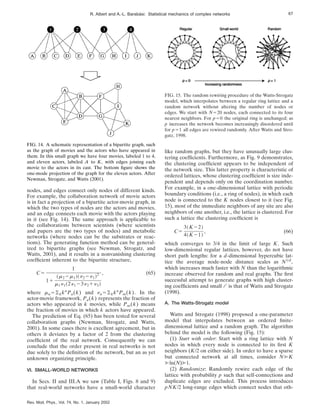


![The dependence of C(p) on p can be derived using a
slightly different but equivalent definition of C, intro-
duced by Barrat and Weigt (2000). According to this
definition, C8(p) is the fraction between the mean num-
ber of edges between the neighbors of a node and the
mean number of possible edges between those neigh-
bors. In a more graphic formulation (Newman, Strogatz,
and Watts, 2001),
C85
33number of triangles
number of connected triples
. (73)
Here triangles are trios of nodes in which each node is
connected to both of the others, and connected triples
are trios in which at least one is connected to both oth-
ers, the factor 3 accounting for the fact that each triangle
contributes to three connected triples. This definition
corresponds to the concept of the ‘‘fraction of transitive
triples’’ used in sociology (see Wasserman and Faust,
1994).
To calculate C8(p) for the WS model, let us start
with a regular lattice with a clustering coefficient C(0).
For p.0, two neighbors of a node i that were connected
at p50 are still neighbors of i and connected by an
edge with probability (12p)3
, since there are three
edges that need to remain intact. Consequently C8(p)
.C(0)(12p)3
. Barrat and Weigt (2000) have verified
that the deviation of C(p) from this expression is small
and goes to zero as N→`. The corresponding expres-
sion for the Newman-Watts model is (Newman, 2001e)
C8~p!5
3K~K21!
2K~2K21!18pK2
14p2
K2 . (74)
3. Degree distribution
In the WS model for p50 each node has the same
degree K. Thus the degree distribution is a delta func-
tion centered at K. A nonzero p introduces disorder in
the network, broadening the degree distribution while
maintaining the average degree equal to K. Since only a
single end of every edge is rewired (pNK/2 edges in
total), each node has at least K/2 edges after the rewir-
ing process. Consequently for K.2 there are no isolated
nodes and the network is usually connected, unlike a
random graph which consists of isolated clusters for a
wide range of connection probabilities.
For p.0, the degree ki of a vertex i can be written as
(Barrat and Weigt, 2000) ki5K/21ci , where ci can be
divided into two parts: ci
1
<K/2 edges have been left in
place (with probability 12p), while ci
2
5ci2ci
1
edges
have been rewired towards i, each with probability 1/N.
The probability distributions of ci
1
and ci
2
are
P1~ci
1
!5CK/2
ci
1
~12p!ci
1
pK/22ci
1
(75)
and
P2~ci
2
!5CpNK/2
ci
2
S1
NDci
2
S12
1
NDpNK/22ci
2
.
~pK/2!ci
2
ci
2
!
e2pK/2
(76)
for large N. Combining these two factors, the degree
distribution follows
P~k!5 (
n50
f(k,K)
CK/2
n
~12p!n
pK/22n
~pK/2!k2K/22n
~k2K/22n!!
e2pK/2
(77)
for k>K/2, where f(k,K)5min(k2K/2,K/2).
The shape of the degree distribution is similar to that
of a random graph. It has a pronounced peak at ^k&
5K and decays exponentially for large k (Fig. 19). Thus
the topology of the network is relatively homogeneous,
all nodes having approximately the same number of
edges.
4. Spectral properties
As discussed in Sec. III.G, the spectral density r(l) of
a graph reveals important information about its topol-
ogy. Specifically, we have seen that for large random
graphs r(l) converges to a semicircle. It comes as no
surprise that the spectrum of the Watts-Strogatz model
depends on the rewiring probability p (Farkas et al.,
2001). For p50 the network is regular and periodical;
consequently r(l) contains numerous singularities [Fig.
20(a)]. For intermediate values of p these singularities
become blurred, but r(l) retains a strong skewness
[Figs. 20(b) and (c)]. Finally, as p→1, r(l) approaches
the semicircle law characterizing random graphs [Fig.
20(d)]. While the details of the spectral density change
considerably with p, the third moment of r(l) is con-
sistently high, indicating a high number of triangles in
the network. Thus the results summarized in Fig. 20 al-
low us to conclude that a high number of triangles is a
basic property of the WS model (see also Gleis et al.,
2000). The high regularity of small-world models for a
FIG. 19. Degree distribution of the Watts-Strogatz model for
K53 and various p. We can see that only k>K/2 values are
present, and the mean degree is ^k&5K. The symbols are ob-
tained from numerical simulations of the Watts-Strogatz model
with N51000, and the lines correspond to Eq. (77). As a com-
parison, the degree distribution of a random graph with the
same parameters is plotted with filled symbols. After Barrat
and Weigt (2000).
70 R. Albert and A.-L. Barabási: Statistical mechanics of complex networks
Rev. Mod. Phys., Vol. 74, No. 1, January 2002](https://image.slidesharecdn.com/statisticalmechanicsofcomplexnetwork-250217073821-07ec0d15/85/Statistical_mechanics_of_complex_network-pdf-24-320.jpg)

![(1999) focuses on the dynamics of node degrees, fol-
lowed by the master-equation approach of Dorogovtsev,
Mendes, and Samukhin (2000a) and the rate-equation
approach introduced by Krapivsky, Redner, and Leyvraz
(2000). As these methods are often used interchange-
ably in the subsequent section, we briefly review each of
them.
Continuum theory: The continuum approach intro-
duced by Barabási and Albert (1999) and Barabási, Al-
bert, and Jeong (1999) calculates the time dependence
of the degree ki of a given node i. This degree will in-
crease every time a new node enters the system and
links to node i, the probability of this process being
P(ki). Assuming that ki is a continuous real variable,
the rate at which ki changes is expected to be propor-
tional to P(ki). Consequently ki satisfies the dynamical
equation
]ki
]t
5mP~ki!5m
ki
(
j51
N21
kj
. (79)
The sum in the denominator goes over all nodes in the
system except the newly introduced one; thus its value is
(jkj52mt2m, leading to
]ki
]t
5
ki
2t
. (80)
The solution of this equation, with the initial condition
that every node i at its introduction has ki(ti)5m, is
ki~t!5mSt
ti
Db
with b5
1
2
. (81)
Equation (81) indicates that the degree of all nodes
evolves the same way, following a power law, the only
difference being the intercept of the power law.
Using Eq. (81), one can write the probability that a
node has a degree ki(t) smaller than k, P@ki(t),k#, as
P@ki~t!,k#5PSti.
m1/b
t
k1/b D. (82)
Assuming that we add the nodes at equal time intervals
to the network, the ti values have a constant probability
density
P~ti!5
1
m01t
. (83)
Substituting this into Eq. (82) we obtain
PSti.
m1/b
t
k1/b D512
m1/b
t
k1/b
~t1m0!
. (84)
The degree distribution P(k) can be obtained using
P~k!5
]P@ki~t!,k#
]k
5
2m1/b
t
m01t
1
k1/b11 , (85)
predicting that asymptotically (t→`)
P~k!;2m1/b
k2g
with g5
1
b
1153 (86)
being independent of m, in agreement with the numeri-
cal results.
FIG. 21. Numerical simulations of network evolution: (a) Degree distribution of the Barabási-Albert model, with N5m01t
5300 000 and s, m05m51; h, m05m53; L, m05m55; and n, m05m57. The slope of the dashed line is g52.9, providing
the best fit to the data. The inset shows the rescaled distribution (see text) P(k)/2m2
for the same values of m, the slope of the
dashed line being g53; (b) P(k) for m05m55 and various system sizes, s, N5100 000; h, N5150 000; L, N5200 000. The
inset shows the time evolution for the degree of two vertices, added to the system at t155 and t2595. Here m05m55, and the
dashed line has slope 0.5, as predicted by Eq. (81). After Barabási, Albert, and Jeong (1999).
72 R. Albert and A.-L. Barabási: Statistical mechanics of complex networks
Rev. Mod. Phys., Vol. 74, No. 1, January 2002](https://image.slidesharecdn.com/statisticalmechanicsofcomplexnetwork-250217073821-07ec0d15/85/Statistical_mechanics_of_complex_network-pdf-26-320.jpg)
![As the power law observed for real networks de-
scribes systems of rather different sizes, it is expected
that a correct model should provide a time-independent
degree distribution. Indeed, Eq. (85) predicts that as-
ymptotically the degree distribution of the Barabási-
Albert model is independent of time (and subsequently
independent of the system size N5m01t), indicating
that, despite its continuous growth, the network reaches
a stationary scale-free state. Furthermore, Eq. (85) also
indicates that the coefficient of the power-law distribu-
tion is proportional to m2
. All these predictions are con-
firmed by numerical simulations (see Fig. 21).
Master-equation approach: The method introduced by
Dorogovtsev, Mendes, and Samukhin (2000a; see also
Kullmann and Kertész, 2001) studies the probability
p(k,ti ,t) that at time t a node i introduced at time ti has
a degree k. In the Barabási-Albert model, when a new
node with m edges enters the system, the degree of node
i increases by 1 with a probability mP(k)5k/2t; other-
wise it stays the same. Consequently the master equa-
tion governing p(k,ti ,t) for the Barabási-Albert model
has the form
p~k,ti ,t11!5
k21
2t
p~k21,ti ,t!1S12
k
2tDp~k,ti ,t!.
(87)
The degree distribution can be obtained as
P~k!5 lim
t→`
S(
ti
p~k,ti ,t!DYt. (88)
Equation (87) implies that P(k) is the solution of the
recursive equation
P~k!5Hk21
k12
P~k21! for k>m11
2/~m12! for k5m,
(89)
giving
P~k!5
2m~m11!
k~k11!~k12!
, (90)
very close to Eq. (86) obtained using the continuum
theory.
Rate-equation approach: The rate-equation approach,
introduced by Krapivsky, Redner, and Leyvraz (2000),
focuses on the average number Nk(t) of nodes with k
edges at time t. When a new node enters the network in
the scale-free model, Nk(t) changes as
dNk
dt
5m
~k21!Nk21~t!2kNk~t!
(
k
kNk~t!
1dk,m . (91)
Here the first term accounts for the new edges that con-
nect to nodes with k21 edges, thus increasing their de-
gree to k. The second term describes the new edges
connecting to nodes with k edges turning them into
nodes with k11 edges, decreasing the number of nodes
with k edges. The third term accounts for the new nodes
with m edges. In the asymptotic limit Nk(t)5tP(k) and
(kkNk(t)52mt, leading to the same recursive equation
(89), as predicted by the master-equation approach.
The master-equation and rate-equation approaches
are completely equivalent and offer the same asymptotic
results as the continuum theory. Thus for calculating the
scaling behavior of the degree distribution they can be
used interchangeably. In addition, these methods, not
using a continuum assumption, appear more suitable for
obtaining exact results in more challenging network
models.
C. Limiting cases of the Barabási-Albert model
The power-law scaling in the Barabási-Albert model
indicates that growth and preferential attachment play
important roles in network development. But are both
of them necessary for the emergence of power-law scal-
ing? To address this question, two limiting cases of the
Barabási-Albert model have been investigated, which
contain only one of these two mechanisms (Barabási
and Albert, 1999; Barabási, Albert, and Jeong, 1999).
Model A keeps the growing character of the network
without preferential attachment. Starting with a small
number of nodes (m0), at every time step we add a new
node with m(<m0) edges. We assume that the new
node connects with equal probability to the nodes al-
ready present in the system, i.e., P(ki)51/(m01t21),
independent of ki .
The continuum theory predicts that ki(t) follows a
logarithmic time dependence, and for t→` the degree
distribution decays exponentially, following [Fig. 22(a)]
P~k!5
e
m
expS2
k
mD. (92)
The exponential character of the distribution indicates
that the absence of preferential attachment eliminates
the scale-free character of the resulting network.
Model B starts with N nodes and no edges. At each
time step a node is selected randomly and connected
with probability P(ki)5ki /(jkj to a node i in the sys-
tem. Consequently model B eliminates the growth pro-
cess, the number of nodes being kept constant during
the network evolution. Numerical simulations indicate
that while at early times the model exhibits power-law
scaling, P(k) is not stationary (Fig. 22). Since N is con-
stant and the number of edges increases with time, after
T.N2
time steps the system reaches a state in which all
nodes are connected.
The time evolution of the individual degrees can be
calculated analytically using the continuum theory, indi-
cating that
ki~t!.
2
N
t, (93)
assuming N@1, in agreement with the numerical results
[Fig. 22(b)].
Since the continuum theory predicts that after a tran-
sient period the average degree of all nodes should have
the same value given by Eq. (93), we expect that the
73
R. Albert and A.-L. Barabási: Statistical mechanics of complex networks
Rev. Mod. Phys., Vol. 74, No. 1, January 2002](https://image.slidesharecdn.com/statisticalmechanicsofcomplexnetwork-250217073821-07ec0d15/85/Statistical_mechanics_of_complex_network-pdf-27-320.jpg)

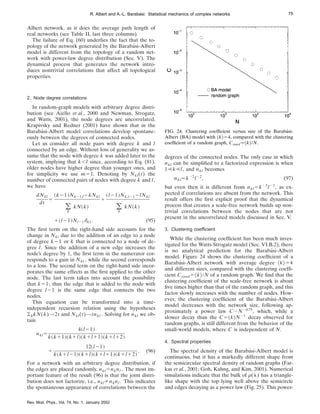
![law decay is due to the eigenvectors localized on the
nodes with the highest degree. As in the case of random
graphs (and unlike small-world networks), the principal
eigenvalue, l1 , is clearly separated from the bulk of the
spectrum. A lower bound for l1 can be given as the
square root of the network’s largest degree k1 . The
node degrees in the Barabási-Albert model increase as
N1/2
; hence l1 increases approximately as N1/4
. Numeri-
cal results indicate that l1 deviates from the expected
behavior for small network sizes, reaching it asymptoti-
cally for N→`. This crossover indicates the presence of
correlations between the longest row vectors, offering
additional evidence for correlations in the Barabási-
Albert model.
The principal eigenvalue plays an important role in
the moments of r(l), determining the loop structure of
the network. In contrast with the subcritical random
graph (i.e., p,1/N), where the fraction of loops be-
comes negligible, in a Barabási-Albert network the frac-
tion of loops with more than four edges increases with
N, and the growth rate of the loops increases with their
size. Note that the fraction of triangles decreases as N
→` (Bianconi, 2000b; Gleiss et al., 2001).
While for random graphs r(l) follows the semicircle
law (Wigner, 1955, 1957, 1958), deriving a similarly
simple expression for small-world (see Sec. VI.B.4) and
scale-free networks remains a considerable challenge.
VIII. THE THEORY OF EVOLVING NETWORKS
The Barabási-Albert model discussed in the previous
section is a minimal model that captures the mechanisms
responsible for the power-law degree distribution. Com-
pared to real networks, it has evident limitations: it pre-
dicts a power-law degree distribution with a fixed expo-
nent, while the exponents measured for real networks
vary between 1 and 3 (see Table II). In addition, the
degree distribution of real networks can have non-
power-law features such as exponential cutoffs (see
Amaral et al., 2000; Jeong, Mason, et al. 2001; Newman
2001b, 2001c) or saturation for small k. These discrep-
ancies between the model and real networks led to a
surge of interest in addressing several basic questions of
network evolution: How can we change the scaling ex-
ponents? Are there universality classes similar to those
seen in critical phenomena, characterized by unique ex-
ponents? How do various microscopic processes, known
to be present in real networks, influence the network
topology? Are there quantities beyond the degree distri-
bution that could help in classifying networks? While
the community is still in the process of answering these
questions, several robust results are already available.
These results signal the emergence of a self-consistent
theory of evolving networks, offering unprecedented in-
sights into network evolution and topology.
A. Preferential attachment P(k)
A central ingredient of all models aiming to generate
scale-free networks is preferential attachment, i.e., the
assumption that the likelihood of receiving new edges
increases with the node’s degree. The Barabási-Albert
model assumes that the probability P(k) that a node
attaches to node i is proportional to the degree k of
node i [see Eq. (78)]. This assumption involves two hy-
potheses: first, that P(k) depends on k, in contrast to
random graphs in which P(k)5p, and second, that the
functional form of P(k) is linear in k. The precise form
of P(k) is more than a purely academic question, as
recent studies have demonstrated that the degree distri-
bution depends strongly on P(k). To review these de-
velopments we start by discussing the empirical results
on the functional form of P(k), followed by the theo-
retical work predicting the effect of P(k) on the net-
work topology.
1. Measuring P(k) for real networks
The functional form of P(k) can be determined for
networks for which we know the time at which each
node joined the network (Jeong, Néda, and Barabási,
2001; Newman 2001d; Pastor-Satorras et al., 2001). Such
dynamical data are available for the co-authorship net-
work of researchers, the citation network of articles, the
actor collaboration network, and the Internet at the do-
main level (see Sec. II).
Consider the state of the network at a given time, and
record the number of ‘‘old’’ nodes present in the net-
work and their degrees. Next measure the increase in
the degree of the ‘‘old’’ nodes over a time interval DT,
much shorter than the age of the network. Then, accord-
ing to Eq. (78), plotting the relative increase Dki /Dk as
a function of the earlier degree ki for every node gives
the P(k) function. Here Dk is the number of edges
FIG. 25. Rescaled spectral density of three Barabási-Albert
networks having m5m055 and various sizes N: solid line, N
5100; long-dashed line, N5300; short-dashed line, N51000.
The semicircle law corresponding to random graphs is drawn
for comparison. The isolated peak corresponds to the largest
eigenvalue, which increases as N1/4
. Inset: the edge of the spec-
tral density decays as a power law. After Farkas et al. (2001).
76 R. Albert and A.-L. Barabási: Statistical mechanics of complex networks
Rev. Mod. Phys., Vol. 74, No. 1, January 2002](https://image.slidesharecdn.com/statisticalmechanicsofcomplexnetwork-250217073821-07ec0d15/85/Statistical_mechanics_of_complex_network-pdf-30-320.jpg)
![added to the network in the time DT. We can reduce
fluctuations in the data by plotting the cumulative distri-
bution
k~k!5 (
ki50
k
P~ki!. (98)
As Fig. 26 shows, the obtained P(k) supports the ex-
istence of preferential attachment. Furthermore, it ap-
pears that in each case P(k) follows a power law, i.e.,
P~k!;ka
. (99)
In some cases, such as the Internet (Jeong, Néda, and
Barabási, 2001; Pastor-Satorras et al., 2001), the citation
network (Jeong, Néda, and Barabási, 2001), Medline,
and the Los Alamos archive (Newman, 2001d) we have
a.1, i.e., P(k) depends linearly on k as assumed in the
Barabási-Albert model. For other networks the depen-
dence is sublinear, with a50.860.1 for the neuroscience
co-authorship and the actor collaboration networks
(Jeong, Néda, and Barabási, 2001).
2. Nonlinear preferential attachment
The effect of a nonlinear P(k) on the network dy-
namics and topology was explained by Krapivsky, Red-
ner, and Leyvraz (2000). Replacing linear preferential
attachment [Eq. (78)] with Eq. (99) in a directed net-
work model, Krapivsky, Redner, and Leyvraz calculate
the average number Nk(t) of nodes with k21 incoming
edges at time t by the rate-equation approach (see Sec.
VII.B). The time evolution of Nk(t) follows
dNk
dt
5
1
Ma
@~k21!a
Nk212ka
Nk#1dk1 , (100)
where Ma(t)5(ka
Nk(t) is the ath moment of Nk(t).
In Eq. (100) the first term accounts for new nodes that
connect to nodes with k21 edges, thus increasing their
degree to k. The second term describes new nodes con-
necting to nodes with k edges, turning them into nodes
with k11 edges and hence decreasing the number of
nodes with k edges. The third term accounts for the con-
tinuous introduction of new nodes with a single outgoing
edge.
Depending on the value of a, distinct phases have
been identified:
(a) Sublinear case (a,1): In this regime in the long-
time limit Ma(t) satisfies Ma(t)5mt, with a pre-
factor 1<m5m(a)<2. Substituting Ma(t) and Nk
into Eq. (100), we obtain the degree distribution
P~k!5
m
ka )
j51
k
S11
m
jaD21
. (101)
This product can be expanded in series, and the
result is a stretch exponential in which a new term
arises whenever a decreases below 1/l, where l is
an arbitrary positive integer.
(b) Superlinear preferential attachment (a.1): In this
regime Eq. (100) has no analytical solution, but its
discretized version can be used to determine recur-
sively the leading behavior of each Nk as t→`. For
a.2 a ‘‘winner-takes-all’’ phenomenon emerges,
such that almost all nodes have a single edge, con-
necting them to a ‘‘gel’’ node that has the rest of
the edges of the network. For 3/2,a,2 the num-
ber of nodes with two edges grows as t22a
, while
the number of nodes with more than two edges is
again finite. Again, the rest of the edges belong to
the gel node. In general for (l11)/l,a,l/(l21)
the number of nodes with more than l edges is fi-
nite even in infinite systems, while Nk;tk2(k21)a
for k<l.
In conclusion, the analytical calculations of Krapivsky,
Redner, and Leyvraz demonstrate that the scale-free na-
ture of the network is destroyed for nonlinear preferen-
tial attachment. The only case in which the topology of
the network is scale free is that in which the preferential
attachment is asymptotically linear, i.e., P(ki);a`ki as
ki→`. In this case the rate equation leads to
P~k!;k2g
with g511
m
a`
. (102)
This way the exponent of the degree distribution can be
tuned to any value between 2 and `.
3. Initial attractiveness
Another general feature of P(k) in real networks is
that P(0)Þ0, i.e., there is a nonzero probability that a
FIG. 26. Cumulative preferential attachment for (a) the cita-
tion network; (b) the Internet; (c) the neuroscience scientific
collaboration network; (d) the actor collaboration network. In
all panels the dashed line corresponds to linear preferential
attachment, and the solid line to no preferential attachment.
After Jeong, Néda, and Barabási (2001).
77
R. Albert and A.-L. Barabási: Statistical mechanics of complex networks
Rev. Mod. Phys., Vol. 74, No. 1, January 2002](https://image.slidesharecdn.com/statisticalmechanicsofcomplexnetwork-250217073821-07ec0d15/85/Statistical_mechanics_of_complex_network-pdf-31-320.jpg)

![such that for k!kc , P(k) follows a power law with ex-
ponent g51.5 and for k@kc the exponent is g53. This
result explains the fast-decaying tail of the degree distri-
butions measured by Newman (2001a), and it indicates
that as time increases the scaling behavior with g51.5
becomes increasingly visible. An equivalent model, pro-
posed by Dorogovtsev and Mendes (2001c), was able to
reproduce the two separate power-law regimes in the
distribution of word combinations (Ferrer i Cancho and
Solé, 2001).
C. Local events
The Barabási-Albert model incorporates only one
mechanism for network growth: the addition of new
nodes that connect to the nodes already in the system. In
real systems, however, a series of microscopic events
shape the network evolution, including the addition or
rewiring of new edges or the removal of nodes or edges.
Lately several models have been proposed to investigate
the effect of selected processes on the scale-free nature
of the degree distribution, offering a more realistic de-
scription of various real networks. Any local change in
the network topology can be obtained through a combi-
nation of four elementary processes: addition or re-
moval of a node and addition or removal of an edge. But
in reality these events come jointly; for example, the
rewiring of an edge is a combination of an edge removal
and addition. Next we briefly review several studies that
address in general terms the effects of local events on
network topology.
1. Internal edges and rewiring
A model that incorporates new edges between exist-
ing nodes and the rewiring of edges was discussed by
Albert and Barabási (2000). Starting with m0 isolated
nodes, at each time step we perform one of the following
three operations:
(i) With probability p we add m(m<m0) new edges.
One end of a new edge is selected randomly, the
other with probability
P~ki!5
ki11
(
j
~kj11!
. (108)
(ii) With probability q we rewire m edges. For this we
randomly select a node i and remove an edge lij
connected to it, replacing it with a new edge lij8
that connects i with node j8 chosen with probabil-
ity P(kj
8) given by Eq. (108).
(iii) With probability 12p2q we add a new node.
The new node has m new edges that with prob-
ability P(ki) are connected to nodes i already
present in the system.
In the continuum theory the growth rate of the degree
of a node i is given by
]ki
]t
5~p2q!m
1
N
1m
ki11
(
j
~kj11!
. (109)
The first term on the right-hand side corresponds to the
random selection of node i as a starting point of a new
edge (with probability p) or as the end point from which
an edge is disconnected (with probability q). The second
term corresponds to the selection of node i as an end
point of an edge with the preferential attachment
present in all three of the possible processes.
The solution of Eq. (109) has the form
ki~t!5@A~p,q,m!1m11#St
ti
D1/B(p,q,m)
2A~p,q,m!21, (110)
where
A~p,q,m!5~p2q!S2m~12q!
12p2q
11D,
B~p,q,m!5
2m~12q!112p2q
m
. (111)
The corresponding degree distribution has the gener-
alized power-law form
P~k!}@k1k~p,q,m!#2g(p,q,m)
, (112)
where k(p,q,m)5A(p,q,m)11 and g(p,q,m)
5B(p,q,m)11.
Equation (112) is valid only when A(p,q,m)1m11
.0, which, for fixed p and m, translates into q,qmax
5min$12p,(12p1m)/(112m)%. Thus the (p,q) phase
diagram separates into two regions: For q,qmax the de-
gree distribution is given by Eq. (112), following a gen-
eralized power law. For q.qmax , however, Eq. (112) is
not valid, but numerical simulations indicate that P(k)
approaches an exponential.
While a power-law tail is present in any point of the
scale-free regime, for small k the probability saturates at
P@k(p,q,m)#, a feature seen in many real networks
[Figs. 3(b) and (d)]. In addition, the exponent g(p,q,m)
characterizing the tail of P(k) for k@k(p,q) changes
continuously with p, q, and m, predicting a range of
exponents between 2 and `. The realistic nature of P(k)
was confirmed by successfully fitting it to the degree dis-
tribution of the actor collaboration network (Albert and
Barabási, 2000).
2. Internal edges and edge removal
Dorogovtsev and Mendes (2000c) consider a class of
undirected models in which new edges are added be-
tween old sites and existing edges can be removed. In
the first variant of the model, called a developing net-
work, c new edges are introduced at every time step,
which connect two unconnected nodes i and j with a
probability proportional to the product of their degrees
[as in Eq. (106)], an assumption confirmed by empirical
measurements on the co-authorship network (Barabási
79
R. Albert and A.-L. Barabási: Statistical mechanics of complex networks
Rev. Mod. Phys., Vol. 74, No. 1, January 2002](https://image.slidesharecdn.com/statisticalmechanicsofcomplexnetwork-250217073821-07ec0d15/85/Statistical_mechanics_of_complex_network-pdf-33-320.jpg)
![et al., 2001). It is assumed that c can be tuned continu-
ously, such that c.0 for a developing and c,0 for a
decaying network. The continuum theory predicts that
the rate of change of the node degrees has the form
]ki
]t
5
ki~t!
E0
t
kj~t!dtj
12c
ki~t!FE0
t
kj~t!dtj2ki~t!G
FE0
t
kj~t!dtjG2
2 E0
t
kj
2
~t!dtj
,
(113)
where the summation over all nodes (jkj has been ap-
proximated by an integral over all introduction times tj .
The first term on the right-hand side incorporates linear
preferential attachment, while the second term corre-
sponds to the addition of c new edges. Every node can
be at either end of the new edge, and the probability of
a node i becoming an end of the new edge is propor-
tional to the product of its degree ki and the sum of the
degrees kj of all other nodes. The normalization factor is
the sum of all products kikj with i different from j.
In the asymptotic limit the second term can be ne-
glected compared with the first term in both the numera-
tor and denominator, and Eq. (113) becomes
]ki
]t
5~112c!
ki~t!
E0
t
kj~t!dtj
, (114)
which predicts the dynamic exponent (81) as
b5
112c
2~11c!
(115)
and the degree exponent as
g521
1
112c
. (116)
The limiting cases of this developing network are c50
when the familiar Barabási-Albert values b51/2 and g
53 are obtained, and c→`, when b→1 and g→2.
In the decaying network at every time step ucu edges
are removed randomly. The decrease in the node de-
grees due to this process is proportional to their current
value, so Eq. (114) applies here as well, the only differ-
ence being that now c,0. A more rigorous calculation
accounting for the fact that only existing edges can be
removed confirms that the end result is identical with
Eqs. (115) and (116), only with negative c. The limiting
value of c is 21, since the rate of removal of edges
cannot be higher than the rate of addition of new nodes
and edges, leading to the limit exponents b→2` and
g→`.
D. Growth constraints
For many real networks the nodes have a finite life-
time (for example, in social networks) or a finite edge
capacity (Internet routers or nodes in the electrical
power grid). Recently several groups have addressed the
degree to which such constraints affect the degree distri-
bution.
1. Aging and cost
Amaral et al. (2000) suggested that while several net-
works do show deviations from the power-law behavior,
they are far from being random networks. For example,
the degree distribution of the electric power grid of
southern California and of the neural network of the
worm C. elegans is more consistent with a single-scale
exponential distribution. Other networks, like the ex-
tended actor collaboration network, in which TV films
and series are included, have a degree distribution in
which power-law scaling is followed by an exponential
cutoff for large k. In all these examples there are con-
straints limiting the addition of new edges. For example,
the actors have a finite active period during which they
are able to collect new edges, while for the electrical
power grid or neural networks there are constraints on
the total number of edges a particular node can have,
driven by economic, physical, or evolutionary reasons.
Amaral et al. propose that in order to explain these de-
viations from a pure power law we need to incorporate
FIG. 27. Deviation from a power law of the degree distribu-
tion due to adding (a) age and (b) capacity constraints to the
Barabási-Albert model. The constraints result in cutoffs of the
power-law scaling. After Amaral et al. (2000).
80 R. Albert and A.-L. Barabási: Statistical mechanics of complex networks
Rev. Mod. Phys., Vol. 74, No. 1, January 2002](https://image.slidesharecdn.com/statisticalmechanicsofcomplexnetwork-250217073821-07ec0d15/85/Statistical_mechanics_of_complex_network-pdf-34-320.jpg)
![aging and cost or capacity constraints. The model stud-
ied by them evolves following growth and preferential
attachment, but when a node reaches a certain age (ag-
ing) or has more than a critical number of edges (capac-
ity constraints), new edges cannot connect to it. In both
cases numerical simulations indicate that while for small
k the degree distribution still follows a power law, for
large k an exponential cutoff develops (Fig. 27).
2. Gradual aging
Dorogovtsev and Mendes (2000b) propose that in
some systems the probability that a new node connects
to a node i is not only proportional to the degree ki of
node i, but it also depends on its age, decaying as (t
2ti)2n
, where n is a tunable parameter. Papers or actors
gradually lose their ability to attract more edges, the
model assuming that this phaseout follows a power law.
The calculations predict that the degree distribution de-
pends on the exponent n: power-law scaling is present
only for n,1, and the degree exponent depends on n
(Fig. 28). Moreover, when n.1 power-law scaling com-
pletely disappears, the degree distribution approaching
an exponential.
E. Competition in evolving networks
The Barabási-Albert model assumes that all nodes in-
crease their degree following a power-law time depen-
dence with the same dynamic exponent b51/2 [Eq.
(81)]. As a consequence, the oldest nodes have the high-
est number of edges, since they had the longest lifetime
to accumulate them. However, numerous examples indi-
cate that in real networks a node’s degree and growth
rate do not depend on age alone. For example, on the
World Wide Web some documents acquire a large num-
ber of edges in a very short time through a combination
of good content and marketing (Adamic and Huberman,
2000), and some research papers acquire many more ci-
tations than their peers. Several studies have offered
models that address this phenomenon.
1. Fitness model
Bianconi and Barabási (2001a) argue that real net-
works have a competitive aspect, as each node has an
intrinsic ability to compete for edges at the expense of
other nodes. They propose a model in which each node
is assigned a fitness parameter hi which does not change
in time. Thus at every time step a new node j with a
fitness hj is added to the system, where hj is chosen from
a distribution r(h). Each new node connects with m
edges to the nodes already in the network, and the prob-
ability of connecting to a node i is proportional to the
degree and the fitness of node i,
Pi5
hiki
(
j
hjkj
. (117)
This generalized preferential attachment ensures that
even a relatively young node with a few edges can ac-
quire edges at a high rate if it has a high fitness param-
eter. The continuum theory predicts that the rate of
change of the degree of node i is
]ki
]t
5m
hiki
(
k
hjkj
. (118)
Assuming that the time evolution of ki follows Eq.
(81) with a fitness-dependent b(h),
khi
~t,ti!5mSt
ti
Db(hi)
, (119)
the dynamic exponent satisfies
FIG. 28. The dependence of the degree exponent g on the
aging exponent n in the model of Dorogovtsev and Mendes
(2000b). The points are obtained from simulations, while the
solid line is the prediction of the continuum theory. After Dor-
ogovtsev and Mendes (2000b).
FIG. 29. Time dependence of the degree kh(t), for nodes with
fitness h50.3, 0.6, and 0.9. Note that kh(t) follows a power
law in each case and the dynamic exponent b(h), given by the
slope of k(t), increases with h. After Bianconi and Barabási
(2000a).
81
R. Albert and A.-L. Barabási: Statistical mechanics of complex networks
Rev. Mod. Phys., Vol. 74, No. 1, January 2002](https://image.slidesharecdn.com/statisticalmechanicsofcomplexnetwork-250217073821-07ec0d15/85/Statistical_mechanics_of_complex_network-pdf-35-320.jpg)

![dN~k!
dt
5dk11
12r
M0
~Nk212Nk!1
r
M0
@~k22!Nk21
2~k21!Nk#. (125)
The first term corresponds to nodes that are just added
to the network. The second term indicates the random
selection of a node to which the new node will attach.
This process affects N(k) if this node has a degree k
21 [in which case its degree will become k, increasing
N(k)] or k [in which case N(k) decreases by one]. The
normalization factor M0 is the sum of all degrees. The
third term corresponds to the rewiring process. Since the
initial node is chosen uniformly, if redirection does oc-
cur, the probability that a node with k21 preexisting
edges will receive the redirected edge is proportional to
k22, the number of preexisting incoming edges. Thus
redirection also leads to a linear preferential attach-
ment.
This rate equation is equivalent with Eq. (100) with an
asymptotically linear attachment P(k);k2211/r.
Thus this model leads to a power-law degree distribution
with degree exponent g5111/r, which can be tuned to
any value larger than 2.
3. Walking on a network
The walking mechanism proposed by Vázquez (2000)
was inspired by citation networks. Entering a new field,
we are usually aware of a few important papers and fol-
low the references included in these to find other rel-
evant articles. This process is continued recursively, such
that a manuscript will contain references to papers dis-
covered this way. Vázquez formulates the corresponding
network algorithm in the following way: We start with
an isolated node. At every time step a new node is
added that links with a directed edge to a randomly se-
lected node, and then it follows the edges starting from
this node and links to their end points with probability
p. This last step is repeated starting from the nodes to
which connections were established, until no new target
node is found. In fact, this algorithm is similar to the
breadth-first search used in determining the cluster
structure of a network, with the exception that not all
edges are followed, but only a fraction equal to p. In the
special case of p51 one can see that nodes of high de-
gree will be more likely to acquire new incoming edges,
leading to a preferential attachment P(k)5(11k)/N.
Consequently, the degree distribution follows a power
law with g52. If p varies between 0 and 1, numerical
simulations indicate a phase transition: for p,pc.0.4
the degree distribution decays exponentially, while for
p.pc it has a power-law tail with g very close to 2, the
value corresponding to p51. Thus, while the model
does not explicitly include preferential attachment, the
mechanism responsible for creation of the edges induces
one.
4. Attaching to edges
Perhaps the simplest model of a scale-free network
without explicit preferential attachment was proposed
by Dorogovtsev, Mendes, and Samukhin (2001a). In this
model at every time step a new node connects to both
ends of a randomly selected edge. Consequently the
probability that a node will receive a new edge is di-
rectly proportional to its degree; in other words, this
model has exactly the same preferential attachment as
the Barabási-Albert model. It readily follows that the
degree distribution has the same asymptotic form as the
Barabási-Albert model, i.e., P(k);k23
.
The evolving network models presented in this section
attempt to capture the mechanisms that govern the evo-
lution of network topology (see Table III), guided by the
information contained in the degree distribution. Less is
known, however, about the clustering coefficients of
these models. Notable exceptions are the models of
Barabási et al. (2001; see also Sec. VIII.B) and Dor-
ogovtsev, Mendes, and Samukhin (2001a; see also Sec.
VIII.F). The clustering coefficient of the model of Bara-
bási et al. displays a complex behavior as the network
increases, first decreasing, going through a minimum,
then increasing again, while the model of Dorogovtsev,
Mendes, and Samukhin (2000d) has a constant
asymptotic clustering coefficient. These results suggest
that evolving network models can capture the high clus-
tering coefficients of real networks.
G. Connection to other problems in statistical mechanics
The modeling of complex networks has offered fertile
ground for statistical mechanics. Indeed, many advances
in our understanding of the scaling properties of both
small-world and evolving networks have benefited from
concepts ranging from critical phenomena to nucleation
theory and gelation. On the other hand, there appears to
be another close link between statistical mechanics and
evolving networks: the continuum theories proposed to
predict the degree distribution can be mapped, often ex-
actly, onto some well-known problems investigated in
statistical physics. In the following we shall discuss two
such mappings, relating evolving networks to the Simon
model (Simon, 1955; see Amaral et al., 2000; Bornholdt
and Ebel, 2001) and to a Bose gas (Bianconi and Bara-
bási, 2001b).
1. The Simon model
Aiming to account for the wide range of empirical
distributions following a power law, such as the fre-
quency of word occurrences (Zipf, 1949), the number of
articles published by scientists (Lotka, 1926), the popu-
lations of cities (Zipf, 1949), or the distribution of in-
comes (Pareto, 1898), Simon (1955) proposed a class of
stochastic models that result in a power-law distribution
function. The simplest variant of the Simon model, de-
scribed in terms of word frequencies, has the following
algorithm: Consider a book that is being written and has
reached a length of N words. Denote by fN(i) the num-
ber of different words that each occurred exactly i times
in the text. Thus fN(1) denotes the number of different
words that have occurred only once. The text is contin-
83
R. Albert and A.-L. Barabási: Statistical mechanics of complex networks
Rev. Mod. Phys., Vol. 74, No. 1, January 2002](https://image.slidesharecdn.com/statisticalmechanicsofcomplexnetwork-250217073821-07ec0d15/85/Statistical_mechanics_of_complex_network-pdf-37-320.jpg)

![(a) With probability p a new node is added, and a ran-
domly selected node will point to the new node.
(b) With probability 12p a directed edge between two
existing nodes is added. The starting point of this
edge is selected randomly, while its end point is
selected such that the probability that a node be-
longing to the Nk nodes with k incoming edges will
be chosen is
P~class k!}kNk . (126)
To appreciate the nature of this mapping, we need to
clarify several issues:
(1) While Eq. (126) represents a form of the ‘‘rich-get-
richer’’ phenomenon, it does not imply preferential
attachment [Eq. (78)] as used in various evolving
network models. However, Eq. (78) implies Eq.
(126). Thus the Simon model describes a general
class of stochastic processes that can result in a
power-law distribution, appropriate to capture
Pareto and Zipf’s laws.
(2) The interest in evolving network models comes from
their ability to describe the topology of complex net-
works. The Simon model does not have an underly-
ing network structure, as it was designed to describe
events whose frequency follows a power law. Thus
network measures going beyond the degree distribu-
tion, such as the average path length, spectral prop-
erties, or clustering coefficient, cannot be obtained
from this mapping.
(3) The mapping described above leads to a directed
network with internal edges, different from the
Barabási-Albert model. However, it is close to the
model proposed by Dorogovtsev, Mendes, and Sam-
ukhin (2000a, 2000b) discussed in Sec. VIII.A.3,
with the only difference being that here the initial
attractiveness is present only for the isolated nodes.
Since Eq. (126) corresponds to an asymptotically
linear preferential attachment, a correspondence
can be made with the model of Krapivsky, Redner,
and Leyvraz (2000) as well.
2. Bose-Einstein condensation
Bianconi and Barabási (2001b) show the existence of
a close link between evolving networks and an equilib-
rium Bose gas. Starting with the fitness model intro-
duced in Sec. VIII.E.1, the mapping to a Bose gas can be
done by assigning an energy ei to each node, determined
by its fitness through the relation
ei52
1
b
ln hi , (127)
where b51/T plays the role of inverse temperature. An
edge between two nodes i and j, having energies ei and
ej , corresponds to two noninteracting particles, one on
each energy level (see Fig. 30). Adding a new node l to
the network corresponds to adding a new energy level el
and 2m new particles to the system. Half of these par-
ticles are deposited on the level el (since all new edges
start from the new node), while the other half are dis-
tributed between the energy levels of the end points of
the new edges, the probability that a particle lands on
level i being given by
Pi5
e2beiki
( e2beiki
. (128)
The continuum theory predicts that the rate at which
particles accumulate on energy level ei is given by
]ki~ei ,t,ti!
]t
5m
e2beiki~ei ,t,ti!
Zt
, (129)
where ki(ei ,t,ti) is the occupation number of level i and
Zt is the partition function, defined as Zt
5(j51te2bejkj(ej ,t,tj). The solution of Eq. (129) is
ki~ei ,t,ti!5mSt
ti
Df(ei)
, (130)
where the dynamic exponent f(e) satisfies f(e)
5e2b(e2m)
, m plays the role of the chemical potential,
satisfying the equation
FIG. 30. Fitness and mapping between the network model and
the Bose gas: (a) On the left we have a network of five nodes,
each characterized by a fitness hi . Equation (127) assigns an
energy ei to each hi (right). An edge from node i to node j
corresponds to a particle at level ei and one at ej . The network
evolves by adding a new node (dashed circle, h6), which con-
nects to m52 other nodes (dashed lines), chosen following Eq.
(78). In the gas this results in the addition of a new energy
level (e6 , dashed) populated by m52 new particles (s), and
the deposition of m52 other particles to energy levels to
which the new node is connected (e2 and e5). (b) In the fit-
get-rich (FGR) phase we have a continuous degree distribu-
tion, the several high-degree nodes linking the low-degree
nodes together. In the energy diagram this corresponds to a
decreasing occupation number with increasing energy. (c) In
the Bose-Einstein condensate the fittest node attracts a finite
fraction of all edges, corresponding to a highly populated
ground level and sparsely populated higher energies. After Bi-
anconi and Barabási (2001b).
85
R. Albert and A.-L. Barabási: Statistical mechanics of complex networks
Rev. Mod. Phys., Vol. 74, No. 1, January 2002](https://image.slidesharecdn.com/statisticalmechanicsofcomplexnetwork-250217073821-07ec0d15/85/Statistical_mechanics_of_complex_network-pdf-39-320.jpg)
![E deg~e!
1
eb(e2m)
21
51, (131)
and deg(e) is the degeneracy of the energy level e.
Equation (131) suggests that in the t→` limit the occu-
pation number, giving the number of particles with en-
ergy e, follows the familiar Bose statistics
n~e!5
1
eb(e2m)
21
. (132)
The existence of the solution (130) depends on the
functional form of the distribution g(e) of the energy
levels, determined by the r(h) fitness distribution (see
Sec. VIII.E.1). Specifically, if Eq. (131) has no non-
negative solution for a given g(e) and b, we can observe
a Bose-Einstein condensation, indicating that a finite
fraction of the particles condens on the lowest energy
level [see Fig. 30(c)].
This mapping to a Bose gas predicts the existence of
two distinct phases as a function of the energy distribu-
tion. In the fit-get-rich phase, describing the case of uni-
form fitness discussed in Sec. VIII.E.1, the fitter nodes
acquire edges at a higher rate than older but less fit
nodes. In the end the fittest node will have the most
edges, but the richest node is not an absolute winner,
since its share of the edges (i.e., the ratio of its edges and
the total number of edges in the network) decays to zero
for large system sizes [Fig. 30(b)]. The unexpected out-
come of this mapping is the possibility of Bose-Einstein
condensation for T,TBE , when the fittest node ac-
quires a finite fraction of the edges and maintains this
share of edges over time [Fig. 30(c)]. A representative
fitness distribution that leads to condensation is r(h)
5(12h)l
with l.1.
The temperature in Eq. (127) plays the role of a
dummy variable, since if we define a fixed distribution
r(h), the existence of Bose-Einstein condensation or
the fit-get-rich phase depends only on the functional
form of r(h) and is independent of b. Indeed, b falls out
at the end from all topologically relevant quantities. As
Dorogovtsev and Mendes (2001b) have subsequently
shown, the existence of Bose-Einstein condensation can
be derived directly from the fitness model, without em-
ploying the mapping to a Bose gas. While the condensa-
tion phenomenon appears to be similar to the gelation
process observed by Krapivsky, Redner, and Leyvraz,
(2000) in the case of superlinear preferential attach-
ment, it is not clear at this point if this similarity is
purely accidental or if there is a deeper connection be-
tween the fitness model and the fitness-free superlinear
model.
IX. ERROR AND ATTACK TOLERANCE
Many complex systems display a surprising degree of
tolerance for errors (Albert, Jeong, and Barabási, 2000).
For example, relatively simple organisms grow, persist,
and reproduce despite drastic pharmaceutical or envi-
ronmental interventions, an error tolerance attributed to
the robustness of the underlying metabolic and genetic
network (Jeong et al., 2000; Jeong, Mason, et al., 2001).
Complex communication networks display a high degree
of robustness: while key components regularly malfunc-
tion, local failures rarely lead to loss of the global
information-carrying ability of the network. The stability
of these and other complex systems is often attributed to
the redundant wiring of their underlying network struc-
ture. But could the network topology, beyond redun-
dancy, play a role in the error tolerance of such complex
systems?
While error tolerance and robustness almost always
have a dynamical component, here we shall focus only
on the topological aspects of robustness, caused by edge
and/or node removal. The first results regarding network
reliability when subjected to edge removal came from
random-graph theory (Moore and Shannon, 1956a,
1956b; Margulis, 1974; Bollobás, 1985). Consider an ar-
bitrary connected graph HN of N nodes, and assume
that a p fraction of the edges have been removed. What
is the probability that the resulting subgraph is con-
nected, and how does it depend on the removal prob-
ability p? For a broad class of starting graphs HN (Mar-
gulis, 1974) there exists a threshold probability pc(N)
such that if p,pc(N) the subgraph is connected, but if
p.pc(N) it is disconnected. This phenomenon is in fact
an inverse bond percolation problem defined on a graph,
with the slight difference (already encountered in the
evolution of a random graph) that the critical probabil-
ity depends on N.
As the removal of a node implies the malfunctioning
of all of its edges as well, node removal inflicts more
damage than edge removal. Does a threshold phenom-
enon appear for node removal too? And to what degree
does the topology of the network determine the net-
work’s robustness? In the following we shall call a net-
work error tolerant (or robust) if it contains a giant clus-
ter comprised of most of the nodes even after a fraction
of its nodes are removed. The results indicate a strong
correlation between robustness and network topology.
In particular, scale-free networks are more robust than
random networks against random node failures, but are
more vulnerable when the most connected nodes are
targeted (Albert, Jeong, and Barabási, 2000).
A. Numerical results
In the first study comparing the robustness of the
Erdős-Rényi random graph and a scale-free network
generated by the Barabási-Albert model, Albert, Jeong,
and Barabási (2000) investigated networks that have the
same number of nodes and edges, differing only in the
degree distribution. Two types of node removal were
considered. Random perturbations can cause the failure
of some nodes; thus the first mechanism studied was the
removal of randomly selected nodes. The second mecha-
nism, in which the most highly connected nodes are re-
moved at each step, was selected because it is the most
damaging to the integrity of the system. This second
choice emulates an intentional attack on the network.
86 R. Albert and A.-L. Barabási: Statistical mechanics of complex networks
Rev. Mod. Phys., Vol. 74, No. 1, January 2002](https://image.slidesharecdn.com/statisticalmechanicsofcomplexnetwork-250217073821-07ec0d15/85/Statistical_mechanics_of_complex_network-pdf-40-320.jpg)
![Let us start from a connected network, and at each
time step remove a node. The disappearance of the node
implies the removal of all edges that connect to it, dis-
rupting some of the paths between the remaining nodes
(Fig. 31). One way to monitor the disruption of an ini-
tially connected network is to study the relative size of
the largest cluster that remains connected, S, and the
average path length l of this cluster, as a function of the
fraction f of the nodes removed from the system. We
expect that the size of the largest cluster will decrease
and its average path length increase as an increasing
number of nodes are removed from the network.
1. Random network, random node removal
We start by investigating the response of a random
network to the random removal of its nodes [see Fig.
32(a), h], looking at the changes in the relative size of
the largest cluster S (i.e., the fraction of nodes contained
in the largest cluster) and its average path length l as an
increasing number of nodes are randomly removed.
As expected, for a random network, the size S of the
largest cluster decreases from S51 as f increases. If only
the removed nodes were missing from the largest cluster,
S would follow the diagonal corresponding to S51 for
f50 and S50 for f51. While for small f, S follows this
line, as f increases the decrease becomes more rapid,
indicating that clusters of nodes become isolated from
the main cluster. At a critical fraction fc , S drops to 0,
indicating that the network breaks into tiny isolated
clusters. These numerical results indicate an inverse per-
colation transition. Indeed, percolation theory can be
used to calculate the critical fraction fc (Sec. IX.B).
The behavior of the average path length l also con-
firms this percolationlike transition: it starts from a value
characteristic of an unperturbed random graph, in-
creases with f as paths are disrupted in the network, and
peaks at fc [Fig. 32(c), filled squares]. After the network
breaks into isolated clusters, l decreases as well, since in
this regime the size of the largest cluster decreases very
rapidly.
When f is small we can use the prediction of random-
graph theory, Eq. (16), indicating that l scales as
ln(SN)/ln(^k&), where ^k& is the average degree of the
largest cluster (Sec. IV.G). Since the number of edges
decreases more rapidly than the number of nodes during
node removal (the disruption of each node inducing the
disruption of several edges), ^k& decreases faster with
increasing f than SN, and consequently l increases.
However, for f.fc the prediction of percolation theory
becomes valid, and Eq. (44) indicates that l no longer
depends on ^k& and decreases with S.
2. Scale-free network, random node removal
While a random network undergoes an inverse perco-
lation transition when a critical fraction of its nodes are
randomly removed, the situation is dramatically differ-
ent for a Barabási-Albert network [Figs. 32(b) and (d),
square datapoints]. Simulations indicate that while the
size of the largest cluster decreases, it reaches 0 at a
higher f. At the same time, l increases much more
slowly than in the random case, and its peak is much less
prominent. The behavior of the system still suggests a
percolation transition, but analytical calculations indi-
cate that this is merely a finite size effect, and fc→1 for
a scale-free network as the size of the network increases
(Sec. IX.B). In simple terms, scale-free networks display
an exceptional robustness against random node failures.
3. Preferential node removal
In the case of an intentional attack, when the nodes
with the highest number of edges are targeted, the net-
work breaks down faster than in the case of random
node removal. The general breakdown scenario again
follows an inverse percolation transition, but now the
critical fraction is much lower than in the random case.
FIG. 31. Illustration of the effects of node removal on an ini-
tially connected network. In the unperturbed state the distance
between nodes A and B is 2, but after two nodes are removed
from the system, it increases to 6. At the same time the net-
work breaks into five isolated clusters.
FIG. 32. The relative size S (a),(b) and average path length l
(c),(d) of the largest cluster in an initially connected network
when a fraction f of the nodes are removed. (a),(c) Erdős-
Rényi random network with N510 000 and ^k&54; (b),(d)
scale-free network generated by the Barabási-Albert model
with N510 000 and ^k&54. h, random node removal; s, pref-
erential removal of the most connected nodes. After Albert,
Jeong, and Barabási (2000).
87
R. Albert and A.-L. Barabási: Statistical mechanics of complex networks
Rev. Mod. Phys., Vol. 74, No. 1, January 2002](https://image.slidesharecdn.com/statisticalmechanicsofcomplexnetwork-250217073821-07ec0d15/85/Statistical_mechanics_of_complex_network-pdf-41-320.jpg)
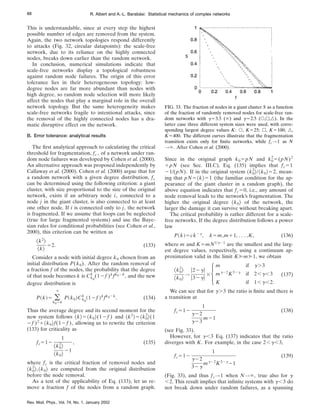

![The removal of a fraction f of the most connected nodes
results in a random removal of a fraction f̃ of edges from
the remaining nodes. The probability that an edge leads
to a deleted node equals the fraction of edges belonging
to deleted nodes,
f̃5
(
k5K
˜
K
kP~k!
^k0&
5f(22g)/(12g)
, (147)
for g.2. We can see that in the limit g→2 any nonzero
f will lead to f̃→1 and thus to the breakdown of the
whole network. Even in a finite network, where the up-
per cutoff of Eq. (145) is K.N, in the limit g52, f̃
5ln(Nf/m), thus very small f values can lead to the de-
struction of a large fraction of the edges.
Since for random node deletion the probability of an
edge’s leading to a deleted node equals the fraction of
deleted nodes, Cohen et al. (2001) argue that the net-
work after undergoing an attack is equivalent to a scale-
free network with cutoff K̃ that has undergone random
removal of a fraction f̃ of its nodes. Replacing f with f̃
and K with K̃ in Eq. (135), we obtain the following
equation for K̃:
SK̃
m
D22g
225
22g
32g
mFSK̃
m
D32g
21G. (148)
This equation can be solved numerically to obtain K̃
as a function of m and g, and fc(m,g) can then be de-
termined from Eq. (146). The results indicate that a
breakdown phase transition exists for g.2, and fc is
very small for all g values, on the order of a few percent.
An interesting feature of the fc(g) curve is that it has a
maximum around g52.25. It is not surprising that
smaller g values lead to increased vulnerability to at-
tacks due to the special role the highly connected nodes
play in connecting the system. However, Cohen et al.
(2001) argue that the cause of the increased susceptibil-
ity of high g networks is that for these even the original
network is formed by several independent clusters, and
the size of the largest cluster decreases with increasing g.
Indeed, the results of Aiello, Chung, and Lu (2000; see
also Sec. V) indicate that for 2,g,3.478 the original
network contains an infinite cluster and several smaller
clusters of size at most ln N, and for g.3.478 the origi-
nal network has no infinite cluster.
D. The robustness of real networks
Systematic studies of the error and attack tolerance of
real networks are available for three systems highly rel-
evant to science and technology.
1. Communication networks
The error and attack tolerance of the Internet and the
World Wide Web was investigated by Albert, Jeong, and
Barabási (2000). Of the two networks, the Internet’s ro-
bustness has more practical significance, as about 0.3%
of the routers regularly malfunction (random errors),
and the Internet is occasionally subject to hacker attacks
targeting some of the most connected nodes. The re-
sults, based on the latest map of the Internet topology at
the interdomain (autonomous system) level, indicate
that the average path length on the Internet is unaf-
fected by the random removal of as many as 60% of the
nodes, while if the most connected nodes are eliminated
(attack), l peaks at a very small f [Fig. 35(a)]. Similarly,
the large connected cluster persists for high rates of ran-
dom node removal, but if nodes are removed in the at-
tack mode, the size of the fragments that break off in-
creases rapidly, the critical point appearing at a very
small threshold, fc
I
.0.03 [Fig. 35(c)].
The World Wide Web study was limited to a subset of
the web containing 325 729 nodes, the sample investi-
gated in Albert, Jeong, and Barabási (1999). As the
World Wide Web is directed, not all nodes can be
reached from all nodes, even for the starting network.
To resolve this problem, only distances between nodes
that had a path between them were included in the av-
erage distance between nodes. Second, directed net-
works cannot be separated into clusters unambiguously:
two nodes can be seen as part of the same cluster when
starting from a certain node, yet they appear to be in
separate clusters when starting from another. Hence the
number of independent clusters was ambiguous, but the
largest cluster could still be determined. Third, when
simulating an attack on the World Wide Web, the nodes
with the highest number of outgoing edges were re-
moved, since kout can be readily obtained by looking at
a web document, while kin can only be determined from
FIG. 35. The relative size S (a),(b) and average path length l
(c),(d) of the largest cluster in two communication networks
when a fraction f of the nodes are removed: (a),(c) Internet at
the domain level, N56209, ^k&53.93; (b),(d) subset of the
World Wide Web (WWW) with N5325 729 and ^k&54.59. h,
random node removal; s, preferential removal of the most
connected nodes. After Albert, Jeong, and Barabási (2000).
90 R. Albert and A.-L. Barabási: Statistical mechanics of complex networks
Rev. Mod. Phys., Vol. 74, No. 1, January 2002](https://image.slidesharecdn.com/statisticalmechanicsofcomplexnetwork-250217073821-07ec0d15/85/Statistical_mechanics_of_complex_network-pdf-44-320.jpg)
![a map of the whole web. Despite these methodological
differences, the response of the World Wide Web is simi-
lar to that of the undirected networks: after a slight ini-
tial increase, l remains constant in the case of random
failures [Fig. 35(b)], while it increases for attacks. The
network survives as a large cluster under high rates of
failure, but under attack the system abruptly falls apart
at fc
w
50.067 [Fig. 35(d)].
2. Cellular networks
Cellular networks can be subject to random errors as
a result of mutations or protein misfolding, as well as
harsh external conditions eliminating essential metabo-
lites. Jeong et al. (2000) studied the responses of the
metabolic networks of several organisms to random and
preferential node removal. Removing up to 8% of the
substrates, they found that the average path length did
not increase when nodes were removed randomly, but it
increased rapidly upon removal of the most-connected
nodes, attaining a 500% increase with the removal of
only 8% of the nodes. Similar results have been ob-
tained for the protein network of yeast as well (Jeong,
Mason, et al., 2001; see also Vogelstein, Lane, and Le-
vine 2000).
3. Ecological networks
As a result of human actions or environmental
changes, species are deleted from food webs, an issue of
major concern for ecology and environmental science.
Solé and Montoya (2001) studied the response of the
food webs discussed in Sec. II to the removal of species
(nodes; Montoya and Solé, 2000). The authors measured
the relative size S of the largest cluster, the average size
^s& of the rest of the species clusters, and the fraction of
species becoming isolated due to the removal of other
species on whom their survival depended (secondary ex-
tinctions). The results indicate that random species re-
moval causes the fraction of species contained in the
largest cluster to decrease linearly. At the same time the
values of ^s& remain 0 or 1, and the secondary extinction
rates remain very low (smaller than 0.1) even when a
high fraction of the nodes is removed. The estimate of
Eq. (135) for the critical fraction at which the network
fragments gives fc
fail
values around 0.95 for all networks,
indicating that these networks are error tolerant. How-
ever, when the most connected (keystone) species are
successively removed, S decays quickly and becomes
zero at fc
attack
.0.2, while ^s& peaks. The secondary ex-
tinctions increase dramatically, reaching 1 at relatively
low values of f (f.0.16 for the Silwood Park web).
The results presented in this section offer a simple but
compelling picture: scale-free networks display a high
degree of robustness against random errors, coupled
with a susceptibility to attacks. This double feature is the
result of the heterogeneity of the network topology, en-
coded by the power-law degree distribution. While we
focused on two measures only, S and l , it is likely that
most network measures will show distinct behavior for
scale-free and random networks.
The types of disturbances we considered were static,
that is, the removal of a node affected other nodes only
in the topological sense. However, in many networks
there is a dynamical aspect to error tolerance: the re-
moval of a node could affect the functionality of other
nodes as well. For example, the removal of a highly con-
nected router on the Internet will redirect traffic to
other routers that may not have the capacity to handle
the increased traffic, creating an effective denial of ser-
vice. Thus in many systems errors lead to cascading fail-
ures, affecting a large fraction of the network. While
little is known about such events, Watts (2000) has re-
cently shown that the network topology makes a big dif-
ference under cascading failures as well. He investigated
a binary model in which the state of a node changed
from off to on if a threshold fraction of its neighbors
were on. In this model the probability that a perturba-
tion in an initially all-off state will spread to the entire
network can be connected to the existence of a giant
cluster of vulnerable nodes. Using the method of gener-
ating functions, Watts (2000) showed that scale-free ran-
dom graphs are much less vulnerable to random pertur-
bations than are Erdős-Rényi random graphs with the
same average degree.
It is often assumed that the robustness of many com-
plex systems is rooted in their redundancy, which for
networks represents the existence of many alternative
paths that can preserve communication between nodes
even if some nodes are absent. We are not aware of any
research that would attempt to address this issue in
quantitative terms, uncovering the degree to which re-
dundancy plays a role.
X. OUTLOOK
The field of complex networks is rapidly evolving.
While the potential for new and important discoveries is
high, the field has attained a degree of coherence that
made a review necessary and appropriate. The fact that
the obtained results have reached a critical mass is best
illustrated by the amount of work that had to be omitted
from this review for lack of space. Being forced to make
a choice, we focused on the mechanisms and models that
describe network topology. In the following we briefly
discuss some results that could not be covered in this
approach but that are important for the field. In many
ways work in these areas is as important as the work
covered so far.
A. Dynamical processes on networks
Most networks offer support for various dynamical
processes, and often the topology plays a crucial role in
determining the system’s dynamical features. The range
of possible dynamical processes is wide. Watts (1999)
studied the impact of clustering on several processes,
including games, cooperation, the Prisoner’s Dilemma,
cellular automata, and synchronization (see also Lago-
Fernández et al., 2001). Wang and Chen (2001) have
shown that the inhomogeneous scale-free topology plays
91
R. Albert and A.-L. Barabási: Statistical mechanics of complex networks
Rev. Mod. Phys., Vol. 74, No. 1, January 2002](https://image.slidesharecdn.com/statisticalmechanicsofcomplexnetwork-250217073821-07ec0d15/85/Statistical_mechanics_of_complex_network-pdf-45-320.jpg)


