
Some random graphs for network models  Birgit Plötzeneder
Bell-shaped node degree distributions
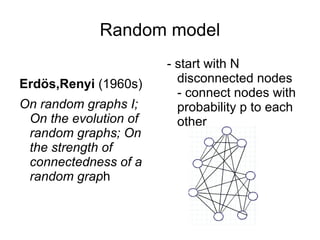
Random model Erdös,Renyi  (1960s) On random graphs I; On the evolution of random graphs; On the strength of connectedness of a random grap h - start with N disconnected nodes - connect nodes with probability p to each other
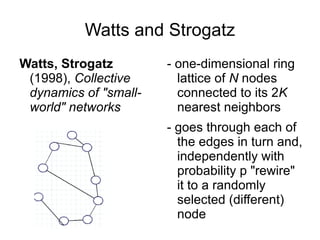
Watts and Strogatz Watts, Strogatz  (1998),  Collective dynamics of "small-world" networks - one-dimensional ring lattice of  N  nodes connected to its 2 K  nearest neighbors  - goes through each of the edges in turn and, independently with probability p "rewire" it to a randomly selected (different) node
Watts and Strogatz - average distance grows like O(log(N) and not  O(N).  - support high levels of clustering „ The small-world effect (short average distance between nodes and high levelsof clustering) has been detected in networks that include a network of actors in Hollywood, the power generator network in the western US...“ Gerardo Chowell and Carlos Castillo-Chavez,  Worst-Case Scenarios and Epidemics
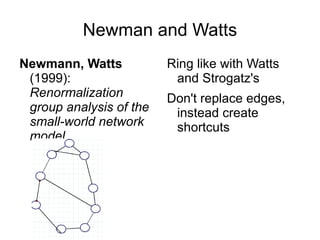
Newman and Watts Newmann, Watts  (1999):  Renormalization group analysis of the small-world  network model , Ring like with  Watts and Strogatz's
Don't replace edges, instead create shortcuts
Power-law degree distributions  = Pareto distributions
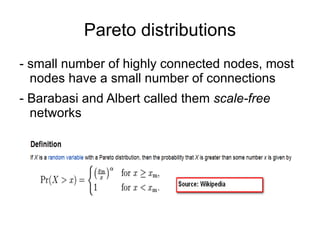
Pareto distributions - small number of highly connected nodes, most nodes have a small number of connections - Barabasi and Albert called them  scale-free  networks
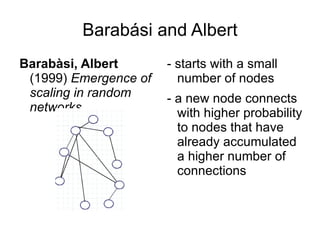
Barabási and Albert Barabàsi, Albert  (1999)  Emergence of scaling in random networks - starts with a small number of nodes - a new node connects with higher probability to nodes that have already accumulated a higher number of connections
Klemm and Eguíluz " When a node is created it is linked to nodes that are popular at the time. It then receives links from nodes created subsequently, he said. "This continues until eventually the node under consideration loses its popularity."  From:  http://ifisc.uib-csic.es/victor/Nets/trn.html
Klemm, Eguíluz  (2002)  Growing scale-free networks with small-world behavior

Some random graphs for network models - Birgit Plötzeneder

  • 1.
    Some random graphsfor network models Birgit Plötzeneder
  • 2.
  • 3.
    Random model Erdös,Renyi (1960s) On random graphs I; On the evolution of random graphs; On the strength of connectedness of a random grap h - start with N disconnected nodes - connect nodes with probability p to each other
  • 4.
    Watts and StrogatzWatts, Strogatz (1998), Collective dynamics of "small-world" networks - one-dimensional ring lattice of N nodes connected to its 2 K nearest neighbors - goes through each of the edges in turn and, independently with probability p "rewire" it to a randomly selected (different) node
  • 5.
    Watts and Strogatz- average distance grows like O(log(N) and not O(N). - support high levels of clustering „ The small-world effect (short average distance between nodes and high levelsof clustering) has been detected in networks that include a network of actors in Hollywood, the power generator network in the western US...“ Gerardo Chowell and Carlos Castillo-Chavez, Worst-Case Scenarios and Epidemics
  • 6.
    Newman and WattsNewmann, Watts (1999): Renormalization group analysis of the small-world network model , Ring like with Watts and Strogatz's
  • 7.
    Don't replace edges,instead create shortcuts
  • 8.
    Power-law degree distributions = Pareto distributions
  • 9.
    Pareto distributions -small number of highly connected nodes, most nodes have a small number of connections - Barabasi and Albert called them scale-free networks
  • 10.
    Barabási and AlbertBarabàsi, Albert (1999) Emergence of scaling in random networks - starts with a small number of nodes - a new node connects with higher probability to nodes that have already accumulated a higher number of connections
  • 11.
    Klemm and Eguíluz" When a node is created it is linked to nodes that are popular at the time. It then receives links from nodes created subsequently, he said. "This continues until eventually the node under consideration loses its popularity." From: http://ifisc.uib-csic.es/victor/Nets/trn.html
  • 12.
    Klemm, Eguíluz (2002) Growing scale-free networks with small-world behavior