Randomized Graph Algorithms-
Techniques and Analysis
CS5443-Advanced Discrete Optimization and networks
Presented by:
Venkat Sai Sharath Chandra Mudhigonda
5/5/2017
Table of Contents
•INTRODUCTION
•A LINEAR TIME MST
•GLOBAL MINCUT
•APPROXIMATE DISTANCE ORACLES
INTRODUCTION
A random graph is obtained by starting with a set of n isolated vertices and adding successive
edges between them at random.
The aim of the study in this field is to determine at what stage a particular property of the
graph is likely to arise.
The results of the graphs are obtained by analyzing the expected performance of an algorithm
on a random instance of the graph Gn,p , a class of graphs with n vertices where each of the
n(n-1)/2 edges occur with probability p.
A LINEAR TIME MST
• The basic idea for obtaining a faster algorithm for MST(minimum spanning tree ) is very intuitive
•We first randomly sample a set of edges S ⊂ E and construct a minimum spanning forest F.
•We can filter edges using F such that there should not be heaviest edge in any cycle belonging
to the final MST
•The algorithm relies on techniques from Boruvka's algorithm along with an algorithm for
verifying a minimum spanning tree in linear time.It combines the design paradigms of divide and
conquer algorithms, greedy algorithms, and randomized algorithms to achieve expected linear
performance.
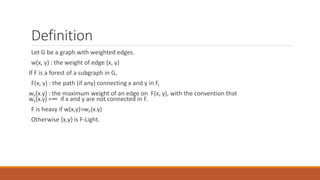
Definition
Let G be a graph with weighted edges.
w(x, y) : the weight of edge {x, y}
If F is a forest of a subgraph in G,
F(x, y) : the path (if any) connecting x and y in F,
wF(x.y) : the maximum weight of an edge on F(x, y), with the convention that
wF(x.y) =∞ if x and y are not connected in F.
F is heavy if w(x,y)>wF(x.y)
Otherwise {x,y} is F-Light.
To obtain a linear MST we need to follow two steps:
1. Boruvka Step
2. F-heavy and F-light edges
BORVUKA STEP
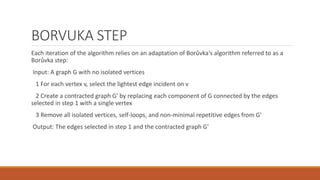
Each iteration of the algorithm relies on an adaptation of Borůvka's algorithm referred to as a
Borůvka step:
Input: A graph G with no isolated vertices
1 For each vertex v, select the lightest edge incident on v
2 Create a contracted graph G' by replacing each component of G connected by the edges
selected in step 1 with a single vertex
3 Remove all isolated vertices, self-loops, and non-minimal repetitive edges from G'
Output: The edges selected in step 1 and the contracted graph G'
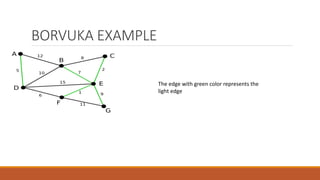
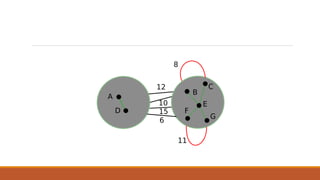
BORVUKA EXAMPLE
The edge with green color represents the
light edge
BORVUKA EXAMPLE
F-LIGHT AND F-HEAVY edges
•In each iteration the algorithm removes edges with particular properties that exclude them from
the minimum spanning tree. These are called F-heavy edges and are defined as follows.
•Let F be a forest on the graph H. An F-heavy edge is an edge e connecting vertices u,v whose
weight is strictly greater than the weight of the heaviest edge on the path from u to v in F.
•Any edge that is not F-heavy is F-light. If H is a subgraph of G then any F-heavy edge in G cannot
be in the minimum spanning tree of G by the cycle property.
Complexity
•For Every Contraction the vertex V is contracted to V/2
•After two rounds the vertex is contracted to V/4 in each round t takes O(|E|) time.
•This algorithm stores the vertices in binary recursive tree.
•At level d there are 2 𝑑−1 𝑛𝑜𝑑𝑒𝑠 𝑒𝑎𝑐ℎ 𝑤𝑖𝑡ℎ 2(n3ℎ 𝑑)edges that yields a total of 𝛴 𝑑
n
2 𝑑
•Therefore Maximal left path starting from these have a total of twice in this quantity that is n.
•So overall number of edges in all subproblems combined is O(m+n).
Global MINCUT
A cut of given(connected) graph G=(V,E) is a set of edges t that when removed disconnects the
graph
A mincut is the minimum number of edges that disconnects a graph and is sometimes referred
to as global mincut to distinguish from s-t mincut.
There have been some improved reductions to s-t mincut other than max flow algorithm over
years.
Karger developed faster algorithm (than maxflow) to compute mincut with high probability..The
algorithm produce a cut which is very likely to be a mincut.
Contraction Algorithm
The fundamental operation contract(v1,v2) replaces the vertices v1 and v2 with a new vertex v
The new vertex v assigns set of edges edges incident on v1 and v2 nd we do not merge edges
from v1 and v2.
ALGORITHM:
Procedure Contraction(v)
Input:A Multigraph G=(V,E)
Output:A t partition of V
Repeat until t vertices remain
Choose an edge (v1,v2) at random
Contract(v1,v2)
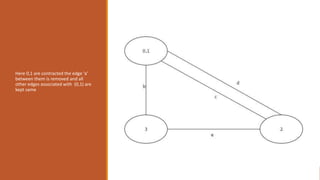
Example
Consider a graph of 4 vertices
Here 0,1 are contracted the edge ‘a’
between them is removed and all
other edges associated with (0,1) are
kept same
Fast Mincut algorithm
Input: A multigraph G=(V,E)
Output: A cut C
1.Let n:=|V|
2.If n<=6 then compute mincut of G directly else
◦ t:=[1+n/√2]
◦ Call contraction(t) twice (independently) to produce to graphs H1 and H2
◦ Let C1=Fastmincut(H1) and C2=Fastmincut(H2)
◦ C=min{C1,C2}
Complexity
•The probability that a specific mincut C survives at the end of Contraction(t) is at least
[t(t-1)/n(n-1)]
• Therefore contraction(2) produces a mincut with probability 𝛺 1/𝑛2 .
•For Fast mincut algorithm it follows the following recurrence
•T(n)=2T([1+n/ 2]) + 𝑂(𝑛2
).
•Solving this recurrence we get T(n)=O(nlogn).
APROXIMATE DISTANCE ORACLES
•All pair shortest path problem is one of the most fundamental algorithmic graph problem where
a graph on n vertices and m edges compute shortest/distance between each pair of vertices.
•In many applications the aim is not to compute all distances, but to have a mechanism(data
structure) through which we can extract distance/shortest-path for any pair of vertices
efficiently.
•Therefore,we preprocess a given graph efficiently to build a data structure that can answer a
shortest path query or a distance query for any path of vertices.
•A simple data structure that achieves this goal is a matrix which specifies, for each pair of nodes,
the distance between them. This structure allows us to answer queries in constant time O(1),
but requires O(n^{2}) extra space. It can be initialized in time O(n^{3}) using an all-pairs shortest
paths algorithm, such as the Floyd–Warshall algorithm.
•A Distance Oracle lies between these two extremes. It uses less than (n^{2}) space in order to
answer queries in less than O(m+nlog n) time. Most Distance Oracles have to compromise on
accuracy, i.e. they don't return the accurate distance but rather a constant-factor approximation
of it
3-Approximate Distance Oracle
In order to achieve subquadratic space, the 3-approximate distance oracle is based on following
idea
From each vertex v, we store distance and shortest paths to a small set of vertices lying within
the small vicinity of v, which take cares of queries from v to near by vertices
For vertices lying outside the vicinity v let say special set of vertices w, we store special vertex
and calculate distance between each of the vertex of the graph.
In order to report distance between v and w, we may report the sum of the distances from same
special vertex to v and w.
Given a graph G=(V,E) a vertex v ∈ V, and any subset S ⊂ V of vertices, we define Ball(u,V,L(u)) as
a set in the following way
Ball(v,V,L(u))= {x ∈ 𝑉 | 𝛿 𝑢, 𝑥 < 𝛿(u,Y)}
Let p(u,L(u)) denote the vertex from say S which is nearest to v. In simple words ,Ball(u,V,L(u))
consisits of all these vertices of the graph whose distance from v is less than the distance of
p(V,L(u)) from v.The 3-approximate distance oracle is built as follows:
Let L(u) ⊂ V be formed by selecting each vertex uniformly and independently with probability
1/ 𝑛
2.From each vertex L(u),store distances to all vertices
3.From each vertex v ∈
V
S
, compute p(v,L(u)) and build a hash table which stores all the vertices
of Ball(v,V,L(u)) and their distance from v.
Air/Road Network
25
𝐵
𝐴
𝐷
𝐶
The Idea
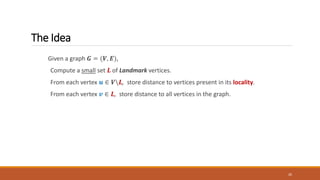
Given a graph 𝑮 = (𝑽, 𝑬),
Compute a small set 𝑳 of Landmark vertices.
From each vertex 𝒖 ∈ 𝑽𝑳, store distance to vertices present in its locality.
From each vertex 𝒗 ∈ 𝑳, store distance to all vertices in the graph.
26
Formal notion of locality
27
𝒖
Formal notion of locality
𝑩𝒂𝒍𝒍(𝒖, 𝑽, 𝑳)= {𝒙 ∈ 𝑽| 𝜹 𝒖, 𝒙 < 𝜹 𝒖, 𝑳(𝒖) }
28
𝒖
𝑳(𝒖)
𝑩𝒂𝒍𝒍(𝒖, 𝑽, 𝑳)
Reporting distance from 𝒖
29
𝒖
𝒗
𝑳(𝒖)
𝑩𝒂𝒍𝒍(𝒖, 𝑽, 𝑳)
𝒗
𝜹 𝒖, 𝑳(𝒖) ≤ 𝜹 𝒖, 𝒗
Report 𝜹 𝒖, 𝑳(𝒖) + 𝜹 𝑳(𝒖), 𝒗
??
30
𝒖
𝒗
𝑳(𝒖)
𝜹 𝒖, 𝑳(𝒖) ≤ 𝜹 𝒖, 𝒗
𝑩𝒂𝒍𝒍(𝒖, 𝑽, 𝑳)
≤ 𝜹 𝒖, 𝒗 + 𝜹 𝒖, 𝑳(𝒖)≤ 𝟐𝜹 𝒖, 𝒗
Expected space of
3-approximate distance oracle
Space for Global distance information:
= 𝑶 𝒏|𝑳|
= 𝑶 𝒏 ∙ 𝒏𝒑
= 𝑶 𝒏 𝟐 𝒑
Space for Local distance information:
= 𝑶 𝑽𝑳
𝟏
𝒑
= 𝑶
𝒏
𝒑
To minimize the total space: (Balance the two terms)
𝒑 =
𝟏
√𝒏
Expected space: 𝑶(𝒏 𝟏+
𝟏
𝟐)
31
Each vertex in 𝑽𝑳 keeps a Ball)
An undirected weighted graph can be processed to build a data structure of expected size
𝑶(𝒏 𝟏+
𝟏
𝟐) that can report 3-approximate distance between any pair of vertices in 𝑶 𝟏 time.
32
References
1) A.Aggarwal,R.j.Anderson Parallel depth-first search in general directed graphs.SIAM
J.Comput,19(2):397-409,1990
2) D.R Karger ,P.N.Klein, and R.E. Tarjan. A randomized linear-time algorithm to find minimum
spanning trees J.ACM,42(2):321-328,1995
3) D.R.Karger. Minimum cuts in near-linear time.J.ACM,47(1):46-76,2000.
4) https://en.wikipedia.org/wiki/Karger%27s_algorithm
5) S.Baswana and T.Kavitha Approximate distance for all –approximate shortest path in
undirected graphs.SIAM J.comput.,39(7):2865-2896,2010

Optimisation random graph presentation

  • 1.
    Randomized Graph Algorithms- Techniquesand Analysis CS5443-Advanced Discrete Optimization and networks Presented by: Venkat Sai Sharath Chandra Mudhigonda 5/5/2017
  • 2.
    Table of Contents •INTRODUCTION •ALINEAR TIME MST •GLOBAL MINCUT •APPROXIMATE DISTANCE ORACLES
  • 3.
    INTRODUCTION A random graphis obtained by starting with a set of n isolated vertices and adding successive edges between them at random. The aim of the study in this field is to determine at what stage a particular property of the graph is likely to arise. The results of the graphs are obtained by analyzing the expected performance of an algorithm on a random instance of the graph Gn,p , a class of graphs with n vertices where each of the n(n-1)/2 edges occur with probability p.
  • 4.
    A LINEAR TIMEMST • The basic idea for obtaining a faster algorithm for MST(minimum spanning tree ) is very intuitive •We first randomly sample a set of edges S ⊂ E and construct a minimum spanning forest F. •We can filter edges using F such that there should not be heaviest edge in any cycle belonging to the final MST •The algorithm relies on techniques from Boruvka's algorithm along with an algorithm for verifying a minimum spanning tree in linear time.It combines the design paradigms of divide and conquer algorithms, greedy algorithms, and randomized algorithms to achieve expected linear performance.
  • 5.
    Definition Let G bea graph with weighted edges. w(x, y) : the weight of edge {x, y} If F is a forest of a subgraph in G, F(x, y) : the path (if any) connecting x and y in F, wF(x.y) : the maximum weight of an edge on F(x, y), with the convention that wF(x.y) =∞ if x and y are not connected in F. F is heavy if w(x,y)>wF(x.y) Otherwise {x,y} is F-Light.
  • 6.
    To obtain alinear MST we need to follow two steps: 1. Boruvka Step 2. F-heavy and F-light edges
  • 7.
    BORVUKA STEP Each iterationof the algorithm relies on an adaptation of Borůvka's algorithm referred to as a Borůvka step: Input: A graph G with no isolated vertices 1 For each vertex v, select the lightest edge incident on v 2 Create a contracted graph G' by replacing each component of G connected by the edges selected in step 1 with a single vertex 3 Remove all isolated vertices, self-loops, and non-minimal repetitive edges from G' Output: The edges selected in step 1 and the contracted graph G'
  • 8.
    BORVUKA EXAMPLE The edgewith green color represents the light edge
  • 9.
  • 12.
    F-LIGHT AND F-HEAVYedges •In each iteration the algorithm removes edges with particular properties that exclude them from the minimum spanning tree. These are called F-heavy edges and are defined as follows. •Let F be a forest on the graph H. An F-heavy edge is an edge e connecting vertices u,v whose weight is strictly greater than the weight of the heaviest edge on the path from u to v in F. •Any edge that is not F-heavy is F-light. If H is a subgraph of G then any F-heavy edge in G cannot be in the minimum spanning tree of G by the cycle property.
  • 13.
    Complexity •For Every Contractionthe vertex V is contracted to V/2 •After two rounds the vertex is contracted to V/4 in each round t takes O(|E|) time. •This algorithm stores the vertices in binary recursive tree. •At level d there are 2 𝑑−1 𝑛𝑜𝑑𝑒𝑠 𝑒𝑎𝑐ℎ 𝑤𝑖𝑡ℎ 2(n3ℎ 𝑑)edges that yields a total of 𝛴 𝑑 n 2 𝑑 •Therefore Maximal left path starting from these have a total of twice in this quantity that is n. •So overall number of edges in all subproblems combined is O(m+n).
  • 14.
    Global MINCUT A cutof given(connected) graph G=(V,E) is a set of edges t that when removed disconnects the graph A mincut is the minimum number of edges that disconnects a graph and is sometimes referred to as global mincut to distinguish from s-t mincut. There have been some improved reductions to s-t mincut other than max flow algorithm over years. Karger developed faster algorithm (than maxflow) to compute mincut with high probability..The algorithm produce a cut which is very likely to be a mincut.
  • 15.
    Contraction Algorithm The fundamentaloperation contract(v1,v2) replaces the vertices v1 and v2 with a new vertex v The new vertex v assigns set of edges edges incident on v1 and v2 nd we do not merge edges from v1 and v2. ALGORITHM: Procedure Contraction(v) Input:A Multigraph G=(V,E) Output:A t partition of V Repeat until t vertices remain Choose an edge (v1,v2) at random Contract(v1,v2)
  • 16.
  • 17.
    Here 0,1 arecontracted the edge ‘a’ between them is removed and all other edges associated with (0,1) are kept same
  • 19.
    Fast Mincut algorithm Input:A multigraph G=(V,E) Output: A cut C 1.Let n:=|V| 2.If n<=6 then compute mincut of G directly else ◦ t:=[1+n/√2] ◦ Call contraction(t) twice (independently) to produce to graphs H1 and H2 ◦ Let C1=Fastmincut(H1) and C2=Fastmincut(H2) ◦ C=min{C1,C2}
  • 20.
    Complexity •The probability thata specific mincut C survives at the end of Contraction(t) is at least [t(t-1)/n(n-1)] • Therefore contraction(2) produces a mincut with probability 𝛺 1/𝑛2 . •For Fast mincut algorithm it follows the following recurrence •T(n)=2T([1+n/ 2]) + 𝑂(𝑛2 ). •Solving this recurrence we get T(n)=O(nlogn).
  • 21.
    APROXIMATE DISTANCE ORACLES •Allpair shortest path problem is one of the most fundamental algorithmic graph problem where a graph on n vertices and m edges compute shortest/distance between each pair of vertices. •In many applications the aim is not to compute all distances, but to have a mechanism(data structure) through which we can extract distance/shortest-path for any pair of vertices efficiently. •Therefore,we preprocess a given graph efficiently to build a data structure that can answer a shortest path query or a distance query for any path of vertices.
  • 22.
    •A simple datastructure that achieves this goal is a matrix which specifies, for each pair of nodes, the distance between them. This structure allows us to answer queries in constant time O(1), but requires O(n^{2}) extra space. It can be initialized in time O(n^{3}) using an all-pairs shortest paths algorithm, such as the Floyd–Warshall algorithm. •A Distance Oracle lies between these two extremes. It uses less than (n^{2}) space in order to answer queries in less than O(m+nlog n) time. Most Distance Oracles have to compromise on accuracy, i.e. they don't return the accurate distance but rather a constant-factor approximation of it
  • 23.
    3-Approximate Distance Oracle Inorder to achieve subquadratic space, the 3-approximate distance oracle is based on following idea From each vertex v, we store distance and shortest paths to a small set of vertices lying within the small vicinity of v, which take cares of queries from v to near by vertices For vertices lying outside the vicinity v let say special set of vertices w, we store special vertex and calculate distance between each of the vertex of the graph. In order to report distance between v and w, we may report the sum of the distances from same special vertex to v and w.
  • 24.
    Given a graphG=(V,E) a vertex v ∈ V, and any subset S ⊂ V of vertices, we define Ball(u,V,L(u)) as a set in the following way Ball(v,V,L(u))= {x ∈ 𝑉 | 𝛿 𝑢, 𝑥 < 𝛿(u,Y)} Let p(u,L(u)) denote the vertex from say S which is nearest to v. In simple words ,Ball(u,V,L(u)) consisits of all these vertices of the graph whose distance from v is less than the distance of p(V,L(u)) from v.The 3-approximate distance oracle is built as follows: Let L(u) ⊂ V be formed by selecting each vertex uniformly and independently with probability 1/ 𝑛 2.From each vertex L(u),store distances to all vertices 3.From each vertex v ∈ V S , compute p(v,L(u)) and build a hash table which stores all the vertices of Ball(v,V,L(u)) and their distance from v.
  • 25.
  • 26.
    The Idea Given agraph 𝑮 = (𝑽, 𝑬), Compute a small set 𝑳 of Landmark vertices. From each vertex 𝒖 ∈ 𝑽𝑳, store distance to vertices present in its locality. From each vertex 𝒗 ∈ 𝑳, store distance to all vertices in the graph. 26
  • 27.
    Formal notion oflocality 27 𝒖
  • 28.
    Formal notion oflocality 𝑩𝒂𝒍𝒍(𝒖, 𝑽, 𝑳)= {𝒙 ∈ 𝑽| 𝜹 𝒖, 𝒙 < 𝜹 𝒖, 𝑳(𝒖) } 28 𝒖 𝑳(𝒖) 𝑩𝒂𝒍𝒍(𝒖, 𝑽, 𝑳)
  • 29.
    Reporting distance from𝒖 29 𝒖 𝒗 𝑳(𝒖) 𝑩𝒂𝒍𝒍(𝒖, 𝑽, 𝑳) 𝒗 𝜹 𝒖, 𝑳(𝒖) ≤ 𝜹 𝒖, 𝒗 Report 𝜹 𝒖, 𝑳(𝒖) + 𝜹 𝑳(𝒖), 𝒗
  • 30.
    ?? 30 𝒖 𝒗 𝑳(𝒖) 𝜹 𝒖, 𝑳(𝒖)≤ 𝜹 𝒖, 𝒗 𝑩𝒂𝒍𝒍(𝒖, 𝑽, 𝑳) ≤ 𝜹 𝒖, 𝒗 + 𝜹 𝒖, 𝑳(𝒖)≤ 𝟐𝜹 𝒖, 𝒗
  • 31.
    Expected space of 3-approximatedistance oracle Space for Global distance information: = 𝑶 𝒏|𝑳| = 𝑶 𝒏 ∙ 𝒏𝒑 = 𝑶 𝒏 𝟐 𝒑 Space for Local distance information: = 𝑶 𝑽𝑳 𝟏 𝒑 = 𝑶 𝒏 𝒑 To minimize the total space: (Balance the two terms) 𝒑 = 𝟏 √𝒏 Expected space: 𝑶(𝒏 𝟏+ 𝟏 𝟐) 31 Each vertex in 𝑽𝑳 keeps a Ball)
  • 32.
    An undirected weightedgraph can be processed to build a data structure of expected size 𝑶(𝒏 𝟏+ 𝟏 𝟐) that can report 3-approximate distance between any pair of vertices in 𝑶 𝟏 time. 32
  • 33.
    References 1) A.Aggarwal,R.j.Anderson Paralleldepth-first search in general directed graphs.SIAM J.Comput,19(2):397-409,1990 2) D.R Karger ,P.N.Klein, and R.E. Tarjan. A randomized linear-time algorithm to find minimum spanning trees J.ACM,42(2):321-328,1995 3) D.R.Karger. Minimum cuts in near-linear time.J.ACM,47(1):46-76,2000. 4) https://en.wikipedia.org/wiki/Karger%27s_algorithm 5) S.Baswana and T.Kavitha Approximate distance for all –approximate shortest path in undirected graphs.SIAM J.comput.,39(7):2865-2896,2010