Graphs
Dr. AMIT KUMAR @JUET
Graphs
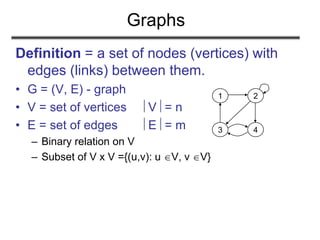
Definition = a set of nodes (vertices) with
edges (links) between them.
• G = (V, E) - graph
• V = set of vertices V = n
• E = set of edges E = m
– Binary relation on V
– Subset of V x V ={(u,v): u V, v V}
1 2
3 4
Applications
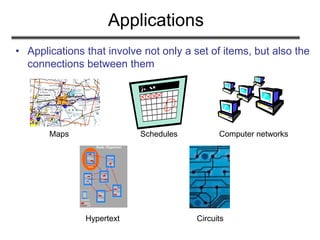
• Applications that involve not only a set of items, but also the
connections between them
Computer networks
Circuits
Schedules
Hypertext
Maps
Terminology
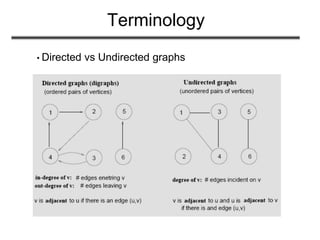
• Directed vs Undirected graphs
Terminology (cont’d)
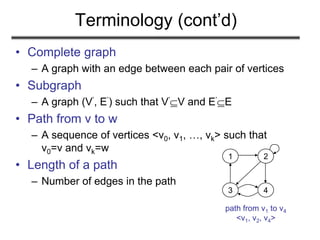
• Complete graph
– A graph with an edge between each pair of vertices
• Subgraph
– A graph (V’, E’) such that V’V and E’E
• Path from v to w
– A sequence of vertices <v0, v1, …, vk> such that
v0=v and vk=w
• Length of a path
– Number of edges in the path
1 2
3 4
path from v1 to v4
<v1, v2, v4>
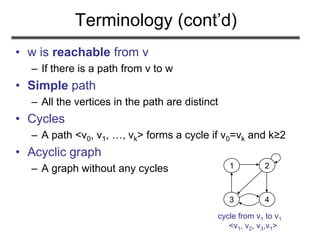
Terminology (cont’d)
• w is reachable from v
– If there is a path from v to w
• Simple path
– All the vertices in the path are distinct
• Cycles
– A path <v0, v1, …, vk> forms a cycle if v0=vk and k≥2
• Acyclic graph
– A graph without any cycles 1 2
3 4
cycle from v1 to v1
<v1, v2, v3,v1>
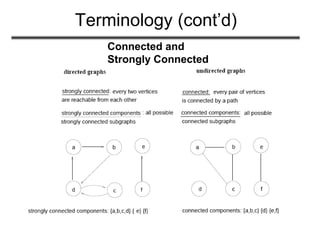
Terminology (cont’d)
Connected and
Strongly Connected
Terminology (cont’d)
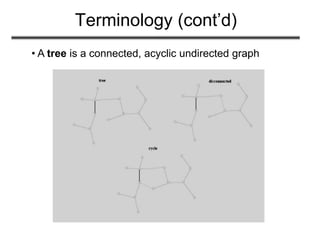
• A tree is a connected, acyclic undirected graph
Terminology (cont’d)
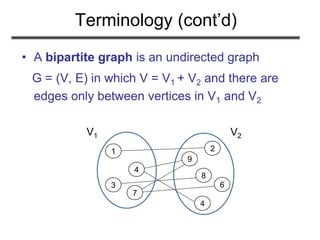
• A bipartite graph is an undirected graph
G = (V, E) in which V = V1 + V2 and there are
edges only between vertices in V1 and V2
1 2
3
4
4
9
7
6
8
V1 V2
Graph Representation
• Adjacency list representation of G = (V, E)
– An array of V lists, one for each vertex in V
– Each list Adj[u] contains all the vertices v that are
adjacent to u (i.e., there is an edge from u to v)
– Can be used for both directed and undirected graphs
1 2
5 4
3
2 5 /
1 5 3 4 /
1
2
3
4
5
2 4
2 5 3 /
4 1 2
Undirected graph
Properties of Adjacency-List
Representation
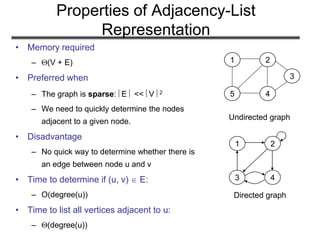
• Sum of “lengths” of all adjacency lists
– Directed graph:
• edge (u, v) appears only once (i.e., in the
list of u)
– Undirected graph:
• edge (u, v) appears twice (i.e., in the lists of
both u and v)
1 2
5 4
3
Undirected graph
1 2
3 4
Directed graph
E 
2 E 
Properties of Adjacency-List
Representation
• Memory required
– (V + E)
• Preferred when
– The graph is sparse: E  << V 2
– We need to quickly determine the nodes
adjacent to a given node.
• Disadvantage
– No quick way to determine whether there is
an edge between node u and v
• Time to determine if (u, v)  E:
– O(degree(u))
• Time to list all vertices adjacent to u:
– (degree(u))
1 2
5 4
3
Undirected graph
1 2
3 4
Directed graph
Graph Representation
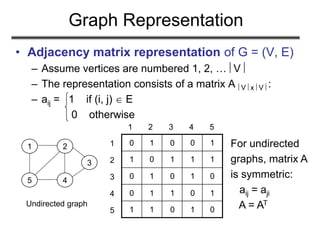
• Adjacency matrix representation of G = (V, E)
– Assume vertices are numbered 1, 2, … V 
– The representation consists of a matrix A V x V :
– aij = 1 if (i, j)  E
0 otherwise
1 2
5 4
3
Undirected graph
1
2
3
4
5
1 2 3 4 5
0 1 10 0
1 1 1 10
1 10 0 0
1 1 10 0
1 1 10 0
For undirected
graphs, matrix A
is symmetric:
aij = aji
A = AT
Properties of Adjacency Matrix
Representation
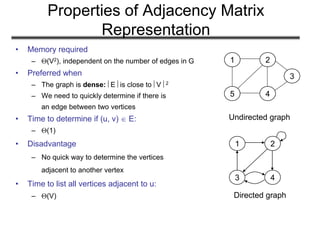
• Memory required
– (V2), independent on the number of edges in G
• Preferred when
– The graph is dense: E is close to V 2
– We need to quickly determine if there is
an edge between two vertices
• Time to determine if (u, v)  E:
– (1)
• Disadvantage
– No quick way to determine the vertices
adjacent to another vertex
• Time to list all vertices adjacent to u:
– (V)
1 2
5 4
3
Undirected graph
1 2
3 4
Directed graph
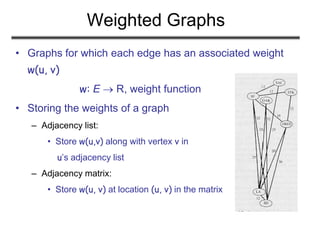
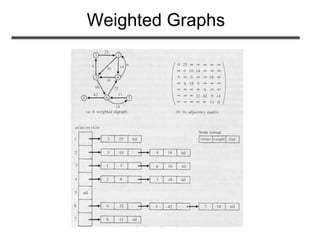
Weighted Graphs
• Graphs for which each edge has an associated weight
w(u, v)
w: E  R, weight function
• Storing the weights of a graph
– Adjacency list:
• Store w(u,v) along with vertex v in
u’s adjacency list
– Adjacency matrix:
• Store w(u, v) at location (u, v) in the matrix
Weighted Graphs
Problem 1
• (Exercise 22.1-1, page 530) Given an adjacency-
list representation, how long does it take to
compute the out-degree of every vertex?
– For each vertex u, search Adj[u]  Θ(E)
2 5 /
1 5 3 4 /
1
2
3
4
5
2 4
2 5 3 /
4 1 2
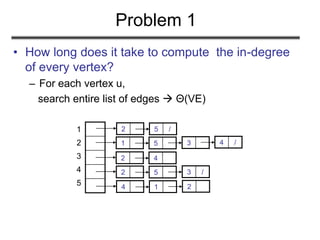
Problem 1
• How long does it take to compute the in-degree
of every vertex?
– For each vertex u,
search entire list of edges  Θ(VE)
2 5 /
1 5 3 4 /
1
2
3
4
5
2 4
2 5 3 /
4 1 2
Problem 2
• (Exercise 22.1-3, page 530) The transpose of
a graph G=(V,E) is the graph GT=(V,ET), where
ET={(v,u)єV x V: (u,v) є E}. Thus, GT is G with
all edges reversed.
(a) Describe an efficient algorithm for computing
GT from G, both for the adjacency-list and
adjacency-matrix representations of G.
(b) Analyze the running time of each algorithm.
Problem 2 (cont’d)
Adjacency matrix
for (i=1; i<=V; i++)
for(j=i+1; j<=V; j++)
if(A[i][j] && !A[j][i]) {
A[i][j]=0;
A[j][i]=1;
}
O(V2) complexity
0 1 10 0
0 0 1 10
1 00 0 0
1 1 10 0
0 0 10 0
1
2 3 4 5
2
3
4
5
1
Problem 2 (cont’d)
Adjacency list
Allocate V list pointers for GT (Adj’[])
for(i=1; i<=V, i++)
for every vertex v in Adj[i]
add vertex i to Adj’[v]
O(V)
O(E)
Total time: O(V+E)
2 5 /
1 5 3 4 /
1
2
3
4
5
2 4
2 5 3 /
4 1 2
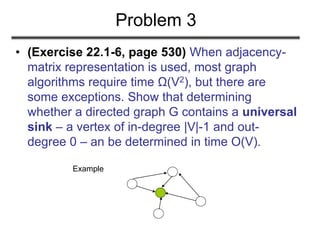
Problem 3
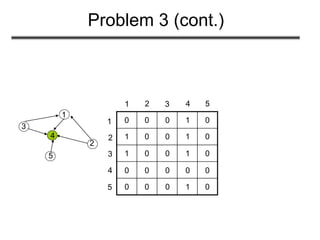
• (Exercise 22.1-6, page 530) When adjacency-
matrix representation is used, most graph
algorithms require time Ω(V2), but there are
some exceptions. Show that determining
whether a directed graph G contains a universal
sink – a vertex of in-degree |V|-1 and out-
degree 0 – an be determined in time O(V).
Example
Problem 3 (cont.)
0 0 00 1
1 0 1 00
0 11 0 0
0 0 00 0
0 0 10 0
1
2 3 4 5
2
3
4
5
1
1
2
3
4
5
Problem 3 (cont.)
• How many sinks could a graph have?
– 0 or 1
• How can we determine whether a given vertex u
is a universal sink?
– The u-row must contain 0’s only
– The u-column must contain 1’s only
– A[u][u]=0
• How long would it take to determine whether a
given vertex u is a universal sink?
– O(V) time
Problem 3 (cont.)
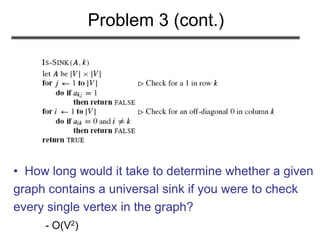
• How long would it take to determine whether a given
graph contains a universal sink if you were to check
every single vertex in the graph?
- O(V2)
Problem 3 (cont.)
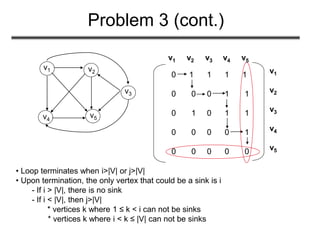
• Can you come up with a O(V) algorithm?
• Observations
– If A[u][v]=1, then u cannot be a universal sink
– If A[u][v]=0, then v cannot be a universal sink
Problem 3 (cont.)
v1 v2
v4
v5
v3
0 1 1 1 1
0 0 0 1 1
0 1 0 1 1
0 0 0 0 1
0 0 0 0 0
v1 v2 v3 v4 v5
v1
v2
v3
v4
v5
• Loop terminates when i>|V| or j>|V|
• Upon termination, the only vertex that could be a sink is i
- If i > |V|, there is no sink
- If i < |V|, then j>|V|
* vertices k where 1 ≤ k < i can not be sinks
* vertices k where i < k ≤ |V| can not be sinks

Graph representation

  • 1.
  • 2.
    Graphs Definition = aset of nodes (vertices) with edges (links) between them. • G = (V, E) - graph • V = set of vertices V = n • E = set of edges E = m – Binary relation on V – Subset of V x V ={(u,v): u V, v V} 1 2 3 4
  • 3.
    Applications • Applications thatinvolve not only a set of items, but also the connections between them Computer networks Circuits Schedules Hypertext Maps
  • 4.
    Terminology • Directed vsUndirected graphs
  • 5.
    Terminology (cont’d) • Completegraph – A graph with an edge between each pair of vertices • Subgraph – A graph (V’, E’) such that V’V and E’E • Path from v to w – A sequence of vertices <v0, v1, …, vk> such that v0=v and vk=w • Length of a path – Number of edges in the path 1 2 3 4 path from v1 to v4 <v1, v2, v4>
  • 6.
    Terminology (cont’d) • wis reachable from v – If there is a path from v to w • Simple path – All the vertices in the path are distinct • Cycles – A path <v0, v1, …, vk> forms a cycle if v0=vk and k≥2 • Acyclic graph – A graph without any cycles 1 2 3 4 cycle from v1 to v1 <v1, v2, v3,v1>
  • 7.
  • 8.
    Terminology (cont’d) • Atree is a connected, acyclic undirected graph
  • 9.
    Terminology (cont’d) • Abipartite graph is an undirected graph G = (V, E) in which V = V1 + V2 and there are edges only between vertices in V1 and V2 1 2 3 4 4 9 7 6 8 V1 V2
  • 10.
    Graph Representation • Adjacencylist representation of G = (V, E) – An array of V lists, one for each vertex in V – Each list Adj[u] contains all the vertices v that are adjacent to u (i.e., there is an edge from u to v) – Can be used for both directed and undirected graphs 1 2 5 4 3 2 5 / 1 5 3 4 / 1 2 3 4 5 2 4 2 5 3 / 4 1 2 Undirected graph
  • 11.
    Properties of Adjacency-List Representation •Sum of “lengths” of all adjacency lists – Directed graph: • edge (u, v) appears only once (i.e., in the list of u) – Undirected graph: • edge (u, v) appears twice (i.e., in the lists of both u and v) 1 2 5 4 3 Undirected graph 1 2 3 4 Directed graph E  2 E 
  • 12.
    Properties of Adjacency-List Representation •Memory required – (V + E) • Preferred when – The graph is sparse: E  << V 2 – We need to quickly determine the nodes adjacent to a given node. • Disadvantage – No quick way to determine whether there is an edge between node u and v • Time to determine if (u, v)  E: – O(degree(u)) • Time to list all vertices adjacent to u: – (degree(u)) 1 2 5 4 3 Undirected graph 1 2 3 4 Directed graph
  • 13.
    Graph Representation • Adjacencymatrix representation of G = (V, E) – Assume vertices are numbered 1, 2, … V  – The representation consists of a matrix A V x V : – aij = 1 if (i, j)  E 0 otherwise 1 2 5 4 3 Undirected graph 1 2 3 4 5 1 2 3 4 5 0 1 10 0 1 1 1 10 1 10 0 0 1 1 10 0 1 1 10 0 For undirected graphs, matrix A is symmetric: aij = aji A = AT
  • 14.
    Properties of AdjacencyMatrix Representation • Memory required – (V2), independent on the number of edges in G • Preferred when – The graph is dense: E is close to V 2 – We need to quickly determine if there is an edge between two vertices • Time to determine if (u, v)  E: – (1) • Disadvantage – No quick way to determine the vertices adjacent to another vertex • Time to list all vertices adjacent to u: – (V) 1 2 5 4 3 Undirected graph 1 2 3 4 Directed graph
  • 15.
    Weighted Graphs • Graphsfor which each edge has an associated weight w(u, v) w: E  R, weight function • Storing the weights of a graph – Adjacency list: • Store w(u,v) along with vertex v in u’s adjacency list – Adjacency matrix: • Store w(u, v) at location (u, v) in the matrix
  • 16.
  • 17.
    Problem 1 • (Exercise22.1-1, page 530) Given an adjacency- list representation, how long does it take to compute the out-degree of every vertex? – For each vertex u, search Adj[u]  Θ(E) 2 5 / 1 5 3 4 / 1 2 3 4 5 2 4 2 5 3 / 4 1 2
  • 18.
    Problem 1 • Howlong does it take to compute the in-degree of every vertex? – For each vertex u, search entire list of edges  Θ(VE) 2 5 / 1 5 3 4 / 1 2 3 4 5 2 4 2 5 3 / 4 1 2
  • 19.
    Problem 2 • (Exercise22.1-3, page 530) The transpose of a graph G=(V,E) is the graph GT=(V,ET), where ET={(v,u)єV x V: (u,v) є E}. Thus, GT is G with all edges reversed. (a) Describe an efficient algorithm for computing GT from G, both for the adjacency-list and adjacency-matrix representations of G. (b) Analyze the running time of each algorithm.
  • 20.
    Problem 2 (cont’d) Adjacencymatrix for (i=1; i<=V; i++) for(j=i+1; j<=V; j++) if(A[i][j] && !A[j][i]) { A[i][j]=0; A[j][i]=1; } O(V2) complexity 0 1 10 0 0 0 1 10 1 00 0 0 1 1 10 0 0 0 10 0 1 2 3 4 5 2 3 4 5 1
  • 21.
    Problem 2 (cont’d) Adjacencylist Allocate V list pointers for GT (Adj’[]) for(i=1; i<=V, i++) for every vertex v in Adj[i] add vertex i to Adj’[v] O(V) O(E) Total time: O(V+E) 2 5 / 1 5 3 4 / 1 2 3 4 5 2 4 2 5 3 / 4 1 2
  • 22.
    Problem 3 • (Exercise22.1-6, page 530) When adjacency- matrix representation is used, most graph algorithms require time Ω(V2), but there are some exceptions. Show that determining whether a directed graph G contains a universal sink – a vertex of in-degree |V|-1 and out- degree 0 – an be determined in time O(V). Example
  • 23.
    Problem 3 (cont.) 00 00 1 1 0 1 00 0 11 0 0 0 0 00 0 0 0 10 0 1 2 3 4 5 2 3 4 5 1 1 2 3 4 5
  • 24.
    Problem 3 (cont.) •How many sinks could a graph have? – 0 or 1 • How can we determine whether a given vertex u is a universal sink? – The u-row must contain 0’s only – The u-column must contain 1’s only – A[u][u]=0 • How long would it take to determine whether a given vertex u is a universal sink? – O(V) time
  • 25.
    Problem 3 (cont.) •How long would it take to determine whether a given graph contains a universal sink if you were to check every single vertex in the graph? - O(V2)
  • 26.
    Problem 3 (cont.) •Can you come up with a O(V) algorithm? • Observations – If A[u][v]=1, then u cannot be a universal sink – If A[u][v]=0, then v cannot be a universal sink
  • 27.
    Problem 3 (cont.) v1v2 v4 v5 v3 0 1 1 1 1 0 0 0 1 1 0 1 0 1 1 0 0 0 0 1 0 0 0 0 0 v1 v2 v3 v4 v5 v1 v2 v3 v4 v5 • Loop terminates when i>|V| or j>|V| • Upon termination, the only vertex that could be a sink is i - If i > |V|, there is no sink - If i < |V|, then j>|V| * vertices k where 1 ≤ k < i can not be sinks * vertices k where i < k ≤ |V| can not be sinks