TOPIC:- Minimum Spanning Tree


 1
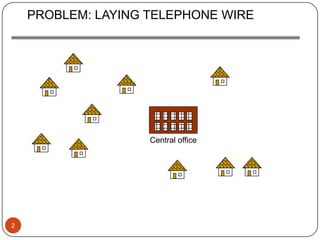
PROBLEM: LAYING TELEPHONE WIRE


                    Central office


2
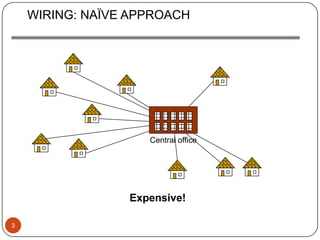
WIRING: NAÏVE APPROACH


                    Central office


                 Expensive!

3
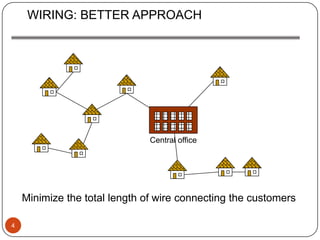
WIRING: BETTER APPROACH


                               Central office


    Minimize the total length of wire connecting the customers

4
Minimum Spanning Trees


5
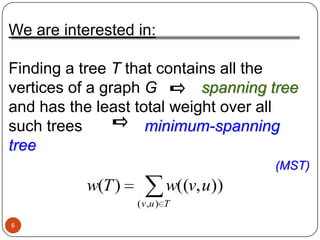
We are interested in:

Finding a tree T that contains all the
vertices of a graph G       spanning tree
and has the least total weight over all
such trees          minimum-spanning
tree
                                       (MST)
           w(T )           w((v, u))
                   ( v ,u ) T

6
Before discuss about MST (minimum
    spanning tree) lets get familiar with Graphs.


7
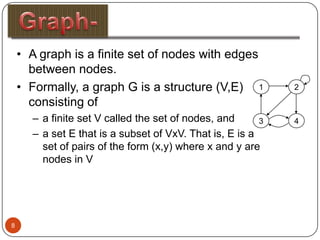
• A graph is a finite set of nodes with edges
      between nodes.
    • Formally, a graph G is a structure (V,E) 1             2

      consisting of
      – a finite set V called the set of nodes, and      3   4
      – a set E that is a subset of VxV. That is, E is a
        set of pairs of the form (x,y) where x and y are
        nodes in V


8
Directed vs. Undirected Graphs

    • If the directions of the edges matter, then we
      show the edge directions, and the graph is
      called a directed graph (or a digraph)

    • If the relationships represented by the edges
      are symmetric (such as (x,y) is edge if and
      only if x is a sibling of y), then we don’t show
      the directions of the edges, and the graph is
      called an undirected graph.


9
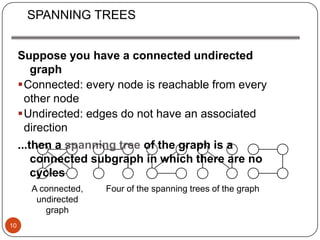
SPANNING TREES


     Suppose you have a connected undirected
       graph
     Connected: every node is reachable from every
      other node
     Undirected: edges do not have an associated
      direction
     ...then a spanning tree of the graph is a
         connected subgraph in which there are no
         cycles
       A connected,   Four of the spanning trees of the graph
        undirected
          graph
10
Minimum Spanning Tree (MST)
     A minimum spanning tree is a subgraph of an
     undirected weighted graph G, such that

     • it is a tree (i.e., it is acyclic)
     • it covers all the vertices V
         – contains |V| - 1 edges
     • the total cost associated with tree edges is the
       minimum among all possible spanning trees
     • not necessarily unique


11
APPLICATIONS OF MST

Cancer imaging. The BC Cancer Research Ctr. uses minimum
spanning trees to describe the arrangements of nuclei in skin
cells.
•Cosmology at the University of Kentucky. This group works on
large-scale structure formation, using methods including N-body
simulations and minimum spanning trees.
•Detecting actin fibers in cell images. A. E. Johnson and R. E.
Valdes-Perez use minimum spanning trees for biomedical
image analysis.
•The Euclidean minimum spanning tree mixing model. S.
Subramaniam and S. B. Pope use geometric minimum
spanning trees to model locality of particle interactions in
turbulent fluid flows. The tree structure of the MST permits a
linear-time solution of the resulting particle-interaction matrix.
12
•Extracting features from remotely sensed images. Mark Dobie
and co-workers use minimum spanning trees to find road
networks in satellite and aerial imagery.
•Finding quasar superstructures. M. Graham and co-authors use
2d and 3d minimum spanning trees for finding clusters of
quasars and Seyfert galaxies.

•Learning salient features for real-time face verification, K. Jonsson,
J. Matas, and J. Kittler. Includes a minimum-spanning-tree based
algorithm for registering the images in a database of faces.
•Minimal spanning tree analysis of fungal spore spatial patterns, C.
L. Jones, G. T. Lonergan, and D. E. Mainwaring.


13
•A minimal spanning tree analysis of the CfA redshift survey. Dan
Lauer uses minimum spanning trees to understand the large-
scale structure of the universe.

•A mixing model for turbulent reactive flows based on Euclidean
minimum spanning trees, S. Subramaniam and S. B. Pope.

•Sausages, proteins, and rho. In the talk announced here, J.
MacGregor Smith discusses Euclidean Steiner tree theory and
describes potential applications of Steiner trees to protein
conformation and molecular modeling.

•Weather data interpretation. The Insight group at Ohio State is
using geometric techniques such as minimum spanning trees to
extract features from large meteorological data sets
14
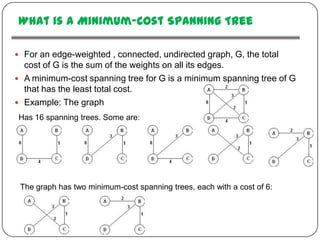
What is a Minimum-Cost Spanning Tree

 For an edge-weighted , connected, undirected graph, G, the total
  cost of G is the sum of the weights on all its edges.
 A minimum-cost spanning tree for G is a minimum spanning tree of G
  that has the least total cost.
 Example: The graph
 Has 16 spanning trees. Some are:


 The graph has two minimum-cost spanning trees, each with a cost of 6:
HOW CAN WE
     GENERATE A MST?


16
We have two Ways
     to generate a MST


17
Prim’s Algorithm


Prim’s algorithm finds a minimum cost spanning tree by
selecting edges from the graph one-by-one as follows:
 It starts with a tree, T, consisting of the starting vertex,
  x.
 Then, it adds the shortest edge emanating from x that
  connects T to the rest of the graph.
 It then moves to the added vertex and repeats the
  process.
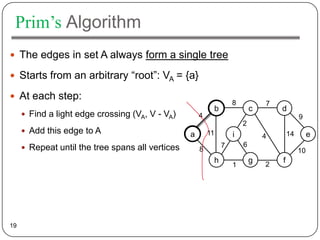
Prim’s Algorithm
 The edges in set A always form a single tree

 Starts from an arbitrary “root”: VA = {a}

 At each step:
                                                                   8           7
                                                           b               c       d
      Find a light edge crossing (VA, V - VA)        4                                     9
                                                                       2
      Add this edge to A                         a       11       i                   14        e
                                                                               4
      Repeat until the tree spans all vertices                7       6
                                                      8                                     10
                                                           h               g   2
                                                                                   f
                                                                   1


19
Example
                              8                   7
                  b                       c               d                          0
         4                                                             9
                                      2                                         Q = {a, b, c, d, e, f, g, h, i}
     a           11           i                               14            e
                                                  4                             VA =
                          7           6
         8                                                             10       Extract-MIN(Q)        a
                  h                       g       2
                                                          f
                              1


                      4
                                  8                   7                         key [b] = 4       [b] = a
                      b                       c               d
         4                                                              9       key [h] = 8       [h] = a
                                      2
     a           11               i               4               14        e
                          7               6
             8                                                         10            4                8
                      h                       g       2
                                                              f                 Q = {b, c, d, e, f, g, h, i} VA = {a}
                                  1
                      8                                                         Extract-MIN(Q)        b
20
Example
          4                        8                                 key [c] = 8       [c] = b
                       8               7
          b                        c           d                     key [h] = 8       [h] = a - unchanged
     4                                                      9
                               2
                                                                          8             8
a        11            i               4           14            e
                  7            6                                     Q = {c, d, e, f, g, h, i} VA = {a, b}
     8                                                      10
          h                        g           f                     Extract-MIN(Q)        c
                       1               2
          8
                                                                     key [d] = 7       [d] = c
              4                    8           7
                           8               7                         key [f] = 4       [f] = c
              b                    c           d
     4                 2 2                                  9        key [i] = 2        [i] = c
 a       11            i               4               14        e
                   7           6
     8                                                      10           7    4      8 2
               h                   g       2
                                                   f                 Q = {d, e, f, g, h, i} VA = {a, b, c}
                           1
              8                                4
21                                                                   Extract-MIN(Q)        i
Example
          4                   8       7                  key [h] = 7       [h] = i
                      8           7
              b               c       d                  key [g] = 6       [g] = i
     4                                         9
                      2   2                                   7     46 8
 a       11           i           4       14        e
                                                         Q = {d, e, f, g, h} VA = {a, b, c, i}
                  7       6
     8                                         10
                                                         Extract-MIN(Q)        f
          h                   g   2
                                      f
                      1
          8                   6       4
          7
          4                   8       7                   key [g] = 2      [g] = f
                      8           7
          b                   c       d                   key [d] = 7      [d] = c unchanged
     4                                         9
                      2 2                           10    key [e] = 10     [e] = f
 a       11           i                   14        e
                                  4                            7 10 2 8
                  7       6
     8                                         10         Q = {d, e, g, h} VA = {a, b, c, i, f}
          h                   g   2
                                      f
                      1
                              6       4
                                                          Extract-MIN(Q)       g
22        7                   2
Example
          4                   8           7                  key [h] = 1     [h] = g
                      8               7
              b               c           d                       7 10 1
     4                                             9
                      2 2                               10   Q = {d, e, h} VA = {a, b, c, i, f, g}
 a       11           i           4           14        e
                  7       6
                                                             Extract-MIN(Q)      h
     8                                             10
              h               g       2
                                          f
                      1
          7
          1                   2           4                        7 10
          4                   8           7
                      8           7
                                                              Q = {d, e} VA = {a, b, c, i, f, g, h}
          b                   c           d
     4                                             9          Extract-MIN(Q)      d
                      2 2                               10
 a       11           i           4           14        e
                  7       6
     8                                             10
          h                   g   2
                                          f
                      1
23        1                   2           4
Example


          4               8       7
                  8           7
          b               c       d                 key [e] = 9      [e] = f
     4                                     9 9
                  2 2                        10
                                                         9
a        11       i           4       14        e
              7       6                             Q = {e} VA = {a, b, c, i, f, g, h, d}
     8                                     10
          h               g       f                 Extract-MIN(Q)       e
                  1           2
          1               2       4                 Q=      VA = {a, b, c, i, f, g, h, d, e}


24
Prim’s (V, E, w, r)
1.     Q←
                                       Total time: O(VlgV + ElgV) = O(ElgV)
2.     for each u   V
3.        do key[u] ← ∞            O(V) if Q is implemented
                                   as a min-heap
4.           π[u] ← NIL
5.           INSERT(Q, u)
                                                                 O(lgV)
6.     DECREASE-KEY(Q, r, 0)              key[r] ← 0
                                                                 Min-heap
7.     while Q                              Executed |V| times
                                                                 operations:
8.           do u ← EXTRACT-MIN(Q)            Takes O(lgV)       O(VlgV)
                                                Executed O(E) times total
9.               for each v   Adj[u]
                                                           Constant         O(ElgV)
10.                 do if v   Q and w(u, v) < key[v]
                                                           Takes O(lgV)
11.                       then π[v] ← u
12.                            DECREASE-KEY(Q, v, w(u, v))
25
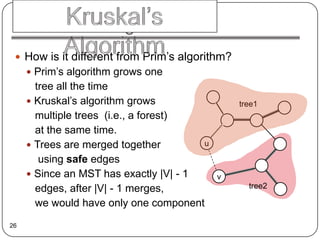
Algorithm
  How is it different from Prim’s algorithm?
      Prim’s algorithm grows one
       tree all the time
      Kruskal’s algorithm grows                tree1
       multiple trees (i.e., a forest)
       at the same time.
      Trees are merged together        u

        using safe edges
      Since an MST has exactly |V| - 1     v
       edges, after |V| - 1 merges,               tree2

       we would have only one component
26
Kruskal’s Algorithm
                                                            8           7
  Start with each vertex being its                 b               c       d
                                               4                                     9
     own component                                              2
                                           a       11       i           4       14        e
  Repeatedly merge two                                         6
                                                        7
                                               8                                     10
     components into one by
                                                    h               g   2
                                                                            f
                                                            1
     choosing the light edge that
                                                                    We would add
     connects them
                                                                    edge (c, f)
  Which components to consider
     at each iteration?
      Scan the set of edges in
       monotonically increasing order by
       weight

27
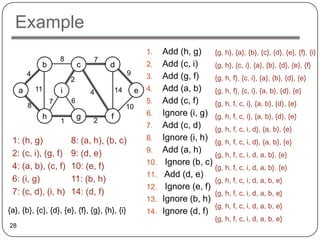
Example
                                                      1.    Add (h, g)     {g, h}, {a}, {b}, {c}, {d}, {e}, {f}, {i}
                      8           7
              b               c       d               2.    Add (c, i)     {g, h}, {c, i}, {a}, {b}, {d}, {e}, {f}
         4                                     9      3.    Add (g, f)
                          2                                                {g, h, f}, {c, i}, {a}, {b}, {d}, {e}
     a       11       i           4       14        e 4.    Add (a, b)     {g, h, f}, {c, i}, {a, b}, {d}, {e}

         8
                  7       6                           5.    Add (c, f)     {g, h, f, c, i}, {a, b}, {d}, {e}
                                               10
              h               g       f               6.    Ignore (i, g) {g, h, f, c, i}, {a, b}, {d}, {e}
                      1           2
                                                      7.    Add (c, d)     {g, h, f, c, i, d}, {a, b}, {e}
 1: (h, g)                8: (a, h), (b, c)           8.    Ignore (i, h) {g, h, f, c, i, d}, {a, b}, {e}
 2: (c, i), (g, f)        9: (d, e)                   9.    Add (a, h)
                                                                           {g, h, f, c, i, d, a, b}, {e}
 4: (a, b), (c, f)        10: (e, f)                  10.    Ignore (b, c)
                                                                           {g, h, f, c, i, d, a, b}, {e}
                                                      11.    Add (d, e)
 6: (i, g)                11: (b, h)                                       {g, h, f, c, i, d, a, b, e}
                                                      12.    Ignore (e, f)
 7: (c, d), (i, h)        14: (d, f)                                       {g, h, f, c, i, d, a, b, e}
                                                      13.   Ignore (b, h)
                                                                           {g, h, f, c, i, d, a, b, e}
{a}, {b}, {c}, {d}, {e}, {f}, {g}, {h}, {i}           14.   Ignore (d, f)
                                                                               {g, h, f, c, i, d, a, b, e}
28
Thank You

      Bibliography-
      http://www.cs.brown.edu/
      en.wikipedia.org/wiki/


29

Minimum spanning Tree

  • 1.
  • 2.
    PROBLEM: LAYING TELEPHONEWIRE Central office 2
  • 3.
    WIRING: NAÏVE APPROACH Central office Expensive! 3
  • 4.
    WIRING: BETTER APPROACH Central office Minimize the total length of wire connecting the customers 4
  • 5.
  • 6.
    We are interestedin: Finding a tree T that contains all the vertices of a graph G spanning tree and has the least total weight over all such trees minimum-spanning tree (MST) w(T ) w((v, u)) ( v ,u ) T 6
  • 7.
    Before discuss aboutMST (minimum spanning tree) lets get familiar with Graphs. 7
  • 8.
    • A graphis a finite set of nodes with edges between nodes. • Formally, a graph G is a structure (V,E) 1 2 consisting of – a finite set V called the set of nodes, and 3 4 – a set E that is a subset of VxV. That is, E is a set of pairs of the form (x,y) where x and y are nodes in V 8
  • 9.
    Directed vs. UndirectedGraphs • If the directions of the edges matter, then we show the edge directions, and the graph is called a directed graph (or a digraph) • If the relationships represented by the edges are symmetric (such as (x,y) is edge if and only if x is a sibling of y), then we don’t show the directions of the edges, and the graph is called an undirected graph. 9
  • 10.
    SPANNING TREES Suppose you have a connected undirected graph Connected: every node is reachable from every other node Undirected: edges do not have an associated direction ...then a spanning tree of the graph is a connected subgraph in which there are no cycles A connected, Four of the spanning trees of the graph undirected graph 10
  • 11.
    Minimum Spanning Tree(MST) A minimum spanning tree is a subgraph of an undirected weighted graph G, such that • it is a tree (i.e., it is acyclic) • it covers all the vertices V – contains |V| - 1 edges • the total cost associated with tree edges is the minimum among all possible spanning trees • not necessarily unique 11
  • 12.
    APPLICATIONS OF MST Cancerimaging. The BC Cancer Research Ctr. uses minimum spanning trees to describe the arrangements of nuclei in skin cells. •Cosmology at the University of Kentucky. This group works on large-scale structure formation, using methods including N-body simulations and minimum spanning trees. •Detecting actin fibers in cell images. A. E. Johnson and R. E. Valdes-Perez use minimum spanning trees for biomedical image analysis. •The Euclidean minimum spanning tree mixing model. S. Subramaniam and S. B. Pope use geometric minimum spanning trees to model locality of particle interactions in turbulent fluid flows. The tree structure of the MST permits a linear-time solution of the resulting particle-interaction matrix. 12
  • 13.
    •Extracting features fromremotely sensed images. Mark Dobie and co-workers use minimum spanning trees to find road networks in satellite and aerial imagery. •Finding quasar superstructures. M. Graham and co-authors use 2d and 3d minimum spanning trees for finding clusters of quasars and Seyfert galaxies. •Learning salient features for real-time face verification, K. Jonsson, J. Matas, and J. Kittler. Includes a minimum-spanning-tree based algorithm for registering the images in a database of faces. •Minimal spanning tree analysis of fungal spore spatial patterns, C. L. Jones, G. T. Lonergan, and D. E. Mainwaring. 13
  • 14.
    •A minimal spanningtree analysis of the CfA redshift survey. Dan Lauer uses minimum spanning trees to understand the large- scale structure of the universe. •A mixing model for turbulent reactive flows based on Euclidean minimum spanning trees, S. Subramaniam and S. B. Pope. •Sausages, proteins, and rho. In the talk announced here, J. MacGregor Smith discusses Euclidean Steiner tree theory and describes potential applications of Steiner trees to protein conformation and molecular modeling. •Weather data interpretation. The Insight group at Ohio State is using geometric techniques such as minimum spanning trees to extract features from large meteorological data sets 14
  • 15.
    What is aMinimum-Cost Spanning Tree  For an edge-weighted , connected, undirected graph, G, the total cost of G is the sum of the weights on all its edges.  A minimum-cost spanning tree for G is a minimum spanning tree of G that has the least total cost.  Example: The graph Has 16 spanning trees. Some are: The graph has two minimum-cost spanning trees, each with a cost of 6:
  • 16.
    HOW CAN WE GENERATE A MST? 16
  • 17.
    We have twoWays to generate a MST 17
  • 18.
    Prim’s Algorithm Prim’s algorithmfinds a minimum cost spanning tree by selecting edges from the graph one-by-one as follows:  It starts with a tree, T, consisting of the starting vertex, x.  Then, it adds the shortest edge emanating from x that connects T to the rest of the graph.  It then moves to the added vertex and repeats the process.
  • 19.
    Prim’s Algorithm  Theedges in set A always form a single tree  Starts from an arbitrary “root”: VA = {a}  At each step: 8 7 b c d  Find a light edge crossing (VA, V - VA) 4 9 2  Add this edge to A a 11 i 14 e 4  Repeat until the tree spans all vertices 7 6 8 10 h g 2 f 1 19
  • 20.
    Example 8 7 b c d 0 4 9 2 Q = {a, b, c, d, e, f, g, h, i} a 11 i 14 e 4 VA = 7 6 8 10 Extract-MIN(Q) a h g 2 f 1 4 8 7 key [b] = 4 [b] = a b c d 4 9 key [h] = 8 [h] = a 2 a 11 i 4 14 e 7 6 8 10 4 8 h g 2 f Q = {b, c, d, e, f, g, h, i} VA = {a} 1 8 Extract-MIN(Q) b 20
  • 21.
    Example 4 8 key [c] = 8 [c] = b 8 7 b c d key [h] = 8 [h] = a - unchanged 4 9 2 8 8 a 11 i 4 14 e 7 6 Q = {c, d, e, f, g, h, i} VA = {a, b} 8 10 h g f Extract-MIN(Q) c 1 2 8 key [d] = 7 [d] = c 4 8 7 8 7 key [f] = 4 [f] = c b c d 4 2 2 9 key [i] = 2 [i] = c a 11 i 4 14 e 7 6 8 10 7 4 8 2 h g 2 f Q = {d, e, f, g, h, i} VA = {a, b, c} 1 8 4 21 Extract-MIN(Q) i
  • 22.
    Example 4 8 7 key [h] = 7 [h] = i 8 7 b c d key [g] = 6 [g] = i 4 9 2 2 7 46 8 a 11 i 4 14 e Q = {d, e, f, g, h} VA = {a, b, c, i} 7 6 8 10 Extract-MIN(Q) f h g 2 f 1 8 6 4 7 4 8 7 key [g] = 2 [g] = f 8 7 b c d key [d] = 7 [d] = c unchanged 4 9 2 2 10 key [e] = 10 [e] = f a 11 i 14 e 4 7 10 2 8 7 6 8 10 Q = {d, e, g, h} VA = {a, b, c, i, f} h g 2 f 1 6 4 Extract-MIN(Q) g 22 7 2
  • 23.
    Example 4 8 7 key [h] = 1 [h] = g 8 7 b c d 7 10 1 4 9 2 2 10 Q = {d, e, h} VA = {a, b, c, i, f, g} a 11 i 4 14 e 7 6 Extract-MIN(Q) h 8 10 h g 2 f 1 7 1 2 4 7 10 4 8 7 8 7 Q = {d, e} VA = {a, b, c, i, f, g, h} b c d 4 9 Extract-MIN(Q) d 2 2 10 a 11 i 4 14 e 7 6 8 10 h g 2 f 1 23 1 2 4
  • 24.
    Example 4 8 7 8 7 b c d key [e] = 9 [e] = f 4 9 9 2 2 10 9 a 11 i 4 14 e 7 6 Q = {e} VA = {a, b, c, i, f, g, h, d} 8 10 h g f Extract-MIN(Q) e 1 2 1 2 4 Q= VA = {a, b, c, i, f, g, h, d, e} 24
  • 25.
    Prim’s (V, E,w, r) 1. Q← Total time: O(VlgV + ElgV) = O(ElgV) 2. for each u V 3. do key[u] ← ∞ O(V) if Q is implemented as a min-heap 4. π[u] ← NIL 5. INSERT(Q, u) O(lgV) 6. DECREASE-KEY(Q, r, 0) key[r] ← 0 Min-heap 7. while Q Executed |V| times operations: 8. do u ← EXTRACT-MIN(Q) Takes O(lgV) O(VlgV) Executed O(E) times total 9. for each v Adj[u] Constant O(ElgV) 10. do if v Q and w(u, v) < key[v] Takes O(lgV) 11. then π[v] ← u 12. DECREASE-KEY(Q, v, w(u, v)) 25
  • 26.
    Algorithm  Howis it different from Prim’s algorithm?  Prim’s algorithm grows one tree all the time  Kruskal’s algorithm grows tree1 multiple trees (i.e., a forest) at the same time.  Trees are merged together u using safe edges  Since an MST has exactly |V| - 1 v edges, after |V| - 1 merges, tree2 we would have only one component 26
  • 27.
    Kruskal’s Algorithm 8 7  Start with each vertex being its b c d 4 9 own component 2 a 11 i 4 14 e  Repeatedly merge two 6 7 8 10 components into one by h g 2 f 1 choosing the light edge that We would add connects them edge (c, f)  Which components to consider at each iteration?  Scan the set of edges in monotonically increasing order by weight 27
  • 28.
    Example 1. Add (h, g) {g, h}, {a}, {b}, {c}, {d}, {e}, {f}, {i} 8 7 b c d 2. Add (c, i) {g, h}, {c, i}, {a}, {b}, {d}, {e}, {f} 4 9 3. Add (g, f) 2 {g, h, f}, {c, i}, {a}, {b}, {d}, {e} a 11 i 4 14 e 4. Add (a, b) {g, h, f}, {c, i}, {a, b}, {d}, {e} 8 7 6 5. Add (c, f) {g, h, f, c, i}, {a, b}, {d}, {e} 10 h g f 6. Ignore (i, g) {g, h, f, c, i}, {a, b}, {d}, {e} 1 2 7. Add (c, d) {g, h, f, c, i, d}, {a, b}, {e} 1: (h, g) 8: (a, h), (b, c) 8. Ignore (i, h) {g, h, f, c, i, d}, {a, b}, {e} 2: (c, i), (g, f) 9: (d, e) 9. Add (a, h) {g, h, f, c, i, d, a, b}, {e} 4: (a, b), (c, f) 10: (e, f) 10. Ignore (b, c) {g, h, f, c, i, d, a, b}, {e} 11. Add (d, e) 6: (i, g) 11: (b, h) {g, h, f, c, i, d, a, b, e} 12. Ignore (e, f) 7: (c, d), (i, h) 14: (d, f) {g, h, f, c, i, d, a, b, e} 13. Ignore (b, h) {g, h, f, c, i, d, a, b, e} {a}, {b}, {c}, {d}, {e}, {f}, {g}, {h}, {i} 14. Ignore (d, f) {g, h, f, c, i, d, a, b, e} 28
  • 29.
    Thank You  Bibliography-  http://www.cs.brown.edu/  en.wikipedia.org/wiki/ 29