In science one tries to tell people, in such a way
as to be understood by everyone, something
that no one ever knew before.
But in poetry, it's the exact opposite.
Paul Dirac
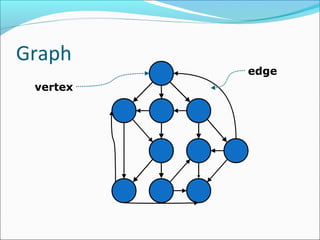
Graph
vertex
edge
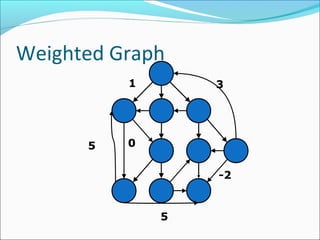
Weighted Graph
5
3
-2
5
1
0
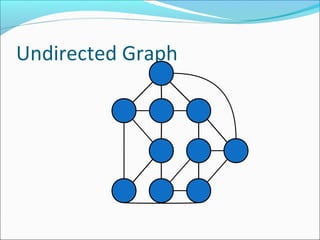
Undirected Graph
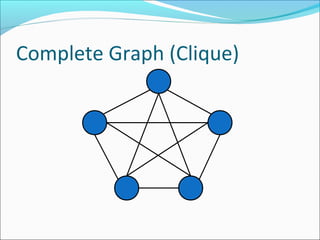
Complete Graph (Clique)
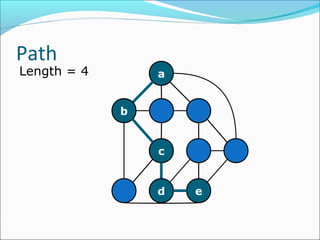
Path
a
c
d e
b
Length = 4
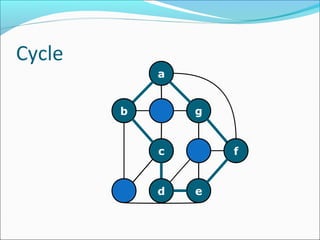
Cycle
a
c
g
d e
b
f
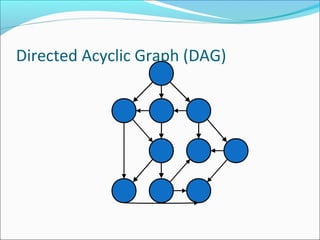
Directed Acyclic Graph (DAG)
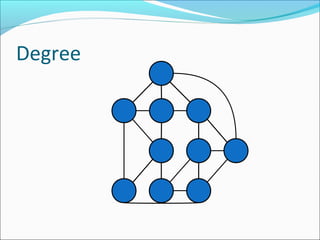
Degree
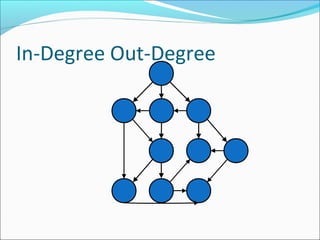
In-Degree Out-Degree
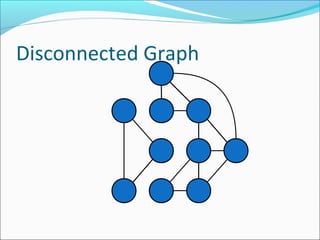
Disconnected Graph
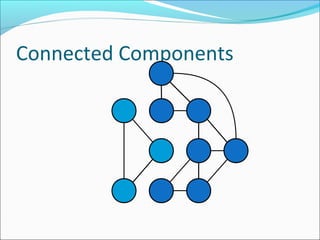
Connected Components
Formally
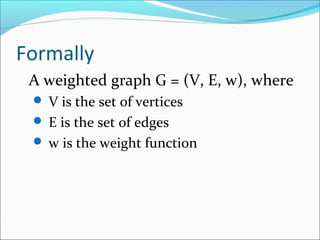
A weighted graph G = (V, E, w), where
 V is the set of vertices
 E is the set of edges
 w is the weight function
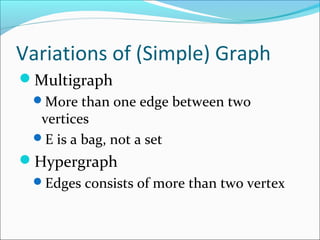
Variations of (Simple) Graph
Multigraph
More than one edge between two
vertices
E is a bag, not a set
Hypergraph
Edges consists of more than two vertex
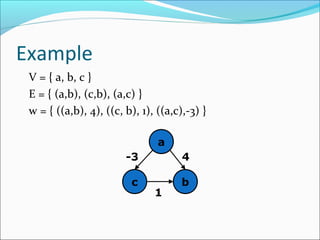
Example
V = { a, b, c }
E = { (a,b), (c,b), (a,c) }
w = { ((a,b), 4), ((c, b), 1), ((a,c),-3) }
a
bc
4
1
-3
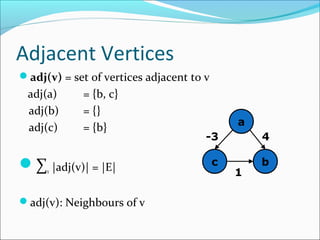
Adjacent Vertices
adj(v) = set of vertices adjacent to v
adj(a) = {b, c}
adj(b) = {}
adj(c) = {b}
∑v |adj(v)| = |E|
adj(v): Neighbours of v
a
bc
4
1
-3
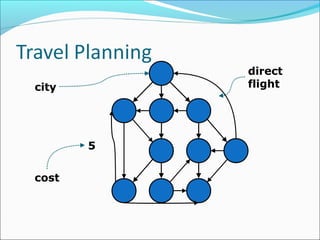
city
direct
flight
5
cost
QuestionWhat is the shortest way to travel between A and
B?
“SHORTEST PATH PROBLEM”
How to mimimize the cost of visiting n cities such
that we visit each city exactly once, and finishing
at the city where we start from?
“TRAVELING SALESMAN PROBLEM”
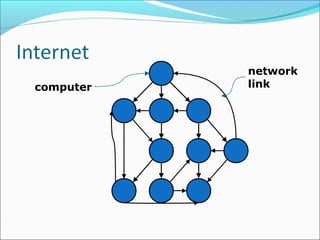
computer
network
link
Question
What is the shortest route to send a packet from A to
B?
“SHORTEST PATH PROBLEM”
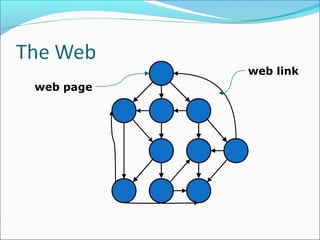
web page
web link
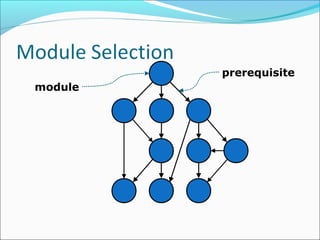
module
prerequisite
Question
Find a sequence of modules to take that satisfy the
prerequisite requirements.
“TOPOLOGICAL SORT”
Other Applications
Biology
VLSI Layout
Vehicle Routing
Job Scheduling
Facility Location
:
:
Adjacency Matrix
double vertex[][];
1
23
4
1
-31 2 3
1 ∞ 4 -3
2 ∞ ∞ ∞
3 ∞ 1 ∞
Adjacency List
EdgeList vertex[];
1
23
4
1
-3
1
2
3
3 -3 2 4
2 1
neighbour cost
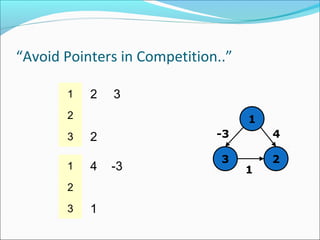
“Avoid Pointers in Competition..”
1
23
4
1
-3
1 2 3
2
3 2
1 4 -3
2
3 1
A
C
D
B
EF
A
C
D
B
EF
A
C
D
B
EF
A
C
D
B
EF
A
C
D
B
EF
A
C
D
B
EF
A
C
D
B
EF
A
C
D
B
EF
0
1
2
2
23
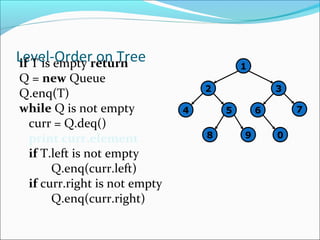
Level-Order on Treeif T is empty return
Q = new Queue
Q.enq(T)
while Q is not empty
curr = Q.deq()
print curr.element
if T.left is not empty
Q.enq(curr.left)
if curr.right is not empty
Q.enq(curr.right)
1
4 5
3
6
9 08
2
7
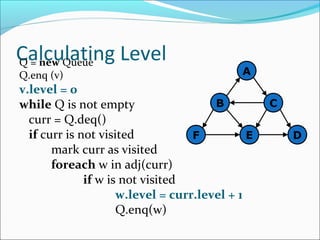
Calculating LevelQ = new Queue
Q.enq (v)
v.level = 0
while Q is not empty
curr = Q.deq()
if curr is not visited
mark curr as visited
foreach w in adj(curr)
if w is not visited
w.level = curr.level + 1
Q.enq(w)
A
C
D
B
EF
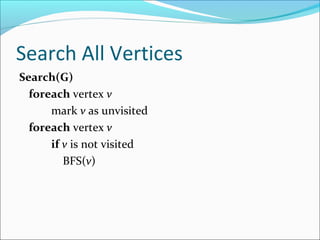
Search All Vertices
Search(G)
foreach vertex v
mark v as unvisited
foreach vertex v
if v is not visited
BFS(v)
A
C
D
B
EF
A
C
D
B
EF
A
C
D
B
EF
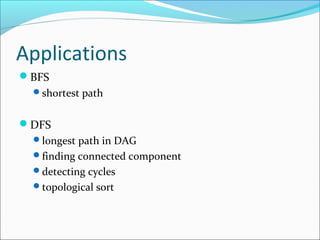
Applications
BFS
shortest path
DFS
longest path in DAG
finding connected component
detecting cycles
topological sort
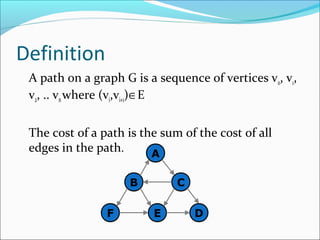
Definition
A path on a graph G is a sequence of vertices v0, v1,
v2, .. vnwhere (vi,vi+1)∈E
The cost of a path is the sum of the cost of all
edges in the path. A
C
D
B
EF
A
C
D
B
EF
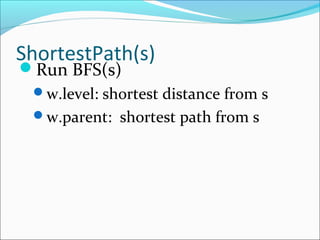
ShortestPath(s)
Run BFS(s)
w.level: shortest distance from s
w.parent: shortest path from s
A
C
D
B
EF
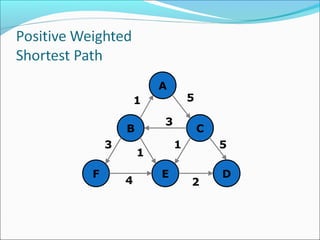
5
51
2
3
1
3
1
4
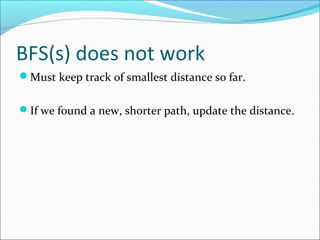
BFS(s) does not work
Must keep track of smallest distance so far.
If we found a new, shorter path, update the distance.
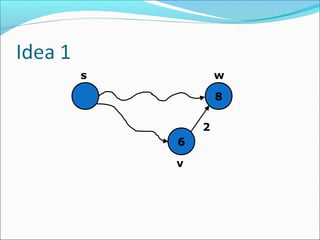
10
6
2
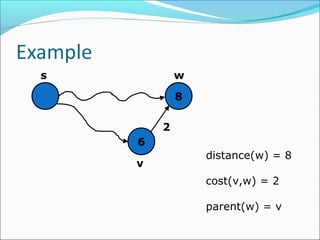
8
s w
v
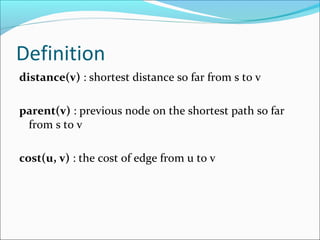
Definition
distance(v) : shortest distance so far from s to v
parent(v) : previous node on the shortest path so far
from s to v
cost(u, v) : the cost of edge from u to v
10
6
2
8
s w
v
distance(w) = 8
cost(v,w) = 2
parent(w) = v
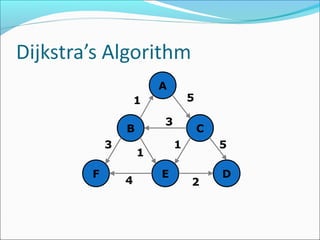
A
C
D
B
EF
5
51
2
3
1
3
1
4
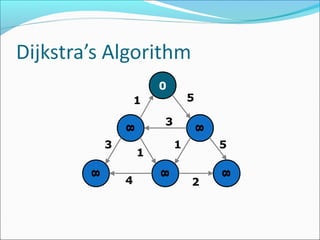
0
8
8
8
8
8
5
51
2
3
1
3
1
4
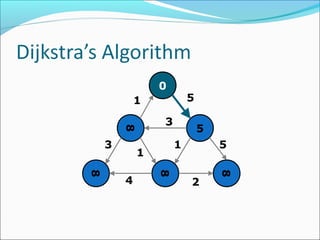
0
5
8
8
8
8
5
51
2
3
1
3
1
4
0
5
8
8
8
8
5
51
2
3
1
3
1
4
0
5
10
8
6
8
5
51
2
3
1
3
1
4
0
5
10
8
6
8
5
51
2
3
1
3
1
4
0
5
8
8
610
5
51
2
3
1
3
1
4
0
5
8
8
610
5
51
2
3
1
3
1
4
0
5
8
8
610
5
51
2
3
1
3
1
4
0
5
8
8
610
5
51
2
3
1
3
1
4
0
5
8
8
610
5
1
2
3
4
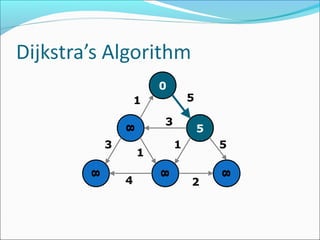
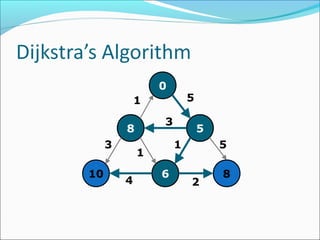
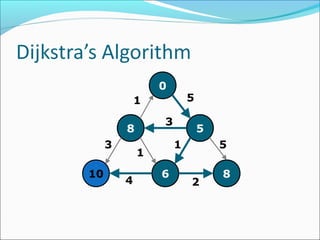
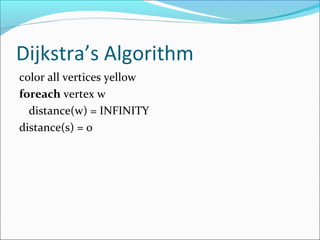
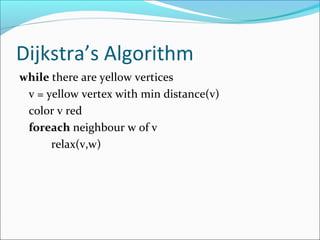
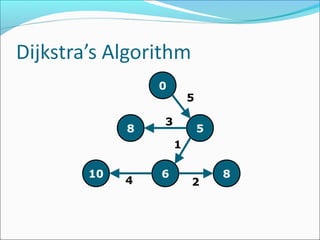
Dijkstra’s Algorithm
color all vertices yellow
foreach vertex w
distance(w) = INFINITY
distance(s) = 0
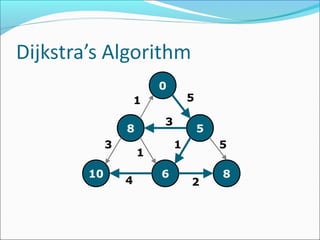
Dijkstra’s Algorithm
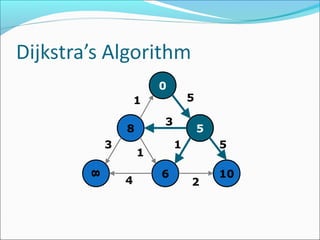
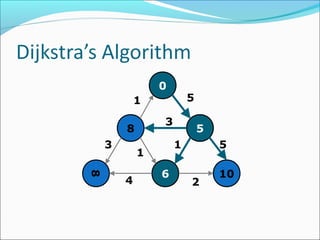
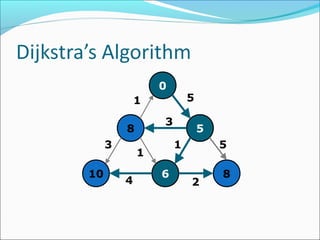
while there are yellow vertices
v = yellow vertex with min distance(v)
color v red
foreach neighbour w of v
relax(v,w)
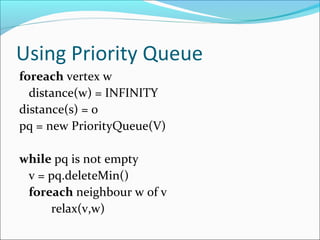
Using Priority Queue
foreach vertex w
distance(w) = INFINITY
distance(s) = 0
pq = new PriorityQueue(V)
while pq is not empty
v = pq.deleteMin()
foreach neighbour w of v
relax(v,w)
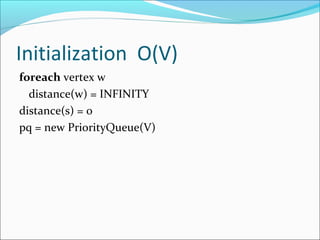
Initialization O(V)
foreach vertex w
distance(w) = INFINITY
distance(s) = 0
pq = new PriorityQueue(V)
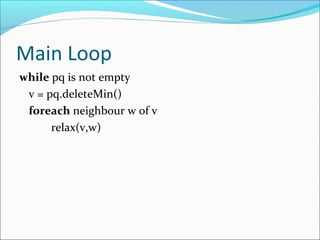
Main Loop
while pq is not empty
v = pq.deleteMin()
foreach neighbour w of v
relax(v,w)
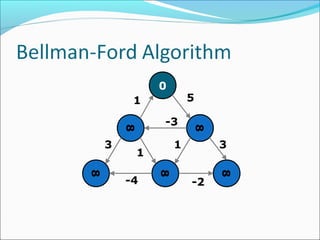
0
8
8
8
8
8
5
31
-2
-3
1
3
1
-4
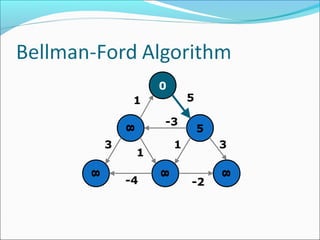
0
5
8
8
8
8
5
31
-2
-3
1
3
1
-4
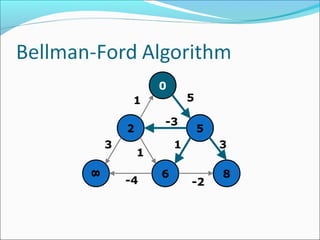
0
5
8
2
6
8
5
31
-2
-3
1
3
1
-4
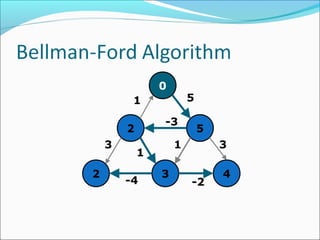
0
5
4
2
32
5
31
-2
-3
1
3
1
-4
0
5
1
2
3-1
5
31
-2
-3
1
3
1
-4
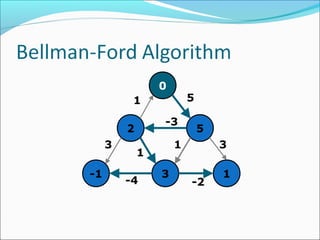
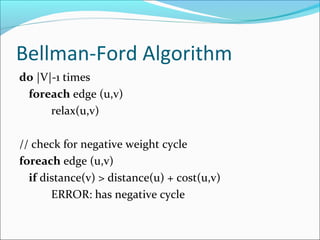
Bellman-Ford Algorithm
do |V|-1 times
foreach edge (u,v)
relax(u,v)
// check for negative weight cycle
foreach edge (u,v)
if distance(v) > distance(u) + cost(u,v)
ERROR: has negative cycle
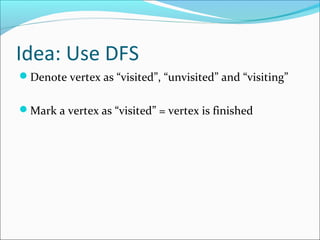
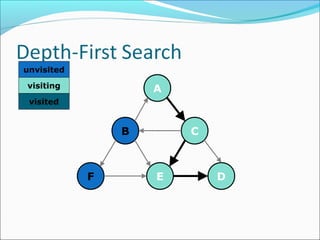
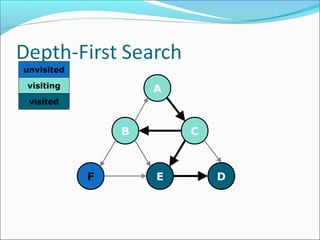
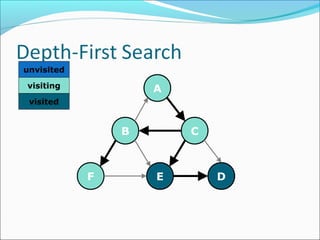
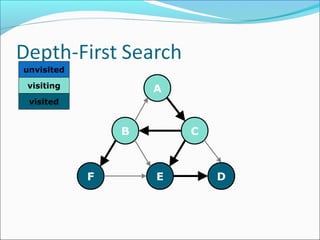
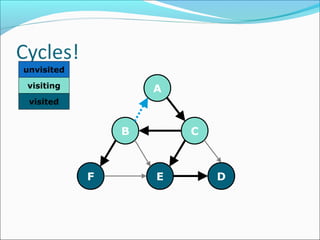
Idea: Use DFS
Denote vertex as “visited”, “unvisited” and “visiting”
Mark a vertex as “visited” = vertex is finished
A
C
D
B
EF
unvisited
visiting
visited
A
C
D
B
EF
unvisited
visiting
visited
A
C
D
B
EF
unvisited
visiting
visited
A
C
D
B
EF
unvisited
visiting
visited
A
C
D
B
EF
unvisited
visiting
visited
A
C
D
B
EF
unvisited
visiting
visited
A
C
D
B
EF
unvisited
visiting
visited
A
C
D
B
EF
unvisited
visiting
visited
A
C
D
B
EF
unvisited
visiting
visited
unvisited
visiting
visited
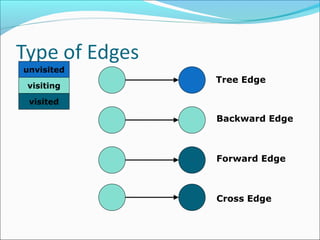
Tree Edge
Backward Edge
Forward Edge
Cross Edge
(in a DAG)
A
C
D
B
EF
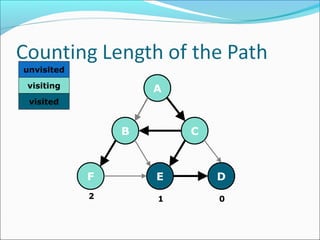
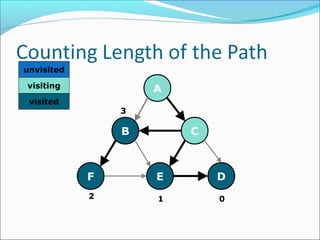
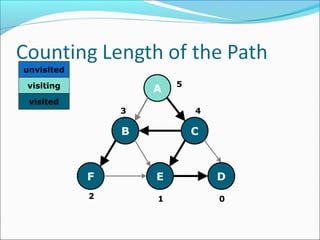
1 0
A
C
D
B
EF
unvisited
visiting
visited
1 02
A
C
D
B
EF
unvisited
visiting
visited
1 0
3
2
A
C
D
B
EF
unvisited
visiting
visited
1 0
3 4
5
2
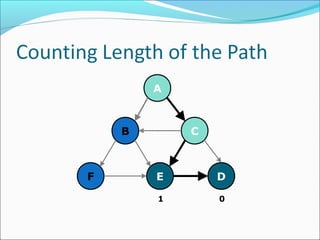
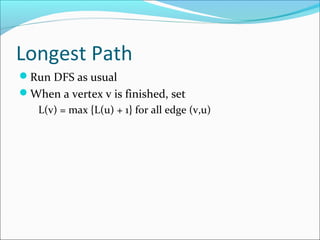
Longest Path
Run DFS as usual
When a vertex v is finished, set
L(v) = max {L(u) + 1} for all edge (v,u)
Topological Sort
Goal: Order the vertices, such that if there is a path
from u to v, u appears before v in the output.
Topological Sort
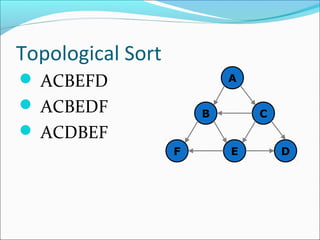
 ACBEFD
 ACBEDF
 ACDBEF
A
C
D
B
EF
Topological Sort
Run DFS as usual
When a vertex is finish, push it onto a stack

Directed Acyclic Graph

Editor's Notes

  • #3 A graph consists of a set of vertices and a set of edges between the vertices. In a tree, there is a unique path between any two nodes. In a graph, there may be more than one path between two nodes.
  • #4 In a weighted graph, edges have a weight (or cost) associated with it. Not all weights are labeled in this slides for simplicity.
  • #5 In an undirected graph, edges are bidirectional.
  • #6 In a complete graph, a node is connected to every other nodes. The number of edges in a complete graph is n(n-1)/2, where n is the number of vertices. (Why is it so?). Therefore, the number of edges is O(n2). A complete graph is also called a clique.
  • #7 A path is a sequence of vertices v0, v1, v2, .. vn where there is an edge between vi and vi+1. The length of a path p is the number of edges in p.
  • #8 A path v0, v1, v2, … vn is a cycle if vn = v0 and its length is at least 2. Note that the definition of path and cycle applies to directed graph as well.
  • #9 A path v0, v1, v2, … vn is a cycle if vn = v0 and its length is at least 2. Note that the definition of path and cycle applies to directed graph as well.
  • #10 In an undirected graph, edges are bidirectional.
  • #11 A path v0, v1, v2, … vn is a cycle if vn = v0 and its length is at least 2. Note that the definition of path and cycle applies to directed graph as well.
  • #12 In a connected graph, there is a path between every nodes. A graph does not have to be connected. The above graph has two connected components.
  • #13 In a connected graph, there is a path between every nodes. A graph does not have to be connected. The above graph has two connected components.
  • #17 Interested students may refer to [CLR] Sec 5.4 for more precise definition of graph terminologies.
  • #28 This requires O(N2) memory, and is not suitable for sparse graph. (Only 1/3 of the above matrix contains useful information). How about undirected graph? How would you represent it?
  • #29 This requires only O(V + E) memory.
  • #30 This requires only O(V + E) memory.
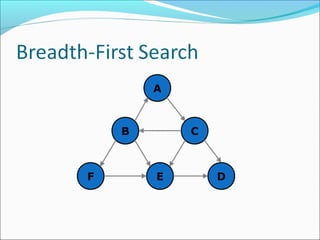
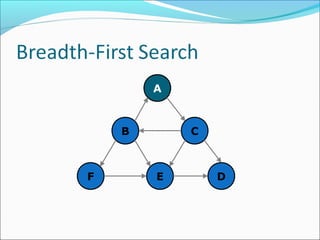
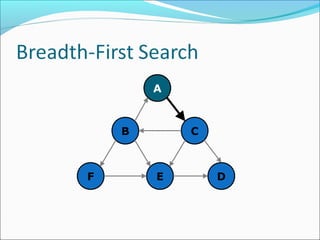
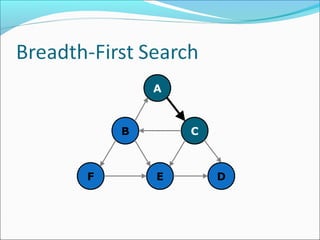
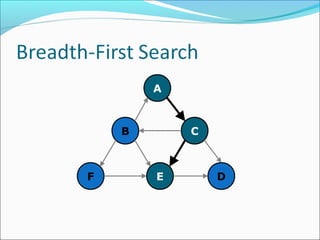
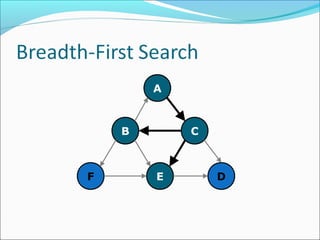
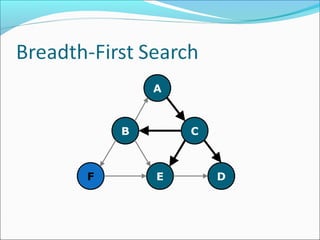
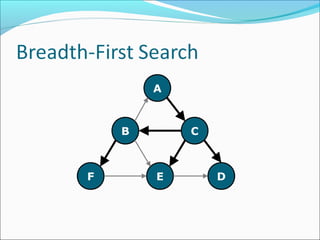
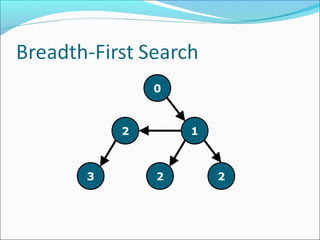
  • #32 Given a source vertex, we like to start searching from that source. The idea of BFS is that we visit all vertices that are of distance i away from the source before we visit vertices that are of distance i+1 away from the source. The order of search is not unique and depends on the order of neighbours visited.
  • #40 After BFS, we get a tree rooted at the source node. Edges in the tree are edges that we followed during searching. We call this a BFS tree. Vertices in the figure are labeled with their distance from the source.
  • #42 Similarly, we can maintain the distance of a vertex from the source.
  • #43 BFS guarantees that if there is a path to a vertex v from the source, we can always visit v. But since some vertices maybe unreachable from the source, we can call BFS multiple times from multiple source.
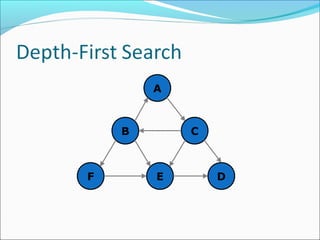
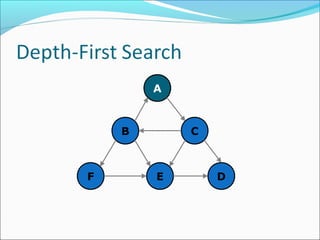
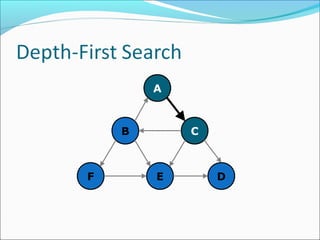
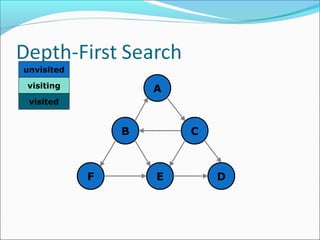
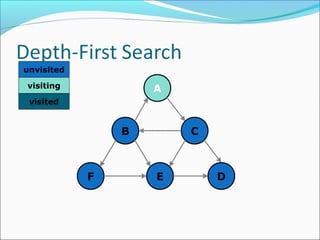
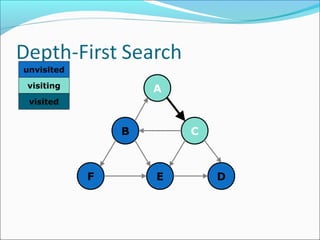
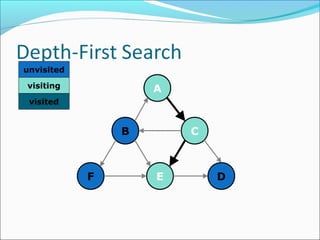
  • #45 Idea for DFS is to go as deep as possible.
  • #50 In Single-source shortest path problem, we are given a vertex v, and we want to find the path with minimum cost to every other vertices.
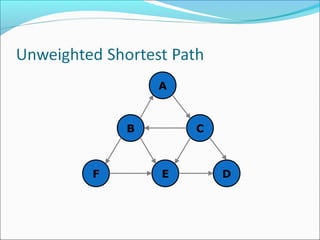
  • #51 If a graph is unweighted, we can treat the cost of each edge as 1.
  • #52 The shostest path for an unweighted graph can be found using BFS. To get the shortest path from a source s to a vertex v, we just trace back the parent pointer from v back to s. The number of edges in the path is given by the level of a vertex in the BFS tree. (Why does BFS guarantee that the paths are shortest?)
  • #53 Next, we look at another version of the problem, where the cost of the edges are positive.
  • #54 Convince yourself the BFS does not solve our shortest path problem here. Distance here refers to the cost of the path, not the number of edges as in BFS.
  • #55 In the following figures, we label a node with the shortest distance discovered so far from the source. Here is the basic idea that will help us solve our shortest path problem. If the current shortest distance from s to w is 10, to v is 6, and the cost of edge (v,w) is 2, then we have discovered a shorter path from s to w (through v).
  • #58 Now we are ready to describe our single source, shortest path algorithm for graphs with positive weights. The algorithm is called Dijkstra’s algorithm.
  • #71 Since priority queue supports efficient minimum picking operation, we can use a priority queue here to improve the running time. Note that we no longer color vertices here. Yellow vertices in the previous pseudocode are now vertices that are in the priority queue.
  • #72 Initialization still takes O(V)
  • #73 But we have to be more careful with the analysis of the main loop. We know that each deleteMin() takes O(log V) time. But relax(v,w) is no longer O(1).
  • #79 I claim that the running time for Bellman-Ford algorithm is O(VE). Verify this claim.
  • #82 Idea for DFS is to go as deep as possible.
  • #100 ACDBEF is NOT topologically sorted.
  • #101 What is the running time for Toposort?