
Cell
As a basic unit of life
Cell
Basic structural and functional unit of life
Bound by a cell membrane
Perform essential functions of life
Intro
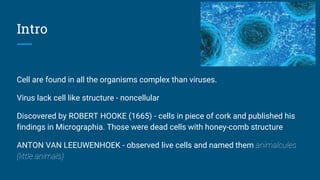
Cell are found in all the organisms complex than viruses.
Virus lack cell like structure - noncellular
Discovered by ROBERT HOOKE (1665) - cells in piece of cork and published his
findings in Micrographia. Those were dead cells with honey-comb structure
ANTON VAN LEEUWENHOEK - observed live cells and named them animalcules
(little animals)
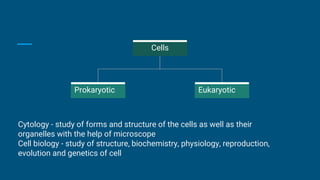
Cells
Prokaryotic Eukaryotic
Cytology - study of forms and structure of the cells as well as their
organelles with the help of microscope
Cell biology - study of structure, biochemistry, physiology, reproduction,
evolution and genetics of cell
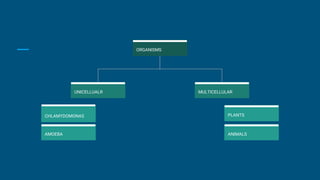
ORGANISMS
UNICELLUALR MULTICELLULAR
ANIMALS
PLANTSCHLAMYDOMONAS
AMOEBA
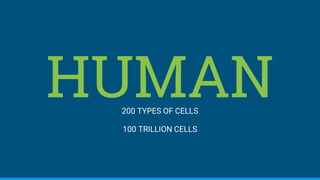
HUMAN200 TYPES OF CELLS
100 TRILLION CELLS
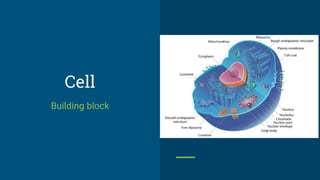
Cell
Building block
“Any living cell carries with it the experience of a billion years of experimentation
by its ancestors. (1949) ”
- Max Ludwig Henning Delbrück
Cell are organised as tissues (group of cells having common origin and common function)
Animals - 4 types - epithelial, connective, muscular, nervous
Plants - simple - parenchyma, collenchyma, sclerenchyma
Organ - complex structure formed by association of two or more tissues specialised to perfom a
function
Organ system - organs coordinate to perform a specific function
Organism - integrated unit of organ systems
Thanks!

cell as a basic unit of life

  • 1.
    Cell As a basicunit of life
  • 2.
    Cell Basic structural andfunctional unit of life Bound by a cell membrane Perform essential functions of life
  • 3.
    Intro Cell are foundin all the organisms complex than viruses. Virus lack cell like structure - noncellular Discovered by ROBERT HOOKE (1665) - cells in piece of cork and published his findings in Micrographia. Those were dead cells with honey-comb structure ANTON VAN LEEUWENHOEK - observed live cells and named them animalcules (little animals)
  • 4.
    Cells Prokaryotic Eukaryotic Cytology -study of forms and structure of the cells as well as their organelles with the help of microscope Cell biology - study of structure, biochemistry, physiology, reproduction, evolution and genetics of cell
  • 5.
  • 6.
    HUMAN200 TYPES OFCELLS 100 TRILLION CELLS
  • 7.
  • 8.
    “Any living cellcarries with it the experience of a billion years of experimentation by its ancestors. (1949) ” - Max Ludwig Henning Delbrück
  • 9.
    Cell are organisedas tissues (group of cells having common origin and common function) Animals - 4 types - epithelial, connective, muscular, nervous Plants - simple - parenchyma, collenchyma, sclerenchyma Organ - complex structure formed by association of two or more tissues specialised to perfom a function Organ system - organs coordinate to perform a specific function Organism - integrated unit of organ systems
  • 10.