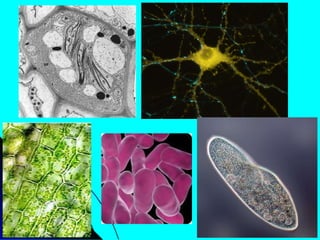
CELLS Cells are the basic structural and functional units of life. They differ in structure and complexity.
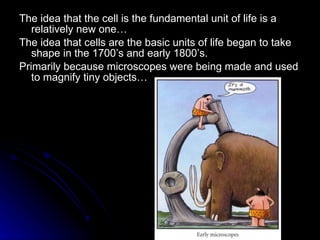
The idea that the cell is the fundamental unit of life is a relatively new one… The idea that cells are the basic units of life began to take shape in the 1700’s and early 1800’s. Primarily because microscopes were being made and used to magnify tiny objects…
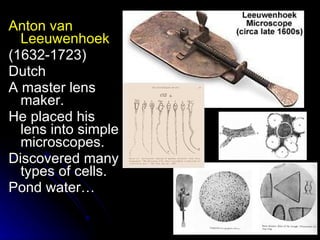
Anton van Leeuwenhoek (1632-1723) Dutch A master lens maker. He placed his lens into simple microscopes. Discovered many types of cells. Pond water…
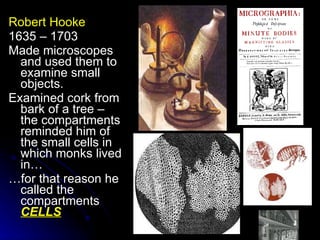
Robert Hooke 1635 – 1703 Made microscopes and used them to examine small objects. Examined cork from bark of a tree – the compartments reminded him of the small cells in which monks lived in… … for that reason he called the compartments  CELLS
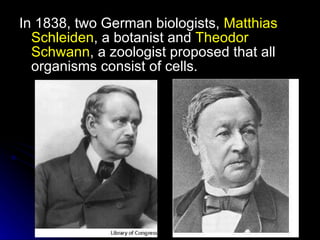
In 1838, two German biologists,  Matthias   Schleiden , a botanist and  Theodor Schwann , a zoologist proposed that all organisms consist of cells.
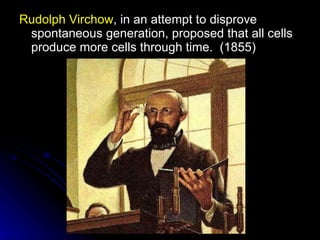
Rudolph Virchow , in an attempt to disprove spontaneous generation, proposed that all cells produce more cells through time.  (1855)
The Cell Theory All living things are composed of cells. Cells are the basic units of structure and function in living things. New cells are produced from existing cells. According to the cell theory, all organisms consist of cells and cell products, and one can understand how living creatures are built and how they function if cells can be understood. The Cell Theory is one of the major unifying themes of biology.
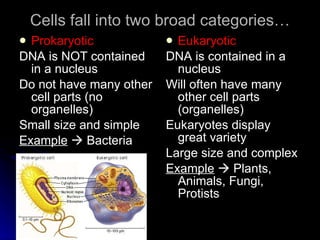
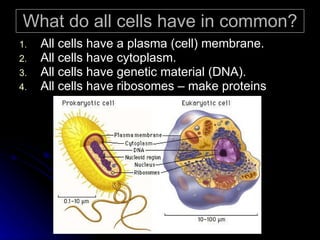
Cells fall into two broad categories… Prokaryotic DNA is NOT contained in a nucleus Do not have many other cell parts (no organelles) Small size and simple Example     Bacteria Eukaryotic DNA is contained in a nucleus Will often have many other cell parts (organelles) Eukaryotes display great variety Large size and complex Example     Plants, Animals, Fungi, Protists
What do all cells have in common? All cells have a plasma (cell) membrane. All cells have cytoplasm. All cells have genetic material (DNA). All cells have ribosomes – make proteins
Can you think of a reason why the introduction of the cell theory into mainstream thinking altered (in a ‘negative’ way?) our view of life? (especially human life) The ‘discovery’ of the Cell Theory saw a much more  materialistic ,  reductionistic  view of life being introduced into mainstream thinking.

Life Is Cellular

  • 1.
  • 2.
    CELLS Cells arethe basic structural and functional units of life. They differ in structure and complexity.
  • 3.
    The idea thatthe cell is the fundamental unit of life is a relatively new one… The idea that cells are the basic units of life began to take shape in the 1700’s and early 1800’s. Primarily because microscopes were being made and used to magnify tiny objects…
  • 4.
    Anton van Leeuwenhoek(1632-1723) Dutch A master lens maker. He placed his lens into simple microscopes. Discovered many types of cells. Pond water…
  • 5.
    Robert Hooke 1635– 1703 Made microscopes and used them to examine small objects. Examined cork from bark of a tree – the compartments reminded him of the small cells in which monks lived in… … for that reason he called the compartments CELLS
  • 6.
    In 1838, twoGerman biologists, Matthias Schleiden , a botanist and Theodor Schwann , a zoologist proposed that all organisms consist of cells.
  • 7.
    Rudolph Virchow ,in an attempt to disprove spontaneous generation, proposed that all cells produce more cells through time. (1855)
  • 8.
    The Cell TheoryAll living things are composed of cells. Cells are the basic units of structure and function in living things. New cells are produced from existing cells. According to the cell theory, all organisms consist of cells and cell products, and one can understand how living creatures are built and how they function if cells can be understood. The Cell Theory is one of the major unifying themes of biology.
  • 9.
    Cells fall intotwo broad categories… Prokaryotic DNA is NOT contained in a nucleus Do not have many other cell parts (no organelles) Small size and simple Example  Bacteria Eukaryotic DNA is contained in a nucleus Will often have many other cell parts (organelles) Eukaryotes display great variety Large size and complex Example  Plants, Animals, Fungi, Protists
  • 10.
    What do allcells have in common? All cells have a plasma (cell) membrane. All cells have cytoplasm. All cells have genetic material (DNA). All cells have ribosomes – make proteins
  • 11.
    Can you thinkof a reason why the introduction of the cell theory into mainstream thinking altered (in a ‘negative’ way?) our view of life? (especially human life) The ‘discovery’ of the Cell Theory saw a much more materialistic , reductionistic view of life being introduced into mainstream thinking.