WELCOME
Content Standard
The learners demonstrate an understanding of:
1. Cell theory
2. Cell Structure and Functions
3. Prokaryotic vs Eukaryotic Cells
4. Cell Types
5. Cell Modifications
Performance Standard
The learners:
1. construct a 3D model of a
plant/animal/ bacterial cell using
recyclable materials
2. construct a cell membrane model from
indigenous or recyclable materials
Learning Competencies
The learners:
1. explain the postulates of the cell theory
2. describe the structure and function of major and
subcellular organelles
3. distinguish prokaryotic and eukaryotic cells according
to their distinguishing features
4. classify different cell types (plant/animal tissues) and
specify the function(s) of each
5. describe some cell modifications that lead to
adaptation to carry out specialized functions (e.g.,
microvilli, root hair)
What is the basic unit of life?
Objectives of the lesson
The learners should be able to:
1.determine the events that led to the
cell theory
2.explain the postulates of cell theory
3.name scientist and their significant
contribution in the field of cell theory
Picture No. 1
Picture No. 2
Picture No. 3
multicellular
unicellular
• ....History and development of cell theory _ Cells _ MCAT _ Khan
Academy_HIGH.mp4
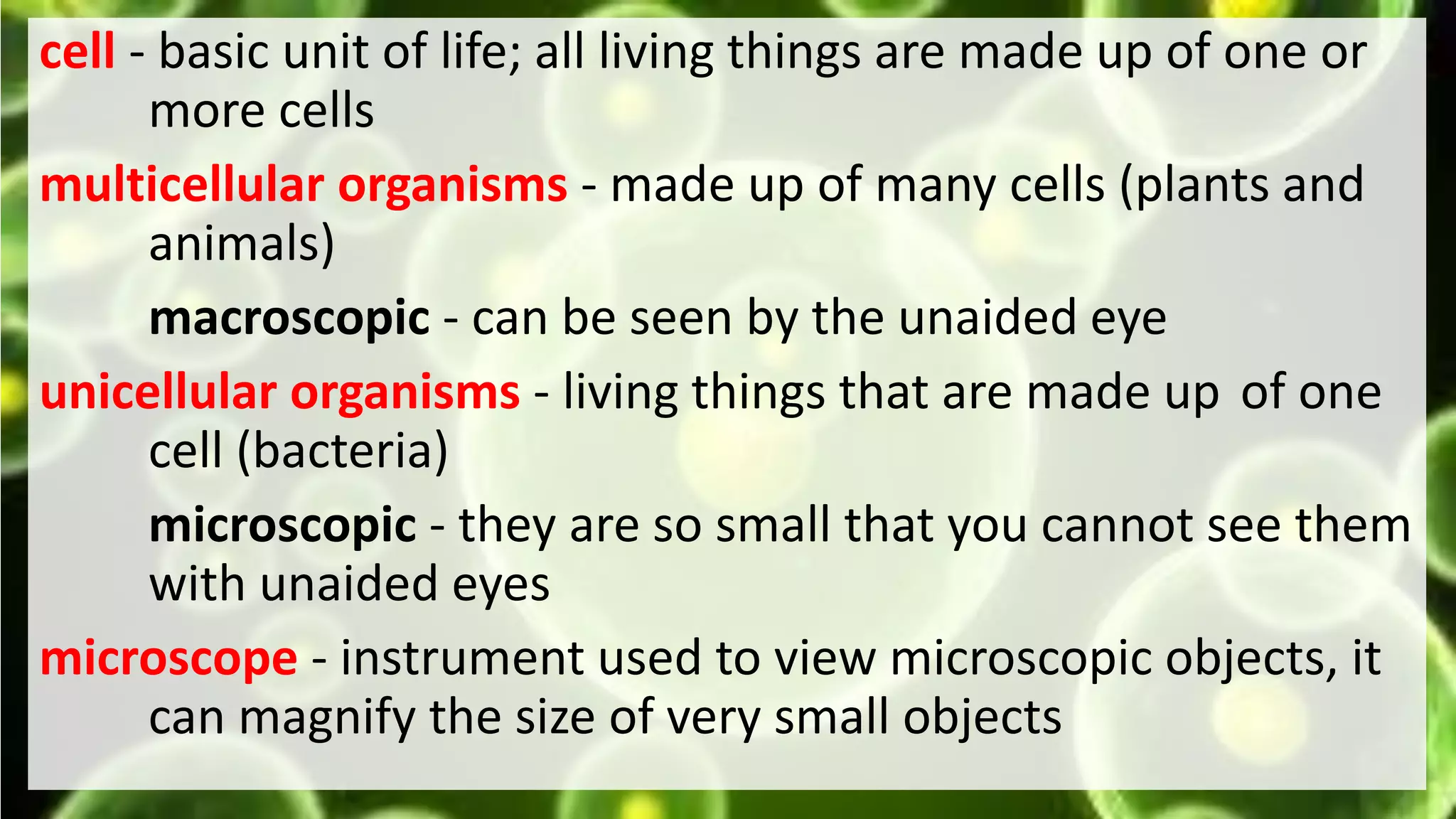
cell - basic unit of life; all living things are made up of one or
more cells
multicellular organisms - made up of many cells (plants and
animals)
macroscopic - can be seen by the unaided eye
unicellular organisms - living things that are made up of one
cell (bacteria)
microscopic - they are so small that you cannot see them
with unaided eyes
microscope - instrument used to view microscopic objects, it
can magnify the size of very small objects
The Invention of Microscope and Discovery of the Cell
Romans
•they had already invented and
expiremented with glasses before
the microscope invented, during the
first century
•they discovered that small objects
become larger when viewed
through the glass sample
•became the earliest form of lens
(derived from the Latin word lentil)
The Invention of Microscope and Discovery of the Cell
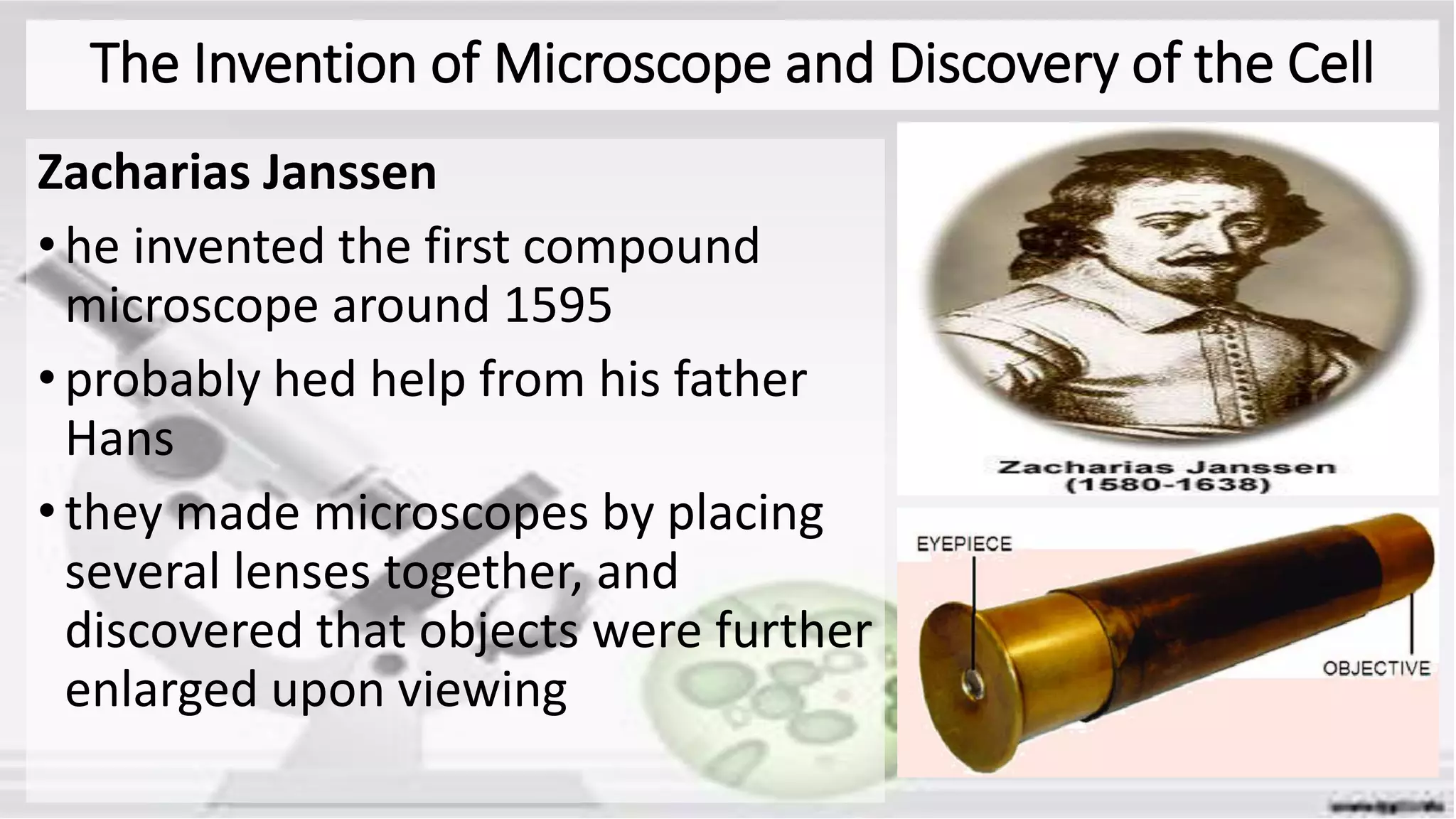
Zacharias Janssen
•he invented the first compound
microscope around 1595
•probably hed help from his father
Hans
•they made microscopes by placing
several lenses together, and
discovered that objects were further
enlarged upon viewing
The Invention of Microscope and Discovery of the Cell
Robert Hooke
•examined a thin slice of cork
under the microscope he built
•he saw small compartments
of the cork and named cellula
“little rooms”
•these eventually became
known as cells
cork
The Invention of Microscope and Discovery of the Cell
Anton van Leeuwenhhoek
•created a microscope with much
higher magnification than the
microscope that Hooked used.
•he found motile objects, he
stated that motility is a quality of
life, therefore those were living
organisms “animalcules”
•includes protozoa and other
unicellular organism
The Cell Theory
Matthias Jakob Schleiden
• a German botanist and professor
of botany
•published his research in 1838,
which was based on several years
of studying different types of
plants under the microscope
•plants are made up of cells and
that cells are the basic units of
organisms
The Cell Theory
Theodor Schwann
•German physiologist expanded on
the cell theory as he showed how
animal tissues are also made up
of individual cells.
•published his research based on
his study of several slides of
animal cells a year later after
Schleiden's research published.
The Cell Theory
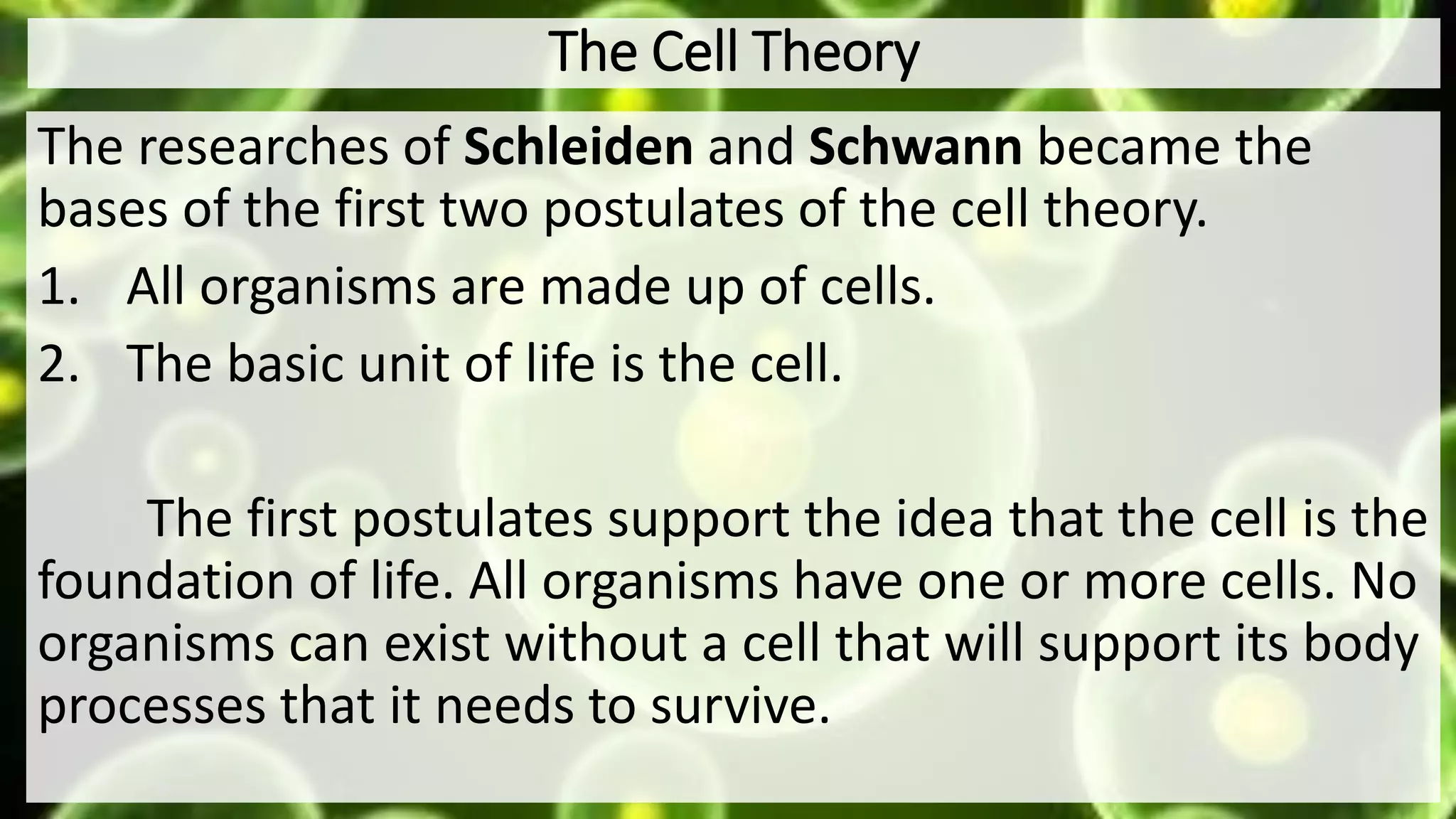
The researches of Schleiden and Schwann became the
bases of the first two postulates of the cell theory.
1. All organisms are made up of cells.
2. The basic unit of life is the cell.
The first postulates support the idea that the cell is the
foundation of life. All organisms have one or more cells. No
organisms can exist without a cell that will support its body
processes that it needs to survive.
The Cell Theory
Rudolf Ludwig Karl Virchow
•proven the last postulate of cell theory upon studying how
cells played a role in body diseases at that time, he noticed
that the existence of diseases in an organs and tissues come
from affected cells.
•from this he stated Omnis cellula e cellula, which means that
all cells arise from pre existing cells.
•believed, however that this discovery was initially made by
Robert Remak, a Jewish scientist, in 1855, when he tried to
prove the idea of cell division by hardening the cell
membrane
Rudolf Ludwig Karl Virchow Robert Remak
Postulates of Cell Theory
1. All organisms are made up of cells.
2. The basic unit of life is the cell.
3. All cells arise from pre existing cells
The Cell Theory of Spontaneous Generation
The cell theory had greatly disproved the theory of
spontaneous generation, which states that organisms
can come from nonliving sources. The theory os
spontaneous generation was generally accepted until
the 19th century. The cell theory's third postulate
directly contardicts the theory of spontaneous
generation.
Aside from the experiments conducted by Virchow
and Remak, prior studies were initially done to test the
validityof spontaneous generation theory.
Redi's Experiment
Francisco Redi - an Italian
scientist, designed a
scientific experiment in 1668
to demonstrate that
maggots do not just appear
spontaneously but are
produced from the eggs of
flies.
Disprove the theory of
spontaneous generation.
Needham's Test
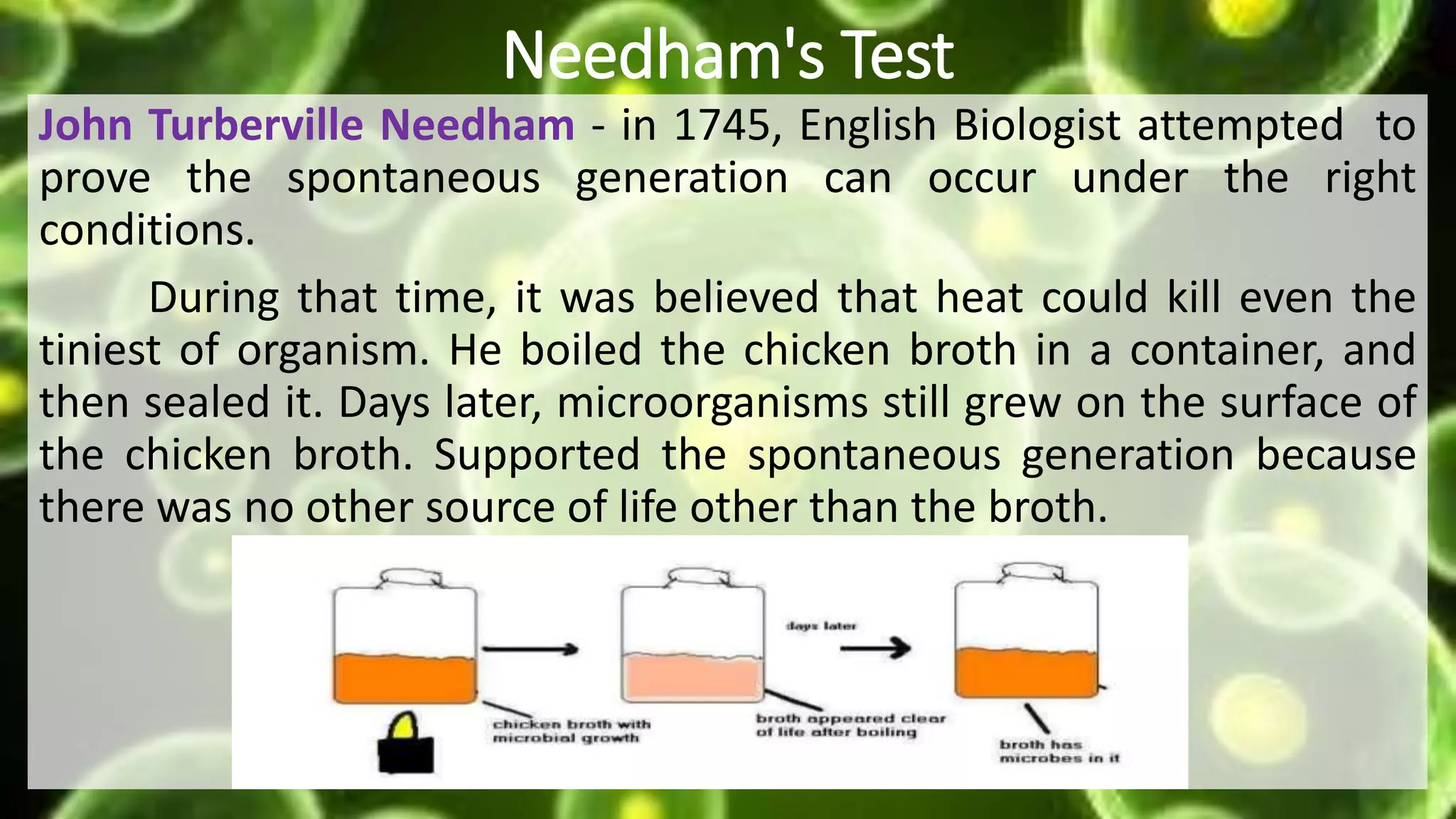
John Turberville Needham - in 1745, English Biologist attempted to
prove the spontaneous generation can occur under the right
conditions.
During that time, it was believed that heat could kill even the
tiniest of organism. He boiled the chicken broth in a container, and
then sealed it. Days later, microorganisms still grew on the surface of
the chicken broth. Supported the spontaneous generation because
there was no other source of life other than the broth.
Spallanzani's Experiments
Lazzaro Spallanzani - Italian scholar who sought to
verify Needham's test in 1767. Spallanzani believed that
Neddham had not heated broth enough to kill the
organisms in it.
Pasteur's Test
Louis Pasteur - opposed the concept of spontaneous
generation. He believed that microorganisms present in
putrefying materials are present in the air or might have
been present on the surface where decaying materials are
present.
Sterilization - process of heating was used by Pasteur to
eliminate contaminants
Pasteur's experiment gave rise to the study of
Microbiology. Later on, the sterilization process was
developed and carried out as basic procedure on both
basic and applied microbiology research.
Pasteur's Test
SCIENTIST EXPERIMENT RESULT
Francesco Redi
John Needham
Lazzaro Spallanzani
Louis Pasteur
Complete the following table
Answer the following questions:
1. Which results supported the cell theory? Why?
2. Did the contribution of Rudolf Virchow in the cell theory agree
with the theory of spontaneus generation? Why?
Indicate the order
of their occurance
in the field of cell
theory (with No. 1
being the first and
No. 4 as the last)
Name of Scientist
Significant
Contribution
Fill in the boxes with required information

Biology 1 for Senior High School

  • 1.
  • 2.
    Content Standard The learnersdemonstrate an understanding of: 1. Cell theory 2. Cell Structure and Functions 3. Prokaryotic vs Eukaryotic Cells 4. Cell Types 5. Cell Modifications
  • 3.
    Performance Standard The learners: 1.construct a 3D model of a plant/animal/ bacterial cell using recyclable materials 2. construct a cell membrane model from indigenous or recyclable materials
  • 4.
    Learning Competencies The learners: 1.explain the postulates of the cell theory 2. describe the structure and function of major and subcellular organelles 3. distinguish prokaryotic and eukaryotic cells according to their distinguishing features 4. classify different cell types (plant/animal tissues) and specify the function(s) of each 5. describe some cell modifications that lead to adaptation to carry out specialized functions (e.g., microvilli, root hair)
  • 5.
    What is thebasic unit of life?
  • 6.
    Objectives of thelesson The learners should be able to: 1.determine the events that led to the cell theory 2.explain the postulates of cell theory 3.name scientist and their significant contribution in the field of cell theory
  • 7.
    Picture No. 1 PictureNo. 2 Picture No. 3 multicellular unicellular
  • 8.
    • ....History anddevelopment of cell theory _ Cells _ MCAT _ Khan Academy_HIGH.mp4
  • 9.
    cell - basicunit of life; all living things are made up of one or more cells multicellular organisms - made up of many cells (plants and animals) macroscopic - can be seen by the unaided eye unicellular organisms - living things that are made up of one cell (bacteria) microscopic - they are so small that you cannot see them with unaided eyes microscope - instrument used to view microscopic objects, it can magnify the size of very small objects
  • 10.
    The Invention ofMicroscope and Discovery of the Cell Romans •they had already invented and expiremented with glasses before the microscope invented, during the first century •they discovered that small objects become larger when viewed through the glass sample •became the earliest form of lens (derived from the Latin word lentil)
  • 11.
    The Invention ofMicroscope and Discovery of the Cell Zacharias Janssen •he invented the first compound microscope around 1595 •probably hed help from his father Hans •they made microscopes by placing several lenses together, and discovered that objects were further enlarged upon viewing
  • 12.
    The Invention ofMicroscope and Discovery of the Cell Robert Hooke •examined a thin slice of cork under the microscope he built •he saw small compartments of the cork and named cellula “little rooms” •these eventually became known as cells
  • 13.
  • 14.
    The Invention ofMicroscope and Discovery of the Cell Anton van Leeuwenhhoek •created a microscope with much higher magnification than the microscope that Hooked used. •he found motile objects, he stated that motility is a quality of life, therefore those were living organisms “animalcules” •includes protozoa and other unicellular organism
  • 16.
    The Cell Theory MatthiasJakob Schleiden • a German botanist and professor of botany •published his research in 1838, which was based on several years of studying different types of plants under the microscope •plants are made up of cells and that cells are the basic units of organisms
  • 17.
    The Cell Theory TheodorSchwann •German physiologist expanded on the cell theory as he showed how animal tissues are also made up of individual cells. •published his research based on his study of several slides of animal cells a year later after Schleiden's research published.
  • 18.
    The Cell Theory Theresearches of Schleiden and Schwann became the bases of the first two postulates of the cell theory. 1. All organisms are made up of cells. 2. The basic unit of life is the cell. The first postulates support the idea that the cell is the foundation of life. All organisms have one or more cells. No organisms can exist without a cell that will support its body processes that it needs to survive.
  • 19.
    The Cell Theory RudolfLudwig Karl Virchow •proven the last postulate of cell theory upon studying how cells played a role in body diseases at that time, he noticed that the existence of diseases in an organs and tissues come from affected cells. •from this he stated Omnis cellula e cellula, which means that all cells arise from pre existing cells. •believed, however that this discovery was initially made by Robert Remak, a Jewish scientist, in 1855, when he tried to prove the idea of cell division by hardening the cell membrane
  • 20.
    Rudolf Ludwig KarlVirchow Robert Remak
  • 21.
    Postulates of CellTheory 1. All organisms are made up of cells. 2. The basic unit of life is the cell. 3. All cells arise from pre existing cells
  • 23.
    The Cell Theoryof Spontaneous Generation The cell theory had greatly disproved the theory of spontaneous generation, which states that organisms can come from nonliving sources. The theory os spontaneous generation was generally accepted until the 19th century. The cell theory's third postulate directly contardicts the theory of spontaneous generation. Aside from the experiments conducted by Virchow and Remak, prior studies were initially done to test the validityof spontaneous generation theory.
  • 24.
    Redi's Experiment Francisco Redi- an Italian scientist, designed a scientific experiment in 1668 to demonstrate that maggots do not just appear spontaneously but are produced from the eggs of flies. Disprove the theory of spontaneous generation.
  • 25.
    Needham's Test John TurbervilleNeedham - in 1745, English Biologist attempted to prove the spontaneous generation can occur under the right conditions. During that time, it was believed that heat could kill even the tiniest of organism. He boiled the chicken broth in a container, and then sealed it. Days later, microorganisms still grew on the surface of the chicken broth. Supported the spontaneous generation because there was no other source of life other than the broth.
  • 26.
    Spallanzani's Experiments Lazzaro Spallanzani- Italian scholar who sought to verify Needham's test in 1767. Spallanzani believed that Neddham had not heated broth enough to kill the organisms in it.
  • 28.
    Pasteur's Test Louis Pasteur- opposed the concept of spontaneous generation. He believed that microorganisms present in putrefying materials are present in the air or might have been present on the surface where decaying materials are present. Sterilization - process of heating was used by Pasteur to eliminate contaminants Pasteur's experiment gave rise to the study of Microbiology. Later on, the sterilization process was developed and carried out as basic procedure on both basic and applied microbiology research.
  • 29.
  • 30.
    SCIENTIST EXPERIMENT RESULT FrancescoRedi John Needham Lazzaro Spallanzani Louis Pasteur Complete the following table Answer the following questions: 1. Which results supported the cell theory? Why? 2. Did the contribution of Rudolf Virchow in the cell theory agree with the theory of spontaneus generation? Why?
  • 31.
    Indicate the order oftheir occurance in the field of cell theory (with No. 1 being the first and No. 4 as the last) Name of Scientist Significant Contribution Fill in the boxes with required information