LIVE INTERACTIVE LEARNING @ YOUR DESKTOP 
1 
How Do You Know That? Helping Students 
Write About Claims and Evidence 
Presented by: Jodi Wheeler-Toppen 
December 12, 2012 
7:30 p.m. – 9:00 p.m. Eastern time
Introducing today’s presenter… 
2 
Jodi Wheeler-Toppen 
• Former science teacher 
• NSTA Press author
Welcome! 
Quick Poll: 
How do you use a claims and evidence approach in your 
classroom? 
a) I’m still learning about it. 
b) I talk about it in the context of how science works. 
c) Students are required to support claims with evidence in 
class discussions. 
d) Students have to write claims and support them with 
evidence for some or all labs. 
e) We have class discussion and writing activities that revolve 
around making claims and supporting them with evidence. 
3
This Evening 
Claims, Evidence, and Reasoning 
• Session Plan 
– Solve a murder mystery 
– Look at the structure for C‐E‐R arguments and 
what they look like in science 
– Tackle the practical issues of helping students do 
this kind of writing 
– Look at a science mystery, with competing claims 
4
“Slip or Trip” 
– Adapted from: Hillocks, G. Teaching Argument 
Writing: Grades 6‐12. Portsmouth, NH: 
Heinemann Press. 
• He adapted it from: Treat, Lawrence, and Kathleen 
Borowik. Crime and Puzzlement 2: More Solve‐them‐yourself 
Picture Mysteries. Boston: D.R. Godine, 1982. 
5
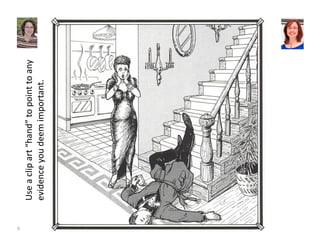
Use a clip art “hand” to point to any 
evidence you deem important. 
6
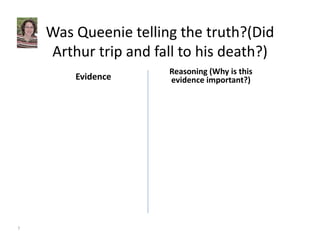
Was Queenie telling the truth?(Did 
Arthur trip and fall to his death?) 
Evidence Reasoning (Why is this 
evidence important?) 
7
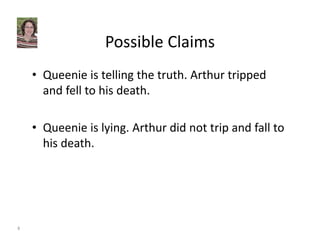
Possible Claims 
• Queenie is telling the truth. Arthur tripped 
and fell to his death. 
• Queenie is lying. Arthur did not trip and fall to 
his death. 
8
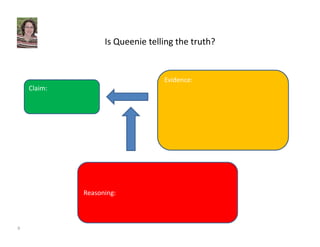
Claim: 
Is Queenie telling the truth? 
Evidence: 
Reasoning: 
9
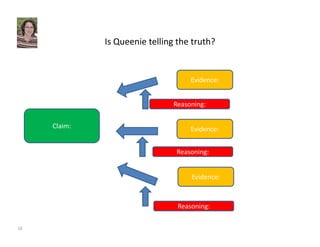
Claim: 
Is Queenie telling the truth? 
Evidence: 
Reasoning: 
Evidence: 
Reasoning: 
Evidence: 
Reasoning: 
10
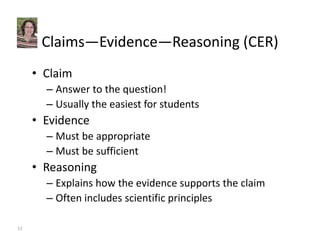
Claims—Evidence—Reasoning (CER) 
• Claim 
– Answer to the question! 
– Usually the easiest for students 
• Evidence 
– Must be appropriate 
– Must be sufficient 
• Reasoning 
– Explains how the evidence supports the claim 
– Often includes scientific principles 
11
Why take a C‐E‐R Approach? 
• Students are more successful understanding what’s 
going on than with the generic term “Conclusions.” 
• This is how you make an argument or explanation 
convincing. 
• This is what scientists do. 
• This is the language of both the Common Core and the 
Next Generation Science Standards. 
12
Common Core Standards: 
Writing in History, Science, Technical Subjects 
WHST.6‐8.1. Write arguments focused on discipline‐specific content. 
• Introduce claim(s) about a topic or issue, acknowledge and 
distinguish the claim(s) from alternate or opposing claims, and 
organize the reasons and evidence logically. 
• Support claim(s) with logical reasoning and relevant, accurate data 
and evidence that demonstrate an understanding of the topic or 
text, using credible sources. 
• Use words, phrases, and clauses to create cohesion and clarify the 
relationships among claim(s), counterclaims, reasons, and evidence. 
• Establish and maintain a formal style. 
• Provide a concluding statement or section that follows from and 
supports the argument presented. 
13
Next Generation Science Standards 
Scientific and Engineering Practices 
1. Asking questions (for science) and defining problems (for engineering) 
2. Developing and using models 
3. Planning and carrying out investigations 
4. Analyzing and interpreting data 
5. Using mathematics and computational thinking 
6. Constructing explanations (for science) and designing solutions (for 
engineering) 
7. Engaging in argument from evidence 
8. Obtaining, evaluating, and communicating information 
14
Why write it down? 
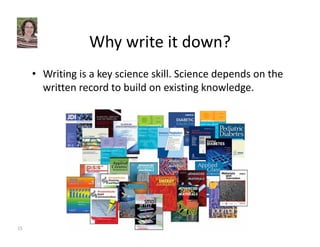
• Writing is a key science skill. Science depends on the 
written record to build on existing knowledge. 
15
Why Writing Is Important 
• Writing helps students learn. 
– It forces them to organize their thoughts and find 
the relationships between ideas. 
–Writing holds ideas in place long enough for 
students to think about them. 
–Writing gets all students to participate. 
• Writing helps you (as the teacher) spot 
misconceptions. 
16
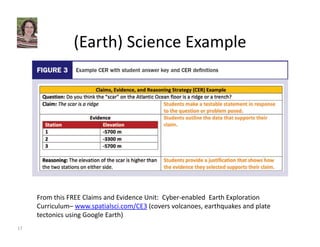
(Earth) Science Example 
From this FREE Claims and Evidence Unit: Cyber‐enabled Earth Exploration 
Curriculum– www.spatialsci.com/CE3 (covers volcanoes, earthquakes and plate 
tectonics using Google Earth) 
17
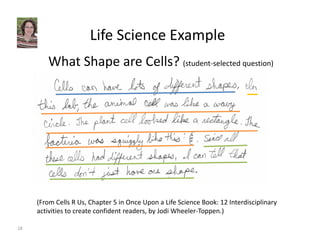
Life Science Example 
What Shape are Cells? (student‐selected question) 
(From Cells R Us, Chapter 5 in Once Upon a Life Science Book: 12 Interdisciplinary 
activities to create confident readers, by Jodi Wheeler‐Toppen.) 
18
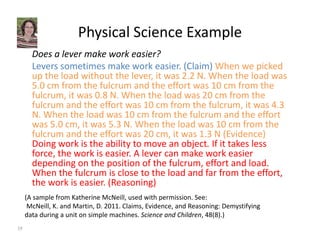
Physical Science Example 
Does a lever make work easier? 
Levers sometimes make work easier. (Claim) When we picked 
up the load without the lever, it was 2.2 N. When the load was 
5.0 cm from the fulcrum and the effort was 10 cm from the 
fulcrum, it was 0.8 N. When the load was 20 cm from the 
fulcrum and the effort was 10 cm from the fulcrum, it was 4.3 
N. When the load was 10 cm from the fulcrum and the effort 
was 5.0 cm, it was 5.3 N. When the load was 10 cm from the 
fulcrum and the effort was 20 cm, it was 1.3 N (Evidence) 
Doing work is the ability to move an object. If it takes less 
force, the work is easier. A lever can make work easier 
depending on the position of the fulcrum, effort and load. 
When the fulcrum is close to the load and far from the effort, 
the work is easier. (Reasoning) 
(A sample from Katherine McNeill, used with permission. See: 
McNeill, K. and Martin, D. 2011. Claims, Evidence, and Reasoning: Demystifying 
data during a unit on simple machines. Science and Children, 48(8).) 
19
Chemistry example 
Is there something solid under the cardboard sheet? If so what shape is it? 
[Rutherford’s Atom Simulation] 
There is something under there because some of 
the marbles bounced back. They would go through 
if there was nothing there. I think it’s square 
because they came straight back on all sides and we 
had a square shaped blank spot on our lab sheet. 
[Note: an explanation of how marbles bounce 
against different shapes would complete the 
reasoning here.] 
20
Questions? 
• About the Claims‐Evidence‐Reasoning 
approach? 
• About writing? 
21
Helping students succeed— 
Before they write 
• Talk about why you’re using the CER framework: 
– This is how you make an argument or explanation 
convincing. 
– This is what scientists do. 
• Help students generate (or give them) a clear 
question. 
22
Prewriting 
• Science Ideas 
– What are some possible claims? 
– Where will you look for your evidence? 
– What reasons show that this is good evidence? 
(Gradually reduce support) 
• What science words will you want to include? 
23
Prewriting 
• Audience: Are you explaining this to the 
teacher (who really knows what happened) or 
to an outside audience? 
• Language: Should you use casual or formal 
language? 
24
• What writing words will you want to include? 
– Because 
– Sequencing words: first, second, third 
– “Uncertainty” words: usually, generally; suggests, 
indicates 
– Therefore 
– If… Then… 
– However 
25
“Therefore”: connects reasoning to 
the claim 
What claim can you make about the movement 
of water when the egg was in the syrup? 
Student: The egg was squished [ie, smaller] and 
we got more syrup than we started with. 
Teacher adds: Therefore, water moved from the 
egg into the syrup. 
26
“Therefore”: connects reasoning to 
the claim 
• Claim: What makes up the grasshopper’s 
skeleton? 
The skin. We looked and there’s no bones. The 
muscle connect to the skin. In people, muscle 
connect to the bones. Bones are our skeleton. 
Therefore, skin is their skeleton. 
27
If…Then… helps you say what you 
would predict to happen 
There is something under there because some of 
the marbles bounced back. They would go through 
if there was nothing there. I think it’s square 
because they came straight back on all sides and we 
had a square shaped blank spot on our lab sheet. 
If there was nothing under the cardboard, then the 
marble should go straight through. 
However… 
28
Prewriting: What can you actually see 
yourself doing with your class? 
Helping them think through 
the science ideas 
Having them list science words to 
include 
Talking about a writing word or 
two they might include 
Considering audience and/or 
formality of the language 
29
After they give it a try 
Look at strong and weak arguments with the class. 
30
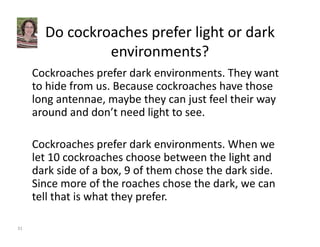
Do cockroaches prefer light or dark 
environments? 
Cockroaches prefer dark environments. They want 
to hide from us. Because cockroaches have those 
long antennae, maybe they can just feel their way 
around and don’t need light to see. 
Cockroaches prefer dark environments. When we 
let 10 cockroaches choose between the light and 
dark side of a box, 9 of them chose the dark side. 
Since more of the roaches chose the dark, we can 
tell that is what they prefer. 
31
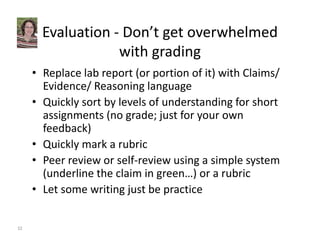
Evaluation ‐ Don’t get overwhelmed 
with grading 
• Replace lab report (or portion of it) with Claims/ 
Evidence/ Reasoning language 
• Quickly sort by levels of understanding for short 
assignments (no grade; just for your own 
feedback) 
• Quickly mark a rubric 
• Peer review or self‐review using a simple system 
(underline the claim in green…) or a rubric 
• Let some writing just be practice 
32
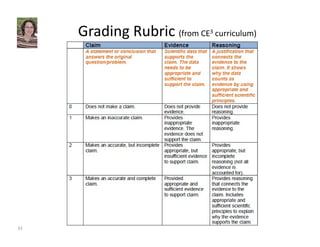
Grading Rubric (from CE3 curriculum) 
33
Questions? 
• Questions about implementing C‐E‐R in your 
classroom? 
• Questions about helping the students with 
writing? 
34
More from the Common Core 
Write arguments focused on discipline‐specific content: 
Grades 9‐10: 
• Introduce precise claim(s), distinguish the claim(s) from alternate or opposing 
claims, and create an organization that establishes clear relationships among 
the claim(s), counterclaims, reasons, and evidence. 
• Develop claim(s) and counterclaims fairly, supplying data and evidence for 
each while pointing out the strengths and limitations of both claim(s) and 
counterclaims in a discipline‐appropriate form and in a manner that 
anticipates the audience’s knowledge level and concerns. 
Grades 11‐12 
• Introduce precise, knowledgeable claim(s), establish the significance of the 
claim(s), distinguish the claim(s) from alternate or opposing claims, and create 
an organization that logically sequences the claim(s), counterclaims, reasons, 
and evidence. 
• Develop claim(s) and counterclaims fairly and thoroughly, supplying the most 
relevant data and evidence for each while pointing out the strengths and 
limitations of both claim(s) and counterclaims in a discipline‐appropriate form 
that anticipates the audience’s knowledge level, concerns, values, and possible 
biases. 
35
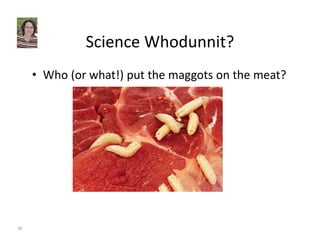
Science Whodunnit? 
• Who (or what!) put the maggots on the meat? 
36
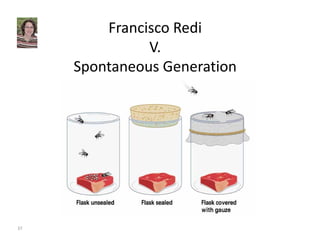
Francisco Redi 
V. 
Spontaneous Generation 
37
Where do flies come from? 
Claim Counter/ competing claim 
38
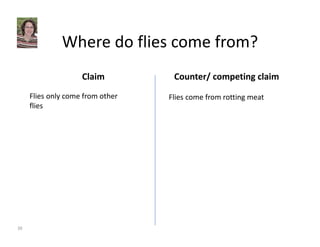
Where do flies come from? 
Claim Counter/ competing claim 
Flies only come from other 
flies 
Flies come from rotting meat 
39
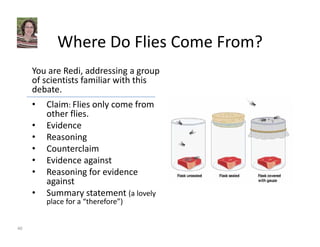
Where Do Flies Come From? 
You are Redi, addressing a group 
of scientists familiar with this 
debate. 
• Claim: Flies only come from 
other flies. 
• Evidence 
• Reasoning 
• Counterclaim 
• Evidence against 
• Reasoning for evidence 
against 
• Summary statement (a lovely 
place for a “therefore”) 
40
Help me find: Claim and counterclaim; 
Evidence/Evidence against; Reasoning 
Flies only come from other flies. Maggots, which develop into flies, only 
formed on the meat in the first flask. Flies could land on that meat, and 
they produced maggots there. Those who support spontaneous generation 
would say that rotting meat alone or in combination with air creates flies. 
If rotting meat alone could produce maggots, then there would be 
maggots in flask 2, which was sealed. If rotting meat in combination with 
air could produce maggots, then there would be maggots in flask 3, which 
allowed air, but not flies, through the gauze. However, neither of these 
flasks had maggots. Therefore, flies are necessary to produce more flies. 
41
Help me find: Claim and counterclaim; 
Evidence/Evidence against; Reasoning 
Flies only come from other flies. Maggots, which develop into flies, only formed on the 
meat in the first flask. Flies could land on that meat, and they produced maggots there. 
Those who support spontaneous generation would say that rotting meat alone or in 
combination with air creates flies. If rotting meat alone could produce maggots, then 
there would be maggots in flask 2, which was sealed. If rotting meat in combination 
with air could produce maggots, then there would be maggots in flask 3, which allowed 
air, but not flies, through the gauze. However, neither of these flasks had maggots. 
Therefore, flies are necessary to produce more flies. 
[Note: 11‐12th grade standards would also want the writer to position this 
within the larger argument of spontaneous generation.] 
42
Further Information 
• McNeill, K. and Martin, D. 2011. Claims, Evidence, and 
Reasoning: Demystifying data during a unit on simple 
machines. Science and Children, 48(8). 
• Preparing for the Next Generation Science Standards— 
Engaging in Argument from Evidence by Joe Krajcik 
(NSTA Webinar Archive) 
• Teaching Argument Writing: Supporting claims with 
relevant evidence and clear reasoning by George 
Hillocks, Jr. (Heinemann Press) 
• Cyber‐enabled Earth Exploration Curriculum– 
www.spatialsci.com/CE3 (covers volcanoes, 
earthquakes and plate tectonics using Google Earth) 
43
Final Questions 
• On counterclaims? 
• On anything else we’ve discussed? 
44
Thanks to today’s presenter! 
Jodi Wheeler-Toppen 
• Former science teacher 
• NSTA Press author 
45
Thank you to the sponsors of 
today’s web seminar: 
This web seminar contains information about programs, products, and services 
offered by third parties, as well as links to third-party websites. The presence of 
a listing or such information does not constitute an endorsement by NSTA of a 
particular company or organization, or its programs, products, or services. 
46
National Science Teachers Association 
Gerry Wheeler, Interim Executive Director 
Zipporah Miller, Associate Executive Director, 
Conferences and Programs 
Al Byers , Ph.D., Assistant Executive Director, 
e-Learning and Government Partnerships 
Flavio Mendez, Senior Director, NSTA Learning 
Center 
NSTA Web Seminars 
Brynn Slate, Manager 
Jeff Layman, Technical Coordinator 
47

Claim, Evidence, and Reasoning

  • 1.
    LIVE INTERACTIVE LEARNING@ YOUR DESKTOP 1 How Do You Know That? Helping Students Write About Claims and Evidence Presented by: Jodi Wheeler-Toppen December 12, 2012 7:30 p.m. – 9:00 p.m. Eastern time
  • 2.
    Introducing today’s presenter… 2 Jodi Wheeler-Toppen • Former science teacher • NSTA Press author
  • 3.
    Welcome! Quick Poll: How do you use a claims and evidence approach in your classroom? a) I’m still learning about it. b) I talk about it in the context of how science works. c) Students are required to support claims with evidence in class discussions. d) Students have to write claims and support them with evidence for some or all labs. e) We have class discussion and writing activities that revolve around making claims and supporting them with evidence. 3
  • 4.
    This Evening Claims,Evidence, and Reasoning • Session Plan – Solve a murder mystery – Look at the structure for C‐E‐R arguments and what they look like in science – Tackle the practical issues of helping students do this kind of writing – Look at a science mystery, with competing claims 4
  • 5.
    “Slip or Trip” – Adapted from: Hillocks, G. Teaching Argument Writing: Grades 6‐12. Portsmouth, NH: Heinemann Press. • He adapted it from: Treat, Lawrence, and Kathleen Borowik. Crime and Puzzlement 2: More Solve‐them‐yourself Picture Mysteries. Boston: D.R. Godine, 1982. 5
  • 6.
    Use a clipart “hand” to point to any evidence you deem important. 6
  • 7.
    Was Queenie tellingthe truth?(Did Arthur trip and fall to his death?) Evidence Reasoning (Why is this evidence important?) 7
  • 8.
    Possible Claims •Queenie is telling the truth. Arthur tripped and fell to his death. • Queenie is lying. Arthur did not trip and fall to his death. 8
  • 9.
    Claim: Is Queenietelling the truth? Evidence: Reasoning: 9
  • 10.
    Claim: Is Queenietelling the truth? Evidence: Reasoning: Evidence: Reasoning: Evidence: Reasoning: 10
  • 11.
    Claims—Evidence—Reasoning (CER) •Claim – Answer to the question! – Usually the easiest for students • Evidence – Must be appropriate – Must be sufficient • Reasoning – Explains how the evidence supports the claim – Often includes scientific principles 11
  • 12.
    Why take aC‐E‐R Approach? • Students are more successful understanding what’s going on than with the generic term “Conclusions.” • This is how you make an argument or explanation convincing. • This is what scientists do. • This is the language of both the Common Core and the Next Generation Science Standards. 12
  • 13.
    Common Core Standards: Writing in History, Science, Technical Subjects WHST.6‐8.1. Write arguments focused on discipline‐specific content. • Introduce claim(s) about a topic or issue, acknowledge and distinguish the claim(s) from alternate or opposing claims, and organize the reasons and evidence logically. • Support claim(s) with logical reasoning and relevant, accurate data and evidence that demonstrate an understanding of the topic or text, using credible sources. • Use words, phrases, and clauses to create cohesion and clarify the relationships among claim(s), counterclaims, reasons, and evidence. • Establish and maintain a formal style. • Provide a concluding statement or section that follows from and supports the argument presented. 13
  • 14.
    Next Generation ScienceStandards Scientific and Engineering Practices 1. Asking questions (for science) and defining problems (for engineering) 2. Developing and using models 3. Planning and carrying out investigations 4. Analyzing and interpreting data 5. Using mathematics and computational thinking 6. Constructing explanations (for science) and designing solutions (for engineering) 7. Engaging in argument from evidence 8. Obtaining, evaluating, and communicating information 14
  • 15.
    Why write itdown? • Writing is a key science skill. Science depends on the written record to build on existing knowledge. 15
  • 16.
    Why Writing IsImportant • Writing helps students learn. – It forces them to organize their thoughts and find the relationships between ideas. –Writing holds ideas in place long enough for students to think about them. –Writing gets all students to participate. • Writing helps you (as the teacher) spot misconceptions. 16
  • 17.
    (Earth) Science Example From this FREE Claims and Evidence Unit: Cyber‐enabled Earth Exploration Curriculum– www.spatialsci.com/CE3 (covers volcanoes, earthquakes and plate tectonics using Google Earth) 17
  • 18.
    Life Science Example What Shape are Cells? (student‐selected question) (From Cells R Us, Chapter 5 in Once Upon a Life Science Book: 12 Interdisciplinary activities to create confident readers, by Jodi Wheeler‐Toppen.) 18
  • 19.
    Physical Science Example Does a lever make work easier? Levers sometimes make work easier. (Claim) When we picked up the load without the lever, it was 2.2 N. When the load was 5.0 cm from the fulcrum and the effort was 10 cm from the fulcrum, it was 0.8 N. When the load was 20 cm from the fulcrum and the effort was 10 cm from the fulcrum, it was 4.3 N. When the load was 10 cm from the fulcrum and the effort was 5.0 cm, it was 5.3 N. When the load was 10 cm from the fulcrum and the effort was 20 cm, it was 1.3 N (Evidence) Doing work is the ability to move an object. If it takes less force, the work is easier. A lever can make work easier depending on the position of the fulcrum, effort and load. When the fulcrum is close to the load and far from the effort, the work is easier. (Reasoning) (A sample from Katherine McNeill, used with permission. See: McNeill, K. and Martin, D. 2011. Claims, Evidence, and Reasoning: Demystifying data during a unit on simple machines. Science and Children, 48(8).) 19
  • 20.
    Chemistry example Isthere something solid under the cardboard sheet? If so what shape is it? [Rutherford’s Atom Simulation] There is something under there because some of the marbles bounced back. They would go through if there was nothing there. I think it’s square because they came straight back on all sides and we had a square shaped blank spot on our lab sheet. [Note: an explanation of how marbles bounce against different shapes would complete the reasoning here.] 20
  • 21.
    Questions? • Aboutthe Claims‐Evidence‐Reasoning approach? • About writing? 21
  • 22.
    Helping students succeed— Before they write • Talk about why you’re using the CER framework: – This is how you make an argument or explanation convincing. – This is what scientists do. • Help students generate (or give them) a clear question. 22
  • 23.
    Prewriting • ScienceIdeas – What are some possible claims? – Where will you look for your evidence? – What reasons show that this is good evidence? (Gradually reduce support) • What science words will you want to include? 23
  • 24.
    Prewriting • Audience:Are you explaining this to the teacher (who really knows what happened) or to an outside audience? • Language: Should you use casual or formal language? 24
  • 25.
    • What writingwords will you want to include? – Because – Sequencing words: first, second, third – “Uncertainty” words: usually, generally; suggests, indicates – Therefore – If… Then… – However 25
  • 26.
    “Therefore”: connects reasoningto the claim What claim can you make about the movement of water when the egg was in the syrup? Student: The egg was squished [ie, smaller] and we got more syrup than we started with. Teacher adds: Therefore, water moved from the egg into the syrup. 26
  • 27.
    “Therefore”: connects reasoningto the claim • Claim: What makes up the grasshopper’s skeleton? The skin. We looked and there’s no bones. The muscle connect to the skin. In people, muscle connect to the bones. Bones are our skeleton. Therefore, skin is their skeleton. 27
  • 28.
    If…Then… helps yousay what you would predict to happen There is something under there because some of the marbles bounced back. They would go through if there was nothing there. I think it’s square because they came straight back on all sides and we had a square shaped blank spot on our lab sheet. If there was nothing under the cardboard, then the marble should go straight through. However… 28
  • 29.
    Prewriting: What canyou actually see yourself doing with your class? Helping them think through the science ideas Having them list science words to include Talking about a writing word or two they might include Considering audience and/or formality of the language 29
  • 30.
    After they giveit a try Look at strong and weak arguments with the class. 30
  • 31.
    Do cockroaches preferlight or dark environments? Cockroaches prefer dark environments. They want to hide from us. Because cockroaches have those long antennae, maybe they can just feel their way around and don’t need light to see. Cockroaches prefer dark environments. When we let 10 cockroaches choose between the light and dark side of a box, 9 of them chose the dark side. Since more of the roaches chose the dark, we can tell that is what they prefer. 31
  • 32.
    Evaluation ‐ Don’tget overwhelmed with grading • Replace lab report (or portion of it) with Claims/ Evidence/ Reasoning language • Quickly sort by levels of understanding for short assignments (no grade; just for your own feedback) • Quickly mark a rubric • Peer review or self‐review using a simple system (underline the claim in green…) or a rubric • Let some writing just be practice 32
  • 33.
    Grading Rubric (fromCE3 curriculum) 33
  • 34.
    Questions? • Questionsabout implementing C‐E‐R in your classroom? • Questions about helping the students with writing? 34
  • 35.
    More from theCommon Core Write arguments focused on discipline‐specific content: Grades 9‐10: • Introduce precise claim(s), distinguish the claim(s) from alternate or opposing claims, and create an organization that establishes clear relationships among the claim(s), counterclaims, reasons, and evidence. • Develop claim(s) and counterclaims fairly, supplying data and evidence for each while pointing out the strengths and limitations of both claim(s) and counterclaims in a discipline‐appropriate form and in a manner that anticipates the audience’s knowledge level and concerns. Grades 11‐12 • Introduce precise, knowledgeable claim(s), establish the significance of the claim(s), distinguish the claim(s) from alternate or opposing claims, and create an organization that logically sequences the claim(s), counterclaims, reasons, and evidence. • Develop claim(s) and counterclaims fairly and thoroughly, supplying the most relevant data and evidence for each while pointing out the strengths and limitations of both claim(s) and counterclaims in a discipline‐appropriate form that anticipates the audience’s knowledge level, concerns, values, and possible biases. 35
  • 36.
    Science Whodunnit? •Who (or what!) put the maggots on the meat? 36
  • 37.
    Francisco Redi V. Spontaneous Generation 37
  • 38.
    Where do fliescome from? Claim Counter/ competing claim 38
  • 39.
    Where do fliescome from? Claim Counter/ competing claim Flies only come from other flies Flies come from rotting meat 39
  • 40.
    Where Do FliesCome From? You are Redi, addressing a group of scientists familiar with this debate. • Claim: Flies only come from other flies. • Evidence • Reasoning • Counterclaim • Evidence against • Reasoning for evidence against • Summary statement (a lovely place for a “therefore”) 40
  • 41.
    Help me find:Claim and counterclaim; Evidence/Evidence against; Reasoning Flies only come from other flies. Maggots, which develop into flies, only formed on the meat in the first flask. Flies could land on that meat, and they produced maggots there. Those who support spontaneous generation would say that rotting meat alone or in combination with air creates flies. If rotting meat alone could produce maggots, then there would be maggots in flask 2, which was sealed. If rotting meat in combination with air could produce maggots, then there would be maggots in flask 3, which allowed air, but not flies, through the gauze. However, neither of these flasks had maggots. Therefore, flies are necessary to produce more flies. 41
  • 42.
    Help me find:Claim and counterclaim; Evidence/Evidence against; Reasoning Flies only come from other flies. Maggots, which develop into flies, only formed on the meat in the first flask. Flies could land on that meat, and they produced maggots there. Those who support spontaneous generation would say that rotting meat alone or in combination with air creates flies. If rotting meat alone could produce maggots, then there would be maggots in flask 2, which was sealed. If rotting meat in combination with air could produce maggots, then there would be maggots in flask 3, which allowed air, but not flies, through the gauze. However, neither of these flasks had maggots. Therefore, flies are necessary to produce more flies. [Note: 11‐12th grade standards would also want the writer to position this within the larger argument of spontaneous generation.] 42
  • 43.
    Further Information •McNeill, K. and Martin, D. 2011. Claims, Evidence, and Reasoning: Demystifying data during a unit on simple machines. Science and Children, 48(8). • Preparing for the Next Generation Science Standards— Engaging in Argument from Evidence by Joe Krajcik (NSTA Webinar Archive) • Teaching Argument Writing: Supporting claims with relevant evidence and clear reasoning by George Hillocks, Jr. (Heinemann Press) • Cyber‐enabled Earth Exploration Curriculum– www.spatialsci.com/CE3 (covers volcanoes, earthquakes and plate tectonics using Google Earth) 43
  • 44.
    Final Questions •On counterclaims? • On anything else we’ve discussed? 44
  • 45.
    Thanks to today’spresenter! Jodi Wheeler-Toppen • Former science teacher • NSTA Press author 45
  • 46.
    Thank you tothe sponsors of today’s web seminar: This web seminar contains information about programs, products, and services offered by third parties, as well as links to third-party websites. The presence of a listing or such information does not constitute an endorsement by NSTA of a particular company or organization, or its programs, products, or services. 46
  • 47.
    National Science TeachersAssociation Gerry Wheeler, Interim Executive Director Zipporah Miller, Associate Executive Director, Conferences and Programs Al Byers , Ph.D., Assistant Executive Director, e-Learning and Government Partnerships Flavio Mendez, Senior Director, NSTA Learning Center NSTA Web Seminars Brynn Slate, Manager Jeff Layman, Technical Coordinator 47