CHAPTER

  Digital Lines and the
Integrated Service Digital
    Network (ISDN)
Chapter Objectives

• Define ISDN, its standards and the type
  of services offered
• Describe the two main types of services,
  namely BRI and PRI
• Give examples of ISDN links
  – Simple SOHO line, ISDN remote bridges
    etc
• Briefly outline a few other features of
  ISDN
Chapter Modules

• An overview of ISDN
• Basic Rate Interchange (BRI)
• Primary Rate Interchange (PRI)
• A practical SOHO ISDN line
• ISDN applications
• Other features of ISDN
MODULE


An Overview of ISDN
ISDN Defined

• Known as the Integrated Services
  Digital Network
  – Data, audio, image and video transmission
• It is a switched digital
  telecommunication line that can be
  delivered over regular copper wires
  – Possible to provide end-to-end digital
    communications
ISDN Application Examples
    • On/off ramp to the information super-
      highway to communicate at speeds of
      128 Kbps for a single ISDN line
      – Multiple ISDN lines can be combined
        together to achieve higher communication
        speeds
    • Home use
.
      – On/Off ramp to the Internet
    • Business world
      – Provide remote access to LANs
ISDN Standard

• There is a national ISDN standard
  known as the NI standard
• It is being implemented in phases
• Current implementation is termed as
  NI-1 to indicate that it is in phase 1 of
  the implementation process
ISDN Connections

• Can be obtained from a local telephone
  company in the same way an analog
  connection is obtained
• Phone companies offer different types
  of ISDN connections
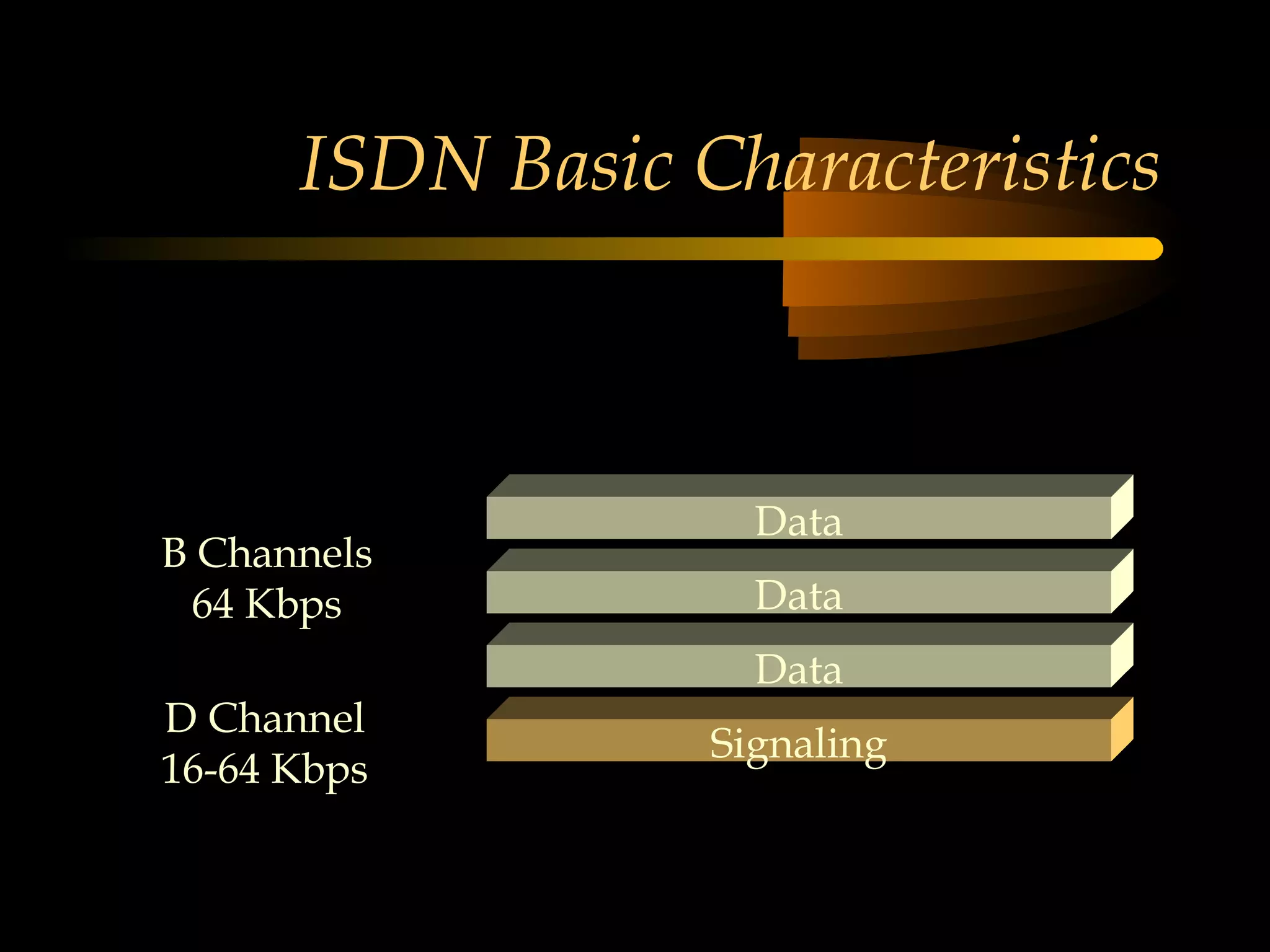
ISDN Basic Characteristics


                    Data
B Channels
 64 Kbps            Data
                    Data
D Channel
                  Signaling
16-64 Kbps
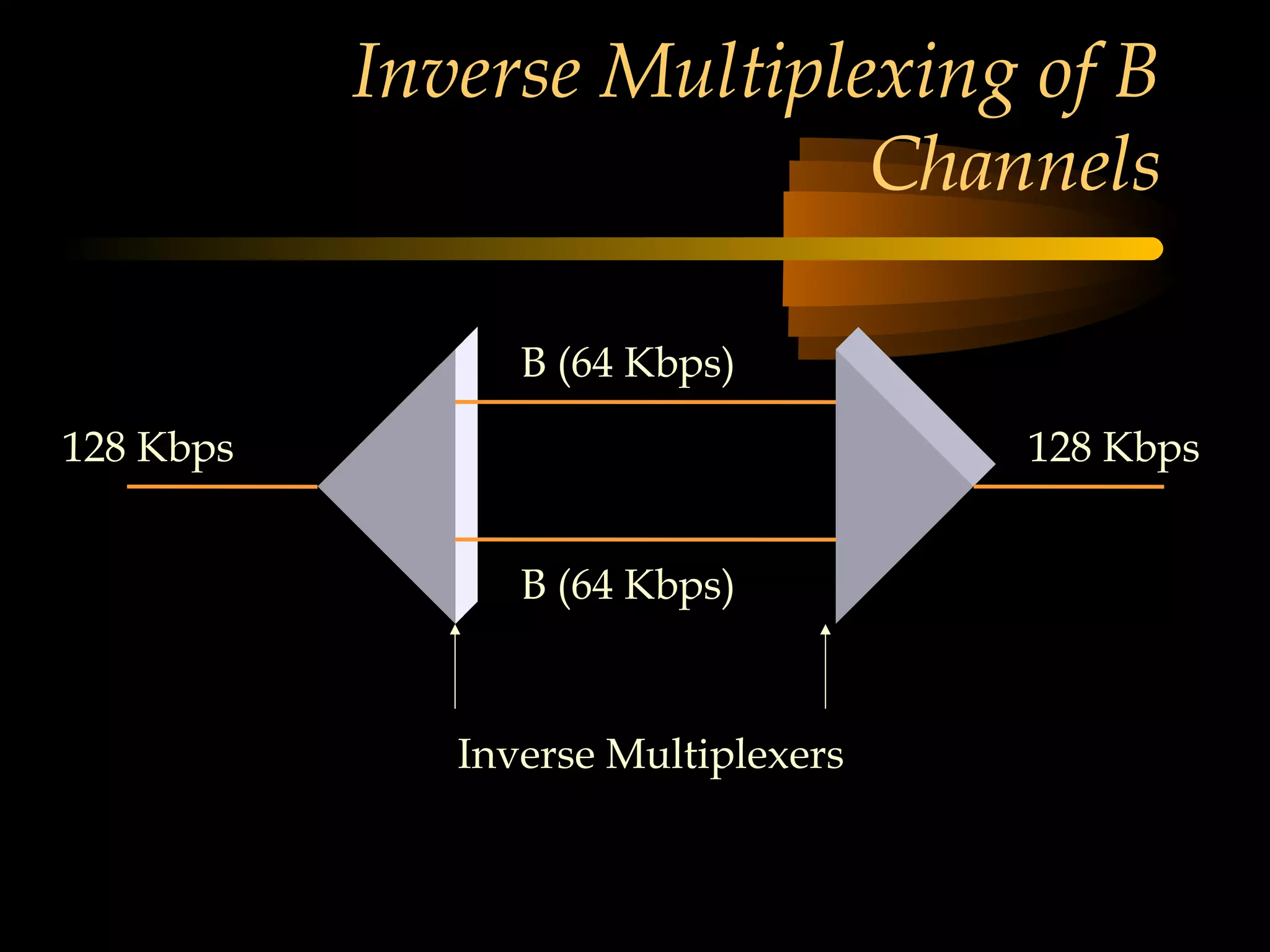
Inverse Multiplexing of B
                           Channels

                 B (64 Kbps)

128 Kbps                             128 Kbps


                 B (64 Kbps)


              Inverse Multiplexers
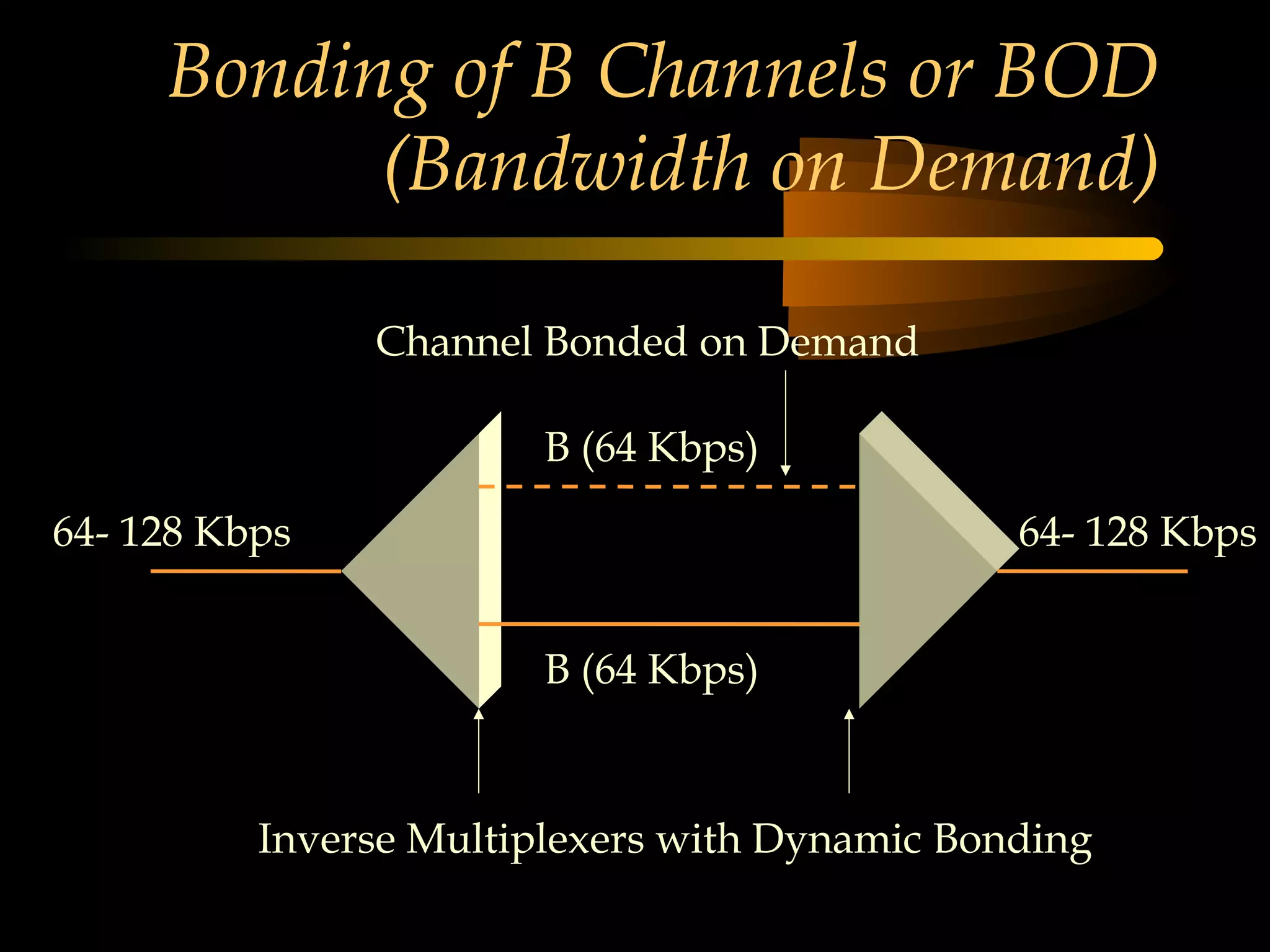
Bonding of B Channels or BOD
           (Bandwidth on Demand)

               Channel Bonded on Demand

                        B (64 Kbps)

64- 128 Kbps                                   64- 128 Kbps


                        B (64 Kbps)


          Inverse Multiplexers with Dynamic Bonding
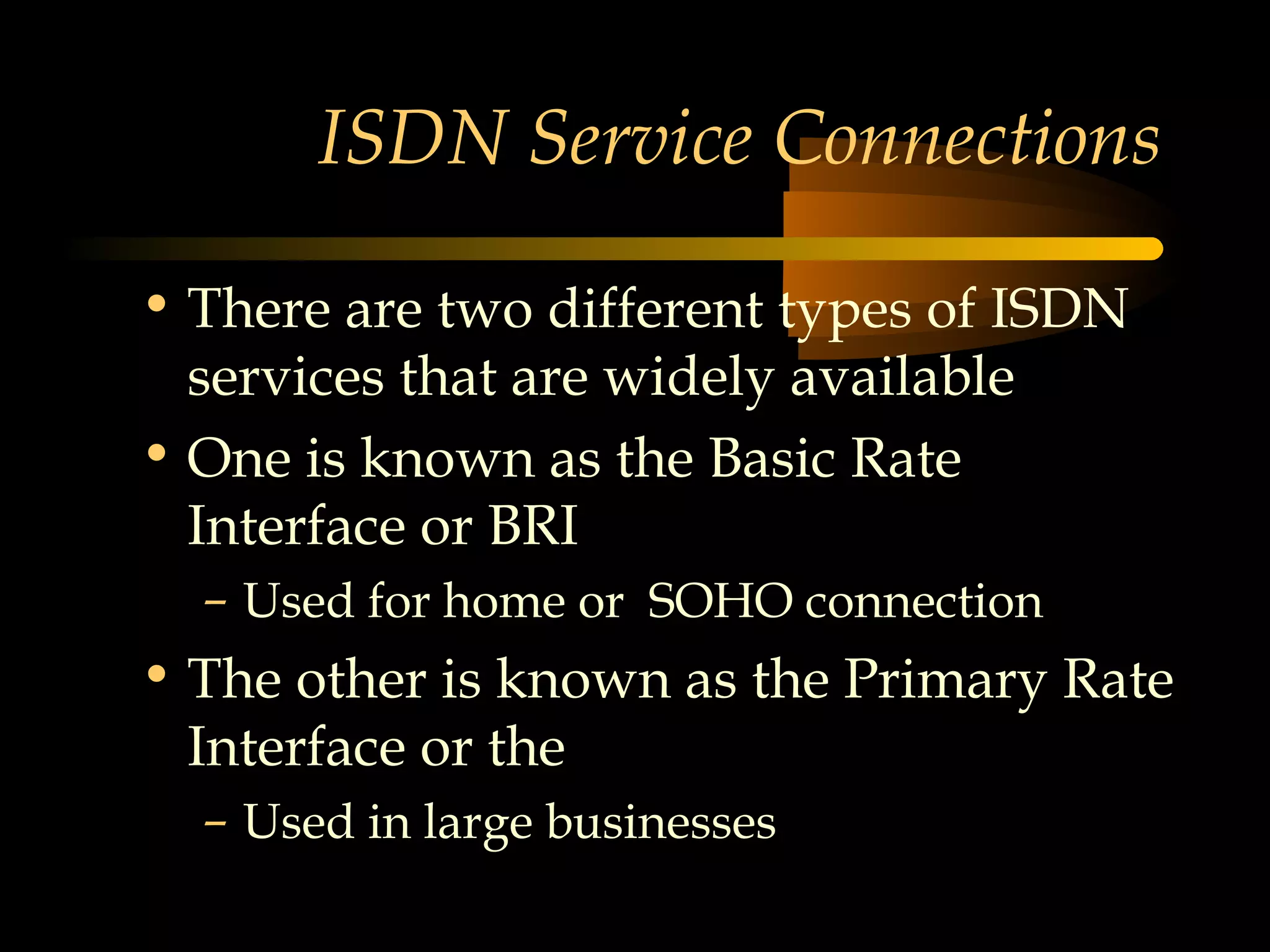
ISDN Service Connections

• There are two different types of ISDN
  services that are widely available
• One is known as the Basic Rate
  Interface or BRI
  – Used for home or SOHO connection
• The other is known as the Primary Rate
  Interface or the
  – Used in large businesses
World-wide Coverage

• U.K.
• India
• Germany
• France
• Australia
• Japan
• Canada
• etc.
In Summary

• ISDN is a switched digital network
• Can be used for establishing a point-to-
  point digital connection
• BRI and PRI
  – Number of B Channels vary in each case
• B channels can be combined together to
  achieve a higher communication speed
END OF MODULE
MODULE


Basic Rate Interface (BRI)
BRI Characteristics

• 2 B Channels
• 1 D Channel
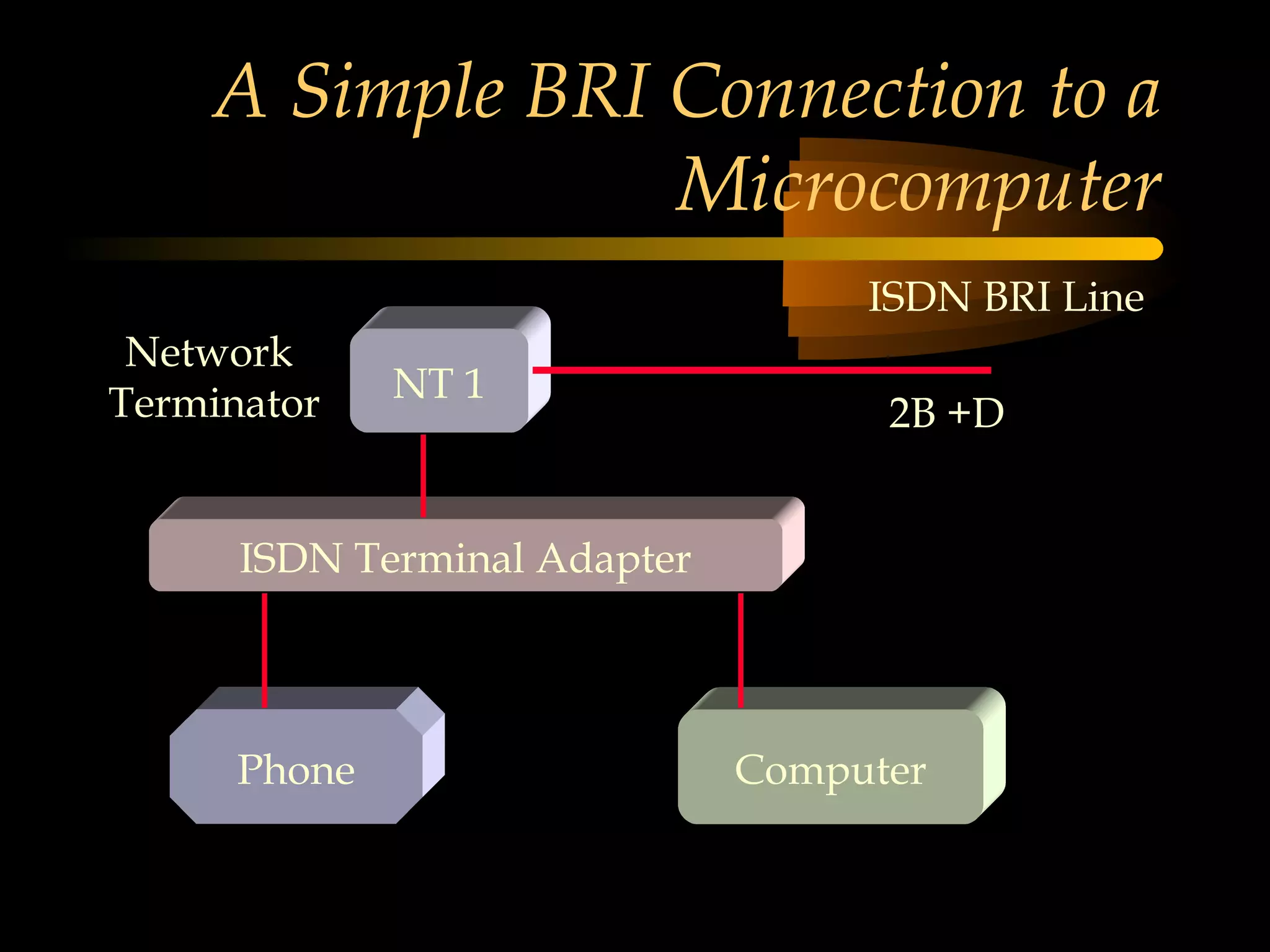
A Simple BRI Connection to a
                 Microcomputer
                                   ISDN BRI Line
 Network
Terminator    NT 1
                                    2B +D


      ISDN Terminal Adapter


      Phone                   Computer
Channels in BRI Service

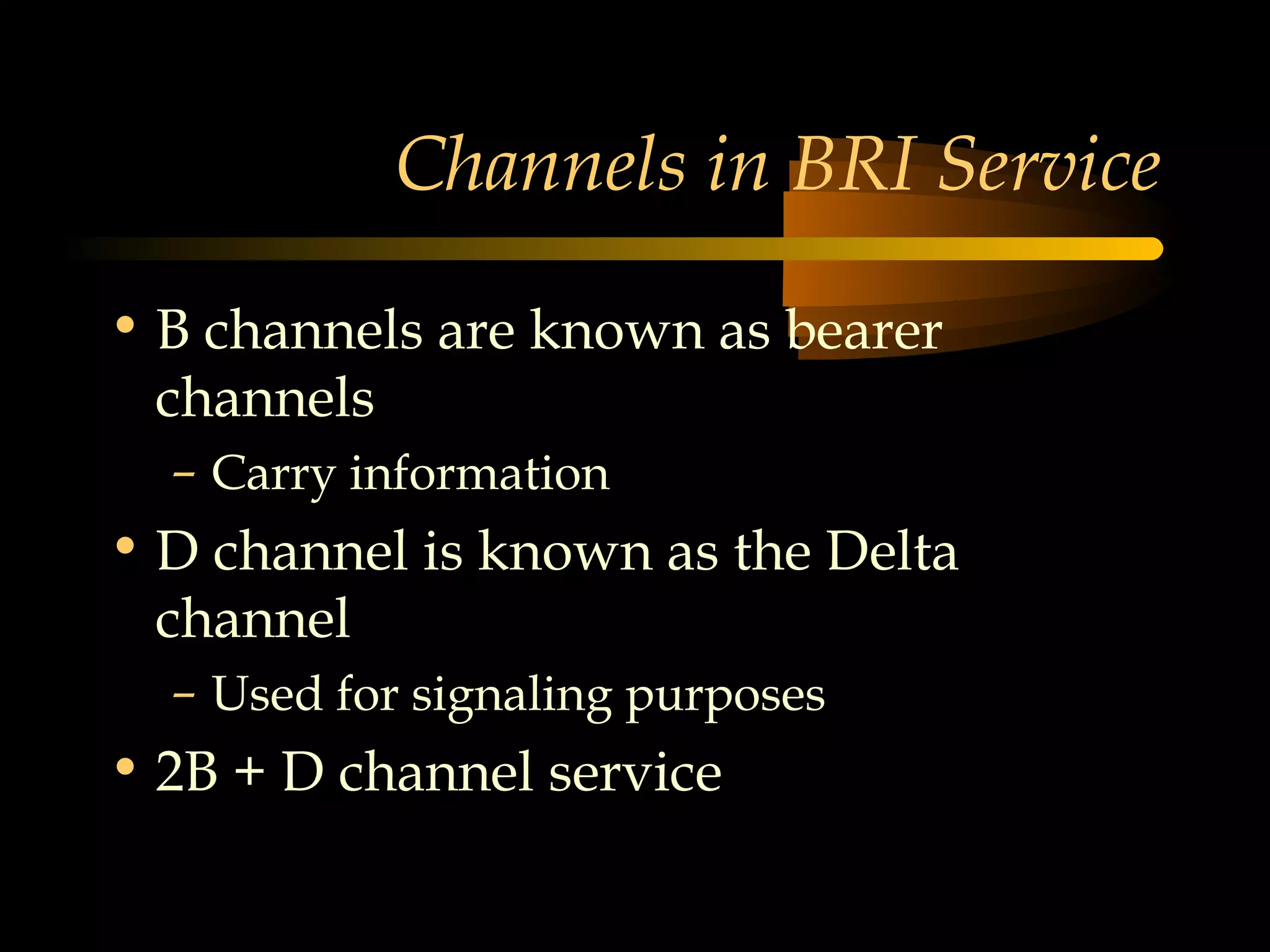
• B channels are known as bearer
  channels
  – Carry information
• D channel is known as the Delta
  channel
  – Used for signaling purposes
• 2B + D channel service
The B Channel

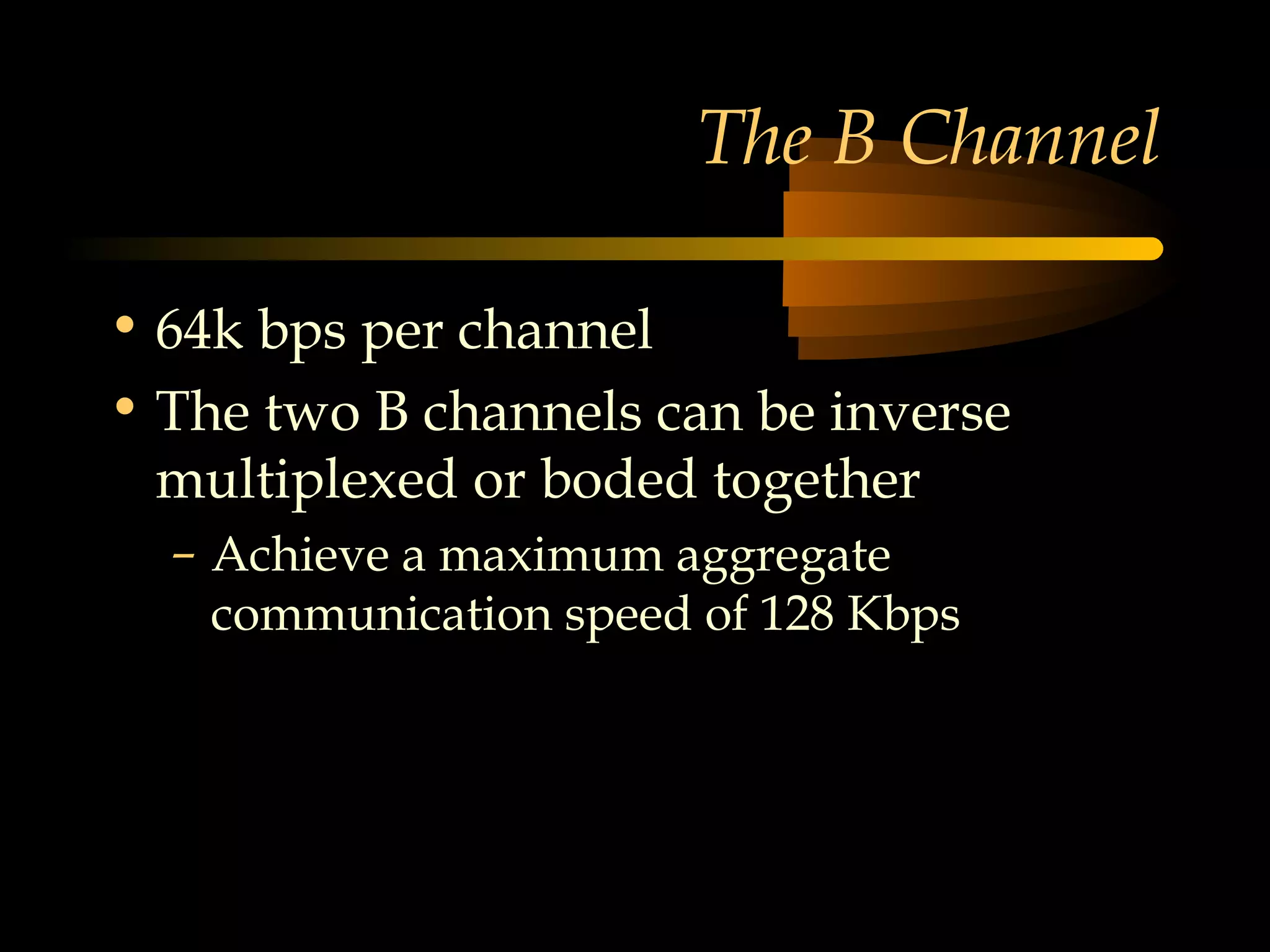
• 64k bps per channel
• The two B channels can be inverse
  multiplexed or boded together
  – Achieve a maximum aggregate
    communication speed of 128 Kbps
The D Channel

• 16 Kbps
• Entire bandwidth is not used for
  signaling purpose
• Excess of 9.6 Kbps is available for
  packet switched data transmission
  applications
• Excess bandwidth usage
  – Climate control, security alarm system etc.
In Summary

• BRI is the basic ISDN service
• Composed of 2 B channels and a D
  channel
• B Channels are circuit switched
• D Channel is packet switched
  – Excess capacity can be utilized for packet
    switched applications
END OF MODULE
MODULE


Primary Rate Interface (PRI)
PRI Service

• More sophisticated service compared
  to BRI
• PRI service offers 23 B channels and 1
  D channel
Properties of B Channels in PRI

• Each B channel operates at a speed of
  64K bps
• The B channels are used for carrying
  data
• B channels can be combined together to
  increase the aggregate communication
  speed
Properties of D Channel in PRI
• Each D channel operates at a speed of
  64 Kbps
  – Considerably faster than the D channel in
    BRI
• 23 B channels share a D channel for
  signaling purpose
PRI Channel Delivery

• PRI channels are delivered over a T1
  line
• T1 speed
  – 1.544M bps
• Aggregate speed of PRI from all 23 B
  channels and the single D Channel is
  computed as follows:
  – 23 * 64 + 64 + xx = 1.544 Mbps
Sample Services (PacBell)

• Centrex ISDN
  – For businesses that already have the Pac
    Bell’s centrex phone system
• SDS-ISDN
  – BRI service offered for small businesses
  – Charges
    • Per channel
    • Per minute
Sample Services (ISDN)
• Home ISDN
  – Offers a BRI connection
    • 2B + D
  – Charges are cheaper especially during off-
    peak hour
    • Per channel
    • Per minute
• SDS-56
  – Single channel switched 56 Kbps digital
    service
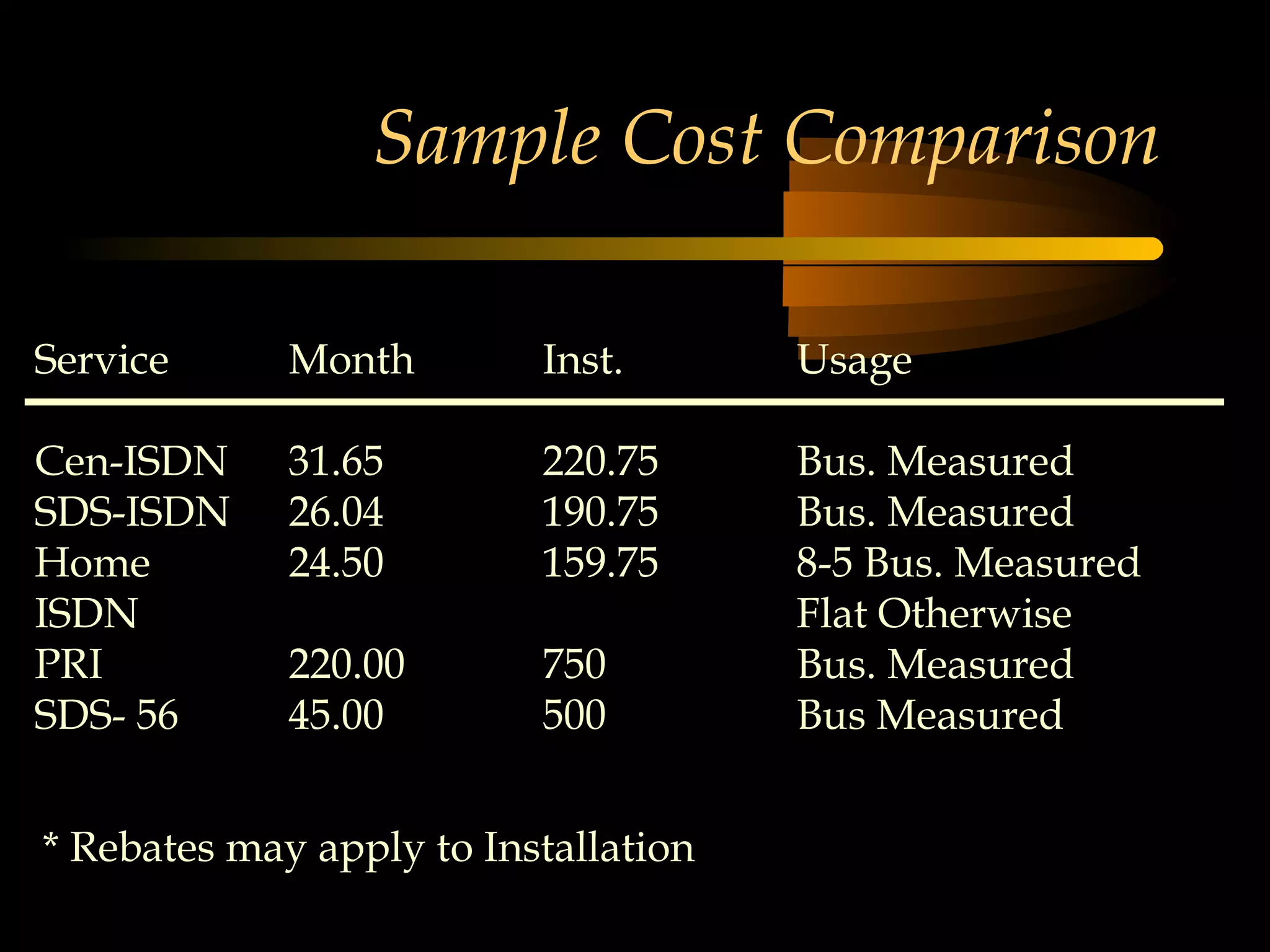
Sample Cost Comparison

Service      Month        Inst.       Usage

Cen-ISDN     31.65        220.75      Bus. Measured
SDS-ISDN     26.04        190.75      Bus. Measured
Home         24.50        159.75      8-5 Bus. Measured
ISDN                                  Flat Otherwise
PRI          220.00       750         Bus. Measured
SDS- 56      45.00        500         Bus Measured


* Rebates may apply to Installation
END OF MODULE
MODULE


Sample ISDN Applications
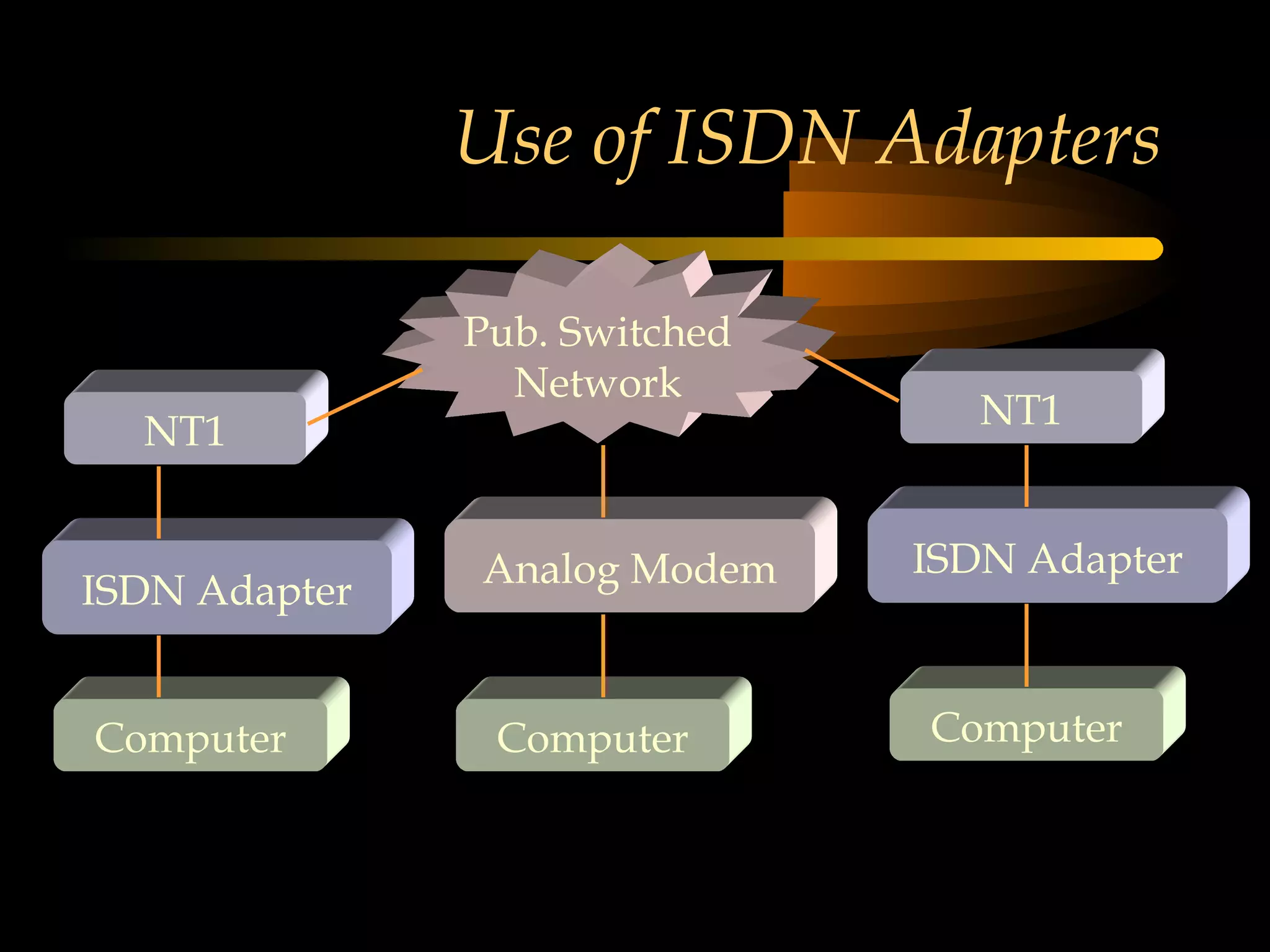
Use of ISDN Adapters

               Pub. Switched
                 Network
                                  NT1
  NT1


               Analog Modem    ISDN Adapter
ISDN Adapter


Computer        Computer       Computer
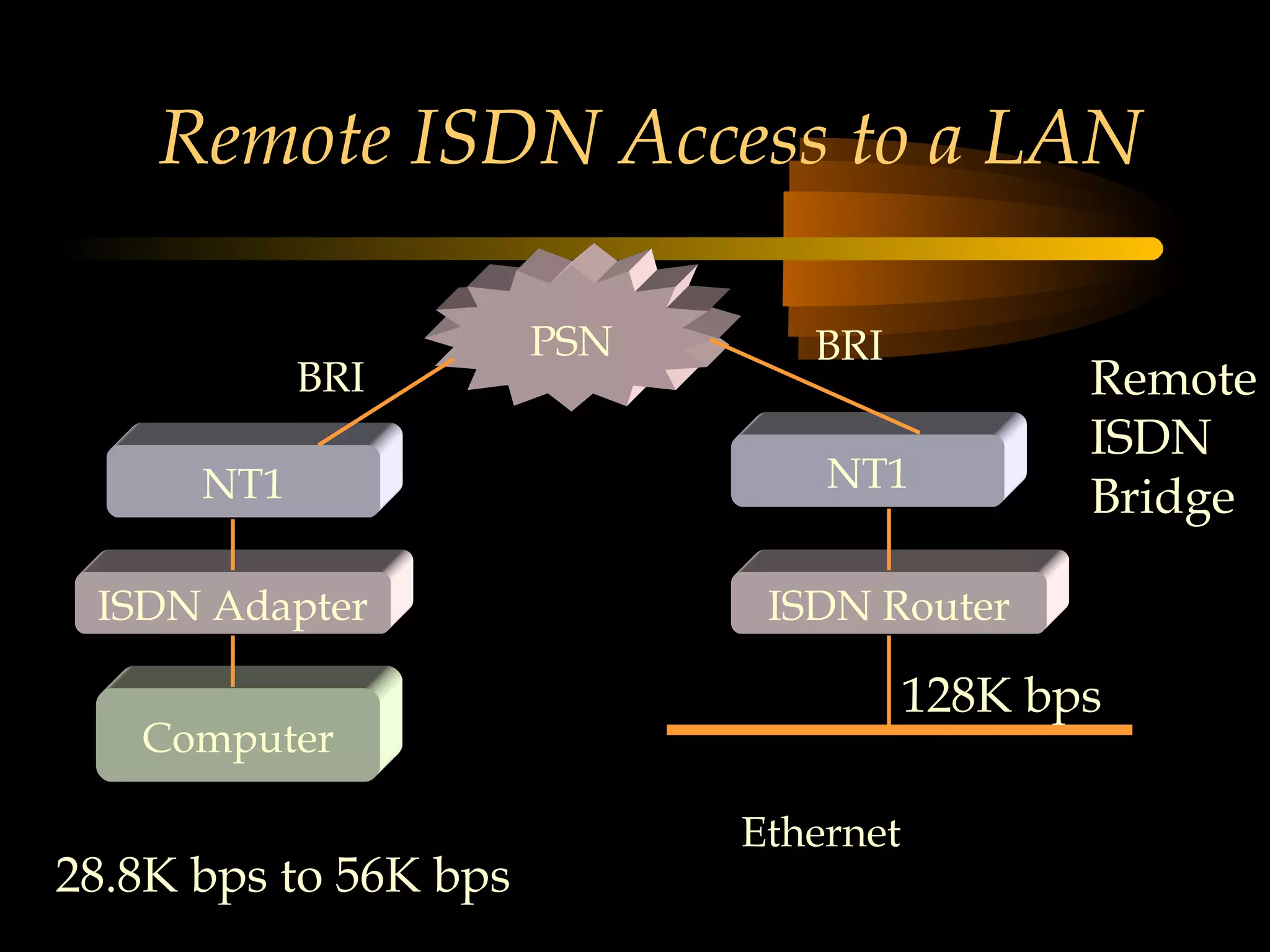
Remote ISDN Access to a LAN

                       PSN      BRI
            BRI                                Remote
                                               ISDN
      NT1                        NT1
                                               Bridge

 ISDN Adapter                 ISDN Router

                                        128K bps
   Computer

                             Ethernet
28.8K bps to 56K bps
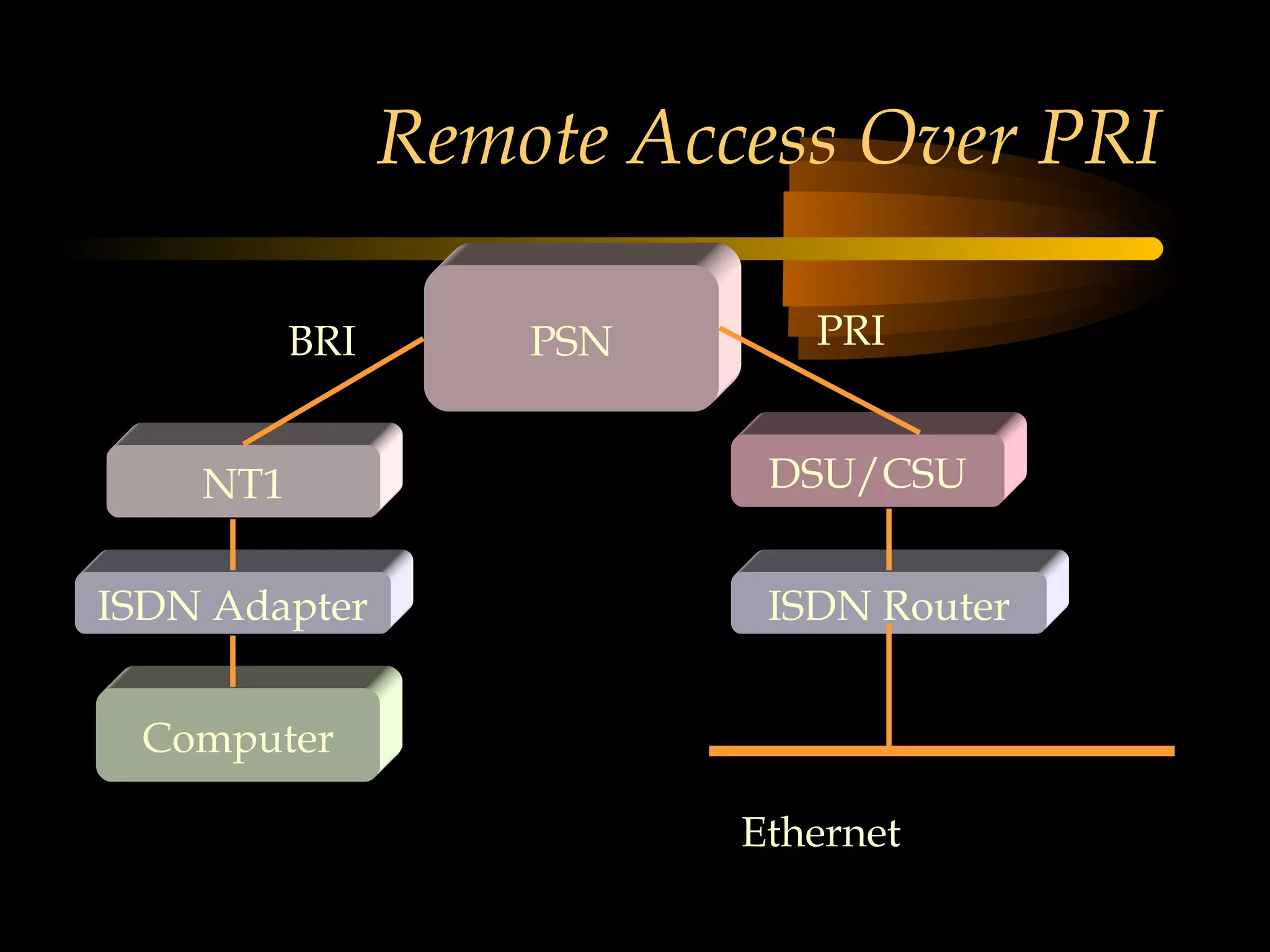
Remote Access Over PRI

          BRI       PSN      PRI


    NT1                    DSU/CSU


ISDN Adapter               ISDN Router


 Computer

                          Ethernet
Important Features of the PRI
                    Connection
• Communication links can be
  established between:
  – remote computers and this LAN
  – this LAN and remote locations
  – this LAN and other remote LANs
• Link is established using a powerful
  router
• A separate DSU/CSU unit is used as
  opposed to the NT1 network terminator
  used in the case of BRI
Commercial Examples of ISDN
                   Equipment
• ISDN adapter
  – 3Com Impact IQ
• ISDN routers
  – Ascend and Cisco are sample
    manufacturers
  – Ascend Pipeline 50 and Ascend Pipeline
    100 are examples of such routers
• For the latest information on ISDN
  equipment access the manufacturers’
  web sites
ISDN Use in Video
                   Conferencing

• Dynamic bandwidth allocation
• Circuit switched
• Symmetric bandwidth
END OF MODULE
END OF MODULE

END OF CHAPTER

Digital services isdn (1)

  • 1.
    CHAPTER DigitalLines and the Integrated Service Digital Network (ISDN)
  • 2.
    Chapter Objectives • DefineISDN, its standards and the type of services offered • Describe the two main types of services, namely BRI and PRI • Give examples of ISDN links – Simple SOHO line, ISDN remote bridges etc • Briefly outline a few other features of ISDN
  • 3.
    Chapter Modules • Anoverview of ISDN • Basic Rate Interchange (BRI) • Primary Rate Interchange (PRI) • A practical SOHO ISDN line • ISDN applications • Other features of ISDN
  • 4.
  • 5.
    ISDN Defined • Knownas the Integrated Services Digital Network – Data, audio, image and video transmission • It is a switched digital telecommunication line that can be delivered over regular copper wires – Possible to provide end-to-end digital communications
  • 6.
    ISDN Application Examples • On/off ramp to the information super- highway to communicate at speeds of 128 Kbps for a single ISDN line – Multiple ISDN lines can be combined together to achieve higher communication speeds • Home use . – On/Off ramp to the Internet • Business world – Provide remote access to LANs
  • 7.
    ISDN Standard • Thereis a national ISDN standard known as the NI standard • It is being implemented in phases • Current implementation is termed as NI-1 to indicate that it is in phase 1 of the implementation process
  • 8.
    ISDN Connections • Canbe obtained from a local telephone company in the same way an analog connection is obtained • Phone companies offer different types of ISDN connections
  • 9.
    ISDN Basic Characteristics Data B Channels 64 Kbps Data Data D Channel Signaling 16-64 Kbps
  • 10.
    Inverse Multiplexing ofB Channels B (64 Kbps) 128 Kbps 128 Kbps B (64 Kbps) Inverse Multiplexers
  • 11.
    Bonding of BChannels or BOD (Bandwidth on Demand) Channel Bonded on Demand B (64 Kbps) 64- 128 Kbps 64- 128 Kbps B (64 Kbps) Inverse Multiplexers with Dynamic Bonding
  • 12.
    ISDN Service Connections •There are two different types of ISDN services that are widely available • One is known as the Basic Rate Interface or BRI – Used for home or SOHO connection • The other is known as the Primary Rate Interface or the – Used in large businesses
  • 13.
    World-wide Coverage • U.K. •India • Germany • France • Australia • Japan • Canada • etc.
  • 14.
    In Summary • ISDNis a switched digital network • Can be used for establishing a point-to- point digital connection • BRI and PRI – Number of B Channels vary in each case • B channels can be combined together to achieve a higher communication speed
  • 15.
  • 16.
  • 17.
    BRI Characteristics • 2B Channels • 1 D Channel
  • 18.
    A Simple BRIConnection to a Microcomputer ISDN BRI Line Network Terminator NT 1 2B +D ISDN Terminal Adapter Phone Computer
  • 19.
    Channels in BRIService • B channels are known as bearer channels – Carry information • D channel is known as the Delta channel – Used for signaling purposes • 2B + D channel service
  • 20.
    The B Channel •64k bps per channel • The two B channels can be inverse multiplexed or boded together – Achieve a maximum aggregate communication speed of 128 Kbps
  • 21.
    The D Channel •16 Kbps • Entire bandwidth is not used for signaling purpose • Excess of 9.6 Kbps is available for packet switched data transmission applications • Excess bandwidth usage – Climate control, security alarm system etc.
  • 22.
    In Summary • BRIis the basic ISDN service • Composed of 2 B channels and a D channel • B Channels are circuit switched • D Channel is packet switched – Excess capacity can be utilized for packet switched applications
  • 23.
  • 24.
  • 25.
    PRI Service • Moresophisticated service compared to BRI • PRI service offers 23 B channels and 1 D channel
  • 26.
    Properties of BChannels in PRI • Each B channel operates at a speed of 64K bps • The B channels are used for carrying data • B channels can be combined together to increase the aggregate communication speed
  • 27.
    Properties of DChannel in PRI • Each D channel operates at a speed of 64 Kbps – Considerably faster than the D channel in BRI • 23 B channels share a D channel for signaling purpose
  • 28.
    PRI Channel Delivery •PRI channels are delivered over a T1 line • T1 speed – 1.544M bps • Aggregate speed of PRI from all 23 B channels and the single D Channel is computed as follows: – 23 * 64 + 64 + xx = 1.544 Mbps
  • 29.
    Sample Services (PacBell) •Centrex ISDN – For businesses that already have the Pac Bell’s centrex phone system • SDS-ISDN – BRI service offered for small businesses – Charges • Per channel • Per minute
  • 30.
    Sample Services (ISDN) •Home ISDN – Offers a BRI connection • 2B + D – Charges are cheaper especially during off- peak hour • Per channel • Per minute • SDS-56 – Single channel switched 56 Kbps digital service
  • 31.
    Sample Cost Comparison Service Month Inst. Usage Cen-ISDN 31.65 220.75 Bus. Measured SDS-ISDN 26.04 190.75 Bus. Measured Home 24.50 159.75 8-5 Bus. Measured ISDN Flat Otherwise PRI 220.00 750 Bus. Measured SDS- 56 45.00 500 Bus Measured * Rebates may apply to Installation
  • 32.
  • 33.
  • 34.
    Use of ISDNAdapters Pub. Switched Network NT1 NT1 Analog Modem ISDN Adapter ISDN Adapter Computer Computer Computer
  • 35.
    Remote ISDN Accessto a LAN PSN BRI BRI Remote ISDN NT1 NT1 Bridge ISDN Adapter ISDN Router 128K bps Computer Ethernet 28.8K bps to 56K bps
  • 36.
    Remote Access OverPRI BRI PSN PRI NT1 DSU/CSU ISDN Adapter ISDN Router Computer Ethernet
  • 37.
    Important Features ofthe PRI Connection • Communication links can be established between: – remote computers and this LAN – this LAN and remote locations – this LAN and other remote LANs • Link is established using a powerful router • A separate DSU/CSU unit is used as opposed to the NT1 network terminator used in the case of BRI
  • 38.
    Commercial Examples ofISDN Equipment • ISDN adapter – 3Com Impact IQ • ISDN routers – Ascend and Cisco are sample manufacturers – Ascend Pipeline 50 and Ascend Pipeline 100 are examples of such routers • For the latest information on ISDN equipment access the manufacturers’ web sites
  • 39.
    ISDN Use inVideo Conferencing • Dynamic bandwidth allocation • Circuit switched • Symmetric bandwidth
  • 40.
  • 41.