Introduction to Data communication
Topic : Huffman Algorithm
Lecture #12
Dr Rajiv Srivastava
Director
Sagar Institute of Research & Technology (SIRT)
Sagar Group of Institutions, Bhopal
http://www.sirtbhopal.ac.in
Unit 1
Lecture 12
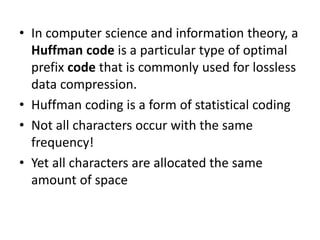
• In computer science and information theory, a
Huffman code is a particular type of optimal
prefix code that is commonly used for lossless
data compression.
• Huffman coding is a form of statistical coding
• Not all characters occur with the same
frequency!
• Yet all characters are allocated the same
amount of space
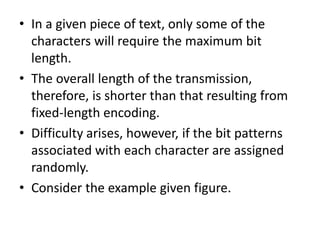
Huffman Encoding
• Huffman coding, however, makes coding more
efficient. In this mechanism we assign shorter
codes to characters that occur more frequently
and longer codes that occur less frequently.
• For example, E and T, the two characters that
occur most frequently in the English language,
are assigned one bit each.
• C,G,K,R,S,U and W are the next most frequently
and are assigned three bits each , and so on.
• In a given piece of text, only some of the
characters will require the maximum bit
length.
• The overall length of the transmission,
therefore, is shorter than that resulting from
fixed-length encoding.
• Difficulty arises, however, if the bit patterns
associated with each character are assigned
randomly.
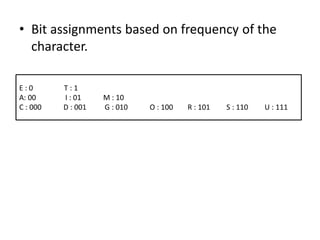
• Consider the example given figure.
• Bit assignments based on frequency of the
character.
E : 0 T : 1
A: 00 I : 01 M : 10
C : 000 D : 001 G : 010 O : 100 R : 101 S : 110 U : 111
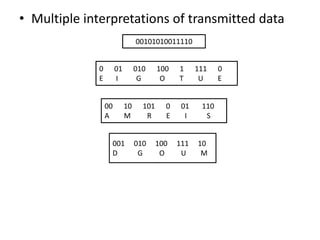
• Multiple interpretations of transmitted data
code sent
First interpretation
Second interpretation
Third interpretation
00101010011110
0 01 010 100 1 111 0
E I G O T U E
00 10 101 0 01 110
A M R E I S
001 010 100 111 10
D G O U M
• Huffman coding is designed to counter this
ambiguity while retaining the bit count
advantages of a compression code.
• Not only does it vary the length of the code
based on the frequency of the character
represented, but each character code is
chosen in such a way that prefix of another
code.
• For example, no three-bit code has the same
pattern as the first three bits of a four or five-
bit code.
Character Tree
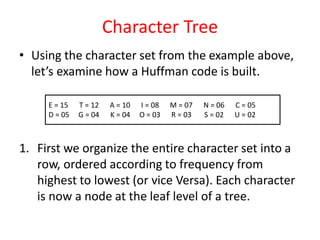
• Using the character set from the example above,
let’s examine how a Huffman code is built.
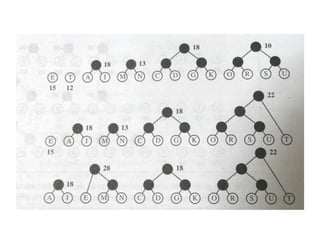
1. First we organize the entire character set into a
row, ordered according to frequency from
highest to lowest (or vice Versa). Each character
is now a node at the leaf level of a tree.
E = 15 T = 12 A = 10 I = 08 M = 07 N = 06 C = 05
D = 05 G = 04 K = 04 O = 03 R = 03 S = 02 U = 02
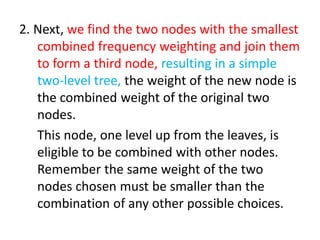
2. Next, we find the two nodes with the smallest
combined frequency weighting and join them
to form a third node, resulting in a simple
two-level tree, the weight of the new node is
the combined weight of the original two
nodes.
This node, one level up from the leaves, is
eligible to be combined with other nodes.
Remember the same weight of the two
nodes chosen must be smaller than the
combination of any other possible choices.
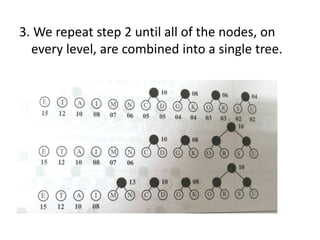
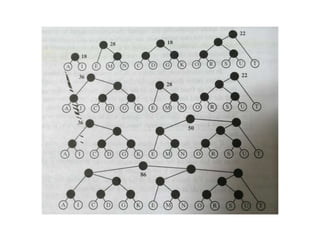
3. We repeat step 2 until all of the nodes, on
every level, are combined into a single tree.
Assigning the codes
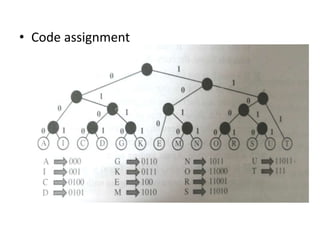
• Once the tree is complete, we use it to assign
codes to each character. First we assign a bit
value to each branch (see figure F.7). Starting
from the root (top node).
• We assign 0 to the branch and 1 to the right
branch and repeat this pattern at each node.
• Which branch becomes 0 and which becomes
1 is left to the designer as long as the
assignments are consistent throughout the
tree.
• Code assignment
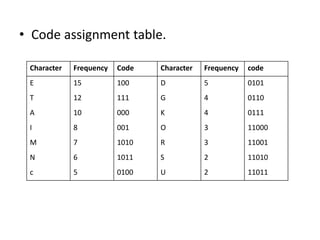
• Code assignment table.
Character Frequency Code Character Frequency code
E 15 100 D 5 0101
T 12 111 G 4 0110
A 10 000 K 4 0111
I 8 001 O 3 11000
M 7 1010 R 3 11001
N 6 1011 S 2 11010
c 5 0100 U 2 11011
DECODING
• A message encoded in this fashion can be
interpreted without ambiguity, using the
following process :
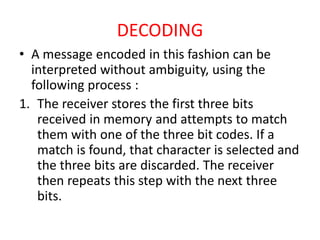
1. The receiver stores the first three bits
received in memory and attempts to match
them with one of the three bit codes. If a
match is found, that character is selected and
the three bits are discarded. The receiver
then repeats this step with the next three
bits.
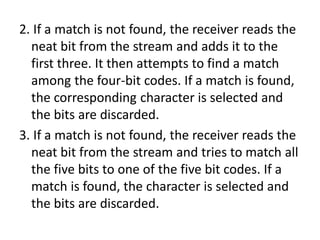
2. If a match is not found, the receiver reads the
neat bit from the stream and adds it to the
first three. It then attempts to find a match
among the four-bit codes. If a match is found,
the corresponding character is selected and
the bits are discarded.
3. If a match is not found, the receiver reads the
neat bit from the stream and tries to match all
the five bits to one of the five bit codes. If a
match is found, the character is selected and
the bits are discarded.
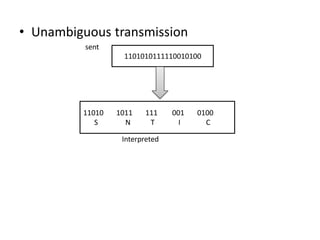
• Unambiguous transmission
sent
Interpreted
1101010111110010100
11010 1011 111 001 0100
S N T I C
Thank You
Dr Rajiv Srivastava
Director
Sagar Institute of Research & Technology (SIRT)
Sagar Group of Institutions, Bhopal
http://www.sirtbhopal.ac.in

Data communication & computer networking: Huffman algorithm

  • 1.
    Introduction to Datacommunication Topic : Huffman Algorithm Lecture #12 Dr Rajiv Srivastava Director Sagar Institute of Research & Technology (SIRT) Sagar Group of Institutions, Bhopal http://www.sirtbhopal.ac.in
  • 2.
  • 3.
    • In computerscience and information theory, a Huffman code is a particular type of optimal prefix code that is commonly used for lossless data compression. • Huffman coding is a form of statistical coding • Not all characters occur with the same frequency! • Yet all characters are allocated the same amount of space
  • 4.
    Huffman Encoding • Huffmancoding, however, makes coding more efficient. In this mechanism we assign shorter codes to characters that occur more frequently and longer codes that occur less frequently. • For example, E and T, the two characters that occur most frequently in the English language, are assigned one bit each. • C,G,K,R,S,U and W are the next most frequently and are assigned three bits each , and so on.
  • 5.
    • In agiven piece of text, only some of the characters will require the maximum bit length. • The overall length of the transmission, therefore, is shorter than that resulting from fixed-length encoding. • Difficulty arises, however, if the bit patterns associated with each character are assigned randomly. • Consider the example given figure.
  • 6.
    • Bit assignmentsbased on frequency of the character. E : 0 T : 1 A: 00 I : 01 M : 10 C : 000 D : 001 G : 010 O : 100 R : 101 S : 110 U : 111
  • 7.
    • Multiple interpretationsof transmitted data code sent First interpretation Second interpretation Third interpretation 00101010011110 0 01 010 100 1 111 0 E I G O T U E 00 10 101 0 01 110 A M R E I S 001 010 100 111 10 D G O U M
  • 8.
    • Huffman codingis designed to counter this ambiguity while retaining the bit count advantages of a compression code. • Not only does it vary the length of the code based on the frequency of the character represented, but each character code is chosen in such a way that prefix of another code. • For example, no three-bit code has the same pattern as the first three bits of a four or five- bit code.
  • 9.
    Character Tree • Usingthe character set from the example above, let’s examine how a Huffman code is built. 1. First we organize the entire character set into a row, ordered according to frequency from highest to lowest (or vice Versa). Each character is now a node at the leaf level of a tree. E = 15 T = 12 A = 10 I = 08 M = 07 N = 06 C = 05 D = 05 G = 04 K = 04 O = 03 R = 03 S = 02 U = 02
  • 10.
    2. Next, wefind the two nodes with the smallest combined frequency weighting and join them to form a third node, resulting in a simple two-level tree, the weight of the new node is the combined weight of the original two nodes. This node, one level up from the leaves, is eligible to be combined with other nodes. Remember the same weight of the two nodes chosen must be smaller than the combination of any other possible choices.
  • 11.
    3. We repeatstep 2 until all of the nodes, on every level, are combined into a single tree.
  • 14.
    Assigning the codes •Once the tree is complete, we use it to assign codes to each character. First we assign a bit value to each branch (see figure F.7). Starting from the root (top node). • We assign 0 to the branch and 1 to the right branch and repeat this pattern at each node. • Which branch becomes 0 and which becomes 1 is left to the designer as long as the assignments are consistent throughout the tree.
  • 15.
  • 16.
    • Code assignmenttable. Character Frequency Code Character Frequency code E 15 100 D 5 0101 T 12 111 G 4 0110 A 10 000 K 4 0111 I 8 001 O 3 11000 M 7 1010 R 3 11001 N 6 1011 S 2 11010 c 5 0100 U 2 11011
  • 17.
    DECODING • A messageencoded in this fashion can be interpreted without ambiguity, using the following process : 1. The receiver stores the first three bits received in memory and attempts to match them with one of the three bit codes. If a match is found, that character is selected and the three bits are discarded. The receiver then repeats this step with the next three bits.
  • 18.
    2. If amatch is not found, the receiver reads the neat bit from the stream and adds it to the first three. It then attempts to find a match among the four-bit codes. If a match is found, the corresponding character is selected and the bits are discarded. 3. If a match is not found, the receiver reads the neat bit from the stream and tries to match all the five bits to one of the five bit codes. If a match is found, the character is selected and the bits are discarded.
  • 19.
  • 20.
    Thank You Dr RajivSrivastava Director Sagar Institute of Research & Technology (SIRT) Sagar Group of Institutions, Bhopal http://www.sirtbhopal.ac.in