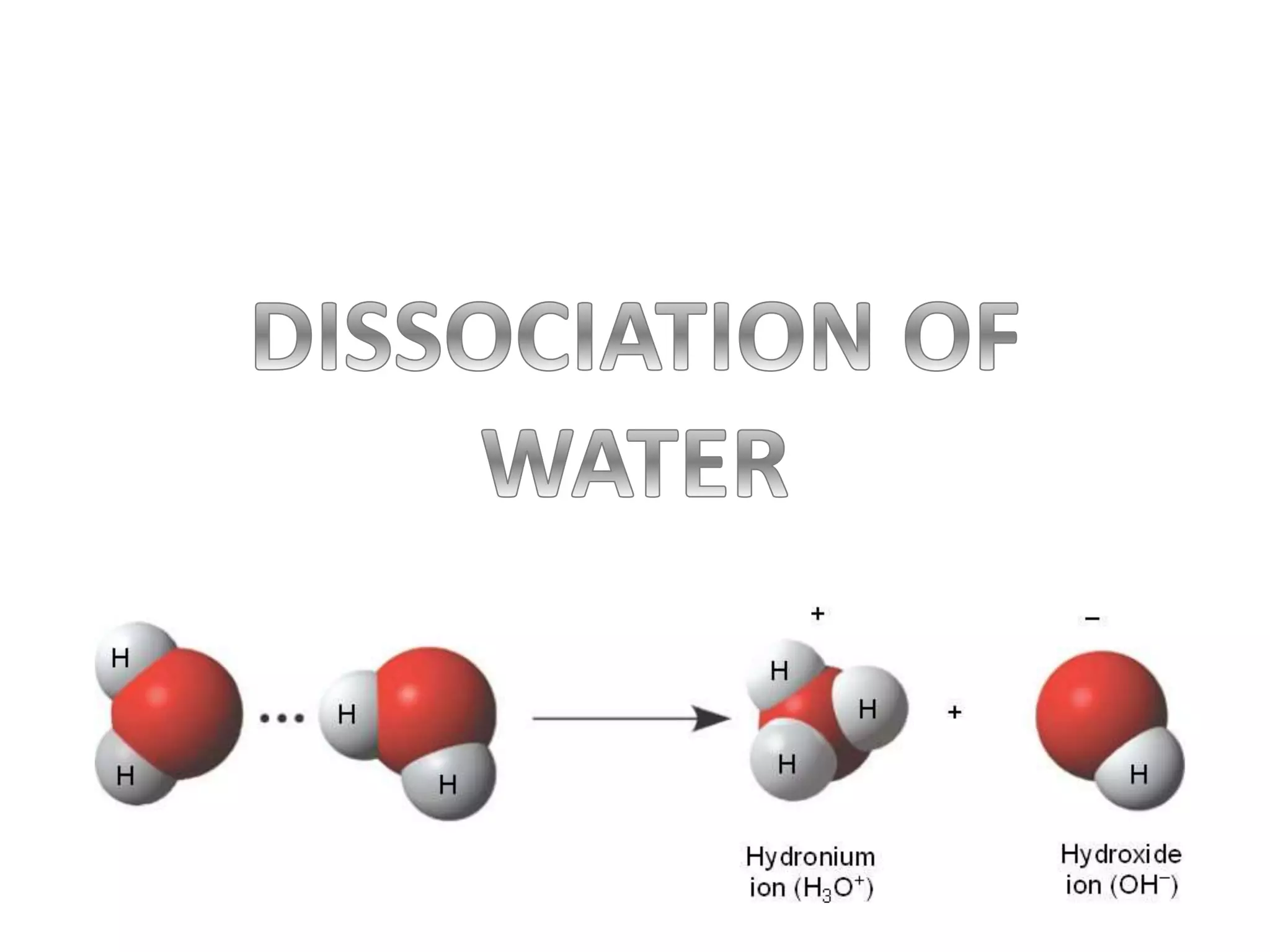
H2O + H2O ⇌ H3O+ + OH-
Acid Base
Kw = [H3O+] [OH-]
Where,
Kw: water dissociation
constant for pure
water at 25 ˚C
• [H3O+] = [OH-] = 1.0 × 10⁻⁷
mol dm-3
• Thus,
Kw = [H3O+] [OH-]
= (1.0 × 10⁻⁷
) (1.0 × 10⁻⁷
) mol2 dm-6
= 1.0 × 10⁻¹⁴
mol2 dm-6
• log [H3O+] + log[OH-] = log (1.0 × 10⁻¹⁴
)
log [H3O+] + log[OH-] = -14.0
-log [H3O+] + log[OH-]= 14.0
• Thus, pH + pOH = 14.0
or pH + pOH = pKw (-log = p)
THE pH of AQUEOUS SOLUTION
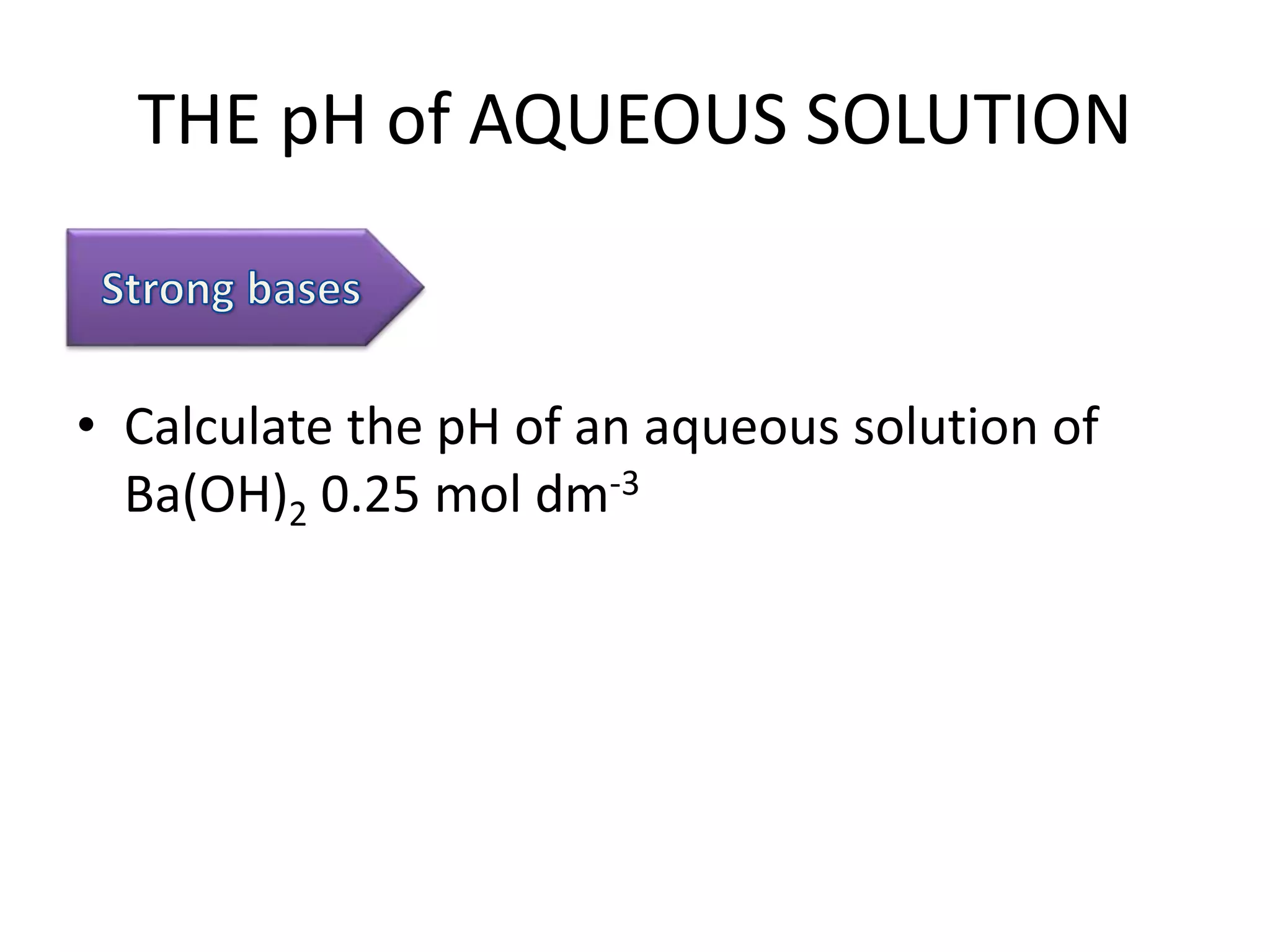
• Calculate the pH of an aqueous solution of
Ba(OH)2 0.25 mol dm-3
• Ba(OH)2 (aq)  Ba2+
(aq) + 2OH-
(aq)
• pOH = -log [OH-]
= -log (0.50)
= 0.3
Initial
molarity (mol
dm-3)
0.25 0 0
Final molarity
(mol dm-3)
0 0.25 0.50
pH = 14.0 – 0.3
= 13.7
What is the molarity of OH- in an aqueous
solution of NaOH if its pH is 13.5?
• pOH = 14.0 – pH
= 14.0 – 13.5
= 0.5
• pOH = -log [OH-]
0.5 = -log [OH-]
log [OH-] = -0.5
[OH-] = 0.3 mol dm-3
SOLUTION :
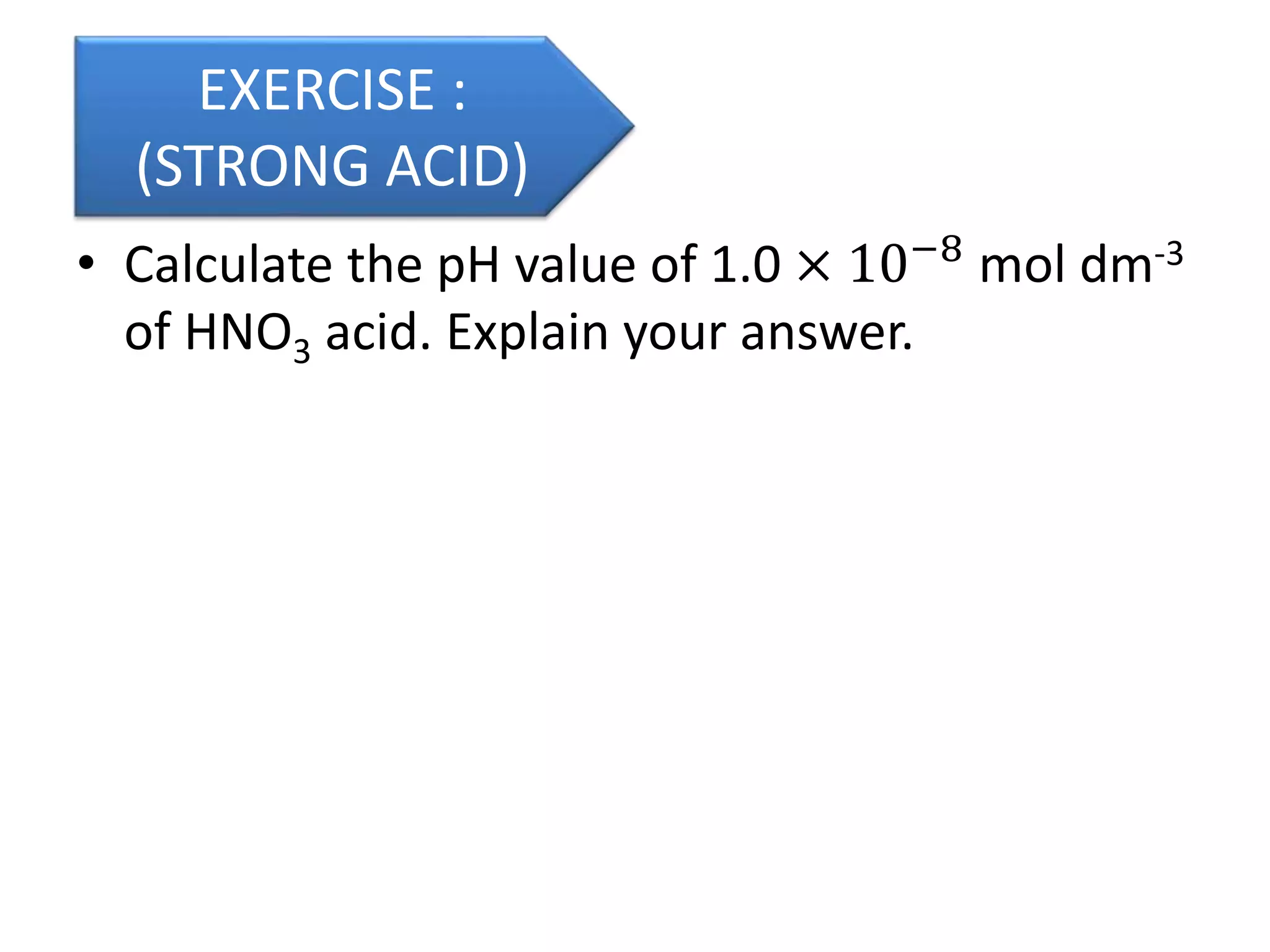
• Calculate the pH value of 1.0 × 10⁻⁸
mol dm-3
of HNO3 acid. Explain your answer.
EXERCISE :
(STRONG ACID)
• HNO3  H+ + NO2
-
1.0 × 10⁻⁸
1.0 × 10⁻⁸
1.0 × 10⁻⁸
• pH = -log [H+]
= -log (1.0 × 10⁻⁸
)
= 8
• For acid, pH <7, [H3O+]> 1.0 × 10⁻⁷
consider
[H3O+] from dissociation of water.
• ∴ [H3O+] = [H3O+]w + [H3O+]acid = 1.0 × 10⁻⁷
+
1.0 × 10⁻⁸
• Anions derived from strong acids (such as Cl-
from HCl) and cations from strong bases (such
as Na+ from NaOH) do not react with water to
affect the pH.
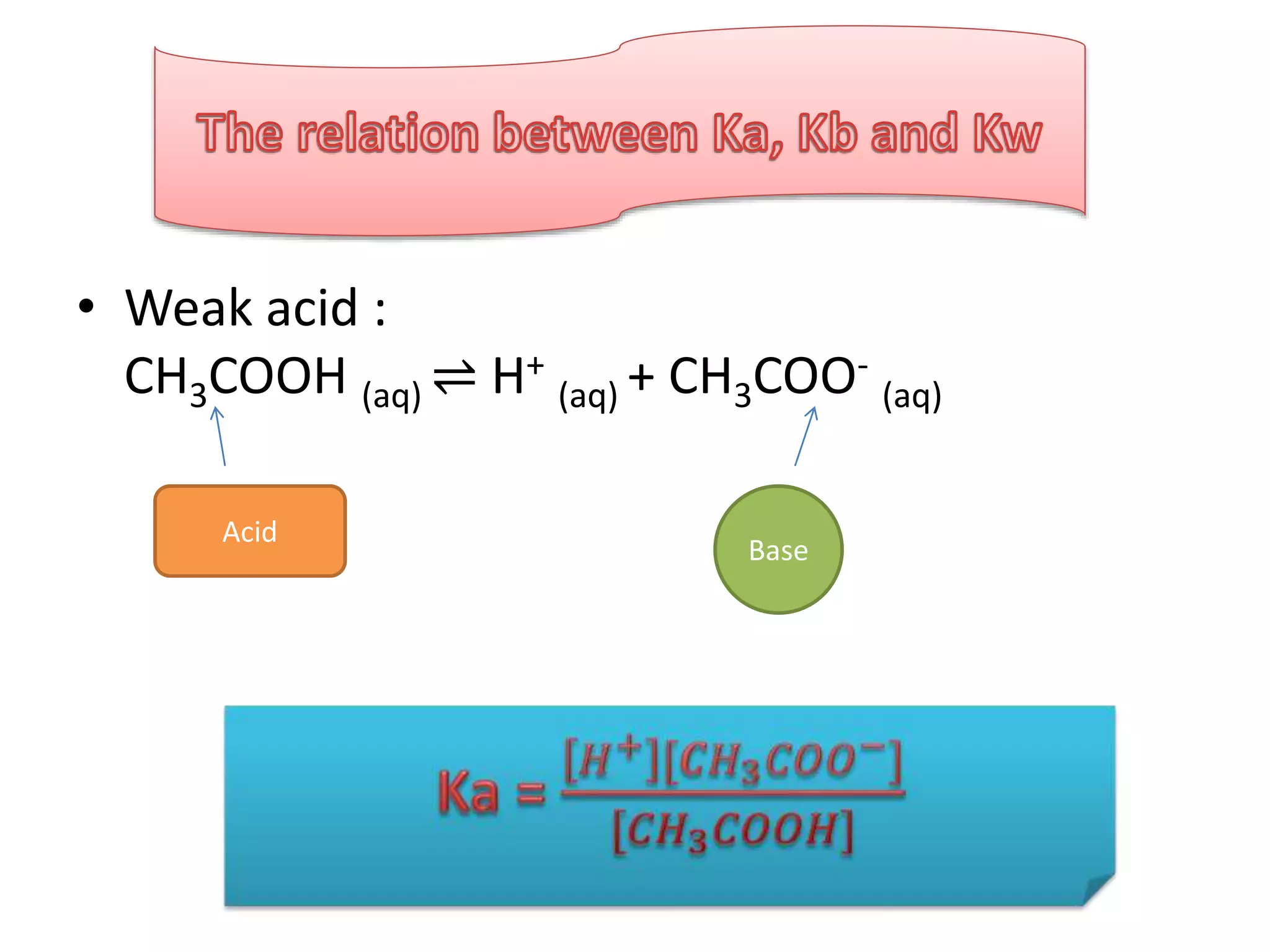
• Weak acid :
CH3COOH (aq) ⇌ H+
(aq) + CH3COO-
(aq)
Acid
Base
* CH3COO-
(aq) + H2O ⇌ CH3COOH (aq) + OH-
• Ka . Kb =
𝐶𝐻3 𝐶𝑂𝑂𝐻 [𝑂𝐻−]
[𝐶𝐻3 𝐶𝑂𝑂−]
To obtain the value of Kb for the anion
derived from a weak acid
•
• ,
• For the hydrolysis of acetate ion (*),
• Kb =
1.0 × 10⁻¹⁴ 𝐾𝑤
1.8 ×10⁻⁵ 𝐾𝑄
= 5.6 × 10⁻¹⁰
• The degree of dissociation of weak acids and
bases, ∝ less than 1 (or less 100%).
• The molarity of H3O+ ions is less than the
molarity of the acid (HA).
•
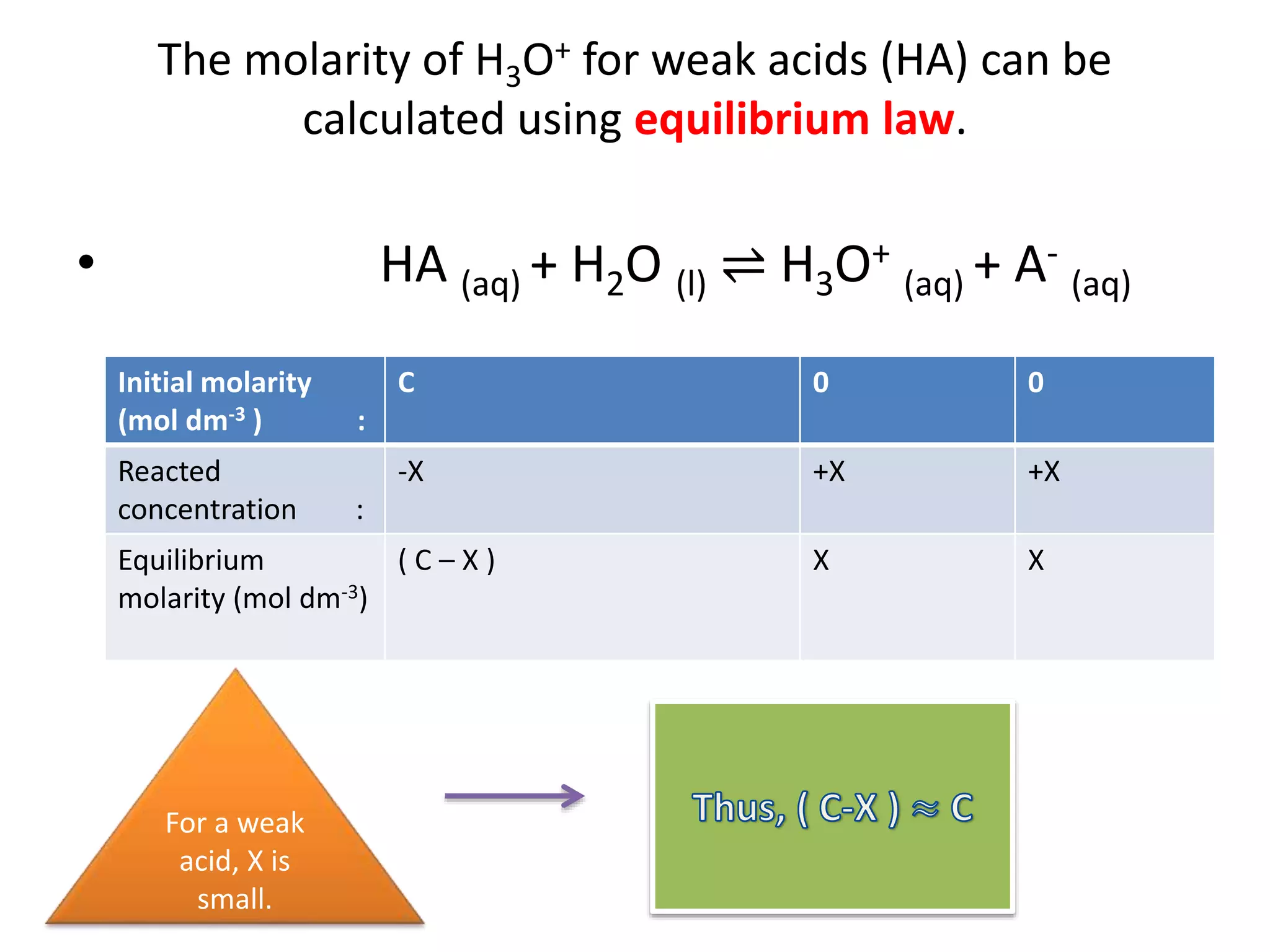
The molarity of H3O+ for weak acids (HA) can be
calculated using equilibrium law.
• HA (aq) + H2O (l) ⇌ H3O+
(aq) + A-
(aq)
Initial molarity
(mol dm-3 ) :
C 0 0
Reacted
concentration :
-X +X +X
Equilibrium
molarity (mol dm-3)
( C – X ) X X
For a weak
acid, X is
small.
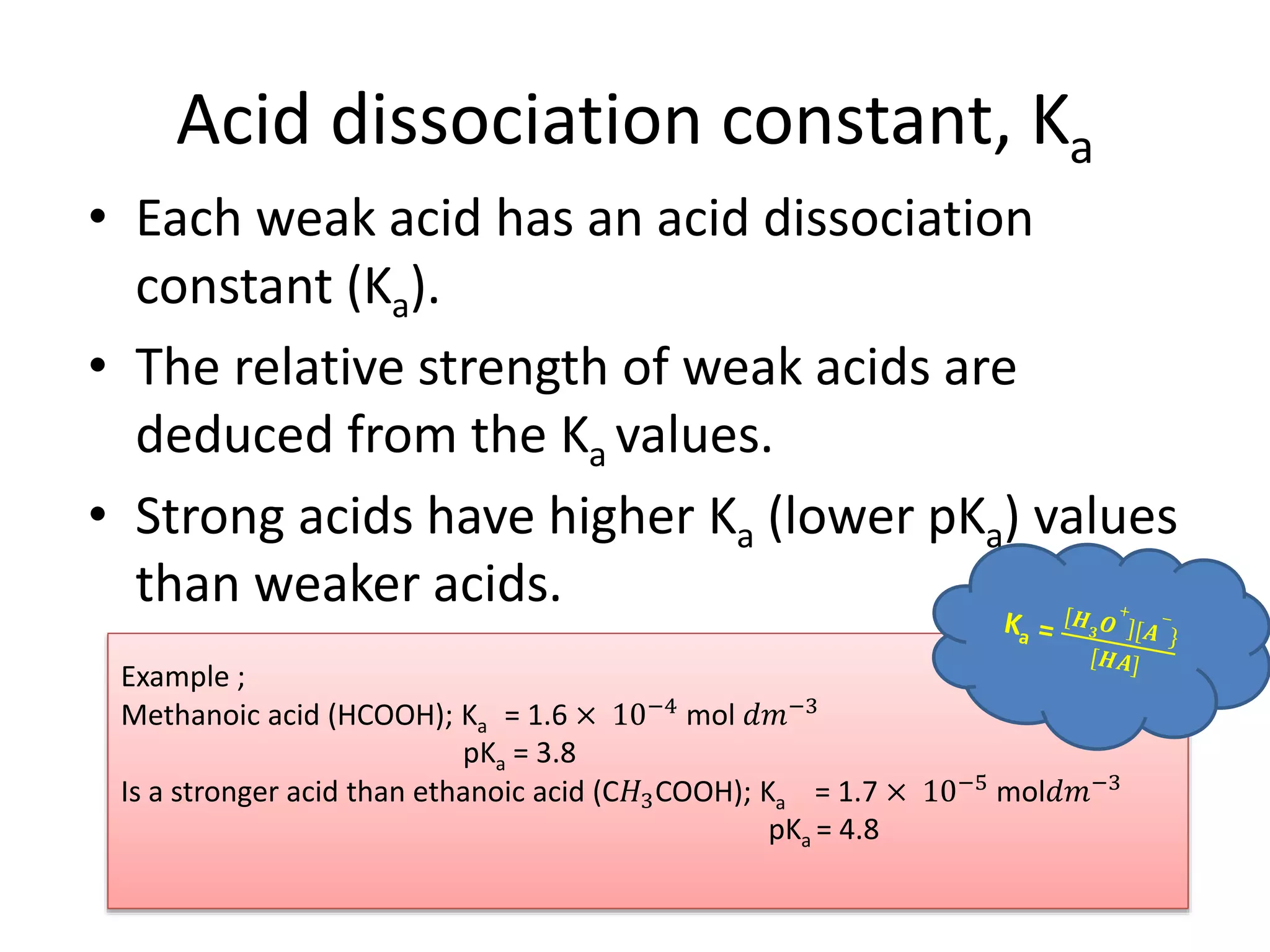
Acid dissociation constant, Ka
• Each weak acid has an acid dissociation
constant (Ka).
• The relative strength of weak acids are
deduced from the Ka values.
• Strong acids have higher Ka (lower pKa) values
than weaker acids.
Example ;
Methanoic acid (HCOOH); Ka = 1.6 × 10⁻⁴
mol 𝑑𝑚−3
pKa = 3.8
Is a stronger acid than ethanoic acid (C𝐻3COOH); Ka = 1.7 × 10⁻⁵
mol𝑑𝑚−3
pKa = 4.8
Example;
Calculate (a) pKa, (b) pH, and (c) degree of
dissociation , of 0.01 mol dm-3 nitrous acid,
HNO2 [Ka = 5.1 × 10⁻⁴ mol dm-3]
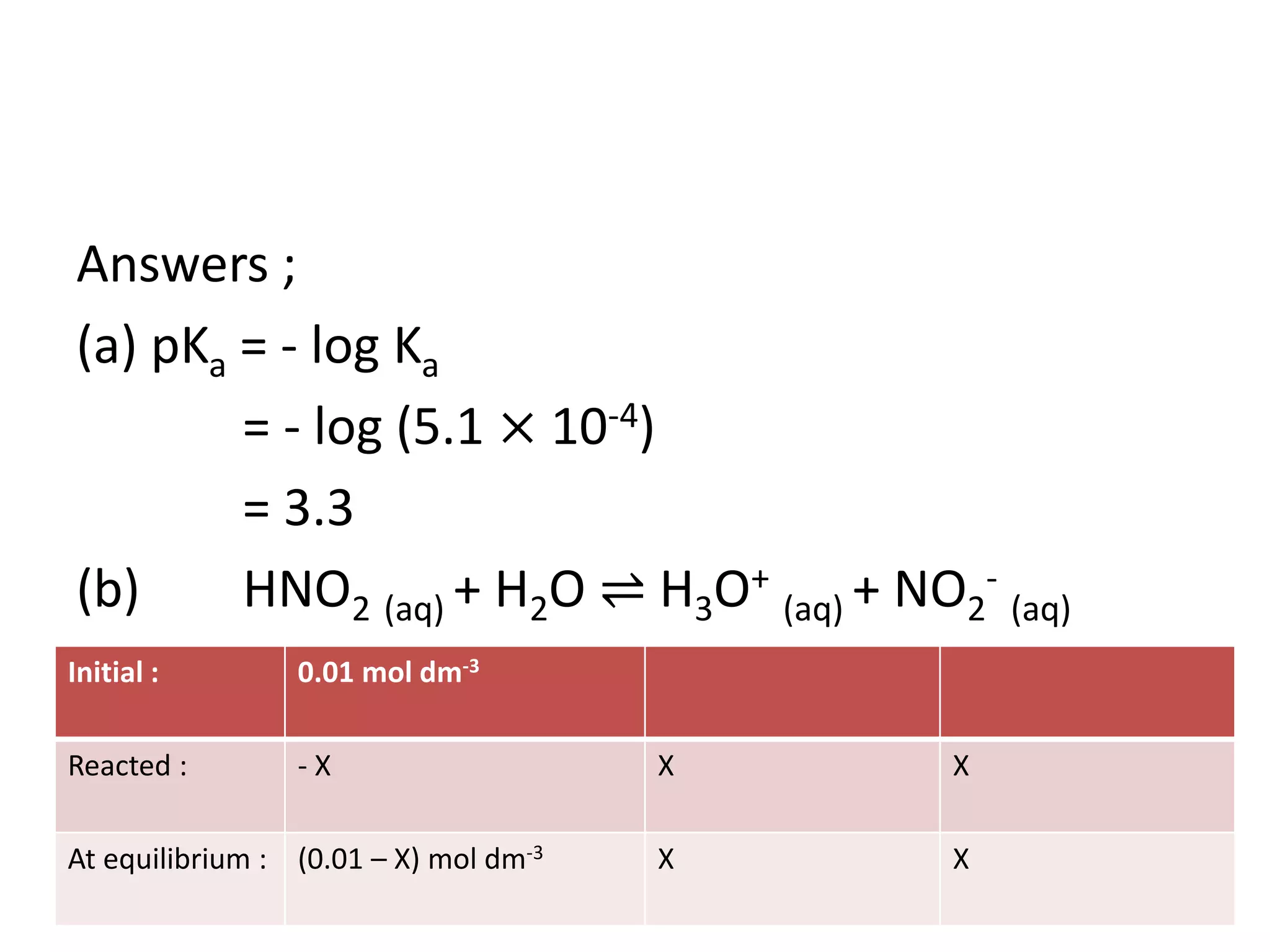
Answers ;
(a) pKa = - log Ka
= - log (5.1 × 10⁻⁴)
= 3.3
(b) HNO2 (aq) + H2O ⇌ H3O+
(aq) + NO2
-
(aq)
Initial : 0.01 mol dm-3
Reacted : - X X X
At equilibrium : (0.01 – X) mol dm-3 X X
Ka =
𝐻3
𝑂
+
[𝑁𝑂2
−
]
[𝐻𝑁𝑂2
]
5.1 × 10⁻⁴ M =
𝑋2
0.01 −𝑋 𝑀
, X is small
∴ (0.01 – X) ≈ 0.01
=
𝑋2
0.01 𝑀
X2 = 5.1 × 10⁻⁶
M2
X = 2.26 × 10⁻³
M
∴ [H3O+] = 2.26 × 10⁻³
M
pH = -log [H+]
= -log (2.26 × 10⁻³
)
= 2.6
X = 𝑲𝒂 . 𝑪
= 𝟓. 𝟏 × 𝟏𝟎−𝟒(𝟎. 𝟎𝟏)
= 𝟓. 𝟏 × 𝟏𝟎−𝟔
= 2.26 × 𝟏𝟎−𝟑 M
Or :
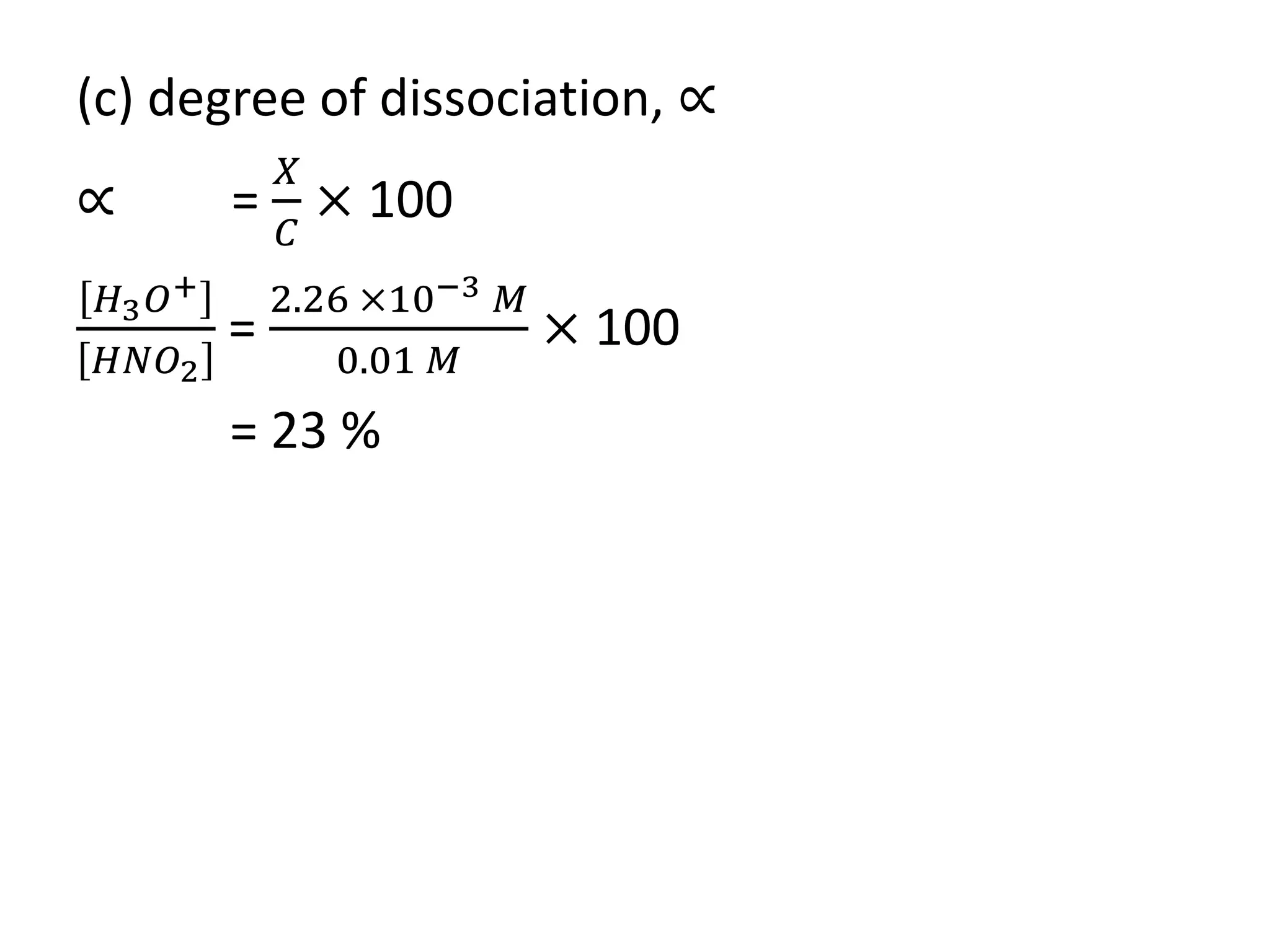
(c) degree of dissociation, ∝
∝ =
𝑋
𝐶
× 100
𝐻3 𝑂+
𝐻𝑁𝑂2
=
2.26 ×10⁻³ 𝑀
0.01 𝑀
× 100
= 23 %
• The degree of dissociation of weak bases ∝ <
1 < 100% .
• The molarity of OH- ion is less than the
molarity of undissociated base.
• The molarity of OH- from weak bases (B) can
be calculated using equilibrium law.
• B (aq) + H2O ⇋ BH+
(aq) + OH-
(aq)
Initial molarity ,
moldm-3
C O O
Reacted -X X X
Equilibrium
molarity , moldm-3
C – X X X
• Weak bases has a base dissociation constant,
Kb.
• The relative strength of weak bases can be
deduced by comparing the Kb values.
• Strong bases have higher Kb (lower pKb) values
than weaker bases.
Example ;
Ammonia, (NH3 ; Kb = 1.7 × 10⁻⁵
𝑚𝑜𝑙𝑑𝑚−3
pKb = 4.8 )
Is a weaker base than methanamine
( CH3NH2; Kb = 4.2 × 10⁻⁴
moldm-3
pKb = 3.4)
Example ;
Calculate (a) pKb, (b) pH and (c) degree of
dissociation of 0.1 moldm-3 NH2OH.
[Kb = 9.1 × 10⁻⁹
mold𝑚−3
]
(a) pKb = -log Kb
= -log ( 9.1 × 10⁻⁹
)
= 8.0
(b) NH2OH + H2O ⇋ NH3OH+
(aq) + OH-
(aq)
Initial : 0.1 0 0
Reacted : -X +X +X
At equilibrium : (0.1 – X) +X +X
Kb =
𝑁𝐻3 𝑂𝐻+ 𝑂𝐻−
𝐵
9.1 × 10⁻⁹
M =
𝑋 2
0.1 −𝑋 𝑀
, X is small, (0.1 – X) ≈ 0.1
=
𝑋2
0.1 𝑀
𝑋2
= 9.1 × 10⁻¹⁰
M2
X = 9.1 × 10⁻¹⁰ M2
X = 3.02 × 10⁻⁵
M
∴ [OH-] = 3.02 × 10⁻⁵
M
POH = -log [OH-]
= -log (3.02 × 10⁻⁵
)
= 4.5
pH = 14.0 – 4.5
= 9.5
(c) degree of dissociation, ∝
∝ =
𝑋
𝐶
× 100%
=
[𝑂𝐻
−
]
[𝑁𝐻2
𝑂𝐻]
× 100%
=
3.02 ×10⁻⁵ 𝑀
0.1 𝑀
× 100%
= 0.03 %
NH2OH is a very
weak base.
!
NOTE :
Both in (a) and (b)-
neglected the
contribution of the
autoionization of
water to [H+]and[OH-]
because 1.0 × 10⁻⁷M is
so small compared with
1.0 × 10⁻³
M and
0.040M.
Worked example :
Question 1
a) Calculate the pH of a 1.8× 10⁻²
M Ba(OH)2
solution.
b) Calculate the pH of HNO3 0.001 moldm-3.
Answer
a) Ba(OH)2 is a strong base. It ionise completely to
form 1.8 x 10⁻² moldm-3 OH-
(aq).
pOH = -log[OH-]
= -log(1.8x10⁻²)
= 1.74
pH + pOH = 14
pH = 14 – pOH
= 14 – 1.74
= 12.3
(b)
HNO3 is a strong acid.
It ionise completely to form 0.001 moldm-3 H+
(aq).
pH = -log[H+]
= -log(0.001)
= 3
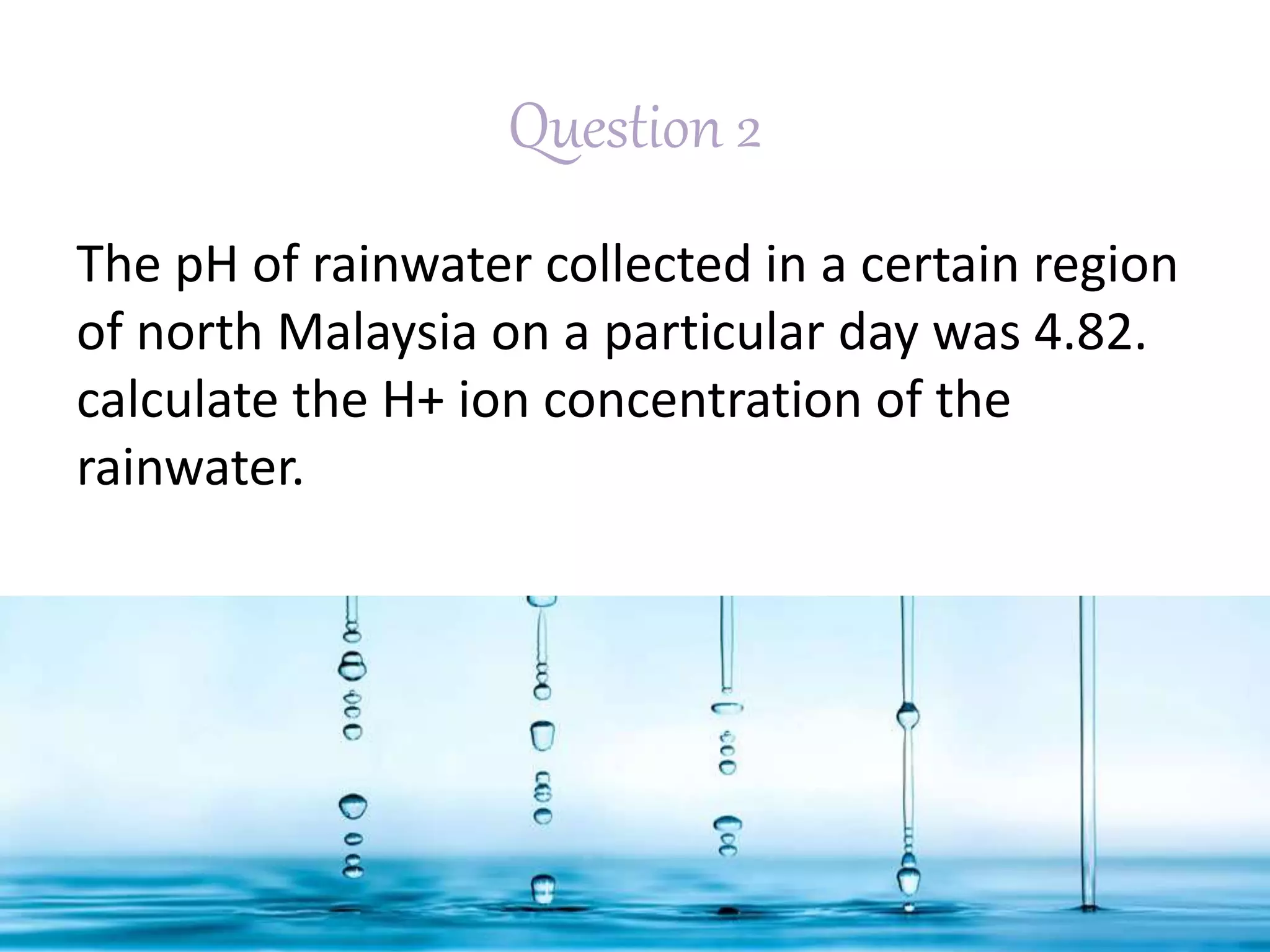
Question 2
The pH of rainwater collected in a certain region
of north Malaysia on a particular day was 4.82.
calculate the H+ ion concentration of the
rainwater.
Answer
pH = 4.82
pH = -log[H+]
log[H+] = -pH
log10[H+] = -pH
[H+] = 10-pH
[H+] = 10-4.82
= 0.000015
= 1.5 x 10⁻⁵ mol dm-3
logab = c
b= ac
Question 3
The pH of a certain fruit juice is 3.33. calculate
the H+ ion concentration.
Answer
pH = 3.33
[H+] = ?
pH = -log[H+]
3.33 = -log[H+]
log[H+] = -3.33
log10[H+] = -3.33
[H+] = 10-3.33
= 0.000468
= 4.7 x 10⁻⁴ M
Question 4
In a NaOH solution, [OH-] is 2.9× 10⁻⁴
M.
calculate the pH of the solution.
Answer
pOH = -log[OH-]
= -log(2.9 x 10⁻⁴)
= 3.5
pOH + pH = 14
pH = 14 – pOH
= 14 – 3.5
= 10.5
Question 5
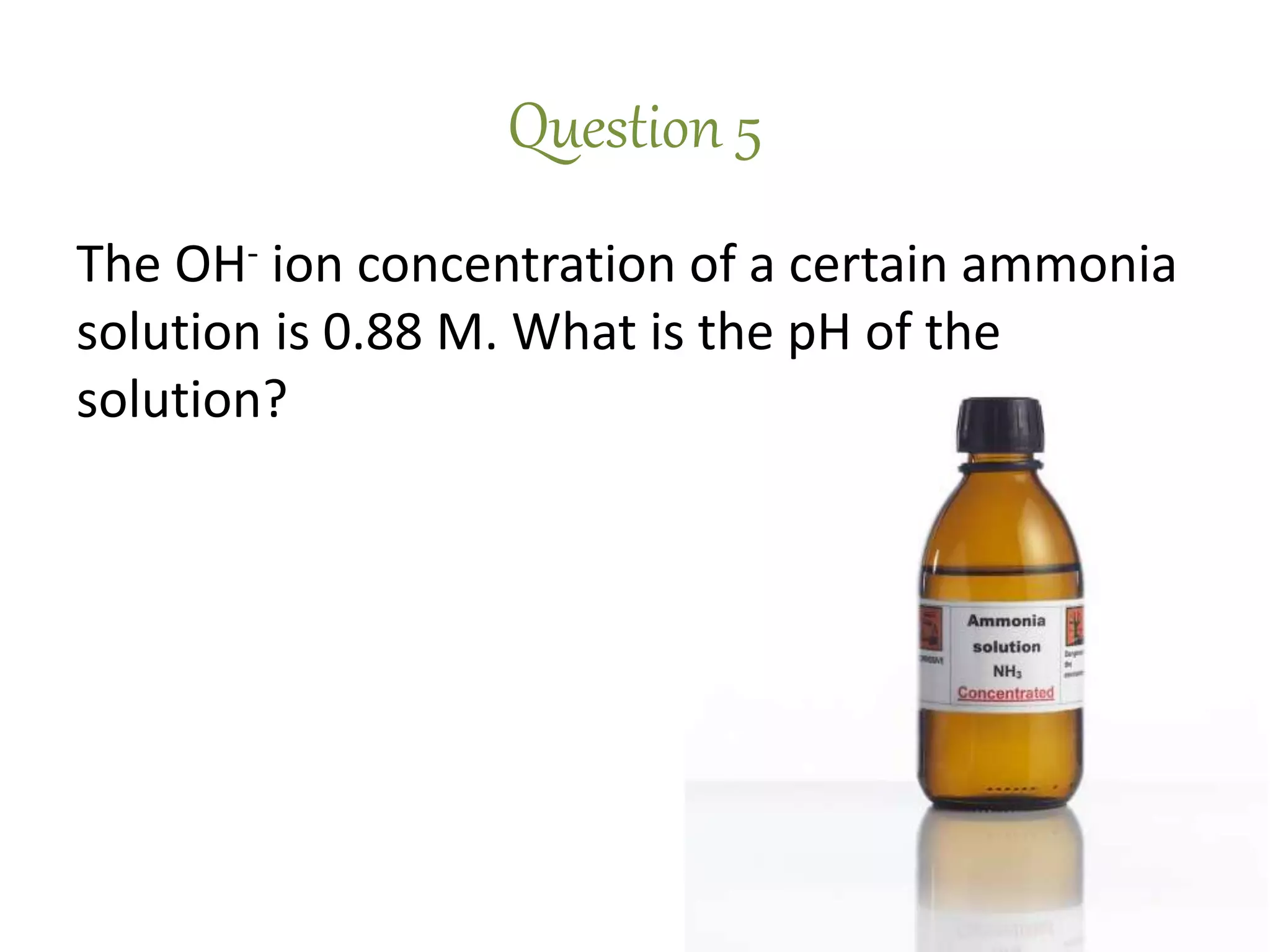
The OH- ion concentration of a certain ammonia
solution is 0.88 M. What is the pH of the
solution?
Answer
pOH = -log [OH-]
= -log(0.88)
= 0.055517
= 0.06
pH + pOH = 14
pH = 14 – pOH
= 14 – 0.06
= 13.94
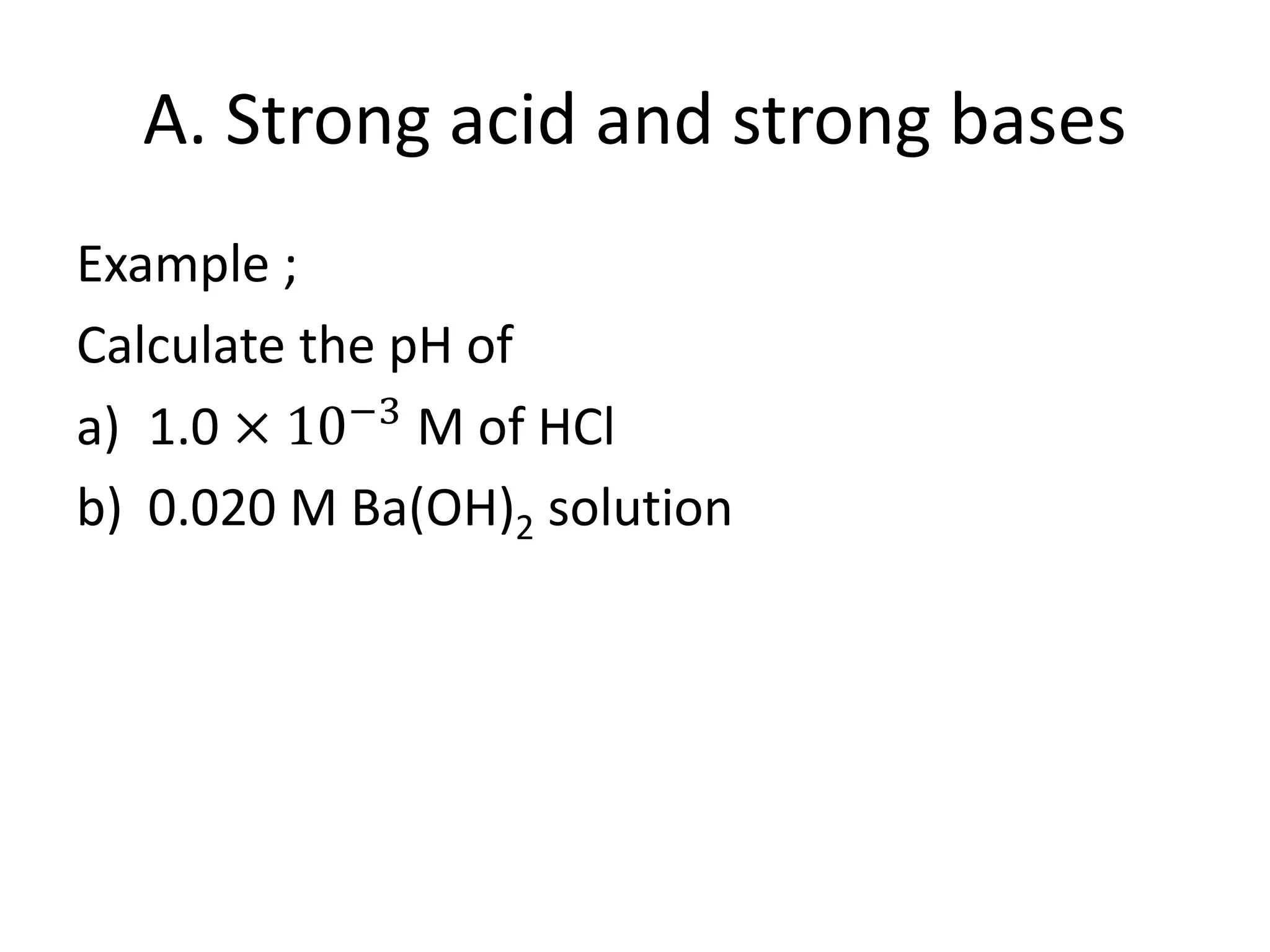
A. Strong acid and strong bases
Example ;
Calculate the pH of
a) 1.0 × 10⁻³
M of HCl
b) 0.020 M Ba(OH)2 solution
Answer
a) HCl is a strong acid, completely ionized in
solution :
HCl(aq)  H+
(aq) + Cl-
(aq)
HCl(aq)  H+
(aq) + Cl-
(aq)
Initial (M) : 1.0 × 𝟏𝟎−𝟑 M 0.0 0.0
Change (M) : -1.0 × 𝟏𝟎−𝟑
M +1.0 × 𝟏𝟎−𝟑
+1.0 × 𝟏𝟎−𝟑
Final (M) : 0.0 1.0 × 𝟏𝟎−𝟑
1.0 × 𝟏𝟎−𝟑
∴ [ H+] = 1.0 × 10⁻³
M
pH = -log (1.0 × 10⁻³
)
= 3.00
(b) Ba(OH)2 is a strong base. Each Ba(OH)2 unit
produces two OH- ions:
Ba(OH)2 (aq)  Ba2+
(aq) + 2OH-
(aq)
∴ [OH-] = 0.040 M
pOH = -log (0.040)
= 1.40
pH = 14.00 – 1.40
= 12.60
Initial (M) : 0.020 0.00 0.00
Change (M) : - 0.020 + 0.020 + 2(0.020)
Final (M) : 0.00 0.020 0.040
Exercise!!!
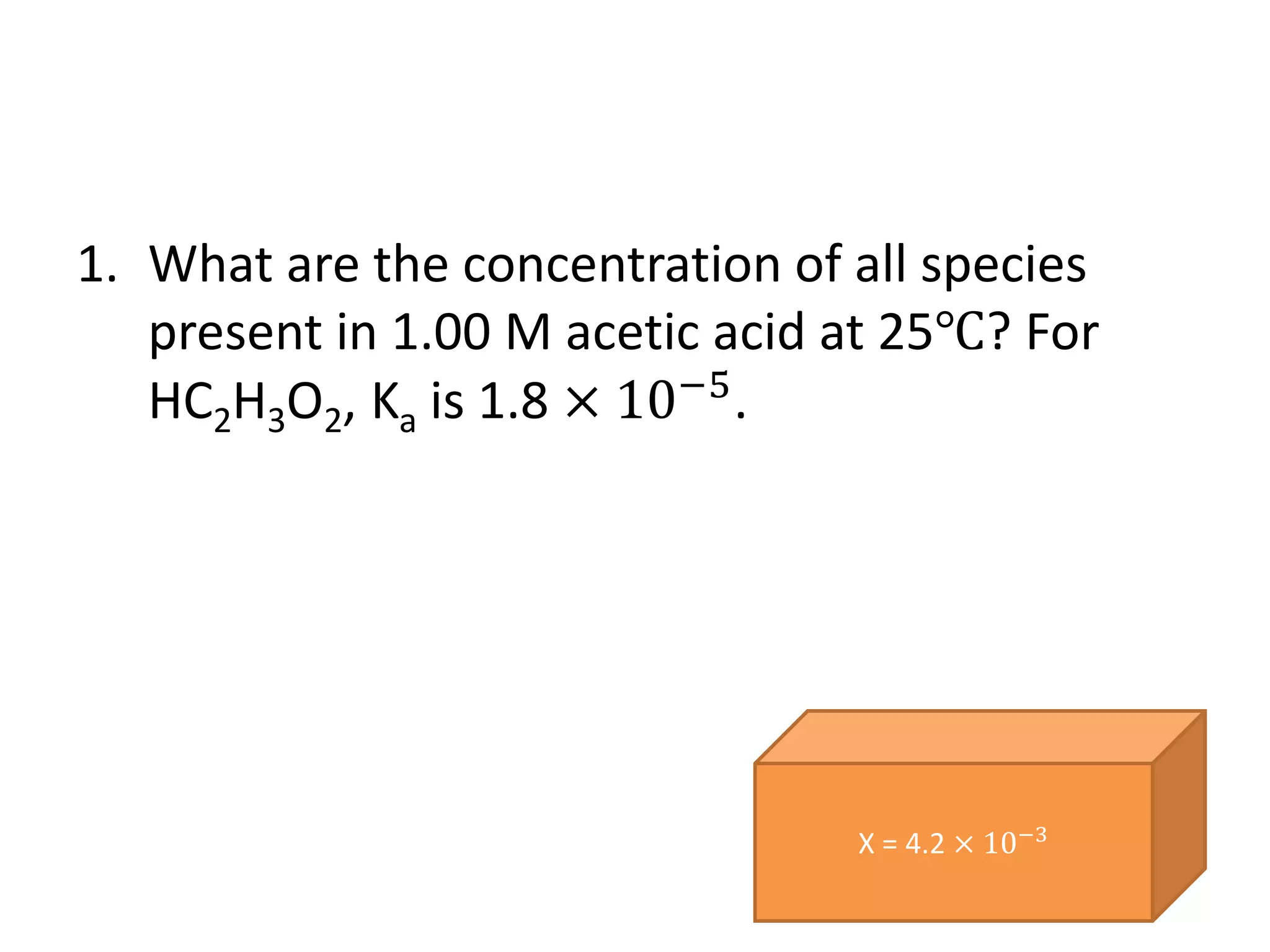
1. What are the concentration of all species
present in 1.00 M acetic acid at 25℃? For
HC2H3O2, Ka is 1.8 × 10⁻⁵
.
X = 4.2 × 10⁻³
2. What are the concentration of all species
present in a 0.10 M solution of HNO2 at 25℃.
For HNO2 Ka is 4.5 × 10⁻⁴
.
X = 6.5 × 𝟏𝟎−𝟑
3. Give the definition of pH.
pH is a measure
of hydrogenion concentration; a
measure of
the acidity or alkalinity of asolution
4.
a) What are [H+] and [OH-] in a 0.020 M solution
of HCl.
b) What are [H+] and [OH-] in a 0.0500 M
solution of NaOH.
5.
a) What is the pH of a solution that is 0.050 M
in H+?
b) What is the pH of a solution for which [OH-] =
0.030 M ?
6. What is [H+] of a solution with a pH of 10.60 ?
7. The pH of a 0.10 M solution of a weak acid HX
is 3.30. what is the ionization constant of HX?
(Ka = 2.5 × 10⁻⁶
)
8.
a) Propanoic acid, HC3H5O2 a weak monoprotic
is 0.72% ionized in 0.25 M solution. What is
the ionization constant for this acid?
b) In 0.25 M solution of benzylamine, C7H7NH2,
the concentration of OH-
(aq) is 2.4 × 10⁻³
M.
C7H7NH2 + H2O  C7H7NH3
+ + OH-
what is the value of Kb for the aqueous
ionization of benzylamine?
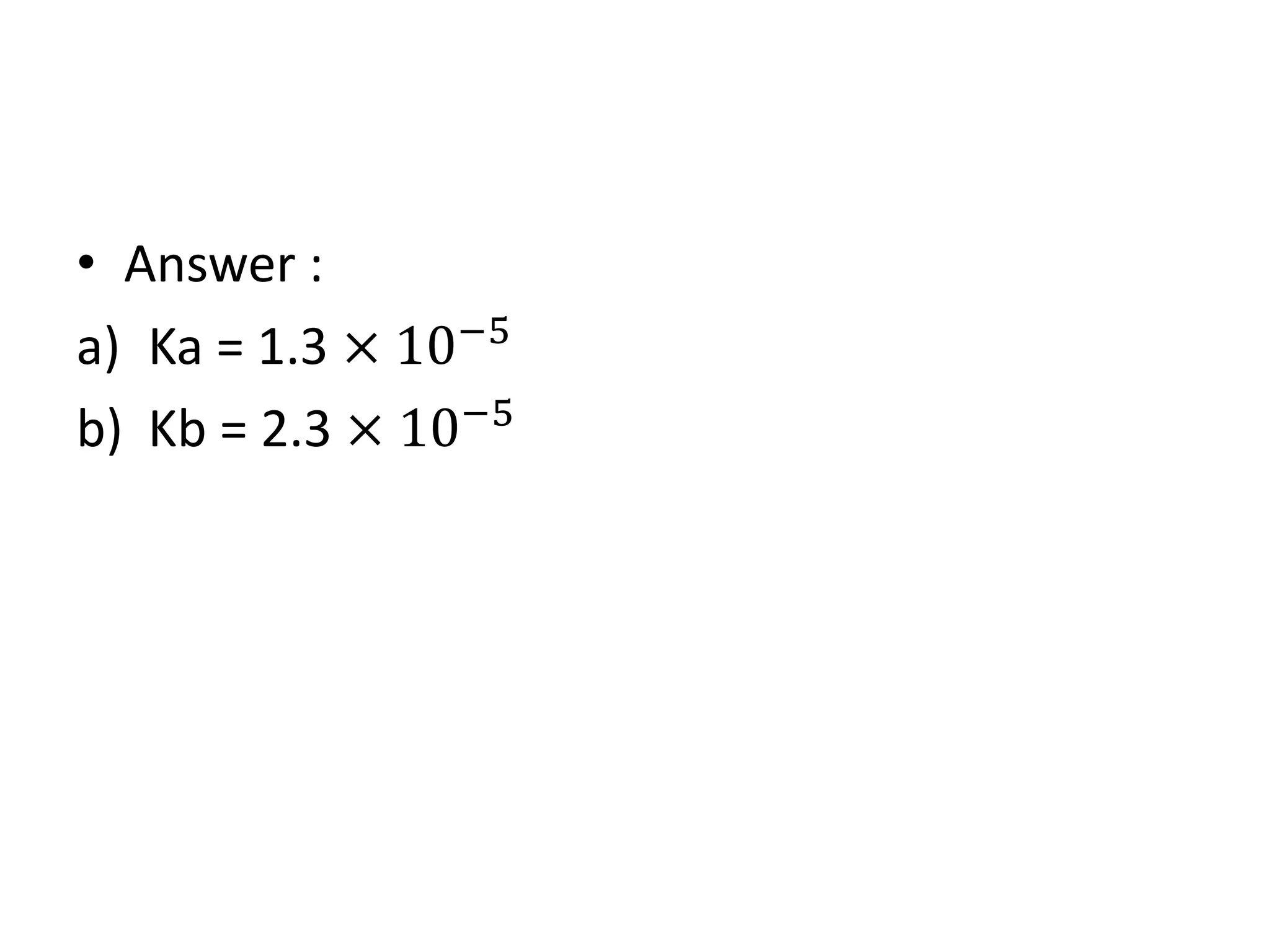
• Answer :
a) Ka = 1.3 × 10⁻⁵
b) Kb = 2.3 × 10⁻⁵

TOPIC 18 : ACIDS AND BASES

  • 2.
    H2O + H2O⇌ H3O+ + OH- Acid Base Kw = [H3O+] [OH-] Where, Kw: water dissociation constant for pure water at 25 ˚C
  • 3.
    • [H3O+] =[OH-] = 1.0 × 10⁻⁷ mol dm-3 • Thus, Kw = [H3O+] [OH-] = (1.0 × 10⁻⁷ ) (1.0 × 10⁻⁷ ) mol2 dm-6 = 1.0 × 10⁻¹⁴ mol2 dm-6 • log [H3O+] + log[OH-] = log (1.0 × 10⁻¹⁴ ) log [H3O+] + log[OH-] = -14.0 -log [H3O+] + log[OH-]= 14.0 • Thus, pH + pOH = 14.0 or pH + pOH = pKw (-log = p)
  • 4.
    THE pH ofAQUEOUS SOLUTION • Calculate the pH of an aqueous solution of Ba(OH)2 0.25 mol dm-3
  • 5.
    • Ba(OH)2 (aq) Ba2+ (aq) + 2OH- (aq) • pOH = -log [OH-] = -log (0.50) = 0.3 Initial molarity (mol dm-3) 0.25 0 0 Final molarity (mol dm-3) 0 0.25 0.50 pH = 14.0 – 0.3 = 13.7
  • 6.
    What is themolarity of OH- in an aqueous solution of NaOH if its pH is 13.5? • pOH = 14.0 – pH = 14.0 – 13.5 = 0.5 • pOH = -log [OH-] 0.5 = -log [OH-] log [OH-] = -0.5 [OH-] = 0.3 mol dm-3 SOLUTION :
  • 7.
    • Calculate thepH value of 1.0 × 10⁻⁸ mol dm-3 of HNO3 acid. Explain your answer. EXERCISE : (STRONG ACID)
  • 8.
    • HNO3 H+ + NO2 - 1.0 × 10⁻⁸ 1.0 × 10⁻⁸ 1.0 × 10⁻⁸ • pH = -log [H+] = -log (1.0 × 10⁻⁸ ) = 8 • For acid, pH <7, [H3O+]> 1.0 × 10⁻⁷ consider [H3O+] from dissociation of water. • ∴ [H3O+] = [H3O+]w + [H3O+]acid = 1.0 × 10⁻⁷ + 1.0 × 10⁻⁸
  • 9.
    • Anions derivedfrom strong acids (such as Cl- from HCl) and cations from strong bases (such as Na+ from NaOH) do not react with water to affect the pH.
  • 10.
    • Weak acid: CH3COOH (aq) ⇌ H+ (aq) + CH3COO- (aq) Acid Base
  • 11.
    * CH3COO- (aq) +H2O ⇌ CH3COOH (aq) + OH-
  • 12.
    • Ka .Kb = 𝐶𝐻3 𝐶𝑂𝑂𝐻 [𝑂𝐻−] [𝐶𝐻3 𝐶𝑂𝑂−]
  • 13.
    To obtain thevalue of Kb for the anion derived from a weak acid • • , • For the hydrolysis of acetate ion (*), • Kb = 1.0 × 10⁻¹⁴ 𝐾𝑤 1.8 ×10⁻⁵ 𝐾𝑄 = 5.6 × 10⁻¹⁰
  • 15.
    • The degreeof dissociation of weak acids and bases, ∝ less than 1 (or less 100%). • The molarity of H3O+ ions is less than the molarity of the acid (HA). •
  • 16.
    The molarity ofH3O+ for weak acids (HA) can be calculated using equilibrium law. • HA (aq) + H2O (l) ⇌ H3O+ (aq) + A- (aq) Initial molarity (mol dm-3 ) : C 0 0 Reacted concentration : -X +X +X Equilibrium molarity (mol dm-3) ( C – X ) X X For a weak acid, X is small.
  • 17.
    Acid dissociation constant,Ka • Each weak acid has an acid dissociation constant (Ka). • The relative strength of weak acids are deduced from the Ka values. • Strong acids have higher Ka (lower pKa) values than weaker acids. Example ; Methanoic acid (HCOOH); Ka = 1.6 × 10⁻⁴ mol 𝑑𝑚−3 pKa = 3.8 Is a stronger acid than ethanoic acid (C𝐻3COOH); Ka = 1.7 × 10⁻⁵ mol𝑑𝑚−3 pKa = 4.8
  • 18.
    Example; Calculate (a) pKa,(b) pH, and (c) degree of dissociation , of 0.01 mol dm-3 nitrous acid, HNO2 [Ka = 5.1 × 10⁻⁴ mol dm-3]
  • 19.
    Answers ; (a) pKa= - log Ka = - log (5.1 × 10⁻⁴) = 3.3 (b) HNO2 (aq) + H2O ⇌ H3O+ (aq) + NO2 - (aq) Initial : 0.01 mol dm-3 Reacted : - X X X At equilibrium : (0.01 – X) mol dm-3 X X
  • 20.
    Ka = 𝐻3 𝑂 + [𝑁𝑂2 − ] [𝐻𝑁𝑂2 ] 5.1 ×10⁻⁴ M = 𝑋2 0.01 −𝑋 𝑀 , X is small ∴ (0.01 – X) ≈ 0.01 = 𝑋2 0.01 𝑀 X2 = 5.1 × 10⁻⁶ M2 X = 2.26 × 10⁻³ M ∴ [H3O+] = 2.26 × 10⁻³ M pH = -log [H+] = -log (2.26 × 10⁻³ ) = 2.6 X = 𝑲𝒂 . 𝑪 = 𝟓. 𝟏 × 𝟏𝟎−𝟒(𝟎. 𝟎𝟏) = 𝟓. 𝟏 × 𝟏𝟎−𝟔 = 2.26 × 𝟏𝟎−𝟑 M Or :
  • 21.
    (c) degree ofdissociation, ∝ ∝ = 𝑋 𝐶 × 100 𝐻3 𝑂+ 𝐻𝑁𝑂2 = 2.26 ×10⁻³ 𝑀 0.01 𝑀 × 100 = 23 %
  • 22.
    • The degreeof dissociation of weak bases ∝ < 1 < 100% . • The molarity of OH- ion is less than the molarity of undissociated base. • The molarity of OH- from weak bases (B) can be calculated using equilibrium law.
  • 23.
    • B (aq)+ H2O ⇋ BH+ (aq) + OH- (aq) Initial molarity , moldm-3 C O O Reacted -X X X Equilibrium molarity , moldm-3 C – X X X
  • 24.
    • Weak baseshas a base dissociation constant, Kb. • The relative strength of weak bases can be deduced by comparing the Kb values. • Strong bases have higher Kb (lower pKb) values than weaker bases.
  • 25.
    Example ; Ammonia, (NH3; Kb = 1.7 × 10⁻⁵ 𝑚𝑜𝑙𝑑𝑚−3 pKb = 4.8 ) Is a weaker base than methanamine ( CH3NH2; Kb = 4.2 × 10⁻⁴ moldm-3 pKb = 3.4)
  • 26.
    Example ; Calculate (a)pKb, (b) pH and (c) degree of dissociation of 0.1 moldm-3 NH2OH. [Kb = 9.1 × 10⁻⁹ mold𝑚−3 ]
  • 27.
    (a) pKb =-log Kb = -log ( 9.1 × 10⁻⁹ ) = 8.0 (b) NH2OH + H2O ⇋ NH3OH+ (aq) + OH- (aq) Initial : 0.1 0 0 Reacted : -X +X +X At equilibrium : (0.1 – X) +X +X
  • 28.
    Kb = 𝑁𝐻3 𝑂𝐻+𝑂𝐻− 𝐵 9.1 × 10⁻⁹ M = 𝑋 2 0.1 −𝑋 𝑀 , X is small, (0.1 – X) ≈ 0.1 = 𝑋2 0.1 𝑀 𝑋2 = 9.1 × 10⁻¹⁰ M2 X = 9.1 × 10⁻¹⁰ M2 X = 3.02 × 10⁻⁵ M ∴ [OH-] = 3.02 × 10⁻⁵ M
  • 29.
    POH = -log[OH-] = -log (3.02 × 10⁻⁵ ) = 4.5 pH = 14.0 – 4.5 = 9.5
  • 30.
    (c) degree ofdissociation, ∝ ∝ = 𝑋 𝐶 × 100% = [𝑂𝐻 − ] [𝑁𝐻2 𝑂𝐻] × 100% = 3.02 ×10⁻⁵ 𝑀 0.1 𝑀 × 100% = 0.03 % NH2OH is a very weak base. ! NOTE : Both in (a) and (b)- neglected the contribution of the autoionization of water to [H+]and[OH-] because 1.0 × 10⁻⁷M is so small compared with 1.0 × 10⁻³ M and 0.040M.
  • 31.
  • 32.
    Question 1 a) Calculatethe pH of a 1.8× 10⁻² M Ba(OH)2 solution. b) Calculate the pH of HNO3 0.001 moldm-3.
  • 33.
    Answer a) Ba(OH)2 isa strong base. It ionise completely to form 1.8 x 10⁻² moldm-3 OH- (aq). pOH = -log[OH-] = -log(1.8x10⁻²) = 1.74 pH + pOH = 14 pH = 14 – pOH = 14 – 1.74 = 12.3
  • 34.
    (b) HNO3 is astrong acid. It ionise completely to form 0.001 moldm-3 H+ (aq). pH = -log[H+] = -log(0.001) = 3
  • 35.
    Question 2 The pHof rainwater collected in a certain region of north Malaysia on a particular day was 4.82. calculate the H+ ion concentration of the rainwater.
  • 36.
    Answer pH = 4.82 pH= -log[H+] log[H+] = -pH log10[H+] = -pH [H+] = 10-pH [H+] = 10-4.82 = 0.000015 = 1.5 x 10⁻⁵ mol dm-3 logab = c b= ac
  • 37.
    Question 3 The pHof a certain fruit juice is 3.33. calculate the H+ ion concentration.
  • 38.
    Answer pH = 3.33 [H+]= ? pH = -log[H+] 3.33 = -log[H+] log[H+] = -3.33 log10[H+] = -3.33 [H+] = 10-3.33 = 0.000468 = 4.7 x 10⁻⁴ M
  • 39.
    Question 4 In aNaOH solution, [OH-] is 2.9× 10⁻⁴ M. calculate the pH of the solution.
  • 40.
    Answer pOH = -log[OH-] =-log(2.9 x 10⁻⁴) = 3.5 pOH + pH = 14 pH = 14 – pOH = 14 – 3.5 = 10.5
  • 41.
    Question 5 The OH-ion concentration of a certain ammonia solution is 0.88 M. What is the pH of the solution?
  • 42.
    Answer pOH = -log[OH-] = -log(0.88) = 0.055517 = 0.06 pH + pOH = 14 pH = 14 – pOH = 14 – 0.06 = 13.94
  • 44.
    A. Strong acidand strong bases Example ; Calculate the pH of a) 1.0 × 10⁻³ M of HCl b) 0.020 M Ba(OH)2 solution
  • 45.
    Answer a) HCl isa strong acid, completely ionized in solution : HCl(aq)  H+ (aq) + Cl- (aq) HCl(aq)  H+ (aq) + Cl- (aq) Initial (M) : 1.0 × 𝟏𝟎−𝟑 M 0.0 0.0 Change (M) : -1.0 × 𝟏𝟎−𝟑 M +1.0 × 𝟏𝟎−𝟑 +1.0 × 𝟏𝟎−𝟑 Final (M) : 0.0 1.0 × 𝟏𝟎−𝟑 1.0 × 𝟏𝟎−𝟑
  • 46.
    ∴ [ H+]= 1.0 × 10⁻³ M pH = -log (1.0 × 10⁻³ ) = 3.00
  • 47.
    (b) Ba(OH)2 isa strong base. Each Ba(OH)2 unit produces two OH- ions: Ba(OH)2 (aq)  Ba2+ (aq) + 2OH- (aq) ∴ [OH-] = 0.040 M pOH = -log (0.040) = 1.40 pH = 14.00 – 1.40 = 12.60 Initial (M) : 0.020 0.00 0.00 Change (M) : - 0.020 + 0.020 + 2(0.020) Final (M) : 0.00 0.020 0.040
  • 48.
  • 49.
    1. What arethe concentration of all species present in 1.00 M acetic acid at 25℃? For HC2H3O2, Ka is 1.8 × 10⁻⁵ . X = 4.2 × 10⁻³
  • 50.
    2. What arethe concentration of all species present in a 0.10 M solution of HNO2 at 25℃. For HNO2 Ka is 4.5 × 10⁻⁴ . X = 6.5 × 𝟏𝟎−𝟑
  • 51.
    3. Give thedefinition of pH. pH is a measure of hydrogenion concentration; a measure of the acidity or alkalinity of asolution
  • 52.
    4. a) What are[H+] and [OH-] in a 0.020 M solution of HCl. b) What are [H+] and [OH-] in a 0.0500 M solution of NaOH.
  • 53.
    5. a) What isthe pH of a solution that is 0.050 M in H+? b) What is the pH of a solution for which [OH-] = 0.030 M ?
  • 54.
    6. What is[H+] of a solution with a pH of 10.60 ? 7. The pH of a 0.10 M solution of a weak acid HX is 3.30. what is the ionization constant of HX? (Ka = 2.5 × 10⁻⁶ )
  • 55.
    8. a) Propanoic acid,HC3H5O2 a weak monoprotic is 0.72% ionized in 0.25 M solution. What is the ionization constant for this acid? b) In 0.25 M solution of benzylamine, C7H7NH2, the concentration of OH- (aq) is 2.4 × 10⁻³ M. C7H7NH2 + H2O  C7H7NH3 + + OH- what is the value of Kb for the aqueous ionization of benzylamine?
  • 56.
    • Answer : a)Ka = 1.3 × 10⁻⁵ b) Kb = 2.3 × 10⁻⁵