Poem ‘“Hope”
is the Thing with Feathers’
by Emily Dickinson
Lecturer:
DR. Yee Bee Choo
IPGKTHO
TOPIC 2c
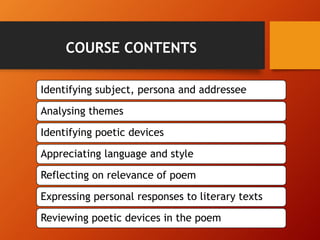
Identifying subject, persona and addressee
Analysing themes
Identifying poetic devices
Appreciating language and style
Reflecting on relevance of poem
Expressing personal responses to literary texts
Reviewing poetic devices in the poem
COURSE CONTENTS
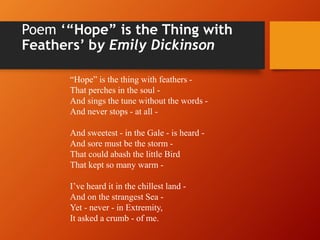
Poem ‘“Hope” is the Thing with
Feathers’ by Emily Dickinson
“Hope” is the thing with feathers -
That perches in the soul -
And sings the tune without the words -
And never stops - at all -
And sweetest - in the Gale - is heard -
And sore must be the storm -
That could abash the little Bird
That kept so many warm -
I’ve heard it in the chillest land -
And on the strangest Sea -
Yet - never - in Extremity,
It asked a crumb - of me.
Identifying subject, persona and
addressee
• Subject:
• Persona:
• Addressee:
Identifying subject, persona and
addressee
• Subject: Hope
• Persona: An unspecified person/ The poet
• Addressee: The readers
Analysing themes
1. Hope
• In the poem, "Hope" is metaphorically transformed
into a strong-willed bird that lives within the human
soul—and sings its song no matter what.
• Essentially, the poem seeks to remind readers of the
power of hope and how little it requires of people.
• The speaker makes it clear that hope has been
helpful in times of difficulty and has never asked for
anything in return.
Analysing themes
2. Endurance
• Human endurance is a significant aspect of the
poem and is symbolised by the strong little bird,
who sings and endures extreme weather
conditions.
• The speaker appears optimistic about the human
ability to hope and survive through suffering.
• This optimism is subtly implied by the bird's song
being described as "sweetest" in a dramatic "gale."
Analysing themes
3. Human suffering
• Dickinson refers repeatedly to the inhospitable
nature of the dark and stormy weather in the
poem's setting.
• This weather represents the hardships humans
face, such as loss and grief.
• The use of seafaring imagery is also significant in
Dickinson's depiction of human suffering.
• Seafaring is often used culturally as a symbol for
hardship and endurance, which is noted in the
poem's descriptions of storms and gales.
Identifying poetic devices
1. Metaphor
• The title and first line “Hope” is the Thing with Feathers show
the whole poem is a metaphor for the persistence of hope.
• Hope has feathers and it can, like a bird, perch in the human
soul. Feathers are soft and gentle to the touch but they are
also strong in flight, even on tiny birds. And feathers are
made up of complex individual fibres; unity is strength.
• The poem portrays hope as a bird that lives within the human
soul; this bird sings come rain or shine, gale or storm, good
times or bad. The poem argues that hope is miraculous and
almost impossible to defeat. Furthermore, hope never asks
for anything in return—it costs nothing for people to maintain
hope.
• The first stanza introduces the metaphor and the bird's
song; the second demonstrates the bird's resilience; and the
third brings the poem into the more personal experience of
the speaker.
Identifying poetic devices
2. Symbol
• Dickinson's use of bird symbolism in this poem has
some cultural significance.
• It is likely an allusion to Christian symbolism and
the image of the dove, which is used in the Bible
as an icon of peace.
• Birds are also often used as a symbol of freedom
and hope in literature.
• The bird's song represents its endurance and
strength. Despite its encounter with the extreme
weather of gales and storms, it carries on singing.
• Dickinson uses this image of the singing bird to
show the persistence of hope and how it can
endure hard times.
Identifying poetic devices
3. Alliteration
• The lines "And on the strangest Sea" and "sore
must be the storm" use alliteration in their S
sounds.
Appreciating language and style
• Form
• A short poem with three stanzas, each one a
quatrain.
• The rhyme scheme in the first two stanzas
is abcb but the final stanza is a bit different,
abbb.
• "Hope is the thing with Feathers" is a
particular type of Dickinson work, which might
be called "definition poems."
Appreciating language and style
• Language & Style
• The syntax has clauses interrupted by dashes, and
only one comma throughout.
• Special emphasis with speech marks (inverted
commas, quotation marks), e.g. “Hope”
• Certain phrases are enclosed in a separate double
dash, which places particular emphasis on
meaning. Note: - at all - in the first stanza, and -
in the Gale - in the second, plus - never - in the
final stanza.
Reflecting on relevance of poem
• What is hope? Why do we feel hope? And why
is hope so important to us?
• In a story from Greek mythology, hope was
famously the only item to remain in Pandora’s
box after it released the evils of the world,
demonstrating just how valuable hope is to us:
had hope escaped from our possession,
humanity would have been unable to survive
the evils of the world.
• Hope is an eternal spring, as it’s a vital
constituent of human beings, enabling us to
conquer unchartered territories.
Expressing personal responses to
literary texts
• Human endurance is a significant aspect of the
poem and is symbolised by the strong little bird,
who sings and endures extreme weather
conditions.
• No matter what hardship we face every day, we
must endure it just like the little bird.
• We should not let the hardship stops us from
moving forward.
My Personal Response
Reviewing poetic devices in the
poem studied (Revision)
• Metaphor
• Symbol
• Alliteration
Tutorial 2c
Based on the poem ‘“Hope” is the Thing
with Feathers’, Dickinson use the bird
to symbolize hope. What will you use to
symbolize hope? Why do you use it?
Hope is ----
References
• https://www.gradesaver.com/hope-is-the-
thing-with-feathers

PPISMP TSLB1124 Topic 2 Poem “Hope is the Thing with Feathers”.pptx

  • 1.
    Poem ‘“Hope” is theThing with Feathers’ by Emily Dickinson Lecturer: DR. Yee Bee Choo IPGKTHO TOPIC 2c
  • 2.
    Identifying subject, personaand addressee Analysing themes Identifying poetic devices Appreciating language and style Reflecting on relevance of poem Expressing personal responses to literary texts Reviewing poetic devices in the poem COURSE CONTENTS
  • 3.
    Poem ‘“Hope” isthe Thing with Feathers’ by Emily Dickinson “Hope” is the thing with feathers - That perches in the soul - And sings the tune without the words - And never stops - at all - And sweetest - in the Gale - is heard - And sore must be the storm - That could abash the little Bird That kept so many warm - I’ve heard it in the chillest land - And on the strangest Sea - Yet - never - in Extremity, It asked a crumb - of me.
  • 4.
    Identifying subject, personaand addressee • Subject: • Persona: • Addressee:
  • 5.
    Identifying subject, personaand addressee • Subject: Hope • Persona: An unspecified person/ The poet • Addressee: The readers
  • 6.
    Analysing themes 1. Hope •In the poem, "Hope" is metaphorically transformed into a strong-willed bird that lives within the human soul—and sings its song no matter what. • Essentially, the poem seeks to remind readers of the power of hope and how little it requires of people. • The speaker makes it clear that hope has been helpful in times of difficulty and has never asked for anything in return.
  • 7.
    Analysing themes 2. Endurance •Human endurance is a significant aspect of the poem and is symbolised by the strong little bird, who sings and endures extreme weather conditions. • The speaker appears optimistic about the human ability to hope and survive through suffering. • This optimism is subtly implied by the bird's song being described as "sweetest" in a dramatic "gale."
  • 8.
    Analysing themes 3. Humansuffering • Dickinson refers repeatedly to the inhospitable nature of the dark and stormy weather in the poem's setting. • This weather represents the hardships humans face, such as loss and grief. • The use of seafaring imagery is also significant in Dickinson's depiction of human suffering. • Seafaring is often used culturally as a symbol for hardship and endurance, which is noted in the poem's descriptions of storms and gales.
  • 9.
    Identifying poetic devices 1.Metaphor • The title and first line “Hope” is the Thing with Feathers show the whole poem is a metaphor for the persistence of hope. • Hope has feathers and it can, like a bird, perch in the human soul. Feathers are soft and gentle to the touch but they are also strong in flight, even on tiny birds. And feathers are made up of complex individual fibres; unity is strength. • The poem portrays hope as a bird that lives within the human soul; this bird sings come rain or shine, gale or storm, good times or bad. The poem argues that hope is miraculous and almost impossible to defeat. Furthermore, hope never asks for anything in return—it costs nothing for people to maintain hope. • The first stanza introduces the metaphor and the bird's song; the second demonstrates the bird's resilience; and the third brings the poem into the more personal experience of the speaker.
  • 10.
    Identifying poetic devices 2.Symbol • Dickinson's use of bird symbolism in this poem has some cultural significance. • It is likely an allusion to Christian symbolism and the image of the dove, which is used in the Bible as an icon of peace. • Birds are also often used as a symbol of freedom and hope in literature. • The bird's song represents its endurance and strength. Despite its encounter with the extreme weather of gales and storms, it carries on singing. • Dickinson uses this image of the singing bird to show the persistence of hope and how it can endure hard times.
  • 11.
    Identifying poetic devices 3.Alliteration • The lines "And on the strangest Sea" and "sore must be the storm" use alliteration in their S sounds.
  • 12.
    Appreciating language andstyle • Form • A short poem with three stanzas, each one a quatrain. • The rhyme scheme in the first two stanzas is abcb but the final stanza is a bit different, abbb. • "Hope is the thing with Feathers" is a particular type of Dickinson work, which might be called "definition poems."
  • 13.
    Appreciating language andstyle • Language & Style • The syntax has clauses interrupted by dashes, and only one comma throughout. • Special emphasis with speech marks (inverted commas, quotation marks), e.g. “Hope” • Certain phrases are enclosed in a separate double dash, which places particular emphasis on meaning. Note: - at all - in the first stanza, and - in the Gale - in the second, plus - never - in the final stanza.
  • 14.
    Reflecting on relevanceof poem • What is hope? Why do we feel hope? And why is hope so important to us? • In a story from Greek mythology, hope was famously the only item to remain in Pandora’s box after it released the evils of the world, demonstrating just how valuable hope is to us: had hope escaped from our possession, humanity would have been unable to survive the evils of the world. • Hope is an eternal spring, as it’s a vital constituent of human beings, enabling us to conquer unchartered territories.
  • 15.
    Expressing personal responsesto literary texts • Human endurance is a significant aspect of the poem and is symbolised by the strong little bird, who sings and endures extreme weather conditions. • No matter what hardship we face every day, we must endure it just like the little bird. • We should not let the hardship stops us from moving forward. My Personal Response
  • 16.
    Reviewing poetic devicesin the poem studied (Revision) • Metaphor • Symbol • Alliteration
  • 17.
    Tutorial 2c Based onthe poem ‘“Hope” is the Thing with Feathers’, Dickinson use the bird to symbolize hope. What will you use to symbolize hope? Why do you use it? Hope is ----
  • 18.