Assessing Reading
Contents
 Reading strategies
 Types of reading tasks
Perceptive
Selective
Interactive
Extensive
 Summary
 Dictocomp
 Strip story
Reading Strategies (1)
 Bottom-up processing (decoding)
which employs micro-skills
Discrimination of graphemes &
orthographic patterns
Recognition & interpretation of
words, word classes, patterns, rules,
etc.
Cohesive devices
Making use of formal schema to
decode the written text
Reading Strategies (2)
 Top-down processing which
employs macro-skills
Recognition of rhetorical forms and
communicative functions
Using background knowledge to
make inferences
Scanning and skimming, guessing
meaning of words from context,
activating relevant schemata
Types of Reading Tasks (1)
 Perceptive:
Bottom-up processing
Decoding letters, words, graphemic
symbols, etc.
Reading aloud, picture-cued word or
sentence identification, etc. (Brown
190-93)
Types of Reading Tasks (2)
o Selective:
A combo of bottom-up and top-
down processing
Formal (lexical and grammatical)
aspects of language
Formats including multiple-choice,
matching, gap-filling
Types of Reading Tasks (3)
 Interactive:
Top-down processing (with some
instances of bottom-up)
More lengthy reading where the reader
must interact with the text
A process of negotiating meaning
Both form-focused and meaning-focused
(but more emphasis on meaning
comprehension)
Cloze, comprehension Qs, editing, short
answers, scanning, ordering, info.
transfer (graphics interpretation)
Types of Reading Tasks (4)
 Extensive:
Top-down processing
Global understanding of a text
Skimming, summarizing and
responding, note-taking and
outlining
Summary
 Types of reading by length
(short, medium, long), focus
(form and meaning), and
process (bottom-up vs. top-
down) (see Brown 190)
Dictocomp
 A variation on the traditional dictation
procedure
T reads while Ss listen carefully
Ss write a summary (not word for word
as in dictation)
Decide scoring criteria (Bailey 151)
 Rationale:
Meaning-oriented
Conveying & capturing meaning = key
component of communication
Communicative Language Teaching
 Around 1980s
 4 principles of communicative lang. test
design:
 Start from somewhere: assessment should be
based on sound theoretical principles
 Concentrate on content
 Appropriate topics and tasks in terms of the age,
proficiency level, interests, and goals of the learners
 Bias for best: to elicit best possible performance
 E.g., can use a dictionary when writing dictocomp
 Work for washback: promote positive washback
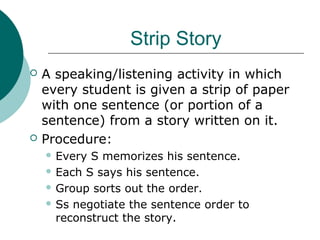
Strip Story
 A speaking/listening activity in which
every student is given a strip of paper
with one sentence (or portion of a
sentence) from a story written on it.
 Procedure:
 Every S memorizes his sentence.
 Each S says his sentence.
 Group sorts out the order.
 Ss negotiate the sentence order to
reconstruct the story.

Assessing reading(1)

  • 1.
  • 2.
    Contents  Reading strategies Types of reading tasks Perceptive Selective Interactive Extensive  Summary  Dictocomp  Strip story
  • 3.
    Reading Strategies (1) Bottom-up processing (decoding) which employs micro-skills Discrimination of graphemes & orthographic patterns Recognition & interpretation of words, word classes, patterns, rules, etc. Cohesive devices Making use of formal schema to decode the written text
  • 4.
    Reading Strategies (2) Top-down processing which employs macro-skills Recognition of rhetorical forms and communicative functions Using background knowledge to make inferences Scanning and skimming, guessing meaning of words from context, activating relevant schemata
  • 5.
    Types of ReadingTasks (1)  Perceptive: Bottom-up processing Decoding letters, words, graphemic symbols, etc. Reading aloud, picture-cued word or sentence identification, etc. (Brown 190-93)
  • 6.
    Types of ReadingTasks (2) o Selective: A combo of bottom-up and top- down processing Formal (lexical and grammatical) aspects of language Formats including multiple-choice, matching, gap-filling
  • 7.
    Types of ReadingTasks (3)  Interactive: Top-down processing (with some instances of bottom-up) More lengthy reading where the reader must interact with the text A process of negotiating meaning Both form-focused and meaning-focused (but more emphasis on meaning comprehension) Cloze, comprehension Qs, editing, short answers, scanning, ordering, info. transfer (graphics interpretation)
  • 8.
    Types of ReadingTasks (4)  Extensive: Top-down processing Global understanding of a text Skimming, summarizing and responding, note-taking and outlining
  • 9.
    Summary  Types ofreading by length (short, medium, long), focus (form and meaning), and process (bottom-up vs. top- down) (see Brown 190)
  • 10.
    Dictocomp  A variationon the traditional dictation procedure T reads while Ss listen carefully Ss write a summary (not word for word as in dictation) Decide scoring criteria (Bailey 151)  Rationale: Meaning-oriented Conveying & capturing meaning = key component of communication
  • 11.
    Communicative Language Teaching Around 1980s  4 principles of communicative lang. test design:  Start from somewhere: assessment should be based on sound theoretical principles  Concentrate on content  Appropriate topics and tasks in terms of the age, proficiency level, interests, and goals of the learners  Bias for best: to elicit best possible performance  E.g., can use a dictionary when writing dictocomp  Work for washback: promote positive washback
  • 12.
    Strip Story  Aspeaking/listening activity in which every student is given a strip of paper with one sentence (or portion of a sentence) from a story written on it.  Procedure:  Every S memorizes his sentence.  Each S says his sentence.  Group sorts out the order.  Ss negotiate the sentence order to reconstruct the story.