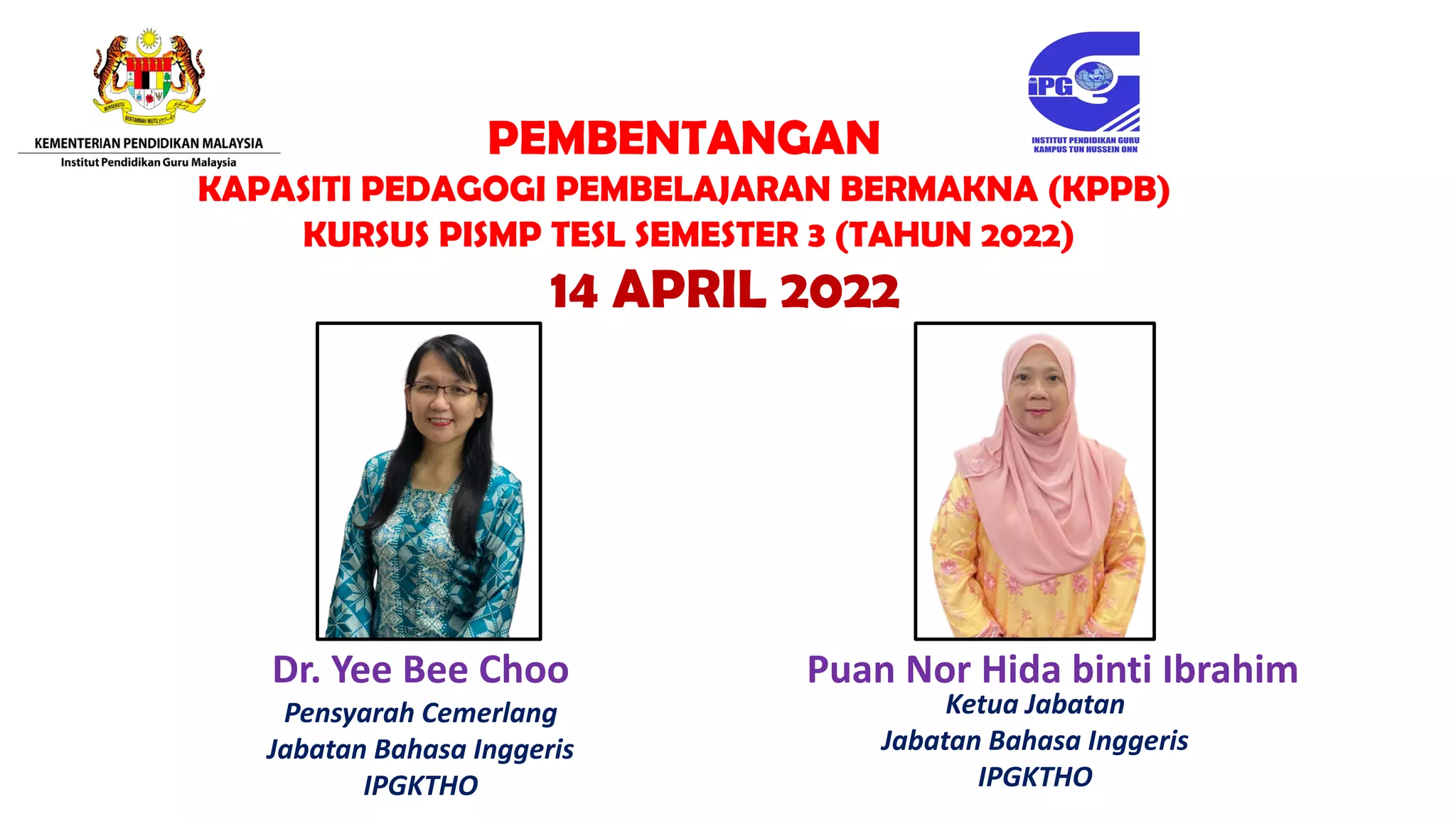
PEMBENTANGAN
KAPASITI PEDAGOGI PEMBELAJARAN BERMAKNA (KPPB)
KURSUS PISMP TESL SEMESTER 3 (TAHUN 2022)
14 APRIL 2022
Puan Nor Hida binti Ibrahim
Dr. Yee Bee Choo
Ketua Jabatan
Jabatan Bahasa Inggeris
IPGKTHO
Pensyarah Cemerlang
Jabatan Bahasa Inggeris
IPGKTHO
PLANNING FOR KPPB
SK PP HP KK
Merungkai dan Merangkai Dokumen
Strategi /
Tugasan
Pembelajaran
Pelan
Pembelajaran
Bermakna
6C 3E
3R
Models
3E: Engagement, Enhancement, Extension
3R: Rigour, Relevance, Relationship
6C: Communication, Collaboration, Critical thinking,
Creativity, Citizenship, Character
B a c k w a r d D e s i g n
SK – Standard Kandungan
PP – Perkembangan Pembelajaran
HP – Hasrat Pembelajaran
KK - Kriteria Kejayaan
TSLB3223
Children’s
Literature
TSLB3052
Arts in Education
TSLB3213
Speech
Communication
INTERDISCIPLINARY COURSES
PISMP Year 1 Semester 3 (TESL) June 2021 intake
Number of Students: 22
No Course Code Course Name Course Coordinator
1 TSLB3052 Arts in Education Dr. Yee Bee Choo
2 TSLB3223 Children’s Literature Dr. Yee Bee Choo
3 TSLB3213 Speech
Communication
Puan Nor Hida binti Ibrahim
COURSE LEARNING OUTCOMES (CLOs)
TSLB3052 TSLB3223 TSLB3213
1. Explain learning theories, basic
concepts and elements of Arts in
Education in the teaching and learning
process with reference to current
resources. (C5, P2, A3, PL01, PLO3,
PLO6, CTPS2, LL1)
2. Apply elements of Arts in Education in
exploring activities, acquiring
experiences, and expression related to
sensory of primary school students (C3,
P4, A4, PL03, CTPS1)
3. Evaluate visual art activities, music and
movements in English language
learning in a written form. (C5, A3,
PLO3, CTPS2)
4. Present arts in education activities
using the performance kit for teaching
and learning of English language in the
primary schools. (C6, P7, A5, PLO2,
PL03, PL05, CTPS4, TS4)
1. Examine different texts and
elements of children’s literature
for young learners (C4, PLO3,
CTPS3)
2. Respond critically in writing to
different literary texts for children.
(C4, PLO3, CTPS4)
3. Present a storytelling performance
incorporating appropriate craft of
storytelling in pairs. (C6, P6, A2,
A5, PLO4, PLO5,CS3,TS4)
4. Write a reflection on the
storytelling performance. (C6, A2,
PLO3, CTPS5)
5. Relate children’s literature to
personal experiences, issues,
challenges and current trends. (C6,
P1, A4, PLO3, CTPS5)
1. Explain the different functions and
elements of verbal and non-verbal
communication. (C5, A3, PLO3, CTPS3)
2. Elaborate ideas in a round table
discussion based on different contexts
using effective communication skills. (C6,
A3, PLO2, PLO4, CS6, TS2)
3. Analyse the different strategies in
managing conflicts of different context in
human communication. (C4, PLO3,
CTPS2)
4. Present a persuasive or informative
speech on any given topic. (C6, A2, PLO4,
PLO6, CS3, LL3)
5. Produce a video recorded speech using
effective communication skills in pairs
(C6, PLO4, PLO5, CS4, TS4)
TSLB3223
Children’s
Literature
TSLB3052
Arts in
Education
TSLB3213
Speech
Communication
2. Apply elements of Arts in Education in exploring activities, acquiring experiences, and
expression related to sensory of primary school students (C3, P4, A4, PL03, CTPS1)
4. Present arts in education activities using the performance kit for teaching and learning of
English language in the primary schools. (C6, P7, A5, PLO2, PL03, PL05, CTPS4, TS4)
5. Produce a video recorded speech using effective
communication skills in pairs (C6, PLO4, PLO5, CS4, TS4)
3. Present a storytelling performance incorporating
appropriate craft of storytelling in pairs. (C6, P6, A2, A5,
PLO4, PLO5,CS3,TS4)
MAPPING OF COURSE LEARNING OUTCOMES (CLOs)
CONTINUOUS ASSESSMENTS
No
Course Code
Course Name Methods of Assessment Percentage KPPB
1 TSLB3052 Arts in Education 1. Critical Review
2. Reflective Report
3. Production of Performance Kit
(Individual)
4. Presentation (Group)
25
20
15
10
ü
ü
2 TSLB3223 Children’s
Literature
1. Reader Response
2. Storytelling performance (Pair
work)
3. Reflective Essay
30
25
15
ü
3 TSLB3123 Speech
Communication
1. Round Table Discussion
2. Oral Presentation
3. Project (Pair work): Produce a 10
minute video recorded
10
30
20 ü
TSLB3223
Children’s
Literature
TSLB3052
Arts in
Education
TSLB3213
Speech
Communication
Task 3 (15%): Production of Performance Kit (Individual)
Task 4 (10%): Presentation (Group)
Task 3 (20%): Project (Pair Work):
Produce a 10-minute video recorded
Task 2 (25%): Storytelling
Performance (Pair Work)
MAPPING OF CONTINUOUS ASSESSMENT
TSLB3052
1. Children, Sense and Arts
2. Exploratory based activities, obtaining
experiences and expression through art
3. Application and Management of Arts in
Education activities in teaching and learning
KNOWLEDGE
1. Apply
2. Present
SKILLS
01
1.Craft of Storytelling
2.Storytelling Performance
KNOWLEDGE
1.Present
2.Write
SKILLS
02
1.Human Communication
2.Elements in Speech Communication
KNOWLEDGE
03
TSLB3223
TSLB3213
KNOWLEDGE AND SKILLS
1.Elaborate
2.Produce
SKILLS
BIG IDEA
Painting life with the
art of teaching
TSLB3052
TSLB3223
TSLB3213
EQ1: How do you teach arts in
education to young learners?
EQ2: Why is arts in education
important in teaching and
learning?
EQ1: How do you
communicate with young
learners?
EQ2: Why is human
communication important
in teaching and learning?
EQ1: How do you deliver
an effective storytelling?
EQ2: Why is storytelling
important in teaching and
learning?
BIG IDEA AND ESSENTIAL QUESTIONS (EQs)
TSLB3223
Children’s
Literature
TSLB3052
Arts in
Education
TSLB3213
Speech
Communication
1. A performance kit of materials and activities that integrate the visual arts,
music and movement in teaching English in the primary school.
2. A video of presentation on using the performance kit.
A 10-minute video of persuasive speech for oral presentation
using the elements in speech communication process, such as
speaker, message, channel, listeners/receivers, feedback and
situation/context of communication.
A video of storytelling performance incorporating
appropriate craft of storytelling in pairs.
ASSESSMENTS AND EVIDENCES
TSLB3223
Children’s
Literature
TSLB3052
Arts in Education
TSLB3213
Speech
Communication
ASSESSMENTS AND EVIDENCES
TSLB3213
Project 20%
TSLB3052
Performance Kit
Presentation
15%
10%
TSLB3223
Storytelling
Performance
25%
Evidences:
1. Storytelling script
2. Checklist
3. Recorded video
Evidences:
1. Performance kit
2. Checklist
3. Recorded video
Evidences:
1. Speech outline
2. Checklist
3. Recorded video
COURSE FEBRUARY MARCH APRIL MAY
TSLB3213
6 February
Beginning of
the semester
TSLB3052
TSLB3223
TIMELINE FOR CONTINUOUS ASSESSMENT
Project
13 – 26 Mac
(14 days)
Performance Kit
14 – 21 April
(8 days)
Presentation
5 – 10 May
(6 days)
Storytelling
Performance
21 April – 5 May
(15 days)
LEARNING PLAN (PELAN PEMBELAJARAN)
W (WHERE) Lead learners to know where they are headed, why they are
going there, and what ways they will be evaluated along the way.
H (HOOK) Hook and hold learners’ interest and enthusiasm through thought provoking
experiences at the beginning of each instruction by using technology and digital
tools to attract interests.
E (EQUIP) Equip learners for success in learning that they explore more ideas by using
Library Search or Google Search.
R (RETHINK) Help learners reflect, revisit, revise, and rethink their understanding through
discussion and reflective writing.
E (EVALUATE) Engage in self-evaluation by using checklist and writing reflective journal.
T (TAILORED) Tailor (differentiate) the instruction to address the unique strengths and needs of
every learner.
O (ORGANIZED) Organise learning so that learners move from teacher-guided and concrete
activities to independent applications that emphasise growing conceptual
understandings as opposed to superficial coverage
PLANNING OF KPPB
1. Discussion with the JU KPPB IPGKTHO, Mr Lim Sing Poh, and
the lecturers involved in the intradisciplinary courses
2. Unpack the curriculum for the 3 courses
1
2
IMPLEMENTATION OF KPPB
1. Webinar on KPPB concepts and use of digital tools in
video and graphic forms
2. Explanation on the KPPB concepts to the students
1 2
APPLICATION OF THE KPPB MODEL (6C)
1. Communication &
Collaboration
2. Critical Thinking &
Creativity
3. Citizenship &
Character
1
2
3
USE OF DIGITAL TOOLS
1. Google Classroom
2. Google Site
3. Audio recording
4. ibis Paint X
5. YouTube
1
2
3
4
5
LEARNING PARTNERSHIP
1. Learning partner: Pn Zaharah, the music lecturer
at IPGKTHO
2. Learning partner: Dr. Corrienna, lecturer from
UTM
1
2
KPPB Lecturer’s Presentation:
https://youtu.be/EZgByVtMkhQ
KPPB Showcase Students’ Presentation:
https://www.youtube.com/watch?v=7HpBbGPHbIk
Google Site Materials:
https://sites.google.com/epembelajaran.edu.my/kppb-
pismp-tesl-2022/home
RELATED MATERIALS

KPPB IPGKTHO LECTURER’S PRESENTATION (TESL PISMP S3 2022).pdf

  • 1.
    PEMBENTANGAN KAPASITI PEDAGOGI PEMBELAJARANBERMAKNA (KPPB) KURSUS PISMP TESL SEMESTER 3 (TAHUN 2022) 14 APRIL 2022 Puan Nor Hida binti Ibrahim Dr. Yee Bee Choo Ketua Jabatan Jabatan Bahasa Inggeris IPGKTHO Pensyarah Cemerlang Jabatan Bahasa Inggeris IPGKTHO
  • 2.
    PLANNING FOR KPPB SKPP HP KK Merungkai dan Merangkai Dokumen Strategi / Tugasan Pembelajaran Pelan Pembelajaran Bermakna 6C 3E 3R Models 3E: Engagement, Enhancement, Extension 3R: Rigour, Relevance, Relationship 6C: Communication, Collaboration, Critical thinking, Creativity, Citizenship, Character B a c k w a r d D e s i g n SK – Standard Kandungan PP – Perkembangan Pembelajaran HP – Hasrat Pembelajaran KK - Kriteria Kejayaan
  • 3.
    TSLB3223 Children’s Literature TSLB3052 Arts in Education TSLB3213 Speech Communication INTERDISCIPLINARYCOURSES PISMP Year 1 Semester 3 (TESL) June 2021 intake Number of Students: 22 No Course Code Course Name Course Coordinator 1 TSLB3052 Arts in Education Dr. Yee Bee Choo 2 TSLB3223 Children’s Literature Dr. Yee Bee Choo 3 TSLB3213 Speech Communication Puan Nor Hida binti Ibrahim
  • 4.
    COURSE LEARNING OUTCOMES(CLOs) TSLB3052 TSLB3223 TSLB3213 1. Explain learning theories, basic concepts and elements of Arts in Education in the teaching and learning process with reference to current resources. (C5, P2, A3, PL01, PLO3, PLO6, CTPS2, LL1) 2. Apply elements of Arts in Education in exploring activities, acquiring experiences, and expression related to sensory of primary school students (C3, P4, A4, PL03, CTPS1) 3. Evaluate visual art activities, music and movements in English language learning in a written form. (C5, A3, PLO3, CTPS2) 4. Present arts in education activities using the performance kit for teaching and learning of English language in the primary schools. (C6, P7, A5, PLO2, PL03, PL05, CTPS4, TS4) 1. Examine different texts and elements of children’s literature for young learners (C4, PLO3, CTPS3) 2. Respond critically in writing to different literary texts for children. (C4, PLO3, CTPS4) 3. Present a storytelling performance incorporating appropriate craft of storytelling in pairs. (C6, P6, A2, A5, PLO4, PLO5,CS3,TS4) 4. Write a reflection on the storytelling performance. (C6, A2, PLO3, CTPS5) 5. Relate children’s literature to personal experiences, issues, challenges and current trends. (C6, P1, A4, PLO3, CTPS5) 1. Explain the different functions and elements of verbal and non-verbal communication. (C5, A3, PLO3, CTPS3) 2. Elaborate ideas in a round table discussion based on different contexts using effective communication skills. (C6, A3, PLO2, PLO4, CS6, TS2) 3. Analyse the different strategies in managing conflicts of different context in human communication. (C4, PLO3, CTPS2) 4. Present a persuasive or informative speech on any given topic. (C6, A2, PLO4, PLO6, CS3, LL3) 5. Produce a video recorded speech using effective communication skills in pairs (C6, PLO4, PLO5, CS4, TS4)
  • 5.
    TSLB3223 Children’s Literature TSLB3052 Arts in Education TSLB3213 Speech Communication 2. Applyelements of Arts in Education in exploring activities, acquiring experiences, and expression related to sensory of primary school students (C3, P4, A4, PL03, CTPS1) 4. Present arts in education activities using the performance kit for teaching and learning of English language in the primary schools. (C6, P7, A5, PLO2, PL03, PL05, CTPS4, TS4) 5. Produce a video recorded speech using effective communication skills in pairs (C6, PLO4, PLO5, CS4, TS4) 3. Present a storytelling performance incorporating appropriate craft of storytelling in pairs. (C6, P6, A2, A5, PLO4, PLO5,CS3,TS4) MAPPING OF COURSE LEARNING OUTCOMES (CLOs)
  • 6.
    CONTINUOUS ASSESSMENTS No Course Code CourseName Methods of Assessment Percentage KPPB 1 TSLB3052 Arts in Education 1. Critical Review 2. Reflective Report 3. Production of Performance Kit (Individual) 4. Presentation (Group) 25 20 15 10 ü ü 2 TSLB3223 Children’s Literature 1. Reader Response 2. Storytelling performance (Pair work) 3. Reflective Essay 30 25 15 ü 3 TSLB3123 Speech Communication 1. Round Table Discussion 2. Oral Presentation 3. Project (Pair work): Produce a 10 minute video recorded 10 30 20 ü
  • 7.
    TSLB3223 Children’s Literature TSLB3052 Arts in Education TSLB3213 Speech Communication Task 3(15%): Production of Performance Kit (Individual) Task 4 (10%): Presentation (Group) Task 3 (20%): Project (Pair Work): Produce a 10-minute video recorded Task 2 (25%): Storytelling Performance (Pair Work) MAPPING OF CONTINUOUS ASSESSMENT
  • 8.
    TSLB3052 1. Children, Senseand Arts 2. Exploratory based activities, obtaining experiences and expression through art 3. Application and Management of Arts in Education activities in teaching and learning KNOWLEDGE 1. Apply 2. Present SKILLS 01 1.Craft of Storytelling 2.Storytelling Performance KNOWLEDGE 1.Present 2.Write SKILLS 02 1.Human Communication 2.Elements in Speech Communication KNOWLEDGE 03 TSLB3223 TSLB3213 KNOWLEDGE AND SKILLS 1.Elaborate 2.Produce SKILLS
  • 9.
    BIG IDEA Painting lifewith the art of teaching TSLB3052 TSLB3223 TSLB3213 EQ1: How do you teach arts in education to young learners? EQ2: Why is arts in education important in teaching and learning? EQ1: How do you communicate with young learners? EQ2: Why is human communication important in teaching and learning? EQ1: How do you deliver an effective storytelling? EQ2: Why is storytelling important in teaching and learning? BIG IDEA AND ESSENTIAL QUESTIONS (EQs)
  • 10.
    TSLB3223 Children’s Literature TSLB3052 Arts in Education TSLB3213 Speech Communication 1. Aperformance kit of materials and activities that integrate the visual arts, music and movement in teaching English in the primary school. 2. A video of presentation on using the performance kit. A 10-minute video of persuasive speech for oral presentation using the elements in speech communication process, such as speaker, message, channel, listeners/receivers, feedback and situation/context of communication. A video of storytelling performance incorporating appropriate craft of storytelling in pairs. ASSESSMENTS AND EVIDENCES
  • 11.
    TSLB3223 Children’s Literature TSLB3052 Arts in Education TSLB3213 Speech Communication ASSESSMENTSAND EVIDENCES TSLB3213 Project 20% TSLB3052 Performance Kit Presentation 15% 10% TSLB3223 Storytelling Performance 25% Evidences: 1. Storytelling script 2. Checklist 3. Recorded video Evidences: 1. Performance kit 2. Checklist 3. Recorded video Evidences: 1. Speech outline 2. Checklist 3. Recorded video
  • 12.
    COURSE FEBRUARY MARCHAPRIL MAY TSLB3213 6 February Beginning of the semester TSLB3052 TSLB3223 TIMELINE FOR CONTINUOUS ASSESSMENT Project 13 – 26 Mac (14 days) Performance Kit 14 – 21 April (8 days) Presentation 5 – 10 May (6 days) Storytelling Performance 21 April – 5 May (15 days)
  • 13.
    LEARNING PLAN (PELANPEMBELAJARAN) W (WHERE) Lead learners to know where they are headed, why they are going there, and what ways they will be evaluated along the way. H (HOOK) Hook and hold learners’ interest and enthusiasm through thought provoking experiences at the beginning of each instruction by using technology and digital tools to attract interests. E (EQUIP) Equip learners for success in learning that they explore more ideas by using Library Search or Google Search. R (RETHINK) Help learners reflect, revisit, revise, and rethink their understanding through discussion and reflective writing. E (EVALUATE) Engage in self-evaluation by using checklist and writing reflective journal. T (TAILORED) Tailor (differentiate) the instruction to address the unique strengths and needs of every learner. O (ORGANIZED) Organise learning so that learners move from teacher-guided and concrete activities to independent applications that emphasise growing conceptual understandings as opposed to superficial coverage
  • 14.
    PLANNING OF KPPB 1.Discussion with the JU KPPB IPGKTHO, Mr Lim Sing Poh, and the lecturers involved in the intradisciplinary courses 2. Unpack the curriculum for the 3 courses 1 2
  • 15.
    IMPLEMENTATION OF KPPB 1.Webinar on KPPB concepts and use of digital tools in video and graphic forms 2. Explanation on the KPPB concepts to the students 1 2
  • 16.
    APPLICATION OF THEKPPB MODEL (6C) 1. Communication & Collaboration 2. Critical Thinking & Creativity 3. Citizenship & Character 1 2 3
  • 17.
    USE OF DIGITALTOOLS 1. Google Classroom 2. Google Site 3. Audio recording 4. ibis Paint X 5. YouTube 1 2 3 4 5
  • 18.
    LEARNING PARTNERSHIP 1. Learningpartner: Pn Zaharah, the music lecturer at IPGKTHO 2. Learning partner: Dr. Corrienna, lecturer from UTM 1 2
  • 20.
    KPPB Lecturer’s Presentation: https://youtu.be/EZgByVtMkhQ KPPBShowcase Students’ Presentation: https://www.youtube.com/watch?v=7HpBbGPHbIk Google Site Materials: https://sites.google.com/epembelajaran.edu.my/kppb- pismp-tesl-2022/home RELATED MATERIALS