República Bolivariana de Venezuela Universidad Pedagógica Experimental Libertador Instituto Pedagógico de Caracas Maestría en Enseñanza del Inglés como Lengua Extranjera Estrategias de Evaluación 07/25/11 Authors: Maite Sangroniz  María Aurora Ovalles  Nairuby Mata,  Professor: Rosa Virguez de Olivo
Assessing  Speaking Authors: Maite Sangroniz  María Aurora Ovalles  Nairuby Mata,  Professor: Rosa Virguez de Olivo June, 2011
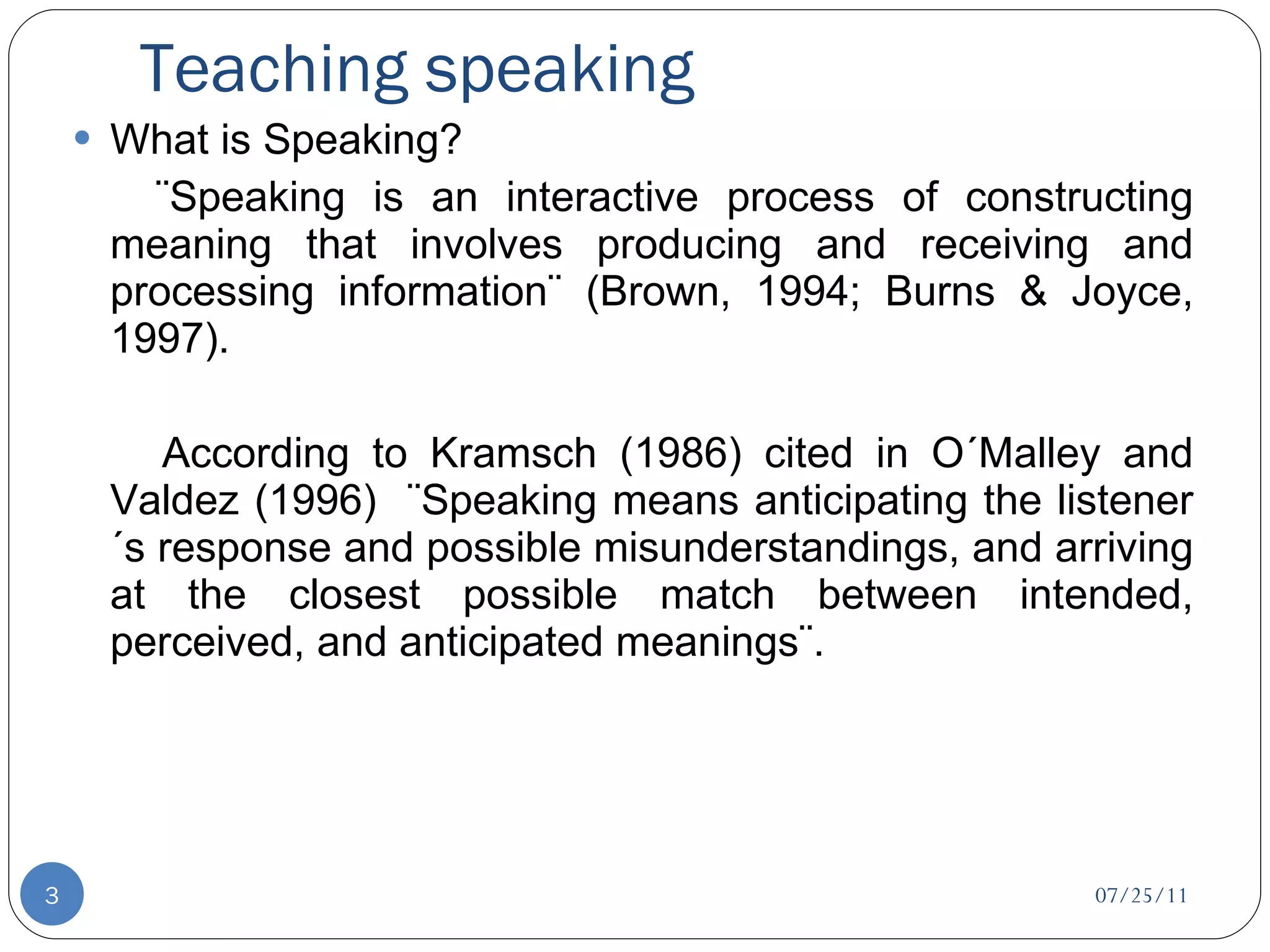
Teaching speaking What is Speaking? ¨Speaking is an interactive process of constructing meaning that involves producing and receiving and processing information¨ (Brown, 1994; Burns & Joyce, 1997).   According to Kramsch (1986) cited in O´Malley and Valdez (1996)  ¨Speaking means anticipating the listener´s response and possible misunderstandings, and arriving at the closest possible match between intended, perceived, and anticipated meanings¨. 07/25/11
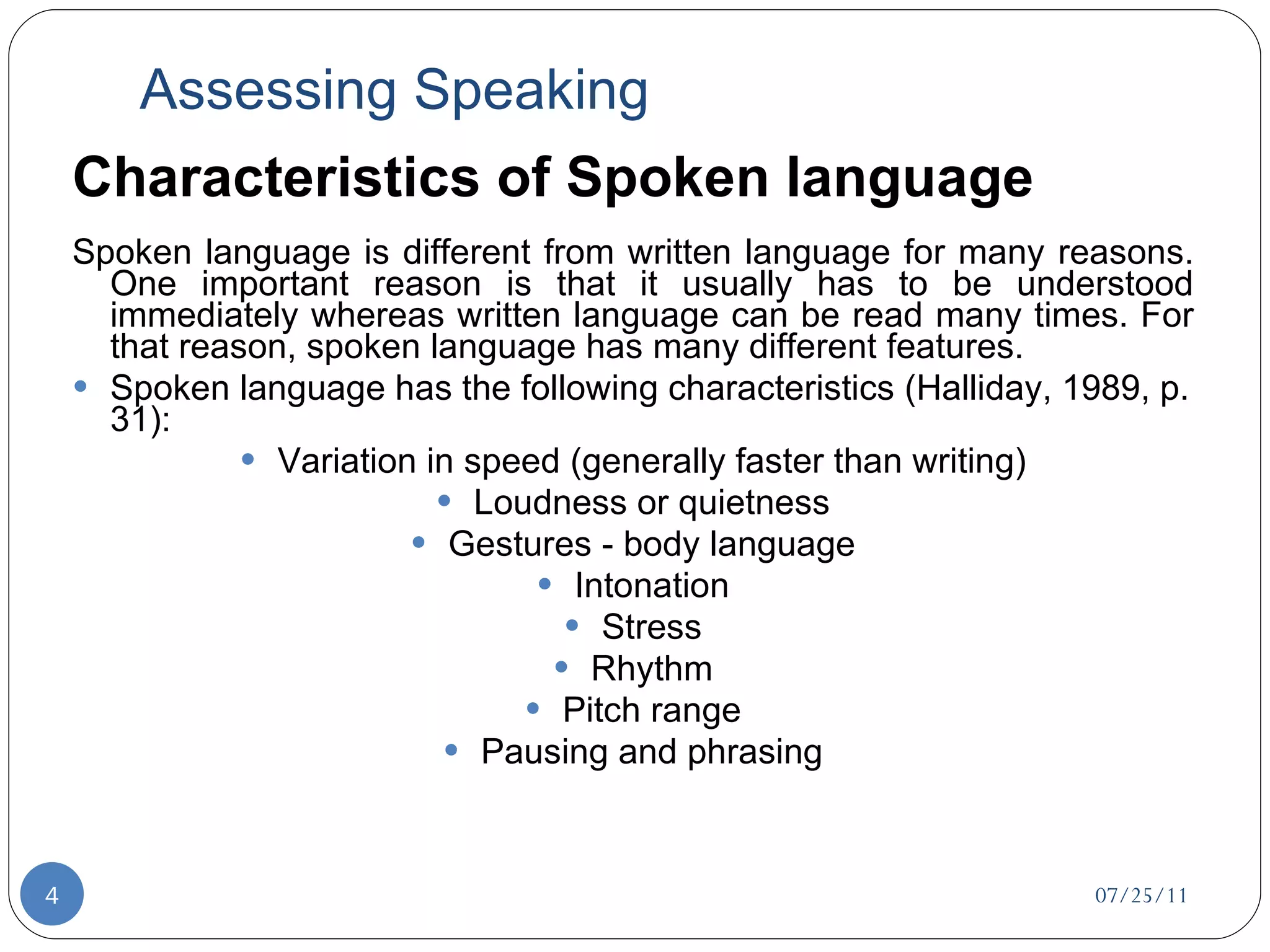
Assessing Speaking Characteristics of Spoken language Spoken language is different from written language for many reasons. One important reason is that it usually has to be understood immediately whereas written language can be read many times. For that reason, spoken language has many different features. Spoken language has the following characteristics (Halliday, 1989, p. 31): Variation in speed (generally faster than writing) Loudness or quietness Gestures - body language Intonation Stress Rhythm Pitch range Pausing and phrasing 07/25/11
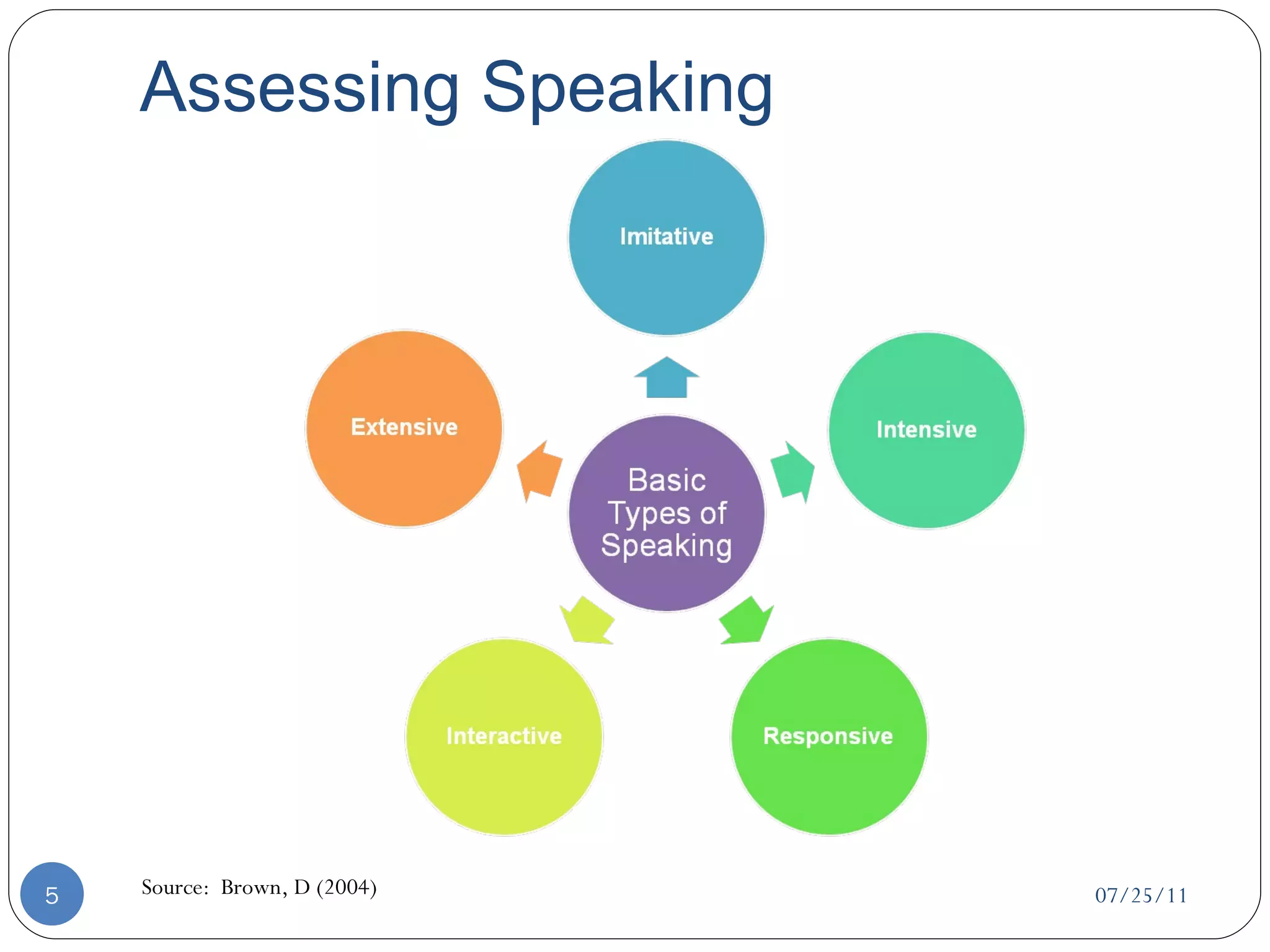
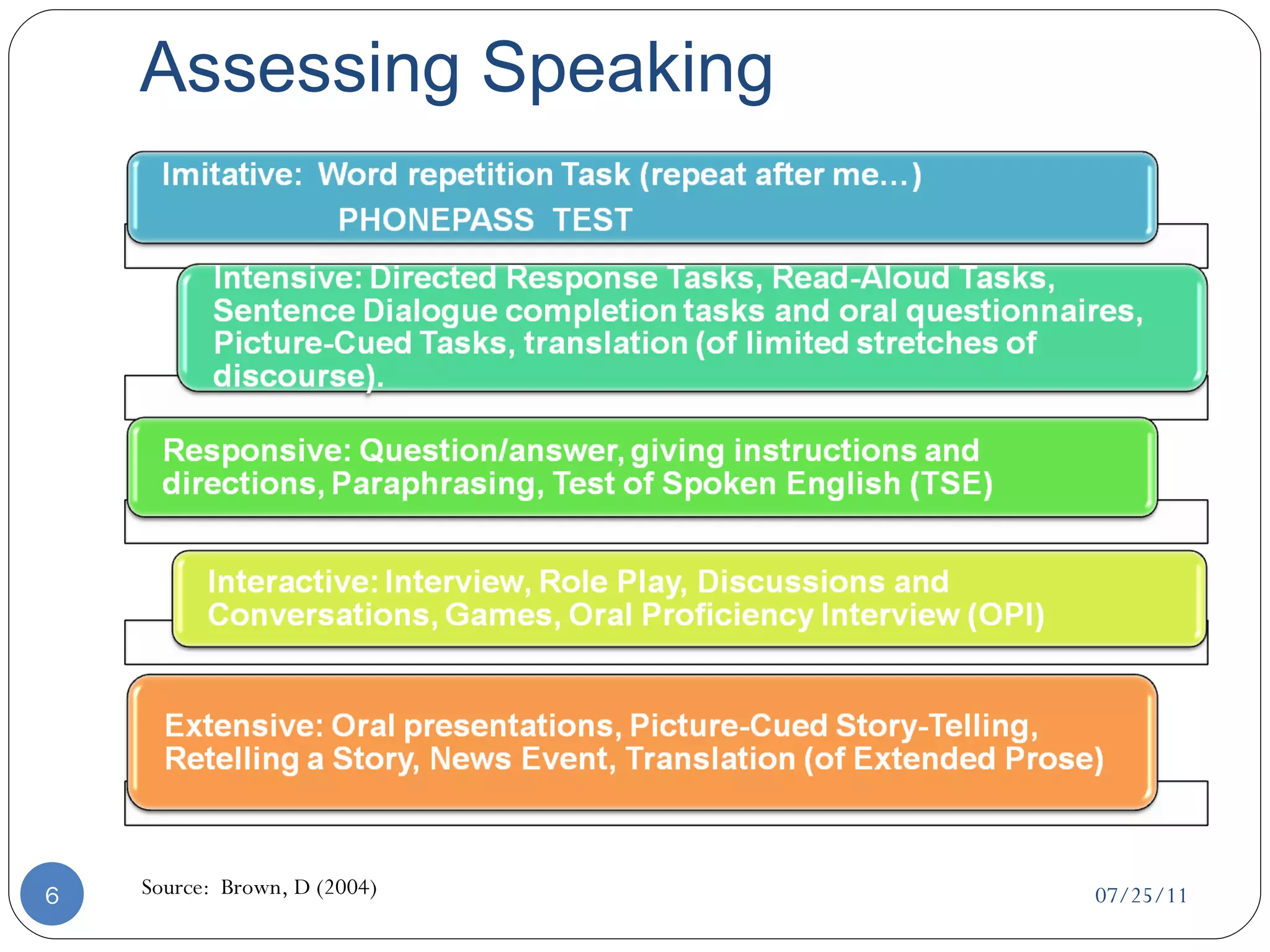
Assessing Speaking 07/25/11 Source:  Brown, D (2004)
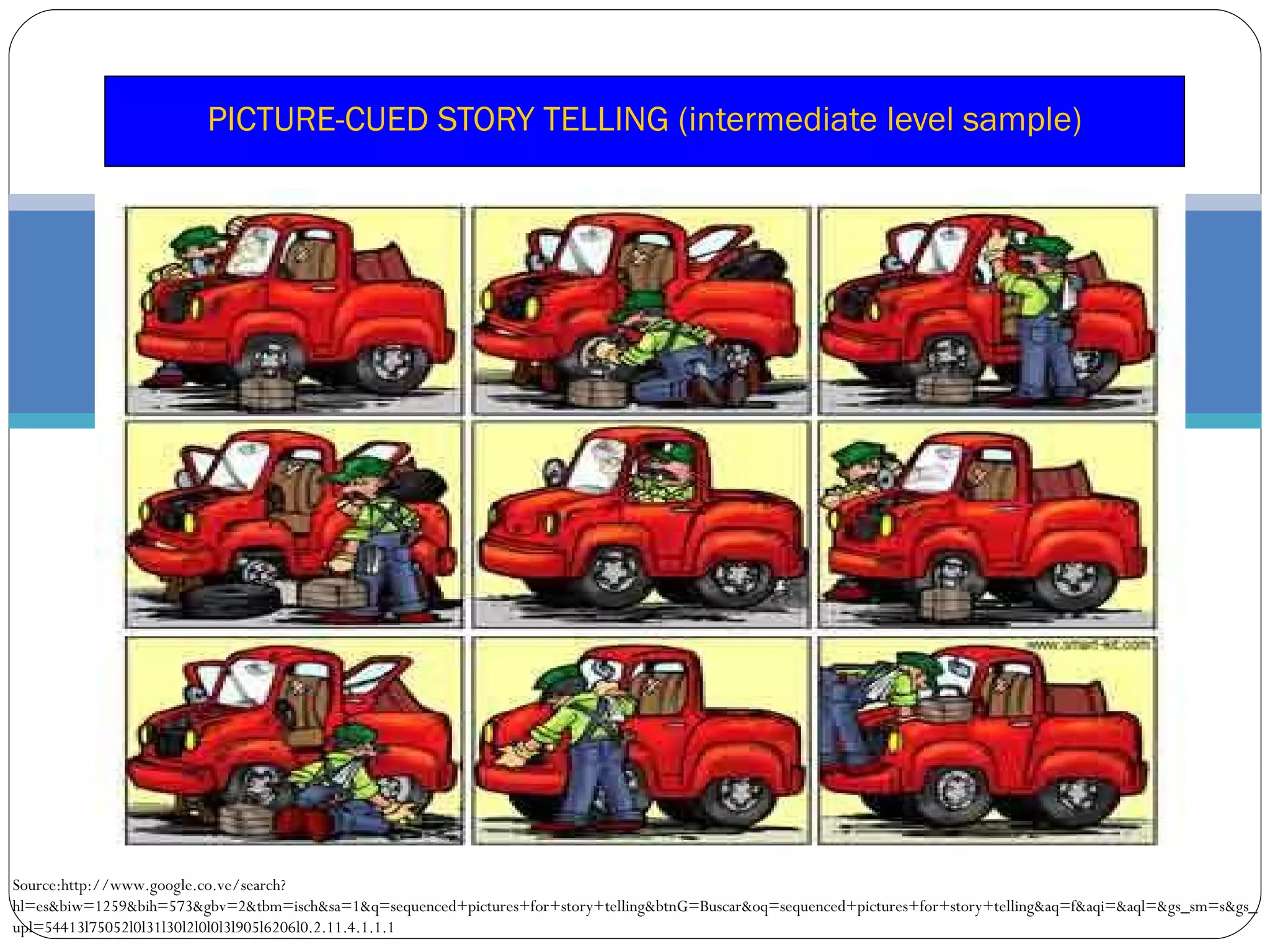
PICTURE-CUED STORY TELLING (intermediate level sample) Source:http://www.google.co.ve/search?hl=es&biw=1259&bih=573&gbv=2&tbm=isch&sa=1&q=sequenced+pictures+for+story+telling&btnG=Buscar&oq=sequenced+pictures+for+story+telling&aq=f&aqi=&aql=&gs_sm=s&gs_upl=54413l75052l0l31l30l2l0l0l3l905l6206l0.2.11.4.1.1.1
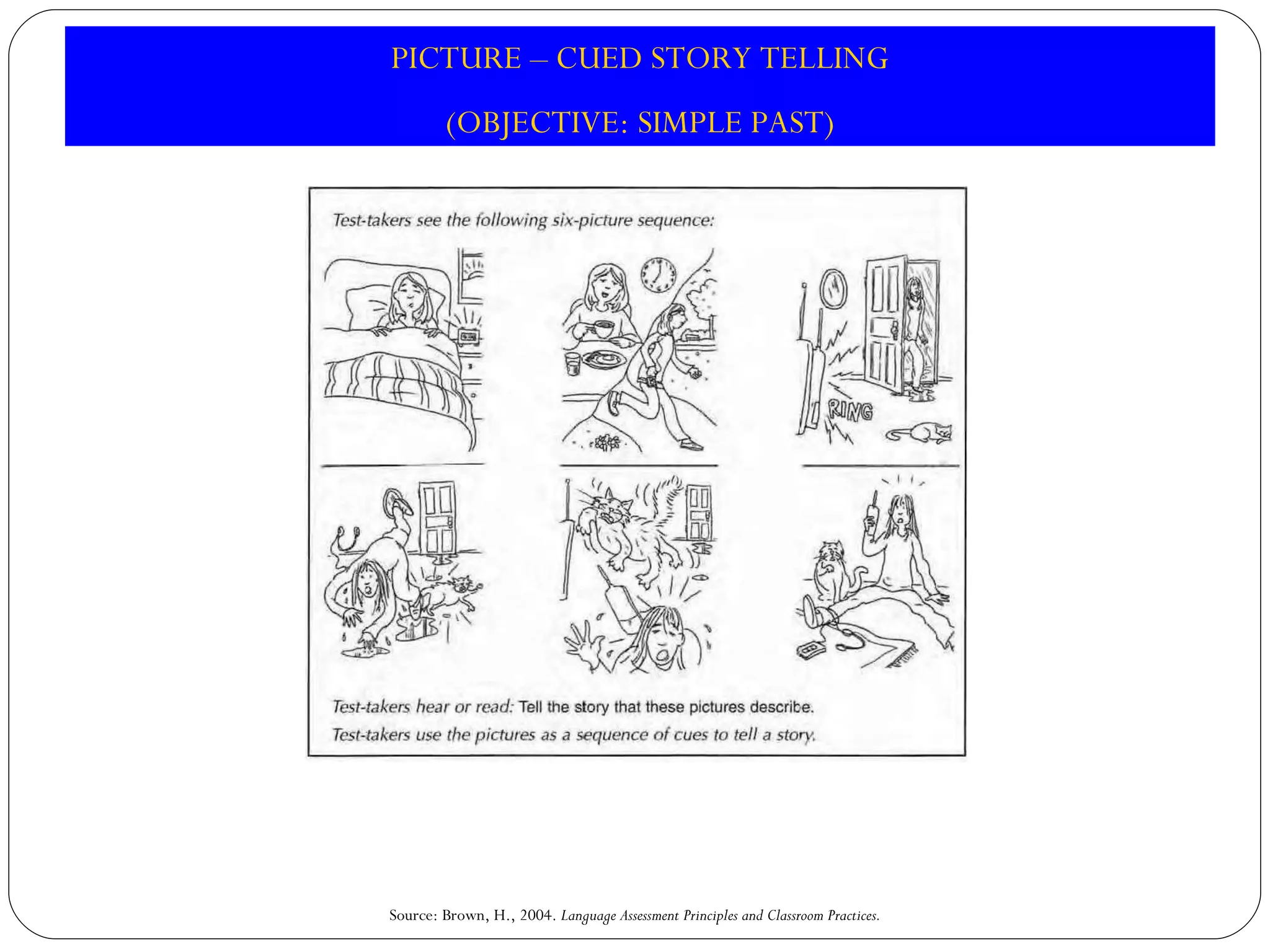
Source: Brown, H., 2004.  Language Assessment Principles and Classroom Practices. PICTURE – CUED STORY TELLING (OBJECTIVE: SIMPLE PAST)
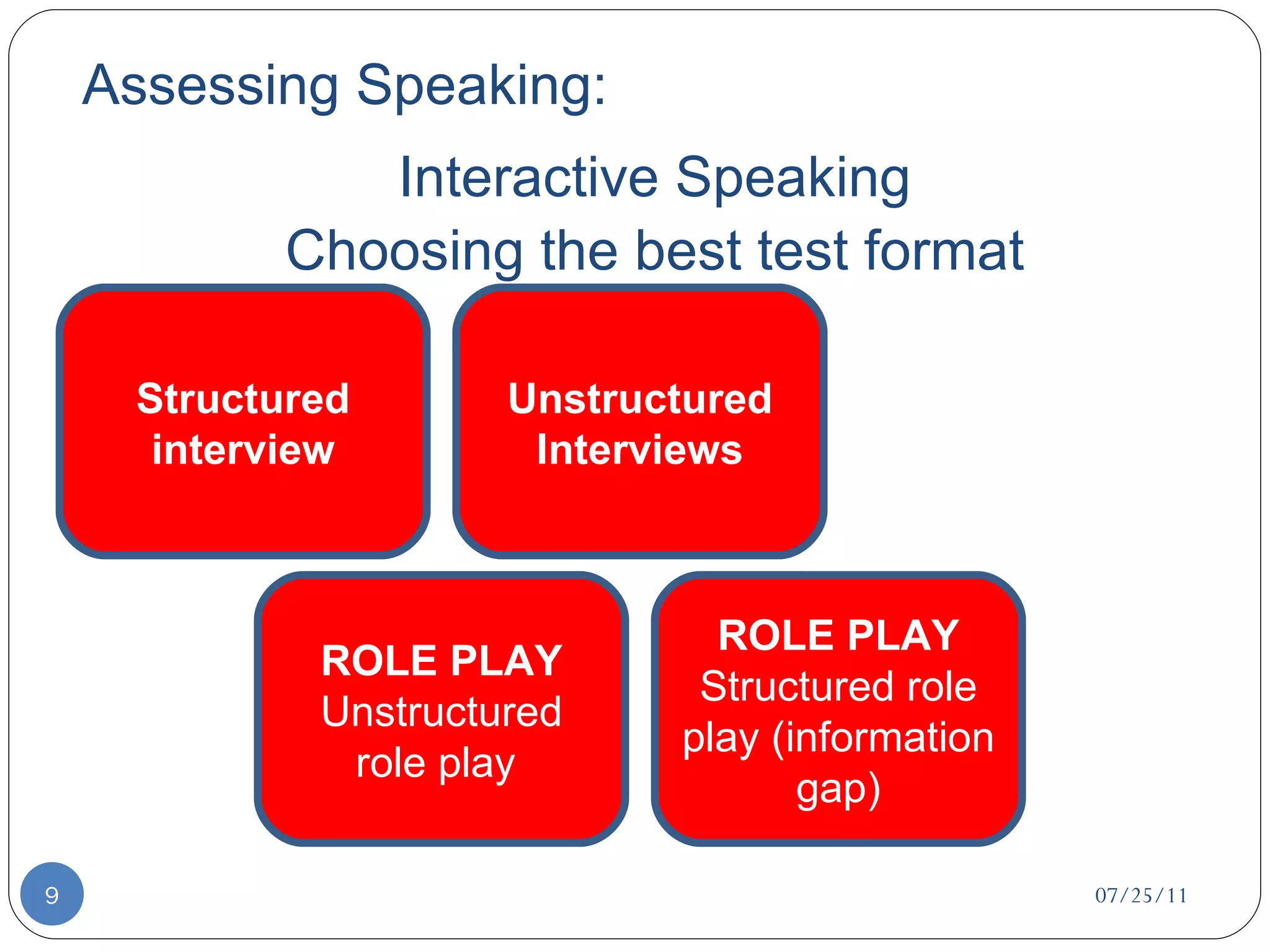
Assessing Speaking: Interactive Speaking Choosing the best test format 07/25/11 ROLE PLAY Structured role play (information gap) Structured interview Unstructured Interviews ROLE PLAY Unstructured role play
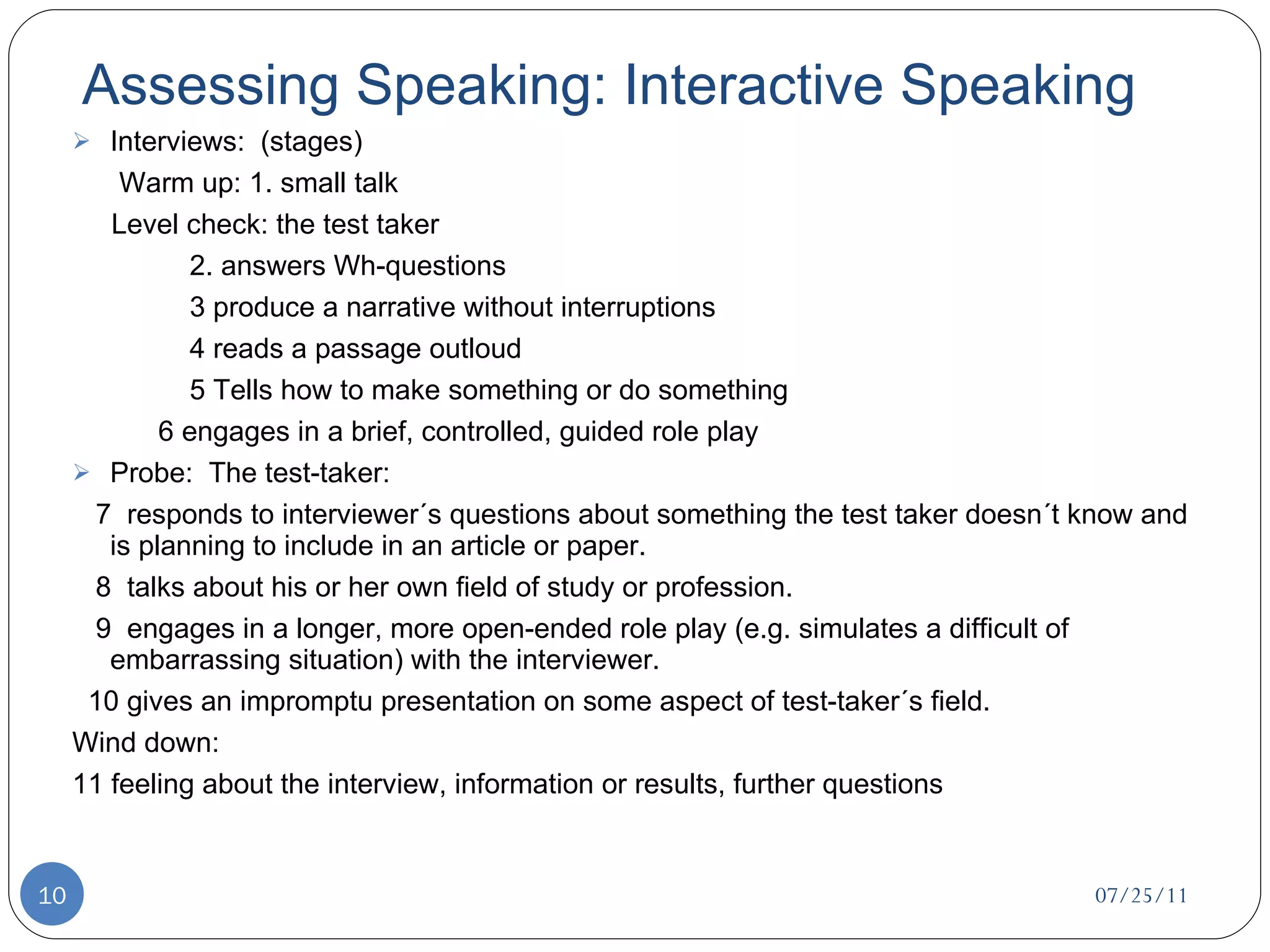
Assessing Speaking: Interactive Speaking Interviews:  (stages) Warm up: 1. small talk Level check: the test taker  2. answers Wh-questions 3 produce a narrative without interruptions 4 reads a passage outloud 5 Tells how to make something or do something 6 engages in a brief, controlled, guided role play Probe:  The test-taker: 7  responds to interviewer´s questions about something the test taker doesn´t know and is planning to include in an article or paper. 8  talks about his or her own field of study or profession. 9  engages in a longer, more open-ended role play (e.g. simulates a difficult of embarrassing situation) with the interviewer. 10 gives an impromptu presentation on some aspect of test-taker´s field. Wind down: 11 feeling about the interview, information or results, further questions 07/25/11
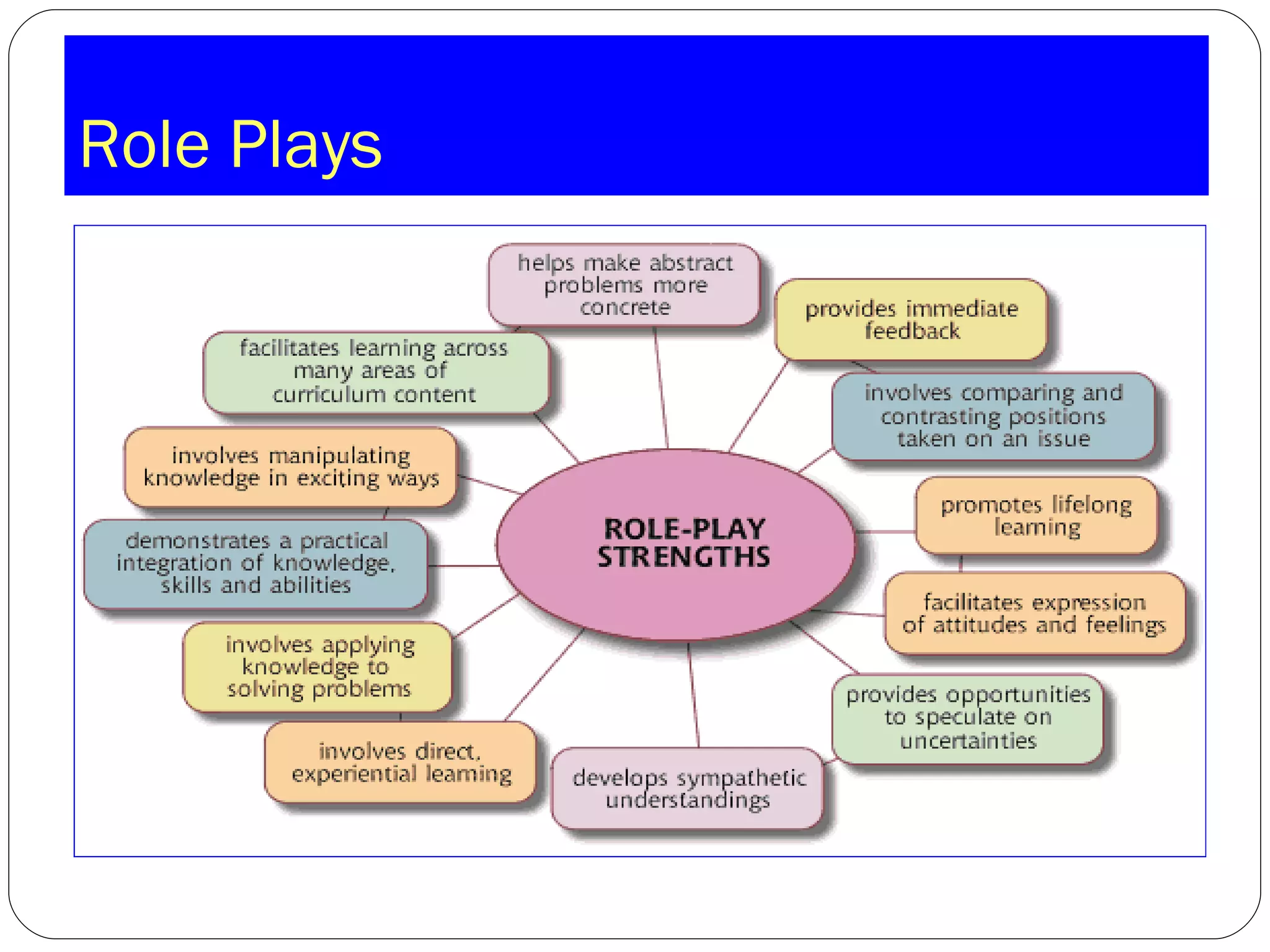
Role Plays
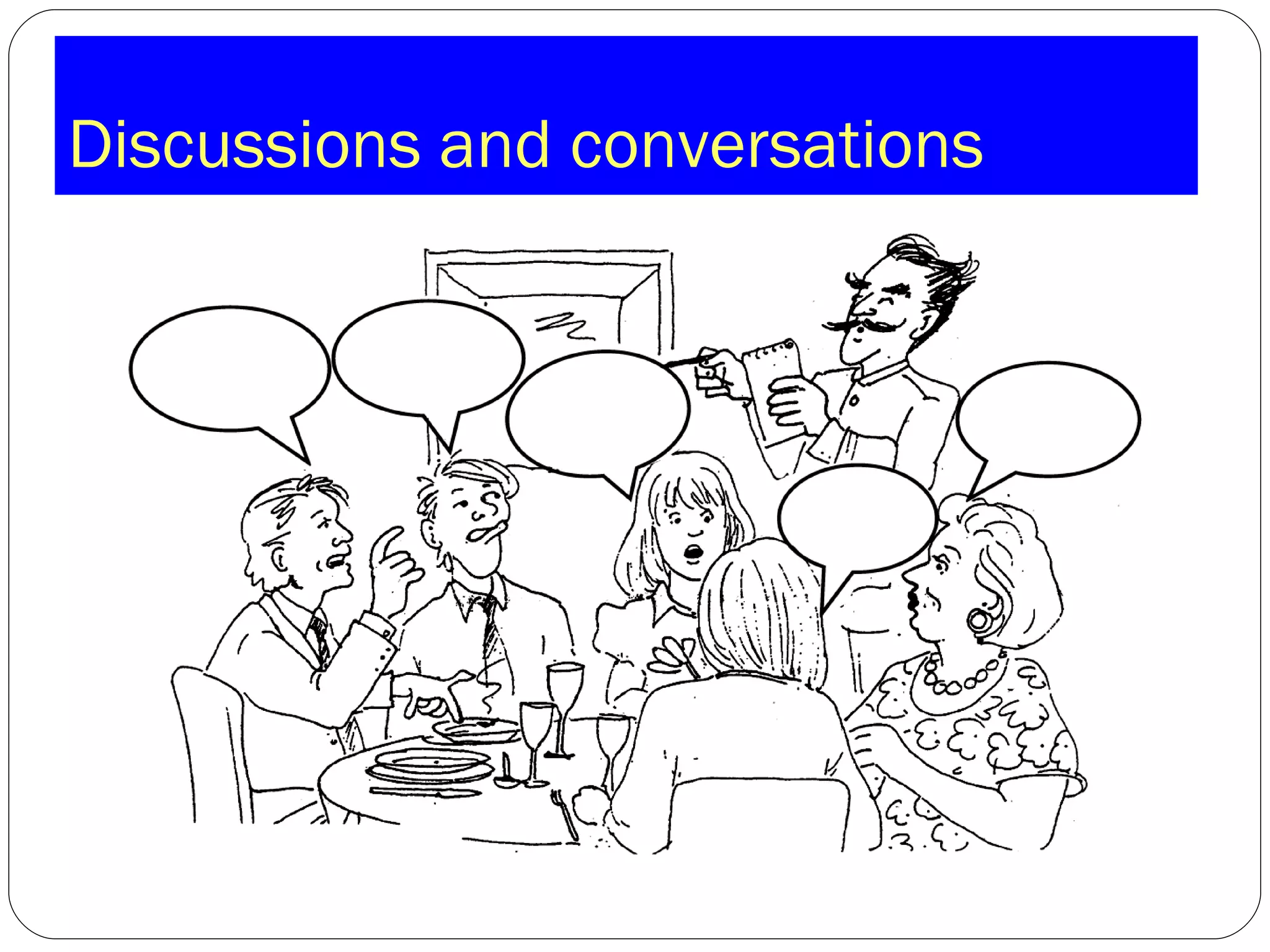
Discussions and conversations
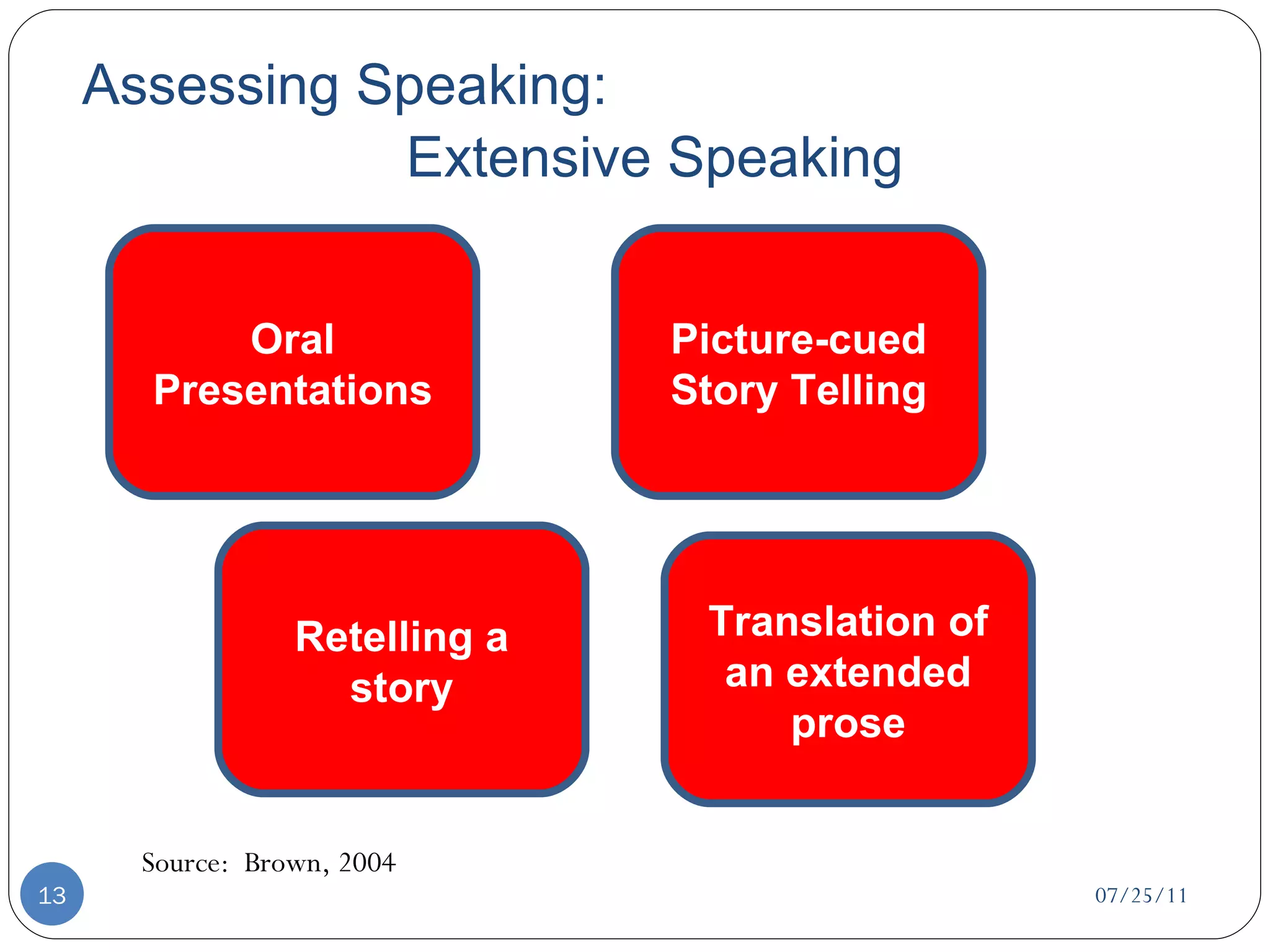
Assessing Speaking: Extensive Speaking 07/25/11 Translation of an extended prose Oral Presentations Picture-cued Story Telling Retelling a story Source:  Brown, 2004
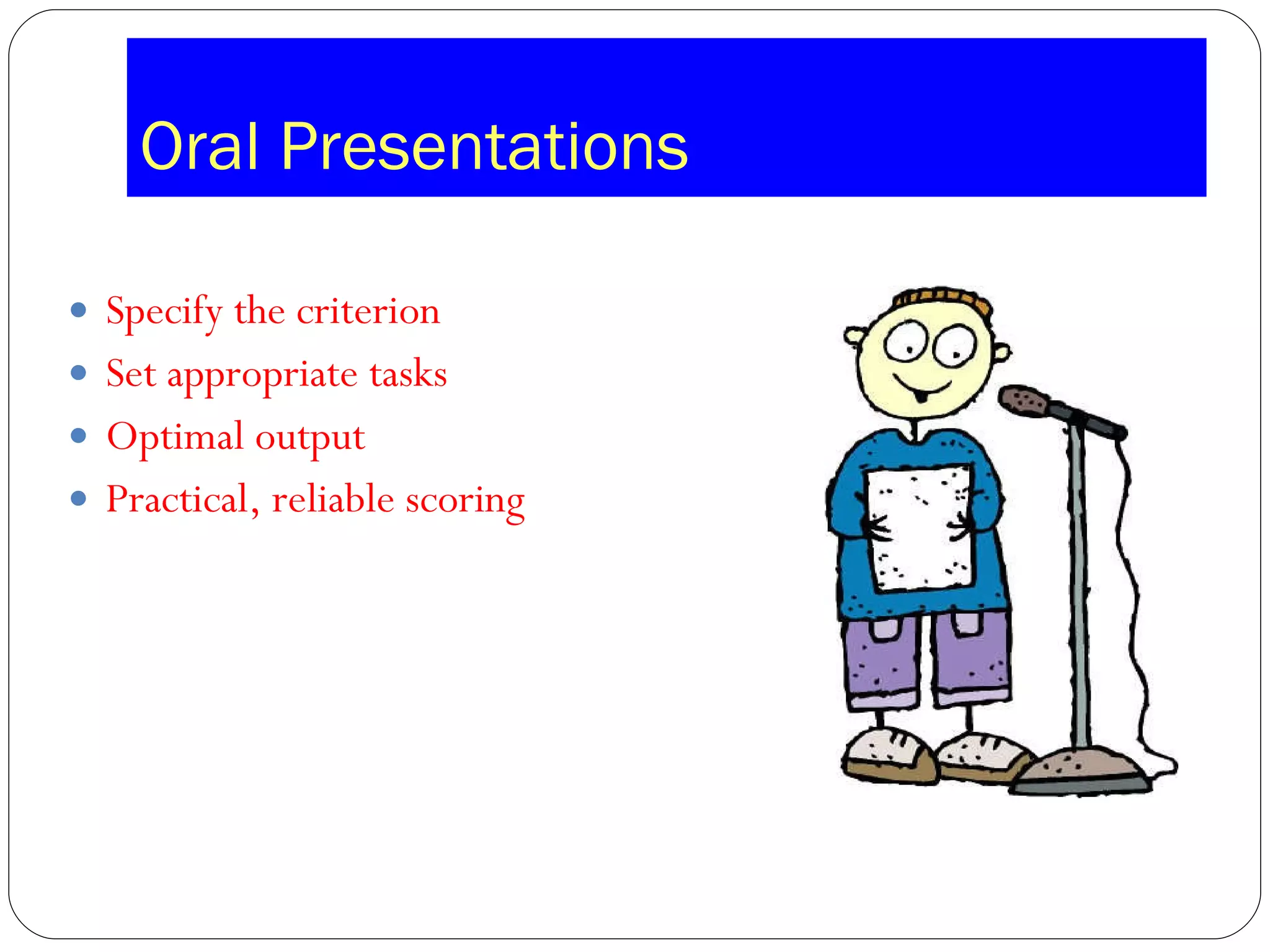
Oral Presentations Specify the criterion Set appropriate tasks Optimal output Practical, reliable scoring
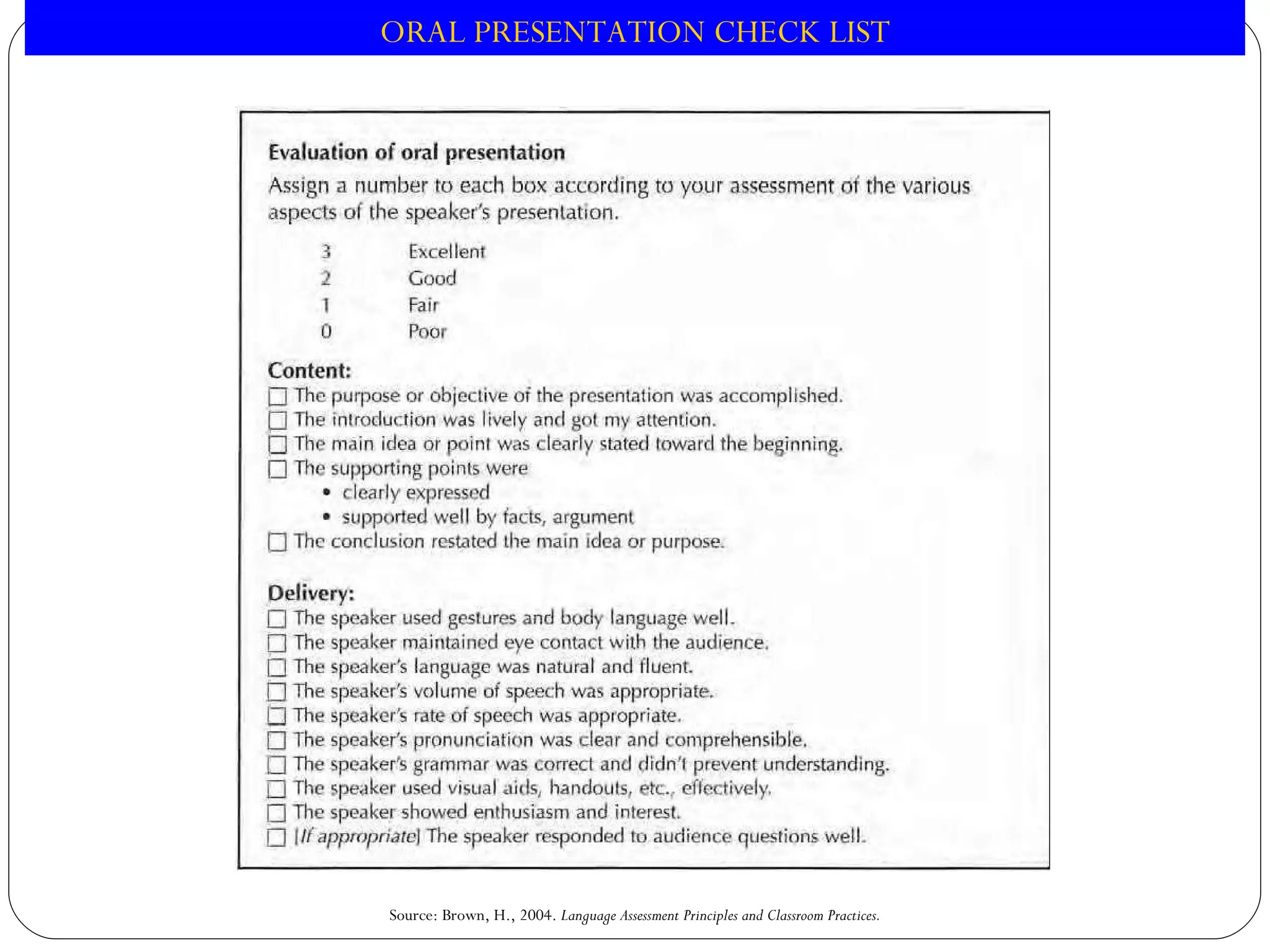
Source: Brown, H., 2004.  Language Assessment Principles and Classroom Practices. ORAL PRESENTATION CHECK LIST
Conclusions Speaking assessment is very difficult. It is important to determine what criteria to use to assess whether accuracy or fluency.  Such criteria can be based upon created models or adapted ones. 07/25/11
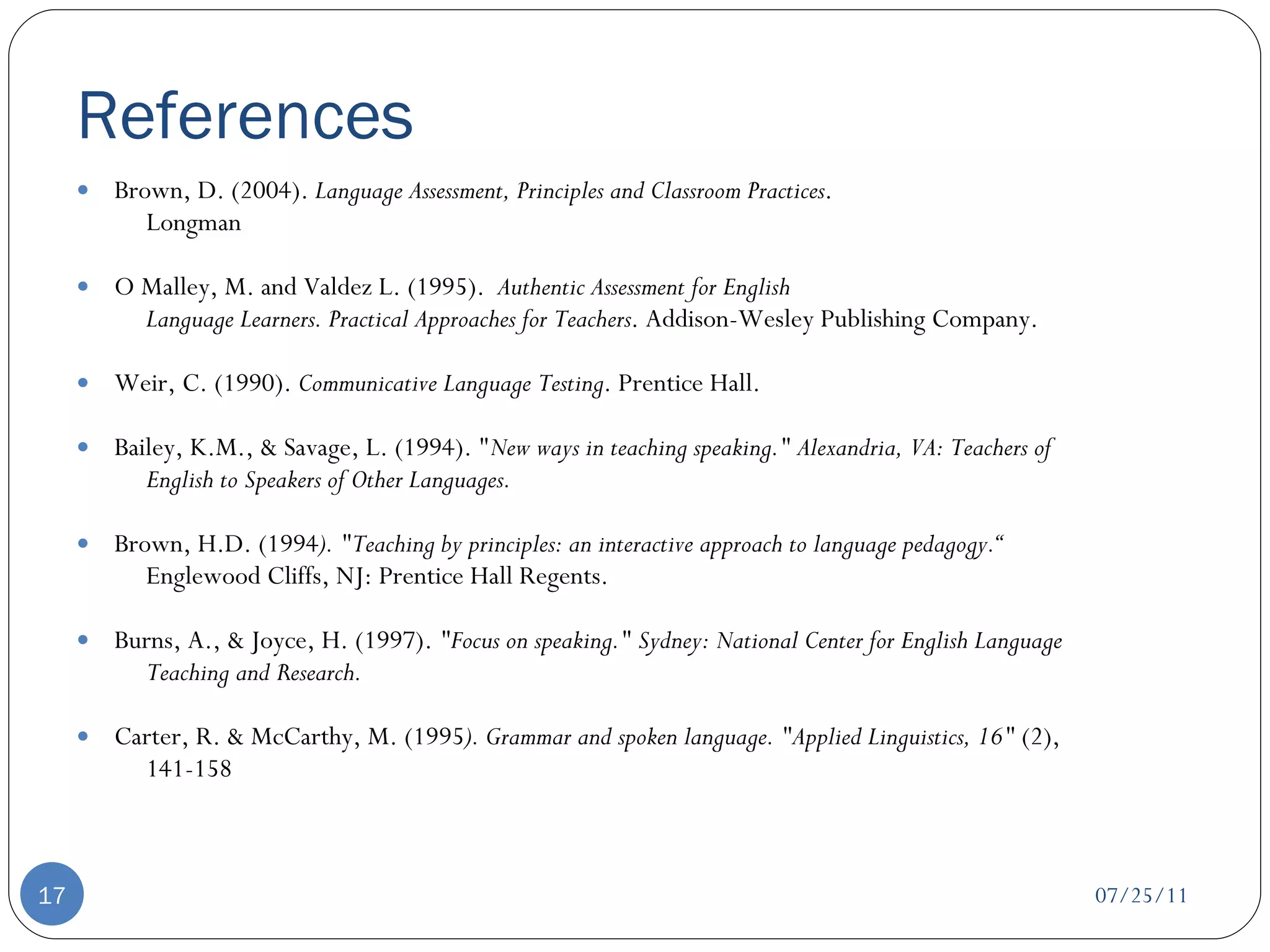
References Brown, D. (2004).  Language Assessment, Principles and Classroom Practices . Longman O Malley, M. and Valdez L. (1995).  Authentic Assessment for English Language Learners. Practical Approaches for Teachers . Addison-Wesley Publishing Company. Weir, C. (1990).  Communicative Language Testing . Prentice Hall. Bailey, K.M., & Savage, L. (1994). " New ways in teaching speaking." Alexandria, VA: Teachers of English to Speakers of Other Languages.   Brown, H.D. (1994 ). "Teaching by principles: an interactive approach to language pedagogy.“ Englewood Cliffs, NJ: Prentice Hall Regents.  Burns, A., & Joyce, H. (1997).  "Focus on speaking." Sydney: National Center for English Language Teaching and Research.   Carter, R. & McCarthy, M. (1995 ). Grammar and spoken language.  "Applied Linguistics, 16"  (2), 141-158  07/25/11

Assessing speaking skills

  • 1.
    República Bolivariana deVenezuela Universidad Pedagógica Experimental Libertador Instituto Pedagógico de Caracas Maestría en Enseñanza del Inglés como Lengua Extranjera Estrategias de Evaluación 07/25/11 Authors: Maite Sangroniz María Aurora Ovalles Nairuby Mata, Professor: Rosa Virguez de Olivo
  • 2.
    Assessing SpeakingAuthors: Maite Sangroniz María Aurora Ovalles Nairuby Mata, Professor: Rosa Virguez de Olivo June, 2011
  • 3.
    Teaching speaking Whatis Speaking? ¨Speaking is an interactive process of constructing meaning that involves producing and receiving and processing information¨ (Brown, 1994; Burns & Joyce, 1997). According to Kramsch (1986) cited in O´Malley and Valdez (1996) ¨Speaking means anticipating the listener´s response and possible misunderstandings, and arriving at the closest possible match between intended, perceived, and anticipated meanings¨. 07/25/11
  • 4.
    Assessing Speaking Characteristicsof Spoken language Spoken language is different from written language for many reasons. One important reason is that it usually has to be understood immediately whereas written language can be read many times. For that reason, spoken language has many different features. Spoken language has the following characteristics (Halliday, 1989, p. 31): Variation in speed (generally faster than writing) Loudness or quietness Gestures - body language Intonation Stress Rhythm Pitch range Pausing and phrasing 07/25/11
  • 5.
    Assessing Speaking 07/25/11Source: Brown, D (2004)
  • 6.
    Assessing Speaking 07/25/11Source: Brown, D (2004)
  • 7.
    PICTURE-CUED STORY TELLING(intermediate level sample) Source:http://www.google.co.ve/search?hl=es&biw=1259&bih=573&gbv=2&tbm=isch&sa=1&q=sequenced+pictures+for+story+telling&btnG=Buscar&oq=sequenced+pictures+for+story+telling&aq=f&aqi=&aql=&gs_sm=s&gs_upl=54413l75052l0l31l30l2l0l0l3l905l6206l0.2.11.4.1.1.1
  • 8.
    Source: Brown, H.,2004. Language Assessment Principles and Classroom Practices. PICTURE – CUED STORY TELLING (OBJECTIVE: SIMPLE PAST)
  • 9.
    Assessing Speaking: InteractiveSpeaking Choosing the best test format 07/25/11 ROLE PLAY Structured role play (information gap) Structured interview Unstructured Interviews ROLE PLAY Unstructured role play
  • 10.
    Assessing Speaking: InteractiveSpeaking Interviews: (stages) Warm up: 1. small talk Level check: the test taker 2. answers Wh-questions 3 produce a narrative without interruptions 4 reads a passage outloud 5 Tells how to make something or do something 6 engages in a brief, controlled, guided role play Probe: The test-taker: 7 responds to interviewer´s questions about something the test taker doesn´t know and is planning to include in an article or paper. 8 talks about his or her own field of study or profession. 9 engages in a longer, more open-ended role play (e.g. simulates a difficult of embarrassing situation) with the interviewer. 10 gives an impromptu presentation on some aspect of test-taker´s field. Wind down: 11 feeling about the interview, information or results, further questions 07/25/11
  • 11.
  • 12.
  • 13.
    Assessing Speaking: ExtensiveSpeaking 07/25/11 Translation of an extended prose Oral Presentations Picture-cued Story Telling Retelling a story Source: Brown, 2004
  • 14.
    Oral Presentations Specifythe criterion Set appropriate tasks Optimal output Practical, reliable scoring
  • 15.
    Source: Brown, H.,2004. Language Assessment Principles and Classroom Practices. ORAL PRESENTATION CHECK LIST
  • 16.
    Conclusions Speaking assessmentis very difficult. It is important to determine what criteria to use to assess whether accuracy or fluency. Such criteria can be based upon created models or adapted ones. 07/25/11
  • 17.
    References Brown, D.(2004). Language Assessment, Principles and Classroom Practices . Longman O Malley, M. and Valdez L. (1995). Authentic Assessment for English Language Learners. Practical Approaches for Teachers . Addison-Wesley Publishing Company. Weir, C. (1990). Communicative Language Testing . Prentice Hall. Bailey, K.M., & Savage, L. (1994). " New ways in teaching speaking." Alexandria, VA: Teachers of English to Speakers of Other Languages. Brown, H.D. (1994 ). "Teaching by principles: an interactive approach to language pedagogy.“ Englewood Cliffs, NJ: Prentice Hall Regents. Burns, A., & Joyce, H. (1997). "Focus on speaking." Sydney: National Center for English Language Teaching and Research. Carter, R. & McCarthy, M. (1995 ). Grammar and spoken language. "Applied Linguistics, 16" (2), 141-158 07/25/11