TECHNIQUES
FOR TEACHING
GRAMMAR
Prepared by: Mary Anne
Dison
Kong Siaw Ting
Yusnitha
Merang
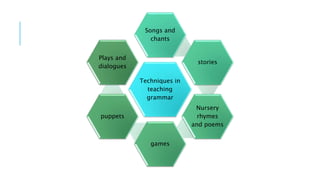
Techniques in
teaching
grammar
Songs and
chants
stories
Nursery
rhymes
and poems
games
puppets
Plays and
dialogues
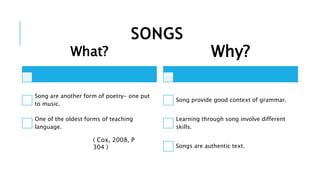
SONGS
What?
Song are another form of poetry- one put
to music.
One of the oldest forms of teaching
language.
Why?
Song provide good context of grammar.
Learning through song involve different
skills.
Songs are authentic text.
( Cox, 2008, P
304 )
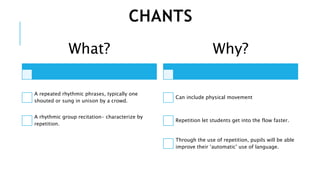
CHANTS
What?
A repeated rhythmic phrases, typically one
shouted or sung in unison by a crowd.
A rhythmic group recitation- characterize by
repetition.
Why?
Can include physical movement
Repetition let students get into the flow faster.
Through the use of repetition, pupils will be able
improve their ‘automatic’ use of language.
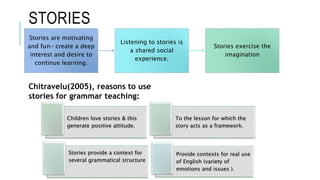
STORIES
Stories are motivating
and fun- create a deep
interest and desire to
continue learning.
Listening to stories is
a shared social
experience.
Stories exercise the
imagination
Children love stories & this
generate positive attitude.
To the lesson for which the
story acts as a framework.
Stories provide a context for
several grammatical structure
Provide contexts for real use
of English (variety of
emotions and issues ).
Chitravelu(2005), reasons to use
stories for grammar teaching:
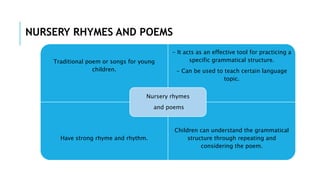
Traditional poem or songs for young
children.
- It acts as an effective tool for practicing a
specific grammatical structure.
- Can be used to teach certain language
topic.
Have strong rhyme and rhythm.
Children can understand the grammatical
structure through repeating and
considering the poem.
Nursery rhymes
and poems
NURSERY RHYMES AND POEMS
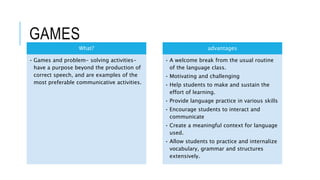
GAMES
What?
• Games and problem- solving activities-
have a purpose beyond the production of
correct speech, and are examples of the
most preferable communicative activities.
advantages
• A welcome break from the usual routine
of the language class.
• Motivating and challenging
• Help students to make and sustain the
effort of learning.
• Provide language practice in various skills
• Encourage students to interact and
communicate
• Create a meaningful context for language
used.
• Allow students to practice and internalize
vocabulary, grammar and structures
extensively.
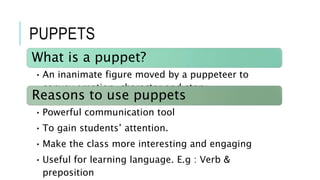
PUPPETS
What is a puppet?
• An inanimate figure moved by a puppeteer to
convey emotion, character and story.
Reasons to use puppets
• Powerful communication tool
• To gain students’ attention.
• Make the class more interesting and engaging
• Useful for learning language. E.g : Verb &
preposition
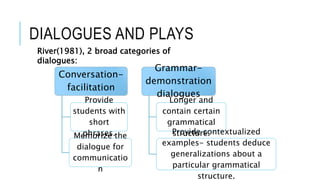
DIALOGUES AND PLAYS
Conversation-
facilitation
Provide
students with
short
phrases.Memorize the
dialogue for
communicatio
n
Grammar-
demonstration
dialogues
Longer and
contain certain
grammatical
structure.Provide contextualized
examples- students deduce
generalizations about a
particular grammatical
structure.
River(1981), 2 broad categories of
dialogues:
EXAMPLE OF QUESTION.
QUESTION 1
Explain the techniques of using songs and stories to teach grammar
to young learners.
QUESTION 2
As an English language teacher, select 3 techniques of teaching
grammar to young learners.

Techniques for teaching grammar (topik 4)

  • 1.
    TECHNIQUES FOR TEACHING GRAMMAR Prepared by:Mary Anne Dison Kong Siaw Ting Yusnitha Merang
  • 2.
  • 3.
    SONGS What? Song are anotherform of poetry- one put to music. One of the oldest forms of teaching language. Why? Song provide good context of grammar. Learning through song involve different skills. Songs are authentic text. ( Cox, 2008, P 304 )
  • 4.
    CHANTS What? A repeated rhythmicphrases, typically one shouted or sung in unison by a crowd. A rhythmic group recitation- characterize by repetition. Why? Can include physical movement Repetition let students get into the flow faster. Through the use of repetition, pupils will be able improve their ‘automatic’ use of language.
  • 5.
    STORIES Stories are motivating andfun- create a deep interest and desire to continue learning. Listening to stories is a shared social experience. Stories exercise the imagination Children love stories & this generate positive attitude. To the lesson for which the story acts as a framework. Stories provide a context for several grammatical structure Provide contexts for real use of English (variety of emotions and issues ). Chitravelu(2005), reasons to use stories for grammar teaching:
  • 6.
    Traditional poem orsongs for young children. - It acts as an effective tool for practicing a specific grammatical structure. - Can be used to teach certain language topic. Have strong rhyme and rhythm. Children can understand the grammatical structure through repeating and considering the poem. Nursery rhymes and poems NURSERY RHYMES AND POEMS
  • 7.
    GAMES What? • Games andproblem- solving activities- have a purpose beyond the production of correct speech, and are examples of the most preferable communicative activities. advantages • A welcome break from the usual routine of the language class. • Motivating and challenging • Help students to make and sustain the effort of learning. • Provide language practice in various skills • Encourage students to interact and communicate • Create a meaningful context for language used. • Allow students to practice and internalize vocabulary, grammar and structures extensively.
  • 8.
    PUPPETS What is apuppet? • An inanimate figure moved by a puppeteer to convey emotion, character and story. Reasons to use puppets • Powerful communication tool • To gain students’ attention. • Make the class more interesting and engaging • Useful for learning language. E.g : Verb & preposition
  • 9.
    DIALOGUES AND PLAYS Conversation- facilitation Provide studentswith short phrases.Memorize the dialogue for communicatio n Grammar- demonstration dialogues Longer and contain certain grammatical structure.Provide contextualized examples- students deduce generalizations about a particular grammatical structure. River(1981), 2 broad categories of dialogues:
  • 10.
  • 11.
    QUESTION 1 Explain thetechniques of using songs and stories to teach grammar to young learners.
  • 12.
    QUESTION 2 As anEnglish language teacher, select 3 techniques of teaching grammar to young learners.